What are model-based reflex agents?
Sep 11, 2026
/
By Ksenija
/
10 min Read
A model-based reflex agent is an AI agent that uses an internal model of its environment to make decisions.
The internal model acts as the agent’s memory. It stores information about the environment, such as the location of objects or recent changes, so the agent can continue making decisions even when some of that information is no longer directly visible.
For instance, a model-based reflex agent controlling a warehouse robot can continue navigating even when shelves temporarily block its view.
Before the shelves obstruct the robot’s path, the agent records their locations and the robot’s position in its internal model.
As the robot moves, the agent continuously updates the model to estimate the robot’s position and the surrounding environment.
When the shelves are no longer visible, the agent relies on the stored information to choose the next action until new observations confirm or correct its understanding.
Model-based reflex agents vs. simple reflex agents
A simple reflex agent makes decisions using only its current observation, while a model-based reflex agent combines its current observation with an internal state built from previous observations.
Simple reflex agents and model-based reflex agents are two of the different types of AI agents, each designed for different decision-making requirements.
The table below highlights their key differences:
Feature | Simple reflex agent | Model-based reflex agent |
Memory | None | Maintains an internal state |
Decision basis | Current observation only | Current observation and internal state |
Handles partial information | No | Yes |
Best suited for | Fully observable environments | Partially observable environments |
Complexity | Lower | Higher |
Typical use | Simple, predictable tasks | Dynamic environments with changing conditions |
Simple reflex agents work well when every decision depends only on the current state of the environment.
A thermostat, for example, turns the heating on or off based solely on the current temperature reading.
Each decision is independent because the thermostat does not need to remember previous measurements to respond correctly.
Model-based reflex agents solve problems where the current observation alone is not enough to determine the correct action.
An autonomous vehicle may temporarily lose sight of another car as it passes behind a truck or rounds a sharp bend.
Instead of assuming the road is clear, the agent uses its internal model to remember the other vehicle’s last known position and movement.
By combining new observations with stored knowledge, the agent estimates the current state of the road and chooses appropriate actions until it can directly observe the vehicle again.
Maintaining an internal model enables more reliable decisions in dynamic environments, but it also increases complexity.
The agent must continuously update its internal state to reflect changes in the environment, ensuring that future decisions are based on the most accurate representation possible.
Components of a model-based reflex agent
Four parts distinguish a model-based reflex agent from a simple one: the internal state, the world model, the condition-action rules, and the state updater.
Internal state
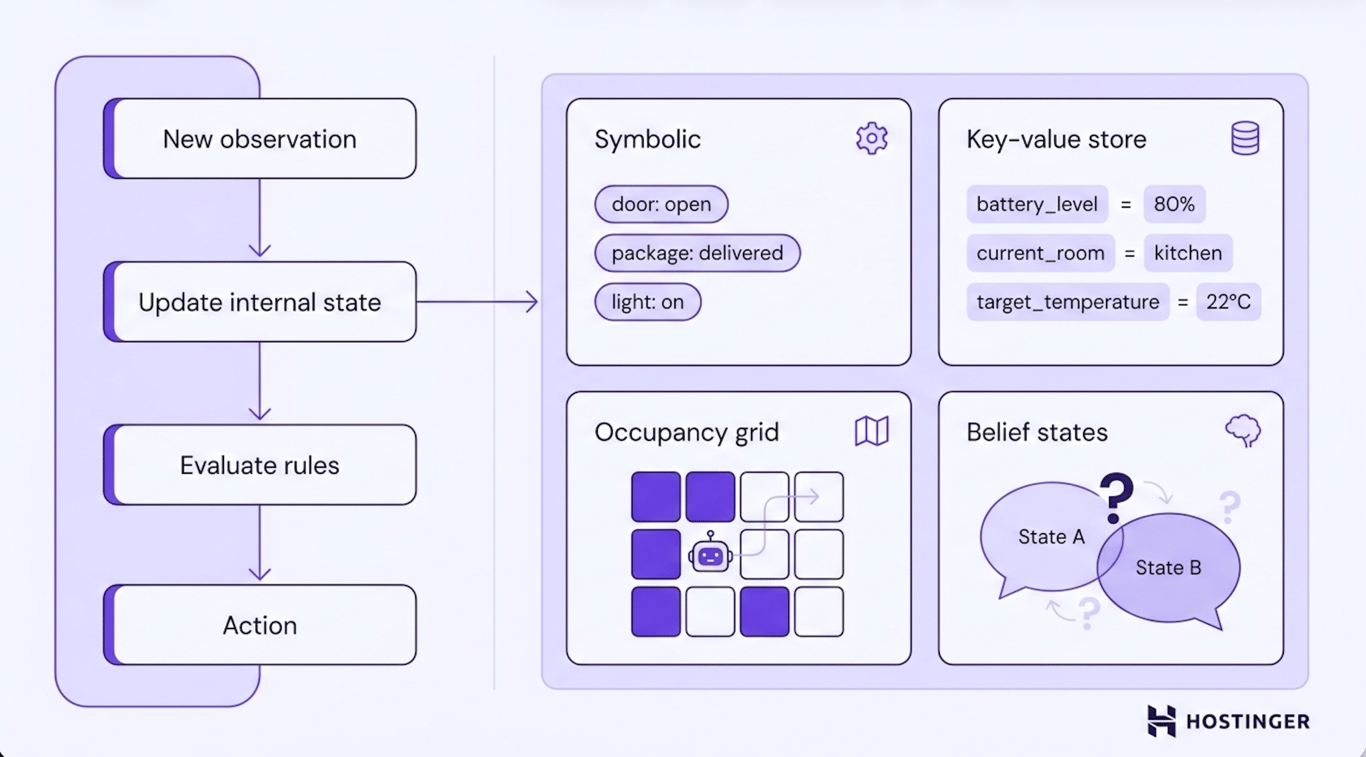
The internal state stores the agent’s current representation of the environment.
Acting as the agent’s short-term memory, it combines recent observations with previously gathered information so important details remain available between decision cycles.
The internal state is updated throughout the decision-making cycle. Each time the agent receives new information, it combines the latest observations with its existing understanding of the environment to produce a revised estimate of the current situation.
The agent then evaluates that updated state against its condition-action rules to determine the next action.
Developers can implement the internal state using different data representations depending on the agent’s task and environment.
Common approaches include:
- Symbolic representations: Storing information as symbols or logical facts that describe the environment. For example, an agent might record that a door is open, a package is delivered, or a room is occupied. This approach works well in environments with clearly defined states and rules.
- Key-value stores: Organizing information as pairs of related values, where each key represents a specific attribute and the corresponding value records its current state. For example, an agent might store battery_level = 80% or current_room = kitchen. This simple structure makes information easy to update and retrieve.
- Occupancy grids: Dividing a physical environment into a grid of cells, with each cell indicating whether the space is occupied, free, or unknown. Robotics systems commonly use occupancy grids to build maps and track obstacles, allowing a robot to navigate safely even when obstacles are temporarily out of view.
- Belief states: Representing the agent’s estimate of the environment when the exact state cannot be determined with certainty. Instead of assuming a single correct state, the agent maintains one or more likely possibilities based on previous observations. Belief states are commonly used in partially observable Markov decision processes (POMDPs), where the agent must make decisions despite incomplete or uncertain information.
World model
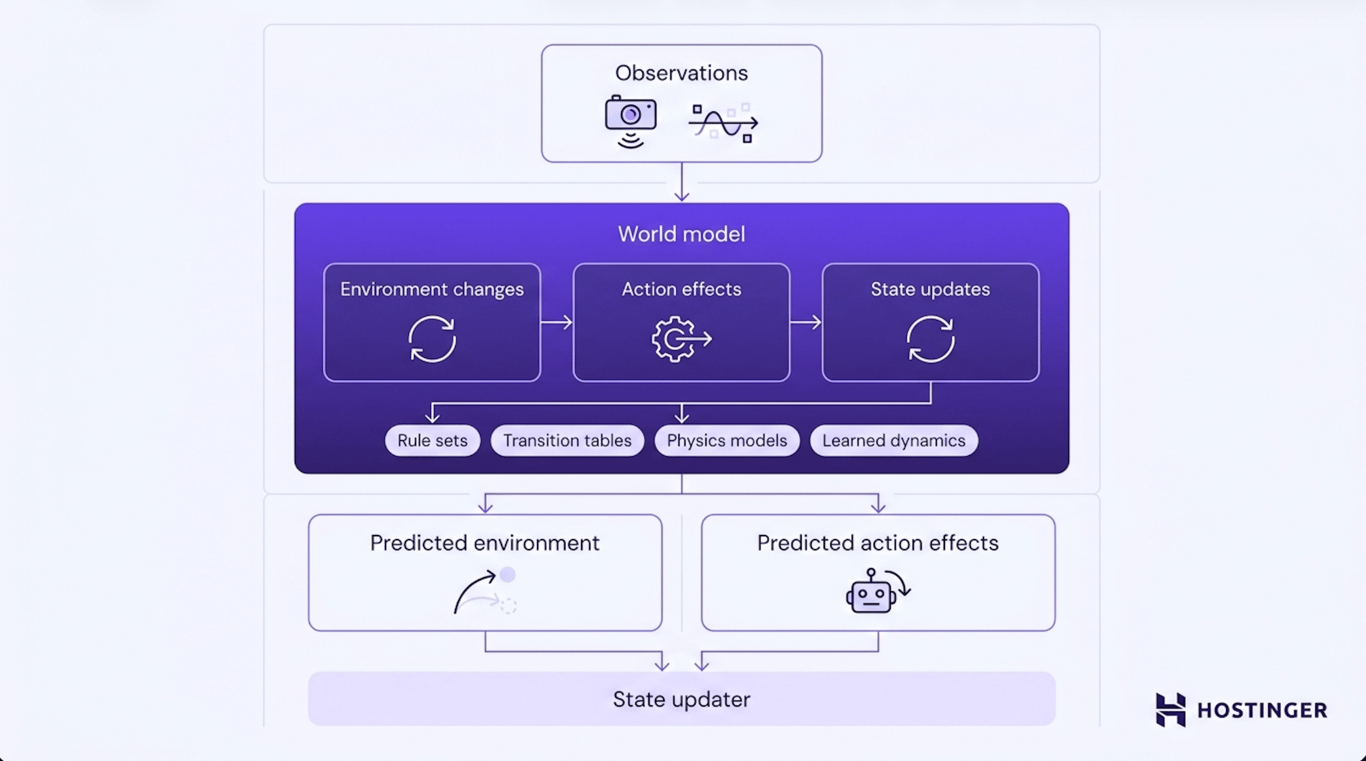
The world model supports the agent by:
- Predicting changes in the environment. It estimates how the environment evolves independently of the agent’s actions. For example, a moving object is expected to continue in the same direction unless new observations suggest otherwise.
- Predicting the effects of the agent’s actions. It estimates how the environment will change after the agent performs an action. If a robot turns left, for instance, the world model predicts how the robot’s position relative to nearby objects will change.
- Supporting state updates. It provides the knowledge the state updater needs to combine new observations with the agent’s existing understanding of the environment. This allows the agent to maintain an accurate estimate of the current state even when some information is temporarily unavailable.
Developers can implement a world model in several ways, depending on the environment’s predictability.
Simpler systems often rely on rule sets, which define how the environment changes using predefined logical rules, or transition tables, which map the possible outcomes of different states and actions.
Robotics and autonomous systems frequently use physics models to predict how objects move based on principles such as speed, acceleration, or gravity.
More advanced applications may use learned dynamics models, in which machine learning estimates how the environment evolves based on historical data.
A world model improves how accurately the agent estimates the environment, but it does not give the agent the ability to learn or set its own goals. Action selection is still governed entirely by predefined condition-action rules.
Condition-action rules
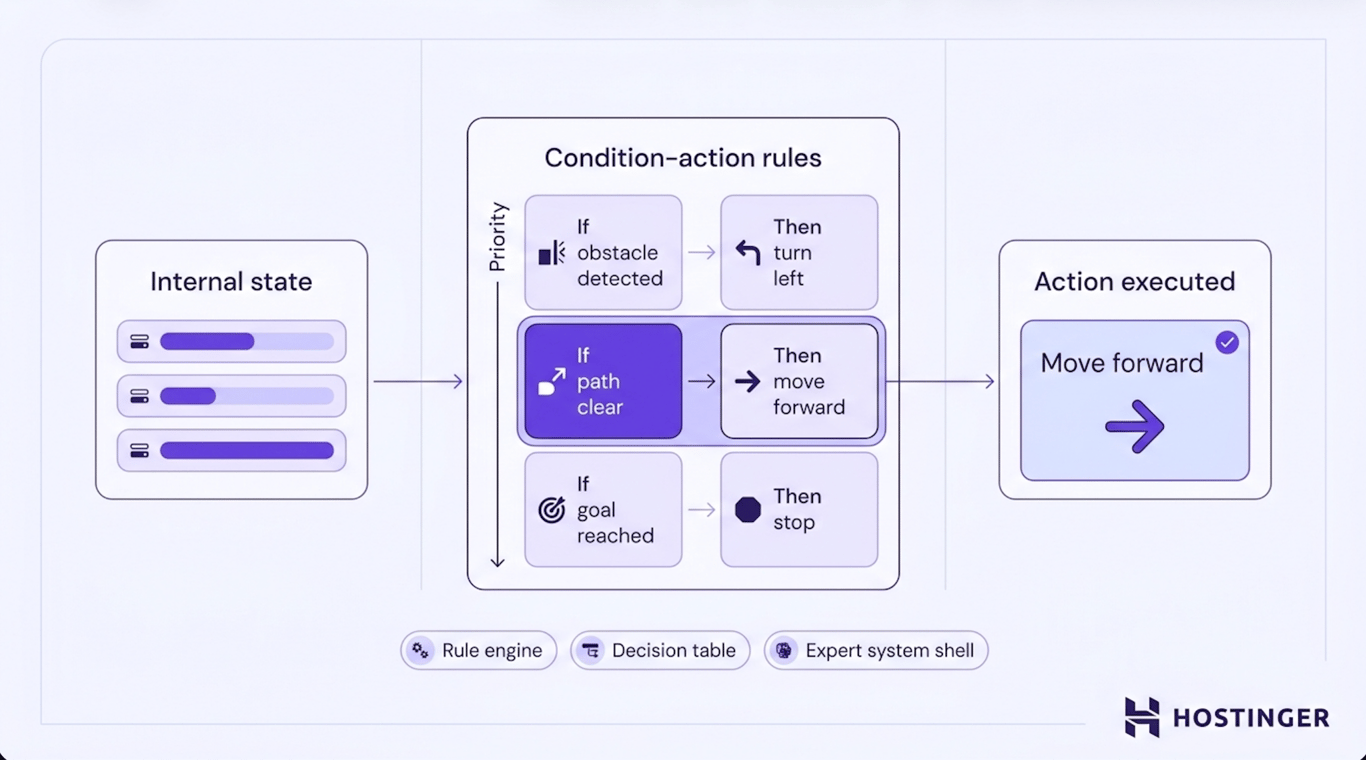
Condition-action rules determine how a model-based reflex agent responds to different situations.
They follow a simple if-then structure, evaluating the agent’s current internal state and selecting the appropriate action.
Condition-action rules enable the agent to:
- Evaluate the current state. Compare the agent’s updated internal state against predefined conditions to determine which rules apply.
- Select an action. Execute the action associated with the first or highest-priority rule that matches the current state.
- Maintain consistent behavior. Ensure the agent responds predictably to the same conditions by following the same predefined rules each time.
Developers can implement condition-action rules using different systems depending on the application’s complexity.
Rule engines evaluate the agent’s internal state against a collection of predefined if-then rules and automatically execute the appropriate action.
Decision tables organize rules into rows and columns, making it easier to manage large sets of conditions and their corresponding actions.
More complex applications may use expert system shells, which provide frameworks for creating, organizing, and maintaining extensive rule bases without having to build the reasoning system from scratch.
The effectiveness of condition-action rules depends on how well they cover the situations the agent may encounter.
As the number of possible states increases, developers often need to create additional rules to handle new combinations of conditions.
Overlapping rules may also require a priority system to determine which action should take precedence.
Because the rules are predefined, the agent cannot automatically respond to situations that were not anticipated during development.
State updater
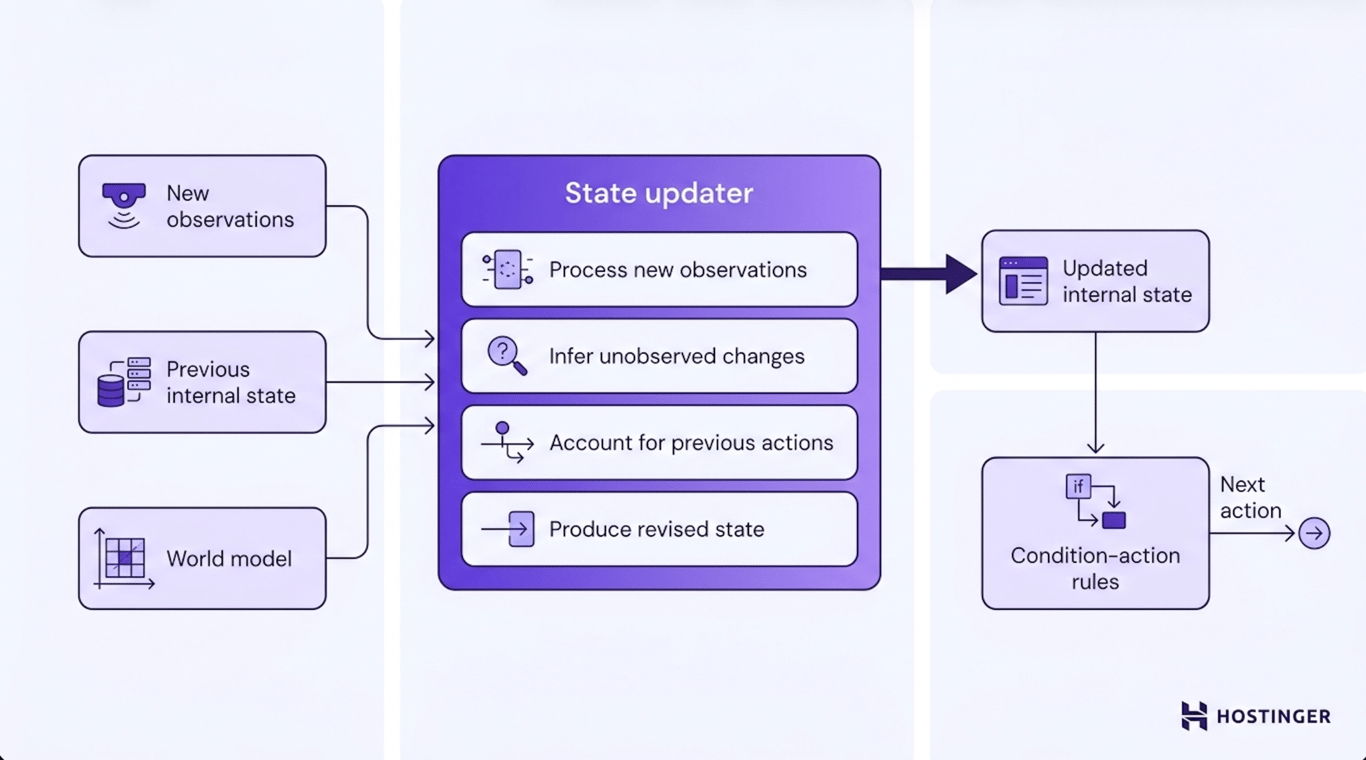
The state updater keeps the agent’s internal state accurate as the environment changes. During each decision-making cycle, it combines the latest observations, the previous internal state, and the world model to produce an updated representation of the environment.
The condition-action rules then use that updated state to select the next action.
The state updater performs four key functions:
- Processes new observations. Incorporates the latest information collected from the agent’s sensors or other input sources.
- Infers unobserved changes. Uses the world model to estimate how the environment may have changed since the last observation, even if those changes were not directly observed.
- Accounts for previous actions. Updates the internal state based on the expected effects of the agent’s most recent action. For example, if the agent moved forward, the updater adjusts its estimated position accordingly.
- Produces a revised internal state. Combines all available information into an updated representation of the environment for the condition-action rules to evaluate.
Developers typically implement the state updater as an update-state function that runs once during every decision-making cycle.
More advanced applications operating in uncertain environments may use Bayesian filters to combine data from multiple sensors and estimate the most likely state of the environment.
This process, known as sensor fusion, helps improve accuracy when individual sensors provide incomplete or noisy information.
How does a model-based reflex agent work?
A model-based reflex agent operates in a continuous decision-making cycle. Each cycle updates the agent’s understanding of the environment before selecting the next action, allowing future decisions to reflect both new observations and previously stored information.
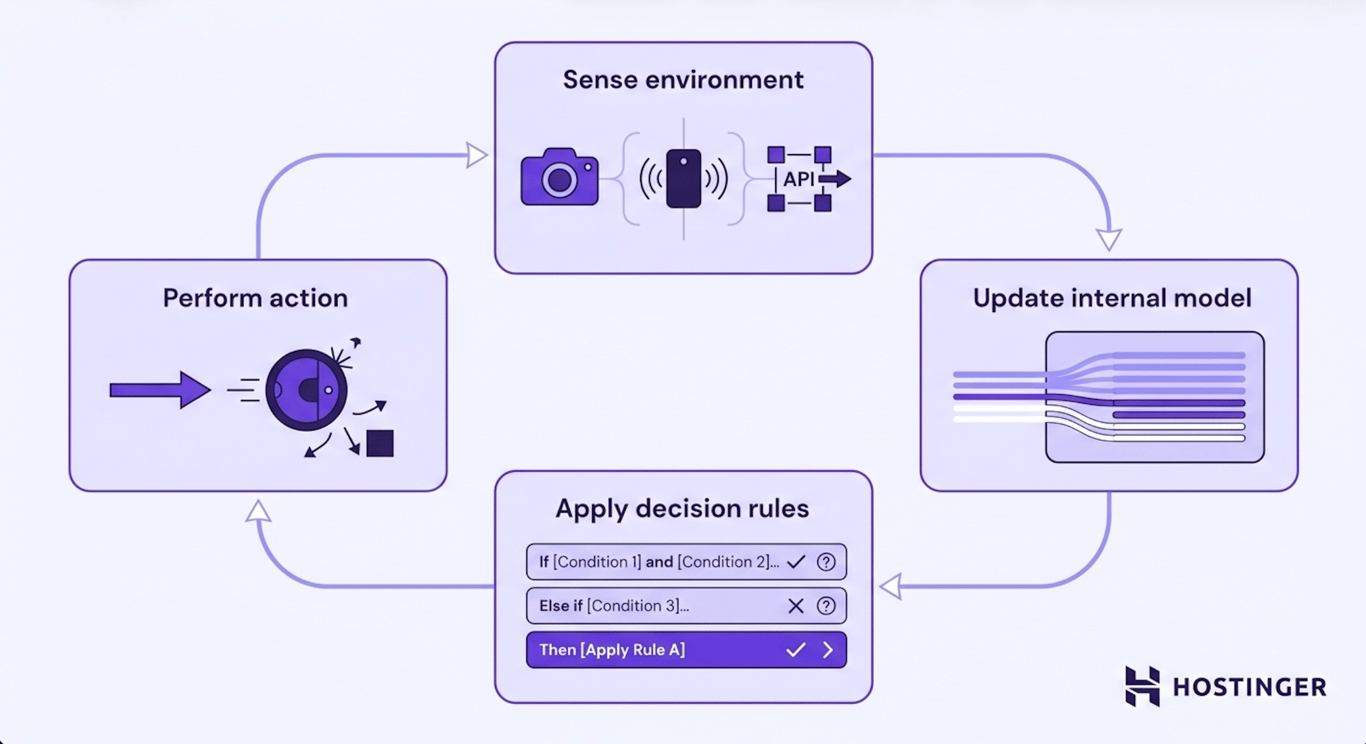
1. Sensing the environment
The process begins by gathering information about the environment through cameras, sensors, user input, APIs, or other data sources.
Each observation provides new information about the agent’s surroundings, but it rarely captures the complete picture.
Objects may be temporarily hidden, information may arrive with a delay, or parts of the environment may simply fall outside the agent’s field of view.
2. Updating the internal model
After collecting new observations, the agent updates its internal model to reflect what it believes the current state of the environment is.
Instead of replacing previous information, the agent combines new observations with its existing knowledge to maintain a consistent view of the world.
For example, a robot vacuum may temporarily lose sight of a piece of furniture after turning a corner or moving into another room.
A model-based reflex agent does not assume the furniture has disappeared. Instead, it uses its internal model to remember the room layout and its own location, allowing the vacuum to continue navigating efficiently until new observations update its understanding of the environment.
3. Applying decision rules
The condition-action rules evaluate the updated internal state and identify the rule that matches the current situation. The associated action is then selected for execution.
The decision rules do not store or remember information themselves; they operate on the updated internal model, which combines current observations with remembered information.
As a result, the agent can make decisions based on a more complete understanding of the environment than current observations alone would provide.
4. Performing an action
The agent executes the selected action, such as changing direction, slowing down, or continuing toward a goal.
Every action changes the state of the environment, creating new conditions for the next decision cycle.
Each completed action creates new conditions for the next cycle. By repeatedly sensing, updating, deciding, and acting, the agent maintains an up-to-date representation of its environment without losing context between observations.
Where are model-based reflex agents used?
Model-based reflex agents are among the many AI agent examples used in applications that must make decisions despite having incomplete information about their environment.
They are commonly found in autonomous vehicles, robotics, industrial automation, video game AI, and monitoring systems, where the agent must remember previous observations to estimate the current state of the environment before choosing an action.
Autonomous vehicles
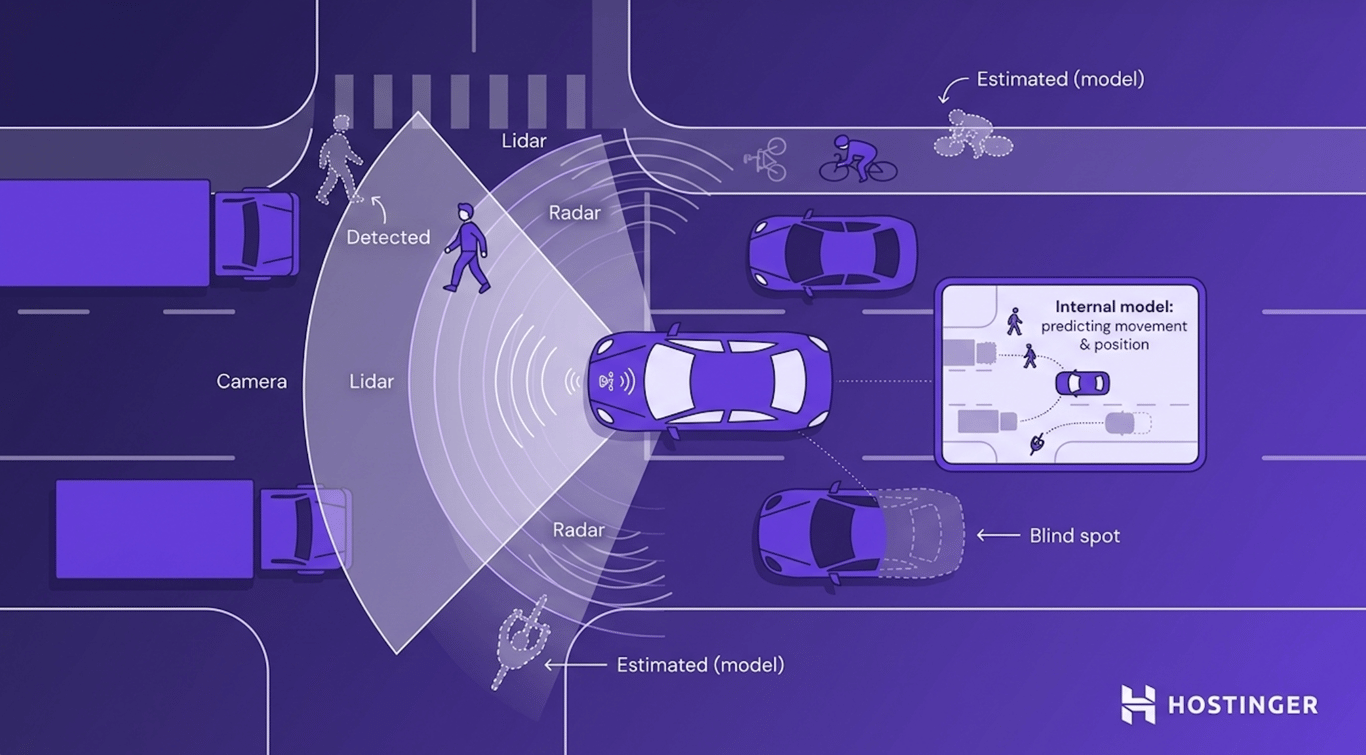
Autonomous vehicles use model-based reflex agents to navigate roads safely despite constantly changing conditions.
Other vehicles, pedestrians, cyclists, and road signs may temporarily disappear from the vehicle’s cameras or sensors because of blind spots, traffic, or weather conditions.
The agent maintains an internal model of the surrounding environment, allowing it to estimate the location and movement of nearby objects until new observations become available.
Robotics
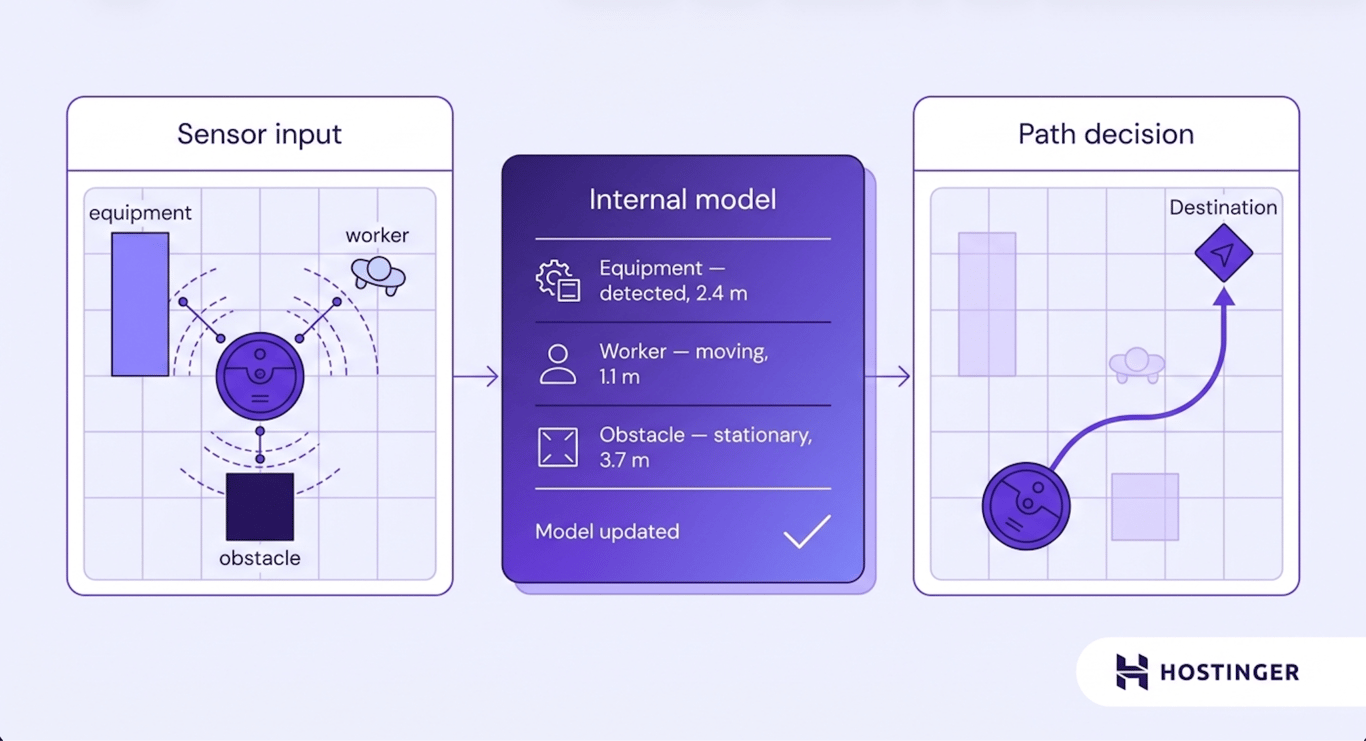
Mobile robots operating in warehouses, factories, and hospitals rely on model-based reflex agents to navigate dynamic environments.
As robots move, equipment, workers, and obstacles may enter or leave their field of view.
Instead of treating every observation as an isolated event, the agent updates its internal model to maintain an accurate estimate of the robot’s surroundings, helping it plan safe and efficient movements.
Video game AI
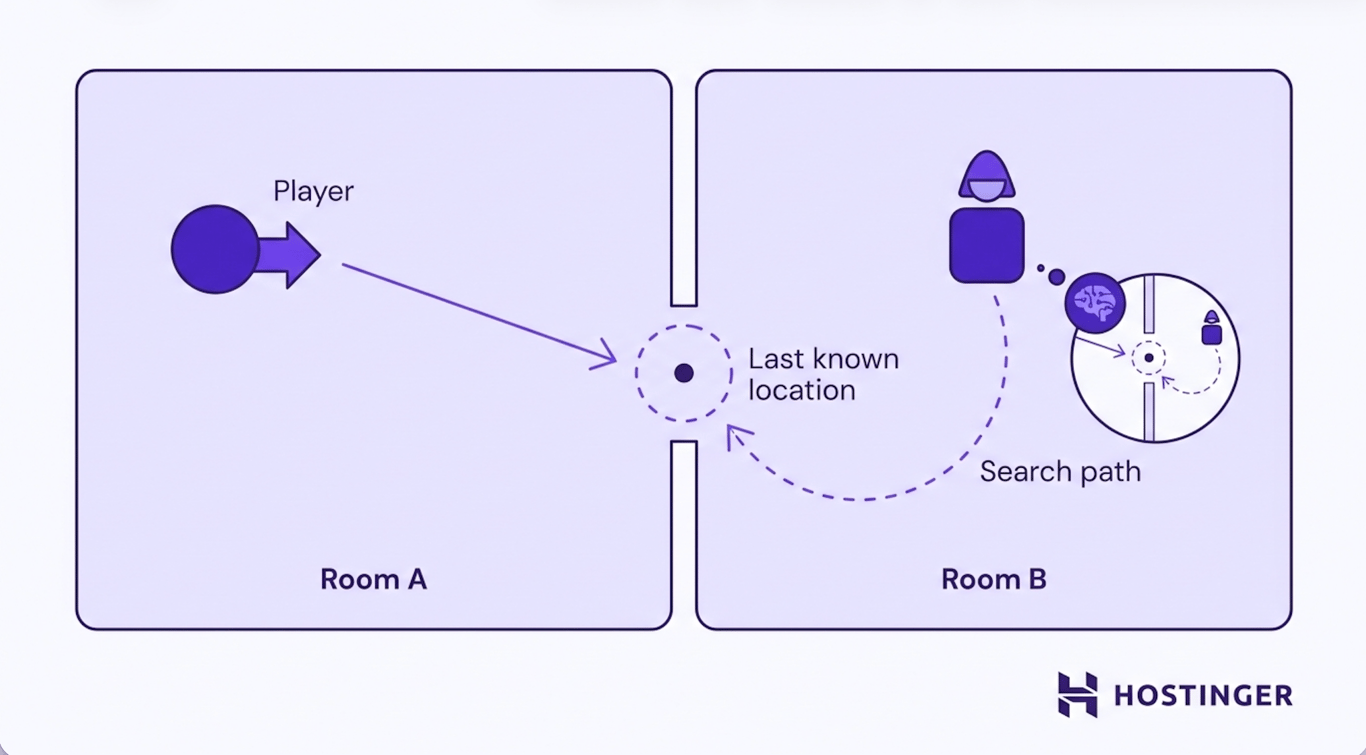
Non-player characters (NPCs) in video games often use model-based reflex agents to create more realistic behavior.
When a player moves behind a wall or enters another room, the AI does not immediately assume they have disappeared.
Instead, it remembers the player’s last known location and direction of movement, allowing characters to search nearby areas or continue pursuing the player until new information becomes available.
Industrial monitoring systems
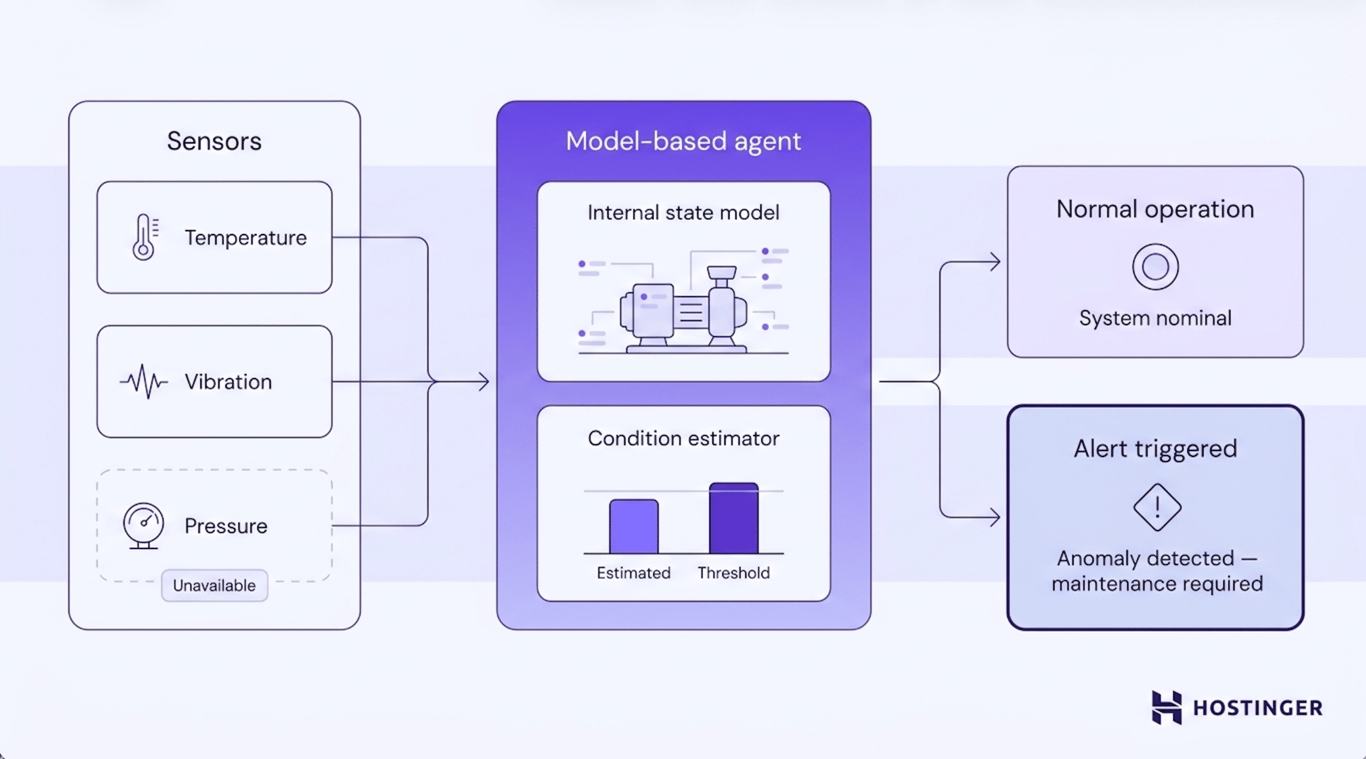
Industrial monitoring systems use model-based reflex agents to track the condition of machines and production equipment.
Sensor readings may arrive at different times or become temporarily unavailable, but the agent combines new data with its existing understanding of the system to estimate the system’s current state.
This helps detect abnormal operating conditions and trigger appropriate responses before equipment failures occur.
Benefits of model-based reflex agents
Model-based reflex agents help AI systems make more reliable decisions in environments where information changes over time or cannot always be directly observed.
Key benefits include:
- More accurate decisions. Decisions are based on both current observations and existing knowledge, reducing mistakes caused by incomplete or delayed information.
- Continuous operation. Temporary gaps in sensor data do not necessarily interrupt the decision-making process. The agent can continue operating while waiting for new observations, helping reduce unnecessary pauses in automated workflows.
- Better adaptability. Changing conditions become easier to handle because the internal model is continuously updated as new information arrives. Instead of treating every observation as a completely new situation, the agent builds on its existing understanding of the environment.
- Improved safety. Maintaining awareness of previously observed objects helps prevent unsafe actions when visibility is limited or information is temporarily unavailable. This is particularly valuable in applications where people, vehicles, or machinery share the same environment.
Limitations of model-based reflex agents
Model-based reflex agents make better decisions than simple reflex agents in dynamic environments, but maintaining an internal model also introduces additional complexity.
Their performance depends on the accuracy of the information they store and the rules that guide their decisions.
Key limitations include:
- Higher computational requirements. Maintaining and updating an internal model requires more processing power and memory than simply reacting to current observations. As the environment becomes more complex, the resources needed to manage the internal state also increase.
- Dependence on an accurate world model. The agent’s decisions are only as reliable as its understanding of the environment. If the world model contains incorrect assumptions or no longer reflects real-world conditions, the agent may make poor decisions based on outdated or inaccurate information.
- State maintenance challenges. The internal state must be updated continuously to remain accurate. If observations are delayed, missing, or processed incorrectly, small errors can accumulate over time, causing the agent’s representation of the environment to drift away from reality.
- Limited flexibility. Model-based reflex agents follow predefined condition-action rules, so they cannot adapt to situations not anticipated during development. Expanding the range of scenarios the agent can handle often requires developers to create additional rules or redesign the world model.
When should you use a model-based reflex agent?
A model-based reflex agent is the right choice when an AI system must make decisions based on both current observations and previously gathered information.
Consider the following questions when evaluating whether a model-based reflex agent is the right architecture for your application:
- Can important information temporarily disappear from view? If the agent cannot always observe everything it needs to make a decision, maintaining an internal model helps preserve context until new observations become available.
- Do decisions depend on previous observations? If choosing the correct action requires remembering past events, object locations, or changes in the environment, a model-based reflex agent can maintain that information between decision cycles.
- Can the environment be modeled with reasonable accuracy? Model-based reflex agents rely on a world model to estimate how the environment changes over time. If those changes are predictable enough to model, the agent can make reliable decisions even with incomplete information.
- Can predefined rules describe the required behavior? Model-based reflex agents follow condition-action rules rather than learning from experience. If the application’s decision-making process can be expressed as a set of predefined rules, this architecture is often a good fit.
If you answer yes to most of these questions, a model-based reflex agent is likely to meet your requirements.
If the environment is fully observable, a simple reflex agent may be a more efficient choice. If the agent must learn from experience, adapt to new situations, or optimize long-term outcomes, a goal-driven agent or learning agent is generally more appropriate.
Do you need to build a model-based reflex agent?
Not necessarily. Choosing the right AI agent architecture is only one part of building an AI-powered solution.
The best approach depends on the environment the agent will operate in, the complexity of the tasks it needs to perform, whether it must learn from experience, how much autonomy it requires, and how much ongoing maintenance you’re prepared to manage.
Many businesses don’t need to design or implement AI agent architectures from scratch. Instead, they can benefit more from ready-to-use AI tools that solve specific business problems without requiring AI engineering expertise.
Hostinger Agent provides specialized assistants for tasks such as SEO, content creation, marketing, sales, and customer support.
Rather than building and maintaining a custom AI agent, businesses can use this managed solution to automate repetitive work, improve productivity, and support day-to-day operations.
Although Hostinger Agent is not a model-based reflex agent, it offers a practical way to bring AI into your business without designing the underlying architecture yourself.
As your AI needs evolve, you can focus on choosing the right tool for the job instead of building every component from the ground up.

Ksenija is a digital marketing enthusiast with extensive expertise in content creation and website optimization. Specializing in WordPress, she enjoys writing about the platform’s nuances, from design to functionality, and sharing her insights with others. When she’s not perfecting her trade, you’ll find her on the local basketball court or at home enjoying a crime story. Follow her on LinkedIn.