What are simple reflex agents and how do they work?
Sep 11, 2026
/
By Alma
/
7 min Read
A simple reflex agent is the most basic type of AI agent. It responds to its current percept – the information it receives right now – by matching it to a predefined condition-action rule. Because it’s stateless, it doesn’t remember earlier inputs, plan ahead, or learn from previous results.
That simple decision process works well when the current input contains everything needed to choose the right action. In a fully observable environment, this allows simple reflex agents to respond quickly and predictably without the memory or processing required by more complex agents.
The limitation is that the current percept isn’t always enough. If a decision depends on earlier events, hidden information, future goals, comparing possible outcomes, or learning from feedback, other agent types are better suited to the task.
What are simple reflex agents?
Simple reflex agents are stateless, rule-based AI agents. Among the main types of AI agents, this one uses the simplest decision process.
Stateless means the agent doesn’t save earlier inputs or actions for later decisions. Each new input is handled on its own, without information carried over from the previous one.
The agent matches that input to a condition-action rule, which is simply an if-then instruction that connects a condition to an action.
Take a basic automatic door controller. A motion sensor detects someone approaching and sends the input motion detected. The rule says if motion is detected, open the door, so the controller tells the motor to open it.
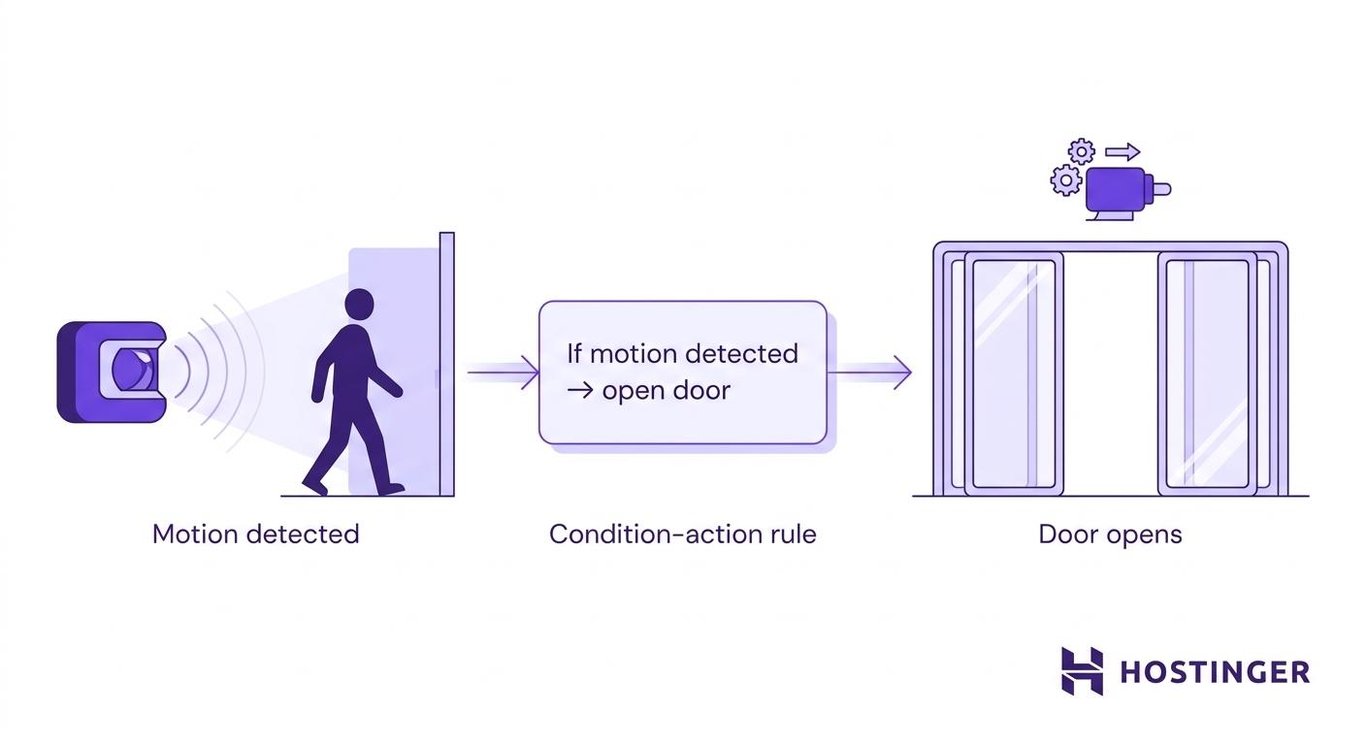
The previous visitor doesn’t affect that decision. Neither does the number of people who’ve already walked through. The controller only responds to what its sensor detects right now.
Simple reflex agents have four defining characteristics:
- They use current information only. The latest sensor reading or software event drives the decision. Earlier inputs aren’t saved for later use.
- They follow predefined rules. Developers decide in advance which action belongs to each recognized condition. The agent can’t create or rewrite those rules on its own.
- They don’t plan or learn. Goals, feedback, and experience don’t automatically change their behavior.
- They need complete current input. Hidden or missing facts can lead to the wrong action because there’s no saved information to fill the gap.
With fixed rules and no added randomness, the same interpreted condition produces the same action. That consistency also makes the logic easy to test: give it a known input and check whether the expected action follows.
How do simple reflex agents work?
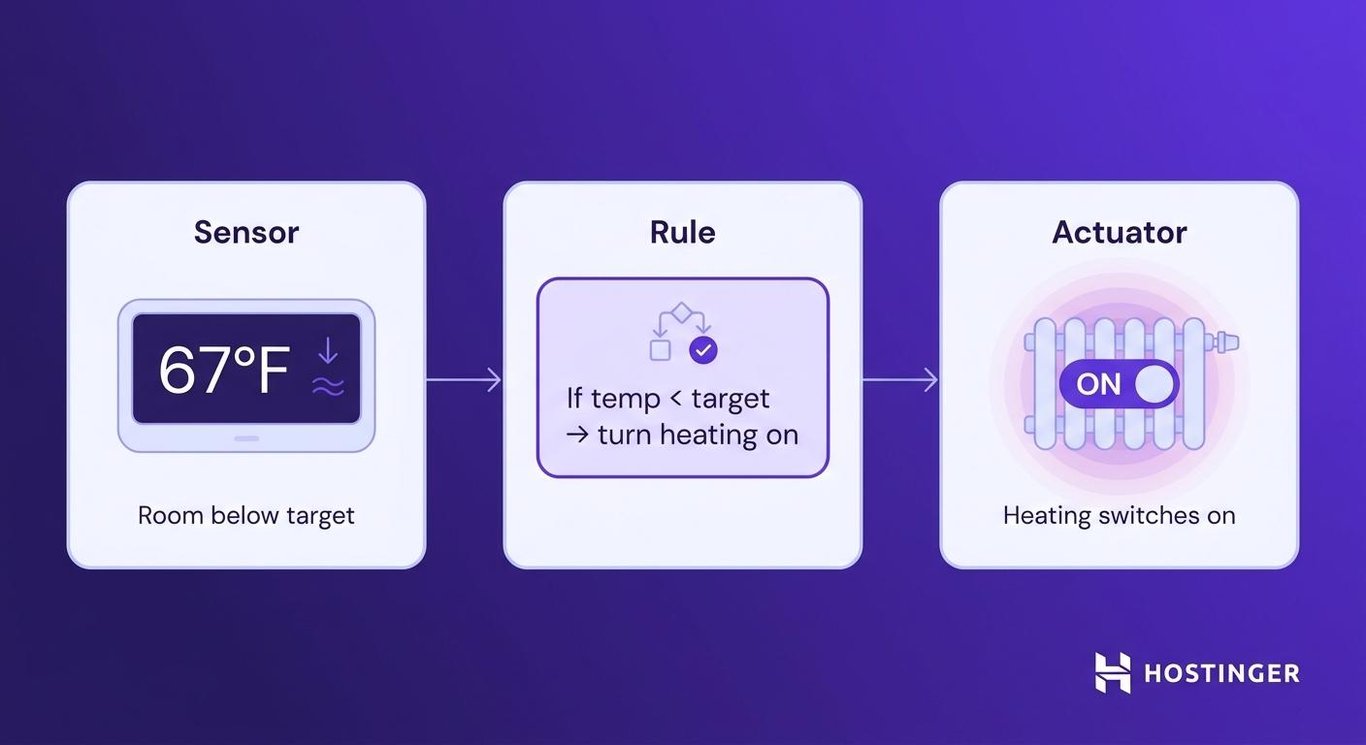
A simple reflex agent works through sensors → condition-action rules → actuators.
- Sensors collect the current input. That input can come from a physical sensor or a software event.
- Rules select an action. The agent matches the recognized condition to a predefined response.
- Actuators or software carry out the action. A physical actuator changes something in the real world, while a software function changes something in a digital system.
For instance, in a basic thermostat controller, the process works like this:
- A temperature sensor reports that the room is below the target temperature.
- The controller matches that reading to the rule
if temperature is below target, turn heating on. - A relay switches on the heating system.
Software can also classify raw input before applying a rule. For example, it might classify 67°F as below target. It’s still simple reflex logic as long as that classification uses only the current reading.
Sensors
Sensors give the agent the current information it needs to make a decision.
They can collect physical measurements or receive digital events:
- Physical sensors – Temperature sensors, motion detectors, pressure switches, dirt sensors, and vehicle detectors.
- Digital inputs – API events, form submissions, application events, and barcode scans.
Correct rules still produce the wrong action when the input is missing, delayed, noisy, or inaccurate. For example, a faulty temperature reading could keep the heating on after the room has already reached its target temperature.
Condition-action rules
Condition-action rules tell the agent what to do when it recognizes a condition.
A basic rule looks like this:
if motion_detected:

    open_door

else:

keep_door_closed
The rules need to account for the conditions the system expects to encounter, including what happens when none of them match.
They also need a priority order when multiple rules match the same input. Without one, the system doesn’t have a clear way to decide which action should win.
Because the agent can’t learn new rules on its own, developers have to update conditions, thresholds, priorities, and actions as requirements change.
Actuators
Actuators carry out the selected action in a physical system. Motors, relays, alarms, heater switches, and door mechanisms are all examples.
Software agents use functions or commands to perform the same task. A digital action might send an API request, create a notification, or update information in an application.
One useful distinction is that fast decision-making doesn’t always mean a fast result. The rule might match immediately, but networks, hardware, software, or the actuator itself can still delay the action or fail before it finishes.
Examples of simple reflex agents
Simple reflex agents include basic rule-based thermostats, vacuum robots, automatic doors, and traffic-light controllers. Real products can add memory, planning, prediction, or learning, so these examples apply only to their simpler versions.
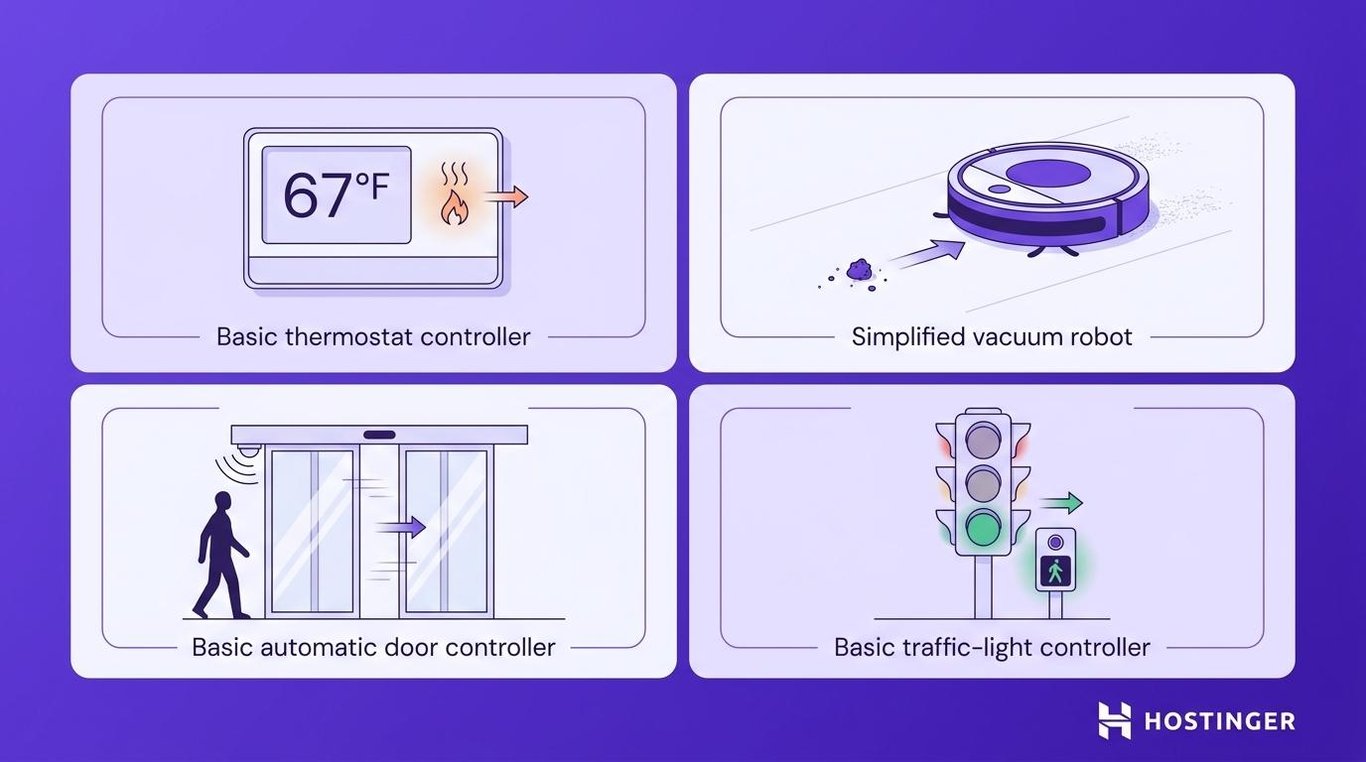
- Basic thermostat controller. A temperature reading below the target triggers a rule that switches the heating on. A thermostat that also uses schedules, weather forecasts, saved preferences, or learning isn’t a pure, simple reflex agent.
- Simplified vacuum-cleaning robot. The robot cleans when it detects dirt or moves according to a fixed rule. Modern robotic vacuums use maps, stored information, navigation systems, and feedback, so their decisions depend on more than the current reading.
- Basic automatic door controller. A motion or presence sensor detects someone nearby, and a fixed rule tells the motor to open the door. Systems that track occupancy or enforce access rules use additional information to decide whether to open.
- Basic traffic-light controller. A timer, pedestrian button, or vehicle sensor starts a predefined light sequence. Adaptive traffic systems also use stored traffic data, coordination with other signals, or predictions about traffic flow.
The same distinction helps separate simple reflex behavior from more complex AI agent examples: once a decision depends on stored information, planning, or learning, the system is doing more than matching the current input to a fixed rule.
Benefits of simple reflex agents
Simple reflex agents provide fast, predictable decision-making with low memory and processing needs for narrow tasks.
- Fast responses. Rule matching skips the extra decision steps needed for planning and prediction.
- Predictable behavior. Fixed rules make it clear what action a known input should produce, which also makes the logic easy to test.
- Low memory and processing needs. The agent doesn’t store a history or maintain a model of how the environment changes.
- Low implementation cost. A small rule set can handle the decision logic without model training, persistent memory, or a planning system.
Limitations of simple reflex agents
Simple reflex agents stop working well when the right action depends on information or decision-making that their fixed rules don’t provide.
- No memory. Suppose a machine should stop after three repeated errors. A simple reflex agent can’t count those earlier errors unless another part of the system stores them.
- No way to fill in hidden information. If a sensor stops reporting a value, the agent can’t fall back to an earlier reading because it hasn’t saved one.
- Rules can become inaccurate. When conditions change, the agent continues to follow the existing rules until someone updates them.
- No planning or outcome comparison. The agent can’t judge whether an action moves toward a future goal or whether another option offers more value or less risk.
- No learning. Feedback and experience don’t change its behavior, so developers have to update the rules manually.
- Rule gaps and conflicts. A missing rule can leave the agent without an action, while overlapping rules can point to different actions for the same input.
Choosing an action also doesn’t prove that it happened. If the system needs to know whether the action succeeded, another component has to check the result and report it.
What environments suit simple reflex agents?
Simple reflex logic suits environments where the current input contains everything needed for the decision, and the same conditions continue to call for the same responses.
In AI, an environment is simply the system or setting in which the agent operates. It produces the inputs the agent reacts to and changes when the agent acts.
A room controlled by a thermostat is one environment. A website handling form submissions is another. A traffic intersection managed by signals is another.
An environment is fully observable when the current input provides the AI agent with all the facts it needs to choose an action.
Use these questions to check whether simple reflex logic fits your task:
- Could the system choose the right action without knowing what happened earlier?
- Does each expected input point to one clear response?
- Can you list the conditions the system needs to handle?
- Will the rules remain correct until someone updates them?
- Is there a safe fallback for invalid input, no matching rule, or a failed action?
If every answer is yes, simple reflex logic is a good fit. If the task needs earlier information or facts that aren’t currently visible, you’ll need an agent that can store and use that information.
How simple reflex agents compare with other AI agent types
Other AI agents have capabilities that simple reflex agents lack, such as memory, goal-based planning, outcome comparison, or learning.
- Model-based reflex agents remember useful context. They save relevant information from earlier inputs as an internal state, so the next decision isn’t limited to what the agent senses right now.
- Goal-based agents work toward a target. They consider whether an action moves the system toward a desired result, such as completing a delivery by a deadline.
- Utility-based agents compare possible outcomes. They use a score based on factors such as value, cost, or risk to decide which outcome is preferable.
- Learning agents change their behavior from experience. Feedback helps them improve instead of relying only on manual rule updates.
Can simple reflex agents work inside larger agent systems?
Yes. Simple reflex rules can handle specific, immediate responses inside larger agent systems.
They can sit inside a larger agent or multi-agent system, where several agents divide tasks or coordinate their work. Other parts of the system handle memory, planning, goals, learning, or coordination, while the reflex rules respond to known events.
Examples include:
- Emergency-stop rules. A threshold reading can send a stop command as one part of a broader safety system.
- Direct event routing. A recognized event goes to a predefined software function or tool.
- Collision-avoidance rules. A proximity threshold can trigger a fixed movement command inside a broader control system.
- Local safety checks. A rule blocks a command that fails a predefined safety condition.
These reflex rules handle one immediate response at a time. By contrast, agentic AI can plan and carry out multiple actions toward a goal.
In agentic workflows, a controller can track a multi-step process, while simple reflex rules handle specific events with known responses.
When should you use a simple reflex agent?
Choose a simple reflex agent when the current input alone is enough to select the right action.
If the task needs more, choose the agent type that provides the missing capability: a model-based agent for memory, a goal-based agent for working toward a target, a utility-based agent for comparing outcomes, or a learning agent for improving based on feedback.
If your goal is to use AI for business tasks rather than design your own agent system, Hostinger Agent gives you a ready-to-use team of specialized AI experts for areas such as SEO, content, marketing, sales, and business planning.

This article is a localized version of What are simple reflex agents and how do they work?, originally published in English.

Alma is an AI Content Editor with 9+ years of experience helping ideas take shape across SEO, marketing, and content. She loves working with words, structure, and strategy to make content both useful and enjoyable to read. Off the clock, she can be found gaming, drawing, or diving into her latest D&D adventure.