Should you buy multiple domain extensions?
Sep 15, 2026
/
By Bruno S.
/
7 min Read
Buy multiple domain extensions when you need to protect an established brand from squatters, reach customers in specific countries, or cover misspellings and lookalike addresses that could send customers elsewhere. One domain is usually enough when none of these risks applies.
Registering multiple domain names doesn’t improve SEO on its own, so redirect extra domains to your primary website instead of publishing duplicate copies of it.
The right portfolio follows a priority order: primary extension first, then the country-code domain of your main market, then one or two recognized alternatives. If you do need extras, one to three is almost always enough.
Hostinger’s Brand protection page lists every available variation of a name you own and registers the selected ones in a single checkout, so protecting a brand across extensions takes minutes.
When is it recommended to buy multiple domain extensions?
Buying multiple domain extensions is worth it in four situations: protecting your brand identity, targeting customers in specific countries, capturing common misspellings, and preventing customer confusion. Each one removes a concrete risk; when none of them applies, the money is better spent elsewhere.
Brand protection, misspellings, and customer confusion all follow the same logic. Domain registration is first-come, first-served.
Every extension is a separate registration of the same name under a different top-level domain (TLD), a core part of how top-level domains work. If you own domain.com, whoever registers domain.net first owns it – whether that’s you, a competitor, or a squatter.
To protect your brand from squatters
Owning the obvious variations of your brand name costs less than recovering them from a stranger. Squatters register versions of known names to resell them at a markup or to trade on their reputation. The most reliable way to protect your brand from domain squatting is to hold those versions yourself before anyone else does.
A defensive registration runs $10–30 per year. Recovering a name someone else registered means filing a complaint under the Uniform Domain-Name Dispute-Resolution Policy (UDRP). That starts at $1,500 in World Intellectual Property Organization fees alone, before lawyers – and the panel’s decision isn’t guaranteed to go your way. Ten years of renewals cost less than one dispute.
To target customers in specific countries
A country-code top-level domain (ccTLD), like .de, .co.uk, or .com.br, tells local customers they’re buying from someone who operates in their market. Local extensions carry weight where it matters commercially: shoppers are more willing to enter payment details, and local partners read them as a commitment.
Register the ccTLD when you already have customers, local pricing, or fulfillment in that country. Skip it while expansion is still only a plan.
To capture common misspellings
Misspelled versions of your domain send real visitors to whoever owns them. It happens even at the extension level. Someone intending to visit domain.com might type domain.co instead, which is one reason .co can be useful in a defensive domain portfolio.
Name-level typos follow the same logic at a larger scale. Popular brands see misspellings of their name searched hundreds of times a month, and a typo domain in the wrong hands collects that traffic or, worse, imitates the real site. You don’t need to buy all the possible misspellings of your brand, only the one or two that people usually make.
To prevent customer confusion
Customers who guess your address should reach you, not whoever owns the extension they guessed. A competitor who owns the .net domain of your name collects your walk-in traffic, and a lookalike domain in a stranger’s hands provides a ready-made address for phishing emails that impersonate your business.
Paid campaigns, printed materials, and word of mouth all produce visitors who type addresses from memory. Every mistyped guess that sends customers to someone else is a customer you paid to lose.
When is one domain extension enough?
One domain extension is enough when your brand has no traffic worth protecting, your audience is local, and your name is too generic for a squatter to profit from. Squatters target names people already search for, so a new project with no established audience is generally a lower-priority target.
A squatter who registers bestplumbingservices.net can’t resell it to you at a markup, because you could choose from dozens of similar domain names. The risk that justifies a defensive portfolio – someone holding your specific name hostage – doesn’t apply when there are plenty of similar domain names available.
The renewal cost also argues against unnecessary registrations. Five extra domains at $15–30 each cost $75–150 per year, and that figure compounds at renewal, not the first-year promotions registrars advertise. Domain registration and renewal costs vary widely by extension, so a defensive portfolio that looks affordable at registration can look different a year later.
Register extras when the brand earns enough traffic that someone else holding a variation would cost you something real. Before that, the money is better spent on the site itself.
Which domain extensions should you prioritize?
Prioritize domain extensions in this order: your primary extension first, the ccTLD of your main market second, one or two widely recognized alternatives third, and typo variations last. The order follows risk, not price.
Choosing the right primary domain name comes before any defensive buying. Every variation you register inherits whatever name you settle on, so a name that’s easy to mistype means more variations to defend..
Here’s how each type maps to who needs it and when to skip it:
Extension type | Who needs it | When to skip it |
Primary (.com for most) | Every website | Never, this is the one you build on |
ccTLD (.de, .co.uk, .com.br) | Businesses with customers or operations in that country | Your audience and your primary extension already match your market |
Recognized alternatives (.net, .org, .co) | Established brands with traffic worth protecting | The brand is new, or the name is generic |
Typo variations | High-traffic brands whose name people type by hand | Most visitors arrive through search and links |
If your preferred primary domain is already registered by someone else, the recognized alternatives in the table are the first place to look – a full breakdown of alternative extensions when your preferred domain is taken can help narrow the choice.
How many domain extensions do most businesses need?
Most businesses need one primary domain, plus one to three extra extensions. A local business does fine with the primary alone; a national brand adds one or two recognized alternatives, and an international one adds the ccTLD of each market it operates in.
Every registration past the first should have a reason you can name. If you can’t say which risk a domain removes, skip it.
Do multiple domain extensions help SEO?
Multiple domain extensions don’t help SEO on their own. Search engines rank websites and their content, not registration lists, so a domain showing a placeholder page contributes nothing to the site you actually run. Redirecting a freshly registered extension adds nothing either, because a domain nobody has ever linked to has no ranking signals to pass on.
The damage shows up when owners publish on every extension they own: identical sites compete with each other, and search engines pick one version to rank while filtering out the rest.
Keep one live website. Every extra extension you own should 301 redirect to it, never host a copy of it.
Country domains are the one partial exception. A ccTLD works as a strong geographic signal, but the benefit arrives with genuinely localized content, such as local language, local currency, and a local address. A .de that redirects to your .com sends no geographic signal at all; it just catches the customers who typed it.
What should you do with your extra domain extensions?
Redirect them. Multiple domains pointing to one website is the point of a defensive portfolio, and a permanent 301 redirect is the mechanism: it forwards visitors and tells search engines which address is the real one.
The steps to redirect additional domains to your main website take minutes per domain with most registrars.
A working portfolio needs four things in place:
- One primary domain. Content, backlinks, business cards, and ad campaigns all use this single address.
- A 301 redirect from every extra extension to it. A 302 signals a temporary move, so search engines treat it differently.
- Valid SSL certificates on the redirected domains. Browsers verify the certificate before following the redirect, so an expired one displays a security warning instead of your homepage.
- Auto-renewal on every defensive registration. An expired defensive domain returns to the open market, which undoes the point of buying it.
Redirecting also gets confused with transferring, and they solve different problems. The difference between redirecting and transferring a domain comes down to what moves: a transfer changes which registrar manages the name, while a redirect changes where visitors end up.
Consolidating a scattered portfolio usually means doing both: transfers to bring every domain under one roof and redirects to point them all to the same website.
How to protect your brand across multiple extensions with Hostinger
Open the Brand protection page in Hostinger dashboard, select the extensions you want, and register them all in one checkout. The page lists every version of your name with its price, marks the ones you already own with an Owned label, and suggests a ready-made bundle of the most common defensive picks.
Hostinger supports more than 500 extensions, so the page loads every variation of your name at once instead of making you check domain availability one at a time. You act on the handful that matter.
Brand protection works on domains already in your Hostinger account. If you’re starting from scratch, buying and registering a domain first takes a few minutes, and once it’s in your account, Brand protection shows every available variation of it.
To secure several variations at once:
- In Hostinger dashboard, go to Domains and click Manage next to the desired domain.
- Select Brand protection in the left sidebar.
- Click Add to cart on the variations you want, or add the suggested bundle.
- Click Continue to cart, set the registration term for each domain, and complete the checkout in one payment.
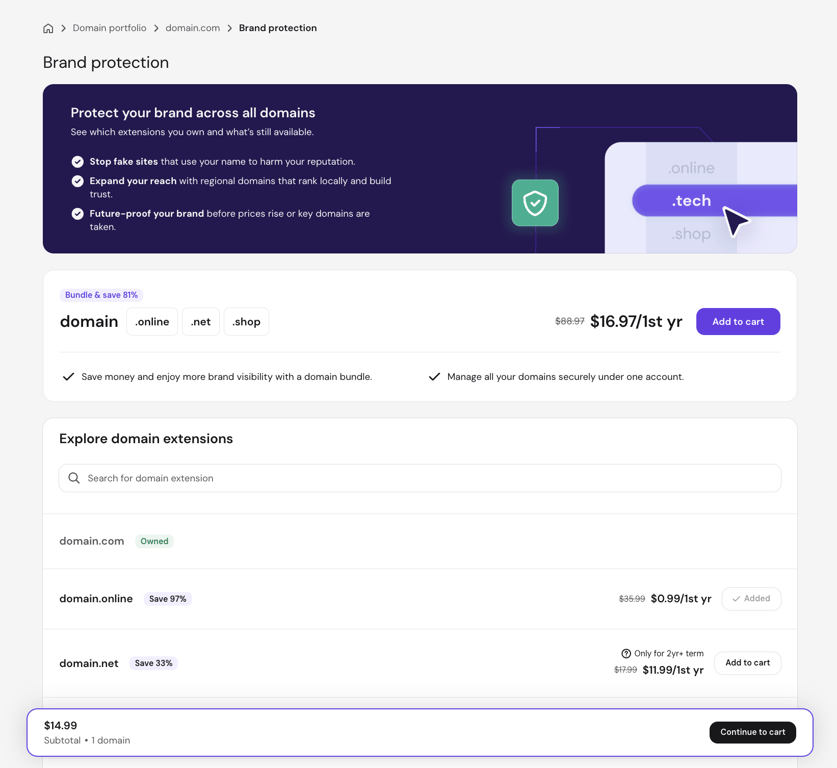
Your contact details apply across the whole cart, and any extension that requires additional information, as some country codes do, gets flagged before payment. Free WHOIS privacy protection is included with each registration, and the cart shows every domain’s renewal rate and renewal date before you commit.
Pro tip
Read the renewal rates in the cart, not just the first-year prices. The renewal figure is what your defensive portfolio costs each year after the first, and it's the number that should drive the decision.
After checkout, each new domain appears in the Domain portfolio with its own Auto-renewal toggle.
Domain Name Checker
Instantly check domain name availability.
How to decide if buying another domain extension is worth it
Another domain extension is worth buying when it protects your brand, supports the market you serve, or costs little relative to the risk it mitigates. Three questions help you check:
- Would a stranger owning this variation cost you customers, revenue, or reputation?
- Do you serve the country behind that ccTLD today?
- Is the renewal price trivial next to the risk it removes?
Register the extension when you can answer yes to the first or second question, and yes to the third. Anything else is a maybe, and maybes belong on a watchlist, not in a cart.
Review the list at renewal time, with the real yearly cost on screen, rather than buying in advance for markets and threats that may never arrive. New extensions launch every year, so this isn’t a decision you make only once.
The brands that handle it well treat their domain list like the rest of their infrastructure: small, current, and tied to a purpose they can name.
This article is a localized version of Should you buy multiple domain extensions?, originally published in English.

Bruno is a Content Writer at Hostinger, focused on creating and optimizing helpful, engaging articles about web development and marketing. With a background in journalism, he combines storytelling with practical insights to make complex topics easier to understand. He has also contributed to publications like MacMagazine and Jornal A Tarde. Outside of work, Bruno enjoys exploring art, cooking, and technology.