What are autonomous AI agents?
Sep 11, 2026
/
By Ksenija
/
12 min Read
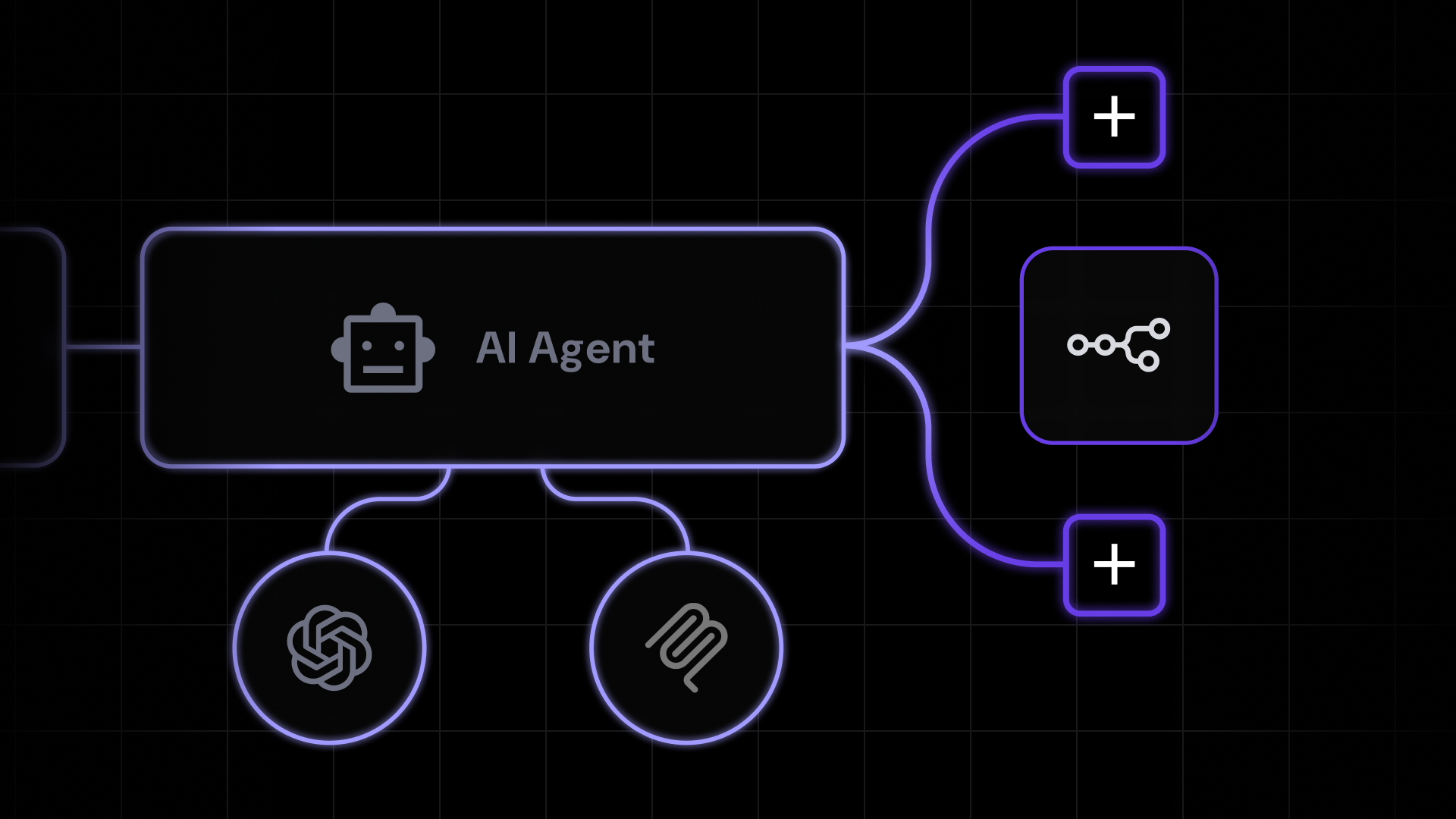
Autonomous AI agents are software systems that can plan, make decisions, use external tools, and carry out a series of actions with limited human input.
Once given an objective, an agent determines the next step, evaluates the outcome, and adjusts its approach until the task is complete or reaches a defined stopping point.
Autonomy does not suggest unlimited independence. Most production systems operate within predefined objectives, permissions, and safety rules that determine which actions can be taken automatically and which require human approval.
People remain responsible for oversight and high-impact decisions, while the agent handles routine work within those boundaries.
Bounded autonomy allows agents to work independently on routine tasks while keeping people responsible for high-impact decisions, compliance, and oversight.
Planning, reasoning, memory, and tool access work together to support autonomous execution.
Planning breaks complex work into manageable steps, memory preserves context between decisions, reasoning evaluates progress, and external tools provide access to applications and information needed to complete the task.
How do autonomous AI agents work?
Autonomous AI agents work by repeatedly planning, acting, evaluating results, and adapting their next decision until they achieve an objective or reach a stopping condition.
Each action changes the information available to the agent, so the next decision is based on the current state of the task rather than a fixed sequence of instructions.
That feedback loop allows the agent to continue working without waiting for another user prompt.
1. Receiving a goal
An autonomous AI agent begins by turning a user request or system event into a task the application can execute and monitor.
The input may arrive as a natural-language prompt, an API request, a support ticket, a scheduled job, or a signal from another application.
Before any planning starts, the system must determine what outcome is required, which conditions apply, and what would count as successful completion.
A request such as “Analyze competitors and recommend a pricing strategy” contains several pieces of information that the agent needs to separate.
The requested outcome is a pricing recommendation. Competitor analysis provides the evidence needed to produce it.
The request may also imply constraints that are not stated directly, such as the relevant market, product category, geographic region, reporting period, or required level of detail.
Missing details create uncertainty, so the system must either retrieve them from available context, apply approved defaults, or ask the user for clarification.
In an LLM-based agent, the application sends the request to the model together with instructions that define the agent’s role, available tools, operating rules, and expected output format.
The model analyzes the combined context and returns a structured interpretation. Depending on the implementation, that interpretation may include fields such as:
{
  "objective": "Recommend a pricing strategy",
  "required_work": [
    "Identify relevant competitors",
    "Collect current pricing data",
    "Compare product positioning",
    "Produce a recommendation"
  ],
  "constraints": {
    "market": "web hosting",
    "region": "United States",
    "currency": "USD"
  },
  "expected_output": "A report with evidence and recommendations",
  "missing_information": [
    "Target customer segment"
  ]
}
The large language model proposes this structure, but the surrounding application determines whether the output is valid.
A schema validator can reject missing fields or incorrect data types. Policy checks can remove actions outside the agent’s permissions.
Business rules can require human confirmation when the request involves sensitive data, financial decisions, or changes to production systems.
The application may also compare the request against the tools available to the agent. A goal that requires database access cannot proceed if the agent has no authorized database tool.
Once validated, the interpreted goal becomes part of the workflow state. The state stores the objective, constraints, available context, permissions, expected deliverables, and any unresolved questions.
Every later component reads from the same state, which prevents the planner, tool executor, and evaluator from working from different interpretations of the request.
Success criteria are especially important because the agent needs a concrete way to determine when the work is complete.
For the competitor analysis, completion might require pricing data from five named competitors, source links for every claim, a comparison table, and a recommendation that follows a defined pricing policy.
Without those conditions, the agent may produce a plausible answer while leaving important parts of the task unfinished.
Planning begins only after the agent has a sufficiently clear and valid representation of what it is trying to achieve.
2. Creating a plan
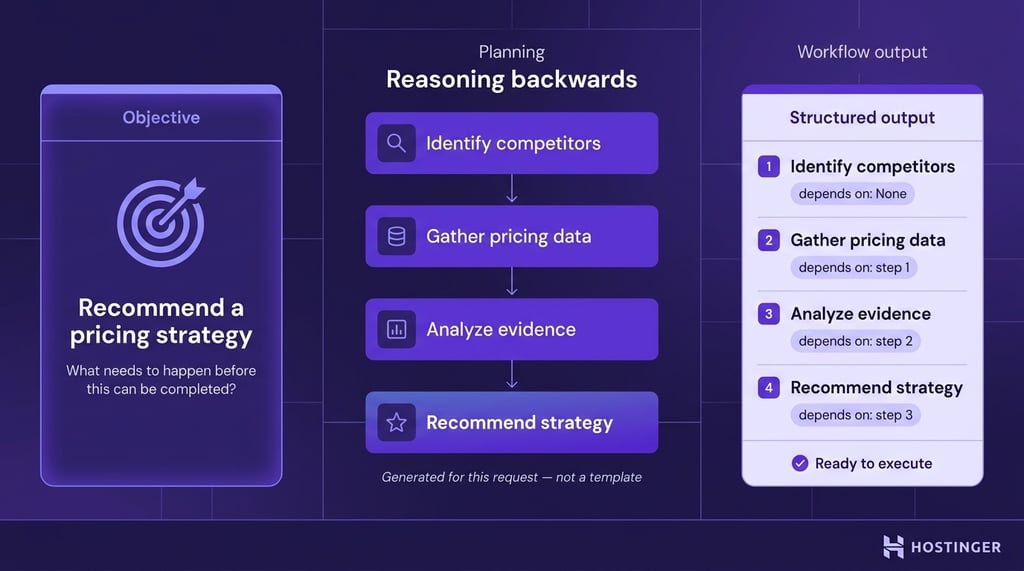
Planning answers a single question: What needs to happen before the objective can be completed?
A large language model answers that question by reasoning about the relationship between the objective and the work required to achieve it.
Instead of generating the final result immediately, the model works backward from the desired outcome to identify the intermediate steps needed to reach it.
For a request to recommend a pricing strategy, the model first recognizes that a recommendation requires evidence.
Evidence requires pricing data, and pricing data requires identifying relevant competitors. Those relationships naturally form a sequence of dependent tasks.
Unlike traditional automation, the workflow is generated for the current request rather than selected from a predefined template.
A different objective, available tools, or set of constraints may produce a completely different plan, even when the same agent is used.
The planner returns the workflow as structured data that describes the tasks, their dependencies, and the order in which they should be completed.
At this point, the agent knows what work needs to happen, but none of that work has been executed yet.
3. Breaking the plan into smaller tasks
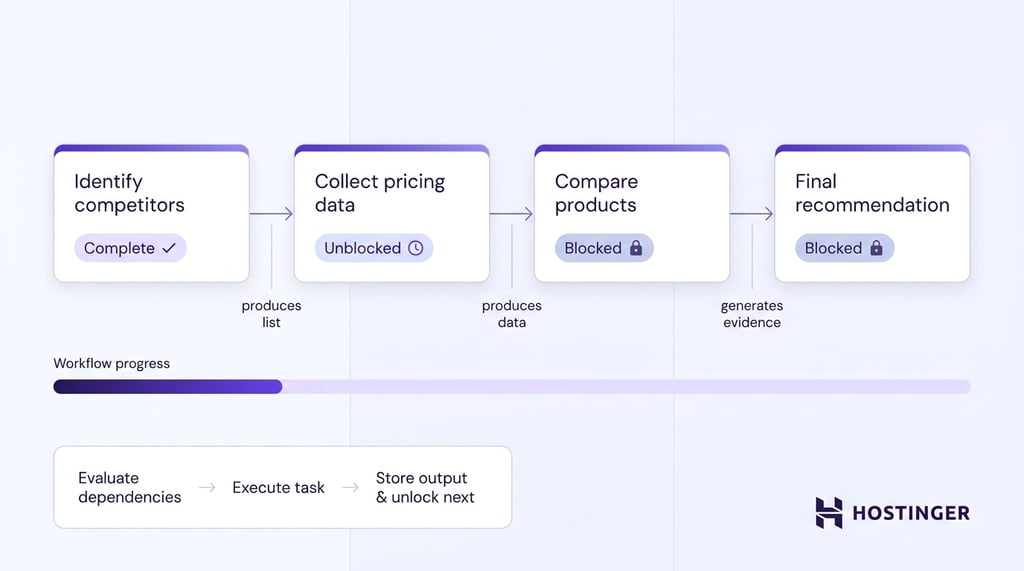
Execution begins by selecting the first task whose dependencies have been satisfied. In the previous example, Identify competitors has no dependencies, so it becomes the current task. Collect pricing data remains blocked until the first task finishes successfully.
When the current task finishes, the application stores its output and updates the task’s status.
The execution engine then checks whether the completed task has satisfied the requirements for any remaining tasks.
If it has, the next task becomes eligible for execution. If it has not, the workflow may retry the task, select an alternative approach, or stop if recovery is no longer possible.
Each completed task contributes new information to the workflow. Identifying competitors produces the list needed for data collection.
Collecting pricing data produces the information required for comparison. Comparing products generates the evidence needed to support the final recommendation.
Later tasks, therefore, consume the outputs produced by earlier ones, gradually moving the workflow toward the original objective.
The execution engine repeats this cycle until every task has been completed or the workflow reaches a stopping condition.
Because each task is evaluated independently, the application can recover from failures, incorporate newly discovered information, or change the remaining workflow without restarting the entire process.
4. Gathering information and using tools
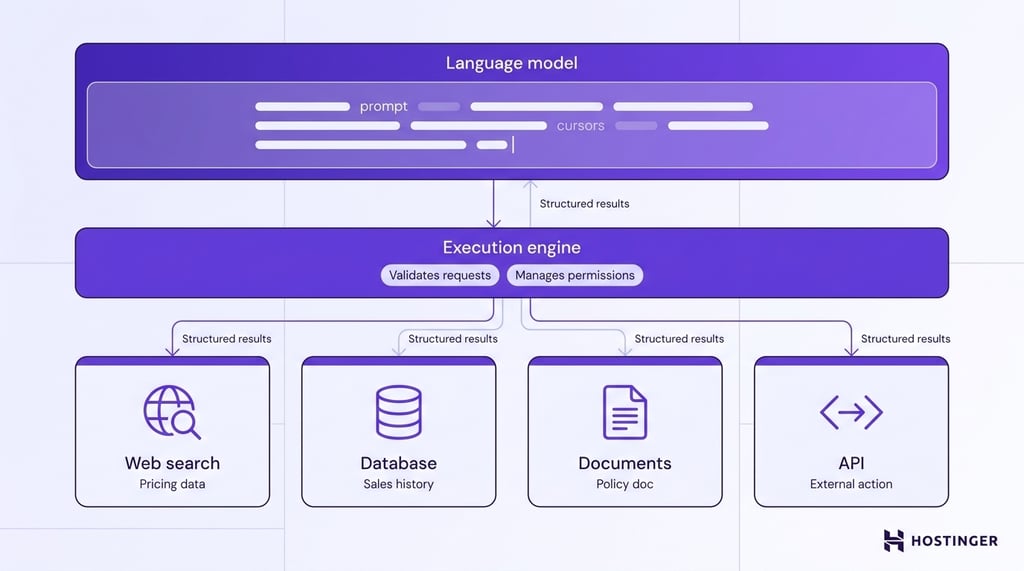
A large language model cannot retrieve live information or modify external systems on its own.
Whenever the current task requires data beyond the conversation or an action outside the model, the application invokes a tool. Tools expose external capabilities through well-defined interfaces.
Depending on the task, the execution engine might call a web search service, query a database, retrieve a document, execute Python code, send an email, or interact with another application’s API.
Each tool returns structured results that become part of the workflow state.
Suppose the current task is Collect pricing data. The model recognizes that answering from its training data would produce outdated or incomplete results, so it requests access to a web search tool.
The application validates that request, executes the search, and returns the retrieved pricing information to the model for analysis. The model never communicates with the external service directly.
One task may require several tools. A competitor analysis could combine web searches for current prices, database queries for historical sales data, and document retrieval for internal pricing policies before producing a comparison.
The execution engine coordinates those calls and supplies their outputs to the model as additional context.
Tool use also operates within defined permissions. The application decides which tools are available, what parameters they accept, and whether a requested action is allowed.
A customer support agent, for example, may retrieve account information but not issue refunds without approval.
Separating reasoning from execution prevents the language model from performing actions outside the limits established by the application.
5. Evaluating the results
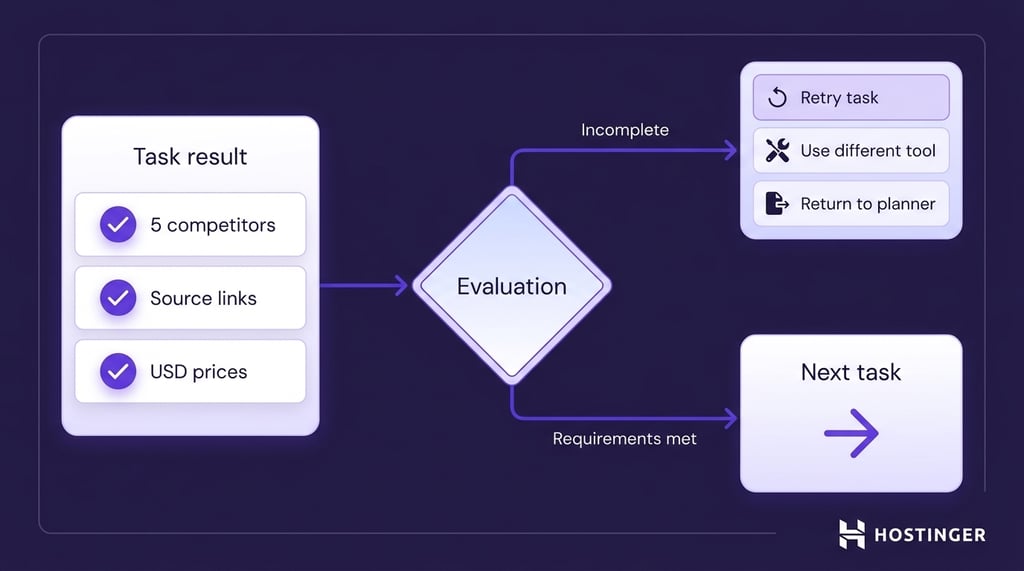
Before the workflow continues, the application evaluates whether the output satisfies the requirements defined for that task.
Evaluation compares the result against measurable criteria instead of assuming that every completed action was successful.
A task to collect competitor pricing, for example, may require data from five named companies, source links for every price, and prices expressed in US dollars.
Returning information for only three competitors completes the tool call, but it does not complete the task.
Different tasks require different evaluation methods. Structured outputs can be validated against a schema to ensure that every required field is present and correctly formatted.
Retrieved information can be checked for completeness, freshness, or consistency with other sources.
Language model responses may be reviewed by another model that verifies whether the response follows the original instructions, cites supporting evidence, or answers the requested question.
Evaluation produces a decision rather than another answer. If the result meets every requirement, the workflow continues to the next task.
If information is missing or validation fails, the application may repeat the task, invoke a different tool, request clarification, or return the task to the planner for revision.
6. Adapting to new information
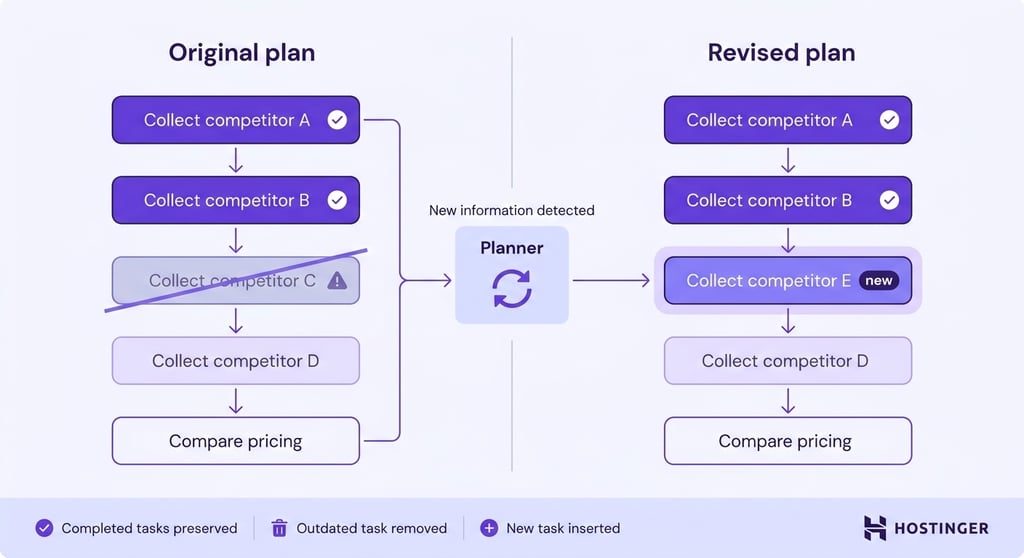
The original workflow is based on the information available when planning begins. As execution progresses, new information can invalidate earlier assumptions, making the remaining workflow incomplete or unnecessary.
The original plan might include collecting pricing data for five competitors. During execution, the agent discovers that one competitor no longer sells the product being analyzed.
Continuing with the original workflow would waste time collecting irrelevant data and could produce misleading conclusions.
Instead of following the outdated plan, the application updates the workflow state with the newly discovered information and asks the planner to generate the remaining steps again.
The planner does not start from scratch. It receives the current workflow state, including completed tasks, collected data, failed actions, and the original objective, then revises only the unfinished portion of the workflow.
The updated workflow may remove unnecessary tasks, insert new ones, or change their execution order.
If another competitor should replace the one that was removed, the planner adds new data collection and comparison tasks before the workflow continues.
Previously completed work remains available unless the new plan determines that it is no longer valid.
Building this plan-act-evaluate loop yourself means managing the orchestrator, memory, and tool integrations — or you can run a ready-made agent on an agentic AI platform that provides that infrastructure for you.
Core components of an autonomous AI agent
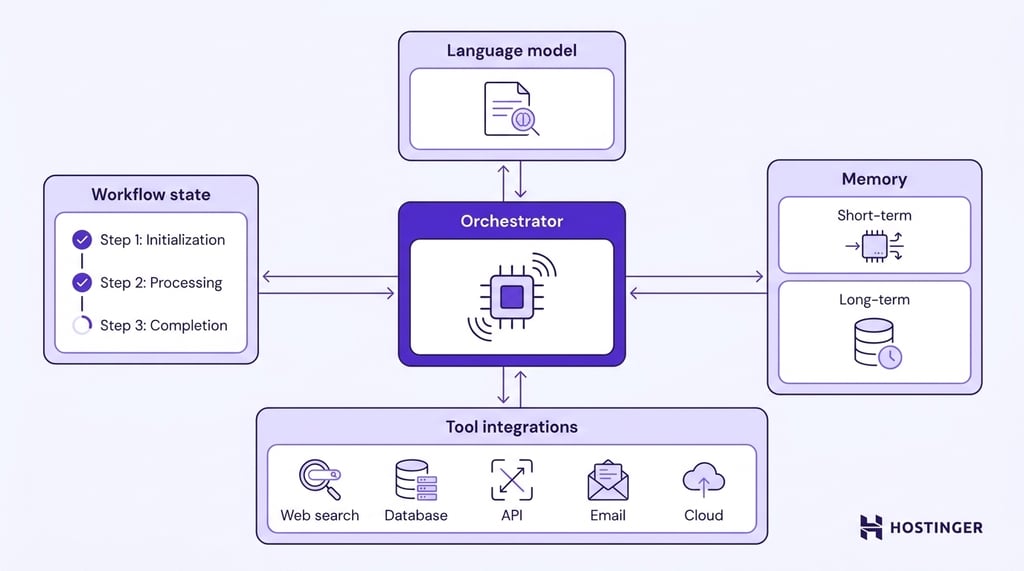
An autonomous AI agent is a collection of software components that coordinate reasoning, execution, memory, and external systems.
The language model supplies intelligence, while the surrounding application manages the workflow that turns reasoning into actions.
The language model
The language model interprets requests, reasons about problems, creates plans, and evaluates information.
It generates structured outputs, but it does not execute code, store long-term state, or communicate directly with external services.
The orchestrator
The orchestrator coordinates the entire workflow. It decides when to call the language model, executes tools, stores intermediate results, updates the workflow state, and determines what should happen next.
Without an orchestrator, the language model would simply generate text instead of performing autonomous work.
Workflow state
Workflow state stores everything the agent has learned while working toward an objective.
Objectives, completed tasks, retrieved information, tool outputs, permissions, and evaluation results remain available throughout execution so every component operates from the same context.
Memory
Memory extends the information available to the agent beyond the current task.
Short-term memory preserves context during a workflow, while long-term memory can retain user preferences, previous conversations, successful workflows, or organizational knowledge for future tasks.
Tool integrations
Tool integrations allow the agent to retrieve information and interact with external systems.
Web search, databases, APIs, email platforms, cloud services, and business applications all become available through controlled interfaces managed by the application.
Levels of autonomy in AI agents
The amount of work an agent can perform without human involvement depends on the permissions, tools, policies, and approval requirements defined by the application.
As those constraints change, so does the agent’s degree of autonomy.
Assisted AI agents
Assisted agents respond to requests but rely on users to direct each step of the workflow. The application may provide access to tools or external data, but the agent waits for new instructions before moving to the next task.
Most AI chatbots and virtual assistants operate at this level, helping users complete work without acting independently.
Semi-autonomous AI agents
Semi-autonomous agents can plan and complete multi-step workflows without continuous guidance.
The application allows the agent to reason, use tools, and adapt to new information, but pauses the workflow before high-impact actions such as approving payments, deploying code, or modifying production systems.
Human approval becomes a built-in checkpoint rather than an indication that the workflow has failed.
Autonomous AI agents
Fully autonomous agents perform most tasks independently from planning through execution.
The application continuously evaluates results, updates the workflow, and allows the agent to adapt its plan as new information becomes available.
Human intervention is limited to exceptional situations, while permissions, business rules, and monitoring ensure the agent operates within predefined boundaries.
Many production systems combine characteristics from multiple levels depending on the workflow and the risk associated with each action.
Autonomous AI agents vs other AI systems
Although autonomous AI agents share capabilities with other AI technologies, each one is designed for a different purpose.
Some generate content, others automate predefined workflows, while autonomous agents combine reasoning, planning, and execution to complete objectives independently.
The following comparison highlights the key differences between these approaches.
Technology | Primary role | Planning | Multi-step execution | Tool use | Human involvement |
Autonomous AI agent | Completes objectives independently | ✓ | ✓ | ✓ | Minimal |
AI assistant | Helps users complete individual tasks | Limited | Limited | Optional | Continuous |
Generative AI | Creates text, images, code, or other content | ✗ | ✗ | Optional | Required |
Traditional automation | Executes predefined rules | ✗ | Predefined only | Limited | None after configuration |
Multi-agent system | Coordinates multiple agents to solve a problem | Depends on the participating agents | Depends | Depends | Depends |
Generative AI focuses on producing content from a prompt. Large language models such as GPT generate text, summarize documents, answer questions, or write code, but they do not manage workflows or execute actions on their own.
Autonomous AI agents often use generative AI as their reasoning engine, combining language generation with planning, memory, and tool use.
AI assistants keep humans at the center of the workflow. A chatbot can answer questions, draft emails, or retrieve information, but each new task begins with another user instruction.
Autonomous agents shift responsibility from responding to prompts toward completing objectives independently.
Traditional automation follows predefined rules instead of reasoning about new situations. A workflow created with scripts or robotic process automation (RPA) performs the same sequence of actions every time unless a developer changes the logic.
Autonomous agents generate and adapt workflows dynamically based on the current objective and the information they gather during execution.
Multi-agent systems describe an architectural pattern rather than a level of autonomy. Instead of relying on a single agent, the application coordinates multiple specialized agents that cooperate on different parts of a workflow.
One agent might research competitors, another analyze pricing, and a third generate recommendations before combining their results into a final report.
Autonomy and multi-agent design describe different characteristics of an AI system. Autonomy explains how independently an individual agent can operate, while a multi-agent system explains how work is distributed across multiple agents.
A single autonomous agent can complete complex workflows alone, and a multi-agent system may include autonomous agents, non-autonomous agents, or a combination of both.
Where are autonomous AI agents used?
Customer support is one of the most mature applications for autonomous AI agents. They can retrieve customer information, search internal knowledge bases, and answer routine questions without human involvement. They can also process account updates or issue refunds within predefined limits.
Software development benefits from AI agents that generate code, review pull requests, write tests, and document changes.
In IT operations and cybersecurity, they investigate alerts, analyze logs, monitor infrastructure, and automate incident response.
Many organizations are using AI agents in marketing to automate audience segmentation, campaign optimization, content generation, performance analysis, and lead nurturing across multiple channels.
Business operations teams apply autonomous AI agents to invoice processing, procurement, inventory management, document routing, report generation, and other administrative workflows that span multiple business systems.
The growing number of AI agent examples reflects a common pattern: organizations deploy autonomous AI agents where they can automate repetitive, multi-step workflows while reserving high-impact decisions for people.
What are the benefits of using autonomous AI agents?
Organizations use autonomous AI agents because they help them:
- Reduce repetitive work. Autonomous AI agents handle routine, time-consuming tasks such as processing documents, updating records, or responding to common customer requests, reducing the manual workload for employees.
- Respond faster. AI agents can analyze information, make routine decisions, and execute actions within seconds, reducing response times for customers, employees, and internal operations.
- Scale operations. A single autonomous workflow can handle thousands of requests simultaneously without requiring organizations to increase headcount at the same pace.
- Operate continuously. Autonomous agentic AI works around the clock, making it well-suited for customer support, infrastructure monitoring, cybersecurity, and other time-sensitive operations.
- Improve consistency. Every workflow follows the same business rules, helping organizations deliver more consistent responses, reduce errors, and standardize routine processes.
What are the risks of using autonomous AI agents?
Every autonomous AI agent introduces some level of operational risk. The impact depends on the decisions the agent can make, the systems it can access, and how independently it can act.
Common challenges include:
- Incorrect decisions. AI agents can misinterpret objectives, choose ineffective actions, or produce results that don’t align with business requirements. For example, a procurement agent might order the cheapest supplier instead of the one that meets quality standards.
- Hallucinations. Large language models may generate inaccurate information or unsupported conclusions that affect downstream decisions if outputs are not properly validated. A research agent, for instance, could cite non-existent sources or summarize outdated information as fact.
- Excessive permissions. Granting agents unnecessary access to systems or sensitive data increases the impact of mistakes, misuse, or compromised accounts. An HR agent that can both view and delete employee records poses a much greater risk than one with read-only access.
- Poor monitoring. Without logging, alerts, and audit trails, organizations may struggle to identify failures, investigate incidents, or understand why an agent made a particular decision. If an inventory agent repeatedly orders duplicate stock, teams need execution logs to determine what caused the error.
- Security concerns. AI agents that interact with external tools, APIs, and business systems can become targets for prompt injection, unauthorized access, or data leakage if they are not adequately protected. For instance, a malicious prompt embedded in a web page could manipulate a browsing agent into exposing sensitive information or performing unintended actions.
- Unexpected behavior. Agents may respond unpredictably to ambiguous instructions, incomplete information, or situations that were not considered during development. A customer service agent instructed to “prioritize urgent requests” might incorrectly classify routine inquiries as urgent if the criteria are poorly defined.
The level of risk depends on both the task and the degree of autonomy. As organizations shift toward intelligent automation, they must balance efficiency with governance by matching each workflow to an appropriate level of autonomy.
The goal is to give the appropriate level of autonomy for each workflow.
When should you use autonomous AI agents?
Autonomous AI agents provide the most value when workflows involve multiple connected decisions that follow predictable business rules.
If a process requires information from several systems, repeated decision-making, and the same sequence of steps every time, an autonomous agent can usually perform it more efficiently than a person.
Good candidates include:
- Research and information gathering
- Lead qualification
- Marketing campaigns and customer journeys
- Infrastructure and application monitoring
- Report generation and data analysis
- Repetitive business processes such as invoice processing, procurement, or document routing
Some decisions should remain under human control because they involve legal, financial, ethical, or safety considerations.
Approving payments, hiring employees, and making legal or compliance decisions are common examples. The same applies to healthcare decisions, customer disputes, and major security incidents.
Should you build autonomous AI agents?
Many businesses do not need to build autonomous AI agents from scratch. Developing a reliable autonomous system requires much more than integrating a large language model.
The application must coordinate planning, execution, memory, tool integrations, permissions, monitoring, evaluation, and ongoing maintenance to ensure the agent operates safely and consistently.
Building that infrastructure makes sense when an organization needs highly customized workflows, deep integrations with internal systems, or strict control over how the agent reasons and executes tasks.
In those cases, businesses can evaluate platforms for building AI agents that provide the foundation for developing, testing, and deploying custom AI solutions.
Regardless of the platform, building autonomous AI agents will still require continuous testing, monitoring, and maintenance as business processes, models, and connected systems evolve.
It also needs continuous testing, monitoring, and updates as business processes, models, and connected systems evolve.
For many businesses, a ready-to-use AI agent is a more practical choice. Hostinger Agent, for instance, provides specialized capabilities for tasks such as SEO, marketing, content creation, and sales.

Businesses can automate those workflows without developing and maintaining their own AI infrastructure.
Each AI assistant focuses on a specific business function, making it easier to automate common workflows and increase productivity.

Ksenija is a digital marketing enthusiast with extensive expertise in content creation and website optimization. Specializing in WordPress, she enjoys writing about the platform’s nuances, from design to functionality, and sharing her insights with others. When she’s not perfecting her trade, you’ll find her on the local basketball court or at home enjoying a crime story. Follow her on LinkedIn.