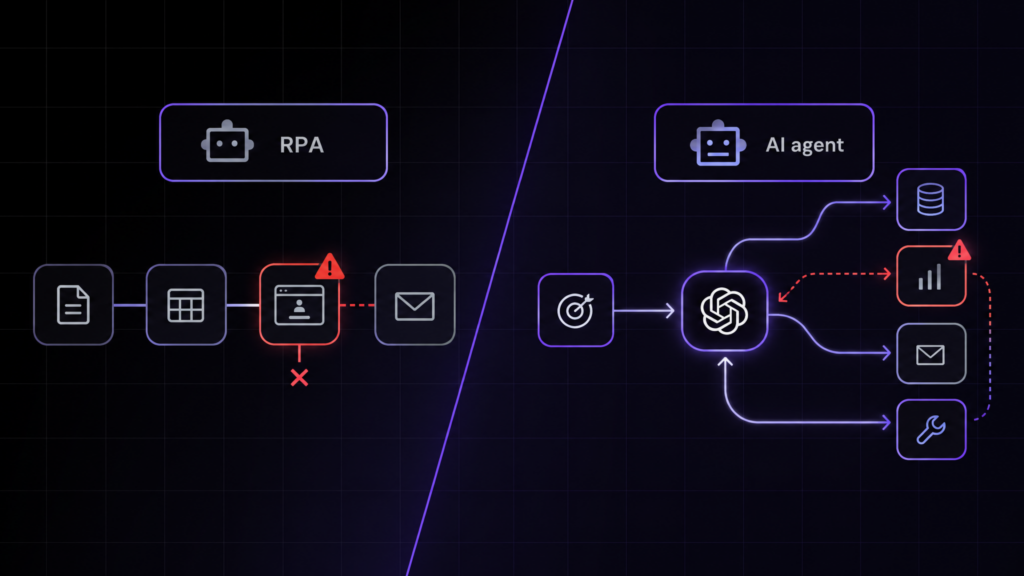
Organizations with $1 billion or more in revenue are scaling AI agents at nearly twice the rate of those below that line: 40% versus 22%. An AI agent is software that completes multi-step tasks, such as answering customer questions or compiling research, with minimal human input.
Customer service and research are the most common jobs for agents, and quality is the top obstacle for teams putting them into production. Hostinger’s own AI assistant resolves 91% of about 1.5 million support conversations a month without human involvement.
Key AI agent statistics for business in 2026
Here are the key numbers on AI agents in business:
- 40% of organizations with $1 billion or more in revenue are scaling AI agents in at least one function, compared with 22% of smaller organizations.
- 62% of large US organizations are building, deploying, or developing AI agents, up from 53% a quarter earlier.
- 46% of surveyed US small employer firms use AI, and another 15% plan to start within a year.
- 24.6% of all US employer businesses use AI in a business function.
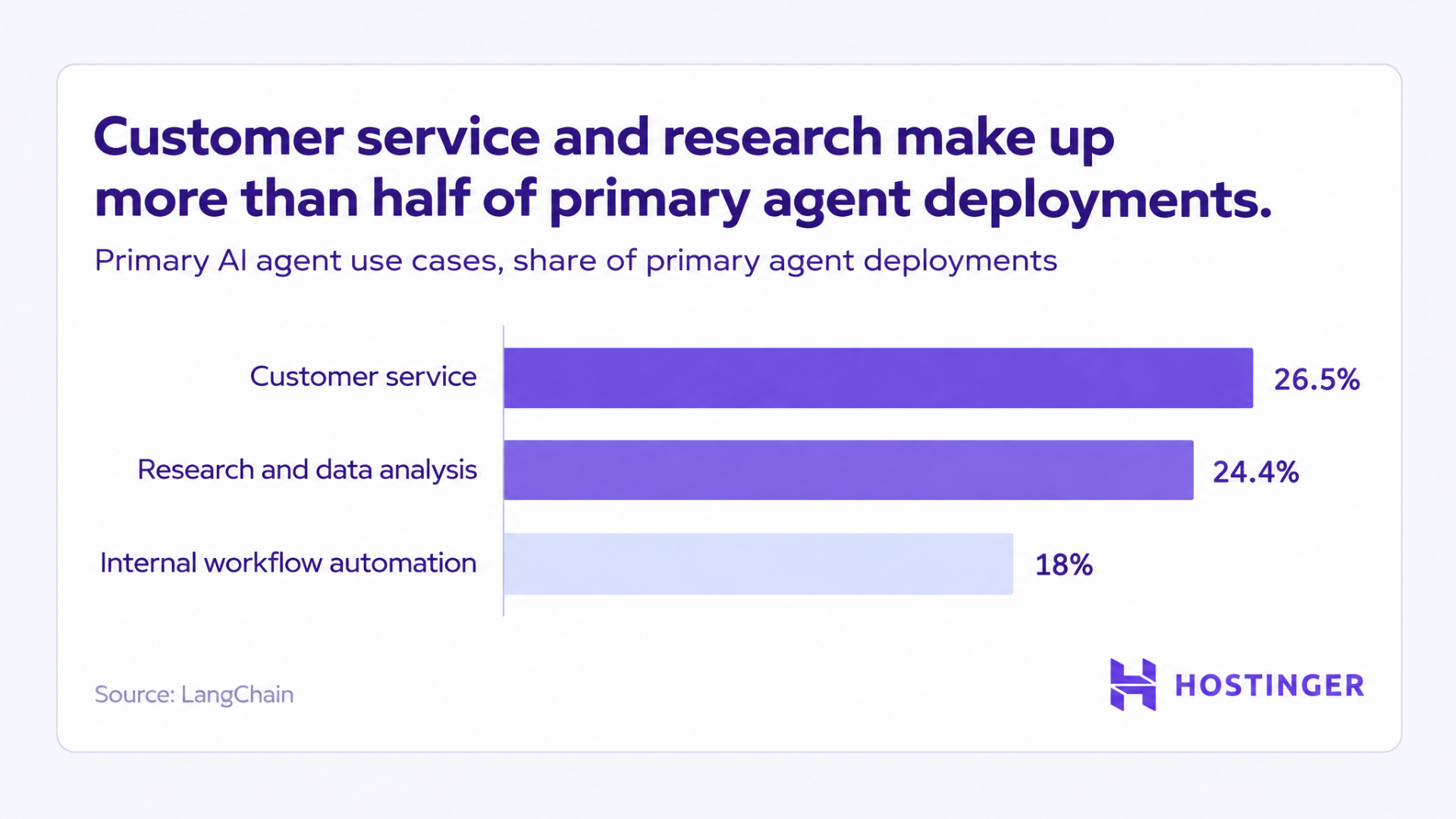
- 26.5% of agent builders name customer service as their main use case, the most common answer, ahead of research and data analysis at 24.4%.
- 58% of leaders at large US organizations report measurable business value from AI.
- 22% of total AI value comes from agents, up from 17% the year before.
- $29.2 billion is the forecast for worldwide spending on AI agents and assistants in 2026, up from $16.5 billion in 2025.
- 32% of agent practitioners name quality as their top barrier to production.
- 87% of customers say companies using GenAI in customer service must offer a way to reach a human.
Larger companies lead AI agent adoption in 2026
In 2026, 40% of respondents at organizations with $1 billion or more in revenue said they were scaling AI agents in one or more functions, compared with 22% at smaller organizations, according to a McKinsey survey. Smaller here means under $1 billion in revenue, which includes many midsize companies.
The large-company share was 27% in 2025, while the smaller group stayed flat. About two in 10 respondents said their organization had reached the scaling phase across the whole organization, a stricter measure than scaling in one function.
KPMG’s AI Pulse survey found 62% of 314 US C-suite and business leaders at organizations with $1 billion or more in revenue building, deploying, or developing AI agents, up from 53% a quarter earlier. And 25% were developing or implementing multi-agent systems, up from 6% in each of the two quarters before.
In a LangChain survey of 1,340 professionals, most of them in technology roles and already working with agents, 57.3% had agents in production, and another 30.4% were developing them with concrete plans to deploy. That’s a lower bar than McKinsey’s scaling phase, and the respondents lean toward early adopters, so the share runs higher.
Size made a difference here, too: 67% of organizations with 10,000 or more employees had agents in production, compared with 50% of those with fewer than 100 employees, though another 36% of the smaller group were developing them
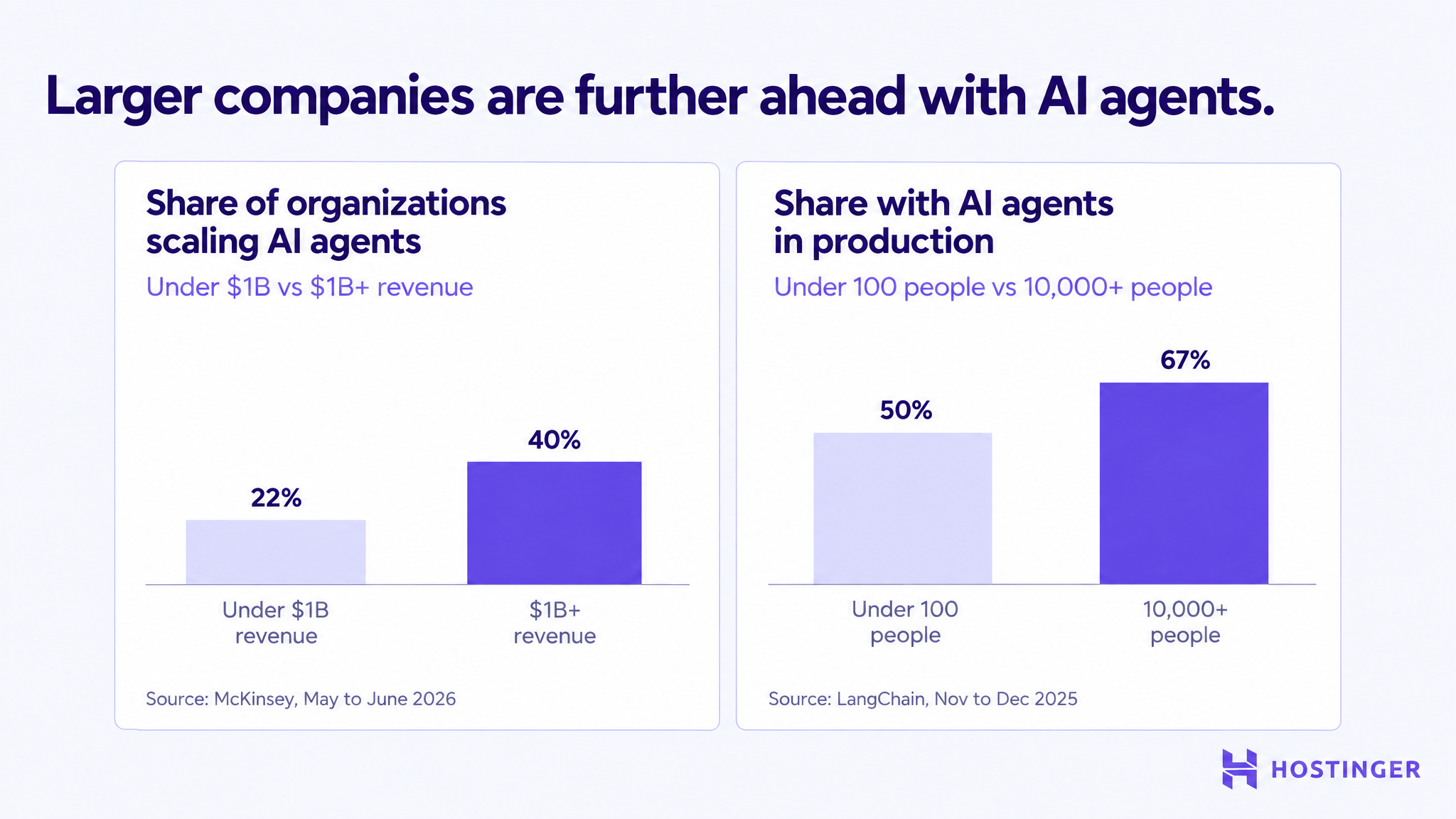
Across the surveys, smaller organizations are working on agents almost as often as large ones, but fewer have moved them into production or scaled them.
Customer service and research lead AI agent use cases
Customer service and research are nearly tied as the most common jobs for AI agents: 26.5% of respondents in LangChain’s survey named customer service as their primary use case, and 24.4% named research and data analysis. Between them, the two account for more than half of primary deployments, and another 18% use agents mainly to automate internal workflows.
Big companies lean toward internal uses. At organizations with 10,000 or more employees, internal productivity tops the use-case list at 26.8%, ahead of customer service at 24.7% and research and data analysis at 22.2%.
McKinsey ranks agent work differently because it asks a different question: where agents have reached the scaling phase, not each team’s main use case. By that measure, respondents most often scale agents in information technology (IT), knowledge management, and software engineering, while respondents in consumer goods and retail most often use them in marketing and sales.
Coding agents are already shifting some buying decisions. About 20% of respondents said their organization was scaling software coding agents, rising to 31% at larger enterprises. And 32% of respondents at organizations using AI said they had skipped buying at least one software product or feature because it could be built in-house with agentic coding tools, most often in technology and healthcare.
The answer depends on what you measure: customer service and research are the most common main jobs for agents, while IT and software engineering are where they’ve scaled furthest.
Small businesses use AI mostly for writing and marketing
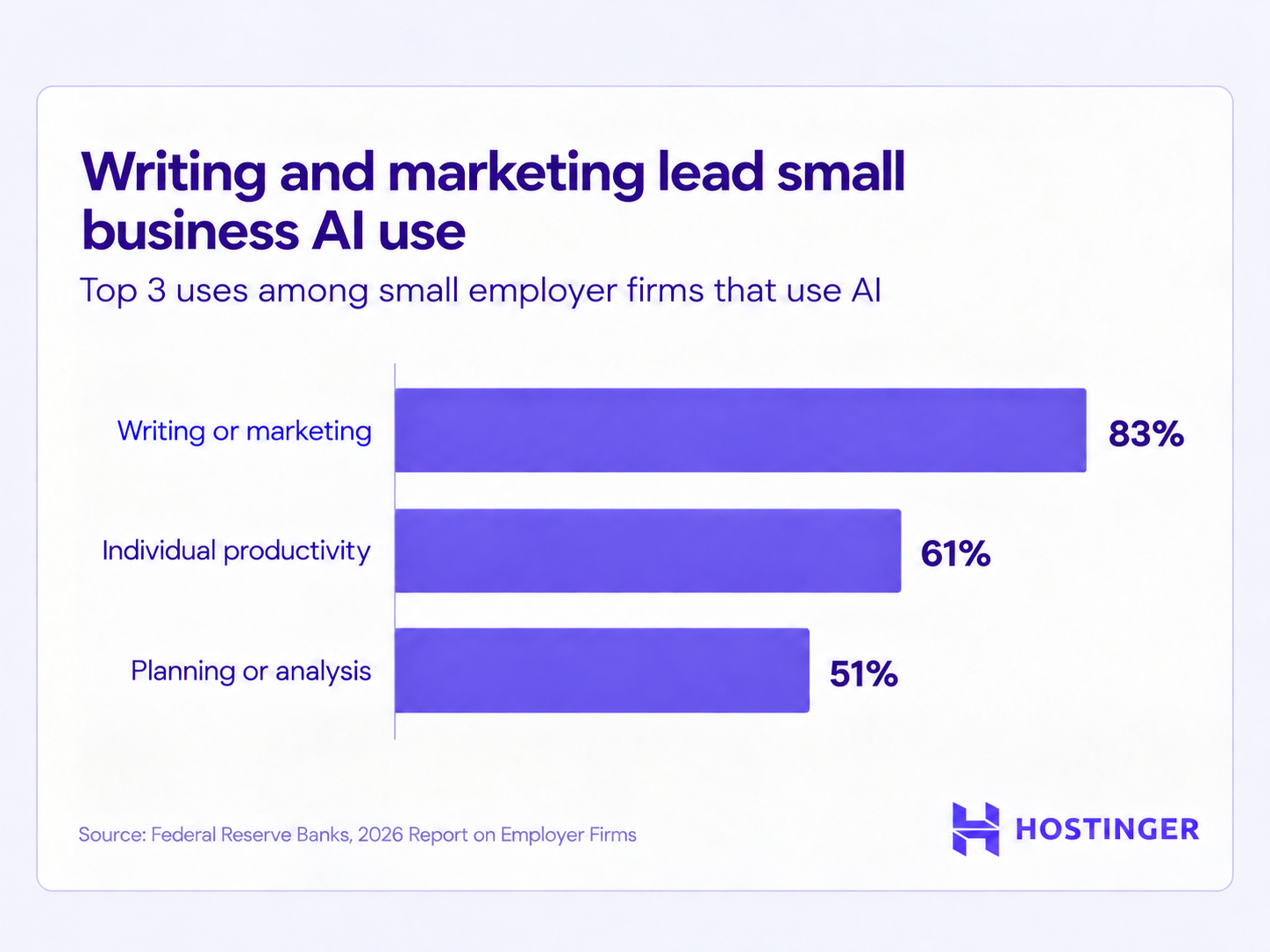
Of the US small employer firms that use AI, 83% use it for writing or marketing, well ahead of individual productivity at 61% and planning or analysis at 51%, according to the Federal Reserve Banks report.
Across all surveyed firms, 46% said their business or employees use AI, another 15% planned to start within 12 months, a third had no plans to use it, and 6% were unsure. These figures cover AI in general. None of the surveys here measure AI agent use at small businesses specifically.
AI users report gains: 71% saw higher productivity and 31% higher sales, while 77% saw no change in labor costs and only 16% saw them fall. Most of these firms are still early, though. About half of AI users are experimenting, 44% have partially built AI into their business processes, and 7% have fully integrated it.
Firms planning to start cite practical hurdles: 54% can’t find tools that fit their needs, and 37% lack the time to implement AI or train staff. Starting with one workflow you already run narrows the search to a single job, as our small business AI guide shows.
US Census Bureau data shows lower AI use than the Fed survey, and a clear rise since spring. In the Business Trends and Outlook Survey, 24.6% of US employer businesses used AI in a business function in the period ending October 18, 2026, up from 19.8% in the period ending May 3.
The smallest firms are following the same trend. Use at firms with one to four employees rose from 19.0% to 24.3% over the same months.
Larger firms use AI more. As of October 18, use reached 35.3% at firms with 100 to 249 employees and 43.6% at firms with 250 or more.
The two surveys aren’t directly comparable. The Fed asks whether a business or its employees use AI at all, based on a late-2025 sample of small firms, while the Census Bureau asks whether a business used AI in any business function in the past two weeks, across employer businesses of all sizes.
Both point the same way, though: AI use at small firms is growing, but most are still early in adopting it.
Agents are a growing share of the value businesses get from AI
Agents account for 22% of the value companies get from AI in 2026, up from 17% in 2025, according to BCG’s Applied AI Index. The index draws on a survey of more than 1,300 senior executives across 20-plus sectors.
Maturity makes a big difference. 44% of the most AI-mature companies, which BCG calls future-built, already get value from agentic AI, compared with 2% of laggards.
McKinsey’s survey shows a similar pattern. AI high performers, the roughly 6% of respondents who attribute at least 5% of EBIT (earnings before interest and taxes) to AI and report significant value, were more than three times as likely as others to be scaling agents in most business functions. The survey doesn’t say whether scaling agents drives the results or strong performers simply scale more.
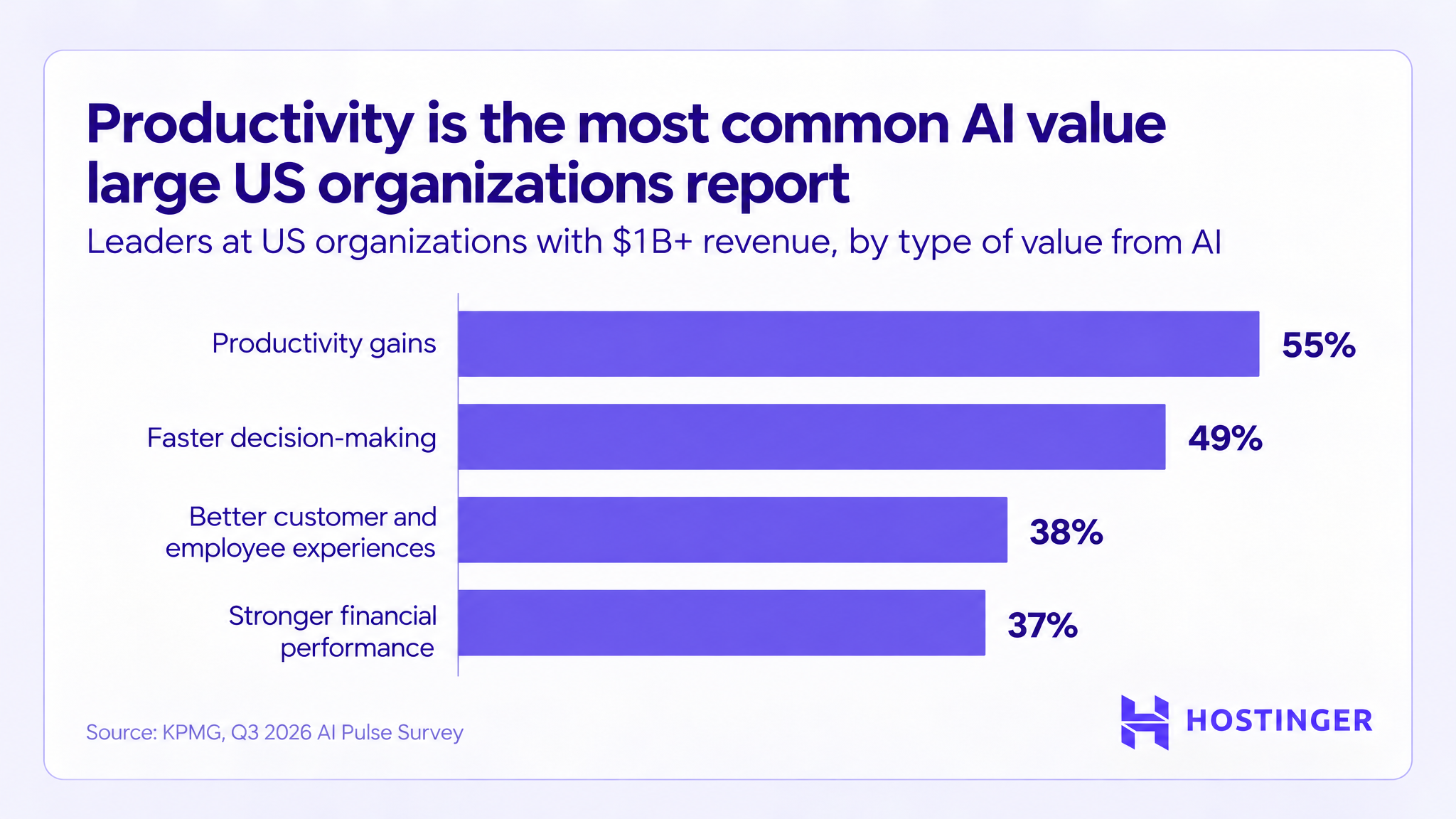
Measurable value from AI overall is more common. In KPMG’s survey, 58% of leaders at US organizations with $1 billion or more in revenue reported measurable business value from AI initiatives, including but not limited to agents. Productivity gains led at 55%, followed by faster decision-making at 49%, better customer and employee experiences at 38%, and stronger financial performance at 37%.
Hostinger’s own support desk shows what this looks like in one operation. Hostinger’s AI assistant resolved 91% of roughly 1.5 million support conversations a month without human involvement. That support work now runs inside Hostinger Agent, which combines support with specialized agents for business tasks.
Expert tip
The resolution rate matters most when customers don’t come back with the same problem. That’s the check worth adding to any agent you put in front of customers: did it solve the issue, not just close the chat.

Ričardas Kudirka
Hostinger Agent Project Manager at Hostinger
Spending on AI agents and assistants is forecast to reach $29.2 billion in 2026
Worldwide spending on AI agents and assistants will reach $29.2 billion in 2026, up from $16.5 billion in 2025, according to Gartner’s forecast, growth of about 77% calculated from its table.
| Year | Worldwide spending on AI agents and assistants | Type |
|---|---|---|
| 2025 | $16.5 billion | Estimate |
| 2026 | $29.2 billion | Forecast |
| 2027 | $65.5 billion | Forecast |
Source: Gartner, September 2026.
Gartner expects spending to more than double again in 2027, to $65.5 billion. Part of that reflects what the forecast now counts: it includes consumer agents and assistants alongside business spending.
Even so, agents remain a small slice of total AI spending. The 2026 figure is about 1.1% of total worldwide AI spending forecast for the year, calculated from the same forecast. None of these sources puts a typical price on a business AI agent.
Cost holds back a minority of organizations so far. In McKinsey’s survey, about 10% of respondents said costs had limited their organization’s use of AI agents, the same share as for chatbots and coding agents. For AI overall, 20% said operating costs, including tokens, had held them back.
Overall AI budgets are climbing fast. BCG found corporate AI spending doubled in a year to 3.3% of revenue, across all AI.
Large companies are adding cost controls. In KPMG’s survey, 74% of leaders include cost reviews in their AI approval processes, up from 61% the previous quarter, 70% use AI monitoring dashboards, and 43% set usage or token budgets.
Quality is the biggest barrier to putting AI agents into production
Quality is the biggest barrier to putting agents into production: 32% of respondents in LangChain’s survey named it first, ahead of latency at 20%. Quality here means accuracy, relevance, consistency, and staying on tone and within policy.
Cost came up less often than in past years, and at enterprises with 2,000 or more employees, security ranked second at 24.9%.
Most teams monitor what their agents do
In the same survey, most teams track what their agents do:
- 89% of respondents have some form of observability for their agents.
- 52.4% run offline evaluations on test sets.
- 37.3% run online evaluations in production.
Large organizations are setting limits, but full controls are rare
Large companies are fencing off decisions. In KPMG’s survey, 49% of leaders had defined high-risk use cases where agents may not decide on their own, and 73% felt confident in their AI governance, up from 57% a quarter earlier. Few have the full toolkit yet: BCG’s index found only 5% of companies had every control it lists as critical for AI agents.
Security policies lag behind use: 82% of surveyed organizations already use AI agents, but only 44% have policies in place to secure them, according to Hostinger’s agentic AI statistics.
Customers expect a way to reach a human
Customers draw the clearest line. In a Gartner survey, 87% said companies using generative AI (GenAI) in customer service must offer a way to reach a human agent, even though 50% said GenAI makes their interactions easier. This covers GenAI in customer service, not agents specifically.
What forecasts say about AI agents through 2030
These are projections from consultancies and analysts, not measurements, and each uses its own definitions.
| Source | Horizon | What it projects | Agent-specific? |
| Census Bureau | Next 6 months (from Oct 18, 2026) | 28.6% of US employer businesses expect to use AI | No, AI in general |
| McKinsey | Next 12 months | 60% of respondents expect to raise AI investment | No, AI in general |
| Gartner (June 2025) | By end of 2027 | Over 40% of agentic AI projects canceled | Yes |
| Gartner (June 2025) | By 2028 | 33% of enterprise software applications include agentic AI (under 1% in 2024) | Yes |
| Gartner (June 2025) | By 2028 | At least 15% of day-to-day work decisions made autonomously through agentic AI | Yes |
| Capgemini Research Institute | By 2028 | Up to $450 billion in economic value | Yes |
| BCG | By 2030 | Agents account for 39% of total AI value (22% in 2026) | Yes |
| BCG | By 2030 | 42% of surveyed companies expect agents to act without human approval | Yes |
Gartner’s cancellation forecast cites escalating costs, unclear business value, or inadequate risk controls. Only about 10% of McKinsey respondents say cost limits their use of agents today, so this is a prediction about future project failures, not a current constraint.
How to start using AI agents in your business
1. Start with one customer-facing or research task. These are the jobs agents already handle most often, so tools and examples are easy to find. If you’d rather not build an agent from scratch, Hostinger’s agentic AI tools include a ready-made agent for support, content, and SEO tasks, as well as private agents you run yourself.
2. Keep a route to a person. Nearly nine in 10 customers expect a human option when a company uses GenAI for service.
3. Check quality before you add a second task. Review a sample of the agent’s answers for accuracy and tone, since quality problems stop more agents from reaching production than anything else.
4. Cap costs from day one. Set a usage limit before launch, the same control many large organizations now build into their AI approvals.
Most businesses are still early with AI, so one task done well is a reasonable place to start.
This article is a localized version of AI agent for business: who uses agents, what they do, and what businesses spend, originally published in English.

Daniela is an Off-Site SEO Specialist with extensive expertise in link building, digital PR, and content optimization. She has led international outreach campaigns across the U.S., Brazil, France, and Spain, securing high-quality backlinks. Follow her on LinkedIn.