Domain name alternatives: 10 extensions to use when .com is taken
Jun 27, 2026
/
Alma F.
/
8 min Read
Domain name alternatives help you choose a clear web address when your first-choice .com is already registered.
An alternative domain can mean changing the name itself, but that often makes the address longer. If your brand name is already short and easy to remember, the shorter option is to keep the name and change the ending after the dot.
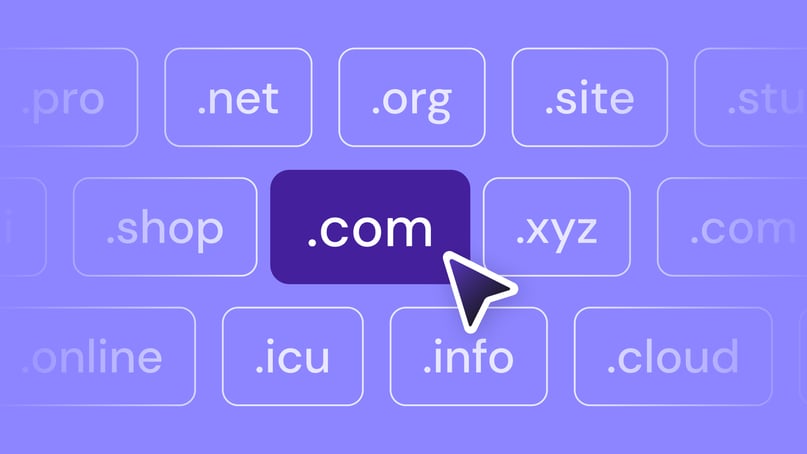
For example, northpeak.com could become northpeak.net, northpeak.co, or northpeak.shop. The ending after the dot is called a domain extension, or top-level domain (TLD).
The extension also shapes what visitors expect from the site. .org points to a cause or public resource, .ai points to an AI product, and .shop or .store points to shopping.
Before registering a domain name alternative, check that the full address is easy to say and spell, and that the matching .com doesn’t send visitors to a competitor.
Check the renewal price before you register, too. Domains renew every year, so the renewal price is the amount you’ll keep paying to use the address after the first-year offer ends.
What are domain name alternatives?
Domain name alternatives are backup web addresses you can use when your first-choice domain is already registered. They work in one of two ways: you either adjust the name itself or keep the name and change the extension.
If you adjust the name, a business called Northpeak could try getnorthpeak.com, northpeakstudio.com, or northpeaknyc.com.
If you keep the name and change the extension, you can use options like northpeak.net, northpeak.co, northpeak.shop, or northpeak.me.
Changing the extension only helps when the original name is worth keeping. A good domain name should be specific enough to match your brand or business, easy to spell, and not so narrow that it limits what you can offer later.
If the name is confusing, hard to say, or tied to one product you may outgrow, a different extension won’t fix it.
Even with a strong name, the extension still affects how quickly people trust the address. .net and .org feel familiar because they’ve been around for decades. Newer endings like .xyz or .online need more support from the rest of the brand, so the name, homepage, design, policies, and offer should make the site feel clear and trustworthy from the start.
1. .net

.net is the closest broad alternative to .com. It started as an extension for network-related sites, which still gives it a light technical feel. Today, it works for software products, agencies, developer tools, blogs, portfolios, and business websites that need a flexible ending.
Use .net when the name before the dot already explains the site. The extension is broad, so it won’t tell visitors much on its own.
The main risk comes from habit. Since people are used to typing .com, someone who hears northpeak.net might enter northpeak.com without thinking. If another company owns that address, they’ll land there instead of on your site.
Open the matching .com before registering .net. If it belongs to a competitor, choose another name or a more specific extension that reduces confusion.
2. .org

The .org extension is the strongest choice for nonprofits, charities, open-source projects, communities, and public-purpose websites. Use it for donation pages, advocacy groups, free learning projects, and open-source software.
Conversely, using .io becomes confusing when the website is a business. If an online store or paid software product uses .org, visitors may expect a nonprofit, free tool, or public resource instead.
For a business website, choose other extensions like .net, .co, .shop, or .store. Those endings make it clearer that the site sells products, offers services, or represents a company.
3. .co

Many businesses use .co as a short form of “company,” making it common in startup and app names, small businesses, and short domain names.
The drawback is how close it looks and sounds to .com. If someone hears your domain in conversation, they might type .com without thinking. When another business owns the .com, that business gets traffic meant for you.
4. .io

.io is a strong choice for software products, developer tools, technical platforms, and browser-based games.
The extension is popular in tech because IO stands for input/output in software. Developers are familiar with the term, so .io feels natural for products built around data, tools, dashboards, APIs, and web apps.
Outside those audiences, .io loses its meaning. A developer dashboard or web game on .io makes sense, but a local bakery or salon doesn’t gain anything from the software or gaming reference.
5. .ai

.ai works best for products built around artificial intelligence (AI), such as an AI writing tool, AI design platform, machine learning product, automation platform, or research lab.
Avoid this extension when AI is only a small part of the product. For example, a standard project management app with an AI summary tool shouldn’t use .ai, because the domain makes the product sound like it’s built around AI.
Choose a broader extension if AI supports the product but doesn’t define it. Visitors should not land on the homepage and feel like the domain promised something bigger than the product delivers.
6. .xyz

The .xyz extension is best for side projects, developer experiments, Web3 brands, and creative projects that don’t need a traditional business ending.
Web3 refers to blockchain-based projects, including crypto tools, token communities, and decentralized apps. You don’t need a Web3 project to use .xyz, but the extension is recognizable to that audience.
Unlike .shop or .ai, .xyz doesn’t tell visitors exactly what the site does. That gives you more naming freedom, but it also means the name before the dot has to carry more meaning.
Use .xyz when the name is already clear or when you’re testing an early-stage idea. pixelmockups.xyz is easier to understand because it suggests a site for design mockups. A vague invented name on .xyz gives visitors almost nothing to work with.
Avoid .xyz for a local service business, ecommerce store, or any site where visitors need quick proof that the brand is established and trustworthy.
7. .online

.online is a broad domain extension for websites where the site is the main place people interact with the brand. Use it for digital services, online courses, remote businesses, portfolios, blogs, and ecommerce projects.
However, .online doesn’t describe what the website does. It doesn’t tell people whether the site sells products, offers services, publishes articles, or represents a local company.
Because of that, the name before the dot needs to be specific. A domain like bostoncleaning.online is clear because “boston cleaning” explains the service and location. A name like brightpath.online is less clear because visitors still don’t know what Brightpath offers.
Choose .online when the full domain makes the website’s purpose clear, or when visitors are meant to buy, book, read, learn, or contact the brand through the site. If the domain name depends on the homepage to explain what the business does, choose a clearer name or a more specific extension.
8. .shop

.shop is for online stores where visitors can browse products, add items to a cart, and buy them on the site, like clothing brands, merch shops, digital download stores, product launches, dropshipping stores, and creators selling physical or digital products.
Don’t use .shop for a service business, portfolio, blog, or company site where the main action is booking a call, requesting a quote, or reading information. Visitors who see .shop will expect to buy products, not services that require discussion first.
9. .store

.store is for brands that want the website to feel like a full online store. This extension is a strong option for product catalogs, boutique retailers, curated collections, creator merch, and brands that sell multiple product types.
Examples include a handmade candle brand, an independent clothing label, or a home goods seller. All of these can use .store since their websites are built around browsing a product range.
That makes .store different from the .shop extension. .shop points directly to buying, while .store gives more room for browsing, comparing products, and presenting a product line.
But like .shop, .store still points to products, so don’t use it for a pure service business unless the domain is for a separate product shop, such as templates, merch, downloads, or physical goods.
Because the .store extension is newer than .com, .net, and .org, visitors may look for extra proof that the website is real before they buy. Show clear product photos, return and shipping policies, customer reviews, secure checkout, and a contact page before someone reaches the payment page.
10. .me
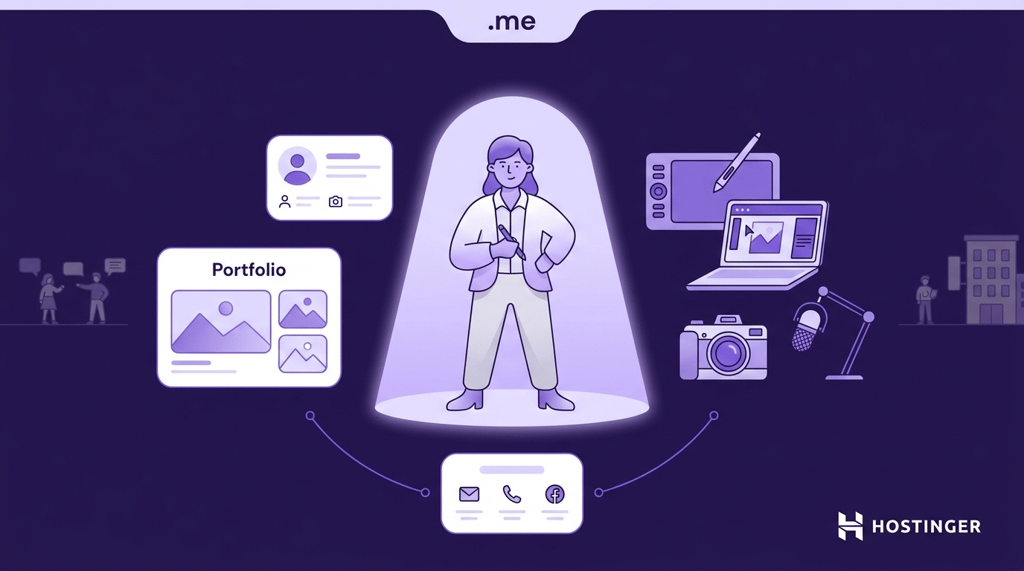
The .me extension is a great choice for portfolios, freelance websites, consultant pages, resume sites, personal blogs, and creator landing pages built around an individual.
A designer, writer, developer, coach, or consultant can use .me when their name or personal brand is the center of the website. For example, a freelance writer named Lyra Winters could use lyrawinters.me for a portfolio, contact page, and writing samples without having to add words like “portfolio” or “official” to the domain.
Avoid .me if the website may grow into a larger brand. A solo consultant can use .me naturally, but an agency, software company, or product brand will outgrow it because the extension still points to an individual.
What are the most important criteria for choosing a domain name alternative?
A domain name alternative should be easy to read, help visitors understand the website, and make sense for your budget long term. The first-year price can be lower than the renewal price, so check what you’ll pay each year after the initial offer ends.
Check these points before registering.
- Name clarity – The full domain should be easy to say, spell, and remember. A short name like northpeak.net is easier to share than trynorthpeakservices.com.
- Website purpose – The extension should match what visitors expect from the site. .shop points to products, .org points to a cause or public resource, and .ai points to artificial intelligence.
- Audience familiarity – Choose an extension your audience understands. Developers recognize .io faster than local service customers. Donors understand .org faster than .xyz.
- Renewal price – Check the yearly domain name cost, not only the first-year offer. The renewal price is what you pay to keep the domain after the discount period ends.
- Typing risk – Check who owns the matching .com. If a competitor owns it, visitors might type the wrong address and land on their site.
- Long-term use – Choose an extension that still fits the website if it grows. .me works for a personal site, but it becomes too narrow for a future agency or company.
If the extension sends the wrong message, choose another one. A nonprofit shouldn’t use .shop. An ecommerce store shouldn’t use .org. A standard app with one AI feature shouldn’t rely on .ai.
How to choose the right domain name alternative
Choose the domain name alternative that matches what the website does and what visitors should expect when they see the address.
| If your priority is… | Choose… |
| A broad alternative to .com | .net |
| A nonprofit, community, or public-purpose website | .org |
| A short domain for a startup, app, or small business | .co |
| A software product, developer tool, technical platform, or browser-based game | .io |
| A product built around AI | .ai |
| A flexible address for an early-stage idea, Web3 brand, or creative project | .xyz |
| A general website where the name explains the purpose | .online |
| An online store built around browsing and checkout | .shop |
| A product catalog, curated collection, or full online store | .store |
| A portfolio, personal brand, or individual professional website | .me |
After you narrow the options, run a domain name search for the exact brand name across the extensions you’re considering. That shows which versions are available before you choose one.
Then say the full domain out loud. It should be easy to repeat and type after hearing it once.
Check the matching .com too. If the .com domain belongs to a competitor, avoid close alternatives like .co or .net, as visitors might mistype the address and reach their site instead.
Domain Name Checker
Instantly check domain name availability.
How to register your domain name alternative
After choosing a domain name alternative, register the exact address through your chosen domain registrar, such as Hostinger, and connect it to your website.
- Search for the full domain. Enter the exact domain you want, such as northpeak.net, into the registrar’s search tool.
- Review the price before checkout. Check the first-year price, renewal price, registration period, and privacy protection options before you pay.
- Register the domain. Create or sign in to your account, add your contact details, and complete the registration.
- Connect the domain to your website. After buying a domain name, connect it to hosting, set up email if needed, and open the domain in a browser. The correct website should load.
- Redirect close variants if you own them. If your main domain is northpeak.co and you also own northpeak.com, redirect the .com to the .co site so visitors reach the right website.
Managing your domain is simpler when registration, DNS settings, hosting, and email are in the same account. With Hostinger, you can search for alternatives when .com is taken, register the extension you choose, connect it to hosting, and set up business email from hPanel.
Eligible new annual hosting plans also include a free domain for the first year, which lowers the starting cost.
All of the tutorial content on this website is subject to Hostinger's rigorous editorial standards and values.

Alma is an AI Content Editor with 9+ years of experience helping ideas take shape across SEO, marketing, and content. She loves working with words, structure, and strategy to make content both useful and enjoyable to read. Off the clock, she can be found gaming, drawing, or diving into her latest D&D adventure.