What is domain privacy? Is domain privacy worth it?
Oct 08, 2026
/
By Bruno S. & Klaudijus J.
/
7 min Read
Domain privacy is a registrar service that keeps your name, home address, phone number, and email address out of public domain registration records. For most personal and small-business domains, it’s worth enabling – especially when the registrar includes it at no extra cost.
The registrar still stores your real details and only changes what shows up in public lookups, hiding your contact info or replacing it with a substitute address. Domain privacy reduces spam, scam messages, and social-engineering risk, but it doesn’t encrypt website traffic, prevent domain hijacking, or secure your registrar account.”Hostinger enables it automatically for supported extensions.
What is domain privacy?
Domain privacy is a registrar service that limits public access to a domain registrant’s contact details. It is also called WHOIS privacy or domain privacy protection.
Enabling privacy does not affect who owns the domain or how it functions. The registrar holds your accurate contact information on file and only changes what shows up when someone looks up the domain.
How does domain privacy work?
Domain privacy works by separating the contact details you give your registrar from the details the public can see. The process has three steps:
- You submit accurate contact details as part of the domain registration process – this is required whether or not you enable privacy.
- The registrar stores your details and replaces or hides them in public registration queries.
- A proxy or forwarding address lets legitimate messages reach you without exposing your personal email.
Your registration data can still be disclosed in response to valid legal, regulatory, or abuse requests. Privacy doesn’t make your details invisible to your registrar, the relevant registry, or law enforcement.
The Registration Data Access Protocol (RDAP) replaced WHOIS as the standard for generic top-level domain (gTLD) registration data in January 2025. The WHOIS name is still widely used, and many lookup tools and country-code registries continue to rely on it.
What information does domain privacy hide?
Domain privacy hides the registrant’s name, address, phone number, and email address from public registration records.
When privacy is active, those fields show hidden information, registrar information, or a proxy address instead. Anyone who performs a WHOIS lookup will still see the registration and expiration dates, current status, registrar name, and nameservers.
Here is a simplified example of a public registration record with and without domain privacy:
Field | Without domain privacy | With domain privacy |
Registrant name | Alex Smith | [Redacted for Privacy] |
Email address | alex@domain.tld | proxy@registrar-domain.tld |
Phone number | +1.5551234567 | [Redacted for Privacy] |
Address | 123 Oak St, Portland, OR, US | [Redacted for Privacy] |
Privacy changes only the contact fields; details like registration dates, status, registrar, and nameservers stay public either way.
Is domain privacy worth it?
Yes, domain privacy is worth enabling for most individual registrants and small-business owners. It matters most when registering with a home address, personal phone number, or personal email that you would not otherwise make public.
When the registrar includes privacy at no extra cost, enabling it is an easy default, since it does not affect how your domain functions.
Who needs domain privacy?
Anyone who doesn’t want their home address, phone number, or personal email tied to a public domain record benefits from domain privacy. That includes:
- Personal website owners keep their home address and personal email out of public registration records.
- Bloggers and content creators reduce unwanted contact from marketers and readers who find their registration details.
- Freelancers and independent contractors keep personal contact details separate from client-facing information.
- Developers and technical users reduce unnecessary exposure of personal data for domains used in side projects or testing.
- Startups and home-based businesses avoid having a residential address appear as their business contact.
- Journalists and advocates reduce the risk of personal information being exposed to bad actors.
When might domain privacy be unnecessary?
Domain privacy provides less practical value when the same business contact information is already intentionally public through a website, business directory, or official registration.
Some registries, particularly for country-code top-level domains (ccTLDs), already restrict the public display of personal data by default. For domain extensions whose registries already restrict public personal data, domain privacy may provide little additional benefit.
Even if a business address is already public, privacy can still keep your domain registration contact separate from everyday business communications. Keeping domain registration contact details private reduces exposure to domain-specific spam and fraudulent renewal messages.
What are the benefits of domain privacy?
Domain privacy provides three main benefits: limiting personal data exposure, reducing unsolicited contact, and lowering social engineering risk.
Domain privacy limits personal-data exposure
Domain privacy prevents a direct public association between a domain name and the registrant’s personal contact details.
A home-based business owner, for example, would otherwise have their residential address appear in publicly searchable registration records for anyone who looks up the domain.
This does not make the registrant anonymous – the registrar, the relevant registry, and regulators retain access to the accurate details. What changes is the information available to the general public.
Domain privacy reduces spam and scam messages
WHOIS privacy reduces spam by masking the contact details that marketers and automated tools collect from public registration records.
Masking the contact details reduces direct collection. Forwarding services do not block every unwanted message, but they eliminate the most direct path to your personal inbox.
Domain privacy lowers social engineering risks
Domain privacy reduces the risk of social engineering by limiting the personal details attackers can use for phishing, impersonation, doxxing, and account recovery attempts.
Masking the registrant’s name, address, and email raises the effort required for these approaches, but domain privacy does not directly prevent domain hijacking.
Strong passwords, two-factor authentication, registrar locks, and steps to strengthen your email security reduce the account-takeover methods that most often lead to domain hijacking.
What does domain privacy not protect?
Domain privacy limits what appears in public registration directories; it does not provide broader security or anonymity. Specifically, domain privacy does not:
- Make the registrant invisible to the registrar, registry, regulators, or law enforcement.
- Encrypt website traffic or protect data transmitted to your site.
- Block malware, bots, contact-form spam, or distributed denial-of-service (DDoS) attacks.
- Secure the registrar account or prevent unauthorized domain transfers on its own.
- Remove previously public details from historical WHOIS databases.
If your contact details were public before you enabled privacy, historical records in third-party databases may still surface them.
Is domain privacy available for every domain?
Domain privacy availability depends on the top-level domain (TLD) and the policies of the registry that manages it. Some registries prohibit privacy services entirely; others restrict how personal data appears in public directories by default.
Privacy availability is worth verifying before purchase, since rules on how top-level domains differ affect what is available to registrants.
Country-code top-level domains follow their respective registry policies, which vary significantly. Generic top-level domains are governed by ICANN’s Registration Data Policy.
Always confirm eligibility for a specific extension before completing a domain purchase.
How do privacy rules affect domain registration data?
Privacy laws and registry policies determine which registration contact details appear publicly when a domain is looked up.
Registrants must still submit accurate information when registering a domain – hidden public records do not remove the obligation to provide correct details to the registrar. The registrar stores this data and uses it to manage the domain and respond to legitimate disclosure requests.
For generic top-level domains, the current framework is ICANN’s Registration Data Policy, effective August 21, 2025. It replaced the Interim Registration Data Policy that defined how registration data was handled after the General Data Protection Regulation (GDPR) was introduced in 2018.
The policy establishes how registrars and registry operators collect, process, and publish registration data, including the handling of personal information in RDAP responses.
Country-code domains follow the policies of their respective registry operators, which fall outside ICANN’s policy for gTLDs.
How much does domain privacy cost?
Domain privacy cost varies by registrar. Some include it at no charge; others sell it as a recurring add-on at around $10 per year.
When evaluating registrars, check both the first-year and renewal prices for privacy separately from the domain registration fee. An introductory offer that skips the privacy fee may charge for it at renewal.
Hostinger includes privacy protection at no extra cost for supported domain extensions, which keeps the full cost of registering and renewing a domain lower than registrars that charge separately.
How to choose a domain privacy provider
Choose a registrar that offers privacy for your TLD, keeps it free at renewal, and forwards proxy email reliably. Privacy is sold as a registrar add-on, not a standalone service. When you compare domain registrars with privacy protection, weigh these factors:
- Privacy availability – whether the service is supported for your specific TLD. Coverage varies by registrar, and not all extensions allow it.
- First-year and renewal pricing – the initial year is often free or discounted. Check the renewal price separately, since some registrars charge for privacy after the promotional period.
- Email forwarding – privacy services replace your email with a proxy address and forward incoming messages. Confirm that forwarding is included and reliable.
- Disclosure terms – registrars are required to share registration data in response to valid legal requests. Know what conditions trigger disclosure and how your registrar handles them.
- Account security features – two-factor authentication, registrar locks, and a strong password protect your domain regardless of privacy status.
Free privacy is worth prioritizing once you’ve confirmed it’s available for your TLD, the renewal pricing is transparent, and the registrar’s account security holds up on its own.
How to enable domain privacy on Hostinger
Hostinger includes domain privacy protection at no extra cost for supported domain extensions.
Enable domain privacy when registering a new domain
For supported TLDs, Hostinger enables privacy protection automatically when you register a new domain. No additional steps are needed.
Privacy protection appears in the checkout summary for eligible extensions, so you can confirm it is included before completing your order.
Hostinger’s domain search lets you register a domain and verify that privacy is included for your chosen extension before checkout.
Enable domain privacy for an existing domain
To enable domain privacy for a domain already registered with Hostinger:
- Log in to Hostinger dashboard.
- Click Domains in the left sidebar.
- Click Manage next to the domain.
- Select Domain Ownership from the left menu.
- Under Privacy settings, select Protected.
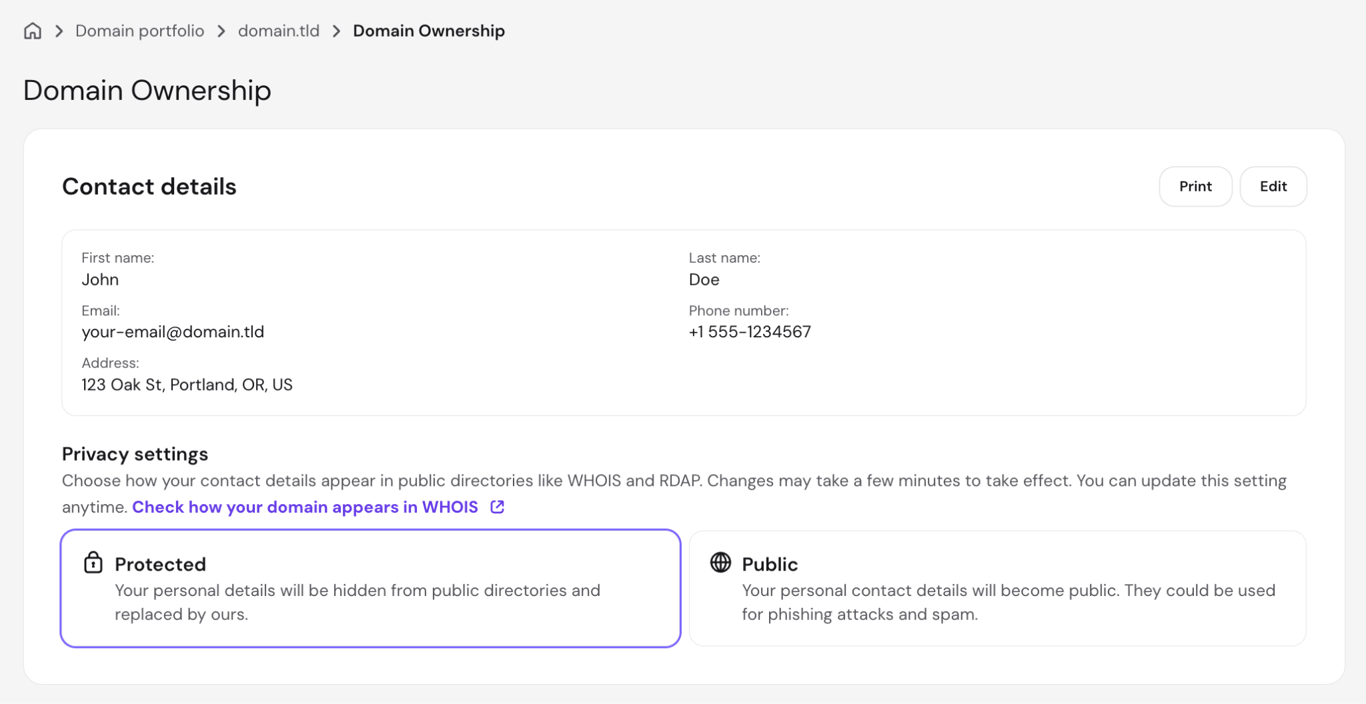
Changes to public registration records can take up to 24 hours to appear in WHOIS.
What is the difference between domain privacy and domain security?
Domain privacy hides your contact details from public directories. It does not block unauthorized domain transfers or changes to your settings.
Hostinger’s Domain Shield security add-on is an optional premium feature ($9.99/year) that requires a one-time password to approve high-risk actions: domain transfers, nameserver changes, privacy-setting changes, and registrant-detail updates. It also extends your renewal window by up to 40 days and keeps your DNS active during the grace period. [/protip]
Domain Name Checker
Instantly check domain name availability.
What to do after protecting your domain
Verifying ownership, connecting hosting, configuring email, enabling auto-renewal, and securing your registrar account come next – domain privacy only covers part of what to do after registering your domain.
- Verify domain ownership. Your registrar sends a verification email after registration. Confirming it keeps your domain active and meets ICANN requirements.
- Connect the domain to hosting. Point your DNS records to your hosting provider, or add the domain to an existing hosting plan, to make the domain serve a live website.
- Configure email. Set up MX records so the domain handles incoming mail. Most hosting control panels, including Hostinger dashboard, handle this in a few clicks.
- Enable auto-renewal. A domain that expires without renewal can be claimed by someone else. Auto-renewal prevents accidental loss.
- Secure your registrar account. Use a strong, unique password and enable two-factor authentication. Your registrar account controls nameservers, ownership records, and transfer locks.
Artikel ini merupakan versi setempat bagi What is domain privacy? Is domain privacy worth it?, asalnya diterbitkan dalam bahasa Inggeris.
All of the tutorial content on this website is subject to Hostinger's rigorous editorial standards and values.

Bruno is a Content Writer at Hostinger, focused on creating and optimizing helpful, engaging articles about web development and marketing. With a background in journalism, he combines storytelling with practical insights to make complex topics easier to understand. He has also contributed to publications like MacMagazine and Jornal A Tarde. Outside of work, Bruno enjoys exploring art, cooking, and technology.

As Hostinger's Head of Domains, Klaudijus Januitis is a product leader but also a customer advocate ensuring the product meets user needs. He works closely with engineering, design, and marketing teams to develop and adapt the product and ensure alignment between product strategy and company goals. Klaudijus is also skilled in building relationships with registries and resellers to support joint marketing efforts and ensure successful partnerships. Follow him on LinkedIn.