What is an AI agent memory?
Sep 11, 2026
/
By Ksenija
/
7 min Read
AI agent memory is the information an AI agent stores and retrieves while completing a task or interacting with users.
The stored information allows the agent to maintain context, make decisions based on previous events, and continue working without treating every interaction as completely new.
An AI agent can remember many kinds of information depending on its purpose. Short-term memory helps the agent keep track of the current conversation or workflow, while long-term memory stores information that remains useful across multiple sessions, such as user preferences, past interactions, or recurring tasks.
A customer support agent, for example, can remember that a user has already verified their identity and described the problem earlier in the conversation.
The agent uses that information throughout the support session, allowing the conversation to progress naturally without asking for the same details again.
What are the different types of AI agent memory?
The four main categories of AI agent memory are working, episodic, semantic, and procedural memory.
Each serves a distinct role, and together they enable AI agents to maintain context, learn from previous interactions, and complete complex tasks efficiently.
Working memory
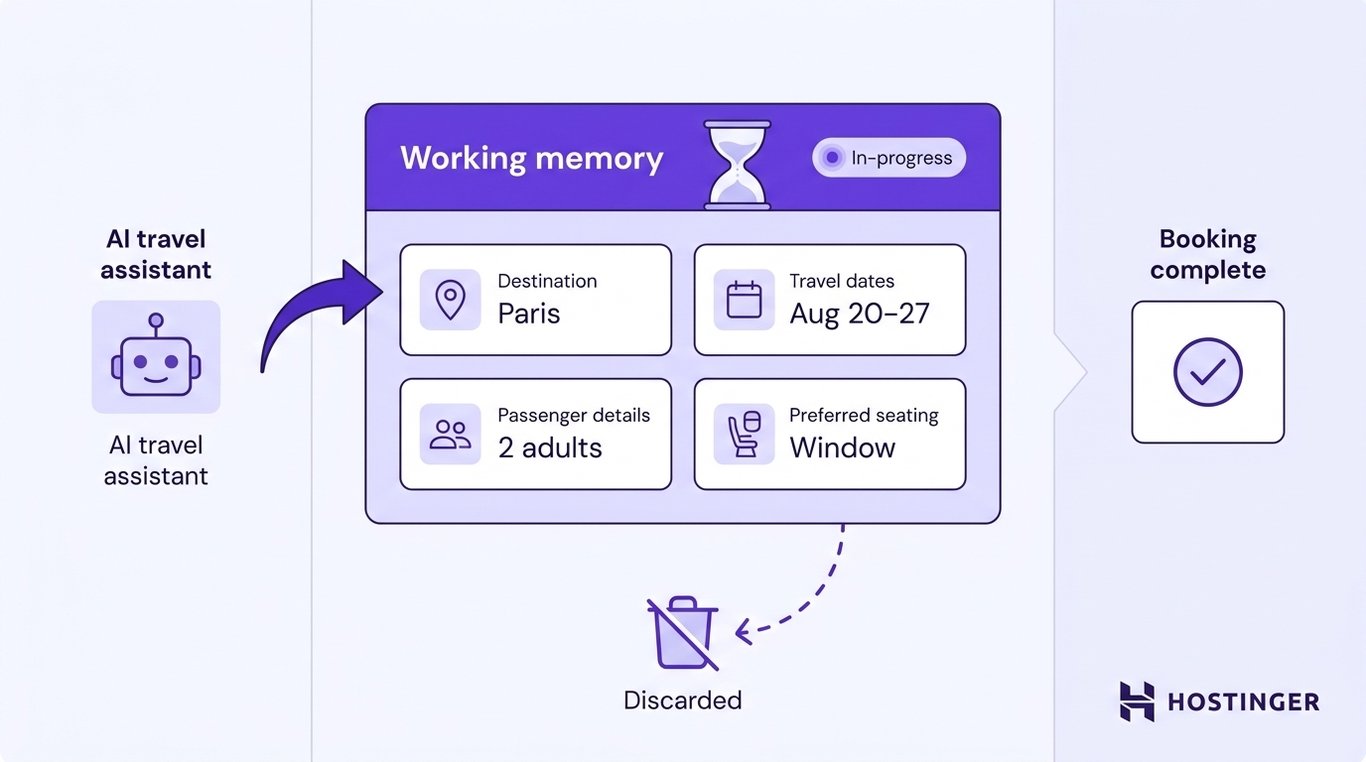
Working memory stores the information an AI agent needs to complete the current task or conversation.
It acts as the agent’s temporary workspace, keeping track of information currently in use while the task is in progress.
The contents of working memory change continuously as new information becomes available. Depending on the application, it may store the recent conversation, user instructions, temporary variables, intermediate reasoning steps, or the results of previous actions.
Once the task is complete, the information is typically discarded because it is no longer needed.
For example, an AI travel assistant helping a user book a flight keeps track of the chosen destination, travel dates, passenger details, and preferred seating while searching for available flights.
The agent uses that information throughout the booking process, but it does not need to retain it after the booking has been completed unless another memory system stores it for future use.
Episodic memory
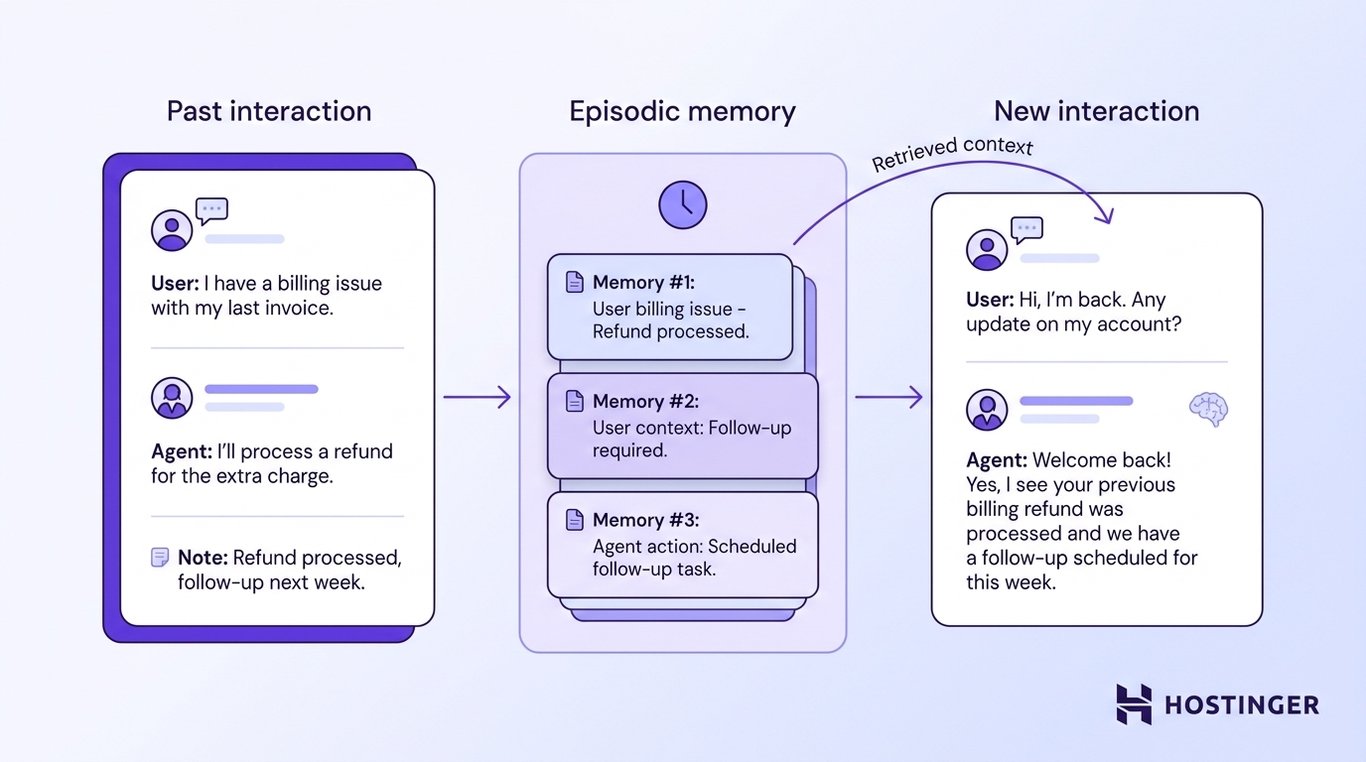
Episodic memory stores records of specific past events that an AI agent can refer to in future interactions.
Each memory captures a particular experience, such as a previous conversation, a completed task, a decision that was made, or the outcome of an action.
Unlike working memory, episodic memory persists after the current task ends. The agent can retrieve those past experiences to understand what has already happened, avoid repeating work, or continue an ongoing process from where it left off.
An AI customer support agent, for instance, may remember that a customer previously contacted support about a billing issue, received a refund, and was asked to monitor the next invoice.
When the customer returns, the agent can continue the conversation from that context rather than treating the issue as a completely new request.
Semantic memory
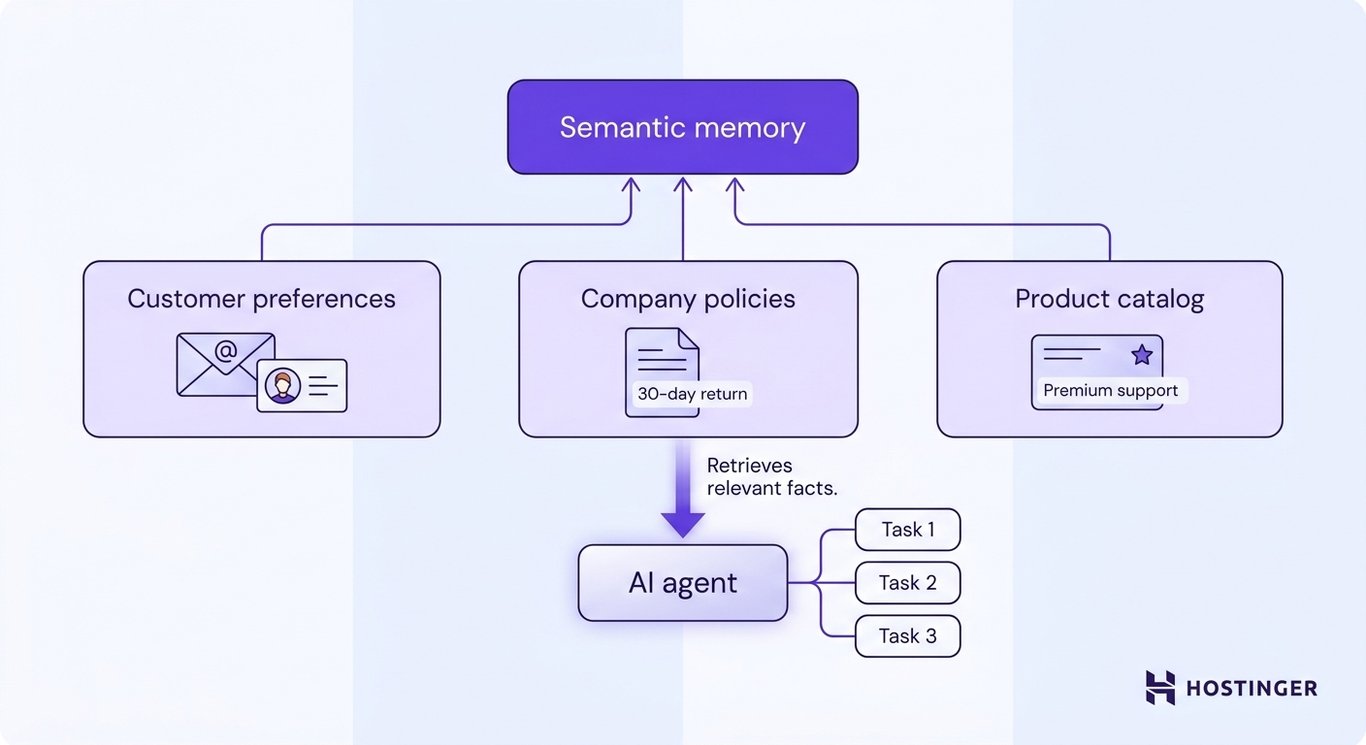
Semantic memory stores long-term factual knowledge that an AI agent can use across multiple tasks and conversations.
Rather than recording individual experiences, it stores information that remains true regardless of when or where the agent uses it.
The information stored in semantic memory depends on the application. It may include customer preferences, company policies, product catalogs, user profiles, technical documentation, or industry-specific knowledge.
Because this information changes less frequently than the current task, the agent can retrieve it as needed without relying on previous conversations.
An AI customer support agent may know that a customer prefers to be contacted by email, that refunds are only available within 30 days of purchase, and that a particular software subscription includes premium support.
The agent applies those facts whenever they are relevant, regardless of whether they were discussed in the current conversation.
Procedural memory
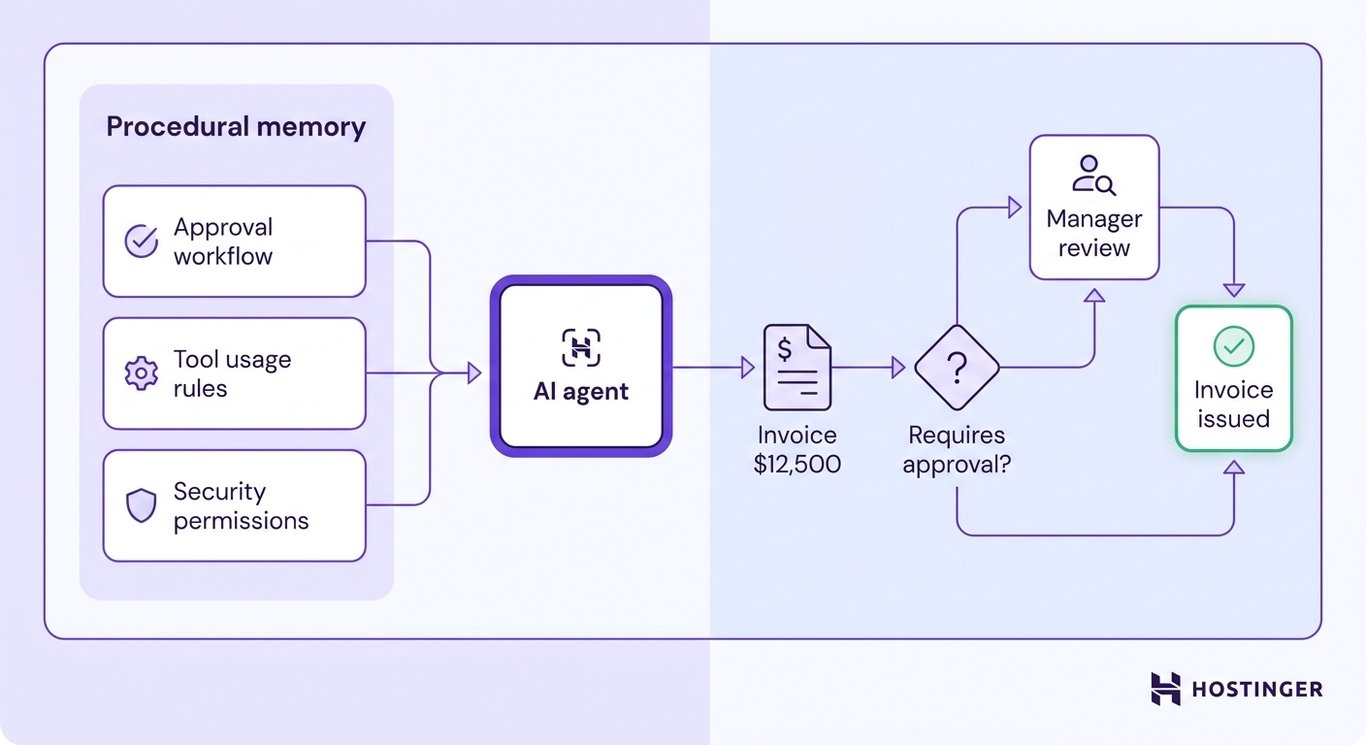
Procedural memory stores the instructions and rules an AI agent follows to perform tasks. It defines how the agent should execute actions, use tools, and follow established agentic workflows.
Depending on the application, procedural memory may include business processes, approval workflows, tool usage instructions, security permissions, or execution rules.
By storing operational knowledge separately from factual knowledge, the agent can perform tasks consistently while following the same procedures every time.
A finance assistant may follow a rule that requires manager approval before sending an invoice for an amount above a certain threshold.
Even if all the invoice details are correct, the agent follows the required approval workflow before completing the task.
How does AI agent memory work?
The memory lifecycle consists of four stages: extracting important information, storing it in an appropriate memory system, retrieving relevant memories when needed, and consolidating memory to keep it accurate and up to date.
1. Extract relevant information
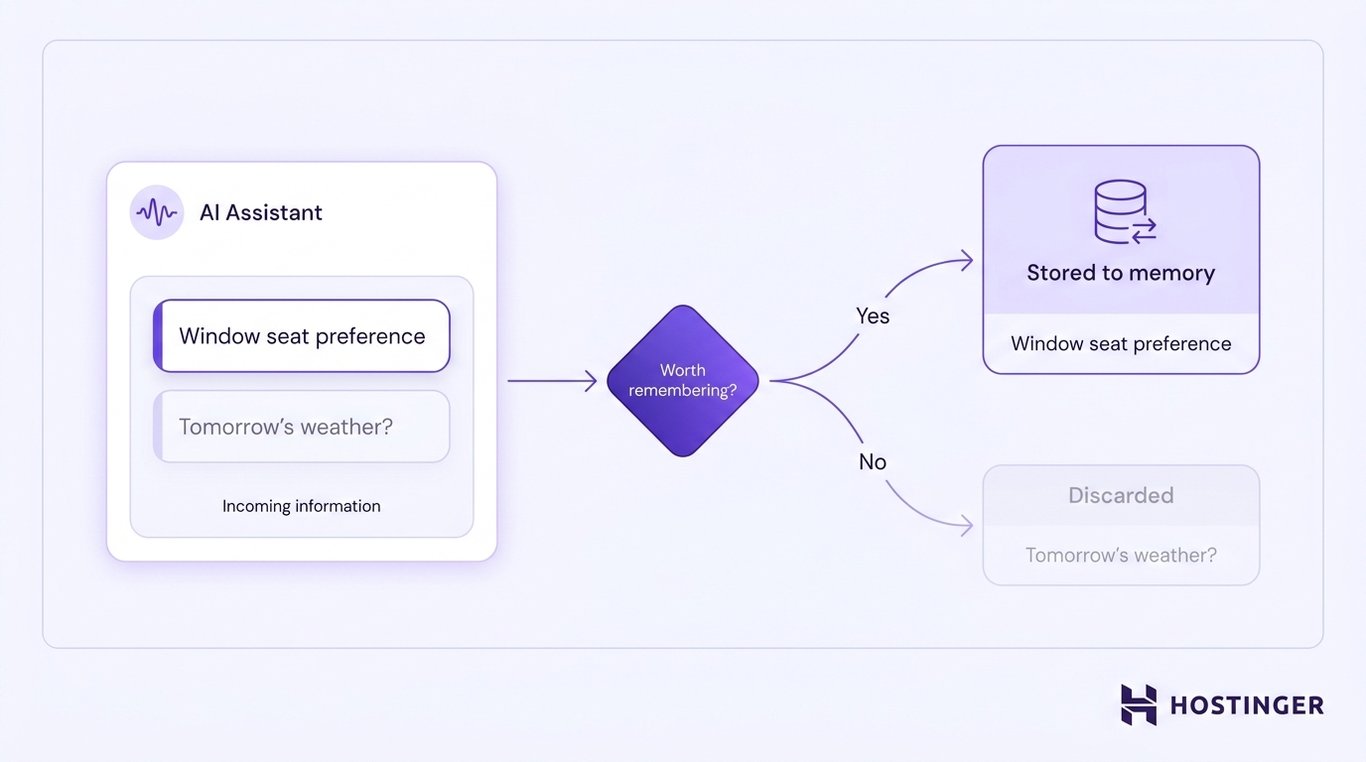
The memory lifecycle begins by identifying information that is worth remembering. During every interaction, the agent evaluates the incoming information and decides whether it will be useful beyond the current task.
Only information that may improve future decisions or interactions is selected for storage.
The agent may extract user preferences, completed actions, important facts, corrections, long-term instructions, or other information that remains valuable over time.
Temporary details that are only relevant to the current conversation stay in working memory and are discarded when the task is complete.
Let’s say a user tells an AI travel assistant they always prefer window seats on flights. Because that preference is likely to be useful again, the agent stores it for future bookings.
Asking about tomorrow’s weather, on the other hand, does not create a permanent memory because the information is only relevant to the current conversation.
2. Store the information
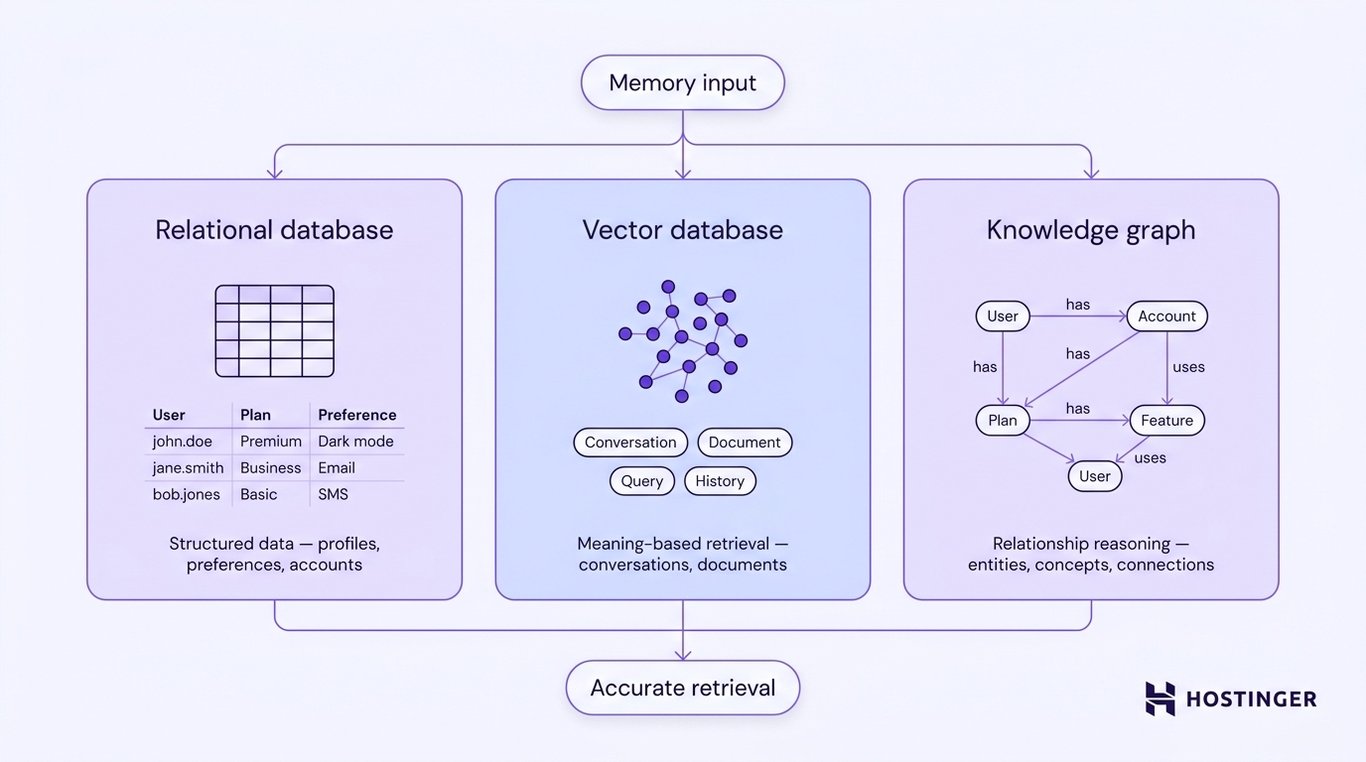
After identifying information worth remembering, the agent stores it in a memory system where it can be retrieved during future tasks or conversations.
The storage method depends on the type of information being saved and how the agent is expected to use it.
Relational databases organize structured information such as user profiles, account details, and preferences.
Vector databases store information in a way that allows the agent to retrieve content based on meaning rather than exact keywords, making them well-suited for conversation history and unstructured documents.
Knowledge graphs represent relationships between people, concepts, and entities, helping agents reason about connected information.
Each storage method serves a different purpose. By storing information in the most appropriate system, the agent can retrieve relevant memories more accurately and efficiently when they are needed.
3. Retrieve relevant memories
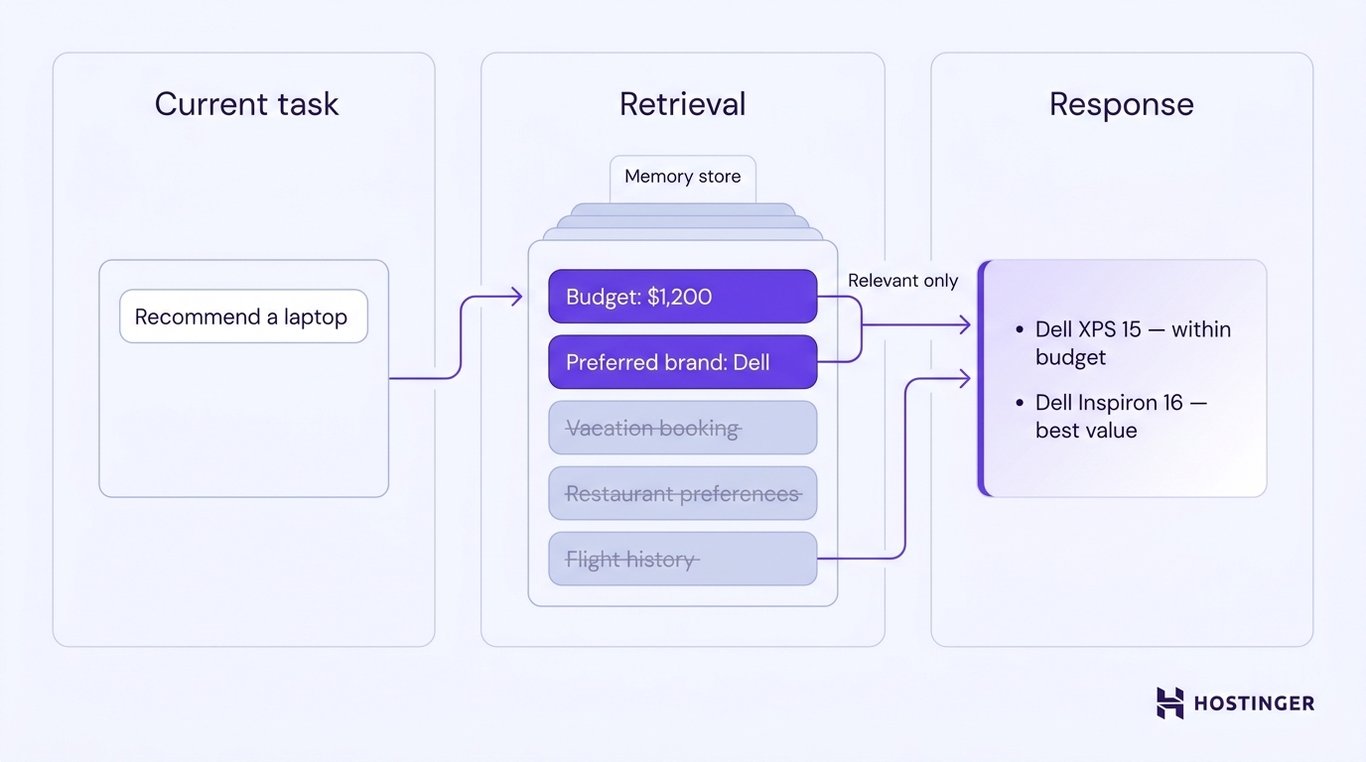
Before performing a task or generating a response, the agent retrieves only the information that is relevant to the current situation.
It searches for the facts, experiences, or instructions that can help complete the task more effectively.
The retrieval process prioritizes relevance over quantity. The agent may use the user’s request, the current conversation, or the task itself to identify which memories are likely to be useful.
Limiting retrieval to relevant information helps the agent produce more accurate responses while avoiding unnecessary context that could slow processing or introduce irrelevant details.
For example, if a user asks an AI shopping assistant to recommend a new laptop, the agent may retrieve the user’s preferred budget, favorite brands, and previous purchases.
It does not need to retrieve unrelated information, such as an earlier conversation about booking a vacation, because it has no bearing on the current request.
4. Update and consolidate memories
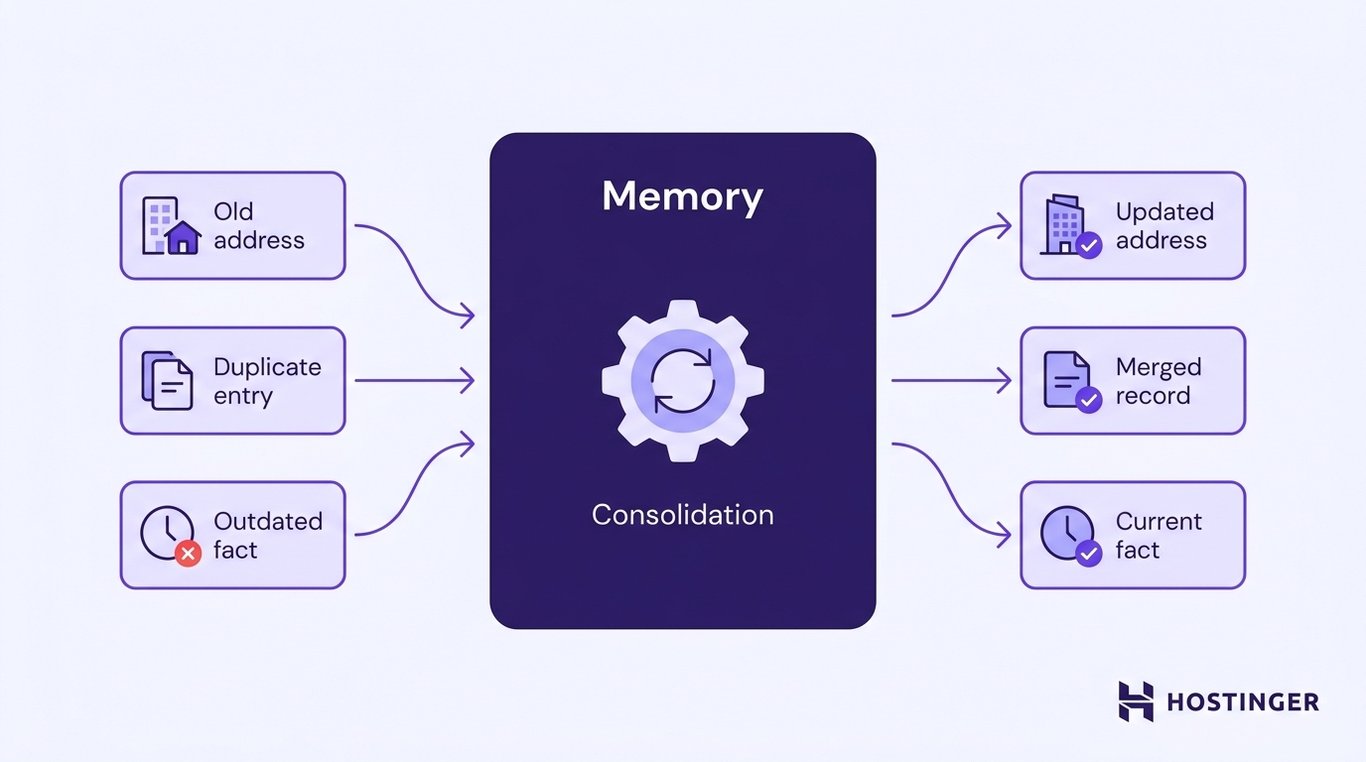
Consolidation is the process of updating and organizing an AI agent’s memory over time. As new information is stored, the agent modifies existing memories to keep them accurate, consistent, and relevant for future tasks.
The consolidation process may involve updating user preferences, replacing outdated facts, merging duplicate memories, or resolving conflicting information.
So, if a user changes their preferred shipping address or communication method, the newer information replaces the older record, so future interactions reflect the latest preference.
Memory is not intended to grow indefinitely. Removing obsolete information and maintaining accurate records helps the agent retrieve more relevant memories, avoid contradictions, and continue making reliable decisions as its knowledge evolves.
Why do AI agents need memory?
AI agents need memory because many tasks cannot be completed using only the current prompt or conversation.
While large language model (LLM) agents generate responses based on the information they receive at that moment, they often need to remember previous interactions, user preferences, completed actions, or ongoing tasks to make consistent decisions over time.
Memory allows an AI agent to carry information from one interaction to the next. Without it, the agent would treat every conversation as a new request, requiring users to repeat information and preventing the agent from continuing long-running tasks or personalizing its responses.
Memory becomes even more important as AI agents take on complex, multi-step workflows. Planning projects, managing customer relationships, coordinating business processes, and using external tools all require the agent to retain information beyond a single interaction.
By preserving relevant context over time, memory enables AI agents to work more efficiently and provide a more consistent user experience.
AI agent memory vs RAG: what’s the difference?
AI agent memory stores and updates information over time, allowing an agent to remember previous interactions and maintain context.
Retrieval-augmented generation (RAG) retrieves information from an external knowledge source to improve the accuracy of a response, but it does not modify or remember that information.
The table below highlights the main differences between AI agent memory and RAG:
Feature | AI agent memory | RAG |
Purpose | Maintain long-term context | Ground responses with external knowledge |
Reads stored information | Yes | Yes |
Writes new information | Yes | No |
Personal to the user or agent | Yes | Usually no |
Changes over time | Yes | Only when the knowledge source is updated |
Typical use | Preferences, conversation history, workflows | Documentation, manuals, product catalogs, knowledge bases |
In practice, AI agents often use both technologies together. Memory provides continuity across interactions, while RAG supplies the external knowledge needed to answer questions that cannot be resolved from memory alone.
Many real-world AI agent examples follow this pattern. An AI IT assistant can remember a company’s infrastructure, previous incidents, and administrator preferences while using RAG to retrieve the latest troubleshooting guides and software documentation.
What challenges come with AI agent memory?
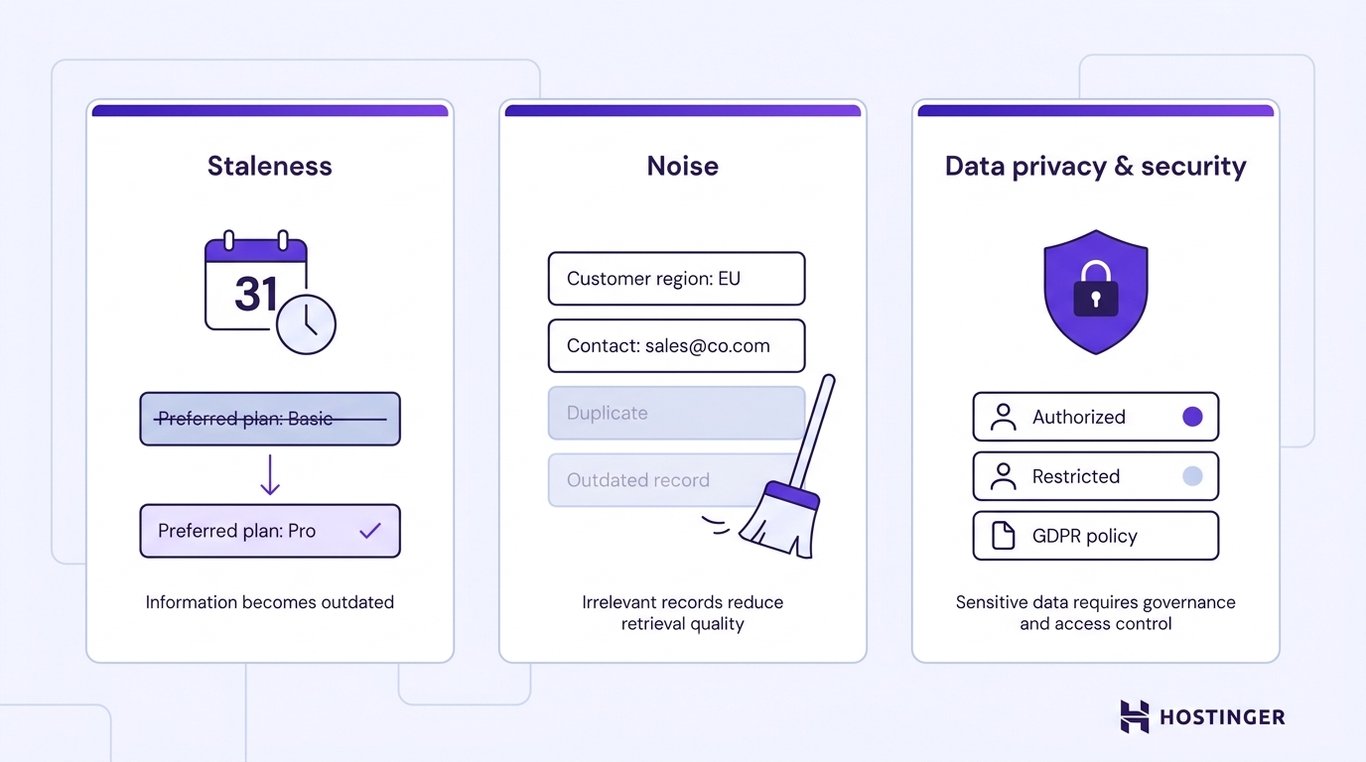
AI agent memory introduces three main challenges: keeping stored information up to date, retrieving only relevant memories, and securely managing sensitive data.
As an agent stores more information over time, each of these becomes more difficult to manage.
Outdated memories
Staleness occurs when information stored in memory no longer reflects reality. User preferences change, company policies are updated, products are discontinued, and business data becomes outdated.
If the agent continues to rely on outdated information, its decisions and responses become less accurate.
For instance, an AI sales assistant that remembers a customer’s preferred pricing plan may recommend the wrong offer if the customer has since upgraded their subscription.
Similarly, an AI HR assistant may provide outdated guidance if company leave policies have changed since they were first stored.
Regularly updating stored information helps ensure the agent continues making decisions based on current facts.
Irrelevant and duplicate memories
Noise is the accumulation of unnecessary, duplicated, or low-value information that makes an AI agent memory less effective.
As memory grows, irrelevant records can make it harder for the agent to retrieve the information that actually matters.
Noise can take many forms, including duplicate memories, outdated records, conflicting information, or details that are no longer relevant to the agent’s tasks.
If left unmanaged, these records reduce retrieval quality by increasing the likelihood that the agent retrieves incomplete, outdated, or irrelevant information.
Memory maintenance helps prevent this problem. Regularly removing obsolete records, merging duplicates, and prioritizing high-value information keeps memory organized and improves the accuracy of future retrievals.
Data privacy and security
AI agent memory often contains personal, financial, or business information that must be protected throughout its lifecycle.
As agents store more information over time, organizations need to ensure that sensitive data is accessible only to authorized users and handled in accordance with privacy requirements.
To address this challenge, organizations establish governance policies that define how long information is retained, who can access it, when it should be deleted, and how it complies with regulations such as GDPR or other privacy frameworks.
Clear governance also helps prevent the agent from exposing sensitive information during future interactions.
Do you need to build an AI agent memory yourself?
Not always. Building an effective memory system involves much more than storing information.
Developers must decide what the agent should remember, when to update or remove memories, how relevant context should be retrieved for each task, and how sensitive information should be protected throughout its lifecycle.
For many organizations, a managed AI solution is a more practical choice. Instead of building memory systems from scratch, businesses can use AI tools that already manage context and support complex, multi-step workflows.
Hostinger Agent offers a team of specialized AI assistants for tasks such as business planning, content creation, SEO, marketing, sales, legal document drafting, and customer communications.
The underlying memory and context management are handled for you, allowing the agent to maintain continuity across conversations and deliver more relevant responses without requiring you to build or maintain the supporting infrastructure.
Artikel ini merupakan versi setempat bagi What is an AI agent memory?, asalnya diterbitkan dalam bahasa Inggeris.
All of the tutorial content on this website is subject to Hostinger's rigorous editorial standards and values.

Ksenija is a digital marketing enthusiast with extensive expertise in content creation and website optimization. Specializing in WordPress, she enjoys writing about the platform’s nuances, from design to functionality, and sharing her insights with others. When she’s not perfecting her trade, you’ll find her on the local basketball court or at home enjoying a crime story. Follow her on LinkedIn.