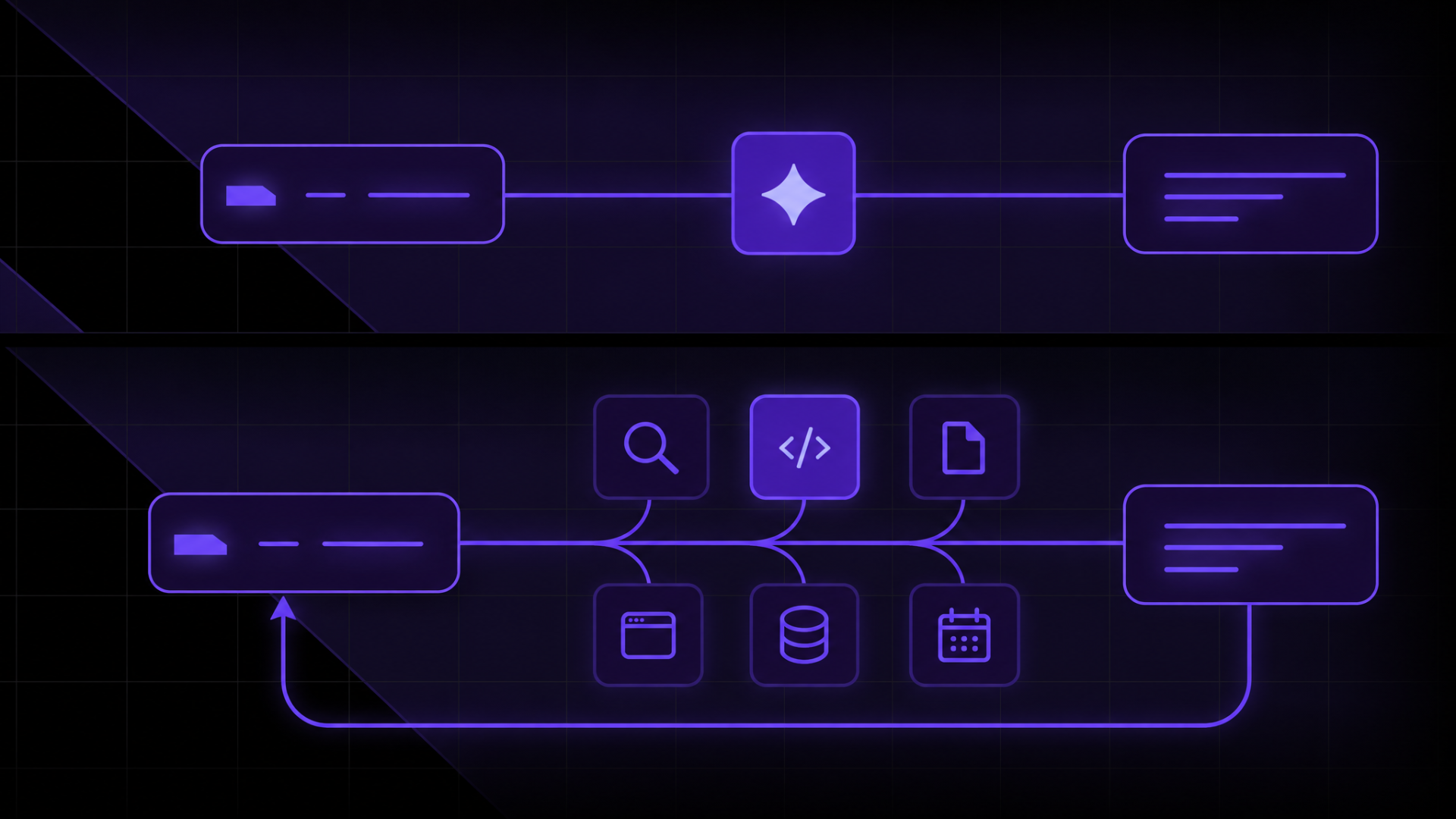
Agentic AI plans and carries out multiple actions toward a goal, whereas traditional AI performs a defined task and returns a specified output.
A traditional AI system’s job ends with the result the task calls for. An agentic system can use that result as a step in a larger process, interact with connected tools, assess the outcome, and adjust its next action.
Traditional AI works well for focused tasks such as prediction, classification, and recommendation. Agentic AI is better suited to multi-step work such as resolving support cases, coordinating inventory replenishment, or troubleshooting technical problems across multiple systems.
What is agentic AI?
Agentic AI is an AI system that can pursue an objective through multiple actions, deciding what to do next based on the information and results it receives along the way.

The ability to continue planning and acting toward a goal distinguishes agentic AI from traditional AI, which is designed to return a defined output for a specific task.
An AI agent operates within the tools, permissions, and rules it has been given. It breaks a goal into steps, uses connected systems to carry them out, evaluates what happened, and adjusts subsequent actions when necessary.
Planning and executing actions separates agentic AI from generative AI, even when an agent uses generative AI as part of its work. The distinction is content generation versus task execution: generative AI produces content, whereas agentic AI determines and carries out the actions needed to pursue a goal.
What is traditional AI?
Traditional AI refers to rule-based systems and task-specific machine learning models designed to perform a predefined function, such as classifying information, making predictions, generating scores, or recommending actions.

Rule-based systems follow predefined logic, whereas machine learning models learn patterns from data and apply them to new inputs.
Unlike ordinary automation, which runs a fixed sequence of steps, traditional AI makes a judgment about its input, such as assigning a ticket category or a fraud risk score.
How do agentic AI and traditional AI differ?
Agentic AI and traditional AI differ in how they adapt to changing conditions, use tools, involve people, handle failures, and incur costs.
Traditional AI follows the task and process it was designed for. Agentic AI has more control over how the work gets done, including which actions to take and how to respond when conditions change.
Here’s a quick agentic AI vs. traditional AI comparison.
Traditional AI | Agentic AI | |
Purpose | Performs a defined task | Works toward an objective that may require multiple tasks |
Autonomy | Operates within a predefined function | Selects and performs permitted actions based on context |
Planning | Follows a fixed process to return its specified output | Determines and revises a sequence of actions |
Adaptation | Adjusts outputs based on rules, its model, or new input | Evaluates intermediate results and changes subsequent actions |
Tool use | May supply an output to software or another workflow | Uses connected tools, services, and models to advance the task |
Human involvement | Humans define the task and decide how to use its output | Humans set goals, access, boundaries, approvals, and escalation rules |
Typical outputs | Prediction, classification, score, recommendation, or optimized result | Completed workflow, performed actions, escalation, or goal-oriented result |
Evaluation | Measured against a defined output metric | Requires evaluation of outcomes, actions, failures, and policy compliance |
Best suited for | Narrow, repeatable analytical or decision-support tasks | Variable, multi-step work where the next action depends on earlier results |
Agentic AI vs. traditional AI: Adaptation
Traditional AI → conditions change → the output changes, but the assigned task stays the same.
Agentic AI → conditions change → the plan changes, but the objective stays the same.
Traditional AI can respond to changing data without changing the task it performs. New information may produce a different forecast, classification, or recommendation, but the system still works toward the same predefined output.
Agentic AI can revise the route to an outcome. When an action fails or produces an unexpected result, the system can reassess the situation and choose another permitted step.
Traditional AI adaptation example: An ecommerce company uses AI to forecast demand before ordering stock for the holiday season. Early sales come in much higher than expected, so the model incorporates the new data and raises its forecast from 5,000 to 7,000 units. It has adapted to changing conditions by revising the result of the same forecasting task.
Agentic AI adaptation example: The same company needs 5,000 units in stock for the holiday season. Its agent initially plans to order them through the usual supplier. Early sales come in much higher than expected, raising the estimate to 7,000 units. The usual supplier cannot provide the additional stock in time, so the agent revises its plan: it checks approved suppliers, splits the order between two that can meet the deadline, and updates the replenishment schedule. It has adapted by changing the path to the goal.
Agentic AI vs. traditional AI: Tool use and system interaction
Traditional AI → a predefined process determines which tools and systems the workflow uses.
Agentic AI → the agent determines which permitted tools and systems to use as the task progresses.
Traditional AI operates within an automated process without controlling that process. The surrounding automation determines which systems to use, when to use them, and at which step the AI performs its assigned task.
Agentic AI determines which permitted tools to use as the work progresses. The goal defines what needs to be achieved, but the agent can choose which systems to interact with and when, based on what it finds.
Traditional AI tool use example: A customer submits a support ticket about a missing order. The store’s predefined support process checks the order, sends the customer’s message and order data to an AI model for classification, and then routes the ticket based on the result. The AI classifies the issue, but the process determines every system interaction and what happens next.
Agentic AI tool use example: A customer submits the same support ticket. The agent checks the order system, then decides it needs the latest delivery status and checks the carrier’s tracking system. The package is overdue, so the agent opens a delivery case and uses the messaging system to update the customer. What the agent finds determines which permitted tool it uses next as it works through the resolution.
Giving an AI agent more access than it needs can expose sensitive data or allow unintended actions, such as changing records, sending messages, or triggering transactions. Restrict each agent to the systems, data, and actions required for its task, and require human approval for high-impact actions.
Agentic AI vs. traditional AI: Human involvement and oversight
Traditional AI → humans control what happens with the AI's output.
Agentic AI → humans set the boundaries for autonomous action, maintain visibility into what the agent does, and step in when necessary.
With traditional AI, human involvement centers on the output. Once the AI completes its defined task, a person or predefined process determines how that output is used and what happens next.
Agentic AI can continue taking actions toward a goal without human review at every step. Human oversight therefore extends beyond the final result to three areas:
- Boundaries. You define which systems and data the agent can access, which actions it can take independently, and any limits on transactions or spending.
- Visibility. Logs and monitoring show what the agent does as it works toward its goal, so you can spot failed, incomplete, or policy-breaking workflows.
- Intervention. Predefined conditions, such as reaching a spending or risk limit, repeated failures, or actions that require approval, determine when the agent must hand the task to a person.
Hostinger’s experience with Hostinger Agent (formerly known as Kodee), its AI support assistant, shows how autonomy and human oversight work together.
From August through October 2026, 22% of Hostinger Agent’s 2.53 million tool-using conversations involved at least one tool capable of changing data, such as unblocking IP addresses and creating orders.
Hostinger Agent didn’t have full autonomy over every action, though. Some workflows required a person at specific steps, resulting in 8,700 human-in-the-loop handoffs. Another 7,400 conversations were escalated after Hostinger Agent detected churn, compliance, legal, or reputation risks.

Traditional AI oversight example: A customer requests a refund. The AI analyzes the request and returns a recommendation to approve it. A person or predefined rule then decides whether to issue the refund. Human oversight focuses on the AI’s recommendations and how they are used.
Agentic AI oversight example: A customer requests a refund. The agent reviews the order and refund policy, confirms the request meets the requirements, and issues the refund if the amount falls within the approved limit. Its actions are logged throughout the process. A refund above that limit triggers human approval before the agent can proceed.
Agentic AI vs. traditional AI: Reliability
Traditional AI → fewer potential failure points within a bounded task.
Agentic AI → more potential failure points across a multi-step workflow.
Neither approach is inherently more reliable. Traditional AI performs a defined task, so there are fewer places for things to go wrong. Agentic AI works more like a chain: each decision and action adds another link that can fail and affect what happens next.
A traditional AI model can produce a wrong result, but the error doesn’t spread because the model’s work ends there. An agent acts on what it learns along the way. A poor decision can send it down the wrong path, and a failed action can leave the job unfinished even when its earlier decisions were correct.
Traditional AI reliability example: A bank uses AI to identify potentially fraudulent transactions. The model incorrectly classifies a legitimate purchase as suspicious, so the transaction is flagged for review. The failure occurs in the classification output.
Agentic AI reliability example: A bank uses an agent to investigate and respond to potentially fraudulent transactions. The agent correctly identifies a fraudulent purchase and decides to block the card, but the blocking action fails. The agent continues the workflow as though the card were blocked and closes the fraud case, leaving the card active and allowing another unauthorized transaction to go through.
Agentic AI vs. traditional AI: Cost
Traditional AI → a predictable cost per task.
Agentic AI → cost varies with the steps needed to reach the goal.
Neither traditional nor agentic AI has a fixed operating cost. The main difference is predictability: traditional AI has more predictable costs because it performs a predefined task through a more consistent processing path, whereas agentic AI costs can vary with the work required to reach its goal.
An agent may make additional model calls, carry context between steps, use several tools, or retry failed actions before reaching its goal. Each additional step consumes resources and adds to the cost.
Hostinger’s support data from August through October 2026 shows how additional AI processing affects model costs in practice.
Across more than 3.28 million support conversations, answer-only conversations averaged $0.02 in AI model costs, compared with $0.08 for conversations where the chatbot used tools: about five times the average cost per conversation.

Initial cost estimates can change substantially as AI moves into production. Based on its analysis of enterprise AI costs, McKinsey & Company found that AI spending nearly quadruples on average from pilot to production, driven by higher model usage and additional costs for cloud infrastructure, software, and human review.
Can agentic AI and traditional AI work together?
Yes, agentic AI and traditional AI can work together within the same workflow.
An AI agent can call a traditional AI model when it needs a specific prediction, classification, recommendation, or score.
The model completes that defined task and returns the output to the agent. The agent uses the output to inform its decisions and continue working toward the broader goal.
An example of agentic and traditional AI working together: A retailer uses an AI agent to manage inventory. When planning next month’s stock, the agent sends the relevant sales data to a demand forecasting model. The model predicts that 7,000 units will be needed and returns the forecast to the agent. The agent checks current inventory against that forecast, calculates the shortage, reviews available suppliers, and places the necessary orders. When one supplier cannot provide sufficient stock, the agent adjusts the plan and sources the remaining units elsewhere.
Which should you use: Agentic AI or traditional AI?
Choose traditional AI when a defined prediction, classification, recommendation, or score is sufficient. Opt for agentic AI when reaching the outcome requires flexible coordination across several actions. Combine them when adaptive execution depends on specialized model outputs.
Assess the workflow against six practical criteria.
Can you define the required output in advance?
Go for traditional AI when the task has a stable input and output, such as classifying a support ticket or forecasting demand.
Consider agentic AI when you can define the outcome but not every action required to reach it, like resolving a customer issue across multiple systems.
Does the execution path change with the situation?
A predefined workflow favors traditional AI. Traditional AI, for instance, can score a loan application and route it according to fixed rules.
Agentic AI fits workflows in which each result can change what happens next, such as website troubleshooting, where one finding determines the next check.
How much integration does the workflow require?
Traditional AI works well when another application already knows what to do with its output. For instance, a recommendation model can rank products, and the storefront handles where and how they appear.
An agentic workflow that retrieves information and takes actions across multiple systems requires connections to each system involved, such as inventory, supplier, and ordering systems.
Assess which systems need to be connected, what data and actions the AI needs access to, and the effort required to maintain those connections.
Does the expected return justify the integration and operating cost?
Compare the time and labor the agent would save with the cost of integrating, running, monitoring, and maintaining it. A focused traditional model usually costs less to run, and its costs are easier to predict.
Automating an occasional task that takes a few minutes may not justify that investment. A high-volume workflow that requires repeated manual coordination has greater potential to offset costs through time and labor savings.
What level of reliability does the task require?
Choose traditional AI when variation in execution is unacceptable, such as calculating a predefined risk score.
Consider agentic AI when the workflow can accommodate controls such as retries, fallbacks, and escalation, as in troubleshooting an issue that can be handed to a person when the agent cannot resolve it.
Which actions require approval?
Assess the consequences of each action. An agent may update a low-risk internal record automatically, but deleting data, making a payment, or changing a customer’s service should require approval or stricter limits.
Should you build an AI system or use an existing one?
Use an existing agent when its capabilities already cover your workflow and the systems it needs to access. Build your own when the workflow requires specialized integrations, business-specific logic, unsupported actions, or tighter controls that existing tools cannot provide.
Some workflows already have an existing option. Hostinger Agent, for instance, is a ready-made agent for business tasks.
It supports business planning and research, website and content creation, email marketing through Hostinger Reach, and WordPress management.
It takes direct actions across your Hostinger account and connects with tools such as Google Sheets, Slack, Notion, and HubSpot to pull data, send messages, and update records as part of the workflow.

Whichever option you choose, start by planning a workflow around your business goal: define one process, set a measurable outcome, identify the systems, data, and actions needed to complete it, and decide which actions require human approval.
This article is a localized version of Agentic AI vs. traditional AI: How they work and when to use each, originally published in English.
All of the tutorial content on this website is subject to Hostinger's rigorous editorial standards and values.

Ksenija is passionate about exploring how AI is changing the digital world. Her work focuses on AI, agentic systems, AI search, and the technologies shaping how people interact with the web. She enjoys digging into new developments, understanding how they work, and making them easier to navigate. When she’s not writing or editing, you’ll find her on the local basketball court or at home enjoying a crime story. Follow her on LinkedIn.