Prompt engineering for marketing: How to write better AI prompts
May 18, 2026
/
Ksenija
/
12 min Read
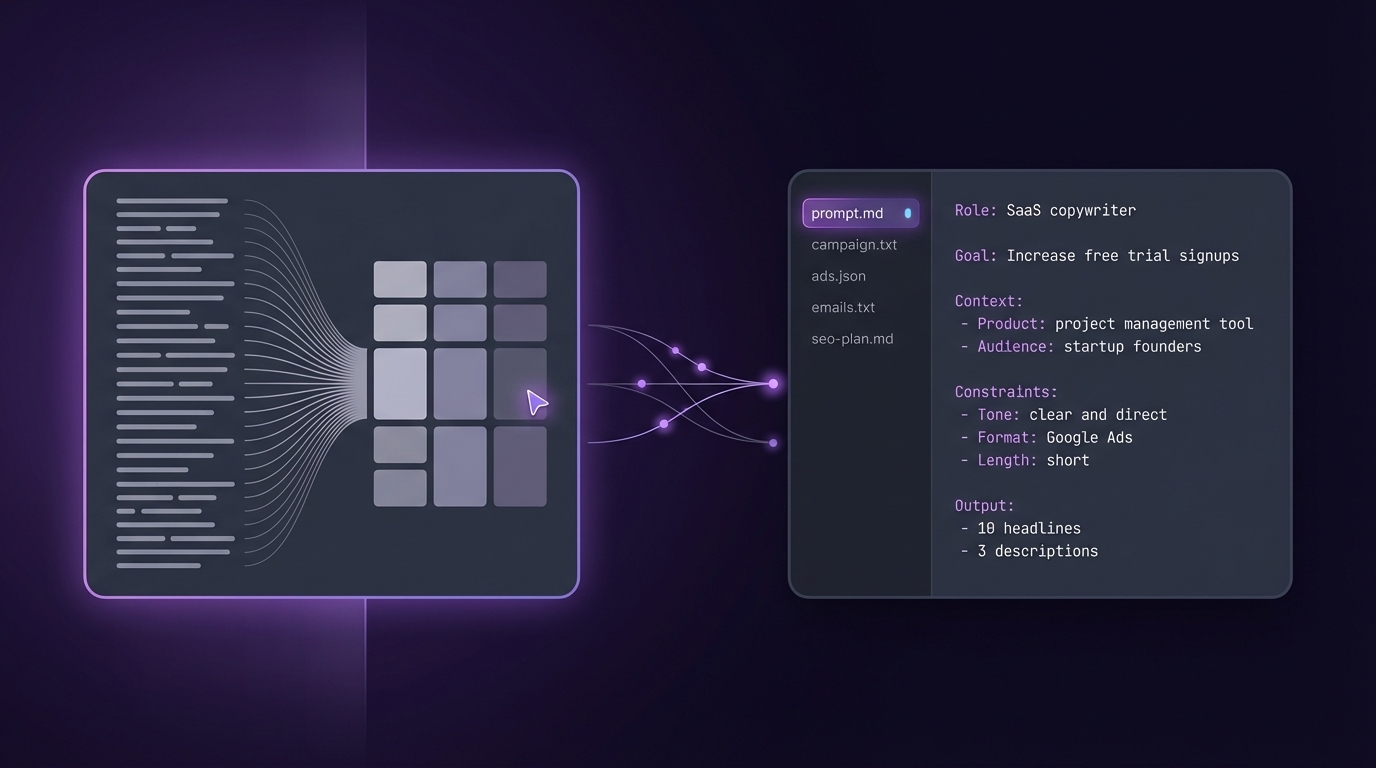
Prompt engineering for marketing means writing clear instructions, so AI tools produce useful marketing content. The way you write a prompt directly affects the quality of ads, emails, SEO content, social posts, and campaign ideas.
In practice, prompt engineering helps you turn a simple idea into usable marketing assets faster and with less rewriting. Instead of vague outputs, you guide AI with specific inputs like audience, goal, tone, and format, so the result fits your channel and intent from the start.
A strong approach combines understanding how prompts work, learning how to structure them, applying simple frameworks, and using real examples across different marketing tasks. This makes it easier to create consistent, high-quality content without having to start from scratch each time.
What is prompt engineering for marketing?
Prompt engineering for marketing means writing clear instructions for AI tools so they generate useful marketing content.
Another way to improve AI output is fine-tuning, where the model is trained on specific data. The difference between prompt engineering and fine-tuning is that prompt engineering relies on clear instructions, while fine-tuning changes how the model behaves.
AI tools like ChatGPT rely entirely on what you tell them. They don’t fill in missing details or context. They follow your instructions as written. That’s why the way you phrase a prompt directly shapes the result.
A marketing prompt that includes key details such as the audience, the product, and the goal makes the AI produce something focused and relevant.
You can see the difference in a simple example.
Weak prompt:
“Write an email about a sale”
Improved prompt:
“Write a promotional email for a 20% summer sale on running shoes. Target beginner runners. Keep the tone friendly and energetic. Include a subject line and a short call to action.”
The second prompt gives clear direction. It defines who the message is for, what is being promoted, and how the output should sound and look. That level of clarity leads to content you can use without heavy rewriting.
What are the benefits of prompt engineering for marketers?
Prompt engineering improves marketing results by giving AI a clear direction. When you tell the tool what you need, who it is for, and how the output should look, you get content that is faster to produce and easier to use.
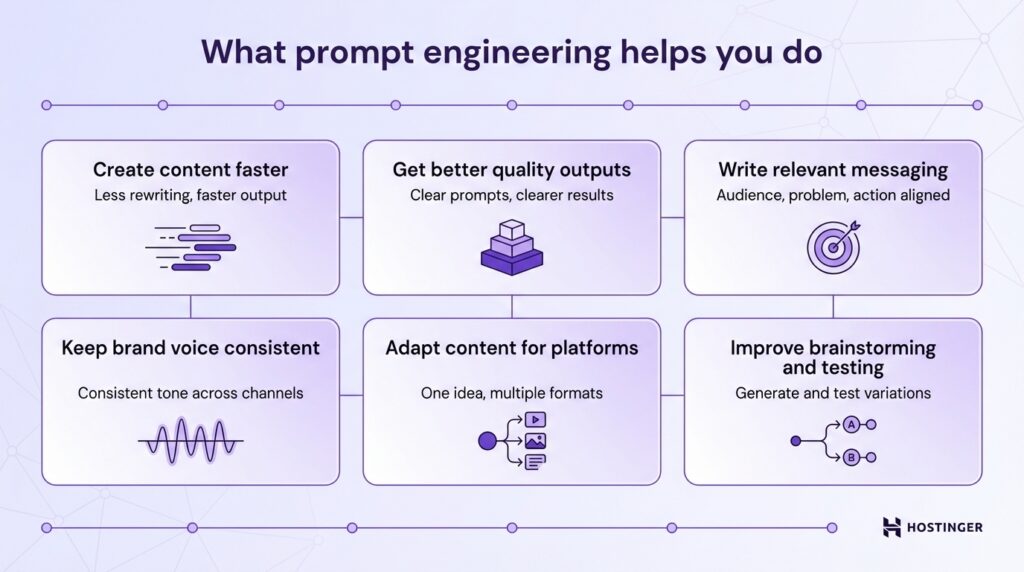
For marketers, the biggest benefit is control. AI can generate ideas and drafts quickly, but the real value lies in producing outputs that match the task. A prompt with the right details helps you create content that fits your audience, your channel, and your brand.
Here’s what prompt engineering helps you do:
- Create content faster. You spend less time rewriting vague AI drafts and more time refining useful ones. This speeds up work on emails, ad copy, blog outlines, social posts, and campaign ideas.
- Get better quality outputs. Clear prompts produce clearer results. You can ask for a specific angle, tone, structure, or format, resulting in content that feels more polished from the start.
- Write more relevant messaging. Marketing works best when the message fits the audience. A strong prompt can include who you are targeting, what problem they have, and what action you want them to take.
- Keep your brand voice consistent. You can tell the AI to sound professional, friendly, direct, playful, or anything else that matches your brand. This helps your content feel more consistent across channels.
- Adapt content for different platforms. One idea can turn into several assets when your prompt includes the channel and format. A product launch message can become an email, a LinkedIn post, a Google ad, and an Instagram caption with the right instructions.
- Improve brainstorming and testing. Prompt engineering helps you generate multiple versions of headlines, hooks, calls to action, or campaign concepts. That gives you more options to test before you publish.
The next step is understanding what separates a useful prompt from a weak one. Once you know the core parts of a good prompt, writing it gets much easier.
What makes a good marketing prompt?
A good marketing prompt is clear and structured. It gives the AI enough direction to produce content that fits your goal, audience, and channel.
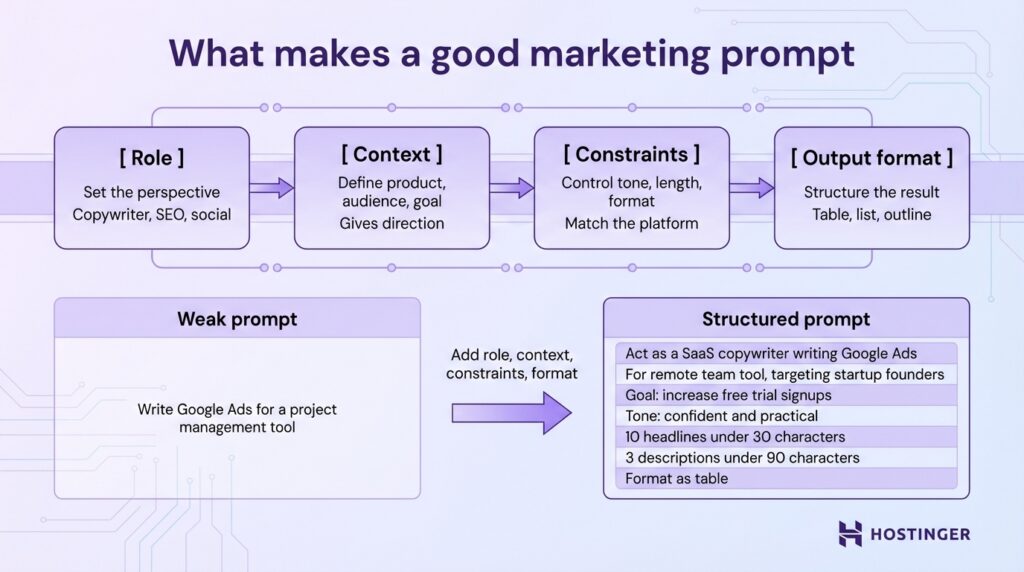
Best practices for writing prompts include using a simple framework that covers four key parts: role, context, constraints, and output format.
Role
Start by telling the AI who it should act as. This sets the perspective and shapes the response.
A copywriter will aim to persuade. A social media manager will focus on engagement. An SEO specialist will shape content around search intent. When you assign a role, you guide the tone, level of detail, and focus.
You can see the impact in a real task like writing ad copy for a project management tool. If you include “act as a SaaS copywriter writing Google Ads,” the AI will lean toward short, benefit-driven lines, clear value propositions, and strong calls to action that fit ad formats.
Context
Add the key details the AI needs to understand the task. This includes the product, the audience, and the goal.
Context gives direction to the response. It tells the AI what it is writing about, who it is writing for, and what the content should achieve. Without it, the output stays broad and lacks focus.
You can see the impact in the same ad example. If you add context like “for a project management tool designed for remote teams, targeting startup founders who struggle with team coordination, with the goal of increasing free trial signups,” the AI now has a clear subject, audience, and outcome to work with.
Constraints
Add constraints to control how the output should sound, how long it should be, and where it will appear. This includes the tone, word count, format, and platform.
Constraints help the AI match the limits of the channel instead of giving you something too long, too vague, or shaped for the wrong format. A Google ad needs concise wording. A LinkedIn post needs more space and a different rhythm.
You can continue the same project management tool example by adding constraints like “use a confident and practical tone, keep each headline under 30 characters, write three descriptions under 90 characters, and format the output as a table.”
At that point, the AI has clear boundaries and can generate ad copy that fits the platform.
Output format
Specify how you want the response organized. This tells the AI what shape the final output should take: a list, a table, a paragraph, a set of headlines, or a step-by-step outline.
If you need ad copy, you might want headlines and descriptions separated clearly. If you are comparing ideas, a table will save time. If you are planning a campaign, a bullet list or a short outline will be easier to scan.
You can finish the same project management tool prompt by adding a format instruction like “present the output in a table with one column for headlines and one for descriptions.”
That gives the AI a clear structure and makes the draft easier to check, edit, and export into your workflow.
Taken together, these four parts give the AI enough direction to produce focused marketing content. The role sets the angle. The context defines the task. The constraints shape the response. The output format organizes the result.
You can also see the value of structure by comparing a weak prompt with an improved one.
Weak prompt:
“Write Google Ads for a project management tool.”
Improved prompt:
“Act as a SaaS copywriter writing Google Ads for a project management tool designed for remote teams. Target startup founders who struggle with team coordination. The goal is to increase free trial signups. Use a confident and practical tone. Write 10 headlines under 30 characters and 3 descriptions under 90 characters. Present the output in a table.”
The weak version gives the AI a task. The improved version gives it direction. That is what turns a broad response into something you can actually use.
How to write prompts for marketing in 5 steps
You can write effective AI prompts by following a simple sequence: define the goal, add context, choose the channel, set constraints, and refine the result.
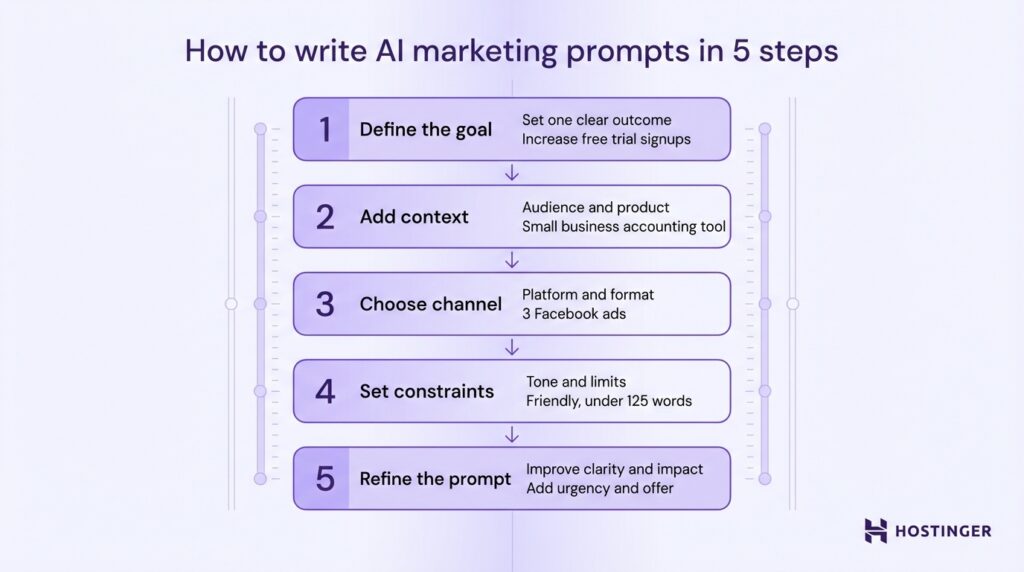
- Define the marketing goal. Start with a clear outcome so the AI knows what to produce. Focus on one task at a time, such as generating leads, increasing clicks, or creating awareness. Example: “Create ad copy to increase free trial signups.”
- Add audience and product context. Include who you are targeting and what you are promoting. This gives the AI direction and keeps the message relevant. Example: “Target small business owners who need simple accounting software.”
- Specify channel and format. Tell the AI where the content will be used and how it should be structured. Each platform has its own style and limits. Example: “Write 3 Facebook ad variations with a headline and primary text.”
- Add tone and constraints. Guide how the content should sound and set clear limits for length or style. This keeps the output aligned with your brand and platform requirements. Example: “Use a friendly and reassuring tone. Keep each ad under 125 words.”
- Refine the prompt. Review the output and adjust your prompt to improve clarity or focus. Small changes can lead to stronger results. Example: “Add urgency and include a limited-time offer in each variation.”
Prompt frameworks marketers can use
Prompt frameworks give you a clear structure so you can write better prompts without starting from scratch each time. You follow a simple pattern and adjust it as needed for your task.
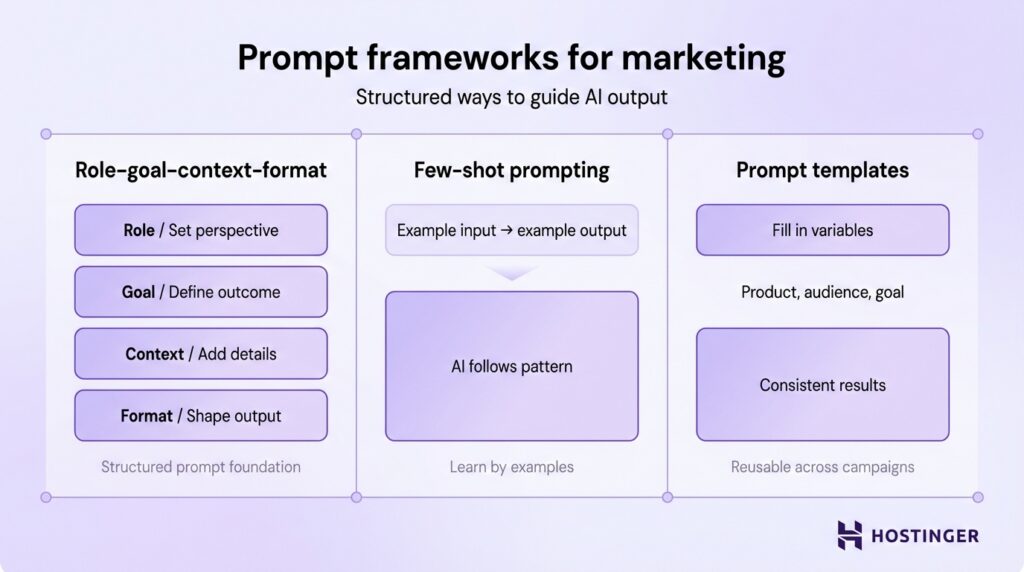
Here are three practical frameworks marketers use most:
- Role–goal–context–format framework – Organizes your prompt into four parts.
- Few-shot prompting (example-based) – Guides the AI by giving it examples to follow.
- Prompt templates for marketing tasks – Creates reusable prompt structures you can apply across different campaigns.
Role–goal–context-format framework
This framework structures your prompt into four clear parts: role, goal, context, and format. Each part adds a specific layer of direction, so the AI knows how to approach the task and what to deliver.
- Role sets the perspective
- Goal defines what you want to achieve
- Context provides the details the AI needs
- Format shapes how the output should look
Together, these elements turn a general request into a focused instruction that produces usable marketing content.
Here is a complete prompt using this framework:
“Act as an email marketer. Write a welcome email for a new user who just signed up for a personal finance app. The audience is young professionals who want to manage their spending and save more each month. The goal is to encourage them to complete their profile and link their bank account. Use a clear and supportive tone. Keep the email under 150 words and include a subject line and a call to action.”
Few-shot prompting (examples-based)
Few-shot prompting means giving the AI a few examples so it can learn a pattern.
The AI uses the examples as a guide and continues in a similar way. It picks up patterns like sentence length, phrasing, and format.
You can use this when writing headlines, social posts, product descriptions, or any content where consistency matters.
Here is a simple prompt using this method:
“Here are two Instagram captions for a skincare brand:
‘Glow starts with good habits. Keep your routine simple.’
‘Healthy skin takes consistency. Start with the basics.’
Write 5 more captions in the same style for a moisturizer designed for sensitive skin.”
Prompt templates for marketing tasks
Prompt templates are reusable structures you can apply across different tasks. You keep the format and replace key details like the product, audience, or goal each time you use it.
This approach helps you work faster and stay consistent. Once you build a few solid templates, you can use them for blogs, emails, ads, or social posts without rewriting prompts from scratch.
Here is a simple example:
“Write a blog post outline about [topic] for [target audience]. Focus on [main problem]. Include 5 sections with clear headings and a short description for each.”
Examples of prompts for different marketing tasks
Each type of marketing task requires a slightly different approach, depending on the goal, channel, and format.
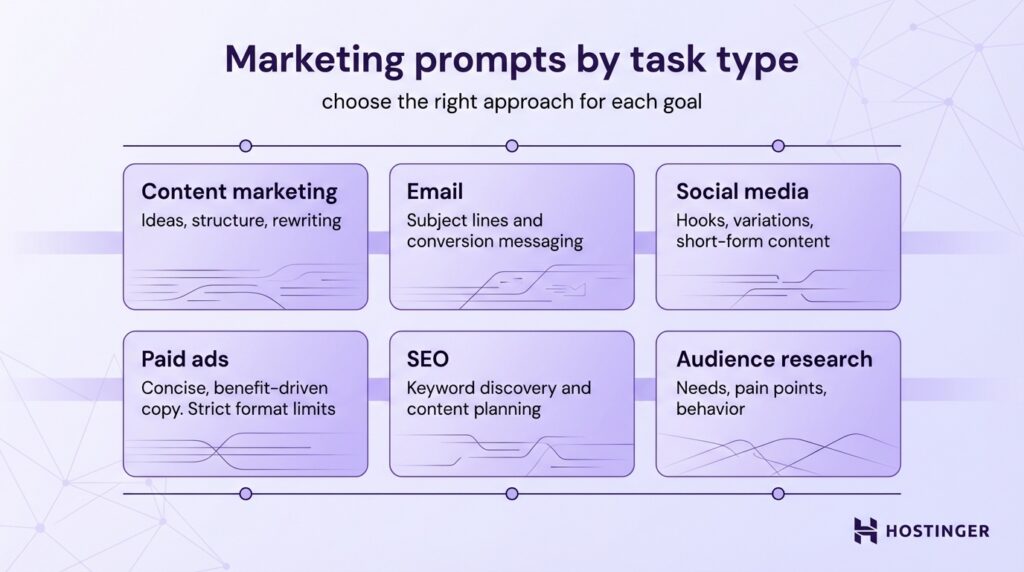
- Content marketing prompts focus on ideas, structure, and rewriting.
- Email prompts center on subject lines and conversion-driven messaging.
- Social media prompts generate variations, hooks, and short-form content. Paid ads require concise, benefit-driven copy that fits strict limits.
- SEO prompts help with keyword discovery and content planning.
- Audience prompts focus on understanding customer needs, pain points, and behavior.
Content marketing prompts
With content marketing prompts, you can generate blog ideas, build outlines, or rewrite existing drafts with a clearer angle.
Here are a few practical prompts you can adapt:
“Generate 10 blog post ideas for a web hosting company targeting first-time website owners. Focus on beginner problems such as choosing a hosting plan, setting up WordPress, and improving site speed.”
“Create a blog post outline for the topic ‘how to speed up a small business website.’ Target readers with little technical knowledge. Include an introduction, five main sections, and a short conclusion.”
“Rewrite this blog introduction so it sounds clearer and more engaging for beginners. Keep the meaning the same, remove jargon, and keep it under 120 words.”
Email marketing prompts
Email prompts help you generate subject lines, plan campaign sequences, or draft emails with a clear goal.
Try prompts like these:
“Write 10 email subject lines for a spring sale on website hosting. Target small business owners who want a professional site at a lower cost. Keep each subject line under 50 characters.”
“Create a three-email campaign for users who started signing up for a website builder but did not finish. The goal is to bring them back and encourage them to complete the setup. Keep the tone helpful and direct.”
“Write a promotional email for a new AI logo maker aimed at first-time business owners. Focus on speed, ease of use, and affordability. Include a subject line, preview text, and a short call to action.”
Social media prompts
Social media prompts help you create short content that grabs attention quickly. You can use them to generate post variations, opening hooks, and platform-specific copy that fits how people read and scroll.
For social media purposes, you can use prompts like these:
“Write 5 LinkedIn post variations for a new website builder designed for freelancers. Focus on saving time, ease of use, and professional design. Start each post with a strong hook and keep the tone clear and confident.”
“Generate 10 short hooks for an Instagram post promoting an AI logo maker for small business owners. Keep each hook under 12 words and make them easy to understand at a glance.”
“Write 3 X posts for a web hosting brand announcing a limited-time discount. Keep each post under 280 characters, lead with the main offer, and end with a clear call to action.”
Paid ads prompts
Paid ad prompts help you write headlines, descriptions, and ad variations that match each platform’s format.
Prompts like these give the AI clear boundaries and a direct goal:
“Write 10 Google Ads headlines for a website builder aimed at small business owners. Focus on ease of use, professional templates, and quick setup. Keep each headline under 30 characters.”
“Create 5 paid ad descriptions for a web hosting service with free SSL and 24/7 support. Target first-time website owners. Keep each description under 90 characters and use a clear, practical tone.”
“Write 3 Facebook ad variations for an AI logo maker for new ecommerce stores. Highlight speed, low cost, and beginner-friendly design tools. Include a short primary text, a headline, and a call to action.”
SEO and research prompts
SEO and research prompts help you find the words, questions, and topics your audience uses. Use them to generate keyword ideas, uncover search intent, and plan content around real problems people want to solve.
These prompts work best when you give the AI a clear topic, audience, and business type. That helps you get ideas closer to your niche, rather than broad suggestions that are hard to use.
For SEO and research use prompts like these:
“Generate 20 keyword ideas for a web hosting company targeting beginners who want to start a small business website. Group the keywords by search intent, including informational, commercial, and transactional.”
“List 10 blog topic ideas for a website builder brand targeting freelancers and small business owners. Focus on topics with clear search intent, such as building a portfolio site, improving local visibility, and choosing the right website template.”
“Identify common questions people ask before buying web hosting for an online store. Turn those questions into content ideas that could work as blog posts, FAQ pages, or comparison articles.”
Audience and persona prompts
Audience and persona prompts help you map out what people want, what slows them down, and what pushes them to take action.
Audience and persona prompts can look something like this:
“Create a buyer persona for a small business owner looking for affordable web hosting. Include their main goals, common frustrations, buying concerns, and the kind of messaging that would help them trust a provider.”
“List the top pain points, motivations, and objections of first-time website owners choosing a website builder. Group the insights into three sections: what they want, what slows them down, and what could convince them to sign up.”
Which AI tools can marketers use for prompt engineering?
You can apply prompt engineering across most AI tools used in marketing. The core skill stays the same, but each tool handles a different type of output.
General AI tools like ChatGPT are used for writing and thinking tasks. You can create emails, ad copy, blog drafts, campaign ideas, and research summaries. These tools respond best to structured prompts that define the goal, audience, and format.
Image tools focus on visuals. You describe what you want to see, including style, subject, and mood. Tools like Midjourney, DALL·E, and Stable Diffusion are commonly used for this. Marketers use them to create social media graphics, ad creatives, product visuals, and branding assets.
Marketing platforms with built-in AI, such as HubSpot, Jasper, and Copy.ai, use prompts within workflows for email campaigns, ad creation, and SEO content planning. In these tools, your prompt directly shapes outputs tied to performance, such as click-through rates, conversions, and engagement.
Tools like Hostinger Horizons AI builder take this further by turning prompts into fully functional websites, landing pages, and web apps. You can describe an idea, adjust content, design, and functionality through prompts, and launch it live without switching tools or writing code.
The key idea stays consistent across all of them. You guide the output through clear instructions.
How to test and improve marketing prompts
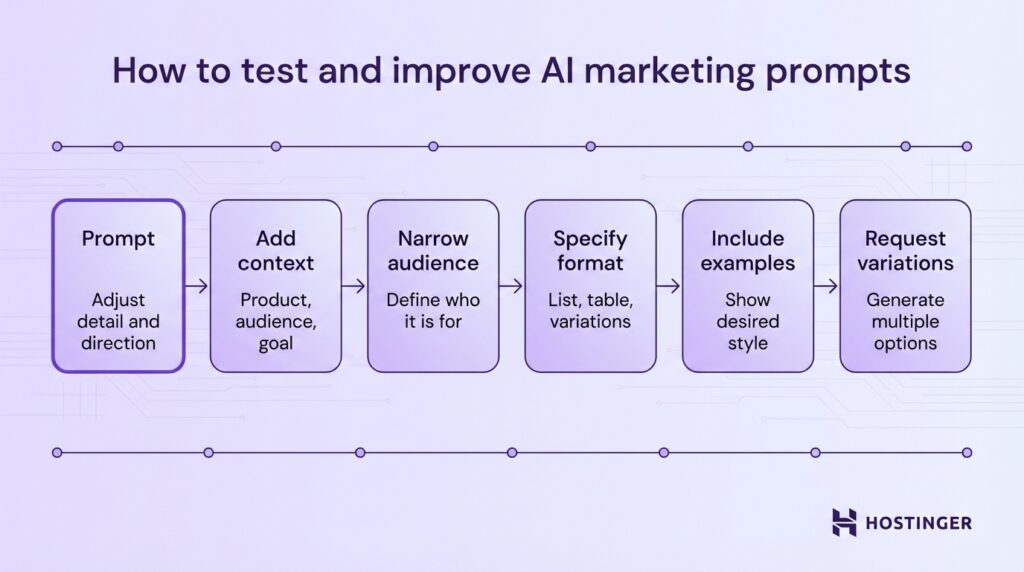
You improve prompts by adjusting the level of detail and direction.
Focus on these improvements:
- Add more context. Include details about the product, audience, or goal to guide the response more precisely.
- Narrow the audience. Define who the content is for instead of keeping it broad. This leads to more relevant messaging.
- Specify the format. Tell the AI how to structure the output, such as a list, table, or set of variations.
- Include examples. Show what a good result looks like when you need a specific style or tone.
- Request variations. Ask for multiple versions so you can compare options and choose the strongest one.
Here’s how prompt tuning looks in practice:
Weak prompt:
“Write a LinkedIn post about productivity.”
Output:
“Productivity is important for success. You should plan your day, avoid distractions, and focus on your goals. Staying organized helps you get more done and feel better about your work.”
Improved prompt:
“Write 3 LinkedIn post variations about productivity for startup founders. Focus on reducing meeting overload and improving focus. Keep each post under 150 words and start with a strong opening line.”
Improved output:
- “Too many meetings are killing your focus. Startup founders lose hours each week switching between calls and tasks. Block time for deep work and protect it like your most important meeting.”
- “Your calendar is full, but your real work is still waiting. Cut one unnecessary meeting today and use that time to move a key task forward.”
- “Startup founders don’t need more tools. They need fewer distractions. Start by limiting meetings and setting clear priorities for the day.”
Testing works best when you compare different outputs side by side. Small changes in your prompt can lead to clearer, more focused results.
Common prompt engineering mistakes in marketing
The most common prompt engineering mistakes in marketing are writing vague prompts, giving no audience context, skipping format instructions, ignoring brand voice, and trusting AI output without review.
Vague prompts
A broad request gives the AI too little direction, so the output stays generic.
Fix: State the exact task, goal, and topic.
No audience context
Messaging falls flat when the AI does not know who it is writing for.
Fix: Include the target audience and, when relevant, their needs or pain points.
No format instructions
The output becomes harder to use when the structure is left open.
Fix: Tell the AI whether you want a list, table, outline, email, ad variation, or something else.
Ignoring brand voice
Content feels off-brand when the prompt lacks tone and style.
Fix: Describe how the content should sound (clear, friendly, direct, professional, etc.).
Trusting AI output blindly
AI can produce errors, weak claims, or awkward phrasing that should not go live without review.
Fix: Check the output for accuracy, clarity, and fit before you publish or send it.
How can marketers become prompt engineers?
To become a prompt engineer, practice prompt writing in real marketing tasks and improve results over time.
Start by using prompts in your daily work. Write prompts for emails, ads, blog outlines, and social posts. Pay attention to the output and adjust your instructions to get closer to what you need. This builds a practical understanding of what works.
Next, build a small prompt library. Save prompts that produce strong results and reuse them across campaigns. Over time, you will have ready-to-use templates for common tasks like ad copy, content ideas, and audience research.
Finally, learn and apply simple frameworks and tools. Use structures like role–goal–context–format to stay consistent, and test your prompts across different AI tools. This helps you adapt your skills to different workflows and marketing channels.
All of the tutorial content on this website is subject to Hostinger's rigorous editorial standards and values.

Ksenija is a digital marketing enthusiast with extensive expertise in content creation and website optimization. Specializing in WordPress, she enjoys writing about the platform’s nuances, from design to functionality, and sharing her insights with others. When she’s not perfecting her trade, you’ll find her on the local basketball court or at home enjoying a crime story. Follow her on LinkedIn.
