Future of Work: AI vs the Global Job Market
Mar 10, 2026
/
By Domantas G.
/
4 min Read
There’s one question that most of us want an answer to.
How is your job going to be affected by AI?
From finance and healthcare to retail and logistics, many sectors can expect exponential growth from AI implementation.
But sometimes, the impact AI has on an industry can affect the people working in it. We’ll talk you through how AI might change job sectors in countries adopting this technology the most.
What We Did
Our goal was to see how AI has and will continue to impact job markets in countries that have adopted AI the most.
To do this, we needed to take into account how much countries are investing in AI and what the employment outlook will potentially look like after AI is implemented. So we referred to two AI studies:
- Investment Monitor’s AI Index, which ranks countries leading the AI investment and talent.
- PwC’s Global Artificial Intelligence Study, which highlights job sectors AI will most disrupt. Its AI Impact Index indicates how much economic potential AI can create for these industries – anything from labor automation to increased productivity.
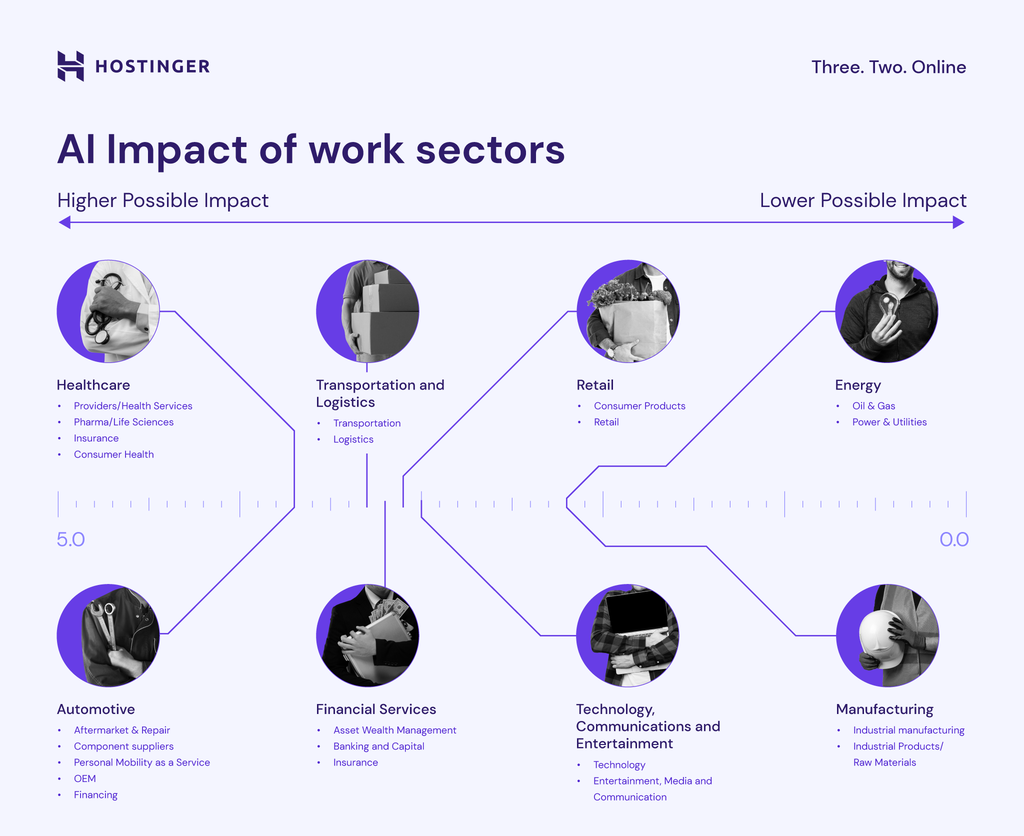
We calculated the indices from each study together to get our own Global AI Impact Score. From there, we were able to see where each country truly stands in terms of having their job markets be affected by AI.
Does the final score equal job displacements? Let’s find out.
Key Findings
- The healthcare sector is the most likely to be disrupted by AI. Expect to see administrative tasks like medical record keeping be automated in the near future – signaling a decline in health administration jobs.
- US workers in retail, technology, and finance job markets have the biggest risk of being replaced by AI.
- Iceland and Estonia follow the US when it comes to being at risk of job displacements due to AI. Interestingly, both countries are also using AI to solve unemployment problems.
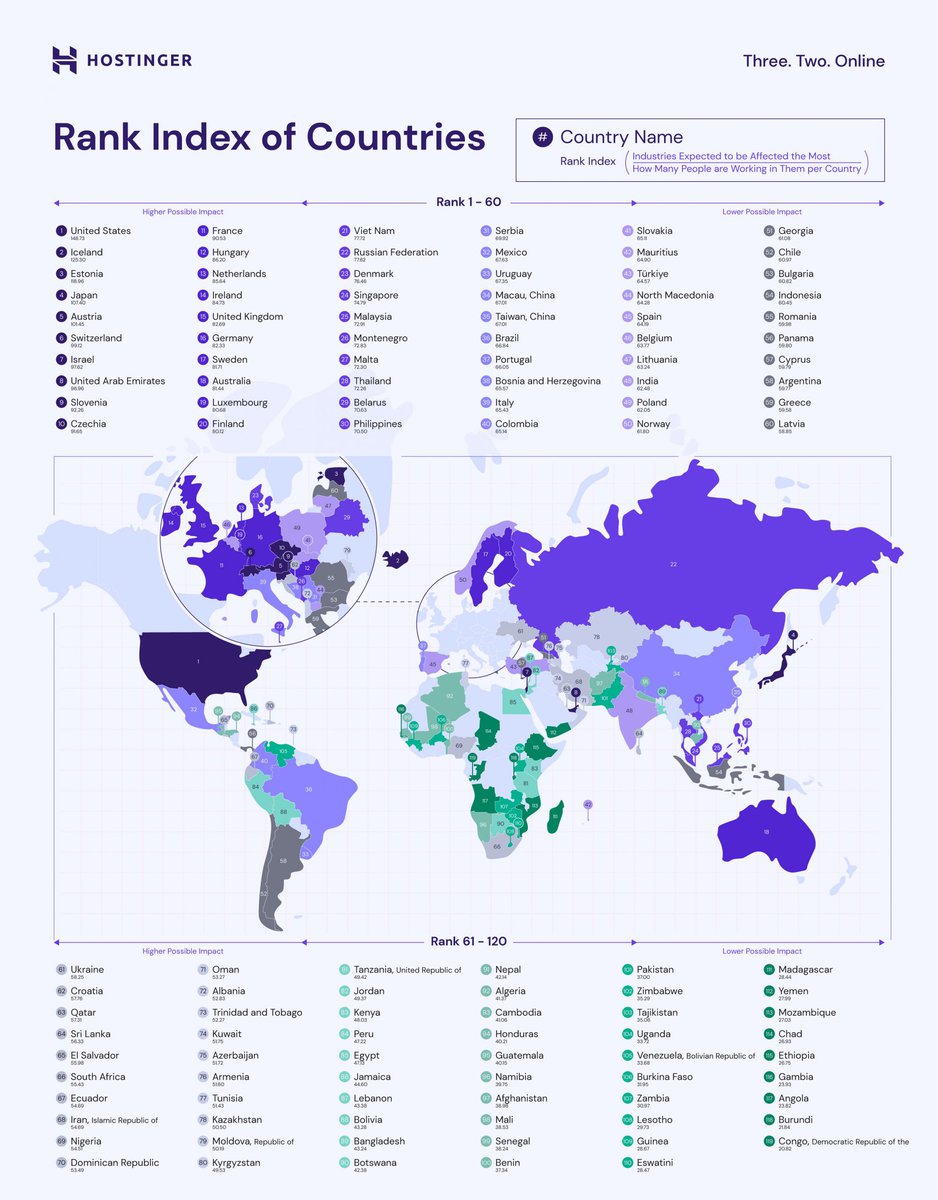
United States
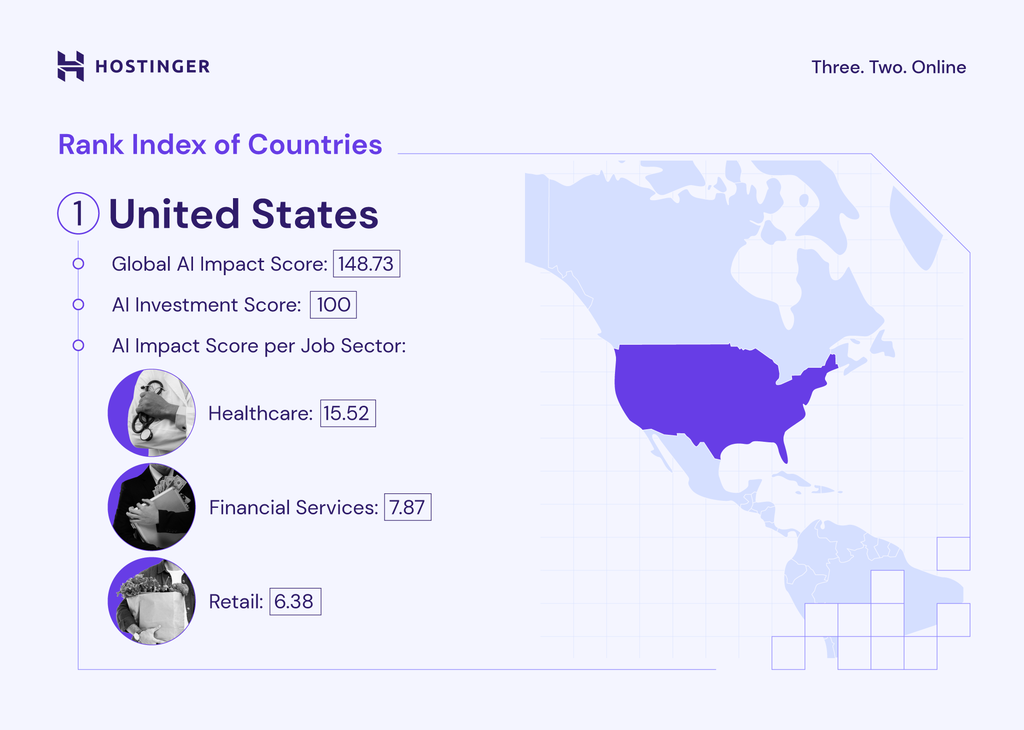
The US is the frontrunner on our Global AI Impact Score. And with tools like ChatGPT and DALL-E making waves, this should come as no surprise. Among all job sectors, healthcare, finance, and retail jobs are at the most risk of being automated.
Take banking, for instance – automation and digitization have caused teller and administrative positions to decline over the years. Experts predict that advanced AI can pose a threat to financial qualitative analysts in the near future.
In retail, self-checkouts have caused the job outlook for cashiers to shrink in the next ten years. AI content generation services like Jasper are also raising debates and concerns among marketers. While such software has helped copywriters speed up their process, many are worried it will surpass their skills soon.
Iceland
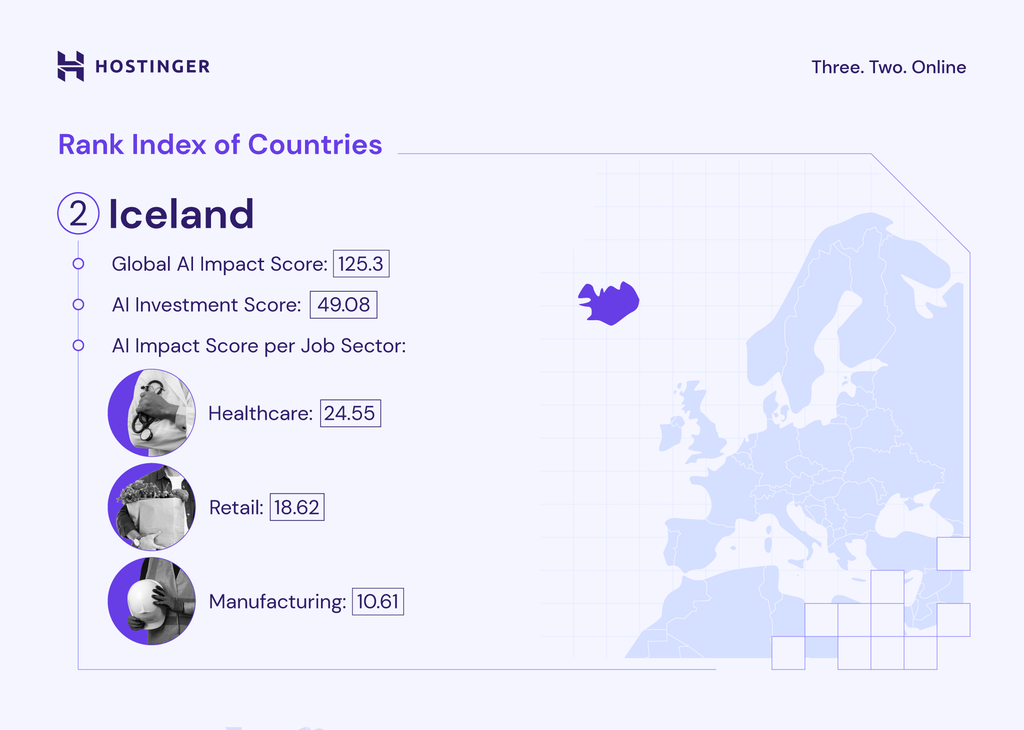
Iceland is no stranger to adopting new technologies. It tops our list of most creative countries online and ranks twentieth in the Global Innovation Index. So how will AI affect their labor market?
According to our data, the healthcare industry is the most likely to be disrupted by AI. As Iceland copes with its healthcare worker shortage, whether AI will improve or worsen the situation remains to be seen. Recently, the country’s data protection authority has launched a sandbox for startups to develop AI-based health services.
Retail takes the next spot, and there’s already evidence for it. For instance, some companies are using conversational AI in customer support chatbots, resulting in faster services and lower demand for human agents.
Estonia
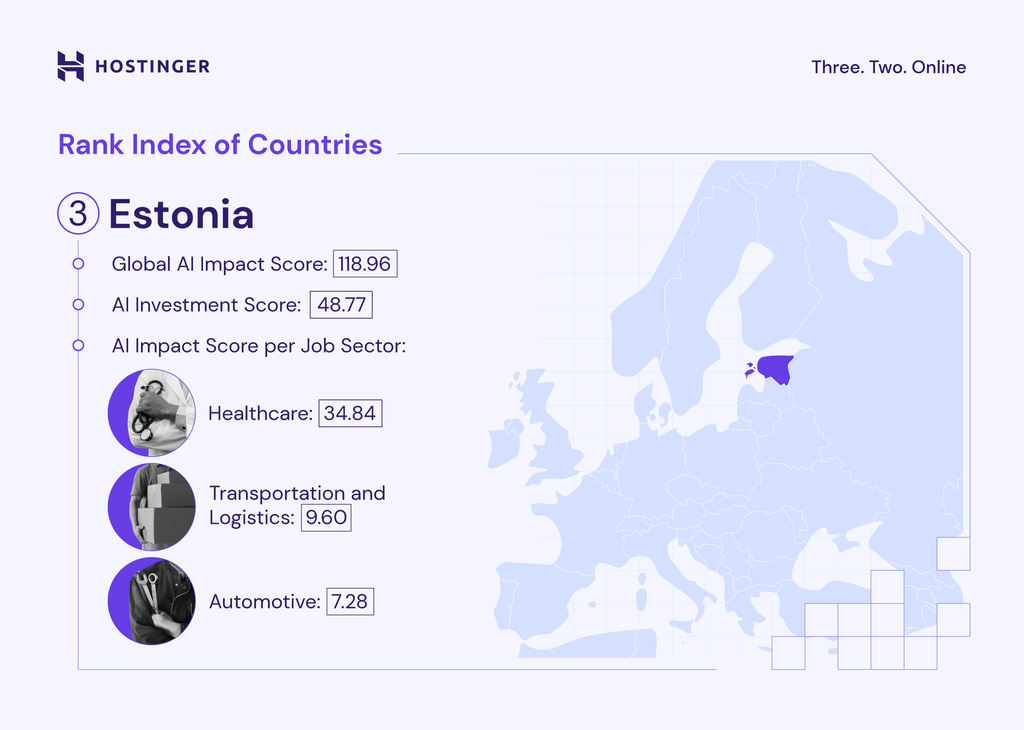
As a pioneer in data-driven government, Estonia has been using AI and machine learning to replace workers in the public sector. Our data shows the country plans to adopt more AI innovation in technology, automotive, and retail industries.
Whether AI will cause more job displacements than new ones in Estonia remains up for debate. Experts predict robots and automation will make the country’s warehouse drivers and construction workers redundant.
Interestingly, Estonia has been harnessing AI to tackle unemployment, lessening the risk of long-term joblessness. The small Baltic powerhouse has also launched an AI Task Force to solve the declining labor shortage due to its aging population.
Japan
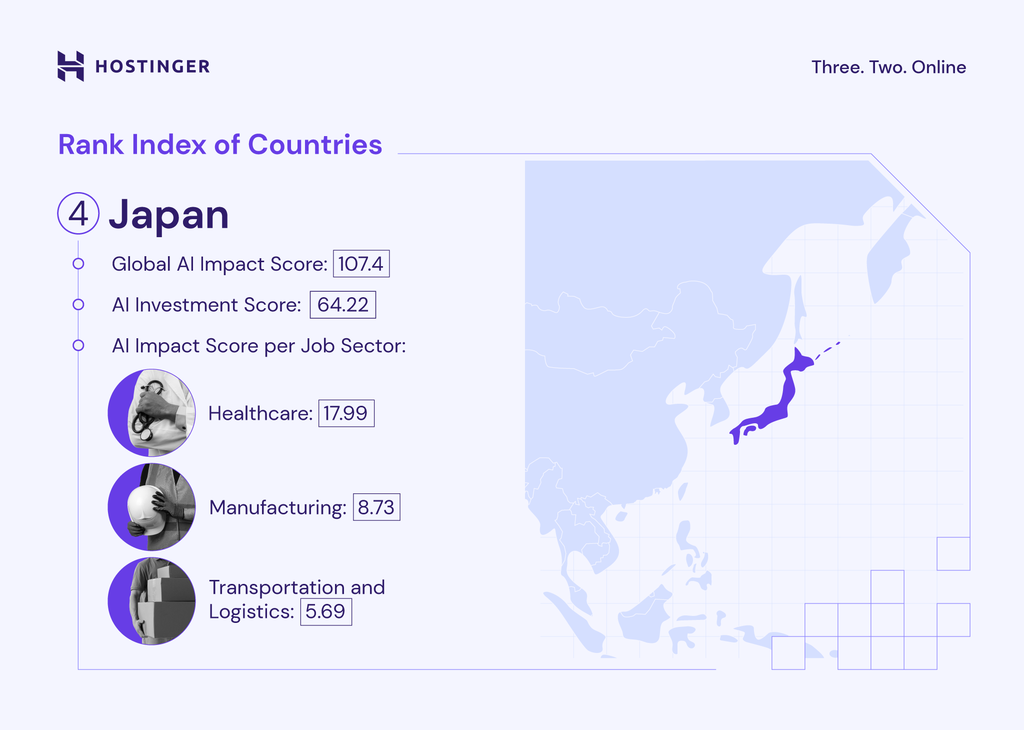
Japan has always been at the forefront of the tech industry, having implemented automation and robotics much earlier than other countries. As AI becomes more advanced, will it displace more jobs in the land of the rising sun?
During the pandemic, Japan saw a 30% decline in job postings for easily-automated labor in the manufacturing sector, largely due to AI and robots. We expect this trend to continue as Japan deals with an aging society and decreasing working population.
Leading tech companies like Fujitsu, Canon, and Toyota have dominated the country’s number of AI-related patent applications, signifying strong support for AI adoption. And who could forget the country’s recent experiments with unmanned convenience stores?
Austria
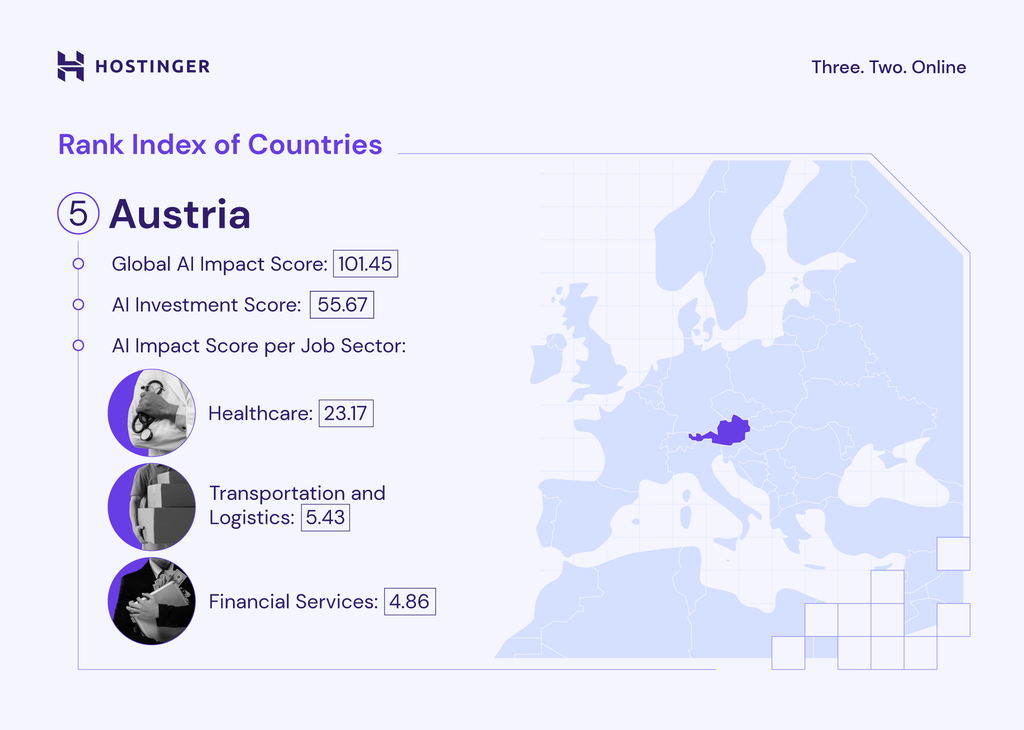
Experts predict that 9% of jobs in Austria will be automated due to robotics and AI. As the country increases its spending on AI innovations for this year, this forecast may come to life.
Interesting fact – Austria is home to some of the most advanced research in autonomous driving. The government has even released a regulation allowing the public testing of self-driving vehicles. If the technology keeps improving, there’s a high chance of human drivers being replaced in the near future.
Finance is another top sector to be affected by AI. In fact, the country is already seeing a rise in Fintech startups like Finmatics, aiming to reduce manual labor in business operations like accounting and tax calculations.
Switzerland
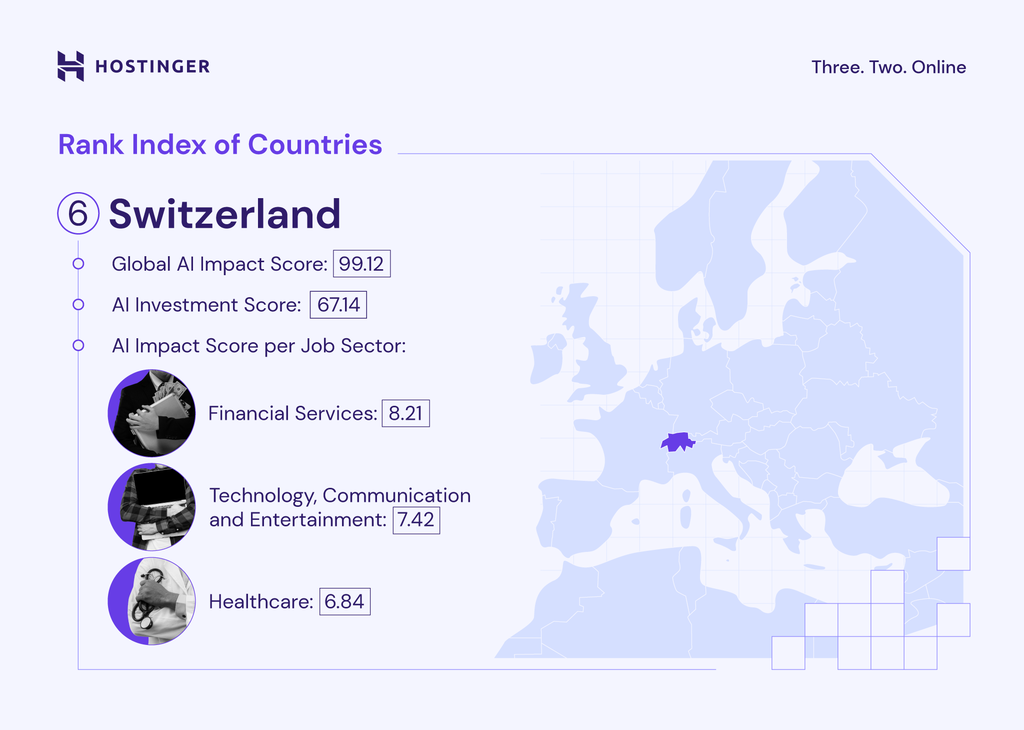
According to experts, over 25% of the Swiss job market could be impacted by AI by 2030. Based on our data, the finance, tech, and healthcare sectors will be the ones feeling the effects the most.
Will AI bring more harm than good to the Swiss economy? On the one hand, researchers believe this technology is highly likely to replace jobs with basic physical and cognitive skills. On the other hand, more opportunities than losses may come out of AI, with a potential of 400,000 jobs being created in Switzerland alone.
In fact, 46% of Swiss companies already have an AI training program in place to help employees upgrade their skills. Swiss banks and insurance companies have also been using various machine-learning applications daily for a while.
Methodology And Sources
We referred to Investment Monitor’s AI Index to understand which countries will have the most AI economic impact. It used 17 indicators to rank each country’s AI investment and talent, including:
- Adoption of emerging technologies
- Investment in emerging technologies
- Government promotion of investment in emerging technologies
- ICT regulatory environment
- Software spending in GDP
- High-tech manufacturing
- Intellectual property receipts in total trade
- High-tech exports in total trade
- ICT services exports in total trade
- Researcher population
- Gross expenditure on research and development
- E-participation
- AI-related news
- AI-related deals
- AI-related fillings
- AI-related jobs
- AI-related patents
We also took the working population data from ILOSTAT’s country profiles and categorized them by job sectors from PwC’s Global Artificial Intelligence Study. Then, we calculated the population numbers with PwC’s AI Impact Index to see how these job sectors in each country are affected by AI.
This article is a localized version of Future of Work: AI vs the Global Job Market , originally published in English.

Domantas leads the content and SEO teams forward with fresh ideas and out of the box approaches. Armed with extensive SEO and marketing knowledge, he aims to spread the word of Hostinger to every corner of the world. During his free time, Domantas likes to hone his web development skills and travel to exotic places.



Comments
0 responses