How many domains are there in 2026? Global statistics and industry insights

There are 392.5 million domain names registered worldwide, and that number is still climbing. The domain market has grown 6.5% year-over-year, driven by expanding internet access, new business formation, and a digital economy where having your own domain is effectively a prerequisite for credibility.
But the headline number only tells part of the story. Growth is uneven across extension types, and renewal rates vary wildly between legacy and newer TLDs. For large brands, third-party lookalike domains have turned domain management into a security issue as much as a branding one.
Top domain statistics for 2026
- More than 392.5 million domain names are registered across all top-level domain types worldwide, a 6.5% increase year-over-year.
- 1,265 domain name extensions are currently delegated in the root zone, giving registrants an unprecedented range of naming options.
- .com leads all extensions with 163.6 million registrations, making it the single most registered top-level domain on the planet.
- New generic top-level domains (TLDs) grew 31.3% year-over-year, the fastest expansion of any domain category.
- The top 10 extensions account for roughly 67% of all domain registrations, despite there being over 1,200 options available.
- Domain registrations grew by 5.6 million in the first quarter of 2026 alone, a 1.4% quarterly increase.
- 88% of homoglyph domains (lookalike domains designed to mimic real brands) are owned by third parties rather than the brands they resemble.
- One domain is registered for approximately every 22 people on Earth, reflecting how central domain names have become to digital identity.
- Legacy generic TLDs such as .net and .org maintain renewal rates above 79%, while many new generic TLDs renew at under 25%.
- The aftermarket domain name industry is projected to reach $1.17 billion by 2033, driven by digital branding and domain investing.
How many domains are there?
As of Q1 2026, the total registered domain name count is 392.5 million, with 24.1 million net new domains added over the past 12 months.
- 5.6 million new domain registrations were added in Q1 2026 alone, a 1.4% increase compared to the previous quarter (DNIB report)
- Approximately one domain is registered for every 22 people worldwide, reflecting how central domain names have become to digital identity (Hostinger domain name statistics)
- Over 3,000 accredited domain registrars operate globally, offering options from privacy-focused providers to web hosting companies that bundle domain services (Hostinger domain name statistics)
- The aftermarket domain name industry is projected to reach $1.17 billion by 2033, as digital branding and domain investing gain momentum (Hostinger domain name statistics)
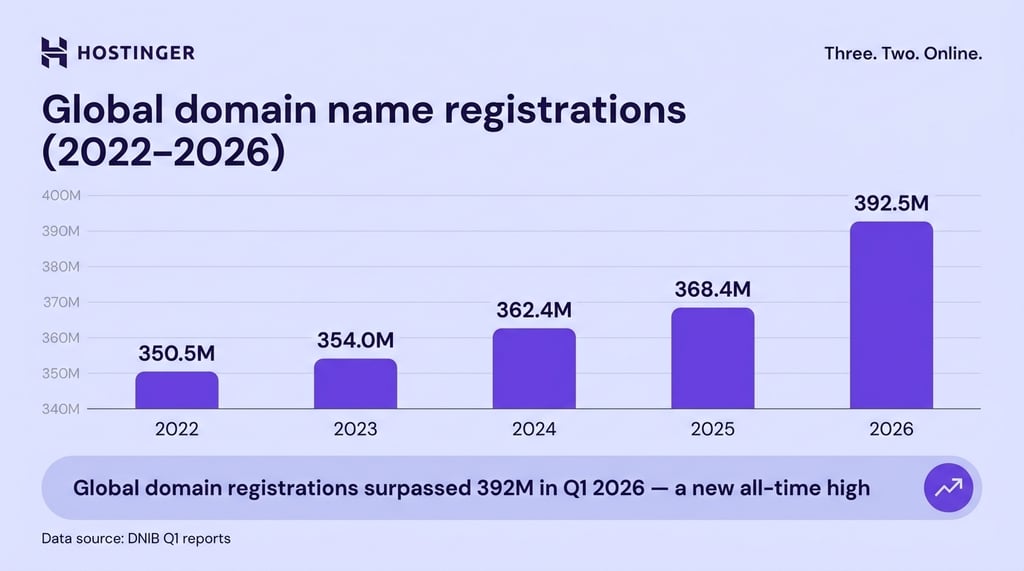
That steady growth reflects something bigger than numbers. Having a dedicated domain has become a baseline expectation for businesses, creators, and individuals alike, and with thousands of registrars competing for customers, getting one has never been more straightforward.
Domain name distribution by TLD type
The global domain base splits across three main categories: legacy generic TLDs (gTLDs), country-code TLDs (ccTLDs), and new generic TLDs, each with very different growth rates and use cases.
- 146.3 million ccTLD registrations globally, reflecting 2.4% annual growth with 3.4 million new domains added year-over-year (DNIB report)
- 49.6 million new generic TLD registrations, up 31.3% year-over-year with 11.8 million additional domains, the fastest-growing category (DNIB report)
- The leading 10 gTLDs account for 88.6% of all gTLD registrations and 55.6% of total TLD registrations worldwide (DNIB report)
- 316 ccTLD extensions were delegated in the root zone (the authoritative directory that makes domain extensions resolvable on the internet) by December 2025, with the 10 largest ccTLDs representing 57.6% of all country-code registrations (DNIB report)
- New generic TLDs make up 12.6% of the total domain registration landscape (DNIB report)
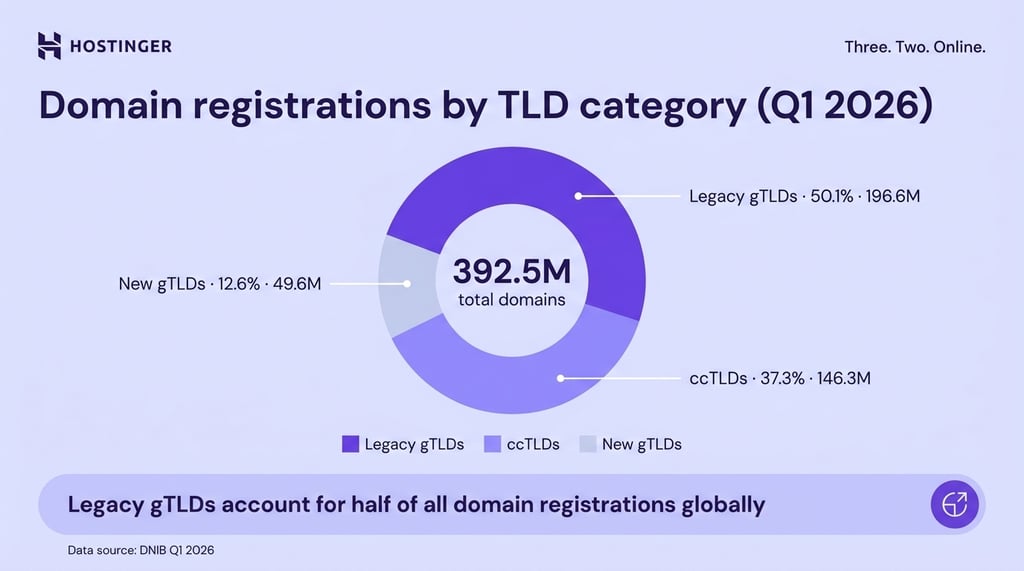
Country-code domains grow predictably because they’re tied to national identity and tend to attract genuine long-term registrations. New gTLDs are moving faster, but renewal data suggests much of that activity is speculative rather than tied to active websites.
How many TLDs are there?
There are 1,265 top-level domain extensions currently delegated in the global root zone.
- The global domain system launched with just 6 gTLDs: .com, .net, .org, .gov, .edu, and .mil, plus two-letter country-code extensions for individual nations (Hostinger domain name statistics)
- Over 1,200 new generic TLDs have expanded the domain space since ICANN’s new gTLD program launched in 2012, adding options like .tech, .store, and .blog (Hostinger domain name statistics)
Having more than 1,200 extensions to choose from hasn’t changed the fact that .com and a handful of legacy TLDs still dominate. Trust and brand recognition are hard to compete with, even when niche or country-code options are cheaper or more specific to what you do.
Expert tip
More extensions mean more options, not more clarity. Most businesses still default to .com for good reason – it carries instant credibility with no explanation required. But for local or industry-specific brands, a well-chosen ccTLD or new gTLD can do real work. What tends to get overlooked is defensive registration: your brand sitting unregistered on adjacent extensions is an open door for confusion, or worse.

Most registered domain extensions
.com leads the global domain market by a wide margin, but the extensions behind it reveal a lot about how different regions and industries use the web.
- The 10 leading TLDs by registration volume are .com, .cn, .de, .net, .org, .uk, .xyz, .ru, .nl, and .top (Hostinger’s most popular domain extensions)
- .com leads with 163.6 million registrations, making it the world’s most widely registered TLD (Hostinger’s most popular domain extensions)
- .com and .net combined hold 176.1 million registrations, growing 3.7% year-over-year (Hostinger’s most popular domain extensions)
- China’s .cn dominates ccTLDs with 20.9 million registrations, followed by Germany’s .de with 17.9 million (Hostinger’s most popular domain extensions)
- Among new gTLDs, .xyz leads with 8.1 million domains, while .top follows with 6.1 million (Hostinger’s most popular domain extensions)
Expert tip
Renewal rates are one of the clearest signals we have for understanding how a TLD is actually being used. When an extension renews at 75% or above, the registrations behind it are almost always tied to real projects and active businesses. When you see rates drop below 25%, the bulk of that volume is speculative: domains registered in batches and dropped before the first renewal. For anyone evaluating whether to build on a new gTLD, the renewal rate of that extension is a more reliable indicator of ecosystem health than the raw registration count.

Domain registration and renewal trends
Domain registration activity has accelerated in recent quarters, and legacy extensions are holding their ground more firmly than many expected.
According to the DNIB report, new .com and .net registrations reached 11.5 million in Q1 2026, up from 10.1 million in Q1 2025, a 13.9% year-over-year increase. Their combined renewal rate sits at 76.3%, while other legacy gTLDs renew at 67.6%. New generic TLDs lag well behind at a combined renewal rate of 30.9%, driven by the speculative registrations that make up much of their volume.
Demand for .com and .net keeps growing despite there being over 1,200 alternatives to choose from. The new gTLD space is expanding fast in raw numbers, but high churn means the active, built-upon portion of that growth is much smaller than the headline figures suggest.
Domain security and third-party registrations
For large brands, the domain landscape has a darker side. Lookalike domains registered by third parties are a growing source of brand confusion, traffic hijacking, and in some cases, active phishing campaigns.
According to CSC’s domain security report, 67% of Global 2000 companies have implemented fewer than half of CSC’s recommended domain security measures, leaving most major brands more exposed than they likely realize.
- 88% of homoglyph domains (lookalike domains designed to resemble a brand’s address) are owned by third parties, not the brands they imitate
- Among third-party-owned homoglyph domains, 40% are used for advertising, pay-per-click ads, or domain parking
- 2% of third-party homoglyph domains host malicious content capable of damaging brand reputation and customer confidence
- 40% of third-party owned homoglyph domains had active mail (MX) records in 2025, compared to 42% in 2024, indicating ongoing capacity to send phishing emails or intercept communications
- 32% of inactive homoglyph domains still have active mail records, meaning non-resolving domains can still be used for email-based attacks
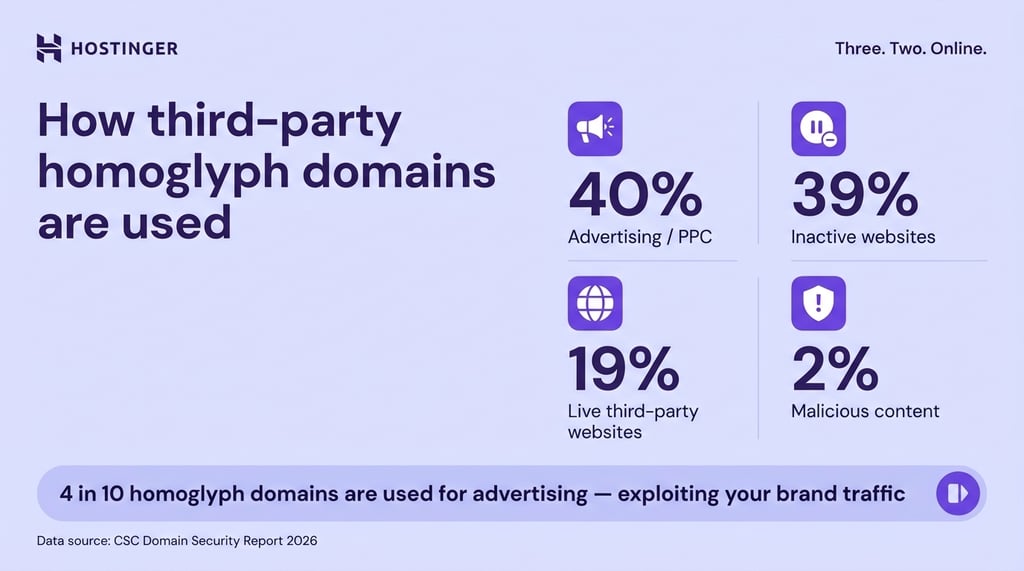
Domain security is a brand protection issue as much as an IT one. Third-party lookalike domains are actively capturing traffic, monetizing confusion, and in some cases targeting customers directly, yet most Global 2000 companies haven’t taken the basic steps to defend against it.
Getting your own domain name
Most domain registrations take just a few minutes. You search for an available name, pick your extension, and complete the process through an accredited registrar.
Domain name prices vary by extension and provider, but the most common TLDs cost a few dollars per year.
If you’re still working out what to call your site, a domain name search lets you check availability across hundreds of extensions at once, filter by category, compare pricing, and register directly without jumping between tools.
And if you’ve never bought a domain before, the step-by-step process of buying a domain name covers everything from picking a registrar to getting your new address configured.
What’s next for global domain registration?
Domain registrations will keep growing. Expanding internet access, new business formation, and a digital economy where having your own domain is basically expected means the 392.5 million registrations counted in Q1 2026 won’t be the peak.
New gTLDs are growing at more than 30% annually, though renewal rates suggest most of those registrations don’t correspond to active websites. The .ai extension is a notable exception, with a 74.1% renewal rate that puts it on par with legacy TLDs and reflects just how much sustained commercial and developer interest there is in the AI space right now.
Emerging markets are another factor to watch. As internet penetration deepens in regions where access has historically lagged, demand for domain names will follow. The aftermarket domain industry is projected to reach $1.17 billion by 2033, a sign that domain names are increasingly being treated as long-term digital assets worth holding onto.

Daniela is an Off-Site SEO Specialist with extensive expertise in link building, digital PR, and content optimization. She has led international outreach campaigns across the U.S., Brazil, France, and Spain, securing high-quality backlinks. Follow her on LinkedIn.