Single-agent vs. multi-agent systems: What’s the difference?
Sep 11, 2026
/
By Ksenija
/
9 min Read
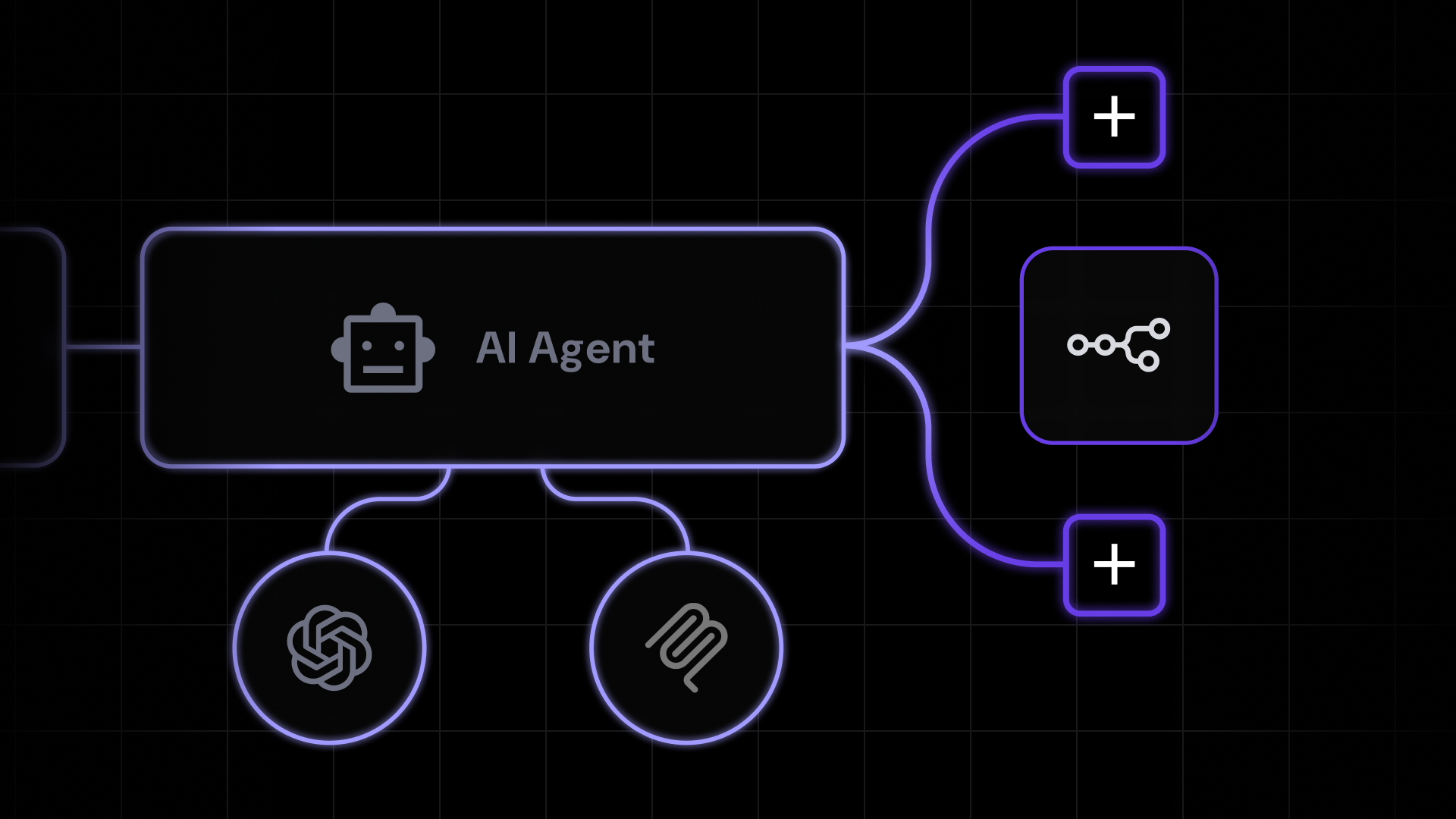
The main difference between a single-agent and a multi-agent system is how AI completes a task.
A single-agent system relies on one AI agent to handle the entire workflow, while a multi-agent system distributes work across multiple specialized agents that coordinate to achieve a shared goal.
Neither approach is universally better. Simple, well-defined tasks can often be completed faster and with fewer resources by a single agent.
As workflows become more complex, however, dividing work between specialized agents can improve reliability, accuracy, and the ability to handle multiple tasks at the same time.
The right choice depends on factors such as task complexity, available computing resources, performance requirements, and how much coordination the workflow requires.
Here’s a quick comparison before we explore each approach in more detail.
| Feature | Single-agent system | Multi-agent system |
| How it works | One AI agent plans and completes the entire task. | Multiple specialized AI agents divide the work and coordinate their results. |
| Best for | Focused, well-defined tasks | Complex, multi-step workflows |
| Complexity | Lower | Higher |
| Accuracy on complex tasks | Can decline as tasks become more involved. | Often higher because specialized agents validate and refine different parts of the workflow. |
| Cost | Lower infrastructure and coordination costs | Higher due to multiple agents and orchestration |
| Speed | Faster for straightforward tasks | Can be faster on large workflows through parallel execution, but coordination adds overhead. |
| Scalability | Limited by a single agent’s workload | Easier to scale by adding or reassigning specialized agents |
| Typical examples | Chatbots, writing assistants, document summarization | Research assistants, software development, customer support, business process automation |
| Main advantages | Simpler architecture, lower cost, easier to deploy | Better specialization, collaboration, and performance on complex tasks |
| Main limitations | One agent handles every responsibility, which can become a bottleneck on larger workflows. | More difficult to design, coordinate, and maintain. |
What is a single-agent system?
A single-agent system assigns one AI agent, typically powered by a large language model (LLM), responsibility for the full task lifecycle.
The same agent receives the request, decides how to approach it, chooses which tools or data sources to use, tracks progress, and produces the final output.
The defining feature is centralized control. Planning, tool selection, intermediate decisions, and error handling all happen within one reasoning process.
The agent may call several external tools, such as a search engine, database, calculator, or API, but those tools only perform actions or return data.
They do not act as independent agents with their own goals or responsibilities.
Centralized control keeps the workflow relatively simple, but it also concentrates every decision in one place.
As tasks become longer, more specialized, or more dependent on parallel work, the agent must manage more context and carry more responsibility on its own.
How a single-agent system works
A single-agent system runs the entire agentic workflow through one decision-making loop. The agent receives a request, determines what information or actions are required, uses available tools, evaluates the results, and returns a final response.
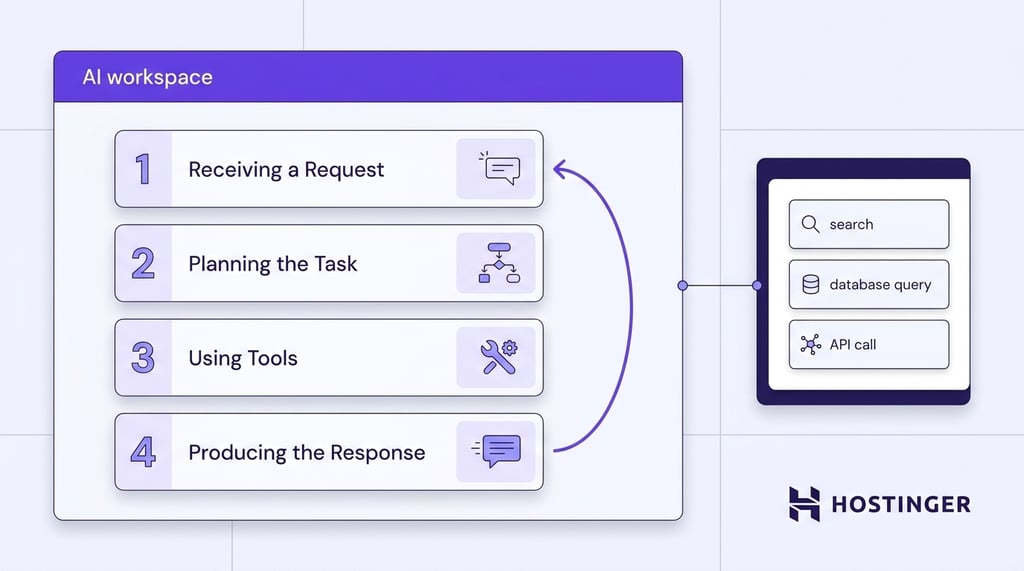
The sequence may contain several steps, but control never passes to another agent.
The workflow usually follows four stages:
- Receiving a request. The process starts with a goal expressed by a user or another application. The agent identifies the task, relevant constraints, and the expected output. A vague request may require clarification, while a precise one can move directly into planning.
- Planning the task. The agent breaks the goal into smaller actions and decides their order. Planning may happen once at the beginning or continue throughout the workflow as new information becomes available. The agent also decides whether its existing context is enough or whether it needs external data.
- Using necessary tools. Tools let the application retrieve information or perform actions the model cannot complete on its own. A tool might search documentation, query a database, calculate a value, send a request to an API, or update a record. The tool returns data, while the agent interprets the result and decides what should happen next.
- Producing the final response. After completing the necessary steps, the agent combines the retrieved information with the original request. It checks whether the result addresses the goal, then generates the final answer or triggers the required action.
A customer support agent shows how the loop works in practice. When a customer asks whether a damaged product can be returned, the agent first identifies the product, purchase date, and reason for the return.
It then searches the company’s documentation, retrieves the relevant policy, and checks whether the order meets the stated conditions.
The same agent evaluates the information and drafts the reply. If the policy allows the return, the response can explain the next steps and provide the correct link.
If important details are missing, the agent can ask for them before continuing. At no point does it hand research, policy interpretation, or response writing to another agent.
The agent can repeat parts of the loop when needed. A failed search may lead to a revised query, an incomplete API response may trigger another tool call, and conflicting information may require an additional check.
The workflow remains single-agent because one agent controls every decision, even when several tools and multiple reasoning steps are involved.
Single-agent system use cases
A single-agent system performs best when the task has a clear objective, limited context, and a predictable sequence of steps.
Many examples of AI agents follow this architecture because one agent can complete the entire workflow from start to finish.
Common use cases include:
- Customer support – Answering questions, retrieving account information, searching company documentation, and drafting responses within the same workflow.
- Document summarization – Reading reports, contracts, or meeting notes and producing concise summaries or key takeaways.
- Question answering – Retrieving information from a knowledge base or a set of documents to answer user queries.
- Information extraction – Identifying and organizing structured data from invoices, forms, emails, or other documents.
- Simple automations – Classifying emails, updating CRM records, routing support tickets, or generating routine reports based on predefined rules.
Pros and cons of single-agent systems
A single-agent system keeps planning, reasoning, tool use, and execution within one AI agent, making the architecture straightforward but placing every decision on a single component.
Single-agent systems: Pros
- Easier to build – One agent is simpler to design, configure, and test because there are no interactions between multiple agents to coordinate.
- Lower operating costs – Running a single agent typically requires fewer compute resources and less orchestration than managing several agents.
- Lower latency – Requests move through one reasoning process without the overhead of passing information between specialized agents.
- Easier monitoring and debugging – When something goes wrong, developers only need to inspect one decision path to identify the cause.
- Simpler infrastructure – A single-agent architecture requires fewer services, communication layers, and workflow management components.
Single-agent systems: Cons
- Context becomes harder to manage as tasks grow – Longer workflows force the agent to keep track of more information, increasing the chance of overlooking important details.
- Complex workflows increase the risk of reasoning errors – As the number of steps and dependencies grows, the agent is more likely to make incorrect assumptions or generate hallucinations.
- Difficult to specialize in different domains – One agent must balance many skills, making it harder to optimize for tasks that require distinct expertise, such as research, coding, or data analysis.
What is a multi-agent system?
A multi-agent system divides a workflow across multiple AI agents, with each agent responsible for a specific part of the task.
One agent might gather information, another analyze it, a third verify the results, and a fourth generate the final output.
Specialization is what distinguishes this architecture. Each agent focuses on a well-defined role, allowing it to solve one part of the problem before passing its work to the next agent or sharing it with other agents in the workflow.
No single agent is expected to reason through every aspect of the task on its own.
Collaboration is coordinated through an orchestrator or predefined workflow that determines which agent should act, when information should be shared, and how the final result is assembled.
The individual agents contribute their expertise, while the workflow ensures those contributions fit together into a coherent outcome.
Breaking work into specialized responsibilities makes multi-agent systems better suited to workflows that involve multiple domains, large amounts of information, or several interconnected decisions.
The trade-off is a more complex architecture, since coordinating multiple agents requires additional planning, communication, and workflow management.
AI agents work by receiving a goal, reasoning about the next action, using tools when necessary, and evaluating the result.
A multi-agent system doesn’t change that process. It simply distributes it across several specialized agents.
How a multi-agent system works
A multi-agent system completes a task by routing different parts of the workflow to agents with separate responsibilities.
An orchestrator coordinates the process, tracks progress, and determines how the individual outputs should be combined.
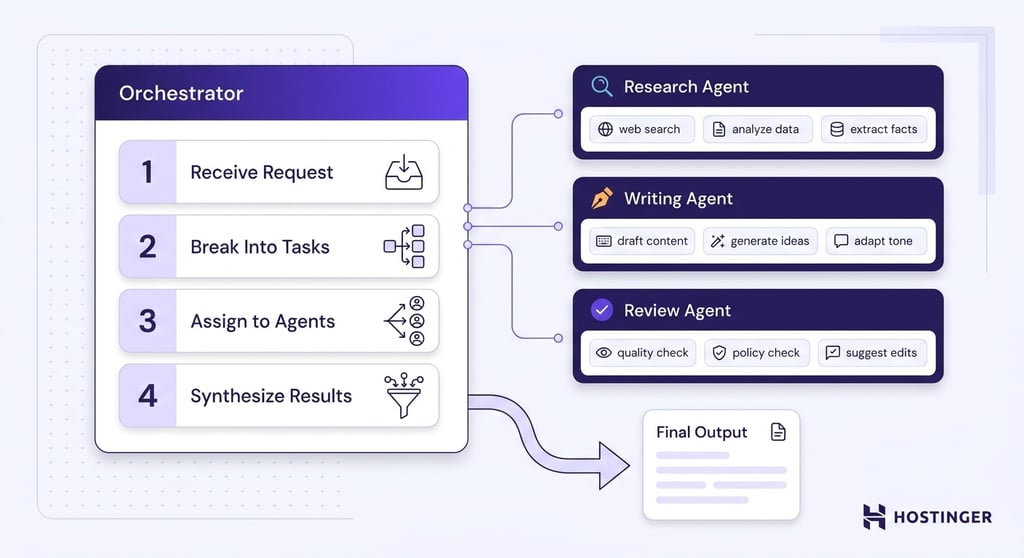
A typical workflow follows four stages:
- The orchestrator receives the request. The process begins with a user goal, such as producing a market analysis or technical report. The orchestrator interprets the request, identifies the required outputs, and breaks the work into smaller tasks.
- Work is assigned to specialized agents. Each task goes to an agent configured for a specific role. The assignment can follow a fixed sequence or change based on earlier results. A research task may need to be finished before writing begins, while independent searches can run at the same time.
- Each agent completes its part of the workflow. Specialized agents use the context, instructions, and tools relevant to their role. They may also send results back for clarification or correction. Because each agent handles a narrower responsibility, it does not need to manage the full task in the same working context.
- The results are combined and reviewed. The orchestrator gathers the outputs, checks whether all required steps are complete, and passes them to the appropriate agent for synthesis. The final response may go through additional review before it is returned to the user.
A team of AI agents preparing a research report is a good example. The researcher gathers sources and extracts relevant evidence.
The writer turns those findings into a structured draft. The fact-checker compares key claims with the source material and flags unsupported statements.
The reviewer checks clarity, consistency, and whether the report answers the original request.
The agents do not simply generate four separate outputs. Each stage depends on the work produced earlier.
A fact-checker may return a questionable claim to the researcher, while the reviewer may ask the writer to clarify a section or remove repetition.
The orchestrator manages those handoffs and keeps the workflow moving toward one final deliverable.
Coordination is the main architectural difference from a single-agent workflow. One agent no longer has to research, write, verify, and edit while carrying every intermediate decision in the same context.
Responsibility is distributed, but the system must now preserve context across handoffs, resolve conflicting outputs, and prevent agents from duplicating work.
A multi-agent system can also run tasks in parallel. Several research agents might investigate different parts of a topic at the same time, reducing the duration of large workflows.
Parallel execution only helps when the tasks are genuinely independent; tightly connected work still needs a clear order and reliable transfer of context.
The final result depends on more than the quality of each agent. Poor task decomposition, vague role boundaries, or incomplete handoffs can undermine the entire workflow.
Effective multi-agent systems, therefore, require clear responsibilities, structured outputs, shared state, and rules for handling errors or disagreements.
Multi-agent system use cases
A multi-agent system is the better choice when a workflow is too broad, specialized, or interconnected for one agent to manage efficiently.
Dividing work between dedicated agents improves coordination, makes complex tasks easier to verify, and allows different parts of the workflow to run independently when appropriate.
Multi-agent systems are well-suited to:
- Research – Different agents can search for information, evaluate sources, summarize findings, and verify claims before producing a final report.
- Software development – Separate agents can plan features, write code, generate tests, review implementations, and identify bugs throughout the development process.
- Complex customer support – One agent can retrieve account information, another interpret company policies, while another drafts or reviews the final response before it reaches the customer.
- Business operations – Workflows that span multiple departments, such as processing orders, approving requests, or onboarding employees, can assign each stage to a dedicated agent.
- Data analysis – One agent can collect data, another clean and transform it, while additional agents perform analysis, generate visualizations, and explain the results.
- Multi-step automation – Long workflows that combine several applications, APIs, and business rules become easier to manage when each agent is responsible for a specific part of the process.
Pros and cons of multi-agent systems
A multi-agent system distributes work across specialized agents, making complex workflows easier to organize while introducing additional coordination and infrastructure requirements.
Multi-agent systems: Pros
- Specialized expertise – Each agent focuses on a specific responsibility, such as research, coding, planning, or quality assurance, allowing it to perform that task more effectively than a general-purpose agent.
- Better performance on complex workflows – Breaking large tasks into smaller components reduces the reasoning burden on individual agents and makes long, multi-step workflows easier to manage.
- Improved verification – One agent can review or validate another agent’s output, helping detect factual errors, inconsistencies, or incomplete work before the final response is delivered.
- Easier scaling – New agents can be added as workflows expand, without redesigning the entire system or increasing the responsibilities of existing agents.
- Isolated permissions and responsibilities – Agents can be given access only to the tools and data required for their role, reducing unnecessary access and making workflows easier to govern.
Multi-agent systems: Cons
- Higher infrastructure costs – Running multiple agents requires more compute resources and an orchestration layer to manage communication and task execution.
- Greater coordination complexity – Agents need clear responsibilities, shared context, and reliable handoffs to avoid duplicated work or conflicting outputs.
- Increased latency – Passing information between agents and waiting for dependent tasks to finish adds overhead, especially in sequential workflows.
- More components to maintain – Every additional agent, tool integration, and workflow rule increases the effort required to test, monitor, and update the system over time.
Multi-agent systems for business owners
Businesses don’t necessarily need to build an agentic AI system from scratch.
While developers can create their own agents, define workflows, and manage orchestration, many businesses simply want the benefits of a multi-agent approach without maintaining the underlying infrastructure.
Hostinger Agent provides a team of specialized AI agents for different business tasks, allowing users to combine their expertise into larger workflows without building the underlying architecture.
Each agent specializes in a different area, such as business strategy, SEO, content creation, or marketing.
Because every agent has its own conversation, you decide what information to carry from one step to the next.
That approach keeps each agent focused on its area of expertise while giving you control over how the workflow develops.
A typical workflow could look like this:
- Business Advisor develops a marketing strategy.
- SEO Agent suggests keywords based on that strategy.
- Content Marketing Agent creates content targeting those keywords.
- Marketing Agent builds a promotion plan for the finished content.
Which should you choose?
Neither architecture is inherently better. The right choice depends on the complexity of the workflow you want to automate.
If one agent can complete the task reliably from start to finish, adding more agents only increases complexity.
When a workflow spans multiple stages or requires different types of expertise, distributing the work across specialized agents becomes a stronger approach.
Choose a single-agent system when you need to:
- Build a first prototype – One agent is quicker to implement, making it easier to validate an idea before expanding the architecture.
- Automate one well-defined task – Customer support, document summarization, information extraction, and similar workflows can be handled efficiently by a single agent.
- Keep infrastructure costs down – One agent requires fewer compute resources and less orchestration.
- Prioritize speed and simplicity – Fewer components reduce latency and make the system easier to monitor, maintain, and debug.
Choose a multi-agent system when your workflow needs to:
- Handle multiple stages – Long processes such as research, content creation, review, and publication benefit from assigning each stage to a dedicated agent.
- Combine different areas of expertise – Specialized agents can focus on planning, coding, analysis, quality assurance, or other domain-specific tasks.
- Verify outputs before delivery – Review and fact-checking agents improve the accuracy and consistency of the final result.
- Overcome context limitations – Dividing a complex workflow into smaller responsibilities reduces the reasoning load on each individual agent.
- Coordinate multiple tools and systems – Different agents can work with separate applications, APIs, or data sources while contributing to the same outcome.
This article is a localized version of Single-agent vs. multi-agent systems: What’s the difference?, originally published in English.

Ksenija is a digital marketing enthusiast with extensive expertise in content creation and website optimization. Specializing in WordPress, she enjoys writing about the platform’s nuances, from design to functionality, and sharing her insights with others. When she’s not perfecting her trade, you’ll find her on the local basketball court or at home enjoying a crime story. Follow her on LinkedIn.