10 best Laravel alternatives for web app development
May 29, 2026
/
By Ksenija
/
15 min Read
Developers compare Laravel alternatives when choosing a framework for web apps, APIs, migrations, or enterprise platforms.
Programming language, hiring availability, deployment workflow, scalability, and long-term maintenance all affect how easily a project grows after launch.
A framework that works well for a startup MVP may create unnecessary complexity for a large engineering team, while an enterprise framework may slow down smaller projects with heavier architecture requirements.
Laravel remains one of the strongest PHP frameworks, combining clean syntax, built-in tooling, and a mature ecosystem that speeds up development.
Authentication, routing, queues, database management, and testing tools are integrated, eliminating extensive setup.
Some teams, however, need stricter architecture, async processing, stronger enterprise tooling, or closer alignment with Python, JavaScript, Java, or C# ecosystems.
Frameworks like Symfony, Django, Rails, NestJS, Express.js, and Spring Boot each solve different operational and development challenges. Some prioritize rapid prototyping, others focus on scalability, modularity, real-time applications, or enterprise infrastructure. Comparing Laravel alternatives helps teams choose a framework that fits both the application requirements and the developers maintaining it long term.
1. Symfony
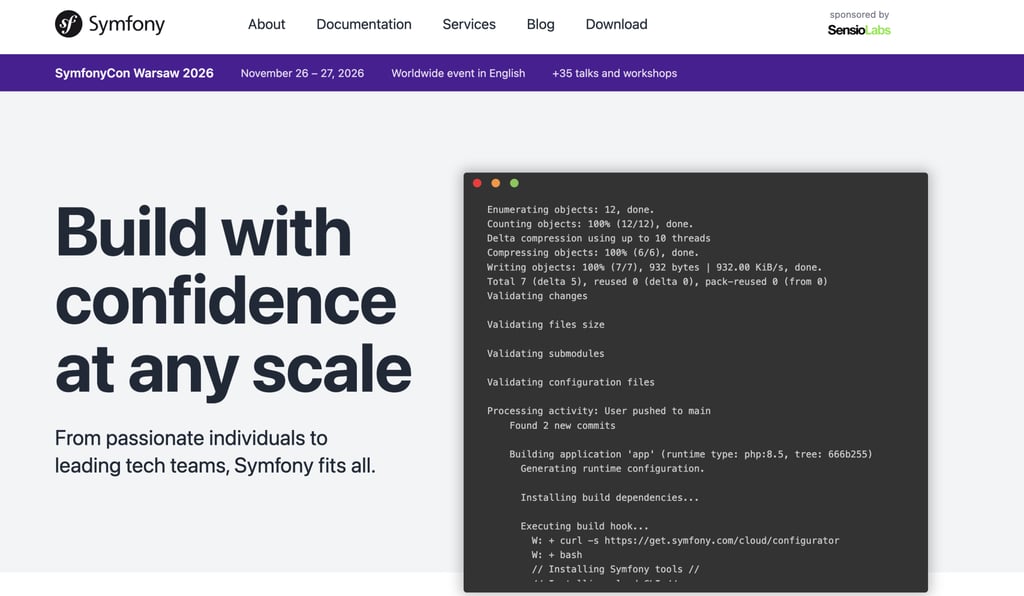
Symfony is the closest Laravel alternative for teams that want to stay with PHP while gaining more control over application architecture.
Laravel focuses on fast development and developer convenience, while Symfony provides a more modular foundation for building large, highly customized applications.
The biggest difference comes from how both frameworks handle structure and configuration. Laravel includes many built-in conventions that reduce setup work and help developers move quickly.
Symfony takes a more explicit approach. Developers configure more parts of the application manually, which creates a steeper learning curve but gives larger teams tighter control over how the system is organized.
Symfony is built around reusable components such as routing, authentication, validation, caching, and form handling.
Developers can use the entire framework or only specific components inside another PHP application.
Laravel itself uses several Symfony components internally, so PHP developers moving from Laravel to Symfony will recognize parts of the ecosystem immediately.
The modular approach makes Symfony a strong fit for enterprise platforms, SaaS products, and applications with complex business logic.
A large ecommerce platform with multiple admin roles, payment integrations, inventory systems, and custom workflows benefits from Symfony’s structure because each part of the application can remain more isolated and easier to maintain over time.
Symfony also has a mature ecosystem with strong documentation, long-term support releases, and deep integration with professional PHP tooling. It supports large codebases and long development lifecycles more comfortably than lighter frameworks.
Laravel still provides a smoother experience for smaller teams and rapid product development. Symfony becomes a better option as application complexity grows and architectural flexibility becomes a bigger priority.
If you want to build a web application with PHP and expect the project to scale across multiple teams or services, Symfony deserves serious consideration among modern php frameworks.
Symfony vs. Laravel quick comparison
Category | Symfony | Laravel |
Language | PHP | PHP |
Best for | Enterprise platforms, complex SaaS applications | Rapid web app development |
Architecture | Modular and highly configurable | Convention-driven and developer-friendly |
Learning curve | Steeper | Easier for beginners |
Built-in tooling | More manual setup | More integrated features out of the box |
Main strength | Flexibility and long-term scalability | Faster development workflows |
2. Django
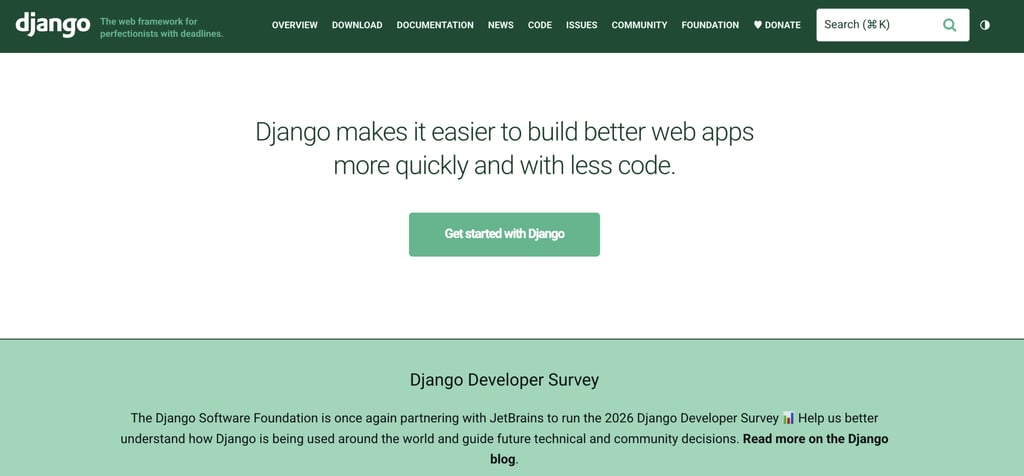
Django is one of the strongest Laravel alternatives for teams that prefer Python and build applications around large amounts of structured data.
The framework is widely used for analytics dashboards, education platforms, internal business systems, content-heavy websites, and SaaS applications with complex database relationships.
A major reason Django fits well with those projects is its batteries-included approach. Routing, authentication, session management, form handling, database tools, and security protections come built into the framework from the start.
Developers who learn Django spend less time evaluating third-party packages and more time building application features.
The built-in structure becomes especially useful when managing application data. Django includes an ORM (Object-Relational Mapping) that lets developers work with databases using Python code instead of writing raw SQL queries for every operation.
Laravel developers moving to Django will recognize a similar model-based workflow, although Django’s ORM follows stricter schema definitions and a more explicit project structure.
Django also uses database models to generate a built-in admin interface automatically. Developers can create internal dashboards with search, filtering, editing, permissions, and user management in a short amount of time.
A content team publishing articles or an ecommerce team updating inventory can manage application data directly from that interface without waiting for developers to build custom internal tools first.
The admin interface is designed for data management and operational workflows rather than public-facing content publishing.
Teams building editorial platforms, customer-facing website builders, or advanced content systems usually extend Django with additional frontend tooling and CMS functionality.
Python’s ecosystem gives Django another advantage for data-heavy and AI-related projects. Teams building recommendation systems, reporting platforms, automation tools, or machine learning features can connect Django more naturally with Python libraries used for analytics and data science.
A SaaS application that combines customer dashboards with predictive insights is one example where Django fits particularly well.
Django works best for structured web applications that depend on backend logic and database management. Laravel remains easier for many PHP-focused teams, especially when PHP hosting compatibility or Laravel’s developer experience already fits the existing workflow.
Django becomes a stronger option when Python already plays a central role in the infrastructure, analytics stack, or product roadmap.
Teams that already work in Python can create a Django project with most of the core development tools available out of the box, which makes onboarding faster than assembling a stack from individual libraries.
Django vs. Laravel quick comparison:
Category | Django | Laravel |
Language | Python | PHP |
Best for | Data-heavy applications, admin systems, analytics platforms | General-purpose web applications |
Admin tooling | Built-in admin interface | Requires separate admin tooling |
Ecosystem focus | Python analytics and AI ecosystem | PHP web development ecosystem |
Application structure | More explicit and schema-driven | More flexible developer experience |
Main strength | Structured backend development and data workflows | Faster PHP application development |
3. Ruby on Rails
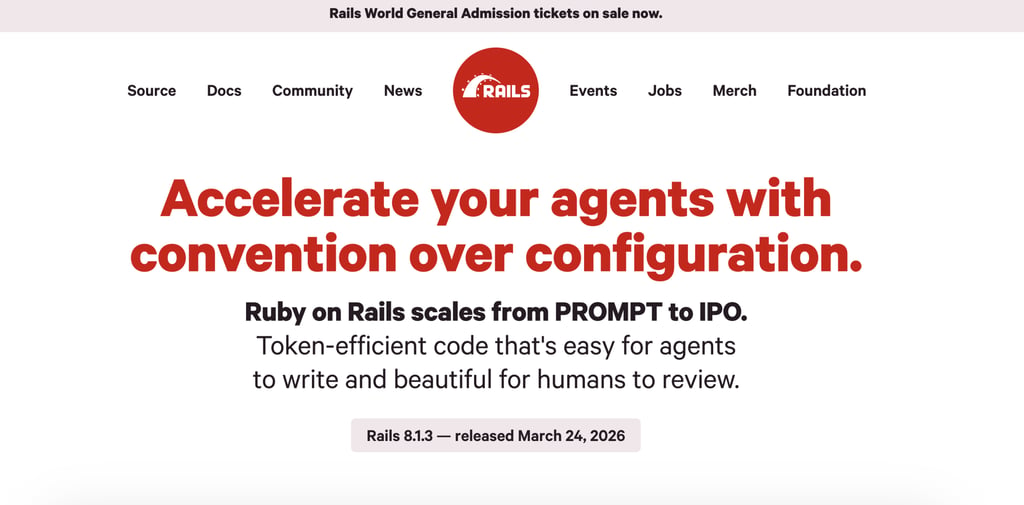
Ruby on Rails is a strong Laravel alternative for startups, SaaS platforms, and web applications that benefit from fast development cycles and convention-driven architecture.
The framework is widely used for MVPs and rapid product development, but Rails also powers large-scale platforms that handle complex backend systems and high traffic workloads.
Rails follows a convention-over-configuration approach. Routing, database structure, controllers, file organization, and application patterns follow standardized conventions, reducing setup work and keeping projects more consistent across development teams.
One of Rails’ biggest strengths is scaffolding. Rails can automatically generate database models, routing, controllers, forms, and basic CRUD functionality – create, read, update, and delete operations – from a single command.
Developers can quickly build working application features without wiring every component together manually. More advanced admin dashboards and operational tools usually require additional packages or custom development beyond the default scaffolding system.
Laravel and Rails both prioritize developer productivity and clean application structure. Rails leans more into framework conventions and automation, while Laravel offers greater flexibility in project organization and ecosystem choices.
Rails has a mature ecosystem of reusable Ruby libraries, called gems, that closely follow the framework’s convention-driven approach.
Developers can extend applications quickly while keeping project structure and workflows relatively consistent across the codebase, helping development teams build applications faster without recreating common backend functionality.
Performance trade-offs become more noticeable in workloads with high concurrency, real-time communication, or infrastructure-heavy scaling requirements.
Large Rails platforms can still scale successfully, but applications handling extremely high throughput often require more infrastructure tuning and optimization than backend systems designed from the start for asynchronous architectures.
Rails works best for SaaS products, content platforms, marketplaces, and business applications that benefit from rapid development and strong framework conventions.
Laravel is more suited for PHP-focused teams because of broader hosting support and a larger PHP ecosystem, while Rails provides a highly productive development environment for structured Ruby applications.
Ruby on Rails vs. Laravel quick comparison:
Category | Ruby on Rails | Laravel |
Language | Ruby | PHP |
Best for | SaaS products, MVPs, rapid prototyping | Modern PHP web applications |
Development style | Convention-over-configuration | Flexible conventions |
Productivity tools | Strong scaffolding and automation | Integrated tooling and developer ergonomics |
Ecosystem | Ruby gems | PHP Composer packages |
Main strength | Fast product iteration | Balanced flexibility and tooling |
4. Node.js
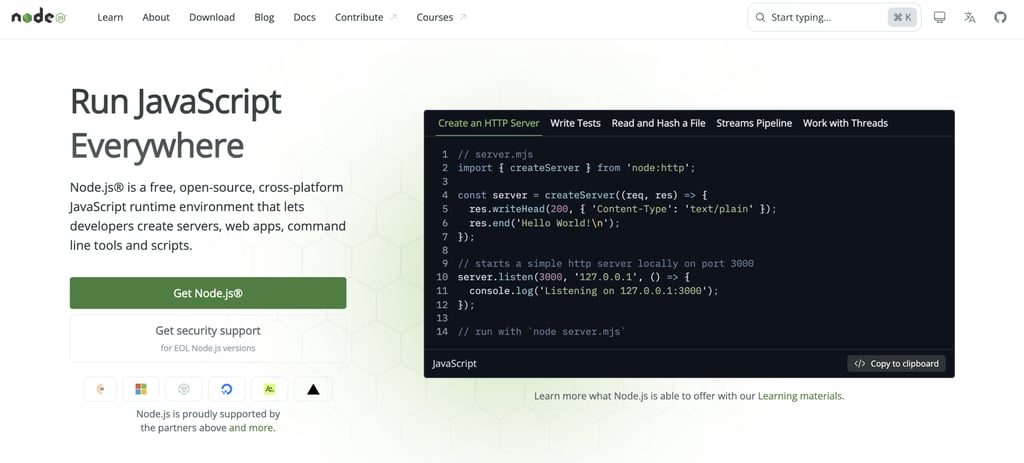
Node.js is a popular Laravel alternative for teams that want to build web applications and APIs with JavaScript across the entire stack.
The runtime is widely used for real-time applications, streaming platforms, chat systems, collaborative tools, and APIs that handle large numbers of simultaneous connections.
Unlike Laravel, Node.js is not a full framework. Node.js is a JavaScript runtime environment that lets developers run JavaScript on the server, not just in the browser.
Developers usually pair Node.js with frameworks and libraries such as Express.js or NestJS to build complete backend applications.
One of Node.js’s biggest advantages is the consistency between frontend and backend languages.
A team using React, Vue, or Angular on the frontend can also use JavaScript or TypeScript on the backend, rather than switching between JavaScript and PHP.
Shared language simplifies development workflows and makes it easier for frontend and backend developers to collaborate on the same codebase.
Node.js’s asynchronous request handling is well-suited to applications that require real-time updates, streaming connections, and large numbers of concurrent requests. Chat platforms, collaboration tools, live dashboards, and event-driven APIs are common examples.
Traditional backend frameworks often process requests in a more sequential way, while Node.js handles tasks asynchronously. An asynchronous system does not wait for one operation to finish before starting another.
This event-driven model works especially well for real-time messaging apps, live dashboards, multiplayer platforms, and APIs that manage large numbers of active users.
The npm ecosystem is another major reason developers choose Node.js. npm is the default package manager for JavaScript and includes millions of reusable packages for authentication, APIs, payments, testing, logging, real-time communication, and database integrations.
Developers can assemble applications quickly because many common backend features already exist as maintained packages.
The trade-off comes from flexibility. Laravel provides a more structured experience with built-in conventions, integrated tooling, and clearer defaults for authentication, validation, database management, and application architecture.
Modern VPS platforms, PaaS services, and Node.js-optimized hosting environments simplify Node.js application deployment workflows, though production environments still require process management, reverse proxies, and monitoring configuration.
Node.js vs. Laravel quick comparison;
Category | Node.js | Laravel |
Language | JavaScript | PHP |
Best for | Real-time apps, APIs, streaming services | Traditional web apps and APIs |
Architecture | Event-driven and asynchronous | Request-response framework architecture |
Frontend/backend stack | Same language across full stack | Separate frontend and backend languages |
Deployment | Requires runtime management | Simpler shared hosting support |
Main strength | Real-time and async workloads | Structured full-stack web development |
5. Express.js
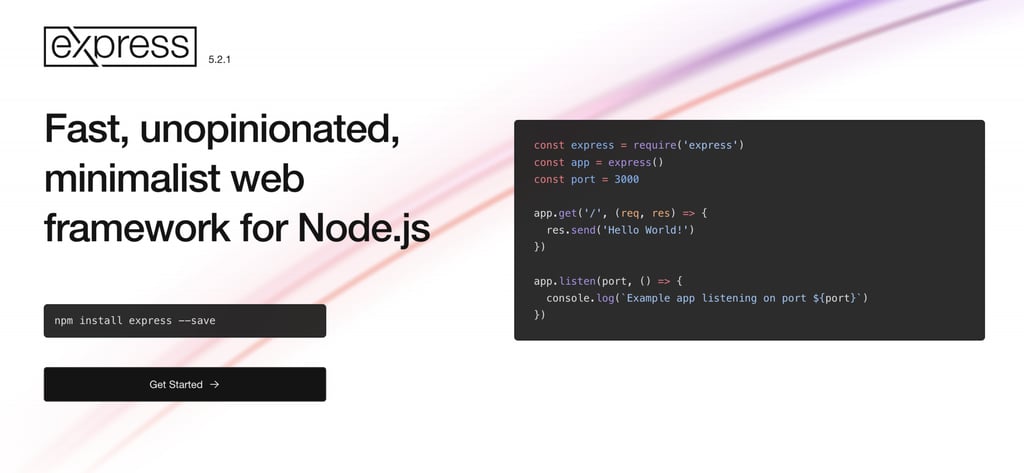
Express.js is a lightweight Node.js framework built for APIs, microservices, and custom backend systems. Developers choose Express.js when they want direct control over backend architecture and application structure.
Express.js keeps the core framework much smaller than Laravel. Routing and request handling are included. Everything else – authentication systems, database layers, API structure, and validation tools – is the development team’s choice.
Custom backend environments benefit from that level of control. A company running several microservices may use different databases, deployment pipelines, or communication patterns across services.
Express.js allows teams to shape each service around its technical requirements without carrying unnecessary framework layers.
JavaScript teams also benefit from using the same language across the frontend and backend.
Developers working with React, Vue, or Angular can build APIs and backend services with JavaScript as well. Shared tooling and shared data structures simplify collaboration across the application stack.
Additional flexibility creates more setup and maintenance work. Developers must evaluate and maintain third-party packages for authentication, testing, validation, and database access.
Engineering teams also need stronger internal standards, as Express.js imposes few architectural conventions by default.
Express.js works best for teams building lightweight APIs, real-time services, and highly customized backend systems.
Laravel remains a stronger fit for developers who want faster setup, integrated tooling, and a more structured development experience for traditional web applications.
Express.js vs. Laravel quick comparison:
Category | Express.js | Laravel |
Language | JavaScript | PHP |
Best for | Lightweight APIs and microservices | Full-stack web applications |
Framework structure | Minimal and flexible | More opinionated and integrated |
Built-in features | Limited | Extensive built-in tooling |
Setup complexity | More architectural decisions | Faster default setup |
Main strength | Fine-grained backend control | Faster development with built-in features |
6. NestJS
NestJS is a structured Node.js framework built for scalable APIs, enterprise platforms, and large TypeScript-based backend systems.
The framework combines Node.js performance with stronger architectural conventions, which helps developers manage complex applications more consistently over time.
Laravel provides PHP developers with integrated tooling and a clear application structure. NestJS brings a similar level of organization to the Node.js ecosystem through modules, dependency injection, and built-in testing support.
NestJS organizes applications into separate modules for authentication, payments, notifications, user management, and other business features.
Each module contains its own controllers, services, and logic, which keeps large codebases easier to maintain as applications expand.
A backend platform with billing systems, user permissions, analytics, and API integrations benefits from that separation because developers can update one part of the application without affecting unrelated services.
Dependency injection is built into the framework as well. It allows application components to communicate through reusable interfaces instead of direct connections between services.
Developers can test features independently, replace services more easily, and keep backend logic cleaner across large projects.
NestJS is also built around TypeScript, which adds static typing to JavaScript. Clearer data structures and stricter type checking help developers catch errors earlier during development.
Large engineering teams benefit from that consistency because shared code remains easier to understand and maintain across long development cycles.
Testing tools are integrated directly into the framework. NestJS includes built-in patterns for unit testing and end-to-end testing, which help teams maintain more predictable testing workflows as backend systems grow.
The stronger architecture creates more setup work compared to lightweight Node.js frameworks such as Express.js. Small APIs and simple backend services may not need that level of structure during early development stages.
NestJS works best for enterprise APIs, scalable backend systems, and long-term applications maintained by larger engineering teams.
Laravel remains easier for rapid PHP development and traditional web applications, while NestJS provides stronger architectural control for complex TypeScript-based platforms.
NestJS vs. Laravel quick comparison:
Category | NestJS | Laravel |
Language | TypeScript | PHP |
Best for | Enterprise APIs and scalable backend systems | Rapid web application development |
Architecture | Modular and strongly structured | Structured but more lightweight |
Type safety | Strong TypeScript integration | PHP typing support |
Testing support | Integrated testing architecture | Strong testing ecosystem |
Main strength | Long-term maintainability for large Node.js systems | Faster onboarding and development speed |
7. Spring Boot
Spring Boot is a Java framework built for enterprise platforms, large backend systems, and applications with complex business logic.
Companies use Spring Boot for banking systems, ecommerce platforms, logistics software, SaaS infrastructure, and internal business tools that need long-term scalability and strict operational control.
Laravel focuses on rapid web development and developer convenience. Spring Boot focuses more on system architecture, service coordination, and large-scale backend infrastructure.
Spring Boot organizes applications into separate services and layers, which helps large engineering teams manage complex systems more cleanly.
A company that runs payment processing, inventory management, reporting, authentication, and customer APIs can separate those functions into independent services that scale and deploy independently.
Like NestJS, Spring Boot uses dependency injection as a core architectural pattern, which helps large engineering teams manage complex service interactions cleanly.
Security is another major strength of the Spring ecosystem. It includes built-in tools for authentication, authorization, session management, and role-based access control.
Applications that process financial records, healthcare data, or private business information benefit from those controls because developers can enforce stricter security policies across the platform.
Spring Boot also works well for microservices and cloud deployments. A microservices architecture splits an application into smaller, independent services connected through APIs.
An ecommerce platform may separate payments, shipping, inventory, and customer accounts into different services so each one can scale independently.
Spring Boot integrates cleanly with Kubernetes, Docker, AWS, Azure, and Google Cloud, helping teams manage large, distributed systems more efficiently.
The framework requires more setup and stronger Java knowledge than Laravel. Small projects and early-stage products may not benefit from the additional architectural complexity.
Spring Boot works best for enterprise applications, large APIs, and backend systems maintained by multiple engineering teams over long development cycles.
Laravel remains easier for rapid application development and smaller web platforms, while Spring Boot provides stronger infrastructure support for complex Java-based systems.
Spring Boot vs. Laravel quick comparison:
Category | Spring Boot | Laravel |
Language | Java | PHP |
Best for | Enterprise systems and microservices | General-purpose web applications |
Infrastructure focus | Cloud-native and distributed systems | Simpler deployment workflows |
Architecture | Highly structured enterprise architecture | Developer-focused framework design |
Deployment complexity | Higher | Lower |
Main strength | Large-scale backend infrastructure | Faster application delivery |
8. ASP.NET Core
ASP.NET Core is a strong Laravel alternative for enterprise APIs, cloud platforms, and large business applications running on Microsoft platforms.
Laravel gives developers a faster path for traditional PHP web applications, while ASP.NET Core focuses more on large-scale backend systems, long-term platform support, and enterprise infrastructure integration.
The biggest difference is the language stack. Laravel uses PHP, which keeps development approachable and hosting widely accessible. ASP.NET Core uses C#, a strongly typed language designed for large applications with stricter project structure and clearer data validation.
Large engineering teams benefit from that structure because shared codebases remain easier to maintain as backend systems grow.
ASP.NET Core also integrates closely with Microsoft infrastructure. Applications connect directly to Azure services, Active Directory, Microsoft SQL Server, and enterprise identity systems through a single ecosystem.
Development, deployment, authentication, and infrastructure management stay more centralized across large business environments.
Tooling is another major difference between the frameworks. Laravel provides a clean developer experience with integrated PHP tooling and a large package ecosystem.
ASP.NET Core integrates with Visual Studio, Azure DevOps, automated testing systems, debugging tools, and enterprise deployment pipelines, all designed for large development teams managing multiple applications and services.
Performance and scalability are stronger priorities in ASP.NET Core’s architecture. The framework supports asynchronous processing, real-time communication, containerized deployments, and high-concurrency APIs.
Applications handling financial transactions, internal business operations, or large numbers of active users can scale more predictably across cloud infrastructure.
Security and long-term maintenance follow a similar enterprise-focused approach. ASP.NET Core integrates directly with Microsoft identity management and centralized access control systems.
Microsoft’s long-term support releases also help engineering teams maintain business-critical applications with more predictable upgrade cycles.
ASP.NET Core is best suited for enterprise APIs, cloud-native applications, and backend systems developed by C# teams within Microsoft-based infrastructure environments.
Laravel remains easier for rapid PHP development and smaller web platforms, while ASP.NET Core provides stronger integration with enterprise tooling, Microsoft services, and long-term infrastructure management.
ASP.NET Core vs. Laravel quick comparison:
Category | ASP.NET Core | Laravel |
Language | C# | PHP |
Best for | Microsoft-based business platforms and APIs | PHP web applications |
Ecosystem | Azure and Microsoft infrastructure | PHP hosting ecosystem |
Tooling | Enterprise development tooling | Simpler developer workflows |
Scalability focus | Large cloud-native systems | Flexible full-stack development |
Main strength | Enterprise integration and long-term support | Faster PHP development |
9. FastAPI
FastAPI is a modern Python framework built for APIs, machine learning services, and high-performance asynchronous applications.
Laravel provides a full web application framework with built-in tools for routing, authentication, templating, and database management, while FastAPI focuses primarily on API development and backend services.
The biggest difference comes from scope and architecture. Laravel supports full-stack web development through integrated frontend tools, session handling, queues, authentication systems, and ORM features.
FastAPI keeps the framework much smaller and more focused on API performance, request handling, and data validation.
FastAPI is built on ASGI and supports both synchronous and asynchronous request handlers. The async pattern lets applications handle many requests efficiently in parallel, while synchronous handlers continue to work as expected.
APIs connected to machine learning models, real-time analytics systems, streaming services, or external APIs benefit from that architecture because the server can continue processing new requests while waiting for slower operations to finish.
Python’s ecosystem also makes FastAPI a strong fit for AI and data-driven applications. Developers can connect APIs directly to machine learning libraries, analytics tools, automation systems, and Python-based data science workflows.
A recommendation engine, fraud detection service, or AI-powered chatbot backend fits naturally into that environment.
FastAPI also simplifies API development by automatically generating documentation. The framework generates interactive API documentation directly from the application code, helping frontend developers, backend teams, and external partners test endpoints and understand API behavior more quickly.
Type hints are another major part of the framework. They allow developers to define expected data structures directly in Python code.
FastAPI uses those definitions for request validation, API documentation, and error handling automatically. Developers spend less time writing repetitive validation logic because the framework handles much of that process internally.
The narrower scope of the framework creates fewer built-in tools for full web application development than Laravel.
Authentication systems, admin panels, frontend rendering, and broader application structure require more manual setup or additional frameworks around FastAPI.
FastAPI works best for APIs, machine learning platforms, async workloads, and backend services connected to Python-based data systems.
Laravel remains a stronger fit for full-stack web applications and traditional backend platforms that benefit from integrated tooling and broader framework features.
FastAPI vs. Laravel quick comparison:
Category | FastAPI | Laravel |
Language | Python | PHP |
Best for | APIs, AI services, async workloads | Full-stack web applications |
Framework scope | API-focused | Full web framework |
Performance model | Asynchronous request handling | Traditional request-response workflows |
API tooling | Automatic API documentation | Broader application tooling |
Main strength | High-performance Python APIs | Integrated web application development |
10. CodeIgniter
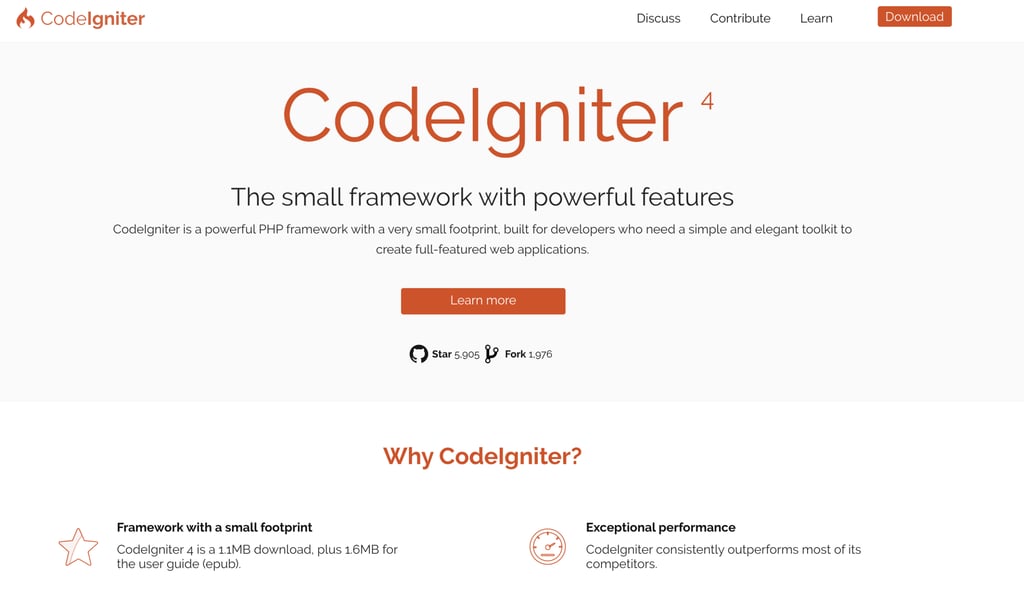
CodeIgniter is a lightweight PHP framework built for small web applications, simple business tools, and projects that need minimal setup.
Laravel provides a larger ecosystem with integrated developer tools and modern framework features, while CodeIgniter focuses on speed, simplicity, and low server overhead.
The biggest difference is framework complexity. Laravel includes built-in authentication, queues, ORM support, task scheduling, caching, and advanced developer tooling designed for modern application workflows.
CodeIgniter keeps the framework much smaller and closer to core PHP, reducing setup time and resource usage. CodeIgniter 4, the current version, modernizes the framework with namespaces, PSR-4 autoloading, and Composer integration while keeping the lightweight footprint.
The simpler structure makes CodeIgniter easier to run on smaller hosting environments. Applications with limited traffic, basic CRUD functionality, or lightweight backend requirements can perform well without the additional infrastructure many larger frameworks expect.
A small company building an internal dashboard, booking form, or inventory tool may prefer a lighter framework that loads quickly and requires fewer dependencies.
CodeIgniter also has a gentler learning curve for developers familiar with traditional PHP development.
The framework uses straightforward project organization and minimal configuration, helping developers build applications quickly without learning a large ecosystem of integrated tools and conventions.
Laravel provides more built-in functionality for modern application development. Authentication systems, database migrations, queues, API tooling, testing support, and package integrations are more mature and more tightly integrated into the framework.
Larger projects with multiple developers, growing infrastructure needs, or complex business logic usually benefit from Laravel’s broader ecosystem and stronger architectural structure.
CodeIgniter works best for lightweight PHP applications, smaller projects, and teams that want fast setup with minimal overhead.
Laravel remains the stronger choice for scalable web applications, modern backend systems, and long-term projects that depend on integrated tooling and a larger development ecosystem.
CodeIgniter vs. Laravel quick comparison:
Category | CodeIgniter | Laravel |
Language | PHP | PHP |
Best for | Small applications and lightweight PHP projects | Modern scalable web applications |
Framework size | Lightweight | Larger ecosystem |
Learning curve | Simpler | More feature-rich |
Resource usage | Lower | Higher |
Main strength | Fast setup and low overhead | Rich tooling and scalability |
How to choose the best Laravel alternative
Start by looking at the programming language your team already uses. Choosing a framework that aligns with your existing stack reduces onboarding time, simplifies deployment, and makes long-term maintenance more manageable.
Symfony and CodeIgniter fit PHP environments with existing PHP hosting and deployment workflows.
Django and FastAPI connect naturally with Python-based analytics, automation, and machine learning systems.
Express.js and NestJS fit JavaScript and TypeScript stacks that already use Node.js across the frontend and backend.
Next, match the framework to the type of application you are building. Django fits data-heavy platforms with dashboards, reporting systems, and admin workflows.
FastAPI works well for APIs, machine learning services, and asynchronous workloads. NestJS fits structured backend systems and scalable TypeScript APIs.
Express.js works better for lightweight APIs and custom backend architectures with fewer framework conventions.
Project size should influence the level of framework structure you choose. Small business tools, internal dashboards, and MVPs benefit from lightweight frameworks with faster setup and fewer dependencies.
Large SaaS platforms and enterprise applications usually need stronger architectural conventions, integrated testing workflows, and clearer project organization to keep development manageable across multiple teams.
Infrastructure requirements are equally important. PHP frameworks such as Laravel, Symfony, and CodeIgniter run on widely available hosting environments with relatively simple deployment workflows.
Java, .NET, and larger Node.js applications often require more infrastructure planning around containers, cloud orchestration, process management, and scaling strategies.
Enterprise environments usually prioritize long-term maintainability, centralized security management, and infrastructure integration.
Spring Boot fits Java-based systems with complex business logic and microservices architectures. ASP.NET Core works naturally inside Microsoft environments that already use Azure, Active Directory, and Microsoft SQL Server.
Team experience should shape the decision as well. Laravel and Rails provide faster onboarding and more approachable developer workflows for smaller teams.
NestJS, Spring Boot, and ASP.NET Core introduce more architectural structure and stricter patterns, which become more valuable as engineering teams and backend systems grow.
Frameworks with mature ecosystems, stable release cycles, strong documentation, and large developer communities become easier to support over time.
A framework choice that is productive during early development can create operational overhead later if deployment, scaling, or hiring becomes difficult.
The best Laravel alternative is the one that fits your application requirements, infrastructure environment, and development workflow without adding unnecessary complexity.
Deploy your web app with confidence
Choose a hosting environment based on the framework and infrastructure your application actually needs.
PHP frameworks such as Laravel, Symfony, and CodeIgniter run well on traditional hosting environments with a relatively simple setup.
Node.js applications require runtime management for long-running processes. Django and FastAPI projects depend on Python environments and application servers such as Gunicorn or Uvicorn.
Spring Boot and ASP.NET Core applications often require more advanced cloud or container-based deployment workflows.
Plan for future infrastructure needs before launching the application. A simple Laravel backend may later need real-time Node.js services, background workers, FastAPI endpoints for AI features, or separate microservices as traffic grows.
Moving between hosting environments later increases deployment complexity and operational overhead.
Choose a hosting platform that supports multiple frameworks and deployment models from the beginning.
Hostinger’s web app hosting platform supports PHP, Node.js, Python, and other modern backend environments within the same infrastructure, which makes it easier to expand applications without rebuilding deployment workflows later.
Look for deployment tools that reduce manual infrastructure work. GitHub integration and automatic deployments simplify application updates by letting you update your application directly from your repository.
IDE-based deployments through VS Code, Cursor, Claude Code, and GitHub Copilot help developers deploy applications without switching between multiple platforms and dashboards.
Prioritize hosting features that improve stability and maintenance over time. Isolated environments prevent applications from interfering with each other across shared workloads.
Scalable CPU, RAM, and NVMe storage resources make traffic spikes easier to handle without rebuilding the server stack.
Global CDN support and multiple server locations also improve application performance for distributed audiences.
Security and operational tooling should also be part of the decision. Managed SSL certificates, daily backups, DDoS protection, web application firewall tools, and monitoring systems reduce routine maintenance work and help teams manage production environments more safely.
The right hosting foundation keeps deployment simpler as your application stack, traffic, and infrastructure requirements continue to grow.

This article is a localized version of 10 best Laravel alternatives for web app development, originally published in English.

Ksenija is a digital marketing enthusiast with extensive expertise in content creation and website optimization. Specializing in WordPress, she enjoys writing about the platform’s nuances, from design to functionality, and sharing her insights with others. When she’s not perfecting her trade, you’ll find her on the local basketball court or at home enjoying a crime story. Follow her on LinkedIn.