What are multi-agent systems?
Sep 11, 2026
/
By Ksenija
/
11 min Read
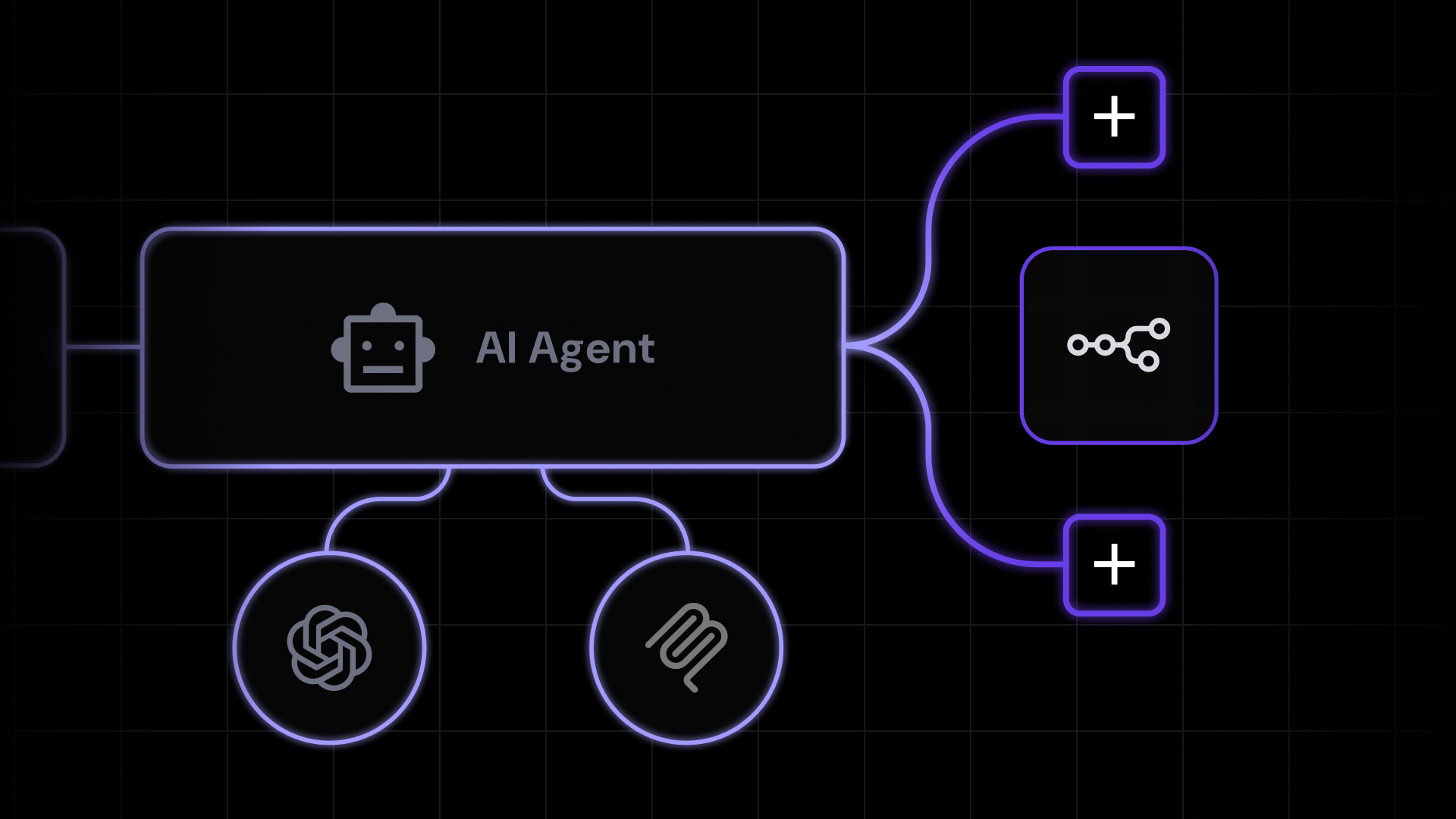
A multi-agent system is a software architecture in which multiple autonomous agents work toward a shared goal.
Each agent is responsible for a specific task, and together they complete a larger workflow.
Splitting work across multiple agents allows the system to tackle complex problems more effectively.
A large task can be divided into smaller parts, with each agent focusing on the work it is designed to perform. Some tasks can run at the same time, while others build on the output of previous steps.
Multiple agents can only function as one system if they stay coordinated throughout the workflow.
They exchange information, share progress, and pass results to one another as work moves forward.
Coordination ensures every task contributes to the same objective and helps prevent duplicated effort, missing information, or conflicting results.
How do multi-agent systems work?
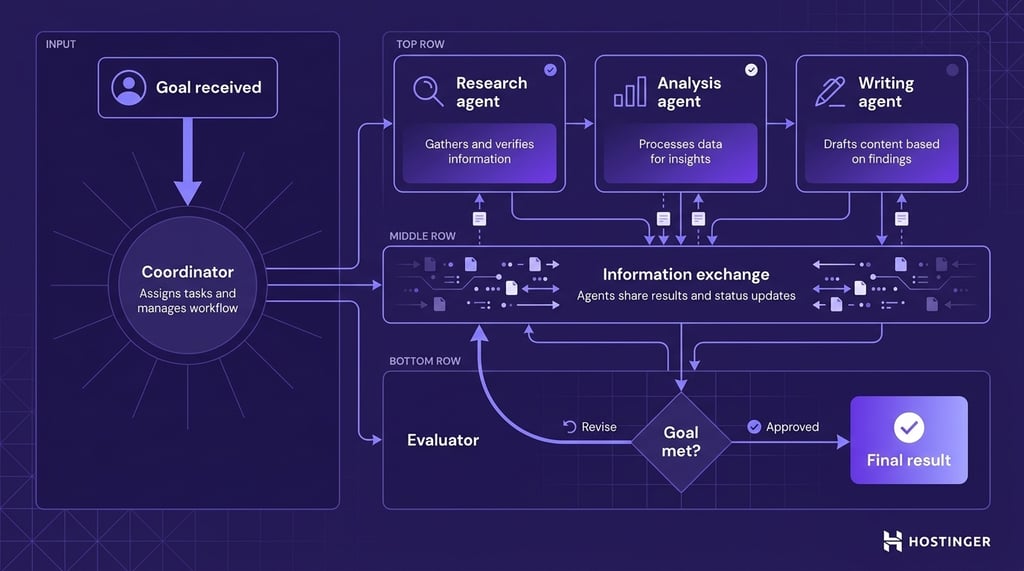
A multi-agent system works by dividing a goal into smaller tasks, coordinating the work between specialized AI agents, and combining their outputs into a final result.
A typical workflow follows these steps:
- The system receives a goal. A user, application, or control agent submits a task for the system to complete.
- The work is divided. The system breaks the goal into smaller subtasks and assigns them to agents based on their roles or capabilities.
- Agents complete their tasks. Each agent uses the available data, tools, or large language models to perform its assigned work.
- Agents exchange information. Agents share intermediate results, status updates, requests, or other information needed to keep the workflow moving.
- The system evaluates progress. A coordinator, supervisor, or predefined rules check whether the outputs meet the required objective and determine whether additional work is needed.
- The workflow continues or stops. Agents revise their outputs, complete any remaining tasks, or end the workflow once the goal or stopping condition has been reached.
The exact sequence depends on the system’s architecture. Some multi-agent systems rely on a central coordinator to assign work and evaluate results, while others allow agents to communicate and make decisions directly.
Many AI agent builder tools provide these coordination patterns out of the box, allowing developers to define agents, workflows, and communication rules without implementing every orchestration mechanism from scratch.
Multi-agent workflow example
Let’s say that a software company wants to launch a project management platform for small businesses.
Before committing to development, the company needs a market research report that answers four questions: Who are the main competitors? What features do customers value most? How are similar products priced? What market trends or risks could affect demand?
A multi-agent system can answer those questions by dividing the project into seven specialized stages:
- Coordinator defines the project. The coordinator sets the report’s scope, identifies the target audience, specifies the required sections, and establishes the deadline before assigning work to the rest of the system.
- Planner creates the research plan. The planner breaks the project into separate tasks, including competitor analysis, customer research, pricing analysis, and market trends. In some implementations, specialized marketing agents may also contribute campaign planning, audience segmentation, or messaging recommendations based on the research findings.
- Research agents collect information in parallel. One agent analyzes competitors’ products and feature sets, another reviews customer feedback to identify common pain points, a third compares subscription pricing across the market, and another examines industry reports to estimate market growth. Each agent documents its findings and supporting sources.
- The analysis agent combines the findings. The agent compares results from every research task, identifies recurring themes, resolves conflicting information, and flags gaps that require additional investigation.
- The writing agent prepares the report. The verified findings are organized into a structured report with sections for competitors, customer demand, pricing, market opportunities, and potential risks.
- The reviewer agent validates the final draft. The reviewer checks that every conclusion is supported by evidence, confirms the report is internally consistent, and verifies that all requested sections have been completed.
- The coordinator delivers the completed report. If the report satisfies the original requirements, the workflow ends. Otherwise, the coordinator returns specific sections for revision before approving the final version.
This workflow shows why multiple agents are useful for complex projects. Independent research tasks can run simultaneously, reducing the overall completion time.
Each stage also benefits from different instructions and evaluation criteria, allowing research, analysis, writing, and review to be optimized separately.
An independent review provides an additional quality check before the report reaches the final decision-maker.
Market research is just one of many practical AI agent examples, with similar workflows used for software development, cybersecurity, customer support, and financial analysis.
What are the core components of a multi-agent system?
The core components of a multi-agent system are the architectural decisions that define how agents work together.
Every design combines three elements: agent roles, control models, and organizational structures.
Together, they determine what each agent does, who makes system-level decisions, and how work moves through the system.
Agent roles
Agent roles define the responsibilities assigned to each agent in a multi-agent system. A role determines the type of work an agent performs, such as planning tasks, gathering information, reviewing outputs, or coordinating the overall workflow.
The following examples show how common roles contribute to a multi-agent system:
Role | Purpose | Example |
Planner | Breaks goals into tasks | Creates a research plan |
Worker | Completes assigned work | Writes content |
Researcher | Collects information | Finds relevant sources |
Reviewer | Checks outputs | Verifies quality |
Coordinator | Routes work | Assigns tasks |
Monitor | Detects failures | Watches workflow execution |
Smaller systems often combine multiple roles into a single agent. For example, one agent might plan the work, conduct research, and produce the final output, while larger systems assign those responsibilities to separate agents.
Control models
Control models define how a multi-agent system makes decisions and coordinates work between agents.
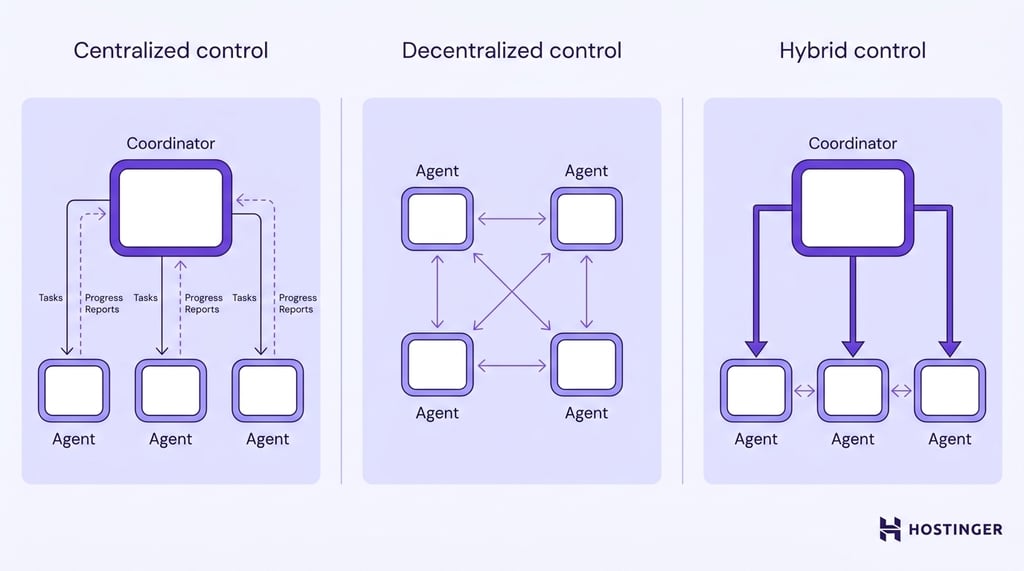
The chosen model determines whether one agent directs the workflow, agents coordinate with one another, or decision-making is shared.
Centralized control places decision-making in the hands of a single coordinator or supervisor. For example, a coordinator agent assigns tasks to research agents, reviews their progress, and decides when the workflow moves to the next stage.
Decentralized control allows agents to make decisions independently by communicating directly with one another.
A research agent that discovers missing information can request additional data from another research agent without waiting for approval from a central coordinator.
Hybrid control combines both approaches. A coordinator manages the overall workflow and final approval, while individual agents collaborate directly to exchange information or resolve dependencies during execution.
Organizational structures
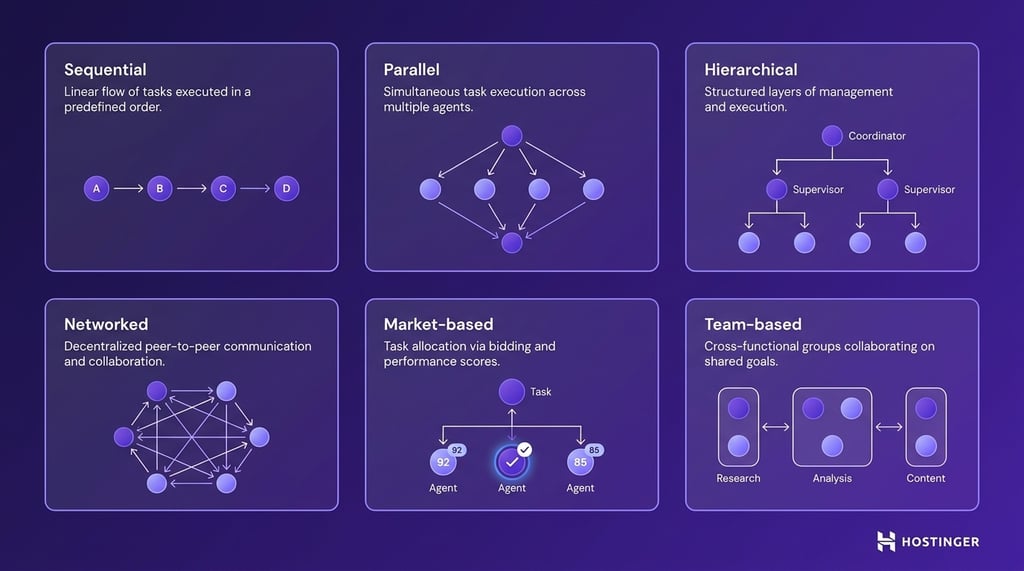
Organizational structures define how tasks, information, and outputs move between agents during a workflow.
The structure determines which agents act first, which tasks can run at the same time, and where results must go before the system can continue.
A sequential structure passes work from one agent to the next in a fixed order. Each stage depends on the output of the previous one, so the workflow cannot advance until the current task is complete.
An approval process might send a draft from a writing agent to a reviewer agent and then to a coordinator for final acceptance.
Sequential structures are easy to follow, but one delayed or failed step can block the entire workflow.
A parallel structure allows several agents to work on independent tasks simultaneously. In a market research workflow, separate agents could analyze competitors, pricing, customer feedback, and industry trends simultaneously.
Once each agent finishes its task, an analysis agent combines the findings into a single view, then identifies patterns, resolves conflicting evidence, or prepares the final report.
Parallel execution can shorten the workflow, but the system still needs a clear method for merging results and handling contradictory information.
A hierarchical structure organizes agents into levels of responsibility. A top-level coordinator defines the objective, intermediate supervisors manage separate workstreams, and worker agents complete individual tasks.
Large projects use this structure when one coordinator cannot manage every agent directly. The hierarchy reduces the number of direct connections each agent must maintain, making coordination easier as the system grows.
The trade-off is that decisions and updates must move through supervisory layers, which can slow the workflow and create bottlenecks if a coordinator becomes overloaded.
A networked structure allows agents to exchange work and information directly across the system. No fixed chain determines every interaction.
An agent can contact another agent when it needs data, expertise, or help resolving a dependency.
Distributed environments benefit from this structure because agents can respond to local conditions without routing every decision through a central path.
On the downside, direct communication makes the workflow harder to trace when many agents interact at once.
A market-based structure assigns work through competition or negotiation between agents.
When a new task becomes available, agents evaluate whether they can complete it based on predefined criteria such as available resources, execution time, or estimated cost.
The system then assigns the task to the most suitable agent. Resource allocation and scheduling systems use this structure to adapt task assignments as workloads and resource availability change over time.
Every assignment, however, requires the system to evaluate competing agents before selecting one, adding extra coordination that may not be worthwhile for simple or short-lived tasks.
A team-based structure organizes agents into small groups that share responsibility for a larger objective. Each team focuses on one part of the workflow, such as research, data analysis, or content creation, while coordinating internally before passing its results to other teams.
Dividing work into teams reduces the coordination required between individual agents and allows specialized groups to tackle complex projects more efficiently.
The trade-off is that teams still need a clear process for sharing information and resolving dependencies across the broader system.
How do agents communicate?
Agents communicate by exchanging structured messages that move work through a workflow.
When an agent completes a task, encounters a problem, or needs additional information, it generates a message for another agent or for the system itself.
The communication process typically follows four steps:
- An agent creates a message. The message contains the information another agent needs to continue the workflow, such as a completed result, a new task, a status update, or an error.
- The system delivers the message. Delivery depends on the system’s architecture. One agent might send the message directly to another, write it to shared memory, publish it as an event, or submit it through an API.
- The receiving agent interprets the message. The agent reads the information, determines whether it is relevant to its role, and decides what action to take next. A researcher might begin collecting data, while a reviewer might evaluate a completed draft.
- The workflow continues. The receiving agent performs its task and produces another message, allowing the next stage of the workflow to begin.
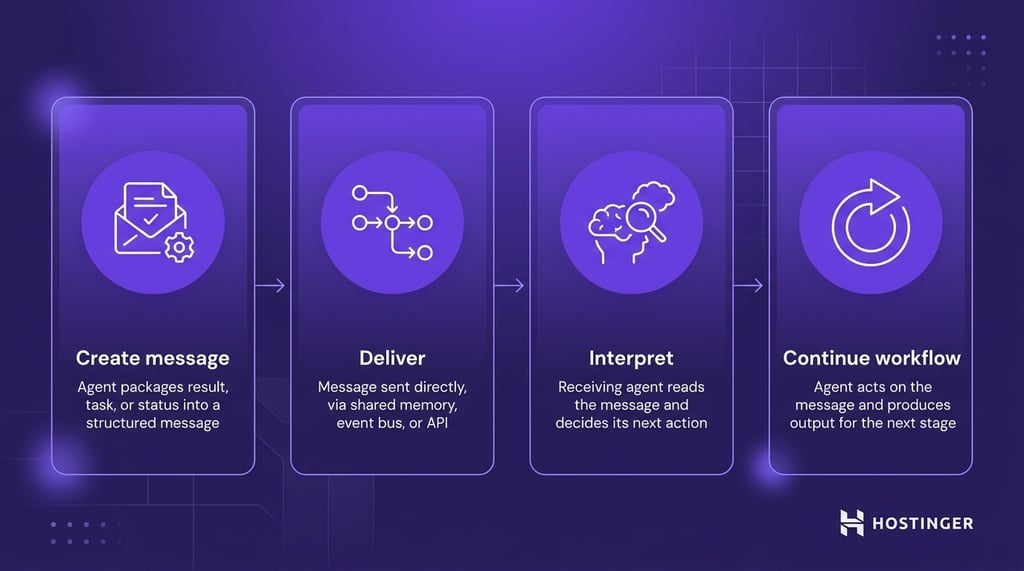
Different systems use different communication mechanisms to deliver those messages.
Direct messaging sends information from one agent to another. The sender knows exactly which agent should receive the message, making this approach straightforward for smaller systems.
Shared memory stores messages and workflow state in a common location. Agents retrieve the information they need without communicating directly, allowing multiple agents to work from the same context.
Event-based communication publishes notifications when something happens, such as a task completing or new data becoming available. Agents subscribed to those events automatically begin the next stage of the workflow.
API calls package messages as structured requests exchanged through software interfaces. This approach is common when agents interact with external applications or services.
The blackboard model lets agents post intermediate results to a shared workspace. Other agents monitor the workspace, contribute additional information, or continue solving the problem as new results appear.
Regardless of the communication method, every message should follow a predictable structure. Multi-agent systems define message formats, permissions, timeout rules, retry policies, conflict resolution procedures, and error reporting so agents can exchange information consistently, even when they use different models, tools, or services.
Multi-agent systems use cases
Multi-agent systems are used in workflows that combine multiple specialized tasks, require different types of expertise, or benefit from parallel execution.
Software development, cybersecurity, scientific research, logistics, and customer support are common examples because the work can be divided between agents that coordinate toward a shared result.
Common use cases include:
- Code generation and review – planning implementation, writing code, generating tests, reviewing changes, and validating security before deployment.
- Customer support automation – classifying requests, retrieving relevant documentation, applying company policies, and escalating complex issues when necessary.
- Security incident response – investigating alerts from multiple sources, assessing the severity of threats, and coordinating containment actions.
- Supply chain optimization – monitoring inventory, forecasting demand, optimizing delivery routes, and adjusting procurement as conditions change.
- Market research and campaign planning – collecting market intelligence, analyzing competitors, identifying opportunities, and generating campaign strategies.
- Financial due diligence – gathering financial records, evaluating risks, identifying inconsistencies, and preparing investment recommendations.
- Scientific literature review – searching publications, comparing findings, identifying conflicting evidence, and producing structured research summaries.
What are the benefits of multi-agent systems?
When the workflow has clear task boundaries and effective coordination, the multi-agent architecture offers several important advantages:
- Task-specific optimization – Each agent can be optimized for a single responsibility instead of trying to solve every problem at once. Different prompts, tools, models, and evaluation criteria can be used for research, planning, coding, or quality assurance, allowing every stage of the workflow to perform its task more effectively.
- Parallel processing – Independent tasks can run simultaneously instead of waiting for one another. Research, data collection, or analysis can proceed in parallel, reducing the overall completion time for workflows with little interdependence between tasks.
- Better scalability – Growing workloads do not require a complete redesign of the system. Additional agents can be introduced to handle more requests, process larger datasets, or support new capabilities without changing the responsibilities of existing agents.
- Higher output quality – Separating execution from evaluation makes it easier to detect errors before producing the final result. Reviewer agents can verify code, challenge unsupported conclusions, or identify inconsistencies that another agent may have missed.
- Greater resilience – Some multi-agent architectures continue operating even when an individual agent fails. Tasks can be reassigned, retried, or postponed without stopping the entire workflow.
- Faster local decisions – Agents can make decisions close to the data or systems they manage. In environments such as logistics, robotics, or network operations, local decisions allow the system to respond more quickly to changing conditions.
What are the limitations of multi-agent systems?
Multi-agent systems introduce additional coordination, making them more suitable for complex workflows than simple tasks.
Before adopting a multi-agent architecture, consider the following limitations:
- Higher coordination overhead – Agents must exchange information, synchronize their work, and decide when to hand tasks to one another. Poor coordination can reduce efficiency and offset the benefits of specialization.
- More complex system design – Defining agent responsibilities, communication rules, and decision boundaries requires careful planning. Overlapping roles or unclear ownership can lead to duplicated work, conflicting outputs, or stalled workflows.
- Increased latency – Every handoff between agents adds processing time. Workflows that involve many sequential agents may take longer than a well-designed single-agent system, especially when individual tasks are short.
- More difficult debugging – Investigating failures often means tracing decisions across several agents instead of inspecting a single execution path. Finding the source of an incorrect output becomes more challenging as workflows grow in complexity.
- Higher resource consumption – Running multiple agents can require more compute resources, memory, API calls, and external tool invocations than a single-agent architecture, increasing operational costs.
- Risk of inconsistent outputs – Agents may reach conflicting conclusions if they use different data sources, instructions, or assumptions. Resolving those conflicts requires additional validation or review before producing a final result.
Multi-agent system vs single-agent system
Single-agent systems complete an entire workflow with one agent, while multi-agent systems divide the work across multiple specialized agents.
The table below compares how single-agent and multi-agent systems differ in design, execution, and operational trade-offs.
Factor | Single-agent system | Multi-agent system |
Task ownership | One agent handles the full workflow | Several agents divide responsibilities |
Setup | Faster and simpler | Requires role and communication design |
Cost | Lower model and infrastructure use | Higher due to multiple agent runs |
Coordination | Minimal | Requires task routing and shared context |
Scalability | Limited by one agent’s context and workload | Supports parallel and specialized work |
Reliability | Easier to debug | More failure points and dependencies |
Best fit | Short, linear, well-defined tasks | Complex, distributed, or multi-stage work |
The biggest architectural difference is coordination. A single-agent system keeps all planning, reasoning, and execution within one agent.
A multi-agent system distributes those responsibilities, which requires agents to exchange information, manage dependencies, and combine their outputs into a single result.
When should you use a multi-agent system?
A multi-agent system is worthwhile when a workflow becomes too broad, specialized, or distributed for a single agent to complete reliably.
Many business tasks do not reach that level of complexity, making a single AI agent or several independent specialized agents the simpler and more cost-effective choice.
A coordinated multi-agent architecture becomes valuable when the workflow benefits from collaboration between specialized agents.
Common signs include:
- The workflow contains several distinct specialist roles.
- Independent tasks can run in parallel.
- Results require review or validation before completion.
- Different tasks need different tools, permissions, or AI models.
- The workflow spans multiple applications or environments.
- A single agent becomes a bottleneck because of context limits or workload.
Tasks such as drafting an email, summarizing a document, answering customer questions, generating code, or analyzing a spreadsheet rarely require work to be divided across multiple specialists.
If one agent has access to the necessary tools and information, introducing additional agents adds coordination without improving the result.
A single agent also works well when every step follows a predictable sequence, response time is more important than independent review, or the cost of occasional mistakes is low.
Small internal automations, personal productivity tasks, and simple customer interactions are often easier to build, operate, and troubleshoot with a single agent.
In these cases, the simplicity of a single-agent architecture usually outweighs the benefits of specialization.
Can specialized AI agents replace a multi-agent system?
In many cases, yes. Specialized autonomous AI agents can replace a multi-agent system when business tasks are independent and do not require agents to coordinate with one another.
Workflows such as SEO, content creation, marketing, sales, customer communication, and business planning are often completed separately, making a custom orchestration layer unnecessary.
Hostinger Agent provides seven AI experts, each dedicated to a specific business function.
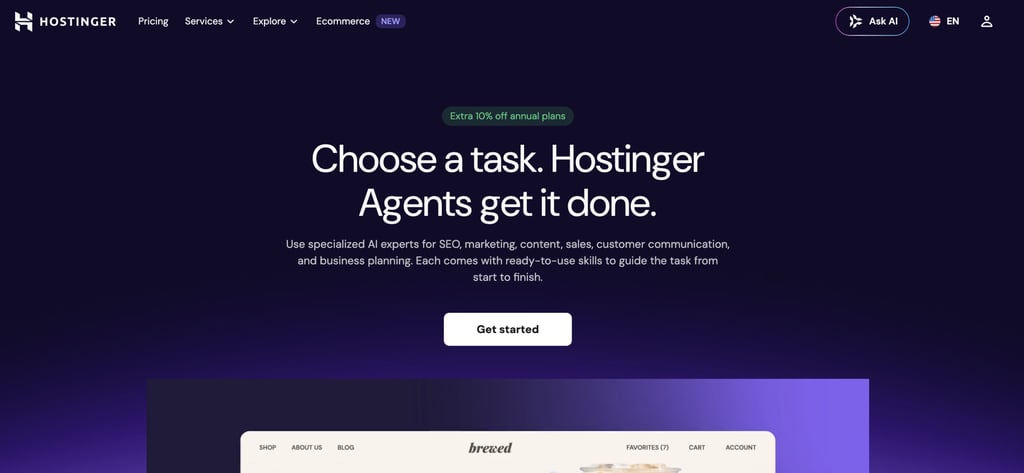
Instead of configuring prompts, tools, and workflows yourself, you can choose an agent that already understands its domain.
For example, the SEO AI agent focuses on keyword research and on-page optimization, the content marketing agent produces website copy and blog posts, while the marketing planner helps build campaigns and content calendars.
Other agents specialize in sales outreach, customer communication, legal drafting, and business strategy.
Each AI expert combines conversational AI with guided workflows for common business tasks, as well as features such as web search, file analysis, and long-term memory.
Agents can also connect to more than 1,000 applications, including Google Sheets, Slack, Gmail, Notion, and HubSpot, allowing them to retrieve information and perform actions across your existing tools.
As a result, teams can switch between specialized expertise as their work changes without designing or maintaining the infrastructure behind a custom AI system.
This article is a localized version of What are multi-agent systems?, originally published in English.
All of the tutorial content on this website is subject to Hostinger's rigorous editorial standards and values.

Ksenija is a digital marketing enthusiast with extensive expertise in content creation and website optimization. Specializing in WordPress, she enjoys writing about the platform’s nuances, from design to functionality, and sharing her insights with others. When she’s not perfecting her trade, you’ll find her on the local basketball court or at home enjoying a crime story. Follow her on LinkedIn.