How to choose a domain name for an ecommerce store
May 31, 2026
/
Alma F.
/
10 min Read


A domain name is the web address people type to visit your store, like freshbloomflowers.com. It shows up in search results, on social media, and on every piece of marketing you send. That makes it one of the first branding decisions you’ll make for your ecommerce store, and one of the most lasting.
To choose a domain name for your ecommerce store, define your brand and audience first, brainstorm short, memorable name ideas, check for availability and potential trademark conflicts, pick the right extension, and register with a reliable registrar.
If you’re worried about getting this wrong, you don’t have to be. Each step is straightforward, and by the end, you’ll have an online store domain that fits your brand identity and is memorable for your customers.
What are the benefits of choosing the right domain name for your ecommerce store?
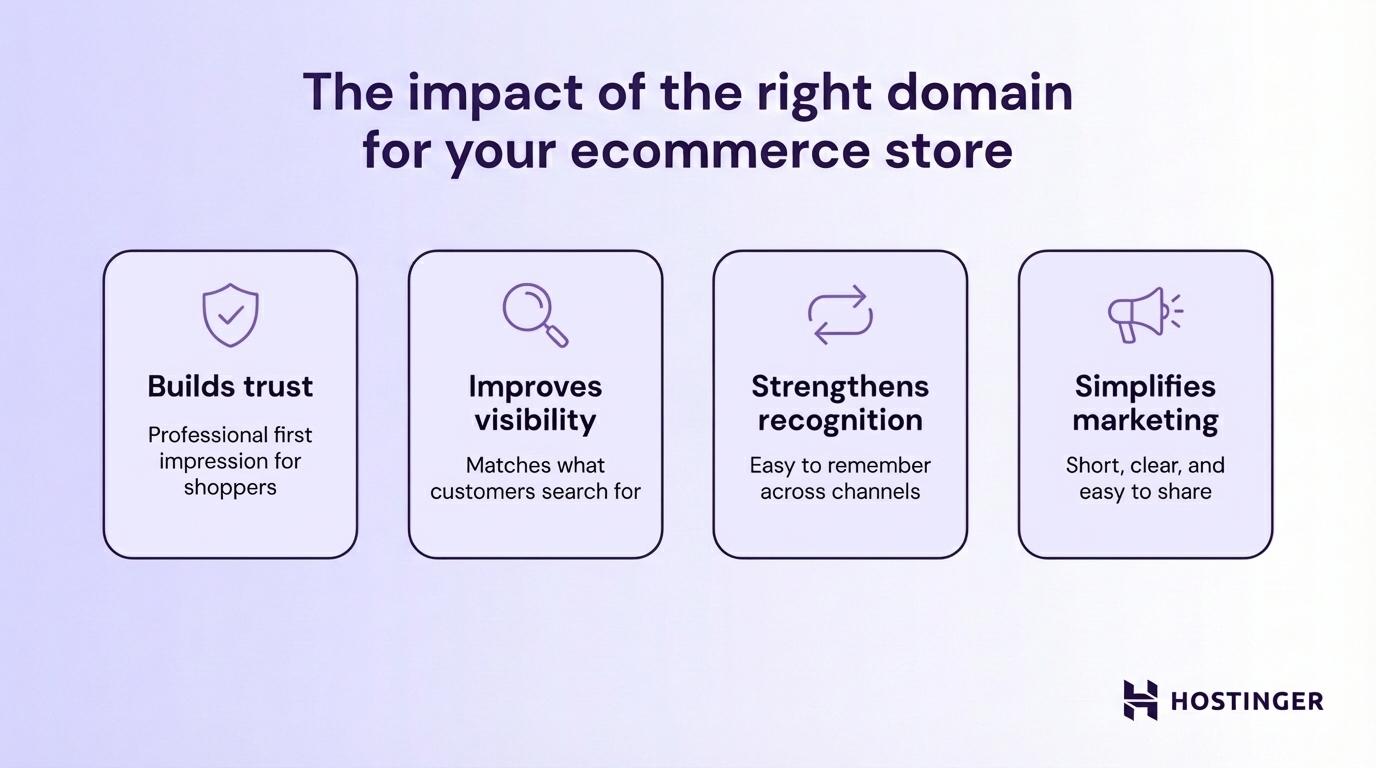
The right domain name makes your ecommerce store easier to find, easier to trust, and easier to remember. Those three things directly affect whether someone clicks, buys, and comes back.
Here’s how a well-chosen domain pays off:
- A clean domain builds customer trust. People are far more likely to enter payment details on freshbloomflowers.com than on fb-flowers123.net. Your domain is their first impression of your store, and first impressions stick.
- A relevant domain helps with online visibility. When your domain matches what you sell, people are more likely to click on it in search results. That small bump in clicks adds up over time, and it helps search engines understand what your site is about.
- A memorable domain builds brand recognition. When someone spots your domain on social media, a product package, or a Google result, it should click right away. That’s how people find you again without having to bookmark your page.
- A short domain makes your marketing easier. Every email, ad, and business card carries your domain name. Something short and clear means people hear it once and type it from memory.
Every month you use a good domain, these benefits get stronger. More people recognize your name, more search engines trust your site, and more customers come back without you spending a dollar on ads.
The trick is picking a name worth building on. That starts with knowing your brand and who you’re selling to.
1. Analyze your ecommerce brand and target audience
Before you pick a domain name, get clear on what your brand stands for. Knowing how to build a brand – your values, your look, your audience – makes choosing a domain name much easier. Your domain should feel like a natural fit for all three.
Start with your brand identity. Are you selling handmade jewelry with a personal touch, or running a high-volume electronics store? The tone of your name should match the feeling your store creates. A luxury skincare brand works well with a polished name like velvetglow.com, while a budget-friendly pet supply store might lean toward something playful like happypaws.com.
Your target audience shapes this decision, too. Even basic customer personas help here – think about your shoppers’ age, budget, and what they care about. If you’re selling to young professionals, a modern and snappy name works. If your customers are parents shopping for kids’ products, something warm and approachable fits better.
Your ecommerce niche – the specific corner of the market you sell in – narrows it even further. A store that only sells running shoes has different naming needs than a general sports shop. Your market positioning, like whether you’re premium, budget, or somewhere in between, should also come through in the name.
2. Brainstorm keyword-rich and memorable domain name ideas
A memorable domain comes from combining your brand words with ecommerce keywords your customers actually search for. You want a name that’s both findable and easy to remember.
Start with some basic keyword research. List words tied to your products, niche, and brand personality. If you sell eco-friendly home goods, your list might include green, home, eco, living, goods, and nest. Combine them in different ways. Some will sound right. Most won’t. That’s normal.
Once you have your raw keywords, try plugging them into different naming styles:
Method | How it works | Example |
Brand + keyword | Combine your brand name with a product term | BloomPetals.com |
Descriptive name | Use words that describe what you sell | FreshCoffeeBox.com |
Invented word | Create a unique, brandable word | Shopenza.com |
Wordplay or mashup | Blend two relevant words together | Fitique.com (fit + boutique) |
As you come up with domain name ideas, filter them through these four rules:
- Aim for one to three words. Shorter names are easier to type, spell, and share out loud.
- Use keywords sparingly. One product-related word helps SEO. Three in a row sounds spammy.
- Say it out loud. If you have to spell it for someone, it’s too complicated.
- Avoid trendy slang. What sounds cool today might feel dated in two years.
AI tools like ChatGPT or Gemini can speed up your creative naming process. Give them your niche, tone, and a few sample words, and they’ll suggest dozens of combinations to start with.
If you’re stuck on the broader naming question, creating a memorable business name involves techniques like word pairing and studying what your competitors chose. You can also explore these ecommerce name ideas for more examples.
Once you have your top 10–15 domain name ideas, write them down and bring them to the next step.
3. Check domain availability and trademark conflicts
Your favorite domain name is worthless if someone else already owns it or has trademarked it. Checking both before you commit to the name saves you time, money, and legal risks down the road.
To check domain availability, use a domain search tool and enter your top choices. Hostinger Domain Name Search, for example, shows whether the exact name is available, along with pricing for different extensions like .com, .shop, and .store.
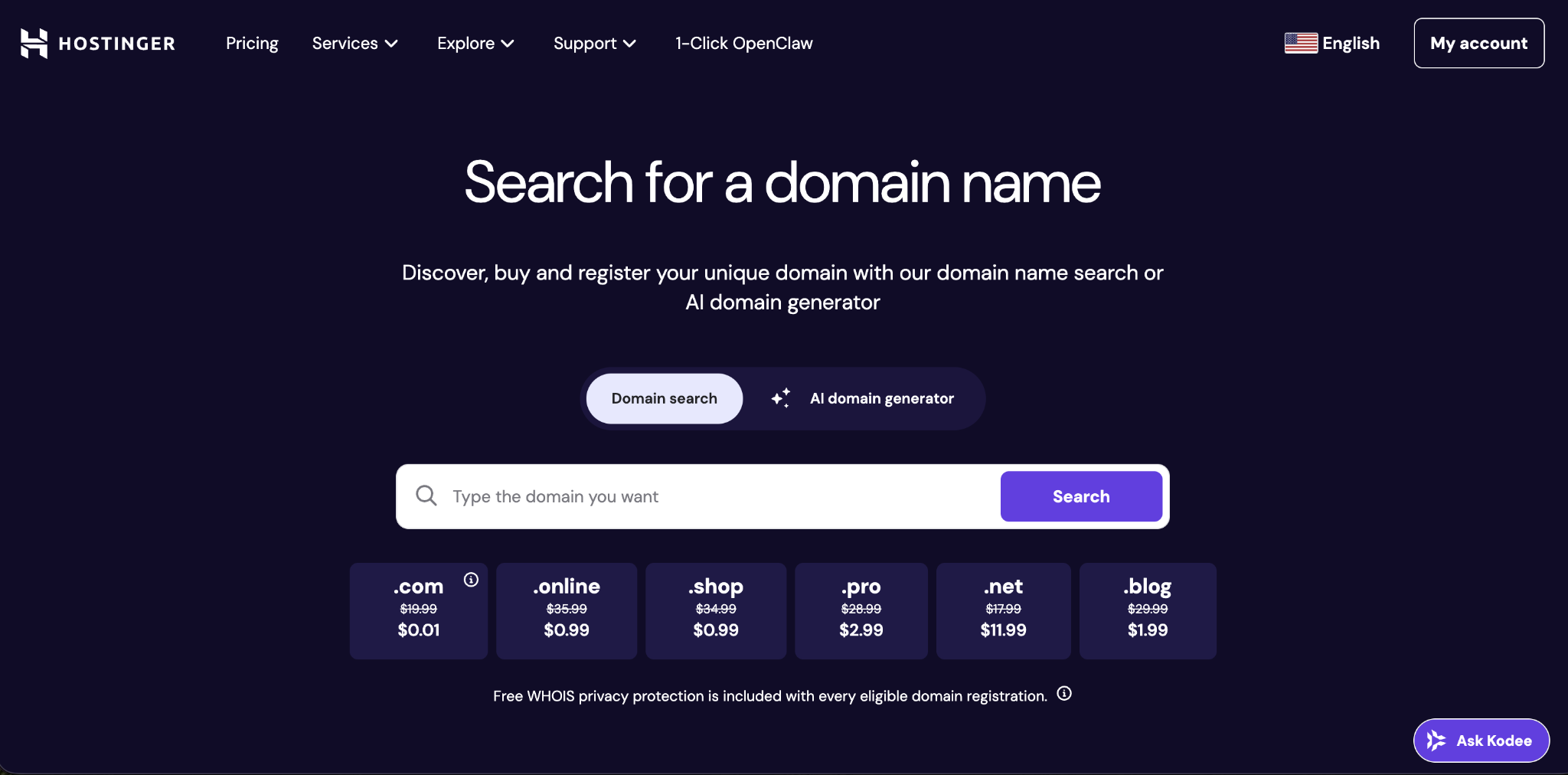
If your first pick is taken, search tools suggest close alternatives. But you’ve still got the rest of your shortlist to try, so work through it before settling on a suggestion.
Most of the best domain registrars – these are services where you search for, buy, and manage domain names – offer similar domain name search tools, so try a couple to compare prices.
After finding an open domain name, run a trademark search. Just because a domain is available for purchase doesn’t mean you’re legally free to use the name. Someone else might already have it trademarked for ecommerce use. A legal warning six months after you launch costs far more than 15 minutes of doing a trademark search.
In the U.S., the USPTO Trademark Search at USPTO.gov lets you look up registered and pending trademarks for free. Look for exact matches and close variations that could cause confusion.
Once you’ve covered those two, round out the process with these checks:
- Search for your domain name on at least two registrars to confirm it’s available.
- Run a trademark search on the USPTO database (or your country’s version of it).
- Google the name to see if anyone is actively using it as a brand.
- Check Instagram, TikTok, and Facebook to see if the handles are free.
That last one is easy to overlook. If your domain is freshbloom.com, but @freshbloom is taken on every social platform, customers won’t be sure it’s the same store. Matching names across your website and social media makes it easier for people to find and trust you.
Pro tip
Consider running your domain search in an incognito browser window. There are long-standing concerns that some registrars may track repeated searches and adjust pricing, so a clean session removes that risk.
Domain Name Checker
Instantly check domain name availability.
4. Evaluate domain name length, extensions, and readability
Your domain should be 15 characters or fewer, use a trusted extension, and be easy to type on the first try. Get these right, and your domain will be easier to remember.
Shorter domains are easier to type on mobile, which is where most shoppers are. If it’s hard to type, people are more likely to make mistakes or give up. They also fit better on business cards, packaging, and social media bios.
Compare Luxebags.com to LuxuryDesignerBagsOnlineStore.com. The shorter one is easier to type on a phone, easier to say when someone recommends your store to a friend, and a lot easier to remember.
Now, your domain has two parts: the name and the extension. The extension is the part after the dot, like .com or .shop, and it matters just as much when choosing the right domain name.
Each extension tells visitors something different about your store:
Extension | Best for | Why it works |
.com | Most ecommerce stores | Most recognized and trusted worldwide |
.shop | Retail-focused stores | People know it’s a shop right away |
.store | Online retailers | Tells visitors you’re an online store |
.co | Startups and modern brands | Short, clean, and works in any country |
A .com domain is still the go-to. Most people type .com out of habit, and it carries the most trust. If your ideal .com is taken, .shop and .store are strong backups that clearly tell visitors your site is a store.
Your niche plays a role in choosing your domain extension, too. A luxury jewelry brand needs the credibility of a .com, while a trendy pop-up shop selling phone accessories could get away with a .store or .shop.
Once you’ve picked a length and extension, make sure the full domain is easy to read and type. If someone heard your domain on a podcast, could they type it correctly on the first try? Hyphens, numbers, and unusual spellings all fail this test. An easy to type domain shouldn’t need a second thought.
Here are the most common traps:
- No hyphens. They’re easy to forget and cause confusion when spoken.
- No numbers, unless they’re part of your brand name.
- Watch for double letters where two words meet. Pressstart.com looks like press-start, but people might miss the double S.
- No weird abbreviations. BstDlsOnline.com saves characters but loses customers.
If your domain fails any of these, go back to your shortlist and run the same checks on your next best option.
5. Test domain name for branding and SEO effectiveness
You can test how well a domain works for your brand and SEO with a few quick real-world tests. What sounds perfect in your head might confuse everyone else, so get outside opinions before you commit.
Start with the pronunciation and spelling test. Say your top three choices out loud to friends or colleagues. Ask them to spell it back after hearing it. If the domain pronunciation confuses them or they get the spelling wrong, that name has a problem. This quick test catches issues you won’t spot just by staring at a screen.
From there, check how it performs for SEO. A domain with one relevant keyword gives you a slight SEO boost in related search results. OrganicPantryShop.com tells both search engines and visitors exactly what the store sells. But don’t stuff keywords in. BestCheapOrganicFoodShop.com reads like spam.
One keyword is enough. The rest of your SEO work happens after the domain is set. Things like product page structure, internal links, and content strategy fall under ecommerce SEO, and they’ll have a bigger impact on your rankings than the domain name alone.
Next, test for brand recall. Show someone your domain, then ask them about it an hour later. Can they recall it? A domain that people forget means you’ll spend more on paid ads just to bring them back. A memorable one brings them back on its own.
Finally, check for social media consistency. Search for your domain name (without the extension) on Instagram, TikTok, Facebook, and X. Matching handles across platforms make it easier for customers to find you everywhere. Tools like Namechk let you search multiple platforms at once.
Does your domain pass the test?
Ask yourself these four questions before you decide on your final domain name:
- Can someone spell it correctly after hearing it just once?
- Can someone remember it an hour later without help?
- Is the name available as a handle on Instagram, TikTok, and Facebook?
- Does it include at least one word related to what you sell?
Mostly yes? You've found your domain. Two or more no's? Try the next name on your list until one passes.
6. Register your chosen domain and secure related domains
Once you’ve found the right name, register it immediately. Good domains get taken fast, and waiting even a day can cost you your first choice.
Here’s what to do once you’re ready for domain registration:
- Pick a reliable registrar. Look for clear pricing, solid support, and no hidden fees. You can buy and register a domain name in about 10 minutes – pick a registrar, complete checkout, and connect the domain to your website.
- Turn on domain privacy to keep your personal info secure. When you register a domain, your name, email, and address get added to a public database called WHOIS. Anyone can look it up. Domain privacy hides this info, and most registrars include it for free.
- Set up auto-renewal. Losing your domain because you forgot to renew it is one of the most avoidable mistakes in ecommerce. Auto-renewal keeps it active without you having to think about it.
- Grab related domains for brand protection. Register common misspellings and other extensions of your main domain. If your store is freshbloom.com, pick up freshbloom.shop and freshbloom.store too. This stops competitors or resellers from using them, and you can point all of them to your main site.
- Claim your social media handles the same day. Even if you don’t plan to post on every platform right away, locking in your name on Instagram, TikTok, and Facebook protects your brand for later.
For extra legal protection, you can also trademark your business name to get legal ownership that a domain registration alone doesn’t cover.
Common mistakes to avoid when choosing a domain name for an ecommerce store
Most domain name mistakes come from rushing the decision or skipping one of the steps above. Here are the branding mistakes ecommerce store owners make the most:
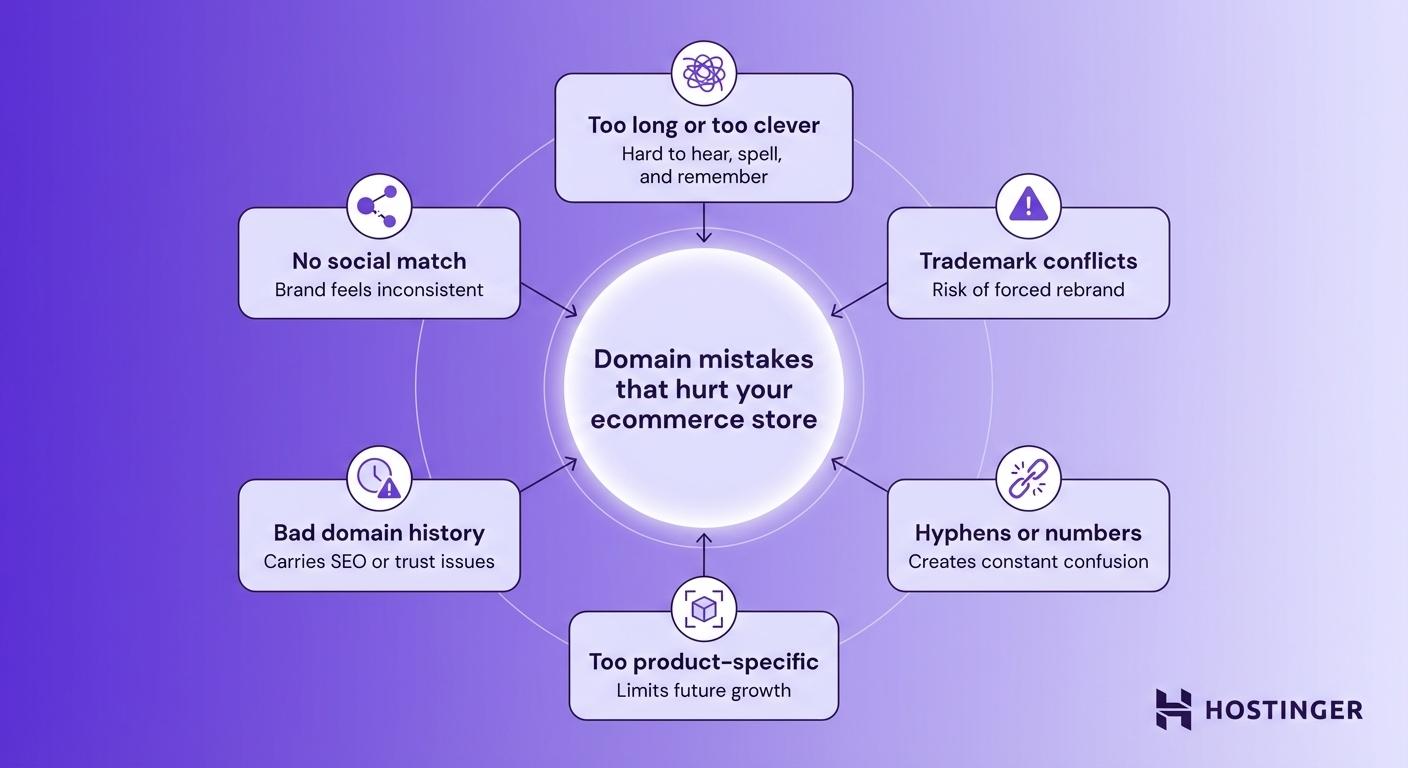
- Picking a name that’s too long or too clever. If someone needs to hear your domain twice to get it right, it’s not working. Puns feel fun during brainstorming but can confuse customers.
- Ignoring trademark infringement risks. Registering a domain doesn’t give you legal rights to the name. If another business holds the trademark, you could face a forced rebrand or be told to hand over the domain.
- Using hyphens or numbers. These cause constant confusion when shared out loud, and they can hurt your SEO too. “Is that a dash or no dash?” “The number 4 or the word four?” Every moment of confusion is a lost visitor.
- Choosing a name too tied to one product. BlueSilkScarves.com is great until you want to sell handbags. Pick a domain that gives your brand room to grow.
- Skipping the domain history check. Some domains have been registered before and might carry a bad reputation from spam or shady SEO. Search the domain on the Wayback Machine at web.archive.org to see what it was used for before. A clean history means you’re starting fresh.
- Not checking social media availability. Your domain and your social handles should match. When they don’t, customers have a harder time finding you, and your brand feels scattered.
How to apply your domain name in building your ecommerce brand?
Use your domain name across your website, email, social media, and packaging to build a consistent ecommerce brand. Once it’s registered, using your domain across all your channels is what makes your store feel like one connected business.
Here’s how to put it to work:
- Start with your website launch. Your domain needs a store behind it. When you build an ecommerce website, you’ll pick a platform, add your products, and set up payments.
- Create a professional email address. An email like hello@freshbloom.com feels more trustworthy than a generic Gmail address. Most hosting plans include email, so you can set this up the same day you launch.
- Keep your branding consistent across channels. Your website URL, email signature, social media bios, packaging, and invoices should all carry the same domain. This makes your store feel established, even if you launched last week.
- Build SEO around your domain from day one. Create content that matches what your domain stands for. If your store is organicpantry.com, publish posts about organic ingredients, meal prep, and product sourcing. Over time, search engines start to see your site as a go-to source in that space.
- Keep an eye on your brand name. Set up Google Alerts for your domain and brand name so you know if someone starts using something similar. Pair that with regular trademark checks, and you’ll catch problems early.
Once you’ve chosen your domain name, it’s time to build around it. Connect it to your online store, set up a matching email, and get your first products live.
All of the tutorial content on this website is subject to Hostinger's rigorous editorial standards and values.

Alma is an AI Content Editor with 9+ years of experience helping ideas take shape across SEO, marketing, and content. She loves working with words, structure, and strategy to make content both useful and enjoyable to read. Off the clock, she can be found gaming, drawing, or diving into her latest D&D adventure.