8 best domain registrars in 2026 (Tested for pricing, renewal fees & privacy)
Sep 14, 2026
/
By Justina B.
/
10 min Read

The best domain registrars stand out for transparent pricing, low renewal fees, free WHOIS privacy, and simple domain management. The right one depends on how you’ll use your domain, since a registrar that’s great for a single .com isn’t always best for a large portfolio.
Hostinger makes sense if you want your domain, hosting, email, and website tools in one dashboard. Porkbun and Spaceship win on flat, low renewal prices, while Cloudflare passes domains through at the same price it pays, with no markup.
Namecheap suits beginners who want cheap first-year deals. GoDaddy is for anyone who wants a large domain marketplace. IONOS works well when you bundle a domain with hosting, and NameSilo is built for buying and managing domains in bulk.
Here’s how the top eight compare at a glance:
| Registrar | .com first year | .com renewal | Free WHOIS privacy | Best for |
| Hostinger | $2.99/year | $19.99/year | Yes | Domain and hosting in one place |
| Namecheap | $11.28/year | $18.48/year | Yes | Cheap first-year deals |
| Porkbun | $11.08/year | $11.08/year | Yes | Flat pricing and free extras |
| Spaceship | $8.88/year | $9.98/year | Yes | Low, flat renewals |
| GoDaddy | $0.01/year | $22.99/year | Yes, most extensions | Domain marketplace and auctions |
| Cloudflare | $10.44/year | $10.44/year | Yes | At-cost pricing and DNS security |
| IONOS | $1/year | $20/year | Yes | Cheap first-year domain bundles |
| NameSilo | $17.29/year | $17.29/year | Yes | Bulk buyers and investors |
1. Hostinger
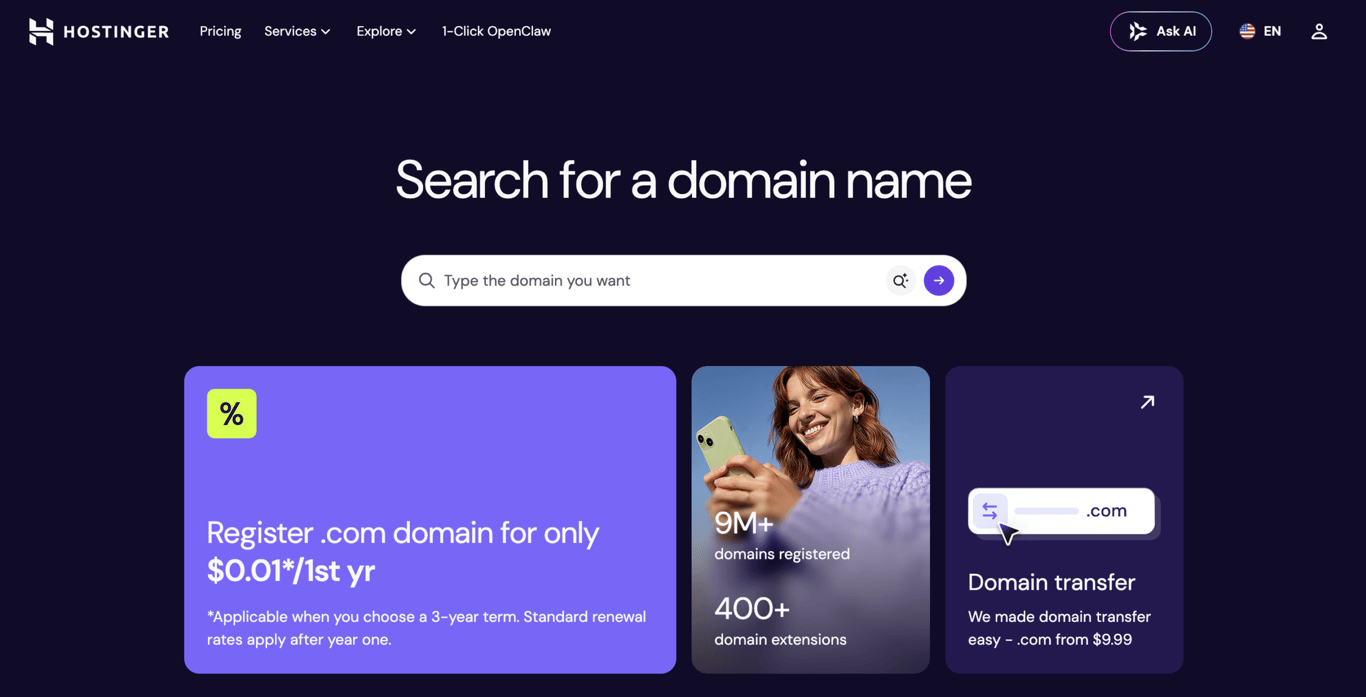
Hostinger is an ICANN-accredited registrar that pairs affordable domains with hosting, so you keep both on one bill. You can search and register your domain with Hostinger in a few minutes. It also covers a wide range of top-level domains (TLDs) if your first pick is taken.
The AI-powered domain search helps when you’re short on ideas. From a few words you type, it suggests brandable, niche-specific names, not just what’s free.
Every domain comes with free WHOIS privacy protection, which many registrars still sell as an add-on. It hides your name, address, email, and phone number from public databases, so you get less spam and fewer phishing attempts. For most people and small businesses, that’s one less cost to worry about.
If you’re also building a website, bundling the domain with a hosting plan lowers your total cost. Hostinger hosting plans start at $2.99 and include a free domain for the first year with extensions like .com, .xyz, .online, .shop, plus a free email account, SSL certificate, and a website builder.
Why choose Hostinger as your domain registrar
- Free WHOIS privacy keeps your contact details off public databases at no extra cost.
- AI-powered domain name search suggests brandable name ideas based on a short prompt.
- Domain and hosting in one dashboard lets you manage your domain, email, SSL, and site from a single account.
- Affordable transfers move .com domains for $9.99 and add a free year to your registration.
- DNSSEC and full DNS control let you set A, AAAA, MX, CNAME, TXT, and CAA records, with DNSSEC for extra security.
- 24/7 support is available by live chat, backed by the knowledge base and tutorials.
Want to see how buying a domain through Hostinger works in practice? This walkthrough covers the full process, from searching to verifying ownership:

Domain Name Checker
Instantly check domain name availability.
2. Namecheap
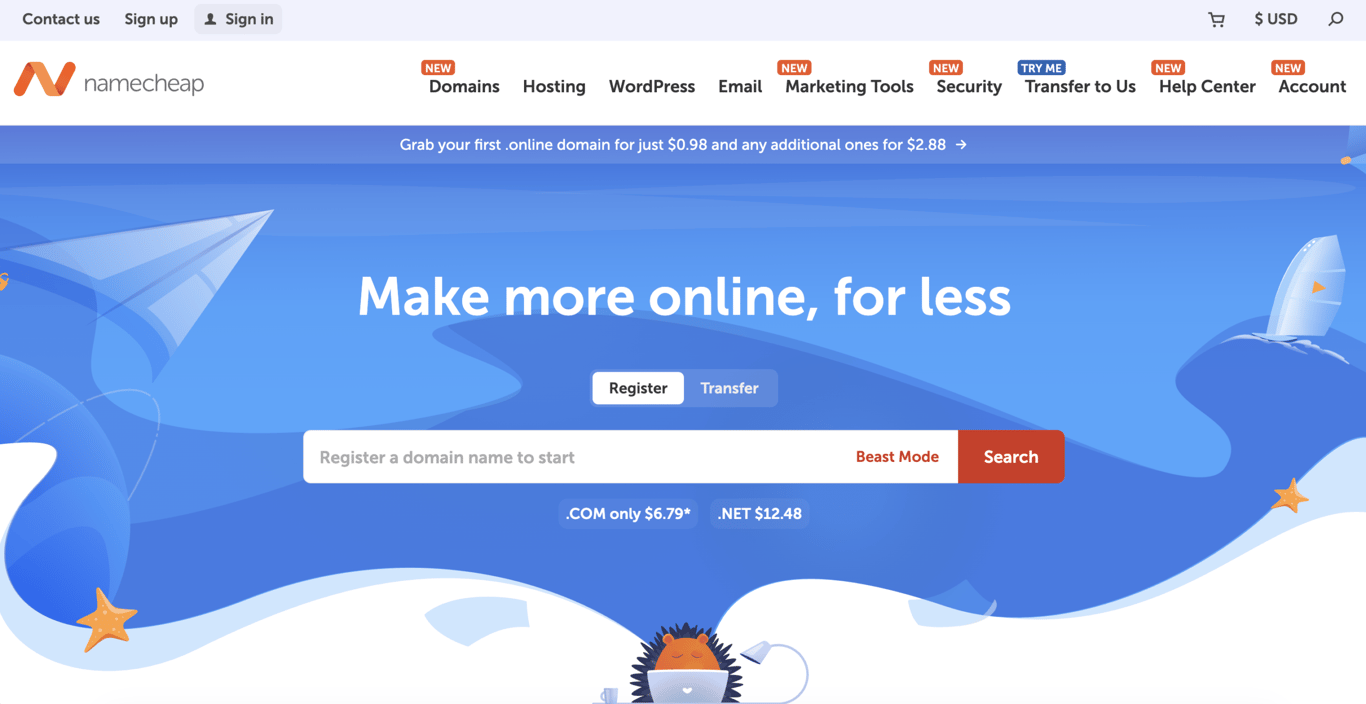
Namecheap is a long-running budget registrar with one of the friendliest dashboards for beginners. Its search tool lets you filter by price and check names in bulk, and you can import a CSV file to look up thousands of names at once.
Beyond domains, Namecheap offers the extras you need to get a site running, such as shared hosting, DNS hosting, and SSL certificates.
The main thing to watch is the renewal jump. The standard first-year price is $11.28, with a $6.79 promo for new customers, but a .com can renew closer to $18.48, so check the long-term cost before you commit.
Why choose Namecheap as your domain registrar
- Free WHOIS privacy protects your personal data from public WHOIS records for as long as you own the domain.
- New-customer promos can drop the first year to $6.79, though the standard rate is $11.28.
- Bulk domain search checks up to 5,000 names at once, including CSV imports.
- Marketplace and auctions let you bid on premium and expiring domains.
- Domain Vault adds registry locking and DNS change monitoring for valuable names.
- Free email forwarding routes mail to an existing address without a full mailbox.
3. Porkbun
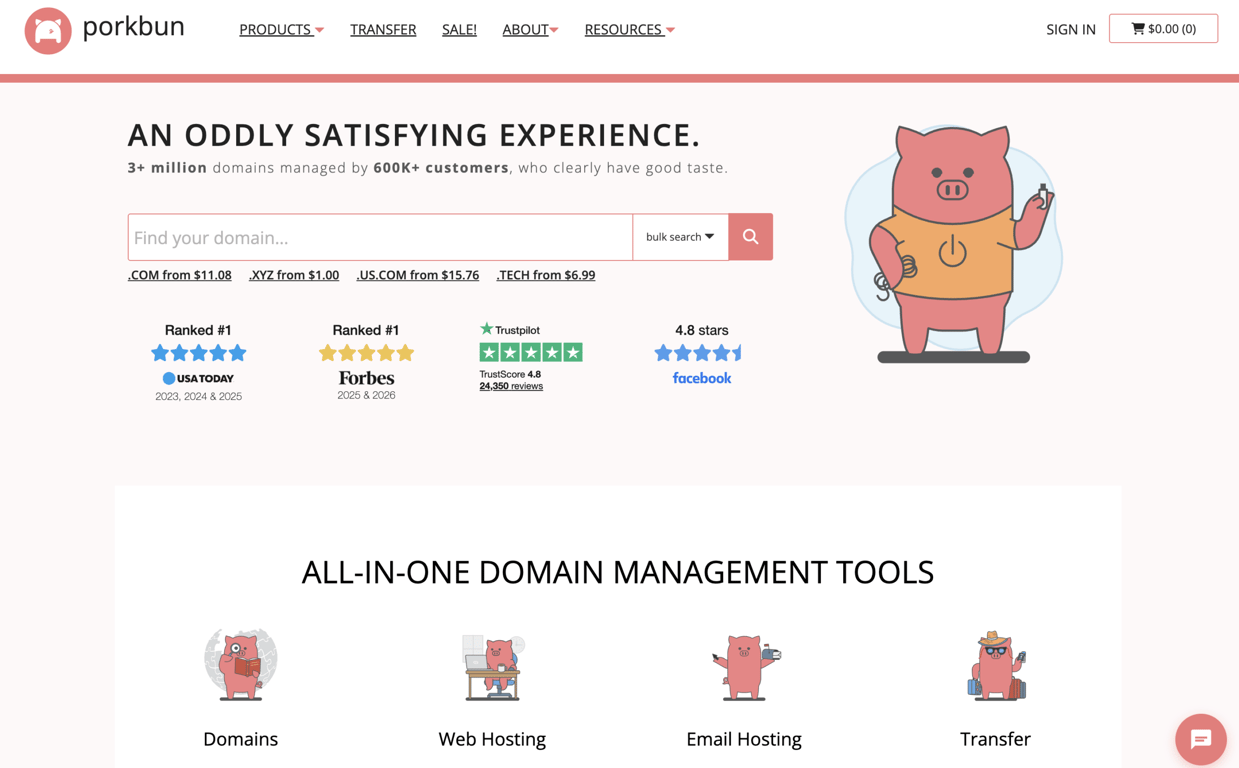
Porkbun is a Portland-based registrar that charges the same at registration and renewal on most extensions. It offers more than 550 TLDs, which makes it a good place to hunt for a creative ending.
Porkbun bundles a free SSL certificate, domain forwarding, and up to 20 free email forwards. Domain forwarding supports the main redirect types, so moving visitors to another site won’t hurt your SEO.
There’s also a marketplace for premium domains and an API for developers. Porkbun doesn’t refund registrations or renewals, so double-check before you buy.
Why choose Porkbun as your domain registrar
- Matching renewal price means a .com costs $11.08 in year one and every year after.
- Free WHOIS privacy comes built in on eligible domains.
- Free SSL and forwarding include a Let’s Encrypt certificate, URL forwarding, and email forwarding.
- Free DNSSEC adds a layer of security to your domain’s DNS.
- 550+ extensions give you plenty of room to get creative with a name.
- API access helps developers and agencies manage domains at scale.
4. Spaceship
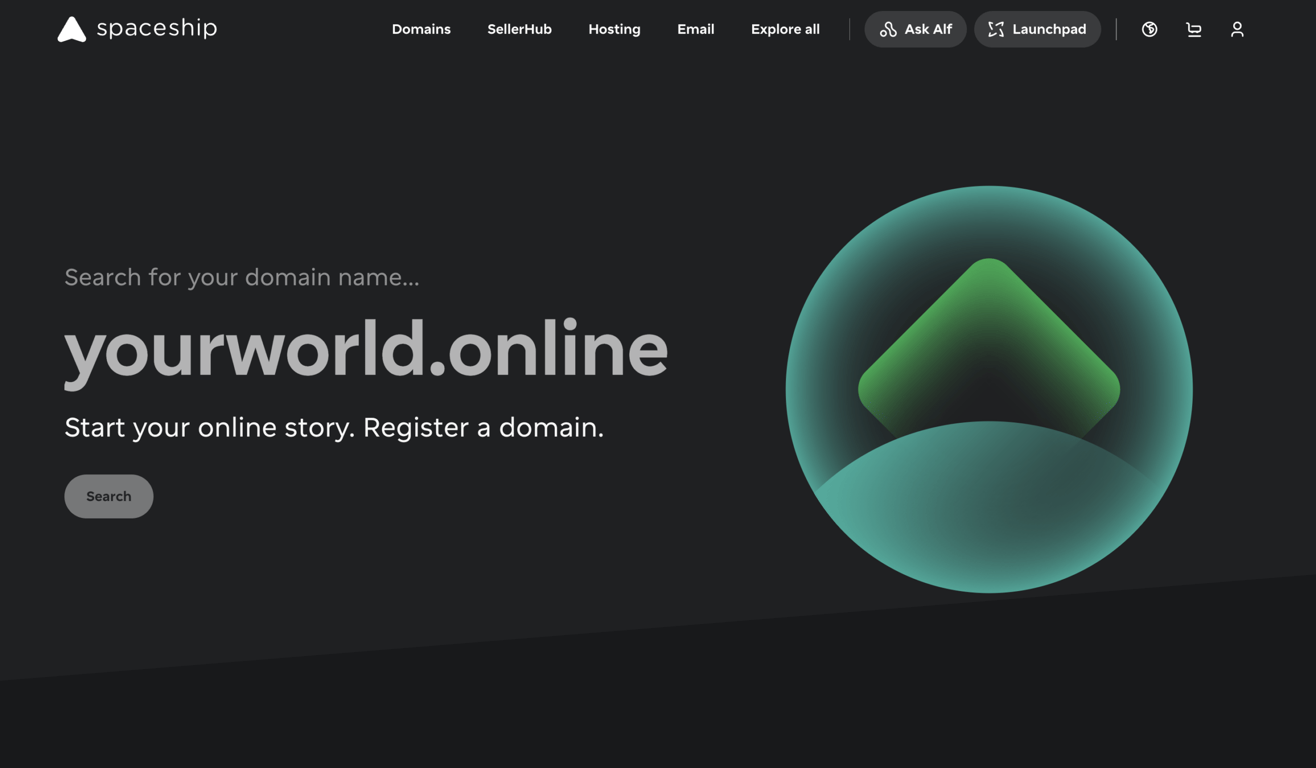
Spaceship is a newer registrar built and owned by Namecheap, launched in 2023, and already managing more than 5 million domains. It runs on a modern, fast dashboard, but pricing is the main reason people pick it.
Most of its security and DNS tools are switched on by default, and it’s one of the few registrars to support passkeys for login. The Advanced DNS panel handles the full set of records most sites need.
Beyond domains, Spaceship offers email, hosting, and a tool called SellerHub for listing domains you want to sell. The two trade-offs are a narrower TLD catalog than the big players and no phone support, so help comes through chat and tickets.
Why choose Spaceship as your domain registrar
- $9.98 .com renewals stay the same every year, with no hikes.
- Free WHOIS privacy stays active for the life of the domain, at no extra cost.
- Free DNSSEC by default protects your DNS without any setup.
- Free email and URL forwarding cover up to 100 redirects per domain.
- Modern DNS panel supports A, AAAA, ALIAS, CNAME, MX, NS, TXT, SRV, and CAA records.
- SellerHub lets you list and sell domains you no longer need.
5. GoDaddy
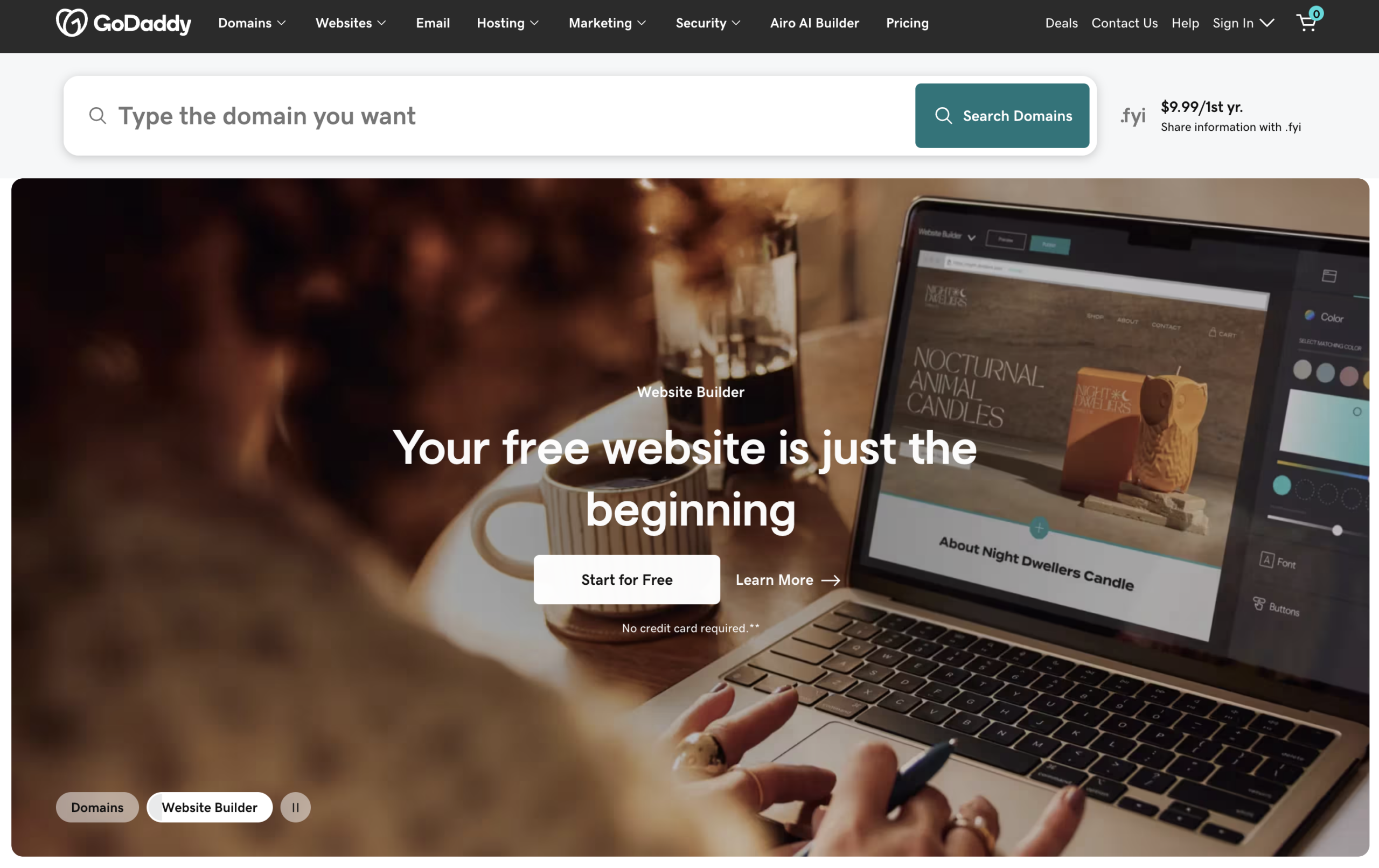
GoDaddy is the largest registrar by volume. You can register a .com for as little as a cent in the first year, though that price requires a 3-year term. Bundles across several extensions get discounted first-year rates, too.
Its domain search adds filters, favorites, and history, so you can save names and revisit them later. GoDaddy Airo, its AI setup assistant, can also suggest a name, logo, and starter site once you register.
GoDaddy leans into domain investing. The appraisal tool estimates what a domain is worth, the Discount Domain Club lowers registration and renewal costs for heavy buyers, and CashParking and Auctions help you earn from names you aren’t using.
Hosting plans start at $5.99/month and can include SSL, Microsoft 365 mailboxes, and daily backups. Just keep an eye on the renewal price. The first year is almost free, but after that, a .com renews at $22.99. Also, the checkout pushes many add-ons.
Email services can also affect the overall value of keeping your domain and other services with the same provider. Hostinger Mail vs. GoDaddy Email differs in areas such as pricing, mailbox storage, aliases, AI features, and support.
Why choose GoDaddy as your domain registrar
- First-year promos drop a .com to as little as a cent on a 3-year term.
- 500+ extensions cover standard, location-based, and industry-specific endings.
- AI-assisted setup suggests names, logos, and a starter site through GoDaddy Airo.
- Domain investing tools include appraisals, the Discount Domain Club, and broker services.
- Auctions and CashParking let you buy, sell, and earn from domains.
- Free WHOIS privacy is included on most eligible extensions.
6. Cloudflare
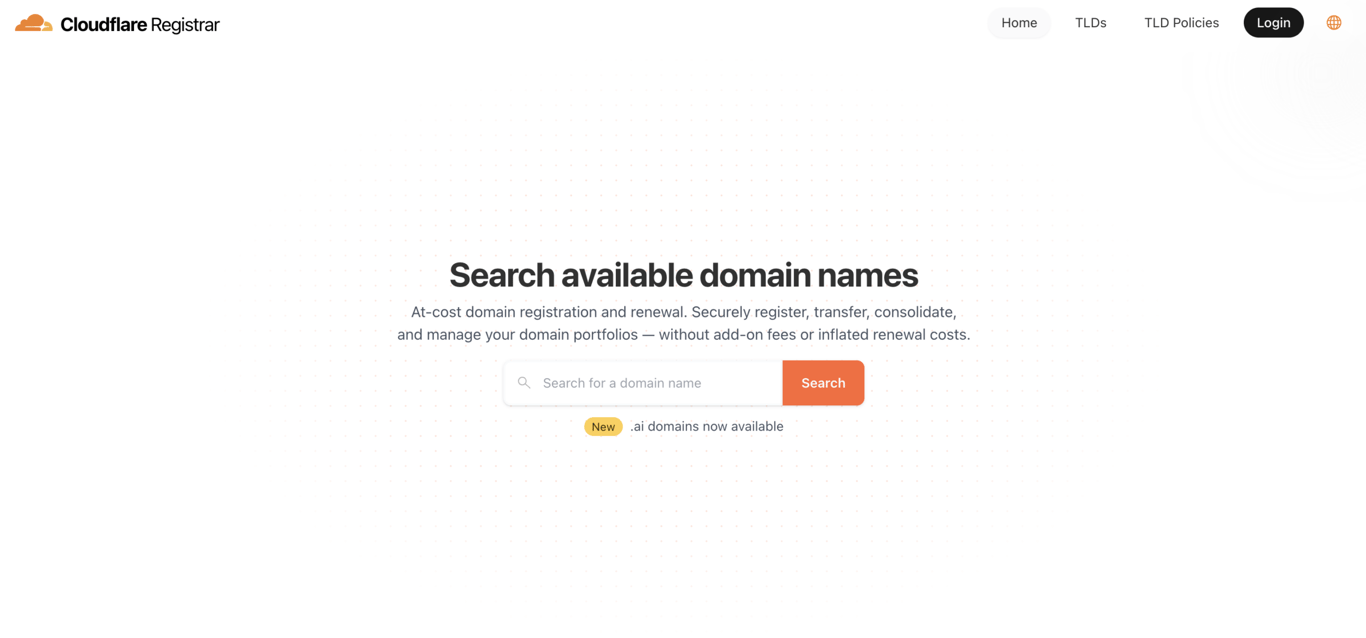
Cloudflare is the domain arm of the security and performance company, and it sells domains at cost. Registration, renewal, and transfer all cost the same, so there’s no renewal spike to plan around. The price can still edge up, but only if the registry raises its own rate.
Security is the other half of the pitch, tied to Cloudflare’s wider network. If you already use Cloudflare for DNS, a content delivery network (CDN), or DDoS protection, keeping your domain in the same account means one less place to log in.
There are clear limits, though. You have to use Cloudflare’s nameservers, so third-party DNS isn’t an option, and there’s no email hosting, just email routing. The catalog covers 390+ extensions, though it doesn’t support domains with international characters, and there’s no marketplace or auctions.
Why choose Cloudflare as your domain registrar
- At-cost pricing charges you only what Cloudflare pays, with no markup at registration or renewal.
- Free WHOIS privacy hides your contact details on every domain.
- Free 1-click DNSSEC adds DNS security without extra setup.
- Domain lock and two-factor login are on by default to block unauthorized transfers.
- Tight Cloudflare integration pairs your domain with fast DNS, a CDN, and DDoS protection.
- 390+ extensions cover the common endings, including .com, .io, and .ai.
7. IONOS
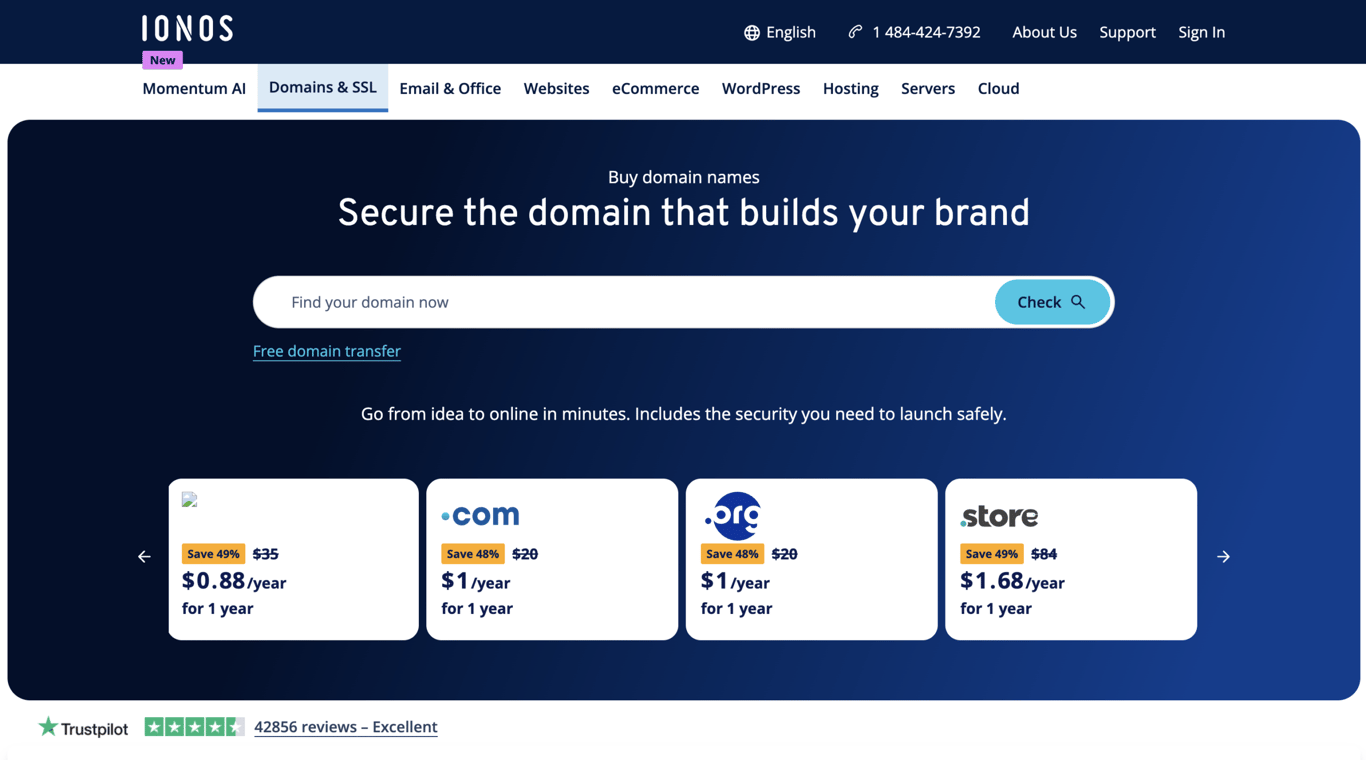
IONOS is a European hosting provider that also registers domains, and it’s at its best when you bundle the two. Many hosting plans include a free domain for the first year and a wildcard SSL certificate at a low starting price.
The checkout walks you through picking a domain, and you may see upsells for extra services along the way. It’s worth checking availability first with the IONOS domain checker, which also suggests AI-generated name ideas.
Transfers to IONOS are free, although you pay for one extra year of registration, which is added to your term. Some packages bundle in SSL or privacy, while email hosting and other add-ons are usually billed separately.
Why choose IONOS as your domain registrar
- Cheap first-year bundles pair a domain with hosting and a Wildcard SSL certificate.
- Free domain transfer moves your domain over for the cost of a 1-year renewal.
- Fast, reliable DNS keeps your site resolving quickly with high uptime.
- AI name suggestions help you find an available domain at checkout.
- Email add-ons include built-in spam and virus protection.
- Bulk search checks up to 100 domains at a time.
8. NameSilo
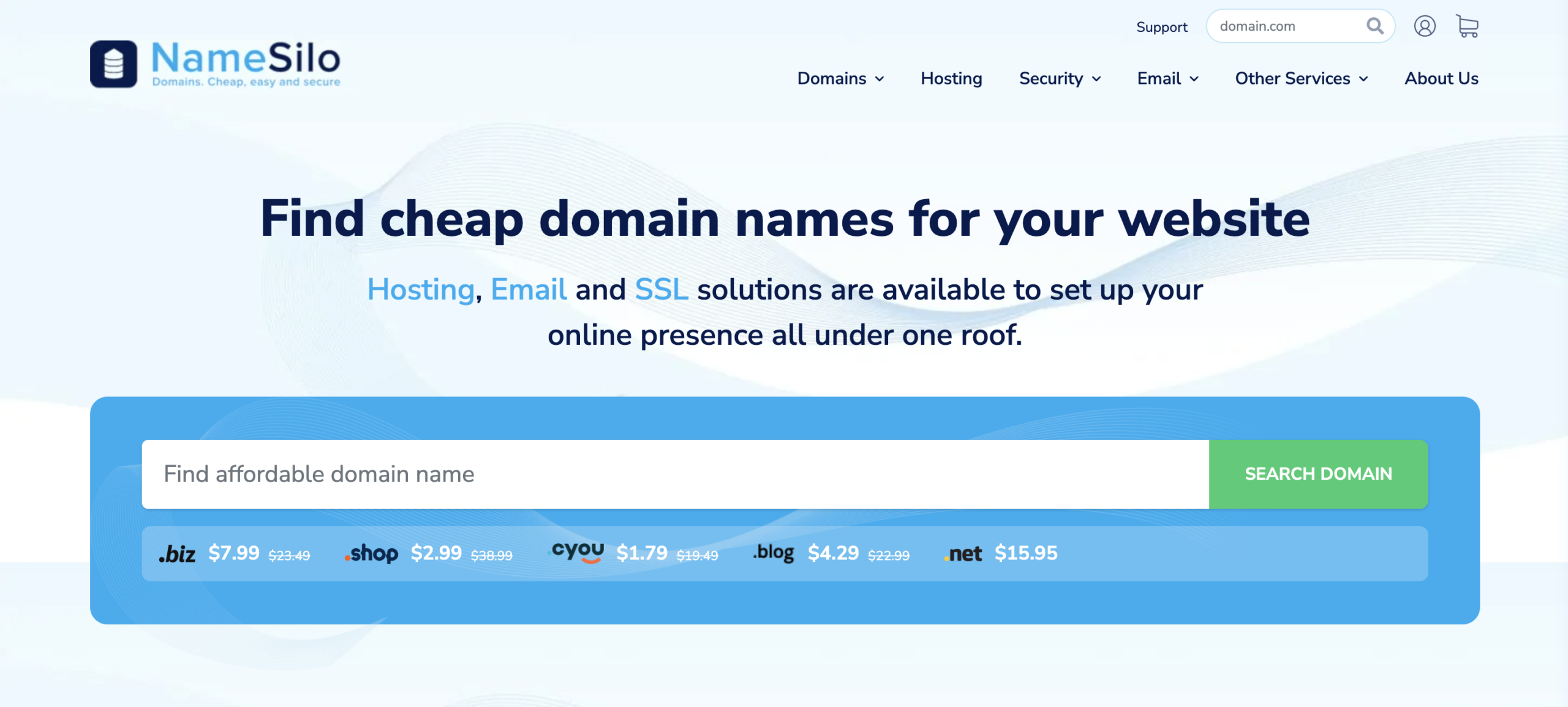
NameSilo is built for managing many domains. Registration and renewal cost the same, with no first-year gimmicks. Bulk mode lets you set the term and auto-renew across multiple domains, and the Discount Program cuts per-domain prices for heavy buyers with a $50 top-up.
The marketplace lets you buy and sell premium and expiring domains at a flat 3% commission on sales over $5,000, with no listing fees. You also get free parking, landing pages, and backorders for expiring names. You can change your nameservers and connect a domain to an outside host.
Registrations also include free email forwarding. Transfers for .com run for $10.80 and add a year to your term, and you can move up to 500 domains at once with a TXT or CSV file. The interface is plain, but it’s built for speed rather than looks.
Why choose NameSilo as your domain registrar
- Flat pricing keeps .com registration and renewal at $17.29/year, dropping to $11.05 with the Discount Program.
- Free WHOIS privacy keeps your registrant details out of public records.
- Bulk management registers, renews, and configures up to 500 domains at once.
- Marketplace access lists domains with no listing fees and a flat 7.5% commission.
- Backorders help you catch expiring domains through NameSilo or Catch.club.
- API access and two-factor login support investors managing large portfolios.
How to choose the best domain registrar?
The best domain registrar for you depends on price transparency, the features you need, and how easy the platform is to manage. Weigh the factors below to narrow your options.
Registration period
The registration period is the length of time you own a domain before you need to renew it, usually 1 to 10 years. A longer period suits a project you plan to keep, since it locks in the price and saves you from yearly renewals.
A shorter period is better for an experiment, because it costs less upfront and keeps you flexible. Check whether the registrar gives a discount for longer terms and whether your chosen extension has any limits.
Domain transfers
Domain transfer policies decide how easily you can move a domain to another registrar later. New domains are usually locked for up to 60 days before a transfer, and ICANN is working to shorten that window to 30 days, so check the current rule before you buy.
The process itself should be simple, with a clear interface and support you can reach if something stalls. If you manage several domains, look for a registrar that allows bulk transfers, and check how long each transfer takes.
Value for money
Value for money means looking past the first-year price to the renewal cost and what’s actually included. Many registrars advertise a cheap first year, then raise the renewal sharply, so the long-term cost matters more than the sticker price.
Watch for paid add-ons, such as WHOIS privacy or domain forwarding, which some registrars charge for. A slightly higher price can be worth it for responsive support, security tools, and extras like hosting or a site builder.
Extensions
A domain extension is the ending of a web address, like .com, .net, or .store. A wider choice matters because it gives you more ways to find a name that’s still free and fits your brand.
If the .com you want is already taken, you’ve still got good options. You can:
- Choose a different ending that suits your business, such as .net, .co, or .store.
- Tweak the name itself by adding a short, relevant word.
- Buy the .com from its current owner, though that usually costs more than registering a new name.
Renewal prices also vary a lot from one ending to the next. A .com is usually one of the cheaper endings to renew, while newer ones like .store or .tech can cost several times more each year.
The first-year price is often a discount, so it can be much lower than what you’ll pay each year after. Compare both to pick an ending that fits your brand and budget.
Ease of use
Ease of use comes down to how quickly you can search for, buy, and manage a domain without friction. Look for a clean layout, a fast search tool, and a checkout that doesn’t bury you in upsells.
Day-to-day management should be simple as well. Updating DNS records, setting up email, renewing, and turning on privacy should all take a few clicks.
Customer support
Good customer support helps you fix domain and DNS problems fast, which matters most when your site is down. It’s especially helpful if you’re new to managing domains or aren’t confident troubleshooting on your own.
Solid support can walk you through DNS settings, record changes, and connection problems before they cost you uptime. If you want to stay ahead of issues, here’s how to monitor your website’s uptime and downtime.
Renewal process
The renewal process decides whether you keep your domain or risk losing it when it expires. Under ICANN rules, registrars must send at least two renewal reminders before a domain expires. But it’s still smart to enable auto-renew and keep your payment details up to date.
Check the rules for expired domains too, including grace periods and any redemption fees. Pick a registrar that gives you a clear window to recover a domain if you miss a renewal.
Registering your domain with confidence
Once you’ve picked a registrar, the next move is to register your domain and connect it to your site. If you’re not sure where to start, here’s how to buy a domain name in a few steps.
Lock in a multi-year term if you’re sure about the name, turn on WHOIS privacy if it’s available, and enable auto-renew so you don’t lose ownership. These three steps cover the basics that trip people up the most.
If this is your first domain, spend a few minutes learning your registrar’s dashboard, especially how to manage DNS and email forwarding. A clean setup early on saves you time later.
Before you go live, run through a website launch checklist to confirm your domain, DNS, security, and performance are all set up right.
All of the tutorial content on this website is subject to Hostinger's rigorous editorial standards and values.

Justina is a Content Writer passionate about marketing, with a background in social media and customer success management. She also loves reading books, traveling and exploring new places as well as cooking, and trying out new recipes. Follow her on LinkedIn.