Web hosting statistics 2026: Global trends, market insights, and key facts
Mar 10, 2026
/
Emman Z. & Saulius L.
/
8 min Read

Web hosting is at the core of every online experience – whether it’s a personal blog, a growing ecommerce store, or a large-scale platform. Behind every website is a hosting solution that keeps it accessible and running smoothly.
As more users come online and digital services continue to grow, the hosting landscape is becoming increasingly competitive and dynamic. New technologies, rising performance standards, and shifting user needs are shaping how websites are built, hosted, and maintained. Keeping up with these trends and market insights is essential for making informed decisions about web hosting solutions.
In this article, we’ve compiled the latest web hosting statistics to help you understand the industry’s ongoing changes. From market trends and user behavior to the technologies driving growth, these insights will offer you a clear look at the state of web hosting today.
Top web hosting statistics for 2025
- The global web hosting market is projected to reach $355.81 billion by 2029.
- North America is expected to account for 39% of the global web hosting market in 2025.
- Amazon Web Services (AWS) leads the global web hosting market, powering 5.1% of all websites.
- Cloudflare leads among the top 1 million websites with a 16% market share.
- The top 10 hosting providers collectively account for 33.6% of the global market.
- Shared hosting market is set to reach $70.6 billion by 2026.
- The “Big Three” cloud providers (AWS, Microsoft Azure, and Google Cloud) together hold about 80% of the global cloud infrastructure market.
- Website performance remains critical, with 47% of users expecting a site to load in 2 seconds or less.
- 88% of websites now use HTTPS as the default security protocol.
Global web hosting market overview
To gain a deeper understanding of the web hosting market’s direction, let’s explore growth projections and key regional insights influencing the industry.
1. Web hosting market size to reach $355.81 billion by 2029
The global web hosting market is projected to grow from $125.36 billion in 2025 to $355.81 billion by 2029 at a compound annual growth rate (CAGR) of 23.6%.
This growth is fueled by rising cloud adoption, AI-powered site builders, and the growing need for managed hosting services. Businesses of all sizes are investing more in hosting to support their digital growth.
2. North America to hold 39% of the global web hosting market in 2025
North America is expected to lead the global web hosting market with a 39% share in 2025. Europe and Asia Pacific follow closely, driven by digital transformation initiatives and increased internet penetration. In contrast, South America holds a smaller share but shows steady year-over-year growth, especially in the ecommerce and SaaS segments.
3. The U.S. web hosting market projected to hit $127.17 billion by 2029
The U.S. web hosting market is forecasted to grow from $44.75 billion in 2025 to $127.17 billion by 2029, with a CAGR of 23.5%. The country remains a global hub for hosting and cloud infrastructure providers, thanks to strong demand from startups, content platforms, and large enterprises. Continued innovation in server technology and security also contributes to this upward trend.
4. Average spend per employee in web hosting market expected to reach $52.44
In 2025, the average spend per employee in the web hosting industry is expected to reach $52.44 globally. This figure reflects how businesses operating in the hosting market allocate resources toward their digital operations. Countries with more digitally mature economies tend to invest more per employee, especially in sectors like IT, media, and online retail.
Web hosting market share by provider
Let’s take a closer look at how the top hosting providers are performing and what market shares they hold in the global web hosting landscape.
5. Hostinger holds 4.1% of the global hosting market and powers 1.43% of the top one million websites
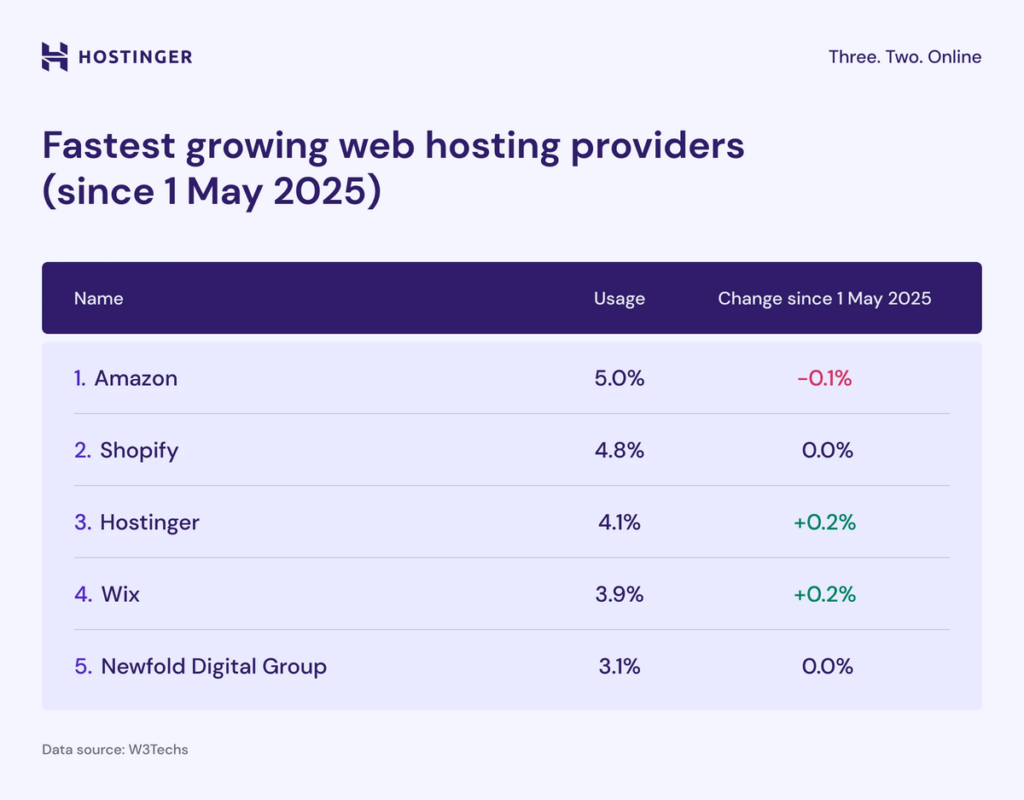
Hostinger currently holds 4.1% of the global web hosting market and powers 1.43% of the top one million websites worldwide. It’s recognized as one of the fastest-growing hosting providers with a growth of over 50% in market share in the past year alone, thanks to its affordable pricing, user-friendly interface, and reliable performance. These factors make Hostinger a popular web hosting choice for beginners, developers, startups, and businesses worldwide.
6. Amazon leads the global web hosting market, powering 5.1% of all websites
Amazon Web Services (AWS) powers 5.1% of all websites globally, making it the top hosting provider by volume. Known for its scalable infrastructure and enterprise-grade features, AWS remains the go-to choice for large businesses and high-traffic platforms.
7. Cloudflare leads among the top one million websites with a 16% market share
Cloudflare stands out with a 16% share among the top one million websites. Its focus on speed, CDN integration, and security gives it a strong position among performance-focused websites and web apps.
8. Top 10 web hosting companies account for 33.6% of the global market
The top 10 hosting providers hold 33.6% of the total market combined.
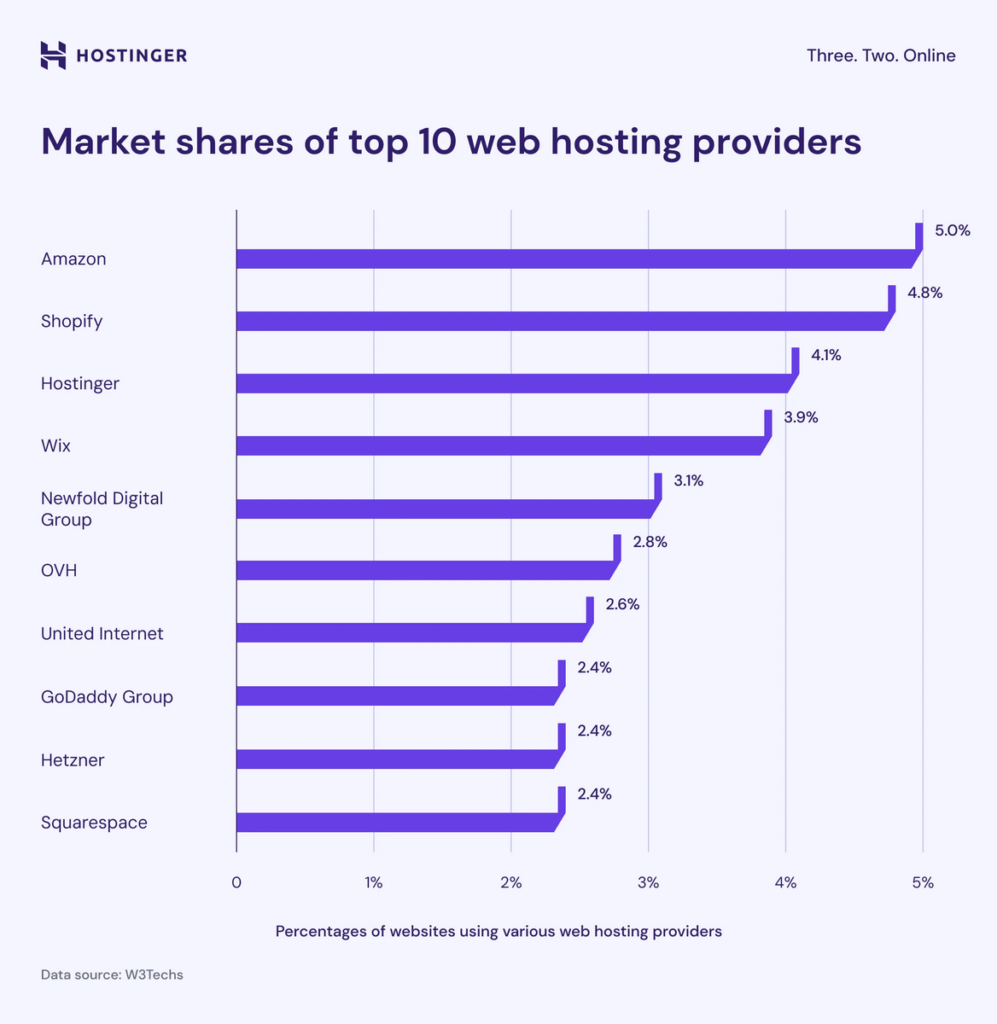
This shows how much of the industry is concentrated among a few major players, even though there are many smaller providers serving niche audiences.
9. Web hosting prices range from $3–$15 for shared plans to $80–$500 for dedicated hosting
Web hosting prices vary depending on the type of service you choose. Shared hosting typically costs between $3 to $15 per month, while dedicated hosting can range from $80 to over $500. Pricing depends on factors like performance, storage, bandwidth, and support, which tend to scale with more advanced website hosting plans.
Web hosting services statistics
Understanding the growth of different hosting services reveals how businesses are diversifying their strategies to accommodate evolving digital needs. Here are the key statistics about different web hosting services and how they’re catering to businesses of all sizes.
10. Shared hosting market is set to reach approximately $70.6 billion by 2026
Shared hosting remains a popular choice, with more than 18.5 million websites using shared hosting worldwide, especially among beginners and small businesses. The market is expected to grow steadily, reaching about $70.6 billion by 2026.
This growth aligns with the broader projection of the shared hosting market hitting $125.7 billion by 2030, with a CAGR of 15.5%.
11. Dedicated server hosting market is forecasted to grow to $29.6 billion by 2026
Dedicated hosting offers maximum control and resources for websites with high traffic or specific security needs. This market is expanding rapidly, expected to hit $29.6 billion by 2026 from $16.95 billion in 2023, growing at a CAGR of 18.9%.
Over 41 million websites currently rely on dedicated servers to meet their performance demands.
12. Virtual private server (VPS) market is expected to reach around $6.4 billion by 2026
VPS hosting provides a middle ground between shared and dedicated hosting, giving users more power without the high cost. The VPS market is forecasted to reach about $6.4 billion by 2026, growing steadily at a CAGR of 11.9%. There are over 24 million websites globally using VPS hosting today.
Expert tip
Developers turn to VPS for its speed, security, and full control – without the high price. Setup tools have gotten so easy that even non-tech users are joining in. Being able to host almost any project for a fraction of a dedicated server’s cost is making VPS the first choice for nearly everyone.

13. The big three cloud providers hold almost 80% of the global cloud market
Cloud hosting is booming, driven largely by the dominance of Amazon Web Services, Microsoft Azure, and Google Cloud.
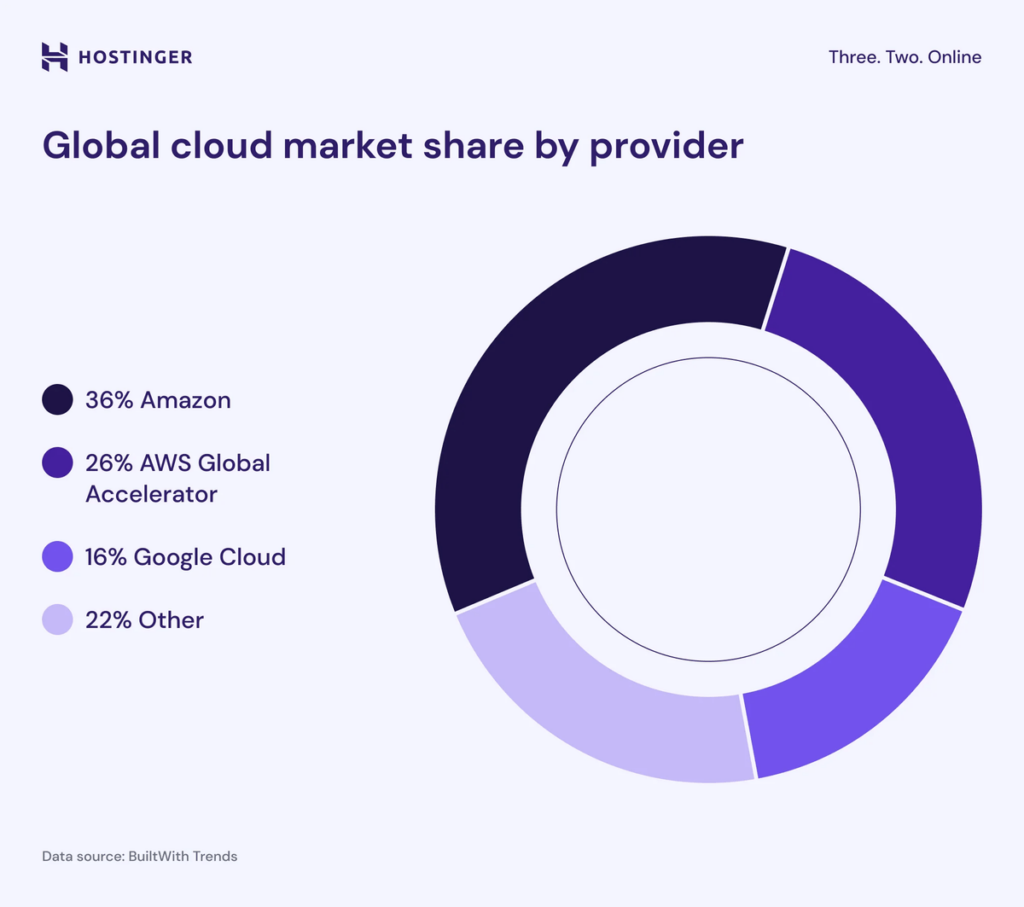
Together, these three control almost 80% of the cloud hosting market, powering over 182 million websites. Cloud hosting’s scalability and flexibility make it a preferred choice for businesses of all sizes.
14. WordPress powers 43.5% of all websites, making it the most popular platform
WordPress powers 43.5% of all websites, making it the most popular platform worldwide. Due to this widespread use, hosting providers often optimize their services to support WordPress’s unique features and large user base, which continues to grow according to the latest WordPress statistics.
15. Approximately 47% of businesses see the benefits of hybrid hosting solutions
Hybrid hosting, combining multiple hosting types like cloud and dedicated servers, is gaining momentum. Nearly half of all businesses (47%) recognize the advantages, including better uptime, cost savings, and flexibility, making hybrid hosting an important trend to watch.
Web hosting performance and user experience
With speed and reliability becoming paramount, the performance of hosting solutions has a direct impact on user experience and business success.
16. Nearly 47% of users expect a web page to load in two seconds or less
According to our landing page statistics, almost half of internet users expect websites to load within two seconds. Slow loading times can drive visitors away quickly, making speed a critical factor when choosing a hosting provider.
17. Power issues drive 54% of major data center outages
More than half (54%) of significant data center outages are caused by power failures. These incidents can result in costly downtime, affecting businesses and their customers. That’s why investing in reliable power backup systems is critical to minimize such risks.
18. Data privacy compliance concerns reported by 68% of businesses
Data privacy is a top concern for most businesses, with 68% reporting challenges in staying compliant with regulations. Hosting providers that prioritize security and compliance help companies protect user data and avoid costly penalties.
Expert tip
While the stakes are high when it comes to data privacy, the rewards are just as significant. Businesses that proactively handle compliance are not only protecting themselves, but also building trust with their customers.

19. Industry standard uptime of 99.9% results in nearly 9 hours of downtime per year
While 99.9% uptime is considered the industry standard, it still translates to about 9 hours of downtime annually. For many websites, even this amount can affect user experience and business operations.
20. Default HTTPS protocol is used by 88% of all websites
Security is now a baseline expectation online. HTTPS, the protocol that secures data between websites and users, is used by 88% of all websites, which clearly indicates how widespread secure connections have become.
Web hosting trends and technologies
The ongoing evolution of web hosting is largely driven by cutting-edge technologies and trends that continue to redefine what businesses expect from their hosting providers.
21. Green web hosting adoption is rising, but awareness gaps remain
Sustainability is becoming more important, with 46.2% of website professionals considering switching to green hosting and 35.4% of shoppers more likely to buy from eco-friendly websites. However, many still aren’t fully aware of green hosting options and their benefits, as shown in a recent report on green web hosting adoption.
Expert tip
While the IT industry has made strides in sustainability, it still lacks comprehensive, widely adopted sustainability practices, benchmarks, and programs. While common goals such as increasing renewable electricity and reducing greenhouse gas emissions are broadly embraced, accurately accounting for customer-related GHG emissions without double counting remains a complex issue, requiring further collaboration. For us, this represents a clear opportunity to make a meaningful impact – and the time to start is now.

22. Industry-specific cloud platforms will reshape hosting offerings
Tailored cloud platforms designed for specific industries are emerging, offering specialized features and compliance support. These industry-specific solutions help businesses meet unique requirements more efficiently.
23. About 92% of enterprises adopt multi-cloud strategies to optimize cost and performance
Approximately 92% of enterprises use multi-cloud strategies, leveraging multiple cloud providers to balance costs, boost performance, and avoid vendor lock-in. This approach allows businesses to tailor hosting to their exact needs.
24. Low-code platforms set to drive 75% of new app development by 2026
Low-code platforms are transforming app development by enabling faster, more accessible creation without deep coding skills. By 2026, they are expected to drive 75% of all new app development, reshaping how websites and applications are built, according to the latest low-code trends.
25. Nearly nine in 10 small businesses without a website plan to build one soon
As nearly 90% of small businesses without an online presence prepare to launch websites, many are turning to new technologies to simplify the process. AI-powered tools are increasingly popular, with about 41% of businesses using them to design and manage sites efficiently. These developments reflect broader trends in small business growth and the rising role of AI in business.
26. Edge computing transforms web hosting with low-latency, localized performance
Edge computing is revolutionizing web hosting by processing data closer to users, reducing latency, and speeding up load times. This localized approach significantly enhances performance, especially for applications that require real-time responses. As a result, the edge computing market is experiencing rapid growth, with its size expected to reach $350 billion by 2027.
Final insights on web hosting trends and statistics
As businesses continue to adapt to new changes in the web hosting industry, many forward-thinking companies are embracing cloud and hybrid hosting models, with 60% of enterprises planning to increase their cloud investments in the coming years.
Challenges like data privacy, integration issues, and cost remain significant concerns. Smaller businesses tend to prioritize affordable, reliable hosting, while larger organizations focus on performance and scalability to support their growing digital needs.
Looking ahead, web hosting will continue to be shaped by emerging technologies like AI and edge computing. By staying ahead of these trends, businesses can enhance performance, reduce operational costs, and maintain a competitive edge.
The key is to adapt, choose the right hosting solutions, and stay proactive as the industry continues to change.
Sources
- Hostinger
- Cognitive Market Research
- Statista
- W3Techs
- BuiltWith Trends
- Research and Markets
- Maximize Market Research
- IMARC Group
- Liquid Web
- Uptime Institute
- Uptimia
- Gartner
- Mordor Intelligence
Web hosting statistics FAQ
u003cstrongu003eHow big is the web hosting industry?u003c/strongu003e
The global web hosting industry is projected to reach $355.81 billion by 2029, growing at a compound annual growth rate (CAGR) of 23.6%. This growth is driven by factors like cloud adoption, AI-powered site builders, and the increasing need for managed hosting services.
u003cstrongu003eHow many web hosting companies are there?u003c/strongu003e
There are u003ca href=u0022https://www.hostingadvice.com/how-to/how-many-web-hosting-companies-are-there/u0022 target=u0022_blanku0022 rel=u0022noreferrer noopeneru0022u003emore than 330,000 web hosting companiesu003c/au003e worldwide, ranging from small, niche providers to large-scale, global platforms. The top 10 providers control around 33.6% of the market share, with major players like Amazon Web Services (AWS), Hostinger, and Cloudflare leading the way.
u003cstrongu003eWhat is the future of web hosting?u003c/strongu003e
The future of web hosting is focused on cloud, hybrid, and AI-powered solutions, as businesses prioritize scalable, secure, and fast hosting. Edge computing and multi-cloud strategies will become essential for meeting the increasing demand for performance and reliability.
u003cstrongu003eIs web hosting still profitable?u003c/strongu003e
Yes, web hosting remains profitable as demand grows for flexible and scalable hosting solutions. With businesses increasingly going digital, there are many opportunities for entrepreneurs. For those starting out, exploring different u003ca href=u0022/tutorials/website-ideasu0022 target=u0022_blanku0022 rel=u0022noreferrer noopeneru0022u003ewebsite ideasu003c/au003e can help shape a successful venture.
All of the tutorial content on this website is subject to Hostinger's rigorous editorial standards and values.

Emman is a Content Writer at Hostinger where she helps simplify complex topics for readers around the world. With over 5 years of experience in crafting SEO content, she’s passionate about making tech topics easy to understand. In her free time, Emman enjoys traveling and watching Formula 1 races. Follow her on LinkedIn.

As VP of Product at Hostinger, Saulius oversees Web Hosting Platform & Tools, Managed WordPress, and WebPro Experience. Saulius enjoys observing users through their daily life activities, looking for problems to solve, and building products that make users more efficient online, help them spend more time on the things they love, and leave all the rest for technology to solve. Follow him on LinkedIn.