Hermes Agent cost: managed, self-hosted, and local pricing 2026
Sep 15, 2026
/
By Bruno S. & Ariffud M.
/
11 min Read
Hermes Agent costs from $5.99/month for a managed plan, while a self-hosted deployment typically costs around $6 to $85+ per month once VPS hosting and LLM usage are included. You can also run Hermes Agent locally and avoid recurring hosting and LLM API costs if you already have suitable hardware and use a local model.
The Hermes Agent software itself is free under the MIT license. Your total cost depends on the setup method, AI model, workload, and optional tools you choose.
Here’s how the main cost options compare:
- Managed Hermes Agent. Starts at $5.99/month and renews at $11.99/month. The plan includes infrastructure management, maintenance, security, AI credits, and web search, although heavier usage may require additional credits.
- Self-hosted Hermes Agent. VPS hosting usually costs $4 to $25/month, while LLM API calls can add around $2 to $60/month, depending on the model and usage.
- Local Hermes Agent. Removes the VPS bill and can avoid LLM API charges when you use a local model. However, you still need suitable hardware and must account for electricity and possible upgrades.
- Optional services. Nous Portal, web search, browser automation, image generation, and text-to-speech can increase the monthly total.
This guide breaks down each cost, compares managed, self-hosted, and local setups, and explains how to estimate and reduce your Hermes Agent budget.
Managed Hermes Agent cost
Managed Hermes Agent starts at $5.99/month and renews at $11.99/month for two years. Plans are paid upfront, so the displayed monthly rate is the total subscription price divided by the number of months in the billing term. Prices exclude VAT.
The subscription includes the Hermes Agent environment and its infrastructure management. Hostinger handles the server configuration, software updates, backups, and backend security, so you don’t need to purchase or maintain a separate VPS. The plan also includes:
- Initial AI credits for accessing models such as Claude, Gemini, and GPT through nexos.ai.
- Web search through Oxylabs.
- A visual interface and command-line access.
- Built-in Telegram pairing.
- Application maintenance, including automated onboarding when you first set up the agent.
- The option to switch between Hermes Agent and OpenClaw under the same subscription.
The base subscription may not cover all usage. Hermes uses AI credits each time it responds or completes a task. Once the included nexos.ai credits run out, you can purchase more or connect an external AI provider using your own API key. Web searches can also require additional Oxylabs credits after the included allowance is used.
As a result, $5.99/month is the starting price rather than a guaranteed total. Light users may stay within the included credits, while frequent or model-intensive workflows can increase the monthly cost.
Managed Hermes Agent is best suited to users who want to avoid server administration and keep infrastructure costs predictable. Self-hosting offers more control, but requires a separate VPS subscription and charges for LLM usage from the start.
Self-hosted Hermes Agent cost
Self-hosting Hermes Agent typically involves three expenses: VPS hosting, LLM API usage, and any paid tools or services you connect. The VPS is the fixed part of the bill, while model and tool costs vary with usage.
VPS hosting
VPS hosting provides the server resources needed to run the Hermes Agent container, messaging gateway, browser tools, and scheduled tasks.
For a stable Docker deployment, choose a VPS with at least 2 vCPU cores and 8 GB of RAM. Although the Hermes container may use around 1 GB of RAM during lightweight tasks, Docker, the operating system, messaging channels, and browser automation need additional capacity.
Use the following guidance when choosing a server:
- Cloud LLM and basic automations. At least 2 vCPU cores and 8 GB of RAM.
- Browser automation and concurrent tasks. Consider additional CPU and memory if Hermes regularly opens browser sessions or runs several workflows at once.
- Local AI models. Resource requirements depend heavily on the model size and hardware. We cover these costs separately in the local deployment section.
Hostinger’s self-hosted Hermes Agent plans start from RM25.99/month. However, the KVM 2 plan, with 2 vCPU cores and 8 GB of RAM, better matches the recommended server configuration and starts from RM35.99/month.
The Hostinger template installs Hermes Agent in one click and includes Docker Manager, access to container logs, one-click application updates, and automatic weekly backups. You can also deploy Hermes Agent manually on a VPS from another provider.
When comparing plans, check both the introductory and renewal prices. VPS subscriptions are usually paid upfront, and the advertised monthly rate represents the total contract price divided by the number of months. Renewal rates are often higher, so use them when estimating your long-term budget.
Also consider the provider’s billing model. Hourly servers can suit temporary workloads, but Hermes Agent is generally designed to stay online continuously. For an always-on deployment, compare the cost of roughly 730 billed hours per month with a fixed monthly VPS plan.
LLM API calls
LLM API calls are the main variable cost when self-hosting Hermes Agent. Providers charge separately for input tokens, such as prompts, conversation history, and tool data, and output tokens generated by the model.
Agent tasks can cost more than standard chat requests because Hermes may call the model several times to plan a task, use tools, process the results, and prepare the final response. Longer conversations, large tool outputs, retries, and parallel subagents can increase token usage further.
Here are approximate standard API prices per one million tokens, checked in July 2026:
- Budget models. DeepSeek V4 Flash costs $0.14 for uncached input and $0.28 for output. GPT-5.4 Nano costs $0.20 for input and $1.25 for output. Gemini 3.1 Flash-Lite costs $0.25 for input and $1.50 for output.
- Mid-range models. Claude Haiku 4.5 costs $1 for input and $5 for output.
- Premium models. Claude Sonnet 4.6 costs $3 for input and $15 for output, while Claude Opus 4.8 costs $5 for input and $25 for output.
You can also connect Hermes Agent to OpenRouter, which provides one API for more than 400 models. OpenRouter passes through the providers’ inference prices without adding a markup, but charges a 5.5% fee when you purchase credits.
Prompt caching can reduce the cost of repeated input. For example, DeepSeek V4 Flash charges $0.0028 per million cached input tokens, compared with $0.14 for uncached input. OpenAI, Google, and Anthropic also offer discounted cached-input pricing for supported models.
Hermes Agent also compresses long conversations to keep them within the model’s context window. Its default configuration begins compression at 50% of the context window, although the actual threshold can vary by model and provider. When needed, Hermes uses an auxiliary model to summarise older messages, creating an additional API call but reducing the size of later requests.
Your final cost depends on the model, task length, enabled tools, number of model calls, and cache usage. Run several representative workflows and check your provider’s usage dashboard before setting a monthly budget.
Nous Portal subscription (optional)
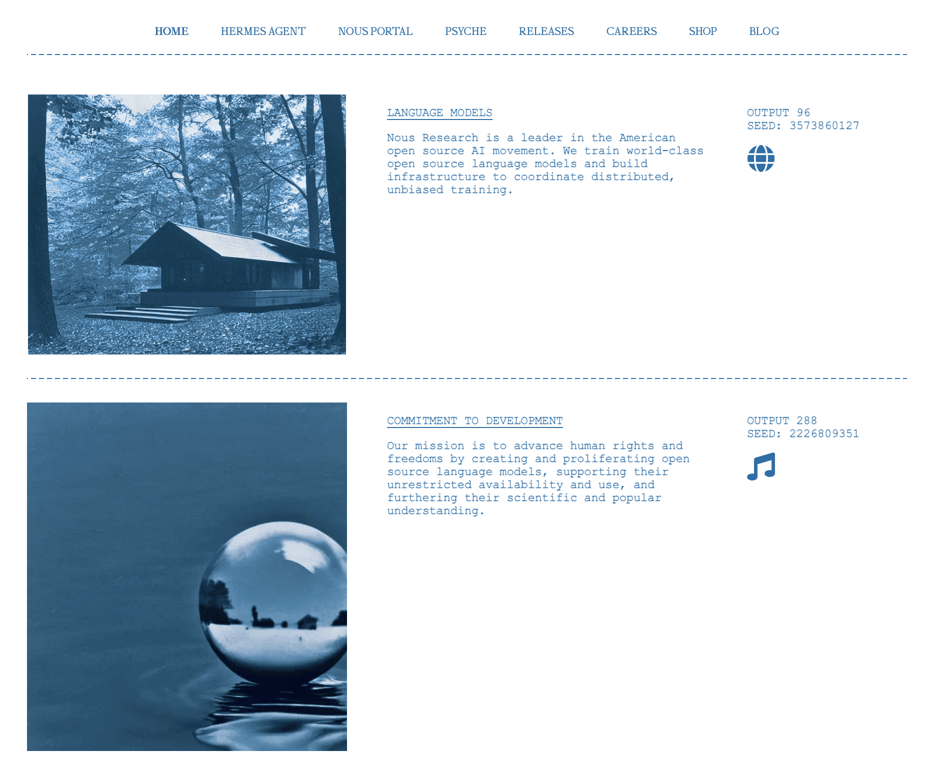
Nous Portal is an optional subscription that connects a self-hosted Hermes Agent to more than 300 AI models and four hosted tools through one account. Model and tool usage draw from the same credit balance, which can simplify billing compared with managing separate providers and API keys.
Run hermes setup –portal to sign in with OAuth, select a model, set Nous Portal as the inference provider, and enable the Tool Gateway.
The available plans are:
- Free – $0/month. Includes free model options and pay-as-you-go access to more than 300 models. It doesn’t include monthly credits or the Tool Gateway.
- Plus – $20/month. Includes $22 in monthly credits, hosted tool access, higher rate limits, and a $10 rollover cap.
- Super – $100/month. Includes $110 in monthly credits, higher rate limits, and a $50 rollover cap.
- Ultra – $200/month. Includes $220 in monthly credits, the highest rate limits, and a $100 rollover cap.
Paid plans provide access to the Tool Gateway for:
- Web search and page extraction.
- Image generation.
- Text-to-speech.
- Cloud browser automation.
These tools are usage-based rather than unlimited. Their charges, along with model inference costs, are deducted from the plan’s credit balance. Unused credits can carry over only up to the limit of your selected plan.
Nous Portal can be useful when you regularly use multiple models and tools and want to manage them under a single subscription. However, it doesn’t replace your VPS or make the self-hosted deployment fully managed.
The subscription isn’t required to run Hermes Agent. You can connect directly to providers such as OpenRouter, Anthropic, or OpenAI, use separate API keys for individual tools, or run a supported local model.
Tool services (optional)
Optional tool services can increase the cost of a self-hosted Hermes Agent when you connect paid providers for web search, image generation, text-to-speech, browser automation, or cloud execution.
The amount depends on which tools you enable and how often Hermes uses them:
- Web search and extraction. Providers such as Firecrawl, Tavily, Exa, and Parallel charge based on searches, extracted pages, or credits. Free options are also available, including DuckDuckGo search and a self-hosted SearXNG instance.
- Image generation. Image providers usually charge per generated image, with prices varying by model, resolution, and quality.
- Text-to-speech. Voice services typically charge according to the number of characters or audio minutes generated.
- Cloud browser automation. Providers such as Browserbase, Browser Use, and Firecrawl charge for remote browser sessions or usage time. Costs can increase when workflows involve long sessions, repeated page loads, or several browsers running at once.
- Cloud execution environments. Services used to run commands or code in isolated environments may charge for compute time, storage, or active workspaces.
You don’t need every service for a basic Hermes Agent setup. Enable only the tools required for your workflows and check whether each provider offers a free allowance before choosing a paid plan.
A paid Nous Portal subscription includes access to web search, image generation, text-to-speech, and cloud browser automation through its Tool Gateway. These services use the same credit balance as model requests, so you don’t need separate accounts or API keys for each provider. However, tool calls are still usage-based and can consume the plan’s monthly credits.
You can also run some tools locally. For example, a local Chromium browser or self-hosted SearXNG instance avoids per-use API fees, but consumes VPS processing power and memory. If these tools run frequently, you may need a larger server, which would increase your fixed hosting costs.
Compare both approaches when budgeting. Hosted APIs add variable usage charges but require fewer server resources, while local tools reduce external service fees but may require a more powerful VPS.
Local Hermes Agent cost
Running Hermes Agent on local hardware removes the VPS cost and avoids per-token API charges when you use a local model. However, the setup may still involve hardware, electricity, storage, and upgrade costs. Connecting cloud models or paid tools also adds usage-based charges.
If you already own a suitable computer, local inference can keep recurring costs low. Buying a new machine specifically for Hermes Agent can cost more than using a managed plan or VPS, especially if you need a larger model or faster performance.
Hardware requirements depend on the model size, quantisation, context length, and inference software:
| Local setup | Approximate hardware requirement | Suitable for |
|---|---|---|
| Small models around 3B | At least 8 GB of RAM | Testing and basic conversations |
| Quantised models around 9B | Around 10–12 GB of available memory | General use and lighter agent workflows |
| Models around 27B or larger | 32 GB of RAM or more | More complex reasoning and tool use |
| GPU-accelerated setup | A GPU with at least 8 GB of VRAM is recommended | Faster responses and heavier workloads |
A GPU isn’t required, but CPU-only inference is slower. Response speed also decreases as the model size and context window increase.
Hermes Agent requires a model with a context window of at least 64,000 tokens. A larger context uses more memory because the system must store the model and its working context at the same time. Quantised models and KV cache compression can reduce memory use, but may affect speed or output quality.
For example, Hermes recommends Qwen3.5-9B as a practical starting point for local use. A quantized version uses around 10–12 GB of memory at a 128K context window, depending on the inference backend. Larger 27B and 35B models generally require at least 32 GB.
You can connect Hermes Agent to local inference software such as Ollama, llama.cpp, vLLM, or another OpenAI-compatible server. Make sure the selected model supports tool calling. Models without it can respond to messages but can’t reliably perform actions such as running commands, editing files, or browsing the web.
Local inference keeps model prompts and responses on your hardware. However, data may still leave the device when Hermes uses hosted web search, browser automation, image generation, or other cloud services. To keep the entire workflow local, both the model and its connected tools must run on your own hardware.
Local deployment works best when you already have capable hardware, want to avoid variable API charges, or need more control over where model data is processed. A managed or self-hosted cloud setup is usually simpler when you don’t want to maintain local inference software or keep a computer running continuously.
How to reduce Hermes Agent cost
You can reduce Hermes Agent costs by choosing the right deployment method, models, tools, and usage limits for your workload. Start with the largest part of your bill instead of changing several settings at once.
Use these tactics:
- Choose the right model. Use budget or mid-range models for routine tasks and reserve premium models for complex reasoning or coding.
- Use cheaper auxiliary models. Assign lower-cost models to context compression, summaries, image analysis, and session titles.
- Disable unused tools. This can reduce prompt size and prevent unnecessary calls to paid services.
- Use prompt caching. Providers may charge less for repeated input, although actual savings depend on cache-hit usage.
- Monitor credits and API usage. Check nexos.ai and Oxylabs credits in Hostinger dashboard or review your provider dashboards. Set budgets or alerts where available.
- Review recurring tasks. Scheduled jobs, retries, subagents, and long browser sessions can increase costs in the background.
- Right-size your infrastructure. Avoid paying for more VPS capacity than your workflows need.
Run several typical workflows before setting a monthly budget. Model prices alone don’t show the full cost, as token volume, tool usage, and task complexity also affect the total.
Hermes Agent cost vs. ChatGPT Plus, Claude Pro, and OpenClaw Cloud
Hermes Agent can cost less than a consumer AI subscription, but the comparison depends on how you deploy it and how much model and tool usage you generate. Managed Hermes provides a more predictable starting cost, while self-hosted and local setups offer more control over the infrastructure and models.
The table compares typical costs as of July 2026:
| Option | Monthly cost | Cost type | Best for |
|---|---|---|---|
| Managed Hermes Agent | From $5.99, renewing at $11.99 | Managed subscription with included AI credits; additional usage may cost extra | Persistent agent workflows without server administration |
| Self-hosted Hermes Agent | From $6.49 for the VPS, plus model and tool usage | Variable | Users who want full control over the server and configuration |
| Local Hermes Agent | Varies by hardware and electricity use | Hardware and operating costs | Users with suitable hardware who want local inference |
| ChatGPT Plus | $20 | Monthly subscription with usage limits | General chat, research, coding, and content tasks |
| Claude Pro | $20 | Monthly subscription with usage limits | Users who prefer Claude for chat, analysis, and coding |
| OpenClaw Cloud Plus | $9.99 | Third-party managed subscription | Users who want a hosted OpenClaw environment |
Managed Hermes Agent currently includes infrastructure management, AI credits, web search, updates, backups, and security. ChatGPT Plus costs $20/month, while Claude Pro costs $20/month in the US. OpenClaw Cloud Plus costs $9.99/month, with a Pro plan available for $39.99/month.
Choose Managed Hermes Agent when you need a persistent agent but don’t want to maintain a server. Choose self-hosting when you need more control over the infrastructure, models, and integrations. A local setup can keep recurring costs low when you already own suitable hardware.
OpenClaw Cloud offers another managed route, but price isn’t the only difference between the two agents. Their features, integrations, and deployment options also vary, so it’s worth considering how Hermes Agent compares with OpenClaw before choosing a platform.
ChatGPT Plus and Claude Pro are better suited to direct conversations and one-off tasks. Their subscription fees don’t include API usage, so you can’t use a ChatGPT Plus or Claude Pro subscription to cover the model calls made by a self-hosted Hermes Agent.
Is Hermes Agent cheaper than ChatGPT Plus?
Hermes Agent can be cheaper than ChatGPT Plus. Managed Hermes starts at $5.99/month, while a lightweight self-hosted setup may also stay below ChatGPT Plus’s $20/month price. If you already pay for ChatGPT Plus or Pro, you can connect your ChatGPT subscription to Managed Hermes instead of also paying for AI credits. However, frequent model calls, premium models, and paid tools can push a self-hosted Hermes setup above that amount.
The better choice depends on the type of work you need to complete. ChatGPT Plus provides predictable pricing for interactive use, while Hermes Agent is designed for persistent, multi-step workflows that can continue running between conversations.
When Hermes Agent cost makes sense (and when it doesn’t)
Hermes Agent cost makes sense when you regularly use it for persistent, multi-step workflows rather than occasional questions. The Hermes Agent use cases most likely to justify the cost include recurring research, development, system administration, and personal-assistant tasks that would otherwise require ongoing manual work.
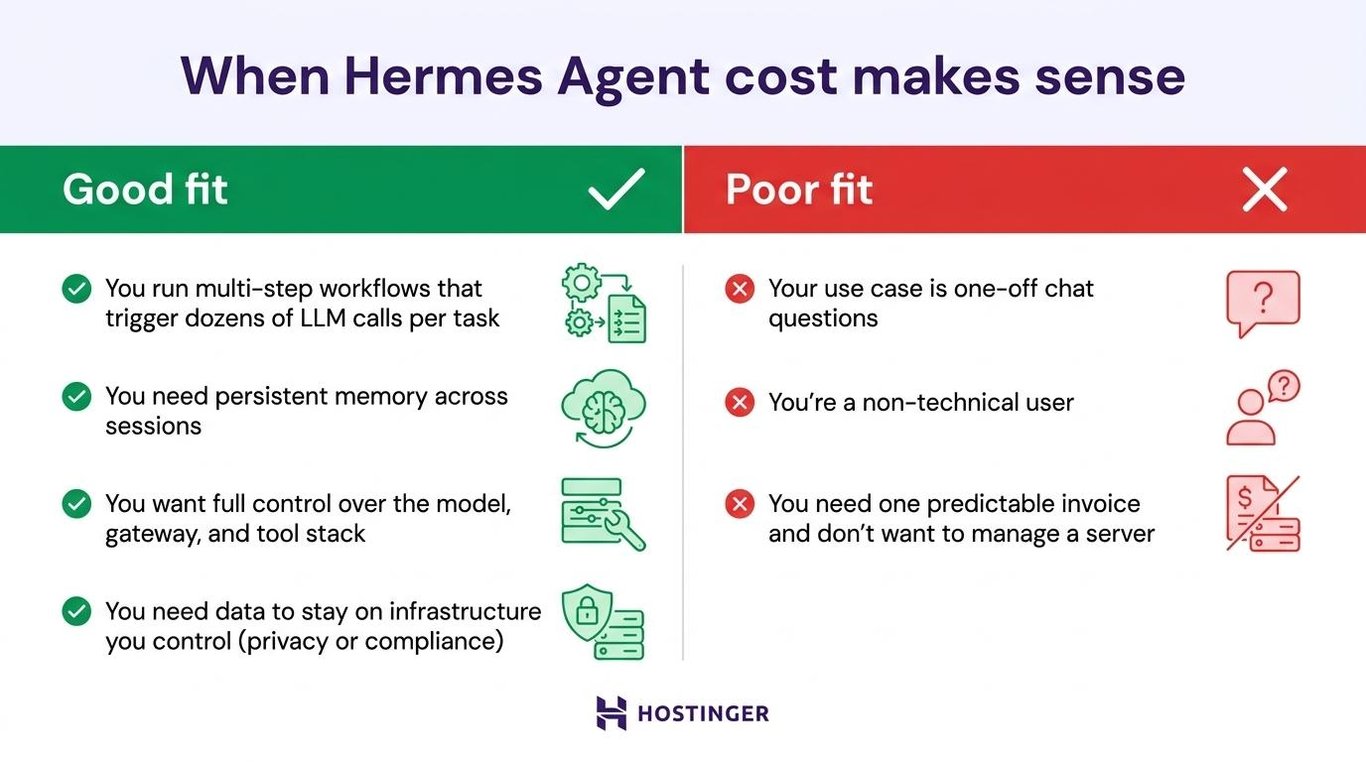
Hermes Agent is a good fit when:
- You regularly automate workflows involving several steps, tools, or model calls.
- You need memory and context to carry across sessions.
- You want the agent to run scheduled tasks or remain available through messaging channels.
- You need control over the models, tools, and integrations it uses.
- You want to run the agent on infrastructure you control for privacy or compliance.
Hermes Agent may not be the best fit when:
- You mainly need answers to one-off questions.
- Your workflows are too infrequent to justify a persistent agent.
- A standard AI chat subscription already covers your research, writing, or coding needs.
Self-hosting may also be a poor fit if you don’t want to configure and maintain a server. Managed Hermes Agent handles the server, updates, backups, and core security configuration, giving you a simpler route to setting up Hermes Agent. Its infrastructure costs are also more predictable, although heavier AI or web search usage may still require additional credits.
Choose Managed Hermes Agent when you want persistent workflows without server administration. Choose self-hosting when you need more infrastructure control, or use ChatGPT or Claude when you only need direct conversations and occasional tasks.
Sizing your Hermes Agent budget
To size your Hermes Agent budget, first choose between managed, self-hosted, and local deployment. This determines whether your main fixed cost is a managed subscription, a VPS plan, or hardware and electricity.
Next, choose a model based on the complexity of your workflows. Budget models can handle routine tasks, while premium models cost more but may perform better on complex reasoning, coding, and multi-step automation.
Run several typical workflows and monitor:
- Model and tool usage.
- Input, output, and cached tokens.
- Managed AI and web-search credits.
- Recurring jobs, retries, and browser sessions.
- VPS utilisation or local electricity use.
Use this data to estimate a typical month, then add a buffer for busier periods. For self-hosted deployments, calculate the budget using the VPS renewal price rather than only the introductory rate. Managed users should account for possible credit top-ups, while local users should include hardware upgrades and operating costs.
This article is a localized version of Hermes Agent cost: managed, self-hosted, and local pricing 2026, originally published in English.
All of the tutorial content on this website is subject to Hostinger's rigorous editorial standards and values.

Bruno is a Content Writer at Hostinger, focused on creating and optimizing helpful, engaging articles about web development and marketing. With a background in journalism, he combines storytelling with practical insights to make complex topics easier to understand. He has also contributed to publications like MacMagazine and Jornal A Tarde. Outside of work, Bruno enjoys exploring art, cooking, and technology.

Ariffud is a Technical Content Writer with an educational background in Informatics. He has extensive expertise in Linux and VPS, authoring over 200 articles on server management and web development. Follow him on LinkedIn.