Inbound email marketing: What it is and how it works
May 21, 2026
/
By Alma
/
9 min Read
Inbound email marketing is a strategy in which you only email people who signed up to hear from you. Instead of cold-emailing strangers, you attract subscribers with useful content, then send them targeted messages that guide them toward a purchase.
It works differently from outbound email, where you contact people who haven’t heard of you yet. Inbound focuses on subscribers who have already shown interest, which is why it tends to deliver higher open rates, stronger engagement, and a stronger return on investment (ROI). The tradeoff is that building your list takes more time upfront, but the leads you get are higher quality.
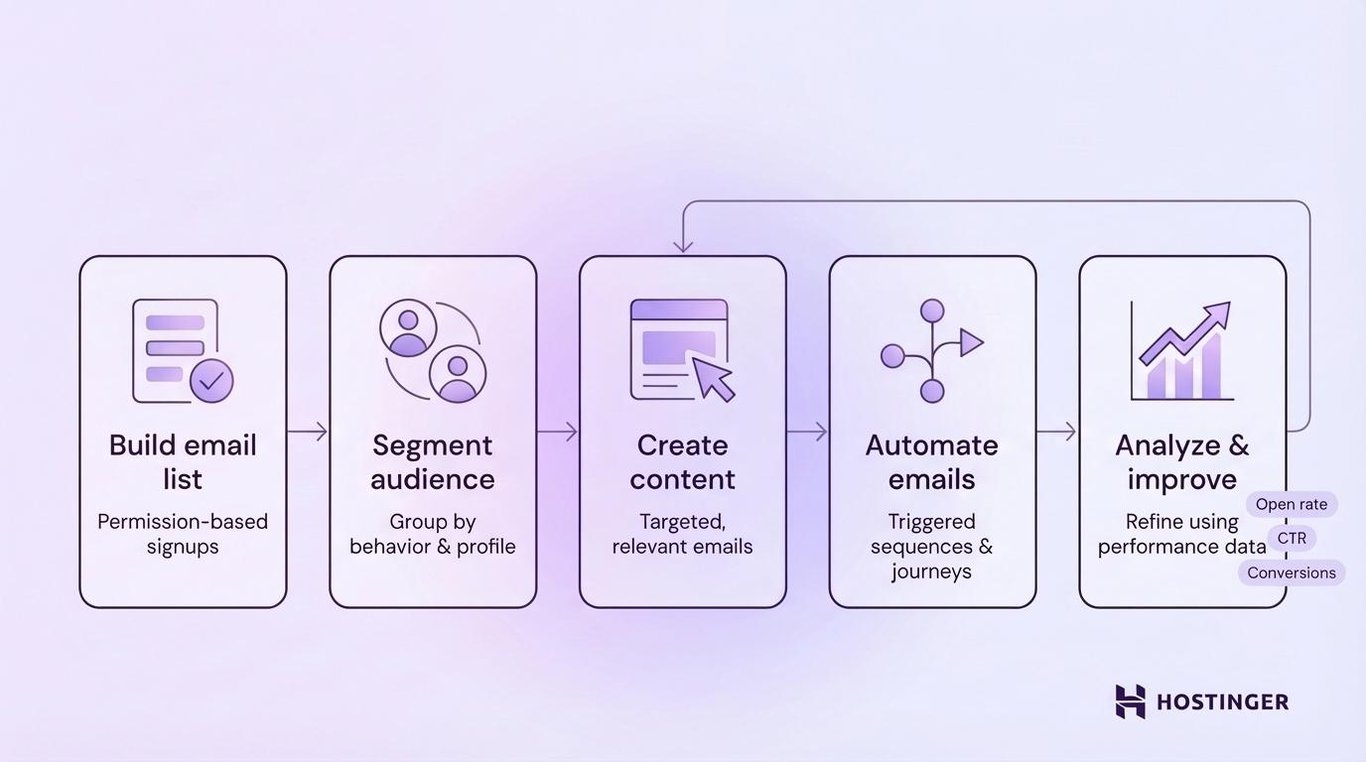
Setting up inbound email marketing comes down to five steps: building your list, grouping subscribers by their interests, sending content that matches those interests, setting up automated emails, and tracking what works.
Along the way, you’ll use different types of campaigns depending on where each subscriber is – like welcome emails for new sign-ups, reminders for people who left items in their cart, or messages to bring back subscribers who’ve gone quiet.
What is inbound email marketing?
Inbound email marketing is an approach where every message you send goes to someone who signed up or subscribed to receive your emails. Your job is to build on your subscribers’ interest with email marketing content that matches where each person is in their journey – whether they just signed up, are comparing options, or are close to buying.
You measure what’s working through open rates, click-through rates (CTR), and conversions. But the metrics only improve when the underlying approach is right: email segmentation to group subscribers by behavior or interest, email personalization to make each message feel relevant, and timing to reach people when they’re most receptive.
Key aspects of inbound email marketing
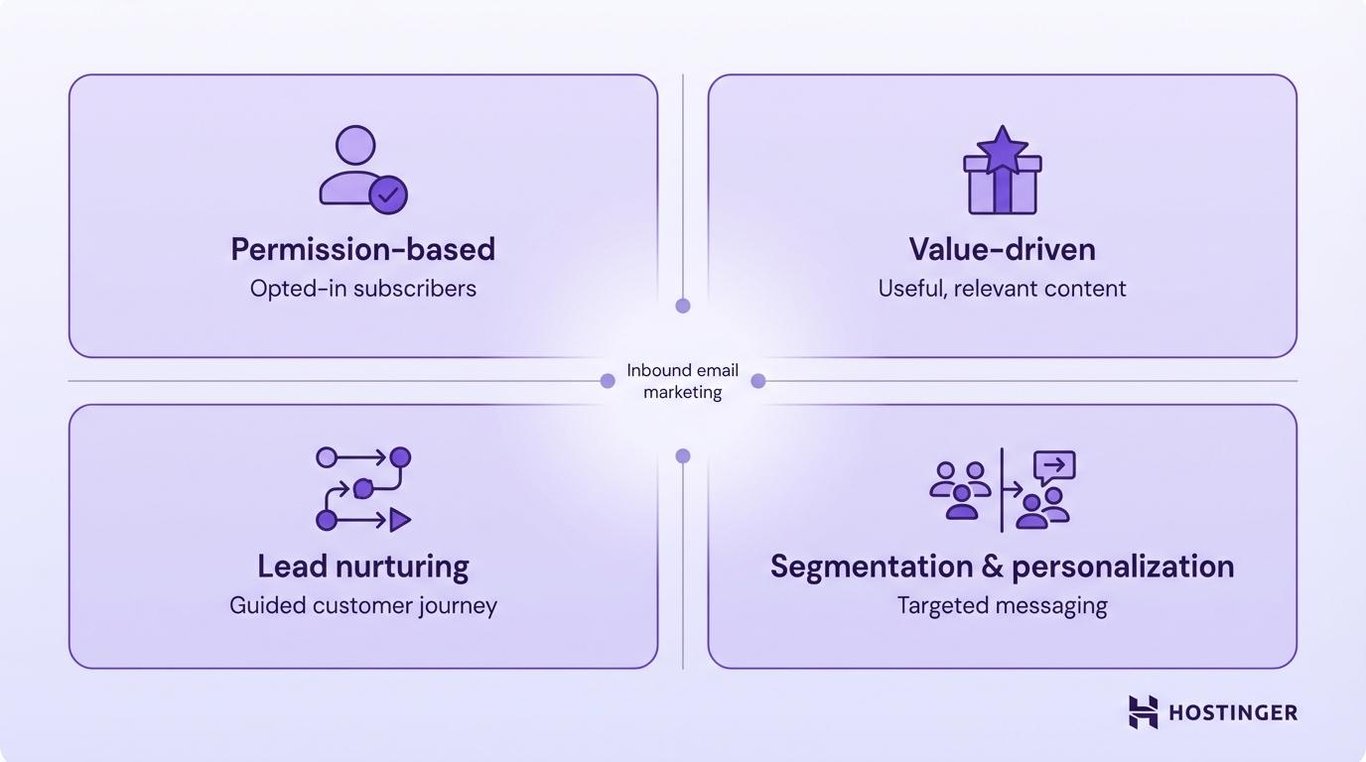
- Permission-based. Every subscriber chose to be on your list. You never buy email lists or add people without consent. Permission-based email marketing keeps your sender reputation strong and your engagement high, because recipients actually expect your emails.
- Value-driven. Each email gives something useful before it asks for anything – a practical tip, an exclusive deal, educational content. This is what earns the trust that makes subscribers open your next email instead of ignoring it.
- Lead nurturing. Not everyone is ready to buy when they first subscribe. Inbound email meets people where they are and moves them forward with the right content at the right time, from initial awareness through to purchase. That gradual approach is what makes inbound different from one-off promotional blasts.
- Segmentation and personalization. You group subscribers by behavior, interests, or demographics, then tailor your messaging to each group. In an Experian Marketing Services study, personalized promotional emails achieved 29% higher unique open rates and 41% higher unique click rates than non-personalized mailings. Email segmentation turns a single list into multiple targeted audiences, so each person gets content that actually applies to them.
Inbound vs outbound email marketing
The difference between inbound and outbound email marketing is who you’re sending to.
Inbound emails go to people who signed up for your emails – someone who subscribed to your newsletter or created an account, for example. A welcome email after someone subscribes is a classic inbound interaction.
Outbound emails go to people who haven’t interacted with your brand yet. Emailing businesses that could benefit from your service is a common example.
| Inbound | Outbound | |
| Targeting | People who opted in | Cold contacts (people who haven’t heard of you yet) or purchased lists |
| Messaging | Personalized, content-driven | Promotional, sales-focused |
| Engagement | Higher open and click rates | Lower engagement overall |
| Best for | Lead nurturing, loyalty, long-term growth | Brand awareness, prospecting, event promotion |
| Drawback | Takes time to build a list | Higher unsubscribe and spam complaint rates |
The strongest results come from using both email marketing strategies – outbound gets your name in front of new people, while inbound turns that attention into lasting relationships.
What does purchasing an email list mean?
Buying an email list means paying a third-party provider for a database of email addresses. Some providers offer verified, targeted data for B2B outbound outreach, which is a common and legitimate prospecting method. Others sell low-quality bulk lists with outdated or unverified addresses, which can lead to spam complaints and deliverability issues. The key difference is quality and intent – targeted outreach to relevant contacts is standard practice, while mass-emailing a cheap list of strangers often does more harm than good.
Benefits of inbound email marketing
Because you’re only emailing people who opted in, inbound gives you built-in advantages that outbound and paid channels struggle to match.
- Higher ROI. According to email marketing statistics, email campaigns deliver an average ROI of $36 for every $1 spent, ranking among the highest-performing marketing channels. Some retail and ecommerce programs report even higher returns when their email strategy is well optimized. Inbound campaigns tend to sit at the higher end because engaged, opted-in subscribers convert at better rates than cold contacts.
- Stronger customer trust and loyalty. The opt-in creates a foundation of trust from the start. Consistent, helpful emails build on that over time, turning one-time buyers into repeat customers who recommend you to friends and colleagues.
- Better targeting and higher-quality leads. Your list is self-selected – these are people who already care about what you offer. Layer in email segmentation, and you’re matching specific messages to specific needs, which lifts conversion rates well above what untargeted sends achieve.
- Cost-effectiveness. Once your list and automated workflows are set up, the cost of email marketing is low. You’re not paying per impression or per click like you would with paid ads, and you’re not burning budget on contacts who never asked to hear from you.
- Effective lead nurturing and automation. Inbound shines at the long game. Automated sequences guide subscribers from initial interest to purchase over days or weeks, building familiarity and trust at each step – something a single outbound email can’t replicate.
- Better segmentation and personalization. Because inbound subscribers interact with your content over time, you collect behavioral data that makes your segments richer and your personalization sharper with each campaign. More than half of marketers now personalize email content, tailoring messages based on behavior, location, or purchase history.
- Organic brand awareness. Great emails get forwarded. When subscribers share your content with friends or colleagues, your reach grows without extra ad spend – and those referrals arrive with built-in trust.
How inbound email marketing works
Inbound email marketing starts by building a list of people who want to hear from you. Then you group those subscribers based on what they care about, so you can send content that fits. From there, you set up automated workflows to deliver those emails at the right time, and track your results to keep improving.
1. Build a permission-based email list
A quality email list is the foundation of your inbound email marketing strategy. Without it, nothing else works.
Start with sign-up forms on your website. Place them where visitors are most engaged, like at the end of a blog post, on a pricing page, or as a pop-up after someone spends 30 seconds browsing. Keep the form short. Name and email are usually enough to build an email list that can grow.
But a form alone won’t convince most people to hand over their email. That’s where offering lead magnets come in – you offer something useful in exchange for an email address, like a free template, checklist, discount code, or mini-course. The more specific the offer, the better the conversion rate. ‘Download our free 7-day meal plan’ pulls more sign-ups than a generic ‘subscribe to our newsletter.'”
Remember to stay compliant. Laws like the EU General Data Protection Regulation (GDPR) and the US CAN-SPAM Act set rules for how you collect consent, identify your business in commercial emails, and provide unsubscribe options. As a best practice, use clear opt-in language, explain how you’ll use subscribers’ data, and always provide an easy, visible unsubscribe link.
2. Segment your email audience
Sending the same email to everyone on your list defeats the purpose of inbound. The whole point is relevance, and segmentation is how you deliver it.
You can segment your email list by demographics (age, location, job title), behavior (purchase history, email engagement, website activity), or where someone is in the buying process (new subscriber, active shopper, lapsed customer).
Even basic segmentation makes a noticeable difference in bulk email marketing. A welcome email for new subscribers and a re-engagement email for inactive ones are two completely different messages. Treating them the same drags down performance across the board.
3. Create targeted and valuable email content
Once you know who you’re writing to, the content almost writes itself.
Match the email type to where the subscriber is in their journey. For example, new subscribers get a welcome series introducing your brand. Active shoppers get product recommendations or exclusive deals. Readers who engage with your blog get educational content that positions you as an expert.
There are some content formats that are effective for inbound, such as:
- Newsletters with curated tips, updates, and links to your latest content
- Educational emails that teach a skill or solve a common problem
- Personalized offers based on past purchases or browsing history
- Case studies or success stories that show real results
Keep your emails focused. One clear message per email beats three competing ones. Write subject lines that tell readers exactly what’s inside, and make the call to action (CTA) obvious.
4. Set up automated email workflows
Once you have your segments and content in place, you can set up emails that send automatically based on what your subscribers do. Email marketing automation handles the sending for you.
For example, someone signs up for your list and gets a welcome series over the next week without you doing anything. Someone leaves items in their cart and gets a reminder a few hours later. A subscriber clicks on a product link and gets a follow-up with reviews or a discount. These are all automated workflows called drip campaigns running in the background based on rules you set.
You can also use automation to bring back subscribers who’ve gone quiet. If someone hasn’t opened an email in 60 days, an automated re-engagement message can reach out with a reason to come back.
This is the core engine of inbound email – you’re not pushing a sale. You’re helping someone get ready to buy on their own terms, one email at a time.
5. Analyze and optimize campaign performance
After every campaign, check three numbers:
Open rate tells you if your subject lines are working. The average across industries is around 35.63%, though it varies by niche. Because your inbound subscribers signed up to hear from you, you can often beat that, especially with a well-grouped list where inactive contacts are regularly removed.
CTR shows whether people are engaging with your content and clicking your links and buttons. The average sits around 2–3%, but well-targeted inbound campaigns often do better.
Conversion rate tells you how many people actually took the action you wanted – a purchase, a sign-up, a download.
If open rates are low, test different subject lines. If clicks are high but conversions are low, the problem is probably your landing page, not the email.
Watch your unsubscribe rates and spam complaints too. With inbound, these should stay low. If they start rising, it usually means your content has drifted from what subscribers originally signed up for, or you’re emailing too often.
Types of inbound email marketing campaigns
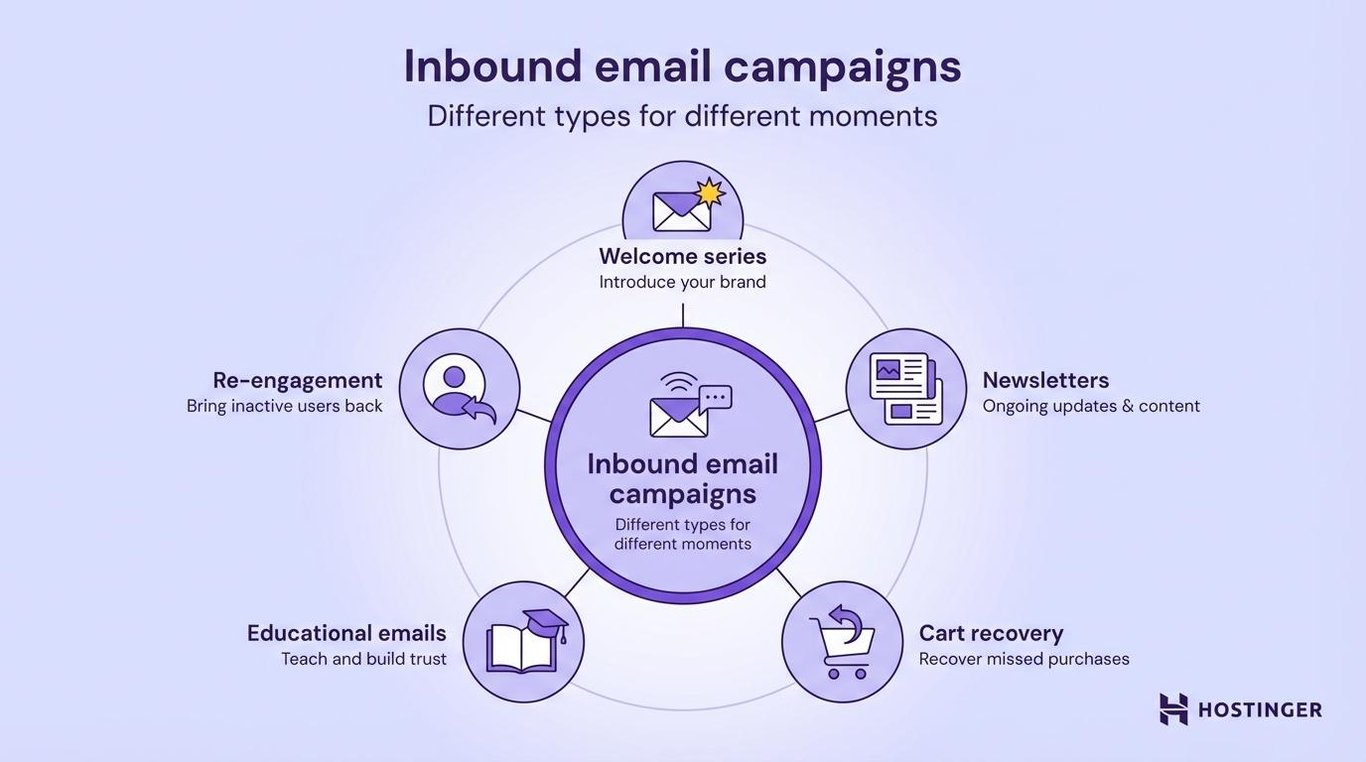
One email marketing campaign type won’t cover every stage of the subscriber journey. The strongest inbound strategies use a mix of five, each matched to a specific moment:
- Welcome email series. This is your first impression after someone opts in. A short sequence of two to four emails introduces your brand, sets expectations, and delivers whatever you promised – like a free template, checklist, or discount code. Welcome emails are usually among your highest-engagement messages, so use that window well.
- Newsletters. Regular newsletters keep your audience engaged between purchases. Share useful tips, new content, product updates, or industry news. Pick a cadence (weekly or biweekly works well for most brands) and stick to it. You can create an email newsletter with most platforms in under an hour, even if you’ve never designed one before.
- Cart abandonment emails. About 70% of online shopping carts get abandoned. A well-timed reminder, sent within a few hours, can recover a meaningful chunk of those lost sales. Include a clear image of the product, the price, and a direct link back to the cart. Some brands add a small discount or free shipping to sweeten the deal.
- Educational series. These emails teach your audience something valuable over several messages. A fitness brand might send a five-part series on building a home workout routine. A SaaS company might walk users through advanced features. Educational series build authority and keep subscribers engaged even when they’re not buying – which is exactly the kind of long-term value that makes inbound work.
- Re-engagement campaigns. Over time, some subscribers go quiet. A re-engagement email acknowledges their absence and gives them a reason to come back – a special offer, a content roundup, or simply asking if they still want to hear from you. If they don’t respond after two or three attempts, remove them. A smaller, active list performs better than a large, disengaged one.
Best practices for high-performing inbound email marketing campaigns
Getting the basics right makes everything else easier. These email marketing tips consistently separate strong inbound campaigns from forgettable ones:
- Use lead magnets that match your audience. A discount code works for ecommerce. A free template works for B2B. The lead magnet should solve a real problem — it’s the first value exchange in your inbound relationship, so make it count.
- A/B test subject lines, CTAs, and content. Small changes can make a big difference. Test one variable at a time so you know exactly what moved the needle. Even swapping a subject line from a statement to a question can improve open rates.
- Respect email regulations. Laws like CAN-SPAM and GDPR are legal requirements, but they also help protect the trust that your entire inbound strategy depends on. Always include your business address, a clear unsubscribe link, and honest subject lines.
On the flip side, emailing too often without enough value is the fastest way to undo your progress. If every message is a sales pitch, you erode the trust that got subscribers onto your list in the first place. Balance promotional emails with content that educates or entertains.
List hygiene matters too. Old, inactive addresses drag down your metrics and can hurt deliverability. Clean your list every few months by removing contacts who haven’t engaged in 90 days or more.
How to use AI and automation to grow your email strategy
AI tools are already making inbound email marketing easier to run, especially for small teams and solo business owners.
For example, AI can analyze how your subscribers behave – what they click, when they open, which emails they ignore – and use that data to adjust your content and timing automatically. For inbound specifically, that means your opt-in list gets more effective over time without extra manual effort.
AI can also flag when part of your audience is losing interest, so you can send a re-engagement campaign before those subscribers go quiet. And if you connect your email tool to your customer database, you can see which emails actually led to purchases and where people are dropping off. That makes your email marketing strategy sharper with each campaign.
As your strategy grows, privacy stays important. Subscribers expect you to protect their information, and following regulations like GDPR reinforces the trust that makes inbound work.
Hostinger Reach brings a lot of this together in one tool. It’s an AI-powered email marketing software built for small businesses and creators. You describe your email idea, and the AI generates a ready-to-send template that you can customize to match your brand.
It also handles email authentication setup so your emails are more likely to land in inboxes instead of spam folders.
The tools keep getting smarter, but what makes inbound email work hasn’t changed — you earn attention first, then keep it by being useful. AI just removes the busywork between those two steps.
All of the tutorial content on this website is subject to Hostinger's rigorous editorial standards and values.

Alma is an AI Content Editor with 9+ years of experience helping ideas take shape across SEO, marketing, and content. She loves working with words, structure, and strategy to make content both useful and enjoyable to read. Off the clock, she can be found gaming, drawing, or diving into her latest D&D adventure.