Best European domain registrars: 10 providers compared
Oct 15, 2026
/
By Alma
/
16 min Read
The best European domain registrars keep your data under European Union (EU) privacy law, make local domains easy to get, and charge fair renewal prices. They’re a good fit if you live in Europe, sell to European customers, or want your data to stay in the EU.
Since registrars are based based in the EU, they must follow the GDPR, the EU’s strict privacy law. For individuals, this usually means your personal details are hidden from public domain lookups.
We compared 10 providers on price, renewal cost, privacy, and tools. Below, you’ll find our top picks, a review of each one, and tips to help you choose.
Here are our top picks by use case:
- Best overall – Hostinger. Affordable pricing with reliable DNS management and strong EU-friendly infrastructure.
- Best for European ccTLDs – OVHcloud. Broad support for country-code domains across European markets.
- Best for domain portfolios – INWX. Broad TLD coverage, portfolio discounts, and predictable pricing.
- Best for businesses – IONOS. Business-oriented domain management with integrated hosting and professional email tools.
- Best for resellers – Realtime Register. Wholesale-focused platform with strong API integrations and automation tools.
1. Hostinger
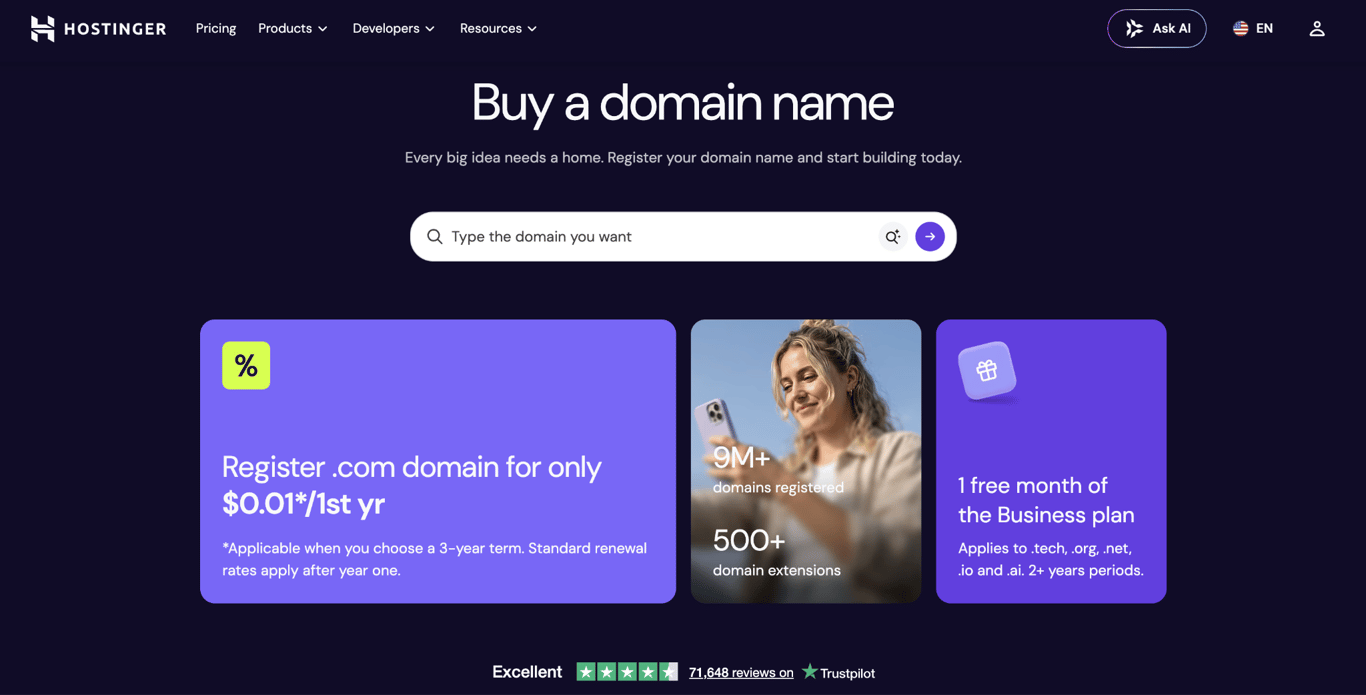
Hostinger is an agentic platform for building, running, and growing your business online, all in one place. The company is based in Lithuania and is an ICANN accredited domain registrar. ICANN (the Internet Corporation for Assigned Names and Numbers) sets the global rules for domain registration.
Hostinger supports popular generic top level domains (gTLDs) such as .com, .net, and .org. It also offers European ccTLDs including .eu, .de, .fr, and .es. Its infrastructure focuses on Europe, with data centers in Lithuania, the Netherlands, and the United Kingdom, among other locations. You can take a look at the portfolio of more than 500 TLDs in our domain extension list.
Hostinger’s main advantage is that domains and hosting work together in one place. You can manage domains, hosting, email, and SSL certificates from a single dashboard. SSL certificates add the padlock icon and encrypt your site’s connection.
When you’re ready, you can buy a domain name through Hostinger’s domain name search tool.
Hostinger pros
- Built-in website tools. Beyond domains, the same dashboard gives you access to Hostinger AI Builder, WordPress auto-installer, and email setup, so you can go from registration to a live site without switching platforms.
- Strong domain management tools. You can configure DNS records, DNSSEC (Domain Name System Security Extensions), domain forwarding, and email forwarding without needing advanced technical knowledge.
- Developer-friendly automation. Hostinger provides Application Programming Interface (API) access and Model Context Protocol (MCP) integration, allowing developer tools or AI agents to manage domains and DNS configurations programmatically.
- Free WHOIS privacy on eligible domains. WHOIS is the public database that lists domain ownership details. Privacy protection hides personal contact information that would otherwise be visible.
- Competitive introductory pricing. First-year promotions can make domain registration very inexpensive.
- Helpful learning resources. Hostinger Academy provides straightforward video tutorials that walk you through DNS setup, domain configuration, and website basics.
- Cloudflare-backed DNS. Domains run on Cloudflare nameservers by default, which adds built-in protection against traffic-flooding attacks (DDoS) and helps your domain connect visitors to your site faster, without extra configuration.
Hostinger cons
- Limited advanced DNS customization. Standard DNS tools work well for most websites, but complex zone-level configurations are better supported by registrar-focused platforms.
- Fewer niche domain extensions. Major gTLDs and European ccTLDs are well-covered, but specialist registrars offer a broader selection of uncommon extensions.
- Higher renewal prices. .com renewals are $19.99/year after the promotional first year, which is above what some registrar-focused providers charge.”
Hostinger pricing
Many hosting plans include a free domain name for the first year, which can reduce startup costs when launching a new website.
Domain prices vary by extension. A .com domain costs $0.01 for the first year when you choose a three-year term, while other extensions, such as .shop or .online start around $0.99–$3.99 during promotions.
After the first year, domains renew at the standard rate for the extension – for .com, that’s $19.99/year. Optional add-ons such as premium DNS or additional domain protection features may carry extra fees.
We use the familiar term “WHOIS privacy” throughout this guide, though it’s slightly outdated. ICANN retired the older WHOIS system on 28 January 2025 and replaced it with RDAP, but registrars and users still call the feature WHOIS privacy – it hides your contact details from public domain lookups either way.
Domain Name Checker
Instantly check domain name availability.
2. OVHcloud
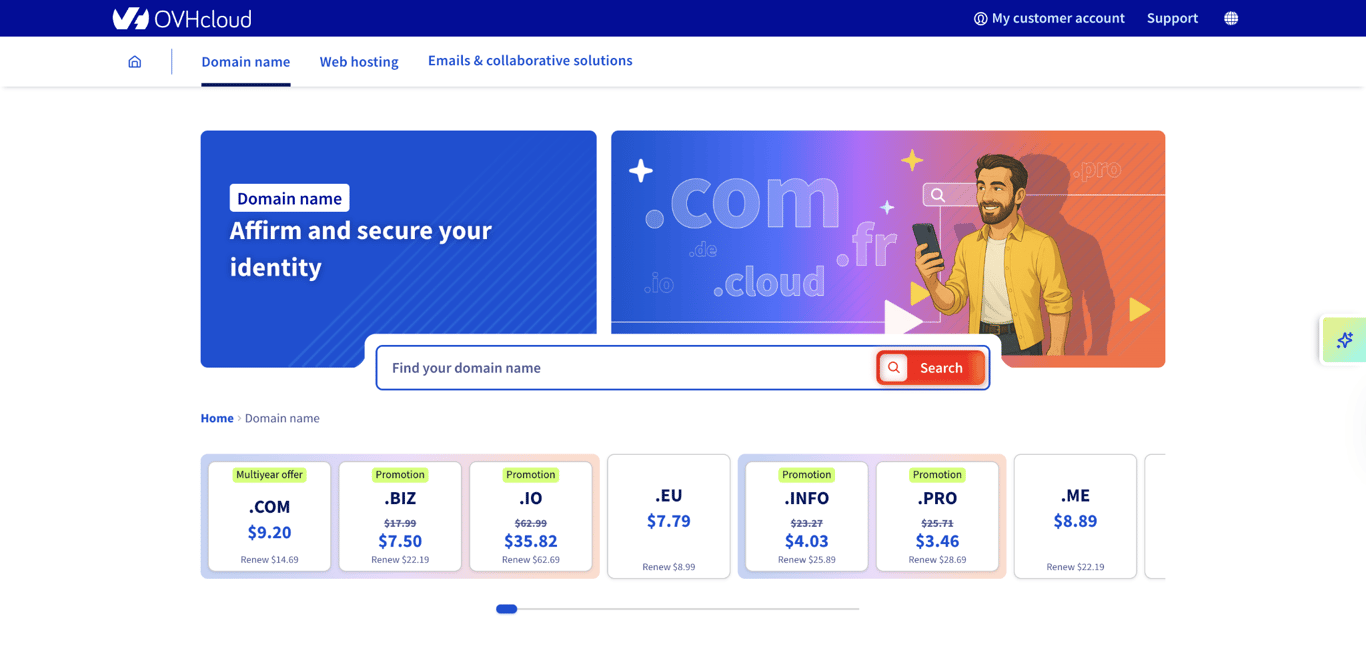
OVHcloud is a France-based hosting company and ICANN-accredited registrar that stands out for its scale and strong coverage of country-code domains, supporting extensions like .de, .fr, .es, .it, .nl, and .pl, along with dozens of others across the continent.
If your business operates in multiple European markets, OVHcloud makes it easier to manage those domains from a single registrar instead of spreading them across different providers.
The platform is also built with developers and infrastructure teams in mind. OVHcloud includes full API access by default.
The control panel reflects that focus. It’s organized around OVHcloud’s full infrastructure lineup rather than domains alone, so first-time buyers may spend longer finding basic settings than they would with a simpler registrar.
OVHcloud pros
- Broad European ccTLD portfolio. OVHcloud supports country-code domains across most European markets, including less common registries like .pt (Portugal), .fi (Finland), and .cz (Czech Republic) that many other registrars don’t offer.
- Strong built-in security. Domains come with DNSSEC and DDoS protection enabled by default, which helps protect your domain from traffic-based attacks or DNS hijacking attempts.
- Developer-friendly infrastructure. The API covers registration, renewals, and DNS record changes, so a team managing hundreds of domains can script routine work instead of clicking through it.
- Free email and web space included. Every domain comes with a free email address and 100 MB of basic web hosting, which is useful for parking pages or simple sites.
OVHcloud cons
- Not beginner-friendly. The control panel is powerful but can feel overwhelming if you’re new to domain registration.
- Support quality varies by region. Response times and support availability can differ depending on where you’re located in Europe.
OVHcloud pricing
OVHcloud’s pricing is generally competitive for a registrar with enterprise-level infrastructure. A .com domain costs $9.20 to register and $14.69 to renew, with WHOIS privacy included at no extra cost on eligible domains.
Each domain also includes a basic hosting plan, and some OVHcloud hosting packages come with a free domain for the first year.
3. INWX
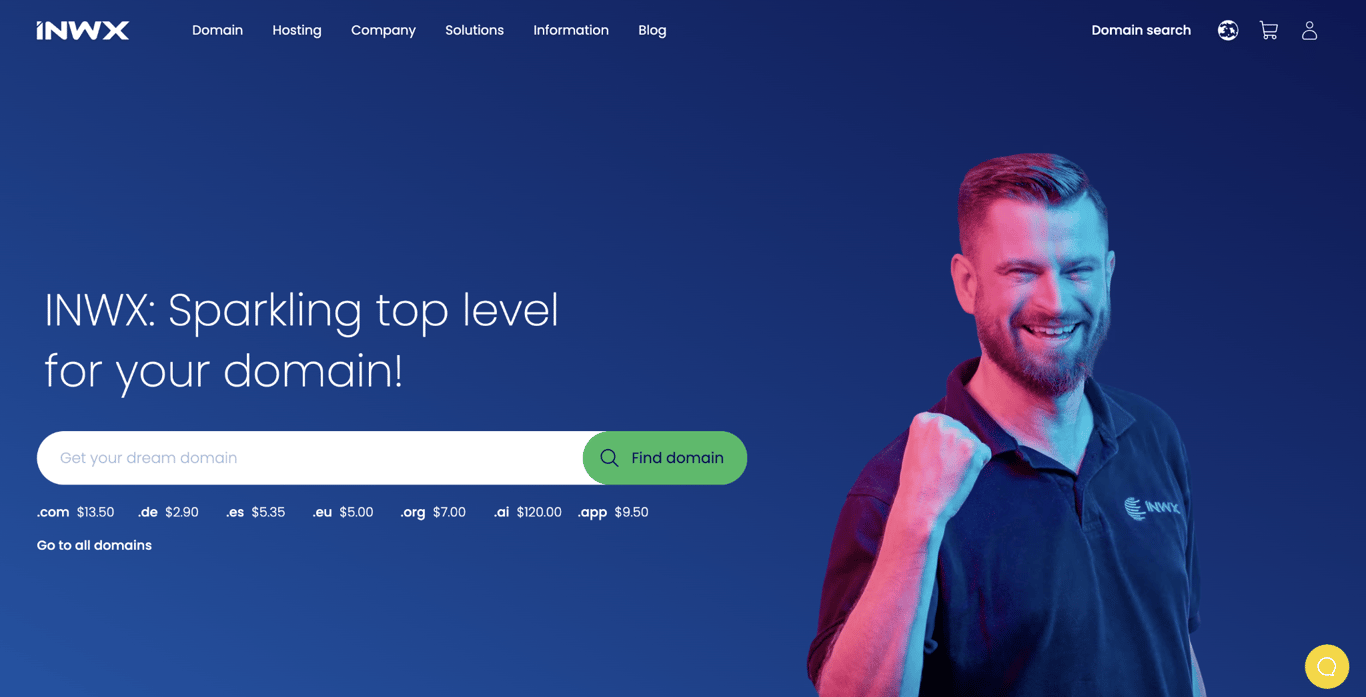
INWX is a Berlin-based, ICANN-accredited registrar founded in 2004, with roots going back to 1998. The company manages more than 500,000 domains and offers one of the widest TLD catalogs available from a European provider, with more than 2,200 extensions.
What sets INWX apart from most registrars on this list is its pricing model. Standard registration and renewal prices usually match, so a domain costs roughly the same in year five as in year one. Promotional first-year deals and some TLDs are exceptions. For anyone managing a larger domain portfolio, this predictability makes long-term budgeting much simpler.
The platform is designed for technically comfortable users. INWX provides a well-documented API (DomRobot) that supports XML-RPC and JSON-RPC for automating domain operations, and its DNS management includes DNSSEC, secondary DNS, and Anycast-based infrastructure, which routes visitors to the nearest server so your site resolves faster worldwide.
INWX also offers a trustee service for domains that require a local address in a specific country, which is useful if you need a ccTLD but don’t have a physical presence in that market.
INWX pros
- Flat registration and renewal pricing. You pay the same price at registration and renewal for most TLDs, which removes the surprise of a steep renewal increase after the first year.
- Wide extension coverage. Beyond standard gTLDs and European ccTLDs, INWX carries niche regional extensions and newer TLDs that most mid-size registrars skip.
- Advanced DNS management. Supports DNSSEC, secondary DNS, dynamic DNS, Anycast infrastructure, and a wide range of record types, including CAA, SRV, and SSHFP.
- Strong API for automation. You can script bulk registrations, transfers, and DNS changes across your entire portfolio without touching the dashboard.
- Volume discount tiers. Businesses managing 250+ domains can access tiered pricing that reduces per-domain costs further.
INWX cons
- WHOIS privacy is a paid add-on. Unlike registrars that include privacy for free, INWX charges a per-domain fee for WHOIS privacy protection. GDPR does redact much of this data for EU registrations, but it’s still a cost to consider for non-EU extensions.
- Interface is functional but not modern. There’s no guided setup wizard or inline help, and settings are organized by function rather than by task, so new users may need time to find their way around.
- No bundled hosting or email. INWX offers web and email hosting as separate products, but they’re not bundled with domain registrations the way some all-in-one providers do.
INWX pricing
INWX uses flat pricing where registration and renewal typically cost the same. Standard .com pricing costs $13.50/year to register and $17.52/year to renew. European ccTLDs are often cheaper – a .de domain registers at $2.90/year and renews at $4/year.
Businesses managing larger portfolios (250+ domains) can contact INWX for volume discount tiers, which reduce the per-domain cost across all extensions. WHOIS privacy is available as a paid add-on for supported extensions.
4. EuroDNS
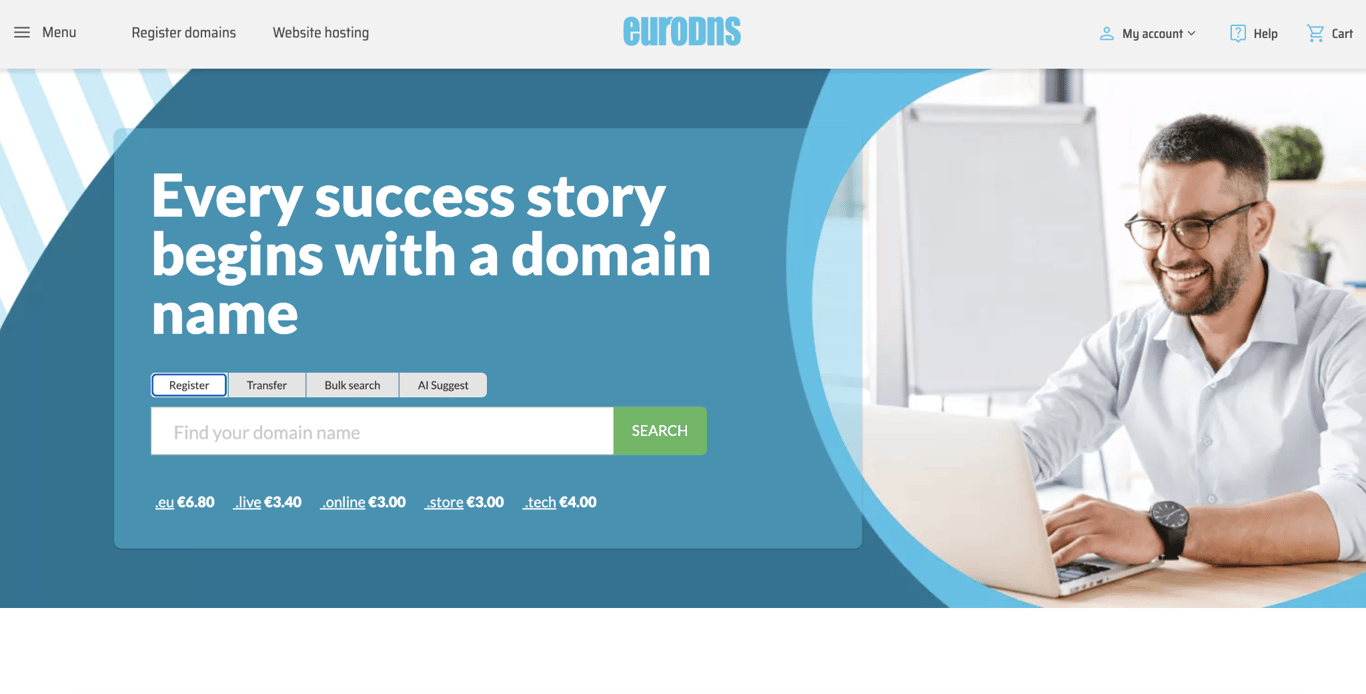
EuroDNS is an ICANN-accredited registrar based in Luxembourg that has been registering and managing domains since 2002. With access to over 1,000 domain extensions, it’s built for businesses and domain professionals who need EU jurisdiction, a wide choice of ccTLDs, and portfolio-scale management tools.
The Luxembourg headquarters is a real advantage for companies where data residency matters. Your registrar account and domain data fall under EU law by default, so there’s no need to check how a US-based provider handles transfers out of the EU.
EuroDNS also runs a mature reseller program with WHMCS integration (the billing software most hosting companies already run), white-label DNS that carries your brand rather than EuroDNS’s, and bulk pricing, which makes it a practical choice for hosting companies and agencies that sell domains as part of a larger service.
EuroDNS pros
- Strong European ccTLD coverage. Over 1,000 extensions, with good support for European country-code domains like .eu, .de, .fr, .nl, and .no.
- Free DNS hosting included. Every domain comes with standard DNS hosting at no extra cost, plus DNSSEC to stop attackers from redirecting your domain to a fake site. If you need faster response times worldwide, premium Anycast DNS is a paid upgrade.
- DNS templates. You can save and reuse DNS configurations across multiple domains, which saves time when provisioning similar setups.
- Multilingual support. The interface and support team are available in English, French, German, and Spanish.
EuroDNS cons
- WHOIS privacy is a paid add-on. Privacy protection costs around $5.30 per domain per year. GDPR covers much of this for EU-based registrations, but non-EU extensions still expose your data without it.
- Higher renewal pricing on popular TLDs. Registration prices are competitive, but .com renewals jump to around $23/year, which is above average.
- Dated control panel. The management interface works but feels less modern than newer registrar platforms. It gets the job done for experienced users but isn’t the smoothest experience for first-time domain buyers.
EuroDNS pricing
A .com currently starts at $12.32 for the first year on promotion and renews at $23.55/year. European ccTLDs vary by extension. WHOIS privacy is an additional $5.61 per domain per year.
EuroDNS prices in euros, so dollar amounts may shift with exchange rates.
Reseller and bulk pricing are available through EuroDNS’s reseller program, with rates depending on volume and account tier. Standard DNS hosting is included free with every domain, while premium Anycast DNS is available as a paid upgrade.
5. IONOS
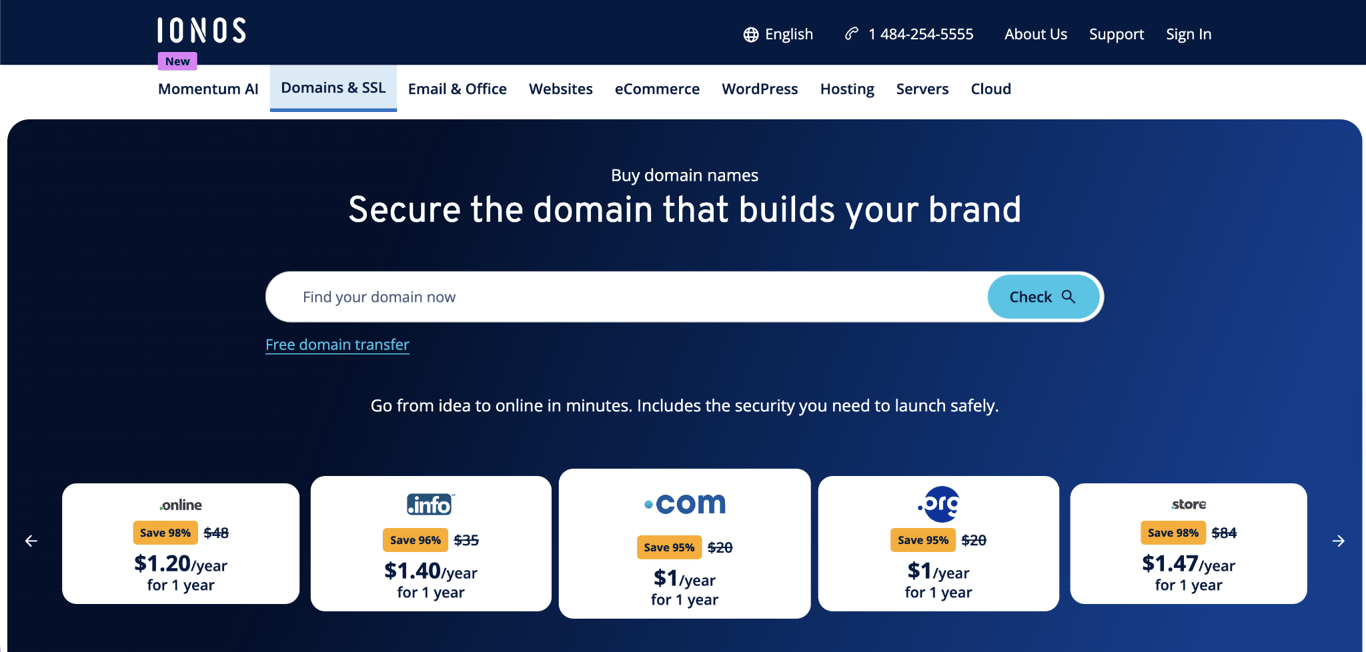
IONOS focuses on small and medium-sized businesses that want domain registration, hosting, and email in one platform. The Germany-based registrar is built around business-oriented packages, with EU-based data centers, GDPR compliance, and integrated services, such as email hosting.
If you’re running a business website, IONOS keeps the core pieces together, meaning you can manage domains, professional email, hosting, and SSL from one provider.
One thing that genuinely sets IONOS apart from most providers on this list is its support. You can call and speak to a person, which is surprisingly uncommon among registrars in this price range.
Just keep the pricing structure in mind. The first year is heavily discounted, but the renewal pricing is significantly higher.
IONOS pros
- Phone support across Europe. If something breaks – whether it’s email downtime or a domain transfer issue – you can reach an actual support agent instead of relying on tickets or chat.
- Business-focused bundles. Packages are pre-configured for common setups like a business website with email, so there’s less manual configuration than with registrar-only platforms.
- Free trial-like entry point. Some first-year deals start at $1, which lets you test the full platform before committing to renewal rates.
- Microsoft 365 integration. IONOS offers Microsoft 365 mailboxes as part of its business packages, with setup tied directly to your domain.
- AI-powered domain name suggestions. The domain checker generates alternative name ideas when your first choice is unavailable.
IONOS cons
- Higher renewal pricing. Introductory discounts are attractive, but renewal costs increase significantly after the first year.
- Upselling during checkout. Several optional add-ons are pre-selected during the purchase process, so it’s worth reviewing your cart before completing the order.
- No WHOIS privacy option. IONOS removed its WHOIS privacy add-on in late 2025 to comply with NIS2, an EU directive that requires registrars to make business contact details publicly accessible. Private individuals are still protected under GDPR, but businesses and organizations can now appear in public domain lookups.
IONOS pricing
A .com currently costs $10 as a standalone purchase, or as low as $1 when bundled with a hosting plan or as a first-time customer offer. Renewal pricing is at $20/year, so check the renewal line item before completing your order. Some bundled hosting packages also include a free domain for the first year.
6. Gandi
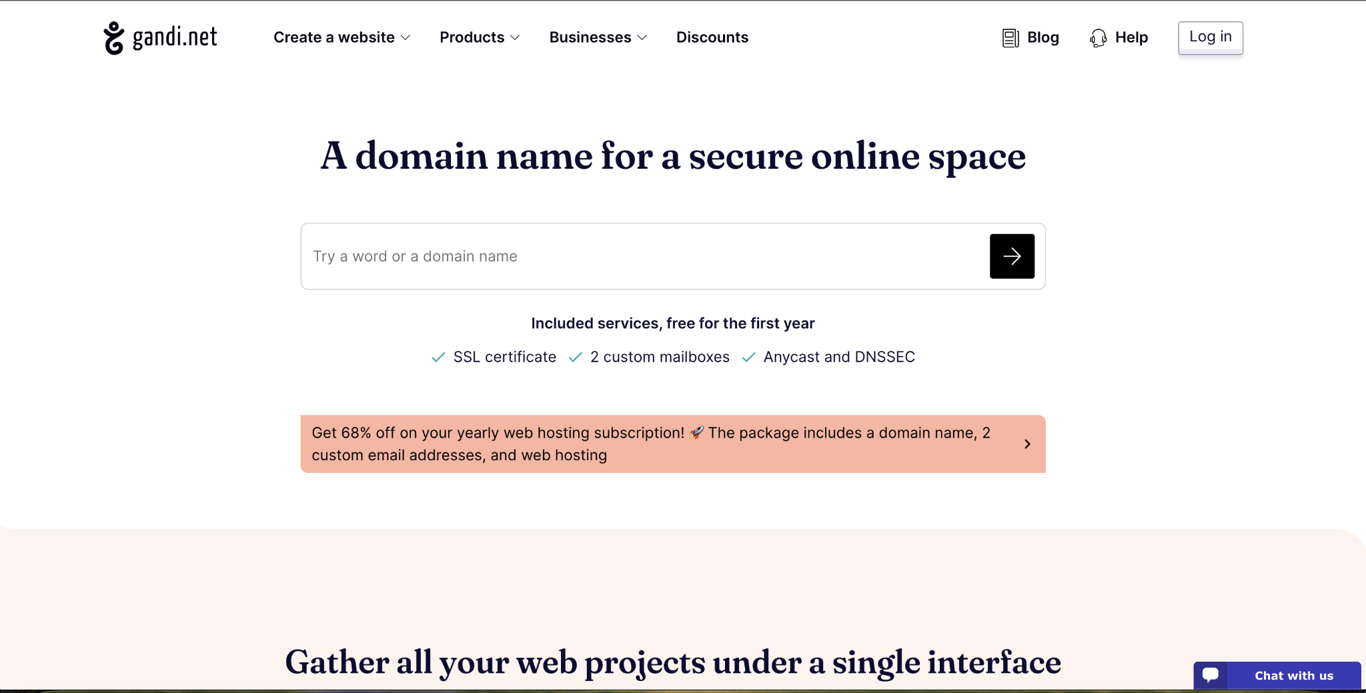
Gandi built its reputation as a registrar that prioritizes transparency and strong domain security. Over the years, it developed a loyal following by doing something many registrars don’t: keeping pricing straightforward and avoiding aggressive upselling.
In 2023, Gandi was acquired by Total Webhosting Solutions and now operates under the Your.Online group. The core domain features haven’t changed, but .com renewal pricing has increased, and email hosting is now a separate paid service.
If you manage domains regularly, Gandi’s DNS infrastructure is one of the reasons people stick with it. You get DNSSEC support, domain locking, and domain portfolio management tools, providing solid protection and control over your domains.
The company also keeps the buying process simple. You won’t run into the usual registrar tactics – no pre-selected add-ons, no confusing pricing steps – and WHOIS privacy is already included at no extra cost.
The catch is the renewal price. Gandi still delivers strong security and transparency, but its long-term cost is higher than that of most other registrars on this list.
Gandi also offers a public API to automate domain, DNS, email, and billing operations, which is useful if you’re managing domains as part of a larger infrastructure.
Gandi pros
- Transparent checkout experience. You see the real price up front – no pre-ticked add-ons or surprise charges during checkout.
- Security included by default. DNSSEC, domain locking, and WHOIS privacy are all active from day one with no paid upgrades required, which is uncommon at this price point.
- Free WHOIS privacy. Your personal contact details stay hidden without needing to purchase privacy protection separately.
Gandi cons
- Higher renewal pricing. Gandi’s renewal rates after the 2023 acquisition are noticeably higher than most other providers – $38/year is well above the market average.
- Email hosting no longer included. Gandi used to include free email mailboxes with every domain. That’s now a separate paid service.
- Not designed for beginners. The interface makes sense once you understand it, but it doesn’t guide new users through setup the way beginner-focused platforms do.
Gandi pricing
A .com currently costs $11 to register and $38.38 for renewal. That renewal price includes services some registrars charge extra for – such as WHOIS privacy and DNSSEC – but it remains one of the highest in this comparison. Gandi also offers a lower per-year rate on some multi-year renewals.
For businesses managing 45+ domains, Gandi offers volume pricing tiers (B through E rates) that can reduce .com renewals by up to 50%.
7. Openprovider
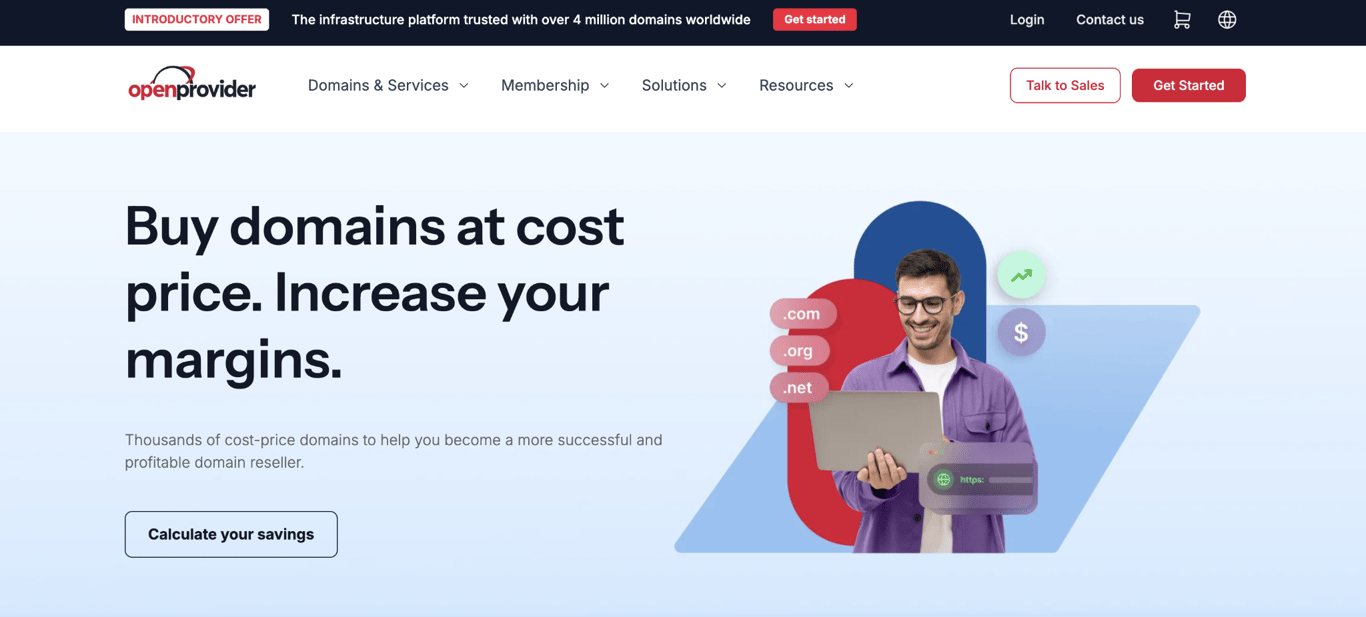
Openprovider operates as a wholesale registrar built for resellers, agencies, and developers managing large domain portfolios. Its pricing works differently from the other providers: instead of a cheap first year followed by a higher renewal, you pay an annual membership fee and then buy domains at the price Openprovider pays the registries – the same amount every year.
Across dozens or hundreds of domains, paying the same rate at renewal instead of a marked-up one can save thousands of dollars a year.
The platform is also designed for automation. Openprovider provides a well-documented API that allows you to integrate domain registration, renewals, transfers, and DNS management directly into your own systems. That said, it’s built for portfolio-scale use, so individual buyers won’t benefit from the pricing model.
Openprovider pros
- Cost-price access through membership. Members pay the same wholesale rate at registration and renewal, with no markup or renewal increase. The tradeoff is a monthly membership fee, which pays for itself once you’re managing enough domains.
- Built for portfolio management. The platform includes tools like CSV-based bulk transfers, grouped renewals by TLD or expiry date, and batch DNS updates that make large-scale operations easier.
- Broad European ccTLD support. Openprovider carries 1,900+ extensions, including European ccTLDs like .nl, .de, .fr, and .es alongside standard gTLDs, so a client portfolio spread across several markets stays under one login and one invoice.
- Wholesale SSL certificates. Resellers can bundle SSL certificates from major certificate authorities at discounted rates alongside domain registrations.
Openprovider cons
- Membership required for best pricing. Wholesale rates only pay for themselves once you’re managing enough domains. If you only need one or two, the membership fee outweighs the savings.
- Basic DNS on free tier. Openprovider’s included DNS is best-effort, so if you need guaranteed uptime for DNS resolution, you’ll need to pay for their Premium DNS upgrade.
Openprovider pricing
Openprovider uses a flat pricing model where .com registration and renewal cost the same amount each year.
With an Openprovider Membership, a .com currently costs $10.46 for both registration and renewal, excluding VAT. Non-member registration is at $11.98.
A paid membership subscription is required to access wholesale rates, so the effective per-domain cost depends on portfolio size.
8. Realtime Register
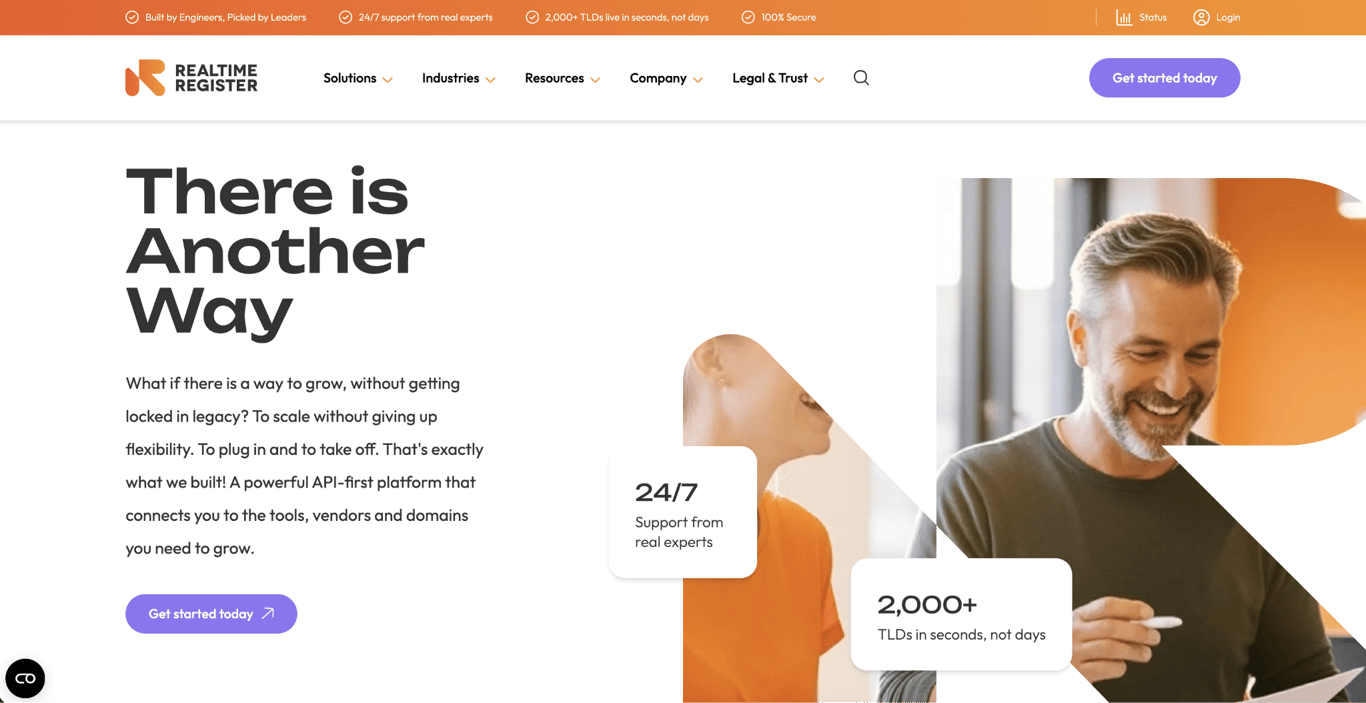
Realtime Register is a Netherlands-based wholesale domain registrar founded in 2004 that manages more than 5 million domains. Like Openprovider, the platform is designed specifically for resellers, hosting companies, agencies, and developers managing large domain portfolios rather than individual buyers.
If you run a domain reseller operation, the platform is built to plug directly into your existing tools. Realtime Register integrates with billing systems such as WHMCS, Hostbill, and HostFact, allowing you to automate domain sales and management without building custom integrations.
As with Openprovider, this isn’t a platform for registering a few personal domains – the tooling and pricing assume volume.
Realtime Register pros
- Extensive TLD catalog. You can access 2,000+ domain extensions through a single platform, which helps agencies and hosting providers manage international portfolios without relying on multiple registrars.
- Additional products beyond domains. You can manage SSL certificates, domain security services, and software licenses from the same account, reducing the number of vendors you need to work with.
- Expanding into full-service distribution. In early 2025, Realtime Register broadened its scope beyond domains and SSL to become a full-service distributor, adding web presence, security, continuity, and server management products for hosting companies and agencies.
- Phishing and abuse detection. Built-in domain protection services that scan for phishing attempts and abuse, adding a security layer that most wholesale registrars don’t include.
Realtime Register cons
- Strictly a reseller platform. There’s no consumer checkout or simple individual account setup, so the platform isn’t suited to individuals registering a few domains.
- Per-TLD pricing requires an account. The GO!ORANGE account fee and surcharge tiers are public, but the actual cost price for each domain extension is only visible after you sign up. Portfolios above 1,000 domains need custom terms.
- Fewer independent reviews. Realtime Register is well established in the hosting industry, but there’s less public discussion and community troubleshooting available compared to larger registrars, so you’ll rely more on their direct support.
Realtime Register pricing
Realtime Register offers a partner account called GO!ORANGE, designed for smaller reseller portfolios. It costs $5/month and gives you access to domains at cost price for up to 100 domains. From 101 to 1,000 domains, an additional $0.03 per domain per month applies. Larger portfolios can request custom terms.
The account also includes free WHOIS privacy, abuse monitoring, and integrations for WHMCS, Hostbill, and HostFact.
9. OpusDNS
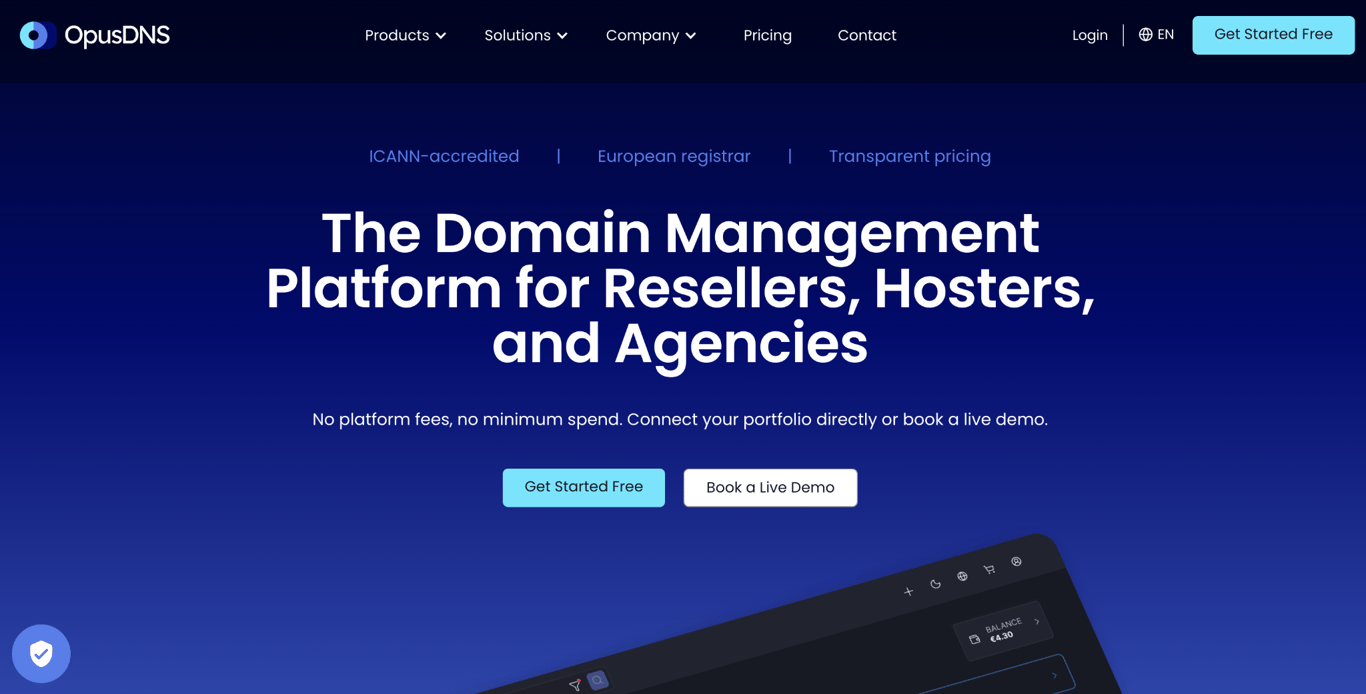
OpusDNS launched in October 2025 and is based in Germany, but the team behind it isn’t new to the domain industry. The founders previously built large wholesale domain platforms, including Hexonet, and started OpusDNS with the goal of modernizing tools used by domain resellers and hosting providers.
In May 2026, OpusDNS acquired fruits.co, a European platform for buying and selling existing domains, adding domain parking, aftermarket sales, and EU VAT compliance tools.
The platform is ICANN-accredited and supports 550+ domain extensions, targeting resellers, hosting companies, and businesses managing large domain portfolios.
If you manage domains through WHMCS, OpusDNS includes a plugin that automates many everyday tasks. You can manage DNS zones, pricing synchronization, and DNS templates for services like Google Workspace and Microsoft 365, which can save time when provisioning domains for clients.
The interface is also noticeably more modern than many older wholesale platforms. For teams used to legacy reseller tools, the cleaner dashboard can make day-to-day domain management easier.
OpusDNS pros
- No platform fee. As of July 2026, OpusDNS eliminated its monthly platform fee entirely. You pay only for the domains you register, with no additional subscription fee.
- Direct engineering support during onboarding. New customers receive a dedicated Slack channel during migration and integration, allowing technical questions to reach the engineering team directly.
- Built-in domain monetization. Through the fruits.co acquisition, OpusDNS now offers domain parking with AI-driven content, aftermarket sales, and click analytics directly from the dashboard.
OpusDNS cons
- New platform with a shorter track record. While the team has deep experience, OpusDNS itself only launched recently.
- Smaller TLD catalog than some wholesale competitors. With 550+ extensions, coverage is growing but remains narrower than that of the largest wholesale registrars.
OpusDNS pricing
OpusDNS removed its platform fee in July 2026. There’s no monthly subscription and no minimum term. You pay only for the domains you register, renew, or transfer.
Specific per-domain pricing depends on the TLD. You can sign up for free to see current rates, or contact the team for a walkthrough.
10. Aruba
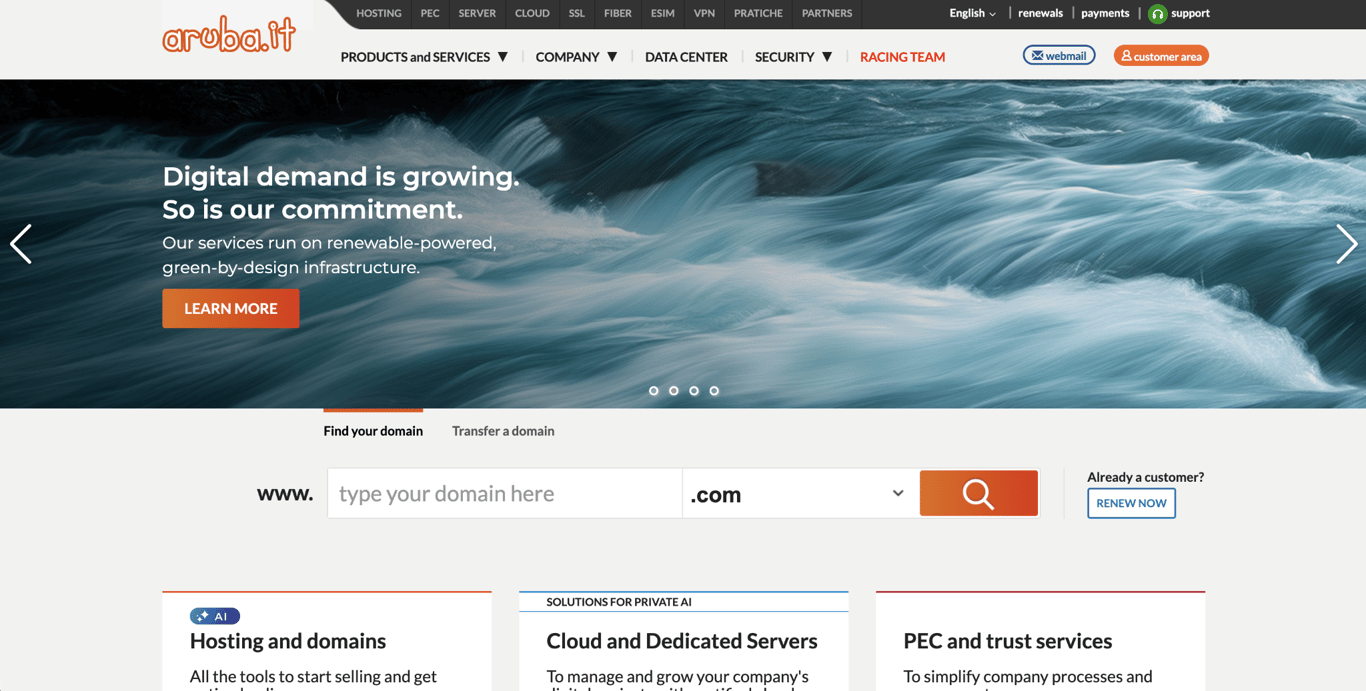
Aruba plays a dominant role in the Italian domain market and the broader Southern European hosting ecosystem. The company operates multiple European data centers and focuses heavily on compliance with EU and Italian regulatory requirements.
Aruba supports major gTLDs alongside European ccTLDs such as .it and .eu, but its real advantage is how closely it works with the Italian registry, meaning .it registrations, transfers, and disputes go through a provider that deals with those rules daily.
If your business operates in Italy, Aruba offers services that generic registrars often don’t handle as smoothly. The platform supports PEC (Posta Elettronica Certificata) – Italy’s certified email system used for official communications with public administration and businesses.
You can also manage domains, hosting, SSL certificates, business email, and PEC from the same account, which simplifies setup for companies operating in the Italian market.
Aruba also operates the .cloud registry through its Aruba PEC subsidiary, so it controls that extension end-to-end rather than reselling it.
Aruba pros
- Strong expertise with .it domains. Aruba has direct experience with the Italian registry and understands the eligibility and compliance requirements that can cause issues with international registrars.
- Local data centers in Italy. Aruba runs its own data centers in Italy, which means faster load times for Italian visitors and data that stays in the country.
- Local-language support and euro billing. Aruba offers Italian and English support with transparent pricing in euros, which can simplify billing and accounting for European businesses.
Aruba cons
- Higher renewal pricing after promotions. First-year .com registration starts at about $5, but renewal jumps to about $16, so the long-term cost is roughly triple the introductory price.
- Upselling during checkout. Services like SSL certificates, PEC, and hosting plans are pre-selected or prominently offered during purchase, so review your cart before confirming.
- Less flexible DNS management. The platform is primarily a hosting provider that includes domain services, so advanced DNS customization may be more limited than with registrar-only platforms.
Aruba pricing
Aruba offers .com domain registrations from around $5.80 + VAT for the first year, with renewal from around $17.45 + VAT/year. Aruba prices in euros, so dollar amounts may shift with exchange rates.
Domain transfers are free, and some transferred extensions receive the associated service free until the domain’s existing expiry date. Pricing varies by extension and promotion, so check the current Aruba price list before registering.
WHOIS privacy is a paid add-on, and additional services such as SSL certificates, business email, PEC, or hosting can increase the total cost depending on the package you choose.
Factors to consider when choosing a European domain registrar
The three main factors to consider when choosing the best European domain registrar are accreditation, security and privacy features, and renewal pricing.
For accreditation, check if the company is officially allowed to sell the domains you want. For .com and other generic top-level domains, the registrar should be ICANN-accredited. If you want a .eu domain, they should be EURid-accredited.
Being directly accredited means the company works directly with the people who run the internet’s address book, rather than buying through a middleman. This makes it easier to transfer your domain elsewhere or get a problem fixed, because there’s no third party in between.
Next, security and privacy. Good providers include features like DNSSEC and WHOIS privacy for free, rather than selling them as add-ons. These tools protect your website from being hijacked and keep your personal contact information private. Since you are in Europe, the provider must also follow GDPR rules.
Finally, always check the renewal price before you sign up. Many companies offer a very low price for the first year, but then double or triple the cost when you have to pay again the next year. It is better to find a provider with a fair, steady price so you aren’t surprised by a large bill later on.
How to choose the right registrar for your use case
To choose the right European domain registrar, match the registrar’s strengths to what you actually need – a single website or a multi-domain portfolio.
If you’re launching a new website or small business project, consider choosing a registrar that offers everything in one package – domains, hosting, email, and SSL. This makes the setup faster and your project easier to manage as you grow.
Developers or business owners managing many websites need different features. In this case, you’ll want tools that help you automate tasks and renewal pricing that stays predictable year after year.
Before registering anything, make sure you’ve chosen the right domain name. This name will represent your brand for a long time, so it’s worth taking an extra moment to be certain it fits your goals.
When to use a European registrar vs. a global provider
Choosing between a European domain registrar and a global provider depends on where your business operates and what kind of domain you want.
A European registrar is the better fit for you if your business operates in Europe and you want a country-specific domain like .de, .it, or .nl. Often, these domains have special residency rules or paperwork requirements. Local providers handle these rules regularly, so the compliance process runs smoothly with them.
They also keep your data under European privacy laws and offer support teams that understand local regulations.
A global registrar is a good option if you only want a .com address and are looking for the lowest possible price. These large international companies often have affordable deals for your first year. However, their support teams might not be as helpful if you run into specific European compliance issues or need help with a local country domain later on.
Your domain name is the foundation of your brand, your website, and your professional email. Once you pick a registrar, the next step is to search for your name, pay for it, and connect it to your European hosting account so you can start building your site.
If you want to see how these local providers compare to the international companies, you can check out our guide on the best global domain registrars.
Domain Name Checker
Instantly check domain name availability.
This article is a localized version of Best European domain registrars: 10 providers compared, originally published in English.
All of the tutorial content on this website is subject to Hostinger's rigorous editorial standards and values.

Alma is an AI Content Editor with 9+ years of experience helping ideas take shape across SEO, marketing, and content. She loves working with words, structure, and strategy to make content both useful and enjoyable to read. Off the clock, she can be found gaming, drawing, or diving into her latest D&D adventure.