How to write a product description in 9 steps
Oct 12, 2026
/
By Ksenija
/
12 min Read
To write a product description, understand who you’re selling to, why they need the product, and what makes it worth choosing.
Once you’ve gathered that information, you can turn it into clear, persuasive copy, optimize it for search engines, and refine it through testing.
A product description explains what a product is, what it does, and why someone should buy it.
In ecommerce, it helps customers evaluate a product they can’t see or try in person while giving them the information they need to make a purchase decision.
A well-written product description combines research, clear writing, and continuous improvement.
Here’s how to write a product description in nine steps:
- Understand who you’re writing for by identifying your target audience and the language that resonates with them.
- Uncover what motivates the purchase by defining the customer’s problem, desired outcome, and buying objections.
- Identify what makes your product different so the description gives shoppers a clear reason to choose it over alternatives.
- Gather the facts before you write, including the product’s features, specifications, and technical details.
- Explain why each feature matters by translating product attributes into meaningful customer benefits.
- Capture attention from the start with a clear product title and an opening that communicates the product’s main value.
- Build the complete description by organizing benefits, supporting details, specifications, and a clear call to action.
- Help customers find the product by naturally incorporating relevant keywords and writing unique, search-friendly copy.
- Review, refine, and test the description to improve clarity, accuracy, and conversion performance.
1. Define your target audience
Start by identifying the specific customer group the product description needs to persuade.
The goal is not to build a detailed marketing persona; you need enough information to decide which product details matter, how much explanation to provide, and what language will feel natural to the buyer.
Before writing, define five things about the audience:
- Who is buying? Identify the relevant role, experience level, or life stage.
- How will they use the product? Focus on the main situation or task the product needs to support.
- What matters most to them? Identify the features or qualities likely to influence their decision.
- How much do they already know? This determines whether you need to explain technical details or can use specialist terminology.
- How do they describe what they need? Use the vocabulary customers use when discussing the product and its benefits.
Use customer evidence to answer these questions. Reviews, pre-purchase support conversations, order data, and search queries can reveal common use cases, concerns, and terminology.
If you don’t have enough first-party data, look at reviews and discussions about comparable products.
Next, check pre-purchase conversations. Search support tickets, live chat transcripts, contact forms, and sales emails for questions asked before someone buys.
Recurring questions highlight gaps in your product page. If customers keep asking the same thing before buying, make sure the answer is easy to find in the product description or elsewhere on the page, so you improve the overall ecommerce customer experience.
By the end of this step, you should have a short audience profile that guides how you write your product descriptions and broader ecommerce marketing copy.
It should look something like this:
“Frequent commuters who carry a laptop every day already understand basic backpack features, and care most about weight, weather protection, and easy access on public transport.
Use straightforward language and avoid outdoor-adventure terminology that does not match their use case.”
Keep that note beside you while writing. It gives you a practical filter for every detail you consider adding: Would this customer care about it, understand it, and use this wording?
Once the audience is clear, the next step is to identify the specific problem or desired outcome that made them look for the product in the first place.
2. Identify the customer’s main problem and buying motivation
To identify the specific problem your customer wants to solve, start by separating four related but different ideas:
- The problem is what frustrates the customer today.
- The desired outcome is what they want to achieve.
- The buying motivation explains why solving that problem matters to them.
- The buying objection is the reason they might hesitate before making a purchase.
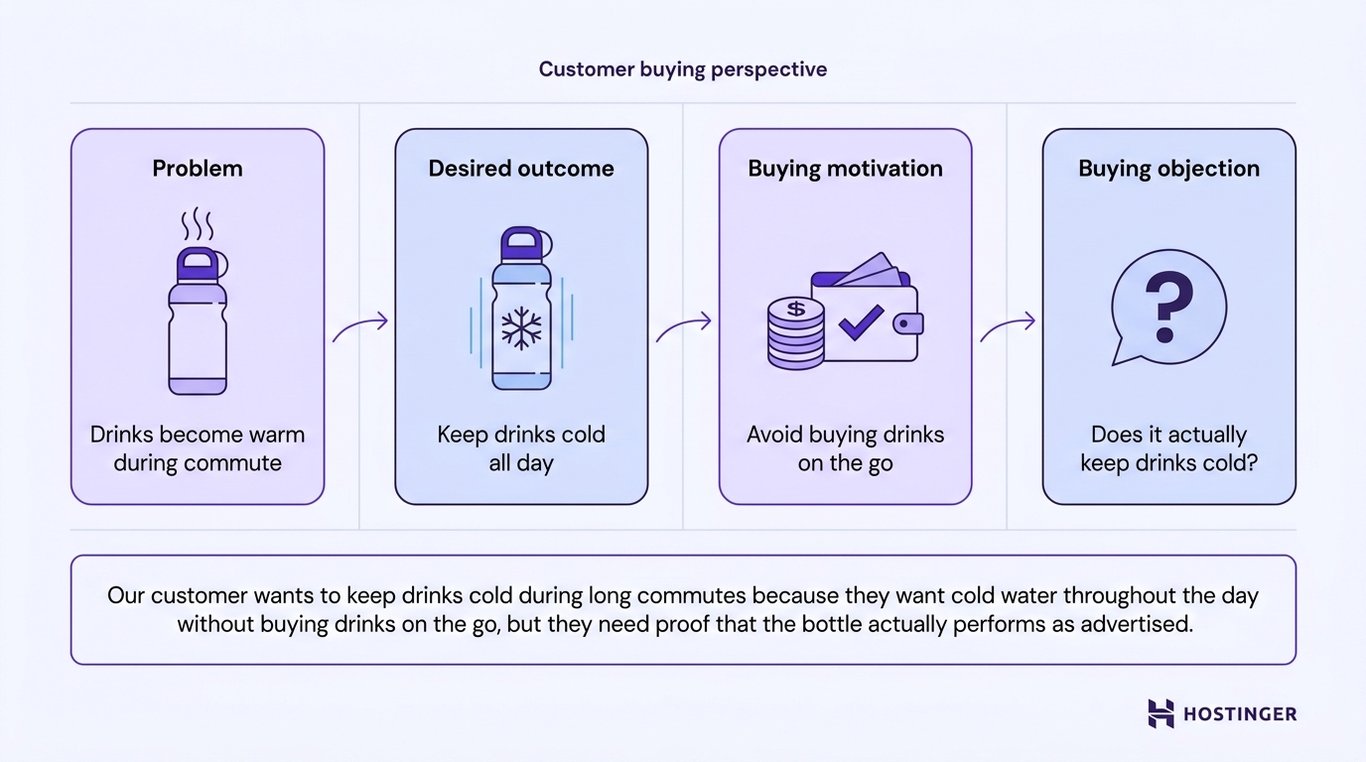
Imagine a customer looking for an insulated water bottle. Their problem is that drinks become warm during a long commute.
The result they want is to keep their drink cold throughout the day. Their buying motivation might be to avoid the cost of bottled drinks or simply to have cold water available whenever they need it.
Before purchasing, they may still have objections, such as whether the bottle really keeps drinks cold for as long as advertised or whether it fits in their backpack.
If you’re unsure what motivates customers, look for evidence. Read product reviews and note why people decided to buy the product in the first place.
As you collect this information, distinguish between what customers say and what they actually want.
Someone searching for a “lightweight laptop backpack” may not care about the weight itself. They may be trying to make a daily commute more comfortable.
The underlying motivation often determines which benefit deserves the most attention in the description.
Before moving to the next step, summarize the customer’s perspective in a single sentence:
“Our customer wants to keep drinks cold during long commutes because they want cold water throughout the day without buying drinks on the go, but they need proof that the bottle actually performs as advertised.”
That sentence becomes a practical writing brief. It tells you which benefits to emphasize, which concerns to address, and which claims need supporting evidence.
Use the same approach to strengthen your ecommerce content marketing and keep every piece of content focused on the customer’s goals rather than the product’s features alone.
Now that you understand why customers are considering the product, the next step is identifying what makes your product the best solution compared with the available alternatives.
3. Write down your business’s unique selling proposition (USP)
A unique selling proposition (USP) is the specific reason a customer should choose your product over comparable alternatives.
Ask yourself:
- What does this product do better than competing products?
- Which benefit do customers mention most often in reviews?
- What problem does it solve that competing products don’t solve as well?
- Which feature or capability would make someone switch from another brand?
- If a customer compared this product with three similar alternatives, what would stand out immediately?
If you struggle to answer those questions, compare your product side by side with competing listings.
Look beyond marketing slogans and create a simple comparison of materials, specifications, warranty, price, durability, included accessories, customization options, or after-sales support.
Differences that repeatedly appear across competitors will reveal your USP.
Your USP should be specific enough that a competitor couldn’t claim exactly the same thing.
Compare these examples:
- Weak USP – High-quality leather bag
- Strong USP – Full-grain leather bag backed by a 100-year warranty
Once you’ve identified your USP, use it consistently wherever customers encounter the product.
Reinforcing the same differentiator across your website, product pages, and marketing materials strengthens your product branding and makes the product easier to recognize.
Before moving on, summarize your USP in one sentence:
“Customers should choose this product because __________________.”
After you’ve identified what makes the product different, the next step is to gather the features and specifications that substantiate those claims.
4. List key product features and specifications
Before writing your product description, gather factual information that accurately describes the product.
Having the details in one place makes it easier to write confidently and reduces the risk of missing important information or making unsupported claims.
Start by collecting everything that objectively describes the product. The exact information depends on what you’re selling, but it often includes:
- Materials or ingredients
- Dimensions and measurements
- Size and weight
- Colors or available variants
- Technical specifications
- Compatibility
- Capacity
- Certifications
- Warranty information
- Care or maintenance instructions
- What’s included in the package
As you collect information, separate decision-making details from reference information.
Ask yourself: Would a customer want to know this before buying, or only after they already own the product?
Prioritize the information that helps someone compare products and decide whether yours meets their needs.
If you’re selling multiple variations of the same product, verify that the specifications match each version.
Dimensions, materials, colors, storage capacity, or included accessories often differ between variants. Generic descriptions copied across every product page can create confusion and lead to returns.
The next step is deciding which of those features matter most to customers and translating them into benefits they immediately understand.
5. Turn product features into customer benefits
Every feature in your product description should answer one follow-up question: “Why should the customer care?”
The answer becomes the benefit, transforming technical information into something shoppers can use to make a buying decision.
A simple way to do this is to follow a three-step process:
- Write down the feature.
- Explain what that feature does.
- Connect it to the outcome the customer cares about.
Helping customers understand the value of you products is one of the most effective ways to increase sales online, especially when shoppers can’t see or try the product before purchasing.
If you’re struggling to identify the benefit, imagine a customer asking, “So what?” after reading every feature. Keep asking that question until you reach an outcome that matters to the buyer.
For example:
Feature: Double-wall vacuum insulation.
So what? It keeps drinks cold for longer.
So what? You can leave home in the morning and still have a cold drink in the afternoon.
That’s the benefit worth highlighting in the product description.
Don’t bury the product’s biggest advantage halfway through the description. Use it to guide the title and opening hook so customers immediately understand the product’s primary value.
6. Write the product title and opening hook
The product title should tell shoppers exactly what the item is, while the opening hook should explain why it is worth their attention.
Together, they are among the most important elements of product page design because they’re often the first information shoppers use to decide whether to keep reading.
Start with the title. A useful product title usually includes the product type plus one distinguishing detail that helps customers tell it apart from similar items.
That detail could be the material, size, intended use, capacity, model, or another attribute that customers actually compare.
For example:
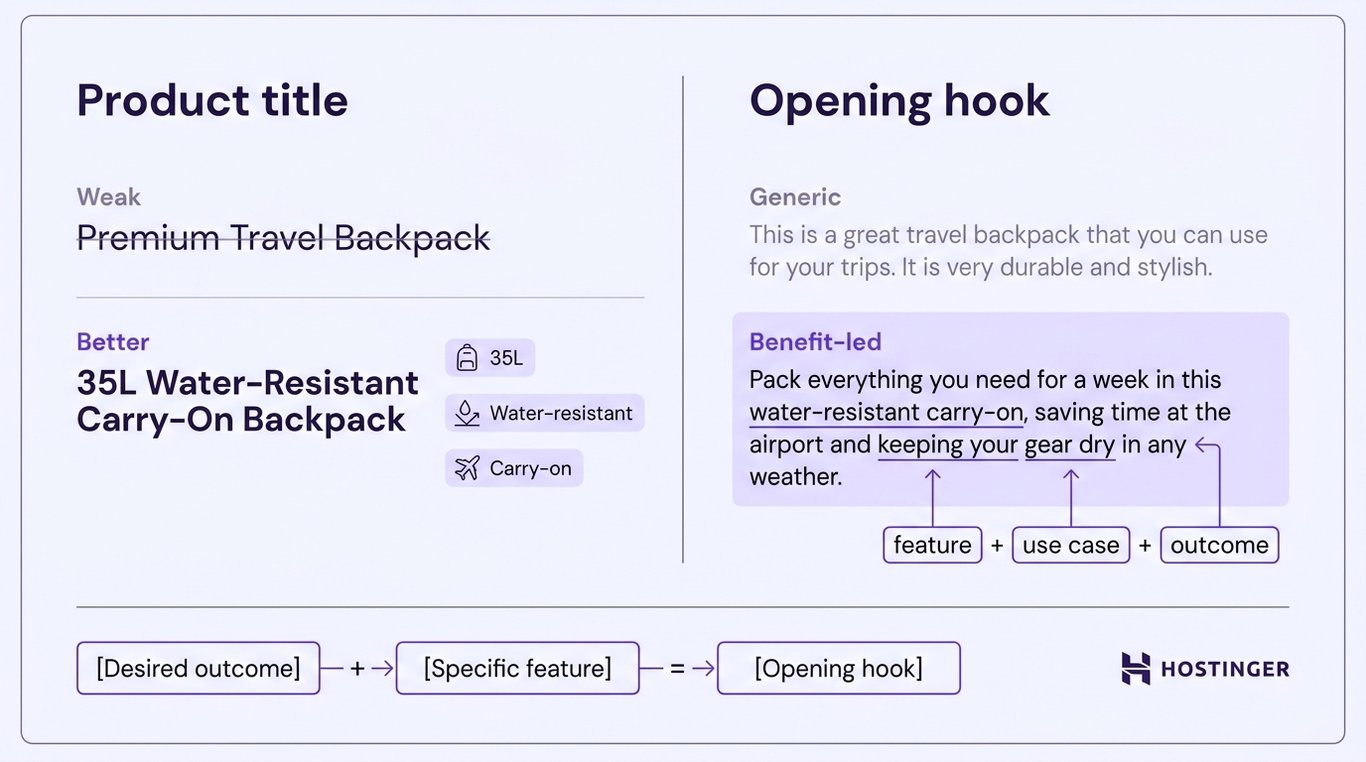
- Weak: Premium Travel Backpack
- Better: 35L Water-Resistant Carry-On Backpack
The stronger versions give shoppers information they can use. Words such as premium, luxury, amazing, or high-quality do not explain what makes the product different; avoid using them unless the claim is supported by concrete evidence.
Keep the title readable. Do not try to squeeze every specification, keyword, or selling point into it.
If several attributes matter, prioritize the one or two that help customers identify the product and distinguish it from nearby alternatives. The remaining details belong in the description or specification list.
The opening hook has a different job. It should connect the product to the main benefit, use case, or outcome you identified in the previous steps.
A shopper who reads only the first sentence should already understand what the product helps them do.
Compare these openings:
Generic: This high-quality insulated bottle is perfect for everyday use.
Benefit-led: Keep your drink cold from the morning commute through the end of the workday with double-wall vacuum insulation.
The second version works better because it combines the feature with a real use case and customer outcome. It gives the shopper a reason to keep reading instead of relying on vague praise.
A practical way to write the opening is to complete one of these patterns:
Get [desired outcome] with [specific feature or product advantage].
Designed for [target user or use case], this [product] helps you [main benefit].
[Specific feature] helps you [customer outcome] without [common inconvenience].
Treat those as drafting prompts, not fixed formulas. Once you have a clear first version, rewrite it to sound natural for your brand and audience.
Use the rest of the description to support the promise they make with benefits, evidence, product details, and scannable information in a logical order.
7. Write and structure the main product description
Start with the product’s biggest benefit, then explain how it delivers on that promise before supporting it with features and specifications.
A simple structure works for most products:
- Opening hook. Communicate the main benefit or customer outcome.
- Supporting benefits. Explain the two or three advantages that matter most to the target audience.
- Relevant features. Introduce the features that make those benefits possible.
- Key specifications. Provide factual details such as dimensions, materials, compatibility, or technical information.
- Scannable details. Use bullet points or short sections so customers can quickly find the information they need.
- Call to action. Encourage the customer to take the next step, whether that’s adding the product to their cart, choosing a size, or comparing available options.
Make the description easy to scan by organizing one idea per paragraph and grouping related information together.
Use bullet points for specifications or features that customers are likely to compare, place the most important information near the top of the page, and remove anything that doesn’t help shoppers understand the product or decide whether it’s right for them.
If you’re planning to start an online store, writing descriptions for dozens or even hundreds of products can quickly become one of the most time-consuming tasks. AI in ecommernce can help speed up that process without replacing your own research and editing.
Hostinger Ecommerce is an AI-powered ecommerce platform with built-in product description generation.
You simply upload a product image, and the AI creates a draft you can refine to match your brand voice, highlight your USP, and emphasize the customer benefits.
8. Optimize product descriptions for SEO
Help search engines understand your product by describing it with the same terms customers use when searching for it.
Like with any ecommerce SEO strategy, you start by identifying the primary search term.
This is usually the phrase a customer would search for if they already knew the type of product they wanted, such as an ergonomic office chair, a stainless steel water bottle, or a wireless gaming mouse.
Next, identify supporting keywords that describe genuine product attributes. These might include material, size, capacity, compatibility, color, intended use, or other characteristics customers commonly use to narrow down their options.
Only include terms that accurately describe the product. Avoid adding keywords simply because they have a high search volume.
Once you’ve identified those terms, write SEO-friendly content by placing keywords where customers naturally expect to find them:
- Product title. Include the primary keyword alongside a distinguishing attribute, such as the size, material, or intended use.
- Opening paragraph. Introduce the primary keyword while explaining the product’s main benefit or use case.
- Benefits and features. Mention supporting keywords when describing how the product solves a problem or what makes it different.
- Specifications. Reinforce relevant attributes such as dimensions, materials, compatibility, or capacity where they belong naturally.
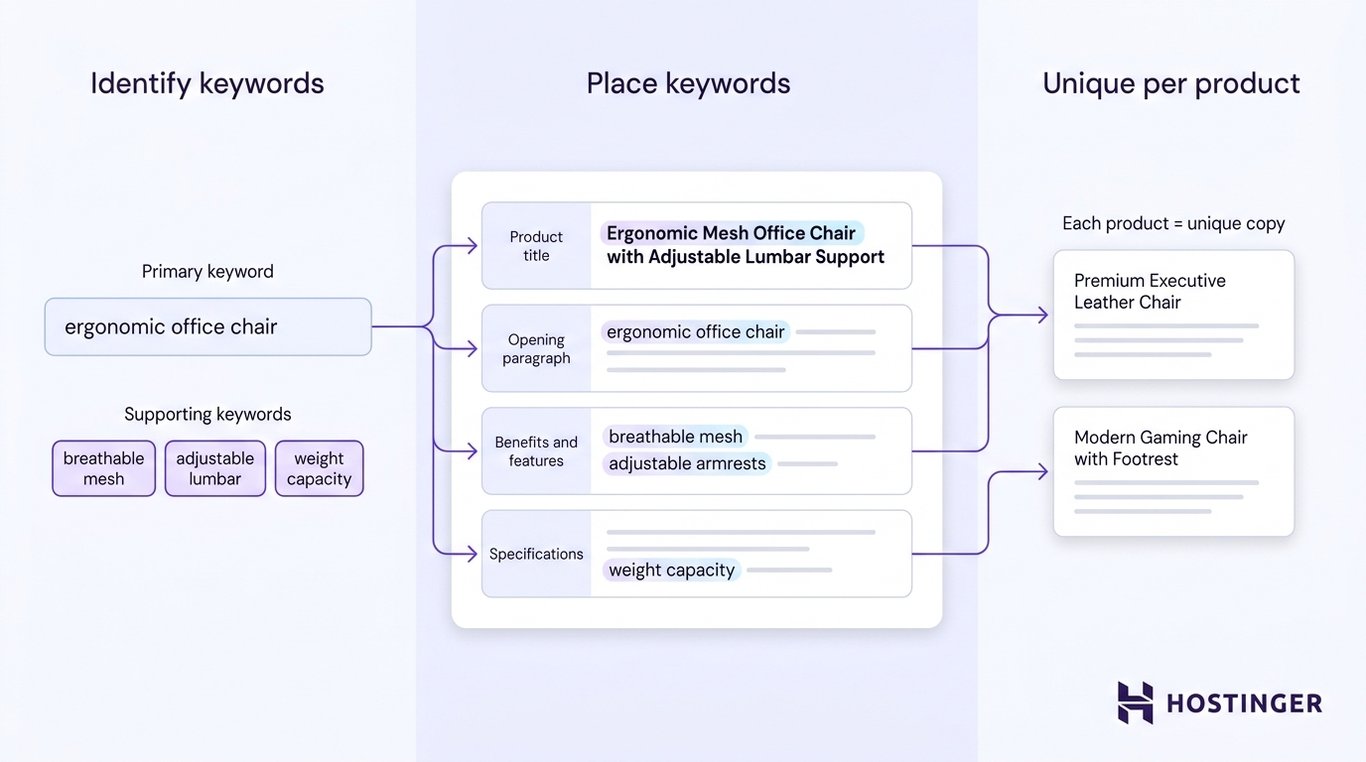
For example, imagine you’re selling an ergonomic office chair. A title such as Ergonomic Mesh Office Chair with Adjustable Lumbar Support tells both customers and search engines exactly what the product is.
The rest of the description can naturally mention related attributes like breathable mesh back, adjustable armrests, and weight capacity while explaining how those features improve comfort throughout the workday.
9. Proofread and test your product description
Start by checking the description for accuracy. Even a well-written description loses credibility if it contains incorrect specifications, unsupported claims, or inconsistent terminology.
A final review should answer questions such as:
- Are the product name, measurements, dimensions, materials, and technical specifications correct?
- Is the same terminology used consistently throughout the description?
- Are spelling, grammar, and punctuation free from errors?
- Does every customer benefit relate to a real product feature or specification?
- Have vague or unsupported claims been replaced with specific evidence?
- Does every sentence help customers understand, compare, or evaluate the product?
- Is the description easy to scan with short paragraphs and bullet points where appropriate?
- Does the call to action match the action you want customers to take, whether that’s adding the product to their cart, choosing a size, or requesting a quote?
Reading the description aloud is a simple way to identify awkward phrasing, repeated words, or sentences that feel longer than necessary.
Pro tip
Text-to-speech tools built into most operating systems (such as Listen to Page on Mac or Narrator on Windows) can read your description back to you, making it easier to catch awkward phrasing without reading it yourself.
Once the description is accurate and easy to read, measure how well it performs. Compare different versions of the copy to see which one produces better results.
Test one element at a time so you know exactly what influenced the outcome. Useful elements to experiment with include:
- Opening hook
- Wording of the primary customer benefit
- Length of the description
- Whether specifications are presented in paragraphs or bullet points
- Wording of the call to action
- Order in which benefits, features, and specifications appear
Measure each variation against a specific goal, such as add-to-cart rate, conversion rate, or completed purchases.
Treat product descriptions as living content rather than one-time writing tasks. Customer feedback, search behavior, and purchasing patterns change over time, and regular reviews help ensure your descriptions continue to answer the questions customers ask before making a purchase
Common mistakes to avoid when writing product descriptions
Generic language, unnecessary jargon, keyword stuffing, poor formatting, and unsupported claims are among the most common mistakes in product descriptions.
Watch for the following before publishing:
- Writing descriptions that could apply to any product. Generic claims such as high quality, premium, or great value don’t explain what makes the product different. Replace them with specific features, measurable benefits, or evidence that supports the claim.
- Using jargon that your audience doesn’t understand. Industry terminology can help when writing for specialists, but unnecessary technical language makes descriptions harder to understand. Choose the level of detail and vocabulary that matches your target audience.
- Letting the price do the selling. Pricing a product at a lower range alone rarely convinces customers to buy if they don’t understand the product’s value. Explain what the product offers before expecting the price to justify the purchase.
- Overusing keywords. Repeating the same search terms unnaturally makes descriptions harder to read and doesn’t improve their usefulness. Focus on describing the product accurately instead of writing for search engines.
- Making unsupported or exaggerated claims. Statements such as the world’s best, guaranteed results, or lasts forever can damage credibility if they can’t be verified. Every important claim should be supported by a real feature, specification, certification, or other evidence. That credibility matters because 90% of consumers read online reviews before making a purchase, and more than half read at least four reviews. If your product description promises something the reviews don’t support, shoppers are likely to notice the mismatch.
- Ignoring formatting. Large blocks of text make product descriptions difficult to scan. Use short paragraphs, bullet points, and logical grouping so customers can quickly find the information they need.
- Publishing without reviewing the description. Incorrect specifications, outdated information, or inconsistent terminology can lead to customer confusion, returns, and unnecessary support requests. Review descriptions whenever the product changes to ensure they remain accurate.
Next steps for a higher-converting product page
Once you’ve improved your product descriptions, review the rest of the page with the same attention to detail.
Effective ecommerce website features, such as product galleries, customer reviews, comparison tools, clear specifications, and a prominent call to action, should work alongside the description to answer customers’ questions and build confidence before they buy.
Next, evaluate the page as a customer would. Check whether your product images clearly show what you’re selling and whether the layout makes important information easy to find.
Make sure customer reviews and other trust signals are visible, the call to action stands out, and the checkout process is simple to complete.
Looking at the page as a whole often reveals opportunities to improve your ecommerce conversion rate that have nothing to do with the product description.
Improving a single product page is also part of a broader ecommerce website development process.
As your store grows, regularly review how product pages, navigation, search, filtering, and checkout work together to support the customer journey.
A good final exercise is to revisit one of your existing product pages after updating its description. Then ask yourself a simple question: If I were seeing this page for the first time, what would stop me from buying?
The answer often reveals opportunities that go far beyond the product description itself.
This article is a localized version of How to write a product description in 9 steps, originally published in English.

Ksenija is a digital marketing enthusiast with extensive expertise in content creation and website optimization. Specializing in WordPress, she enjoys writing about the platform’s nuances, from design to functionality, and sharing her insights with others. When she’s not perfecting her trade, you’ll find her on the local basketball court or at home enjoying a crime story. Follow her on LinkedIn.