How to validate a business idea in 8 steps
Sep 25, 2026
/
By Bruno S.
/
13 min Read
To validate a business idea, gather evidence that real people will pay to solve a specific problem before you commit time and money to building it. That evidence comes from market and competitor research, conversations with potential customers, a landing page test, and payments collected through pre-sales or crowdfunding.
Validation differs from collecting positive feedback. Praise from friends, family, or social media followers is not evidence of demand because agreeing costs the person nothing. Stronger signals involve independent behavior: strangers describing the problem unprompted, taking action on a landing page, or paying before the product exists.
All eight steps can be completed at little to no cost with free communities, direct messages, and free versions of paid tools standing in for the paid route. The process ends by comparing demand evidence with costs, price, and break-even requirements, then deciding whether to proceed, pivot, or drop the idea.
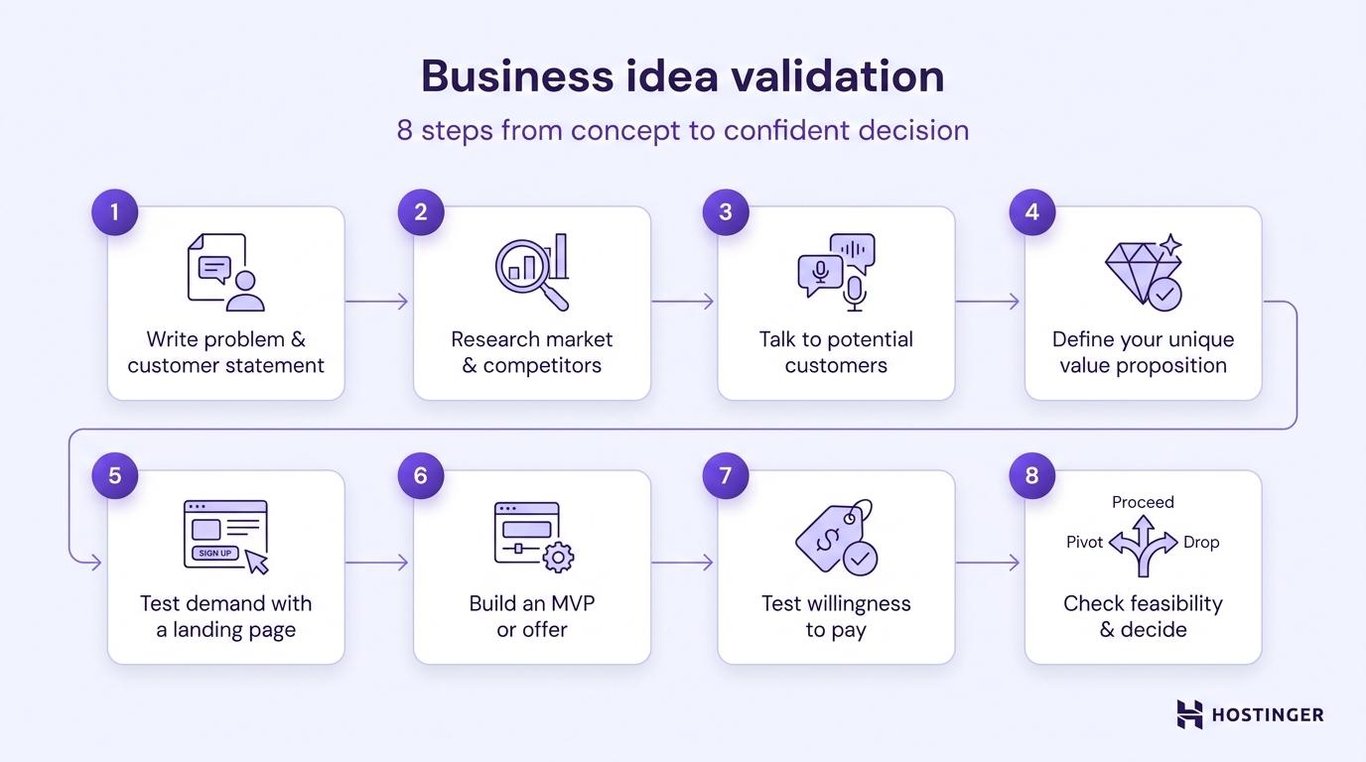
- Describe who has the problem and how they handle it today.
- Look at search interest, online communities, and what competitors offer.
- Interview people who match your target customer about what they’ve already tried.
- Explain what makes your offer different, using your customers’ own words.
- Publish a single-offer page and track how many visitors take action.
- Deliver the smallest working version of your product or service.
- Ask for real payment through pre-sales, small ad tests, or crowdfunding.
- Work out whether your costs and pricing add up to a viable business.
1. Write your idea as a problem-and-customer statement
To write your idea as a problem-and-customer statement, describe in one sentence who has the problem, what the problem is, and how they deal with it today. Write this first version before formal research, so you know which assumptions you’re testing.
That format forces clarity. “An app for dog owners” isn’t a business idea; “dog owners who travel frequently can’t find last-minute pet sitters they trust, so they cancel trips or use strangers from generic platforms” is a business idea you can test.
Once you have that sentence, apply one filter before going further: Is the problem important enough that the target customer already spends time, money, or effort trying to solve it?
People are more likely to pay for problems that are frequent, costly, or time-consuming. If the issue is only mildly inconvenient and customers have no existing workaround or solution, treat that as an early warning rather than assuming marketing will create urgency later.
A precise statement also shows whether the idea maps to a real business model. Anyone figuring out how to start an online business faces the same first test: the problem must point to a product, service, or offer someone will pay for.
The goal of this step is not to convince yourself that the idea is good. Write it precisely enough that a stranger knows exactly who you’re targeting, what pain you’re solving, and why existing options fall short.
2. Research the market and competitors
To research the market and competitors for a business idea, go through five checks: keyword search volume, Google Trends, niche communities, marketplace listings, and competitor pricing pages. Together, they show whether people discuss or search for the problem, what alternatives already exist, and where gaps may be worth testing.
Search volume is an estimate of how often people search for a term over a given period. Use a tool such as Google Keyword Planner to compare the core problem and related phrases. Higher volume shows more search interest in the term, but it does not prove purchase intent or demand for your solution.
Low volume isn’t automatically a dealbreaker. Some problems are solved offline or described in words you haven’t thought of, so a quiet keyword means you need proof of demand from another check, like communities or marketplaces, before moving on.
Run the same search in Google Trends to check whether relative search interest is growing, seasonal, or declining. A shrinking trend in a crowded market is a warning sign, even when current volumes look acceptable.
Then go to Reddit and niche forums. Search for the problem, not the solution. People describing their frustration in their own words is free customer research. That language will help you write everything from landing page text to interview questions.
Also, check marketplace listings on Amazon, Etsy, or Gumroad, depending on your category. Similar products with sustained reviews are evidence that people buy in the category. Read lower-rated reviews for repeated complaints, missing features, and situations where buyers say the existing options fall short.
Finally, study competitor pricing pages. Pricing shows how alternatives are packaged and where budget and premium options sit, giving you reference points for your own test. It does not prove what customers will pay for your offer, which is why step 7 is important.
3. Talk to potential customers
Talk to roughly 10 to 15 people who closely match the customer in your problem statement as a practical first round of interviews, then continue if new conversations still reveal different patterns. Market research shows a problem exists at scale; conversations show whether it matters to the specific people you plan to sell to.
A stronger signal is when the same problem, workaround, or consequence appears independently across several interviews without you introducing it first.
Do not rely on friends, family, or people who have a personal reason to encourage you. Find suitable candidates on LinkedIn, in Reddit communities, in niche Facebook Groups, or in industry Slack channels. If recruiting suitable interviewees is consistently difficult, treat that as a reason to revisit how narrowly you defined the customer or how you are reaching them.
Ask what people have done, not what they say they’d do. Questions like “Would you buy this?” invite hypothetical answers. People say what sounds reasonable, not what they’d actually do. Ask instead:
- “When did you last deal with this problem?”
- “What did you try? What happened?”
- “How much does this cost you per week in time or money?”
- “What’s the most you’ve paid trying to fix it?”
Let them talk about the problem in full before you mention your idea. Listen for how often they bring it up unprompted, how frustrated they sound, and what workarounds they’ve already built. Those details help distinguish a recurring, costly problem from one people notice but rarely act on.
Cut leading questions from your interviews. Asking “Don’t you find it frustrating when X happens?” is not research; it’s fishing for agreement. The goal is to hear what people say when you get out of their way.
4. Define your unique value proposition
To define your unique value proposition, write one plain-language sentence that states who your product is for, what problem it solves, and why it’s different from what already exists.
If the statement needs jargon or technical terms to make sense, it isn’t clear enough yet. A common format is: “[Product] helps [who] do [what] by [how], unlike [alternative].”
Ground the core promise in patterns from real customer conversations. Competitor reviews can help you understand alternatives and gaps, but they should support, not replace, what target customers told you about the problem and the outcome they want.
This is where the problem-solution fit gets tested: whether your solution matches the problem people actually described. Your value proposition needs to be rewritten if it sounds good to you but doesn’t map to the specific frustrations your interviewees described. Interviews shape the claim; the landing-page and payments tests in the next steps show whether that claim produces real behavior.
5. Test demand with a landing page
To test demand with a landing page, publish a standalone page built around one offer and one action, then send people who don’t know you to it and track how many take that action. The test answers one question: will a stranger with no personal connection to you act on this offer?
The page needs five things:
- The problem. State it clearly in the headline.
- The offer. Describe it in one or two sentences.
- The price. Show it directly on the page.
- One call to action (CTA). Ask visitors to sign up, pre-order, or join the waitlist.
- Conversion tracking. Count the actions visitors take, not just the visits.
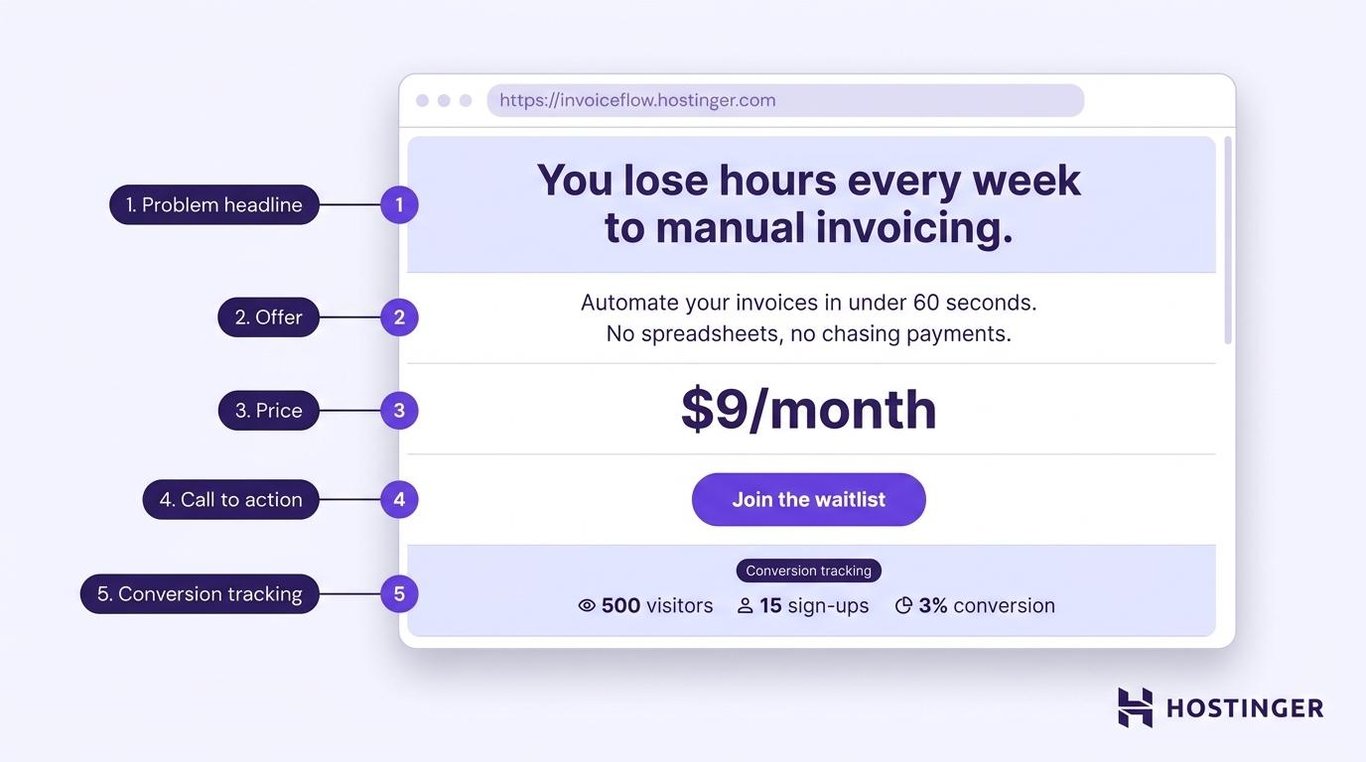
You can create a landing page quickly. It doesn’t need to look polished, just honest about what you’re offering and who it’s for.
A conversion is a visitor who takes the action you asked for. Traffic with few or no conversions is still useful because it signals that you should investigate the audience, offer, price, message, or level of demand. For example, getting 500 visits and 3 sign-ups is a weak response; getting 30 visits and 6 pre-orders is a strong signal, although the smaller sample still needs follow-up.
Landing page performance benchmarks vary by industry, traffic source, price, and requested action. For context, Unbounce’s 2024 benchmark found a 6.6% median across 41,000+ landing pages, with industry medians ranging from 3.8% to 12.3%. Use benchmarks as context, not as proof that the idea is validated
6. Build a minimum viable product or offer
To build a minimum viable product (MVP) or minimum viable offer, create the smallest version of your idea that still delivers real value to a real customer. Aim for something testable, not something impressive.
For software, that’s a working prototype with a handful of core features. For a service, it’s a manually delivered version of what the eventual product will automate. For a physical product, it’s a small production run or a sample batch before you invest in custom manufacturing.
Build just enough to see whether customers get value from it and come back.
Common minimum viable product examples show that the test can be much simpler than the final product. Dropbox, for example, used a targeted demo video to demonstrate its file-syncing experience before opening the product widely; founder Drew Houston later said the beta waitlist rose from 5,000 to 75,000 after the video spread on Digg.
Build only what lets you answer the next question: Does this solve the problem well enough that someone wants to use it again?
7. Test willingness to pay
To test willingness to pay, ask people for money before the product is finished through pre-sales, small paid ad tests, or crowdfunding. Interviews, sign-ups, and page visits measure interest, while payment measures financial commitment.
Use each method to turn interest into a paid commitment or a measurable opportunity to pay:
- Pre-sales. Ask people to pay for the product before it exists. A Stripe payment link, a Gumroad product page, or a simple invoice is enough. Set a concrete target before you start: for example, the minimum number or value of paid orders that would justify the next investment. Then hold yourself to it.
- Small paid ad tests. Set a capped budget to the same-priced offer or pre-order page. Measure completed purchases or paid reservations separately from clicks and free sign-ups. The purpose is to test whether strangers will pay, not whether an ad can generate traffic.
- Crowdfunding. Platforms like Kickstarter and Indiegogo let you run a public pre-sale campaign with a funding target. On Kickstart, pledges are only collected when the campaign reaches its goal. Reaching a target is strong evidence for that specific offer and audience, but it still does not guarantee repeat demand or long-term viability.
Verbal commitments are not willingness-to-pay data. Treat 'I'd definitely buy that' as stated intent until the person actually completes a payment of qualifying pledge.
8. Check feasibility and decide
Feasibility analysis ends in one of three calls: proceed, pivot, or drop. At the validation stage, feasibility means checking whether you make money on each sale at a realistic level of demand, not whether the idea scales to a million customers.
Feasibility comes down to four numbers:
Number | What to estimate |
Unit cost | What it costs to deliver one sale |
Price | What customers said they’d pay, cross-checked against your willingness-to-pay results |
Break-even point | How many sales cover your fixed monthly costs, like tools, rent, and subscriptions |
Time to break-even | How long that takes at the demand level your tests showed |
The numbers point to one of three decisions:
- Proceed. Demand signals are strong, each sale makes money, and you have pre-orders or paying users. Naming a business is the natural next task. Register your name and start building.
- Pivot. The problem is real, but your solution isn’t landing, or the price customers accept doesn’t cover your costs. Exploring online business ideas adjacent to your current one often reveals a stronger version of the same instinct. Change one variable and rerun the demand tests.
- Drop. Demand signals are weak across multiple tests, or the numbers don’t work at any price customers would accept. Stop or park the idea before committing more resources, and document what the tests taught you for the next idea.
If the evidence is mixed, identify the specific uncertainty first, then run targeted follow-up interviews or retest one variable. More data only helps when it is collected to answer a clear validation question.
How to tell real validation signals from false positives
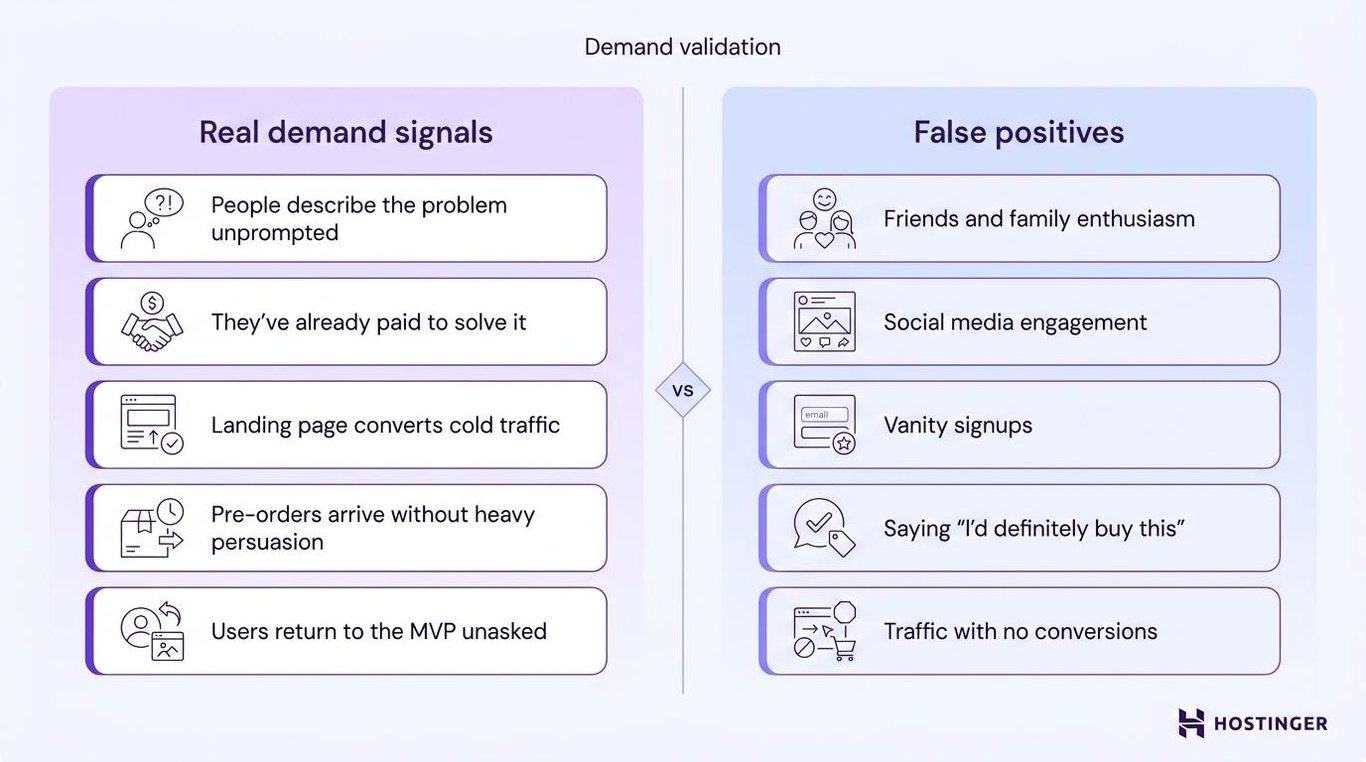
Real validation signals involve behavior that costs the person something: money, time, or effort. False positives cost nothing to give, which is exactly why they feel so encouraging.
Signals that support real demand
Five signals are especially useful when they appear repeatedly across independent tests:
- People describe the problem without prompting. During an interview, they bring it up before you mention your idea.
- They’ve already paid to solve it. A customer who has paid for three inadequate alternatives is a stronger signal than one who says they’d pay for yours.
- Your landing page converts cold traffic. Strangers with no personal connection to you take the action you asked for.
- Pre-orders come in without heavy persuasion. Founder-led selling is normal early on, but if each buyer needs extensive convincing, treat that as a sign that the offer or positioning still needs work.
- Users return to your MVP without being asked. Repeat use is a strong signal that the offer delivered value.
False positives that look like validation
Common false positives include:
- Friends and family enthusiasm. They’re being supportive, not objective.
- Social media engagement. Likes, shares, and comments commit to nothing.
- Vanity sign-ups. A free email list proves interest, not willingness to pay. Getting an email address is far easier than getting a credit card number.
- “I’d definitely buy this.” Verbal intent is not a purchase. The moment you ask someone to actually pay is when you find out.
- Traffic with no conversions. People visited. Nobody acted. Check the traffic source, audience, offer, price, and page before concluding that demand itself is the problem.
Business idea validation checklist
A business idea validation checklist works as a set of pass conditions, not a task list. Each item confirms you’ve collected real evidence rather than encouraging signals.
- Your idea is written as a specific problem-and-customer statement, not a product description.
- You’ve checked keyword search volume and Google Trends for the core problem.
- You’ve reviewed competitor offerings and read their negative reviews.
- You’ve completed an initial round of roughly 10 to 15 conversations with people who closely match your target customer, primarily outside your close personal network.
- The same problem, consequences, and workarounds recur across several interviews without leading questions.
- Most of your evidence comes from target customers who have no personal reason to encourage you.
- Your value proposition traces to specific things interviewees said, not your assumptions.
- Your landing page states a price, has one CTA, and tracks conversions.
- You have conversion data from strangers, not only from people who already follow you.
- You’ve tested willingness to pay with real money: pre-orders, a paid ad test, or a crowdfunding campaign.
- You make money on each sale at the price customers are willing to pay.
- You’ve made a clear decision: proceed, pivot, or drop.
Treat unchecked items that are relevant to your business as evidence gaps.
How to validate a business idea without spending money
You validate a business idea with no upfront budget by swapping paid tools for free communities, direct messages, and free versions of paid software. The evidence standard stays the same: real behavior from real strangers.
Problem research. Reddit, Facebook Groups, Quora, and niche community forums are free. Search for the problem, not the solution: read the threads and post a question if the community allows it. You’re looking for people who have the problem and are actively hunting for a fix.
Customer interviews. LinkedIn lets you contact people with specific job titles or interests. A direct message that explains who you are and asks for 15 minutes works when it’s specific and respectful. Local business associations, meetups, and industry communities work the same way in person.
Survey research. Google Forms’ free plan handles basic surveys. Keep it focused and share it where your target customers already spend time. Surveys complement interviews rather than replacing them.
Landing page. A free single-page site builder covers a basic test page, and a free email form tool handles sign-ups. For a payment test, Stripe Payment Links has no setup or monthly fee on standard pricing, although transaction fees apply when a payment succeeds.
Willingness-to-pay test. Post about the idea on LinkedIn, X, or in a relevant community and ask people to message you if they’d pay for early access. Then actually ask them to pay. You’re converting stated intent into action in real time, for free.
Pro tip
Keep a simple spreadsheet for every conversation: who you talked to, what problem they named, what they've tried, and whether they'd pay. A consistent record makes recurring patterns and contradictions easier to spot.
Benefits of validating a business idea before launch
Validating a business idea before launch has four main benefits: you catch bad ideas early, learn your customer before building, sharpen your pitch, and end up with confidence backed by evidence.
U.S. Bureau of Labor Statistics data shows that around 20% of new businesses fail within their first year, and nearly half don’t survive to five years. Validation doesn’t guarantee success, but it changes the odds.
You find out early if the idea doesn’t work. The point is to discover a bad idea before you’ve paid for development, inventory, or a year of your own time. A short validation cycle that kills a bad idea is cheaper than building far enough to discover the same problem after launch.
You understand your customer before you build. Validation replaces imagined user behavior with evidence from people who actually experience the problem, giving later product, pricing, and marketing decisions a stronger basis.
You get better at pitching before you need to. Repeated customer conversations force you to describe the problem and solution clearly, then adjust the wording when target customers misunderstand or reject it.
You make decisions with more evidence and less confirmation bias. The goal is to challenge the idea, record disconfirming results, and continue only when independent signals support it.
Common mistakes to avoid when validating a business idea
Six mistakes derail business-idea validation: testing everything at once, mistaking surveys for customer conversations, stopping at sign-ups, validating the solution before the problem, ignoring negative results, and building before talking to anyone. Each one produces evidence that looks useful and isn’t.
Testing too many variables at once. It becomes harder to know what caused the result if you change the headline, price, audience, and offer in the same test. Change one variable at a time.
Mistaking surveys for customer conversations. A larger survey can quantify patterns, but a hypothetical rating such as “On a scale of 1-10, how much do you want this?” is a weak evidence of willingness to pay. Use surveys to complement interviews and behavioral tests, not replace them
Stopping at the landing page. A page that converts is a promising signal, not a conclusion. Email sign-ups prove interest. Pre-orders prove demand. Don’t confuse the two.
Validating the solution instead of the problem. Asking whether people like your product is a different question from whether the problem it solves is real and urgent. Validate the problem first. A real problem supports multiple solutions.
Ignoring negative results. When interviews repeatedly surface weak pain or a landing page doesn’t convert, the temptation is to change the question rather than accept the answer. Negative results are valuable because they tell you which assumptions to change, retest, or stop funding.
Building before talking to anyone. Spending months on a product before speaking to a single potential customer means the early roadmap is based mostly on assumptions. Every week you build before validating is a week you’re betting on assumptions instead of evidence.
How to validate a business idea with AI agents
AI agents support business idea validation by assigning each discipline its own specialist, rather than routing everything through a single general-purpose chatbot. Validation spans market research, customer conversations, copywriting, demand testing, and pricing math, and few first-time founders have deep experience in all five.
The approach is already mainstream. According to a survey Hostinger conducted across 1,000 U.S. businesses, 51% of businesses already use generative AI. For founders at the validation stage, the practical question isn’t whether to use AI. It’s whether the AI you’re using is specific enough to be useful.
Hostinger Agents answers that with seven specialized agents: Business Advisor, Creative Writer, SEO Consultant, Marketing Planner, Legal Advisor, Customer Comms, and Sales & Outreach. Each one stays focused on its domain, so you’re talking to the right specialist for the task rather than prompting a generalist to produce expert-level output.
Each agent covers a specific part of the validation workflow.
Validation task | Agent | Skill |
Problem statement | Business Advisor | Validate my business idea |
Market research | SEO Consultant | Keyword research |
Customer outreach | Sales & Outreach | Find leads and reach out |
Value proposition | Business Advisor | Define my value proposition |
Landing page copy | Creative Writer | Generate website copy |
Paid ad tests | Marketing Planner | Create marketing content |
Pre-sale legal pages | Legal Advisor | Draft a privacy policy |
Pricing and break-even | Business Advisor | Review my pricing |
The Business Advisor’s Validate my business idea skill is the most direct entry point. You describe your idea, and the agent stress-tests it: target customer, problem severity, existing alternatives, and what makes your solution different.
The result is a structured conversation that surfaces the assumptions you haven’t questioned yet, not a 1-click verdict.
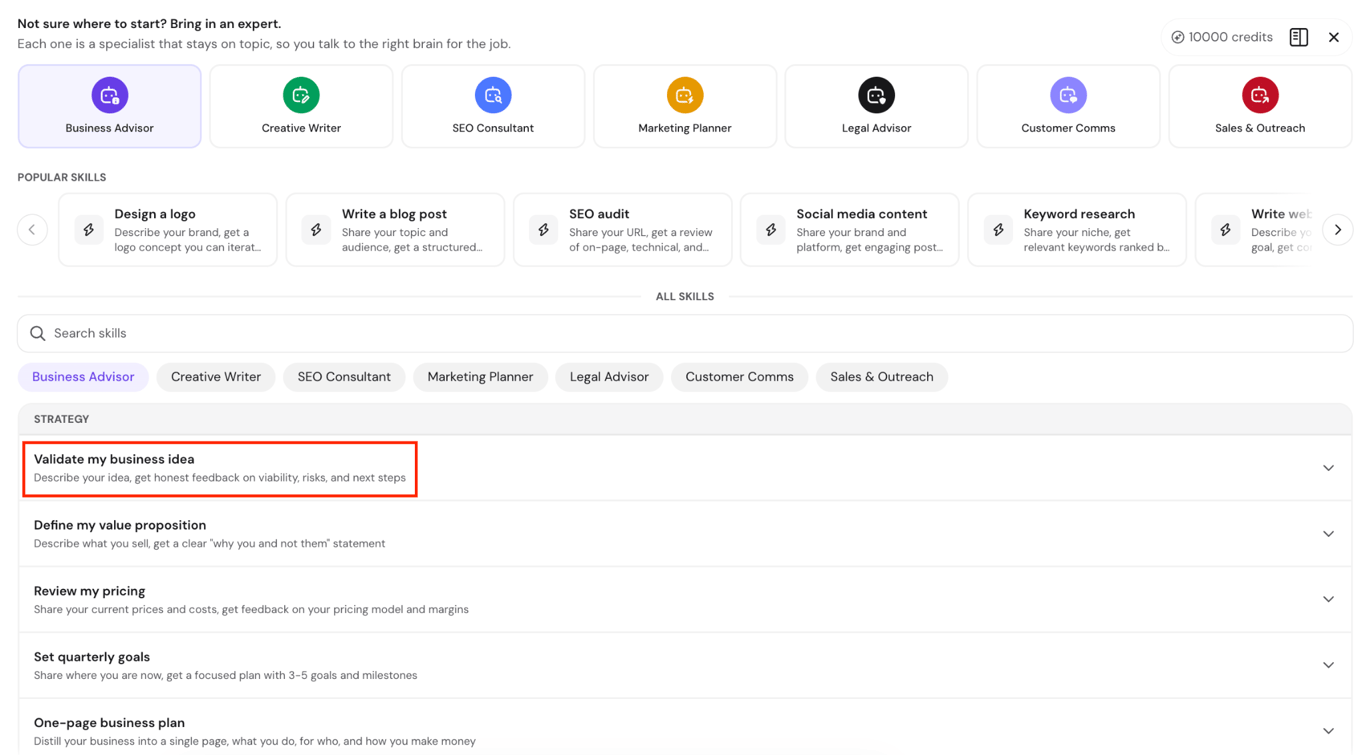
Hostinger Agent can retain business context, preferences, and past decisions across conversations, so you can return to the same validation project without re-explaining the basics each time. That is useful when your evidence changes over several interview, landing-page, and pricing-test rounds.


Bruno is a Content Writer at Hostinger, focused on creating and optimizing helpful, engaging articles about web development and marketing. With a background in journalism, he combines storytelling with practical insights to make complex topics easier to understand. He has also contributed to publications like MacMagazine and Jornal A Tarde. Outside of work, Bruno enjoys exploring art, cooking, and technology.