What is agentic AI in marketing, and how does it work?
Sep 11, 2026
/
By Bruno S.
/
7 min Read
Agentic AI in marketing describes autonomous agents that read real-time data, decide on the next best action, and execute multi-step campaign tasks within boundaries a business sets in advance. That’s different from generative AI, which waits for a new prompt before it does anything, and from traditional automation, which only follows fixed rules.
The distinction matters because marketing teams already put these agents to work on hyper-personalization, ad spend adjustments, workflow management, and ongoing customer conversations.
Speed and scale come with real tradeoffs: brand voice drifts without oversight, teams stop double-checking the output, and compliance questions don’t disappear just because a system is now making the decision.
A business doesn’t need to build agent infrastructure from scratch to put any of this to work, since ready-made platforms already handle these tasks today.
What is agentic AI in marketing?
Agentic AI in marketing is a system of AI agents that pursue a marketing goal across multiple steps, choosing the next action from live data instead of waiting for a new prompt each time.
A retail team sets a target like keeping cart abandonment under 20 percent. The agent adjusts email timing, discount offers, and audience segments on its own, checks results after each change, and reports back once it hits the target or runs into a boundary it isn’t allowed to cross.
Those boundaries are called guardrails: budget caps, approval steps for certain actions, or rules about tone and claims the agent can’t override.
Guardrails are what separate agentic AI from a system running with no oversight at all, and every deployment defines them before the agent starts working.
Marketing is one application of a much broader technology, and the same sense-reason-act structure shows up anywhere software plans multi-step tasks and selects tools on its own. Understanding what agentic AI is at that broader level makes the marketing-specific mechanics easier to place in context.
The agents doing this work are built from the same components used across other industries. That’s what AI agents are: software that combines a language model with memory, defined permissions, and access to specific tools, then points that combination at a marketing task.
That combination of a goal, defined permissions, and access to live data is what turns a chatbot into something that keeps working on its own.
How does agentic AI work in marketing?
Agentic AI in marketing runs on a four-stage loop: sense, reason, act, and learn. It is repeated until the goal is met or a guardrail stops it.
How agents sense marketing data
Sensing means pulling real-time information from the systems a business already runs, instead of working from a report someone pulled last week.
An agent monitoring a paid search campaign senses cost-per-click movement, impression share, and conversion rate every few minutes, not once during a weekly check-in. The same pattern applies to customer relationship management (CRM) activity, on-site behavior, and email engagement, wherever the agent has been given access.
How agents reason through decisions
Reasoning is where the agent decides what to do with that data, through large language models that interpret the situation against the stated goal and compare a few possible actions before picking one.
When cost-per-click rises past a set threshold while conversions hold steady, the agent judges the audience is still worth the spend and shifts budget rather than pausing the campaign outright.
How agents act on campaigns
Acting is the step where the agent executes its decision directly inside the connected tool, without a person clicking the button.
That includes adjusting a bid in the ad platform, sending a follow-up email, or updating an audience segment in the CRM, all inside the permissions the guardrails already define.
How agents learn from outcomes
Learning happens when the agent compares the result of its action against the goal and adjusts its future decisions based on what actually worked.
If a bid increase didn’t improve conversion rate last time, the agent weights that option lower the next time a similar pattern shows up, without a person manually adjusting its setting.
Running this sense-reason-act loop yourself means wiring up data access, reasoning, and connected tools – or you can use Hostinger’s agentic AI, which handles that setup and applies it to marketing tasks out of the box.
Pro tip
Run a new agent in reasoning-only mode for the first cycle, where it recommends the action but a person approves it before anything gets executed. That shows what the agent would have done without the risk of a bad first decision reaching a live campaign.
How is agentic AI different from generative AI and traditional automation?
Agentic AI differs from generative AI and traditional automation in two ways: what triggers the action, and how much the system decides on its own.
Agentic AI vs. generative AI
Generative AI produces an output for a single prompt and stops there, while agentic AI keeps working toward a goal across many actions without a new prompt for each one.
Asking a generative tool to write ten ad headlines produces ten headlines. Asking an agentic system to improve ad performance produces a running process: it tests headlines, tracks results, and adjusts spend, all without someone prompting each step.
Agentic AI vs. traditional automation
Traditional marketing automation runs fixed if-this-then-that rules, while agentic AI reasons over data the rule-maker never anticipated.
A drip email sequence sends message three after message two, regardless of what happens in between. An agent handling the same sequence skips, delays, or changes a message based on what the recipient actually does.
| Type | Trigger | Decision-making | Output |
Generative AI | A prompt from a person | None, follows the prompt | A single piece of content |
Traditional automation | A predefined rule or event | None, follows fixed logic | A scripted action |
Agentic AI | A stated goal | Ongoing, based on live data | A sequence of actions |
What are the key use cases of agentic AI in marketing?
Agentic AI in marketing already runs in four areas that go beyond single-prompt content generation: hyper-personalization, ad optimization, workflow management, and conversational engagement.
AI agents for marketing covers a wider range of platforms and setups than fits into a definitional guide, but the patterns below show what the technology does inside a live campaign.
Hyper-personalization at scale
Hyper-personalization means the agent adjusts messaging to each individual in real time, rather than to a segment built weeks earlier.
An ecommerce agent changes a subject line, a product recommendation, and a send time based on what a shopper did in their browsing session an hour ago, not what an outdated list said about them last month.
Dynamic ad optimization
Dynamic ad optimization is the agent reallocating budget, bids, and creative across channels based on performance it tracks as the campaign runs.
If cost-per-acquisition on one platform climbs past a set limit while another channel holds steady, the agent shifts spend toward the better-performing channel the same day, not at the next scheduled review.
Autonomous workflow management
Autonomous workflow management means the agent coordinates multi-step campaign work across separate tools without a person handing off each stage manually.
An agent drafts a campaign brief, adds it to a project management tool, and notifies the design team once the copy is approved, moving the work forward without anyone chasing the next step.
Intelligent conversational engagement
Intelligent conversational engagement is an agent holding a multi-turn conversation with a customer, remembering earlier context instead of resetting with every new message.
A customer who asks about a return policy on Monday and follows up on Thursday gets a reply that still knows what they talked about, rather than starting the conversation over. AI agent examples outside marketing show the same memory-and-follow-through pattern, from scheduling assistants to research agents that pick up a task exactly where they left off.
Marketing conversations just apply that same pattern to a sales or support context instead of a research task.
What are the benefits of agentic AI in marketing?
Agentic AI in marketing delivers four concrete benefits: speed, personalization at scale, stronger return on investment (ROI), and less manual work for the team running campaigns.
- Speed: Campaign adjustments happen within minutes of a performance shift, not during the next weekly review. An agent monitoring a live promotion changes a discount tier before the promotion underperforms for another day.
- Personalization at scale: Sending individualized messaging to thousands of contacts happens in the same cycle as sending to a handful of manually built segments, since the agent generates the variation instead of a person building each one.
- ROI: Budget shifts toward what’s converting continuously, rather than after a reporting cycle ends, which keeps spend from sitting on an underperforming channel for days at a time.
- Reduced manual work: Routine execution, like adjusting bids, drafting follow-up emails, and updating segments, no longer needs a person for every step, which frees the team for strategy and creative work instead.
What are the risks and challenges of agentic AI in marketing?
Agentic AI in marketing introduces four risks worth planning for before it runs unattended: brand voice consistency, over-reliance, data privacy, and compliance.
- Brand voice consistency: An agent optimizing for a metric doesn’t automatically know how a brand talks. A review step for outbound copy keeps tone consistent while the agent still handles the analysis and drafting.
- Dependence: Letting an agent run unattended for too long lets small errors compound before anyone notices. Scheduled checkpoints where a person reviews recent decisions catch drift early.
- Data privacy: Agents pulling from CRM, email, and browsing data need clear limits on what they can access and store. Limiting permissions to only what a task requires reduces exposure if something goes wrong.
- Compliance and explainability: Regulators and legal teams need to know why an agent made a decision, not just what it did. Agents that log each reasoning step and action make an audit possible after the fact.
Pro tip
A guardrail that made sense at launch often stops fitting six months later, once the agent has more autonomy or the campaign scope grows. Revisit permissions on a fixed schedule instead of leaving them untouched after setup.
How can a business start using agentic AI in marketing?
A business starts using agentic AI in marketing with a ready-made agent platform instead of building custom agent infrastructure from scratch.
Hostinger Agent gives smaller businesses that option: a set of specialized AI experts built for real marketing tasks, ready inside a Hostinger account rather than assembled from separate AI services.
It covers content, campaigns, SEO support, and customer communication through four AI specialists:
- Creative Writer drafts blog posts, landing pages, and product copy in the business’s own voice.
- Marketing Planner plans campaigns, writes the posts that go with them, and keeps output consistent across channels.
- SEO Consultant researches keywords, audits existing pages, and builds a plan for where to rank next.
- Customer Comms writes customer emails, press releases, and internal updates.
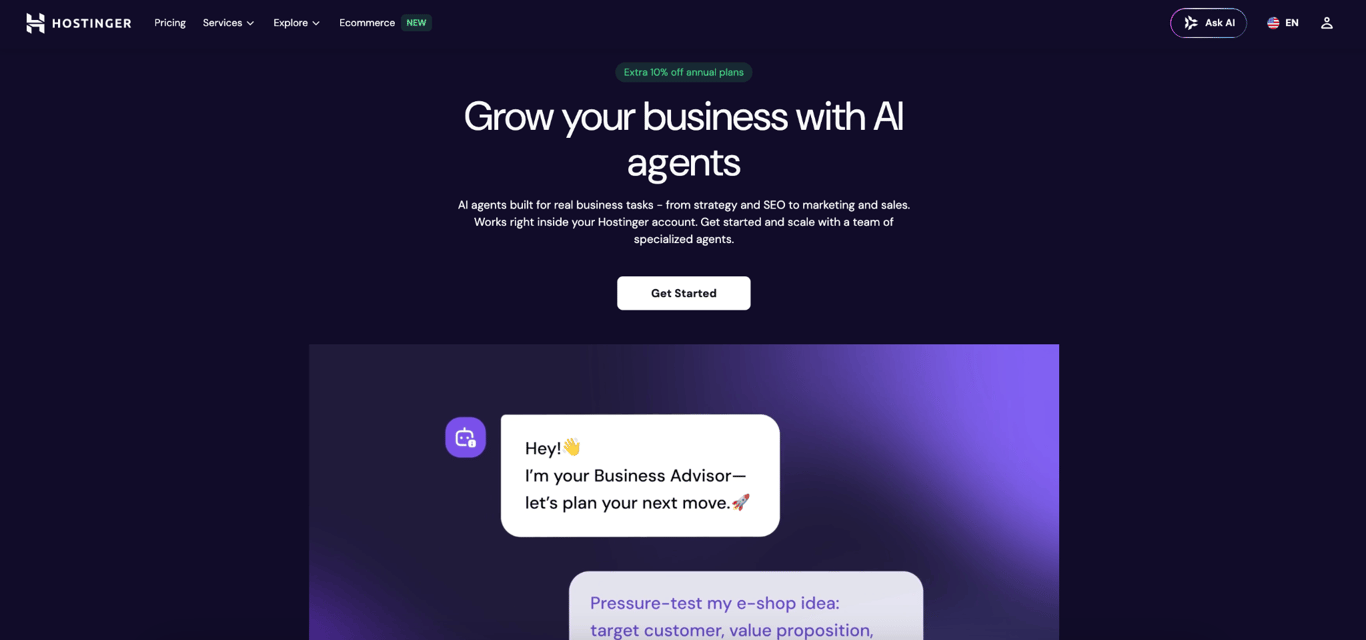
Sales & Outreach rounds out the team for businesses that need the same approach applied to closing deals, building pitches and follow-up messaging instead of marketing content.
Each AI assistant works through skills: pre-built task templates that walk it to a specific outcome, like a keyword audit or a launch email, instead of requiring the business to write a prompt or design a workflow from scratch. The skill already encodes the steps. The business picks one and provides the context.
The specialized agents also connect to tools already in use, including Gmail, HubSpot, Notion, and Slack, so the output lands where the team already works instead of sitting in a separate chat window.
Hostinger Agent needs no engineering background to run, since it’s built for business owners handling their own marketing rather than for a technical team.
Access includes 1,000 credits a month, refreshed automatically, plus 100+ ready-to-use skills organized by task. A new subscriber picks a skill and starts, rather than staring at an empty screen.
Putting agentic AI to work
Putting agentic AI to work starts with one narrow task, not a full rollout across every channel at once. A single campaign or workflow gives a business enough signal to see how the agent reasons without exposing the whole marketing operation to a first attempt.
Set one goal, define the guardrails around it, and review the agent’s decisions after a fixed number of cycles before expanding what it’s allowed to touch. That review point is what turns a pilot into something worth scaling, rather than a system running unchecked because nobody circled back.
Teams still deciding between a single-prompt AI tool and an agentic one get more clarity from a direct look at how agentic and generative AI differ in output and control, since that distinction is usually what determines which one actually fits the task at hand.
This article is a localized version of What is agentic AI in marketing, and how does it work?, originally published in English.

Bruno is a Content Writer at Hostinger, focused on creating and optimizing helpful, engaging articles about web development and marketing. With a background in journalism, he combines storytelling with practical insights to make complex topics easier to understand. He has also contributed to publications like MacMagazine and Jornal A Tarde. Outside of work, Bruno enjoys exploring art, cooking, and technology.