Affiliate email marketing: How to launch a successful campaign
May 21, 2026
/
By Rea G. & Larassatti D.
/
12 min Read

Affiliate email marketing is a method of earning commissions by promoting products or services through email campaigns. According to a survey by AuthorityHacker, affiliates who use email marketing earn 66.4% more than those who don’t, proving it’s an effective strategy for boosting sales.
You can launch a successful affiliate email marketing campaign in just three steps:
- Choose a robust email marketing tool that will scale with your business
- Build a targeted list of subscribers
- Create campaigns by sharing valuable content that includes your affiliate links
At the core of this strategy is crafting valuable email content that provides useful insights, not just sales pitches. Recommend products that truly benefit your audience, and be transparent about your affiliations to build trust. Test different subject lines, calls to action (CTAs), and email formats to learn what resonates best with your readers.
Continue reading to discover each stage of implementing an affiliate email marketing strategy and turn your emails into a consistent source of conversions.
How to start an affiliate email marketing campaign
Email marketing can be a powerful channel to grow your affiliate marketing business, but only if you start with a solid foundation. Let’s break down how to set the stage for an affiliate email marketing campaign that delivers real results.
1. Choose the right email marketing tools
A reliable email marketing platform makes it easy to design newsletters, manage your subscriber list, and track campaign performance. Even better, many platforms now include built-in AI features that further simplify your workflows.
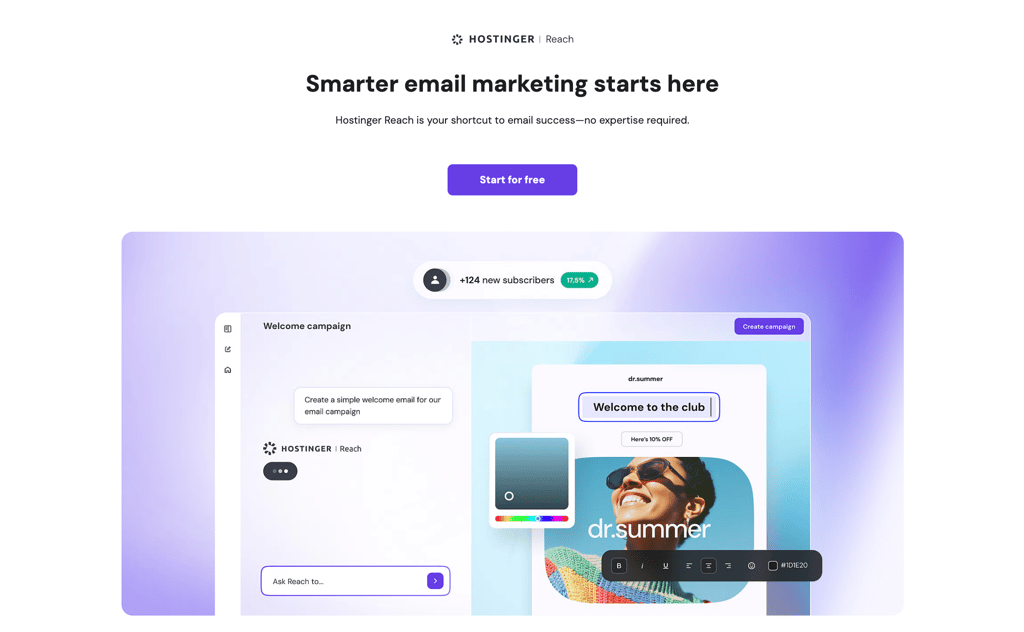
For example, Hostinger Reach lets you generate email templates simply by describing your goals. You can then customize the design using an intuitive drag-and-drop editor, which saves time while ensuring your emails look polished and professional.
With so many options available, consider the following factors to find an email marketing tool that best fits your needs:
- Affiliate-friendliness. Check your preferred platform’s terms of service to ensure they allow affiliate links.
- Contact list management. Look for features like audience segmentation, tagging, and automation to make it easier for you to send targeted emails.
- Ease of use. A tool with a drag-and-drop editor and pre-built email templates can save you time creating professional-looking emails without a steep learning curve.
- Analytics and reporting. Built-in analytics help you monitor open rates, click-through rates, and conversions, so you can improve your campaigns over time.
- Scalability. Choose a tool that can grow with your business, offering higher-tier plans and features as your list and needs expand.
- Value for money. Compare pricing tiers and included features to ensure you’re getting the best balance between cost and functionality.
2. Build your subscriber list
A subscriber list is made up of people who have signed up to receive regular emails from you.
To attract email subscribers, you need a smart strategy that goes beyond simply displaying opt-in forms on your site.. Make sure you reach the right audience, build stronger relationships, and open up more opportunities to promote your affiliate offers.
Here are a few practical strategies to help you grow your email list:
Create a landing page dedicated to sign-ups
Complicated newsletter sign-up processes can turn visitors away, so simplify the steps for them to subscribe. Creating a compelling landing page is one of the most effective ways to do this.
Short landing pages with clear calls to action (CTAs) perform 13.5% better than longer ones. Keep it simple with a strong headline, persuasive copy, and a CTA that further persuades your audience to submit their emails.
Clearly explain the benefits of joining, such as in-depth product reviews, exclusive discount codes, or early access to limited-time deals.
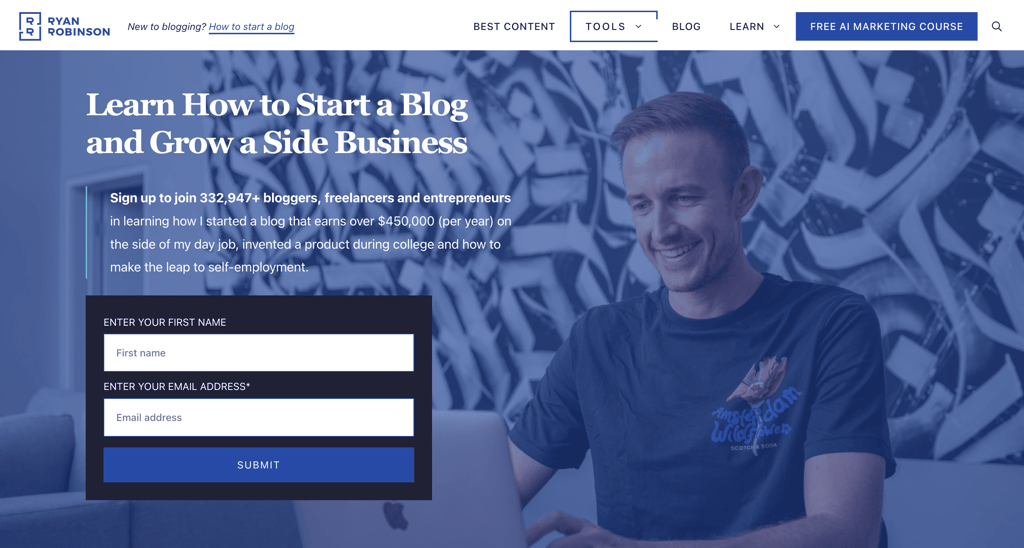
Take a look at Ryan Robinson’s page, which is a great example of persuasive copy combined with a simple sign-up process.
Promote your newsletter on social media
Once you have a landing page, encourage newsletter sign-ups through different social media platforms and formats, such as Instagram Stories, Facebook Reels, and static posts.
Pin a sign-up post to the top of your feed or profile to ensure visitors see it first.
On platforms like Instagram or X, add a sign-up link to your bio to direct users to the landing page where they can subscribe quickly and easily.
Publish relevant content on your website
Publish content that speaks directly to your target audience’s needs and interests. When your content resonates with the right audience, it naturally attracts people who value what you share – and are more likely to subscribe to updates, tips, or affiliate-related deals.
For example, if you promote fitness products, articles like “10-minute home workouts” or “Best protein snacks for weight loss” naturally appeal to readers interested in your niche.
Use your content to build trust and demonstrate expertise. When readers find your advice helpful, they’re often willing to sign up for more, especially if you offer lead magnets like free workout plans, exclusive product discounts, or in-depth guides related to the article topic.
Consistently publishing relevant content also optimizes your site for search engines. This helps new visitors find you through organic searches and allows you to convert traffic into subscribers.
Display lead generation forms
Place lead generation forms in high-visibility areas, such as your homepage or sidebar, to catch your visitors’ attention. Depending on what works best for your site layout and target audience, you can display them in various formats, such as pop-ups, slide-ins, inline forms, or floating bars.
Keep your forms simple. Only ask for essential information like name and email while clearly communicating the value of subscribing, whether it’s access to exclusive tips, free resources, or special affiliate offers. The easier and more appealing your sign-up process, the faster your email list grows.
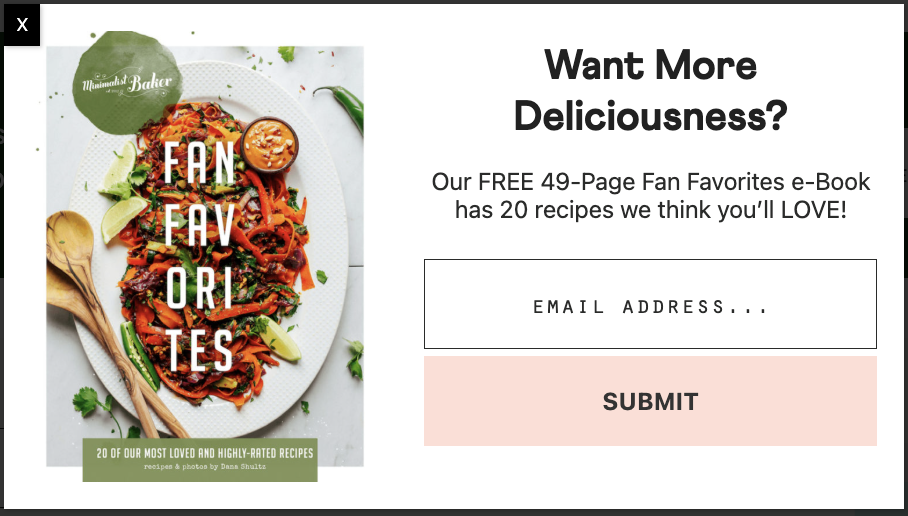
Minimalist Baker, one of the most successful affiliate marketing websites, displays a pop-up lead generation form that highlights the benefit of subscribing. Visitors only need to enter their email to receive a valuable ebook, making the sign-up process straightforward and appealing.
3. Choose the right affiliate products
You can only persuade people to buy by recommending products they need or want. Use the following strategies to curate relevant and profitable affiliate products.
Do competitor research
Studying your competitors’ recommendations provides valuable insights into which products perform well and what strategies work in your affiliate marketing niche.
Start by exploring blogs, newsletters, and social media posts from top-performing affiliate marketers in your niche.
If a competitor promotes a product across multiple platforms, and it gets consistently positive reviews, it’s a strong sign that the product is selling well and customers value it.
Once you identify a high-performing product, focus on how you can differentiate your promotional strategy. This can mean providing better visuals, a more in-depth review, or a unique angle that helps you stand out.
Understand your audience
Social media and search engines are the easiest starting points for researching your target audience’s interests and needs.
For instance, if you’re in the remote work niche, exploring discussions on platforms like Facebook Groups, Reddit, and X can reveal common pain points.
You might find professionals complaining about neck pain from poor desk setups, struggling with power outages that disrupt productivity, or searching for affordable noise-canceling headphones.
These insights help refine your product offerings. Instead of promoting a random selection of work-from-home gadgets, you can focus on ergonomic laptop stands, high-capacity power banks, or budget-friendly noise-canceling headphones.
Conducting affiliate keyword research is also valuable for understanding your audience’s interests. Platforms like SEMrush, Google Trends, and Ahrefs can help you identify emerging trends in your niche.
For example, if you see rising interest in “best budget standing desk” on Google Trends, partner with affiliate programs for standing desks as soon as possible. This helps you capture sales before the market becomes crowded.
Explore affiliate networks
When exploring affiliate networks, it’s essential to consider commission types. There are two types: one-time payouts and recurring commissions.
One-time payouts suit high-ticket items like premium laptops, while recurring commissions offer ongoing earnings from subscriptions like SaaS or hosting services. Many affiliates combine both for immediate and long-term income.
Consider these factors before joining an affiliate network:
- Product demand. Choose popular products with consistent sales and positive reviews.
- Commission rates. Compare percentages or flat fees across networks to maximize earnings.
- Cookie duration. When a person clicks your link, a small file called a cookie is stored in their browser to track their visit. If they return and make a purchase within the affiliate network’s set time, you’ll still earn a commission. So, longer cookie windows increase your chances of earning a commission from delayed purchases.
Pro tip
Research brands within your affiliate marketing niche, as many run their own independent programs outside of major networks. For example, joining Hostinger affiliate program allows you to earn commissions by promoting our services.
4. Prepare and start your email campaign
Once you have an email list and affiliate products to promote, the next step is making sure your emails hit the mark by following these best practices:
Segment your audience
Audience segmentation is the process of dividing your email list into smaller, more targeted groups based on specific characteristics, such as interests, demographics, or engagement levels.
As a beginner in affiliate email marketing, you may not have much data about your audience yet. The best way to start is to use the information from the forms you display when capturing leads.
This basic segmentation ensures that your subscribers receive emails that align with their preferences.
For example, if your niche is fitness, you can segment your subscribers based on interests like weight loss, strength training, and general wellness. This prevents subscribers interested only in strength training from receiving weight loss content, reducing the risk of unsubscribing.
As you send emails and engage with your audience, you’ll gather engagement data that allows you to refine your segmentation further. Over time, you’ll notice two key groups:
- Highly engaged subscribers. These subscribers open emails and regularly click links, indicating a strong interest in your content. Send them more emails that can drive their buying decisions, such as specialized content or discount offers.
- Inactive subscribers. These subscribers don’t interact with your email content, suggesting a need for re-engagement strategies, such as reminder emails or re-engagement campaigns.
Decide on email frequency
Some affiliate marketers recommend sending 1-2 emails per week, while others find that 3-5 emails drive better results.
The best way to determine the right frequency is through testing.
If you notice an increase in unsubscribe requests, it may be a sign that you’re sending too many emails and should scale back. But if higher frequency results in more clicks and conversions without a drop in subscribers, it’s likely a good fit for your audience.
Whatever frequency you choose, consistency matters. Subscribers should know when to expect your emails, as a predictable schedule builds trust and keeps engagement steady.
Quality is equally important. Only send emails when you have relevant information to share. Sending emails just for the sake of it can lead to lower engagement, fewer clicks, and more unsubscribe requests.
How to write an effective affiliate email
Writing affiliate emails that users will open, read, and click on requires engaging content, a mobile-friendly structure, and a data-driven strategy. Let’s explore how to implement each of these factors.
1. Write engaging email content
Engaging affiliate email content consists of four main parts:
- A friendly introduction
- A clear main message
- A compelling CTA
Each part plays a role in keeping the reader interested and moving toward your desired action.
How to write an engaging introduction
Your email introduction should immediately capture the reader’s interest.
Instead of starting with a generic phrase like “Hope you’re doing well!”, directly address a problem or frustration they relate to.
For example: “Hey [Name], I know how tiring it can be to spend hours in the kitchen after a long day.”
This approach makes the email feel relevant and naturally leads to the next part, where you introduce the solution.
Avoid jumping straight into a sales pitch. Instead, acknowledge your reader’s experience before promoting your affiliate products.
How to write a clear and benefit-driven message
The main message should reinforce the subject line and introduction by clearly stating what the product is and how it benefits the reader without overwhelming them with technical details.
An example of a clear and benefit-driven message is: “This blender makes smoothies in seconds, making it perfect for busy mornings when you’re rushing out the door.”
This is engaging because it highlights how the reader will benefit from using the product, unlike a feature-focused statement such as “This is a high-speed blender with stainless steel blades.”
Focusing on benefits makes your email feel helpful rather than overly promotional and keeps your readers engaged.
How to end with a strong CTA
A clear and direct CTA tells your reader exactly what to do next. Without one, they may not take action at all. Do these to make your CTA effective:
- Be direct and specific. Example: “Start your trial today – no credit card needed.”
- Make the CTA stand out so it’s easy to find. Use a button or bold text to draw attention to it.
- Create urgency for time-sensitive offers. Example: “Grab yours before the sale ends!”
- Limit the number of CTAs. Too many CTAs can be overwhelming. Stick to one or two that clearly guide your reader toward the most important actions.
Tips to keep your email content fresh
Repeatedly sending the same type of email can drive your audience to unsubscribe. Try mixing up your content with different email types to keep your audience interested and engaged:
- Educational emails. Provide valuable insights on topics your audience cares about and find a way to seamlessly introduce an affiliate product. Focus on solving a problem or teaching your audience something new before recommending a product.
- Product reviews and comparisons. Help subscribers make informed decisions by reviewing products or comparing different options. Highlight key features, pros, cons, and who each product is best for.
- Case studies. Sharing real-world results with an affiliate product builds credibility and trust. People connect more with genuine experiences than generic sales pitches, making them more likely to engage.
- Exclusive deals and offers. Everyone loves a good deal. Promote limited-time discounts, free trials, or bonuses to create urgency and encourage quick action.
- Follow-up sequences. If a subscriber clicks on your affiliate link but doesn’t make a purchase, a thoughtful follow-up email can help re-engage them. Add extra info, customer testimonials, or a special discount to ease hesitation.
2. Create effective subject lines
Your subject line is just as important as the email body – it’s the very first thing recipients see and often determines whether they open your message or scroll past it.
A strong subject line should be short – ideally 30 to 50 characters – to avoid getting cut off in inbox previews, especially on mobile. It also needs to be clear and compelling. Skip vague phrases like “Check this out!” or “Read this now,” and instead highlight a specific reason to open your email. For example, “Tired of cooking? This kitchen gadget saves time.”
Effective subject line strategies include:
- Asking a question
- Highlighting a solution
- Creating urgency
Rather than settling for the first subject line you write, experiment with a few variations. Use A/B testing by splitting your audience into two groups, sending each group a different subject line, and seeing which one performs better.
Personalization can also increase engagement, and it goes beyond just using your subscriber’s name. For example, rather than simply writing “Hi John!”, try something more tailored, like “John, check out your latest handpicked deals!”
To avoid spam filters, be mindful of your formatting and word choice. Overusing punctuation, writing in ALL CAPS, or including phrases like “Make money fast,” “Get rich quick,” or “100% free” can trigger spam filters and land your email in the junk folder.
3. Optimize for mobile viewing
According to the data from AudiencePoint, 50% to 60% of emails are opened on mobile devices, so it’s essential to ensure your emails are mobile-friendly. In addition to keeping subject lines short, here are other tips to improve readability on smaller screens:
- Choose a simple email template. A single-column layout is more mobile-friendly than multi-column designs. Use a responsive template so your text, images, and CTA buttons adjust properly across different screen sizes.
- Keep offers and CTA buttons above the fold. Make sure your key message and call to action appear early in the email so readers don’t have to scroll to find them. Breaking text into smaller sections also boosts readability.
- Make CTAs prominent. Use easy-to-tap buttons instead of small text links to increase click-through rates. Adjust the text size for mobile so everything stays legible on smaller screens.
- Let your sentences breathe. Keep paragraphs short, ideally under 20 words, to make them easier to scan. Use bold text for emphasis and add spacing to create a clean, readable layout.
- Be mindful of images. To improve loading speed, keep image width under 600px and file sizes under 200KB. Since not all email clients display images by default, add alt text so your message still comes through. Avoid text-heavy graphics, which can be hard to read on small screens.
- Test on different devices. Before sending an email, preview it on both desktop and mobile to check spacing, formatting, and readability. Making minor adjustments prevents display issues and improves the user experience.
4. Include affiliate links
Affiliate links are a valuable part of your email content. They can drive purchases and boost earnings, so placement matters. Here’s how to include affiliate links in a way that feels natural and engaging:
- Focus on one product per email. Dedicating an email to a single affiliate product keeps the message focused on its benefits. When the entire email is centered on the product, the affiliate link feels relevant, not forced.
- Integrate links within valuable content. Place affiliate links inside useful recommendations, tips, or guides. For example, in an email titled “5 tips for better sleep,” you could naturally include a link to a sleep mask or calming tea. This approach keeps your content helpful and authentic while boosting your chances of earning commissions.
- Use roundup emails to showcase multiple recommendations. When promoting more than one product, a structured format featuring related deals or product suggestions allows you to include various affiliate links without overwhelming the reader.
- Build trust before promoting products. Start with a few value-driven emails that introduce yourself and offer helpful content. This builds rapport with new subscribers, so when you eventually recommend products, your audience is more likely to trust your suggestions.
- Limit the number of links. Consulting firm MailGenius recommends a maximum of three hyperlinks per email to improve readability and avoid triggering spam filters.
5. Track your email campaign performance
Tracking your email performance helps you understand what’s working and what needs improvement.
Monitor email performance
Tracking these key metrics helps you understand how your audience is interacting with your emails:
- Open rate. The percentage of recipients who opened your email. A study from Blogging Wizard reveals that the average open rate is 29.49% across all industries. If your open rate is low, experiment with more specific, urgent, or personalized subject lines to capture attention.
- Click-through rate (CTR). The percentage of recipients who clicked any link inside your email. The average email CTR across industries is 2.64%, as reported by HubSpot. A low CTR may indicate weak email content or an ineffective CTA.
- Unsubscribes. The number of people who opted out after receiving your email. A healthy unsubscribe rate is below 0.5%, while anything over 1% could signal issues with email frequency, content relevance, or targeting.
As mentioned, an email marketing tool makes it easier to access and understand this data.
Monitor affiliate sales data
Affiliate networks also provide performance analytics, helping you track:
- Affiliate CTR. The percentage of people who click on your affiliate link. A high email CTR combined with a low conversion rate may mean the product isn’t relevant to your audience.
- Conversion rate. The percentage of visitors who make a purchase after clicking your affiliate link. The average conversion rate in affiliate marketing is 0.5% to 1%. If your conversion rate is low, try a different product, stronger email copy, or a better-designed product page.
- Earnings per click (EPC). The average revenue earned per click on your affiliate links. EPC varies by niche and affiliate program. Compare your EPC to the network average – if it’s low, the product may not resonate with your audience, or your email strategy may need adjustments.
How to ensure successful affiliate marketing beyond email
While email marketing is a powerful tool for affiliate success, it’s just one piece of the puzzle. To truly maximize your affiliate revenue, consider branching out into other channels like content marketing, social media, and paid advertising.
Here are a few ways to go beyond the inbox and get your affiliate links in front of new audiences:
- Writing and publishing helpful blog posts
- Sharing product recommendations on YouTube or TikTok
- Running targeted ads
- Optimizing your affiliate content for search engines
As you develop your strategy, watch out for common pitfalls. Promoting too many unrelated products, failing to disclose affiliate links, neglecting user trust, or chasing quick wins can damage both your reputation and results.
Focus on providing real value, staying authentic, and treating affiliate marketing as a long-term business, not a shortcut. By consistently exploring new channels and keeping up with evolving strategies and trends, you can take your affiliate efforts far beyond the inbox.
This article is a localized version of Affiliate email marketing: How to launch a successful campaign, originally published in English.

Rea has over 10 years of experience in content writing, with a passion for helping small business owners, side hustlers, and freelancers succeed. When not writing, she enjoys spending time with her dog, Shiro, sharing their adventures on social media, and playing online games. Follow her on LinkedIn.

Larassatti Dharma is a content writer with 5+ years of experience in the web hosting industry. She has populated the internet with over 100 YouTube scripts and articles around web hosting, digital marketing, and email marketing. When she's not writing, Laras enjoys solo traveling around the globe or trying new recipes in her kitchen. Follow her on LinkedIn