How to start a painting business in 7 steps
Sep 29, 2026
/
By Alma & Miglė C.
/
11 min Read

To start a painting business, choose the services you want to offer, register your business, get insurance, buy the equipment you need, set your prices, build an online presence, and find your first clients.
How hard each step partly depends on the kind of work you take on.. Starting with straightforward residential jobs makes equipment, scheduling, and quoting easier to manage as you build experience.
Your location also affects what you need before you can start working. Licensing, insurance, and permit requirements vary by state and municipality, so check the local rules before taking on paid jobs.
1. Choose your painting services
Choose your painting services based on the work you can do well, the clients you want to serve, and what people in your area are hiring painters for.

Start by deciding who you want to work for and what type of painting you want to offer:
Decision | Option | When to choose it | What to consider |
Who you work for | Residential | You want smaller projects, plan to work alone or with one helper, or prefer working directly with homeowners, landlords, and property managers | Homeowners care about communication, cleanliness, scheduling, and the finished appearance. Landlords and property managers also value reliable scheduling and fast turnaround |
Commercial | You have the capacity for larger projects, formal bids, tighter deadlines, or work outside normal business hours | Businesses and property managers put more weight on reliability, documentation, turnaround time, and minimizing disruption | |
What work you offer | Interior | You’re strongest at detailed prep and finish work and want jobs that aren’t dependent on weather | The work requires careful prep and protection of floors, furniture, trim, and other surfaces inside the property |
Exterior | You have the equipment and skills to work safely outdoors on larger or harder-to-reach surfaces | Weather, access, surface condition, and safety requirements affect when you can work and how you price the job | |
Specialty | You already have a skill customers will pay for, such as cabinet refinishing, murals, faux finishes, or restoration | Check that customers actually want the specialty and be ready to show examples of similar work |
Next, check whether there is demand for the services you’re considering:
- Talk to potential customers. Ask homeowners, landlords, and property managers what painting work they hire for and what matters when choosing a painter.
- Research local competitors. Check their websites, Google Business Profiles, and reviews to see which services they offer and what customers praise or complain about.
- Look for gaps. For example, if several local painters offer interior painting but few offer deck staining, it could be worth testing whether customers are asking for it.
- Compare local prices. Use competitor prices to understand the market, but set your own rates based on your costs rather than copying what others charge.
Use that research to choose one or two services you can perform reliably. Keeping your initial offer focused reduces the number of tools, materials, and pricing decisions you need to handle when starting a small business, and you can add more services as demand grows.
2. Register your painting business
Register your painting business by choosing a business structure, registering your business name, getting any required tax ID, opening a business bank account, and checking local license, permit, and bond requirements.
Registration requirements depend on where you operate and how your business is structured. Rules vary by country and, in the US, by state and municipality. A sole proprietor using their legal name may not need to register the business with the state, but local licenses, permits, or tax registrations can still apply.
For those in the US, start with these business setup tasks:
Pick a business structure. In the US, new painting businesses often start as a sole proprietorship or limited liability company (LLC), so compare these two first. Other structures may suit businesses with multiple owners, or different tax treatment or more protection for the owner’s personal money and property; the U.S. Small Business Administration explains the full range of options.
- A sole proprietorship is the fastest and cheapest to set up. You file your business income on your personal tax return. The downside is that you are personally responsible for business debts, so your personal assets aren’t legally separated from the business.
- An LLC requires more paperwork and typically costs more to set up, but it separates your personal assets from most business debts and claims. You also need to follow your state’s LLC rules and keep business and personal finances separate.
If you haven’t chosen a name for your business yet, browse these painting business names for ideas before you start the registration process.
Register your business name. If you’re forming an LLC or another registered business entity, you usually register its legal name when you file with your state business office, often the Secretary of State.
If you operate under a different name, check whether your state, county, or city requires a “Doing Business As” (DBA) filing, and then submit it through the relevant government office. Requirements and filing locations vary by state and municipality.
Get a tax ID if needed. In the US, you need an Employer Identification Number (EIN) if you have employees or operate certain business structures, including partnerships and many LLCs. Some sole proprietors and single-member LLCs without employees can use the owner’s Social Security Number instead.
Even if an EIN isn’t required for federal tax purposes, you can still get one for banking or state tax purposes. Applying for an EIN is free through the IRS.
Open a business bank account. A separate account makes it easier to track income and expenses, prepare your taxes, and keep business finances separate from personal spending.
Check for permits and bonds. Depending on where you live, you may need a general business permit, a home occupation permit (if you’re running the business from your home), or a surety bond – a financial guarantee that pays the customer if you don’t finish the job as agreed. Your city or county clerk’s office can tell you which ones apply to you.
Do you need a license to start a painting business?
It depends on where you live. Some states require a contractor’s or painter’s license. Getting one may require work experience, a trade exam, or a surety bond. Other places have no license requirement at all.
Licensing isn’t the only requirement to check. In the US, paid work that disturbs painted surfaces in most pre-1978 homes and child-occupied buildings falls under the U.S. Environmental Protection Agency (EPA) Renovation, Repair, and Painting (RRP) rule. Businesses doing this work need the required certification.
To check the rules that apply to you, start with your state or local government’s contractor licensing website. Search “[your state] contractor license requirements” and check for any additional permits or certifications related to the work you plan to offer.
Once everything is set up, add license, permit, insurance, and registration renewal dates to your calendar.
3. Get painting business insurance
Get general liability insurance first, then add workers’ compensation and commercial auto coverage when they apply to your business.
Painting work comes with financial risks. Spilled paint can damage a client’s flooring, a ladder accident can cause an injury, and driving to job sites or transporting equipment may not be covered by a personal auto policy. Insurance helps cover eligible costs that would otherwise come out of the business.
Insurance type | What it covers | When you should get it |
General liability | Property damage and injuries to anyone who isn’t your employee, caused by your work. | Before taking on paid jobs. Some clients may also require proof of coverage before hiring you. |
Workers’ compensation | Medical costs and lost wages when employees are injured on the job. | When you hire employees, based on your state’s workers’ compensation requirements. |
Commercial auto | Accidents and damage involving vehicles used for business. | When you use a vehicle for work, and your personal auto policy doesn’t cover business use. |
Insurance isn’t only about covering losses. Some clients, general contractors, and local governments require specific coverage before they’ll let you start work. Check these requirements when quoting a job so you know what insurance you need before accepting it.
If you use subcontractors, don’t assume they’re automatically exempt from workers’ compensation. Worker classification follows legal rules, not just the label you use. Misclassifying workers can lead to back taxes and penalties.
4. Buy painting equipment
Buy brushes, rollers, painter’s tape, drop cloths, prep tools, ladders, and safety gear before your first job:
- Brushes and rollers. A set of brushes in sizes 1 to 4 inches covers detail work, edges, and trim. Rollers are faster for walls and ceilings. Get a few roller frames and sleeves in different thicknesses (thin for smooth walls, thicker for textured ones).
- Trays and buckets. Roller trays for small jobs, 5-gallon buckets for bigger ones. A bucket grid (a metal screen that clips inside the bucket) lets you load your roller without a tray, which is faster on large jobs.
- Painter’s tape. Stock up on blue painter’s tape in a few widths. You’ll use it on most jobs for clean lines around trim, windows, and ceilings.
- Drop cloths. Canvas ones hold up longer and don’t slide around like plastic. You need these to protect floors, furniture, and anything the client doesn’t want paint on.
- Prep tools. Putty knives, sanding blocks, caulk guns, wire brushes, scrapers. Prep work (filling holes, sanding rough spots, scraping old paint) takes up a big chunk of most jobs.
- Ladders. A stepladder for interiors. For exterior work, choose an extension ladder with a load rating that covers you and your equipment. A sturdy ladder reduces the risk of falls.
- Safety gear. Respirators, goggles, gloves, and coveralls. These are especially important when sanding, spraying, or working with oil-based products.
Add specialized equipment only when the work requires it. Paint sprayers and other specialized equipment are useful for large exterior walls and commercial spaces, but they cost more, take practice, and aren’t necessary for most interior residential jobs. Rent a sprayer for your first large job before deciding whether to buy one.
Prioritize quality where it affects the finished work or safety. Reliable brushes and rollers help produce a cleaner, more consistent finish, and gear you can trust matters most on ladders and around power tools.
5. Price your painting services
Price each job by calculating your total costs – labor, materials, prep, travel, and overhead (the bills you pay every month regardless of work) – then adding a markup for profit.
A common pricing mistake is copying what competitors charge. You don’t know their costs, how quickly they finish jobs, or whether those prices are profitable. Basing your quotes on your own numbers is more reliable.
Here’s what to account for in every quote:
Factor | What to include |
Labor | Hourly rate × estimated hours, or daily rate × estimated days. If you have a crew, include their wages and payroll costs. |
Paint and materials | Paint, primer, caulk, tape, and anything else you’ll use up. Measure the area and check the paint’s coverage per gallon. |
Prep work | Add the time and materials needed for sanding, scraping, patching, and priming to your labor and material estimates. Older or damaged surfaces can require more prep than painting. |
Job complexity | High ceilings, detailed trim, multiple colors, or difficult access increase the time and materials the job requires. |
Travel | Gas, driving time, and tolls. A job 45 minutes away costs more to service than one nearby. |
Overhead | Insurance, vehicle costs, phone bills, marketing, accounting, and other expenses you pay, regardless of how many jobs you complete. Divide your monthly overhead across the jobs you expect to complete that month. |
Once you have the total cost, add a markup to cover your profit.
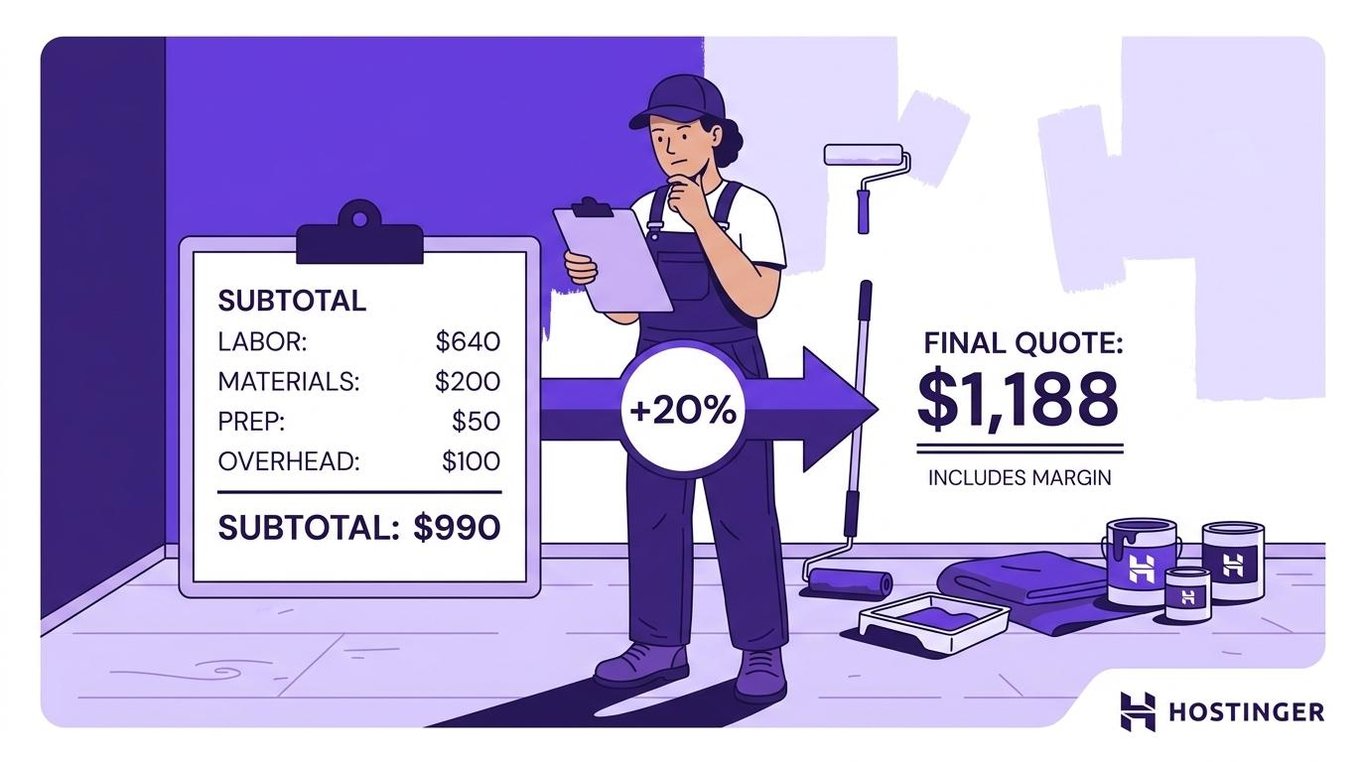
Let’s say a two-day interior job costs:
- $640 in labor – two 8-hour days at $40/hour.
- $200 in paint and materials.
- $50 in prep supplies.
- $100 in overhead.
Your total estimated cost is $990. Add a 20% markup ($990 × 1.20), and the quote becomes $1,188. The $198 difference is the profit included in the estimate.
Once you’ve calculated the quote, choose how you’ll charge the client:
- A flat project price tells the client the total cost upfront.
- Per-square-foot pricing works for simple, repeatable jobs.
- Hourly pricing works better for small or unpredictable jobs, although the final cost isn’t known upfront.
For larger jobs, a deposit can cover some upfront material costs. Check local contractor and consumer-protection laws first, as some states limit how much you can collect upfront.
Is a painting business profitable?
A painting business can be profitable when your quotes cover the full cost of each job, you finish jobs in the hours you estimated, you keep monthly bills low, and work comes in steadily. Underpricing, redoing work you got wrong the first time, and gaps between jobs all reduce profitability.
Pro Tip
Track the actual cost and profit after each job. If you regularly earn less than expected, improve your estimates or raise your prices. If you rarely win quotes, compare your offer and pricing with local competitors before lowering your rates.
6. Build your online presence
Build an online presence so local customers can find your painting business, check your previous work, and request a quote.
Start by building a small business website. Your site should quickly show what you paint, where you work, examples of completed jobs, and how to contact you. At a minimum, include:
- Your painting services and the areas you serve.
- Photos of completed projects, including before-and-after shots.
- A quote request form.
- Your contact details.
- Customer testimonials, once you have them.
Your website also needs a domain name, which is the web address people use to find your site. Choose one that matches your business name, such as yourpaintingbusiness.com.
You can create the site without coding using Hostinger AI Builder. Describe your painting business, then customize the generated site with your services, photos, and contact details.

Next, use a business email address for customer communication. Once you have a domain, you can create an address such as quotes@yourpaintingbusiness.com. This keeps business messages separate from your personal inbox and gives customers a clear, professional way to contact you.
Then, set up a Google Business Profile. This free profile can show your business in Google Search and Maps when people look for local services such as “painter near me.” Add your services, service area, hours, website, and photos of completed work.
After each job, ask satisfied customers to leave a Google review and send them a direct link to do so. Reviews show potential clients that other customers have hired you and were happy with your work.
Optimizing your Google Business Profile for local SEO helps Google understand your services and service area, which can improve your chances of appearing for relevant local searches.
Finally, use social media to show your work. Facebook and Instagram give you another place to share completed projects. Focus on strong before-and-after photos rather than posting just to keep the account active.
Pro Tip
Keep your business name, phone number, address, and website consistent across your website, Google Business Profile, and social accounts. Consistent details help Google recognize them as belonging to the same business and prevent customers from finding conflicting contact information.
7. Get your first painting clients
Get your first painting clients through local channels where homeowners, landlords, and property professionals already look for or recommend painters.
- Tell the people you already know. Start with friends, family, neighbors, and former coworkers. Let them know you’ve started a painting business and ask if they know anyone who needs work done. A personal recommendation gives potential clients a reason to consider you before you’ve built up many reviews.
- Go door-to-door in your target neighborhoods. A simple flyer with your name, phone number, and the services you offer is enough. Focus on areas where homes visibly need painting. Some cities require a permit for door-to-door soliciting, so check with your city clerk before you start.
- Check local online groups. Neighborhood Facebook groups and Nextdoor are useful places to find people asking for painter recommendations. Don’t just post ads. Answer questions about paint, prep, and color choices so people can see you know what you’re talking about.
- Use your Google Business Profile to attract local searches. Once your profile is set up, keep it updated with photos of completed projects and ask satisfied customers for reviews. This gives people searching for services like “painter near me” more proof to consider your business.
- Reach out to real estate agents, landlords, and property managers. They arrange painting work when preparing properties for new tenants or a sale. Introduce yourself, explain the areas and services you cover, and leave your contact details so they can reach you when a property needs painting.
Once those first jobs start coming in, use them to build trust with future clients. Take project photos with the client’s permission, ask satisfied customers for reviews and referrals, and ask whether you can leave a yard sign outside the property for a few weeks.
Referrals depend on delivering a good experience. Show up when promised, provide clear quotes, communicate throughout the job, and leave the property clean when you’re finished.

How hard is it to start a painting business?
Starting a painting business is manageable if you begin alone with simple residential jobs, but running it well takes both painting and business skills. Hiring employees or chasing commercial contracts from day one adds payroll, higher insurance, and written price quotes to a business you’re still learning to run.
The harder part is accurately estimating jobs, staying on schedule, communicating with clients, and ensuring each job actually earns money. An estimate that is too low can leave you with no profit, while booking jobs too close together can leave clients waiting when one project runs late.
Make the first few jobs easier to manage by keeping the scope simple. Before each job, write down your expected labor hours and material costs. Afterward, compare those estimates with what you actually spent and how long the work took. Use that information to improve the next quote. Run every payment through the business bank account, set aside part of each one for taxes, and keep enough cash on hand to buy paint before a client pays you.
Do the same with scheduling and customer acquisition. Leave some time between jobs in case one runs over, and ask each new customer how they found you. Over time, you’ll see which prices, schedules, and marketing channels are actually working for the business.
How to run your painting business more efficiently
Run your painting business more efficiently by simplifying recurring admin tasks and automating work that doesn’t need your full attention.
Once you have a steady flow of jobs, the quotes, emails, invoices, and follow-ups can start taking time away from painting and working with clients.
Start with the communication you send for most jobs. Create templates for estimate confirmations, quote follow-ups, job-date confirmations, and post-job review requests. You can also use email automation for your small business to send these recurring messages without writing each one from scratch.
Then review the other tasks you repeat every week, such as tracking receipts, preparing invoices, and creating marketing content. Start with the tasks that take the most time and look for ways to simplify or automate them.
As the workload grows, using AI for your small business can help with writing, customer communication, marketing, and other routine admin work, so you can spend more time on paid jobs.
This article is a localized version of How to start a painting business in 7 steps, originally published in English.

Alma is an AI Content Editor with 9+ years of experience helping ideas take shape across SEO, marketing, and content. She loves working with words, structure, and strategy to make content both useful and enjoyable to read. Off the clock, she can be found gaming, drawing, or diving into her latest D&D adventure.

Miglė Cicėnaitė-Jocė is a Product Manager for Hostinger's Website Builder. She is on a mission to redefine website creation, focusing on the AI flow and its features, and is always eager for product feedback and market insights to improve the user experience. Follow her on LinkedIn.