How AI became essential for website creation: Tools and challenges for 2026
May 20, 2026
/
Daniela C.
/
6 min Read
ChatGPT reached 700 million weekly active users by July 2025, with web development professionals making up a significant portion of active adopters. This represents the fastest technology adoption in history and may signal a permanent shift in how websites are built.
With 88% of organizations now regularly using AI in their operations and investment hitting $252.3 billion in 2024, AI has become essential infrastructure for website creation.
We present the latest adoption statistics, examine leading tools for 2026, and address the challenges organizations face when scaling AI implementation.
AI reaches mainstream adoption across businesses
The data shows that AI adoption accelerated significantly in 2024-2025, moving from novel experimentation to a built-in feature in essential platforms.
The widespread adoption of AI across business functions is significant:
- 41% of businesses use AI-powered tools for website creation, where AI website builders streamline the entire development process (Hostinger AI in Business).
- 70% of advanced AI adopters use AI for website creation, showing that for businesses with mature AI strategies, this is a necessity, not an option (Hostinger AI in Business).
- 55% of retail and ecommerce companies leverage AI website tools, which highlights that customer-facing industries are at the forefront of AI-powered website creation (Hostinger AI in Business).
- $252.3 billion was invested in AI in 2024, representing a 26% increase year-over-year, and signaling continued acceleration in enterprise AI spending (Stanford HAI).
Despite this rapid adoption, many organizations are still struggling to scale AI beyond initial tests and turn it into a consistent competitive advantage.
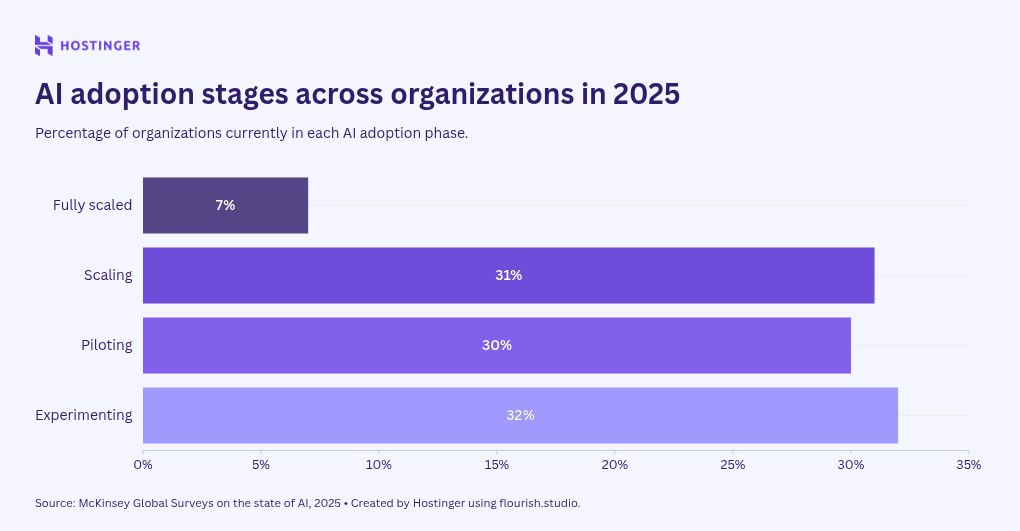
This gap highlights why successful implementation in 2026 will require redesigned workflows and deeper strategic commitment, moving beyond initial proofs of concept.
Organizations that make this shift gain benefits far beyond cost savings, especially in innovation and digital quality.
- 64% report AI has improved innovation. This is cited as the top organizational benefit, ahead of cost savings or revenue growth (McKinsey).
- 45% report improved employee satisfaction. AI enhances workplace experience and reduces repetitive tasks (McKinsey).
- 45% report improved customer satisfaction. AI benefits user experience and response times (McKinsey).
One of the most visible examples of this transformation is website creation. Tools like Hostinger AI Website Builder can generate complete, professional sites in minutes, illustrating how AI is becoming an embedded, reliable assistant for modern digital operations.
Expert tip
As we enter 2026, the winners won’t be those who’ve tested the most AI tools but those who’ve deeply integrated the right ones. For website creation, this means choosing a platform that automates technical tasks reliably so you can focus on what matters: your content, audience, and business goals. Master one AI website builder that supports simplicity and helps you iterate fast, rather than jumping to the next shiny tool.

AI tools shift from creation to core infrastructure
AI is moving from an optional add-on to a built-in feature. In 2026, hosting platforms and content management systems will include AI by default. The next evolution is agentic AI, where systems complete multi-step tasks independently rather than waiting for instructions at each step.
The data on integration and automation supports this shift:
- 20% of business leaders value chatbots and AI assistants, where tools are often integrated directly into website platforms for enhanced customer experience, demonstrating AI’s shift to core site infrastructure (Hostinger AI in Business).
- 23% of organizations are scaling agentic AI systems, representing the next evolution beyond simple automation (McKinsey).
- 39% are experimenting with AI agents, meaning that combined with scaling adopters, 62% of organizations explore autonomous AI capabilities (McKinsey).
This integration means websites will manage routine tasks autonomously, from content updates to performance optimization, moving beyond initial site creation to ongoing automated management.
The most popular AI tools to try in 2026
Popular AI tools in 2026 are shifting toward specialized platforms – from text generators to autonomous systems – that handle complex reasoning and multimodal output.
The following tools represent the cutting edge of accessible AI technology for website creators and marketers:
| AI tool | Company | Primary capability | Key feature | Website use case |
| Gemini 2 | Multimodal AI with computer control | Two times faster than Gemini 1.5, handles audio and image generation | Generate code or complex design iterations for a website | |
| Claude Computer Use | Anthropic | Autonomous computer operation | Completes tasks like file management and email writing independently | Automate file management or CRM responses linked to the website |
| Sora | OpenAI | Video generation | Creates 20-second 1080p videos from text prompts | Create background videos or high-quality hero video content |
| Nova Pro | Amazon | Document processing | Designed for document analysis and financial insights | Analyze website visitor surveys or financial data |
| Ministral 3B/8B | Mistral | Compact language models | Outperforms larger competitors like Gemma and LLaMA in efficiency | Generate meta descriptions, product descriptions, and microcopy efficiently |
| Jamba 1.5 | AI21 Labs | Hybrid text generation | Combines transformers and state-space tech for faster output | Create long-form website content like blog posts and landing pages quickly |
| Imagen 3 | Google Labs | Text-to-image generation | Highest-rated text-to-image model globally by user preference | Generate high-quality hero images, product photos, and visual content |
| Qwen2.5 | Alibaba | Specialized language models | Optimized for coding, math, and enterprise automation | Build custom website functionality and automate technical implementations |
| o3 | OpenAI | Advanced reasoning | Surpasses all prior models in coding, math, and reasoning benchmarks | Generate functional code snippets or solve complex logic problems |
| Apple Intelligence | Apple | Mobile AI suite | iPhone-integrated tools, including Genmoji and ChatGPT-backed Siri | Create and manage websites on mobile devices with voice commands |
Tools are now designed to integrate into specific workflows, allowing website creators to select the best-in-class option for design, content, or optimization rather than settling for a generalist tool.
Most widely adopted AI tools
AI adoption has expanded significantly, with organizations now using AI across diverse business functions, including 40% in knowledge management, 39% in marketing and sales, and 34% in IT.
The scale of adoption is evident in usage patterns, which website creators leverage for efficiency.
According to OpenAI, ChatGPT reached 700 million weekly active users by July 2025, representing approximately 10% of the world’s adult population.
This widespread adoption includes website professionals using AI tools for specialized tasks like writing copy, generating meta descriptions, and coding.
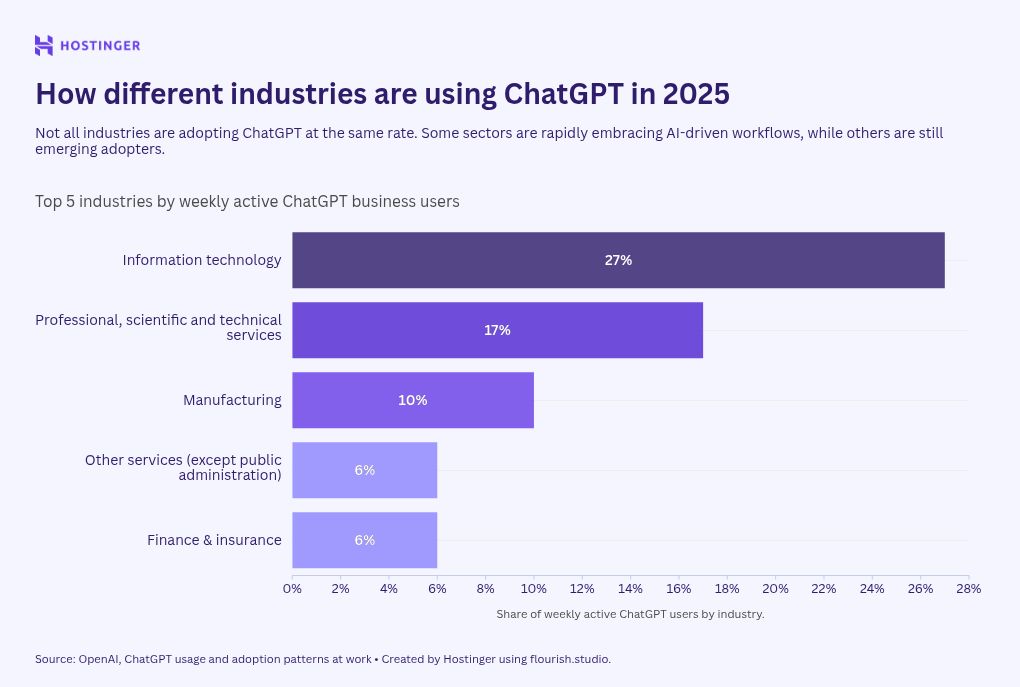
- 27% of US ChatGPT business users work in information technology, leading all industries (OpenAI).
- 17% work in professional, scientific, and technical services, which is the second-highest adoption (OpenAI).
- 10% work in manufacturing, showing AI’s spread beyond tech sectors (OpenAI).
For a broader overview of the top-performing AI tools shaping today’s workforce:
- ChatGPT. Widely adopted for business communication and general-purpose AI tasks across industries.
- Microsoft Copilot. Integrated into productivity suites for office automation and workflow enhancement.
- Gemini. Gaining traction in enterprise environments with its multimodal capabilities and one-million-token context window (McKinsey).
- Claude. Recognized for complex reasoning tasks, document analysis, and enterprise applications requiring deep contextual understanding.
- Midjourney. Preferred by creative professionals for image generation and visual content creation.
- DALL-E. Standard tool for marketing and advertising teams needing AI-generated imagery.
Specialization will only continue to accelerate, as developers favor coding assistants, marketers prioritize content generation, and customer support teams implement conversational AI.
Expert tip
As you plan your 2026 strategy, don’t try to master every AI tool at once. Start the new year with one tool that addresses your biggest bottleneck, whether that’s content creation, design, or website building. Once you see measurable results, gradually add complementary tools. The most productive organizations build focused toolkits rather than collecting every new release.

The accessibility and trust challenges around AI tools
The most successful AI tools for website creation in 2026 must balance accessibility and reliability, distinguishing proven platforms from experimental ones.
The core criteria for an effective AI tool are driven by real-world organizational needs:
- Ease of use. 43% of business leaders cite a lack of AI expertise as the biggest implementation challenge, meaning intuitive, no-code interfaces are critical for faster adoption (Hostinger AI Statistics).
- Data privacy protections. Transparency is essential, as 29% of business leaders express concerns about data privacy and security risks (Hostinger AI in Business).
- Consistent quality. Reliability is key, with 54% of organizations working to mitigate AI inaccuracy risks, the most addressed concern (McKinsey).
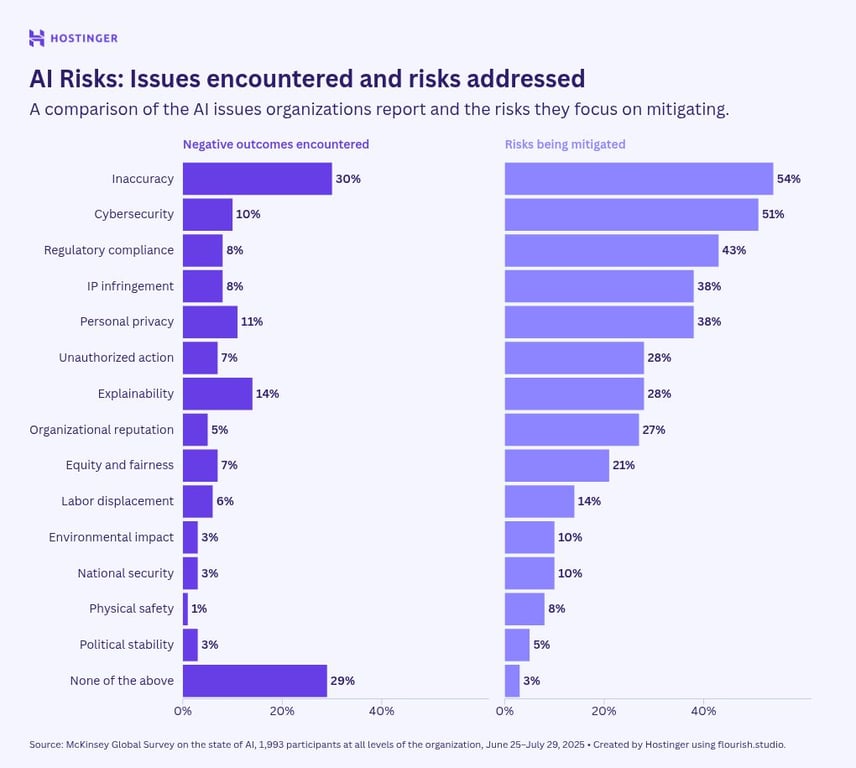
These issues drive the focus on trust. According to McKinsey’s report, 71% of organizations experienced at least one negative consequence from AI use, with 30% encountering inaccuracy problems.
For website creation, trustworthiness means the AI should be able to generate functional code, suggest content matching the brand voice, and create designs that work across all devices.
The tools that succeed are those that combine ease of use with proven reliability. This balance is essential for understanding how to use AI for websites effectively, ensuring creators can build professional sites without sacrificing quality or control.
Risks and realities: Where “AI ease” still has limits
While AI tools delivered impressive results throughout 2025, they work best when combined with human oversight for strategic and quality control. Accessibility alone does not guarantee successful implementation, as shown by common practical challenges.
- 51% of organizations experienced at least one negative consequence from AI, highlighting the inherent risks of integrating new technology (McKinsey).
- 30% encountered inaccuracy issues, cited as the most common problem associated with AI use. For website creators, inaccuracy means broken layouts, off-brand content, or non-functional code, which is why 54% are now working to mitigate these risks. (McKinsey).
- 38% struggle with integrating AI tools into existing systems, as technical compatibility issues remain common, often seen when trying to connect specialized AI tools with an existing Content Management System (CMS) or web hosting platform. (Hostinger AI in Business)
- 34% experience data quality and availability issues, suggesting that AI output quality depends directly on input quality provided by the website creator (Hostinger AI in Business).
These challenges underscore why strategic implementation and human judgment are necessary to deliver reliable results, even with the most intuitive tools. The goal is to work within AI limitations by using its strengths while recognizing where human expertise adds irreplaceable value.
The most effective workflows combine human judgment with AI efficiency:
| Good for AI | Requires human input | Best combined |
| First drafts | Final content review | Content creation |
| Brainstorming | Brand voice refinement | Design iteration |
| Repetitive tasks | Strategic decisions | Code generation |
| Optimization suggestions | Fact verification | Customer support |
Beyond 2026: Toward AI-native websites
The trajectory of AI development points toward websites that will eventually manage themselves with minimal human intervention.
This shift to AI-native websites will be a gradual process where agentic AI systems handle routine optimization, content updates, and performance monitoring, allowing humans to focus on strategy, creativity, and audience understanding.
Organizations that will see the greatest AI value in 2026 and beyond share common characteristics of high performers:
- Transformative change. AI high performers are 3.6 times more likely to pursue transformative change rather than incremental improvements (McKinsey)
- Workflow redesign. 55% of high performers redesigned workflows throughout 2025, compared to 20% of other organizations (McKinsey)
- Investment. 35% of high performers divide 20% or more of their digital budgets to AI, compared to only 7% of other organizations (McKinsey)
These high-level investments and focus on transformative change signal a future where AI will be a core, self-managing infrastructure layer.
The question for 2026 isn’t whether to use AI, but how to use it thoughtfully. Choose accessible tools from credible providers, but keep what only humans can provide: strategic vision, creative judgment, and authentic connection with your audience.
All of the tutorial content on this website is subject to Hostinger's rigorous editorial standards and values.

Daniela is an Off-Site SEO Specialist with extensive expertise in link building, digital PR, and content optimization. She has led international outreach campaigns across the U.S., Brazil, France, and Spain, securing high-quality backlinks. Follow her on LinkedIn.