7 best domain registrars in 2026 (Tested for pricing, renewal fees & privacy)
May 13, 2026
/
Klaudijus J.
/
14 min Read

In 2026, the best domain registrars are the ones that combine transparent renewal pricing, free WHOIS privacy, ICANN accreditation, reliable DNS tools, and simple domain management. The right registrar depends on how you plan to use your domain:
- Cloudflare – best for at-cost pricing, DNS security, and long-term renewals.
- Porkbun – best for affordable domains, free WHOIS privacy, and beginner-friendly domain management.
- Namecheap – best for beginners who want low prices, broad TLD support, and a simple dashboard.
- NameSilo – best for bulk domain buyers and portfolio management.
- Hostinger – best for users who want domain registration bundled with web hosting, email, and website tools.
We compared each registrar’s first-year .com price, renewal fee, WHOIS privacy policy, supported top-level domains, ICANN accreditation, DNS features, and dashboard usability to identify the best options for different domain-buying needs.
Best domain registrars compared
This domain registrar price comparison shows the first-year .com price, renewal cost, WHOIS privacy availability, and best use case for each provider. Prices apply to standard, non-premium .com domains and were checked before publishing. Domain prices and promotions change often, so verify the final checkout price before updating the article.
| Registrar | First-year .com | Renewal .com | Free WHOIS privacy | Best for |
|---|---|---|---|---|
| Cloudflare | $10.44 | $10.44 | Yes | At-cost pricing, DNS security, and long-term renewals |
| Porkbun | $9.73 | $9.73 | Yes | Flat pricing with no renewal surprises |
| Namecheap | $9.58 | $13.98 | Yes | Beginners, broad TLD support, and simple management |
| NameSilo | $17.29 | $17.29 | Yes | Bulk domain buyers and low-upsell management |
| IONOS | $1.00 promo / $10.00 regular | $20.00 | Free for individuals; paid for businesses | Promotional first-year pricing and hosting bundles |
| Hostinger | $2.99 with hosting | $19.99 | Yes | Domains bundled with hosting, email, and website tools |
| GoDaddy | $11.99 / promos from $0.01 | $21.99 | Yes | Marketplace, brand familiarity, and auctions |
Cloudflare and Porkbun are the strongest options for predictable long-term .com renewal prices because their first-year and renewal prices stay the same. Cloudflare is a good fit for users who prioritize at-cost pricing and DNS security, while Porkbun is better for users who want a simple registrar with flat pricing and free WHOIS privacy.
Namecheap works well for beginners because it combines a low first-year .com price, free WHOIS privacy, broad top-level domain support, and simple domain management. NameSilo is better for bulk domain buyers because its pricing is straightforward, and its interface focuses on domain management rather than frequent upsells.
IONOS, Hostinger, and GoDaddy are more situational. IONOS and Hostinger are useful when the domain is included in a hosting bundle or during a first-year promotion. GoDaddy is more relevant for users who want access to a large marketplace, auctions, and a familiar registrar brand, but its renewal cost is higher than most alternatives in this comparison.
All registrars on this list are ICANN-accredited or operate through ICANN-accredited registration services. ICANN accreditation means a registrar is authorized to register domain names under global domain registration rules. This matters because accredited registrars must follow registration, transfer, and ownership requirements that help protect domain owners.
Below, we explain where each registrar performs best, what its renewal pricing looks like, and which type of user should choose it.
1. Hostinger
- Best for: domain registration bundled with web hosting, email, and website tools
- Price for .com: $2.99 with eligible hosting plans
- Renewal cost: around $19.99/year for .com domains, depending on terms and promotions
- Free WHOIS privacy: included on eligible domain registrations
- ICANN accredited: Yes
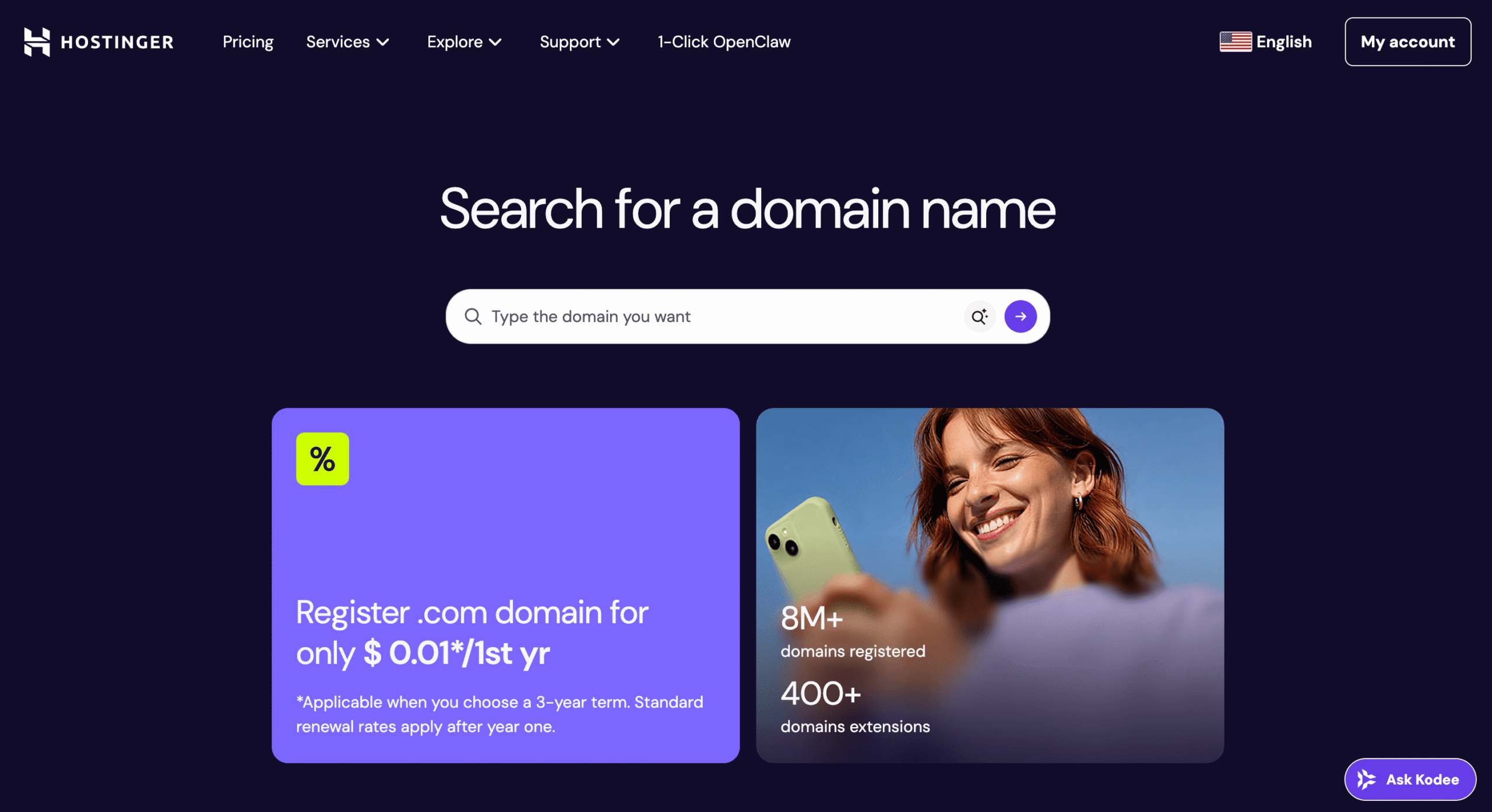
Hostinger is best for users who want to register a domain and build a website from the same dashboard. It is an ICANN-accredited domain registrar that combines domain registration, web hosting, email, SSL, and website-building tools in one platform, making it a practical choice for beginners, small businesses, and website owners who prefer an all-in-one setup.
Hostinger is not the cheapest long-term registrar for standalone domain renewals. Cloudflare and Porkbun offer lower or flatter .com renewal pricing, so they are better choices if you only need a domain registrar. Hostinger makes more sense when the domain is part of a larger website setup, especially if you also need hosting, business email, a website builder, or WordPress tools.
What sets Hostinger apart is the connection between domain registration and website management. After registering a domain, users can connect it to hosting, configure DNS records, create email addresses, install WordPress, or launch a website from the same account. This reduces the need to manage domains, hosting, and DNS settings across separate platforms.
Hostinger also includes an AI-powered domain name search tool. Instead of showing only available names, the tool suggests brandable, niche-specific domain ideas based on the user’s input. This helps users find relevant alternatives when their preferred .com domain is already taken.
WHOIS privacy is included with eligible domain registrations, helping hide personal contact details from public WHOIS databases. This reduces exposure to spam, phishing attempts, and unsolicited outreach. For individuals and small businesses, included privacy protection is an important security feature because some registrars charge extra for it.
Hostinger is a strong option if you want to launch a full web presence from a single platform. Its hosting plans often include a free domain for the first year, plus email, SSL, and website-building tools. For users who prioritize the lowest possible renewal price, Cloudflare or Porkbun is a stronger registrar-only choice. For users who want domain registration and hosting in one workflow, Hostinger is the better fit.
Hostinger’s key features
- ICANN accreditation – Hostinger is an accredited domain registrar, meaning it can register domains directly and comply with global domain registration requirements.
- AI-powered domain search – The domain search tool suggests creative and brandable domain names based on the user’s project, niche, or business idea.
- Free WHOIS privacy protection – Eligible domains include WHOIS privacy to help protect personal information from public domain databases.
- Domain and hosting integration – Users can manage domains, hosting, email, SSL, DNS records, and website tools from one dashboard.
- Affordable domain transfers – Hostinger supports domain transfers and lets users consolidate domains into one account.
- Bulk domain search – Users can check multiple domain names at once, which helps businesses and brand owners compare domain options faster.
- Multi-year registration support – Users can register domains for multiple years to reduce renewal management and secure long-term ownership.
- DNS management – Hostinger lets users configure A, MX, CNAME, TXT, and other DNS records from the control panel.
- 24/7 customer support – Users can contact support at any time and use Hostinger tutorials or knowledge base resources for setup help.
Domain Name Checker
Instantly check domain name availability.
2. Namecheap
- Best for: beginners, freelancers, and small businesses that want low first-year pricing, free WHOIS privacy, and simple domain management
- First-year .com price: $9.58, checked before publishing
- Renewal .com price: $13.98/year, checked before publishing
- Free WHOIS privacy: Yes
- TLD count: 1,500+ TLDs supported
- ICANN accredited: Yes
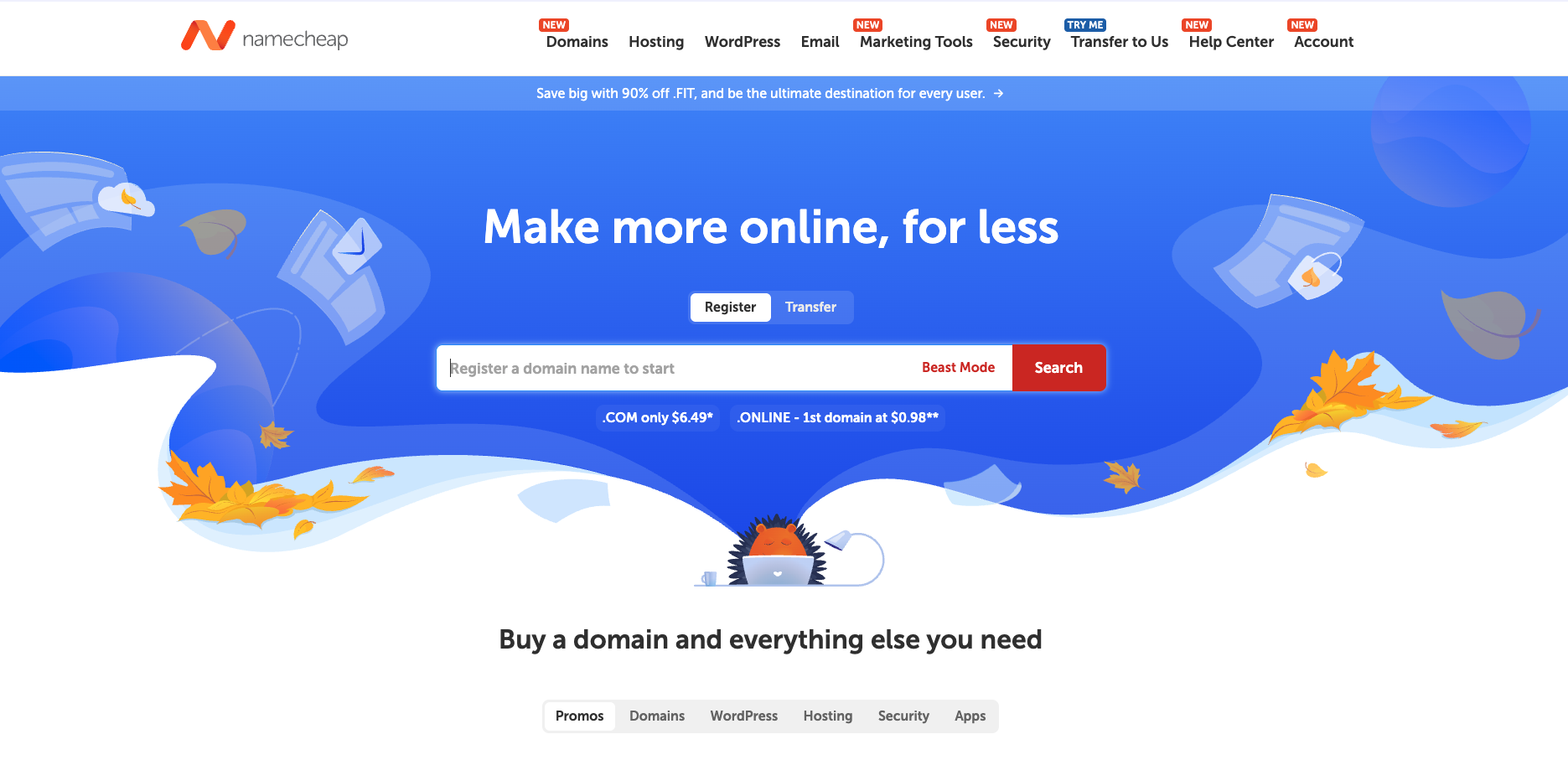
Namecheap is a strong domain registrar for beginners, freelancers, and small businesses that want low first-year .com pricing, free WHOIS privacy, broad TLD support, and a simple dashboard. Its renewal price is higher than its first-year price, so it is less predictable than flat-pricing registrars like Cloudflare and Porkbun, but it remains a practical option for users who want affordable domain registration with beginner-friendly management tools.
When you register a domain, Namecheap includes free lifetime WHOIS privacy protection on eligible domains. In addition to domain registration, Namecheap offers add-on services to help you get started with your website, including shared hosting, WordPress hosting, domain name system (DNS) hosting, and SSL certificates for HTTPS.
Namecheap also supports Handshake domains, alternative TLDs registered on a blockchain‑based system, offering access to unique extensions beyond the standard .com/.net/.org options.
Namecheap’s domain transfer pricing is generally transparent, but the exact cost varies by TLD. For example, the transfer price listed for .com domains may start around $11.48 and includes free lifetime domain privacy on eligible domains.
While Namecheap’s 24/7 live chat support is available, user reviews note a range of experiences with response times and renewal processes.
Namecheap’s key features:
- ICANN accreditation – Namecheap is an accredited domain registrar, ensuring compliant and reliable domain registrations worldwide.
- Extensive TLD selection – Offers a wide range of domain extensions, including popular, niche, and country‑specific TLDs to match diverse branding needs.
- Free WHOIS privacy protection – Eligible domains include free WhoisGuard privacy, protecting your personal data from public WHOIS exposure.
- Domain bidding – Users can bid on registered or premium domain names via auctions in Namecheap’s marketplace.
- Bulk domain search – Search up to 5,000 keywords or domain names simultaneously using Namecheap’s bulk domain tool.
- Domain Vault – advanced domain protection – Protects valuable domains with registry locking, DNS change monitoring, and an enhanced support team.
3. Porkbun
- Best for: affordable domains, flat renewal pricing, free WHOIS privacy, and niche domain extensions
- First-year .com price: $9.73, checked before publishing
- Renewal .com price: $9.73/year, checked before publishing
- Free WHOIS privacy: Yes
- TLD count: 500+ TLDs supported
- ICANN accredited: Yes
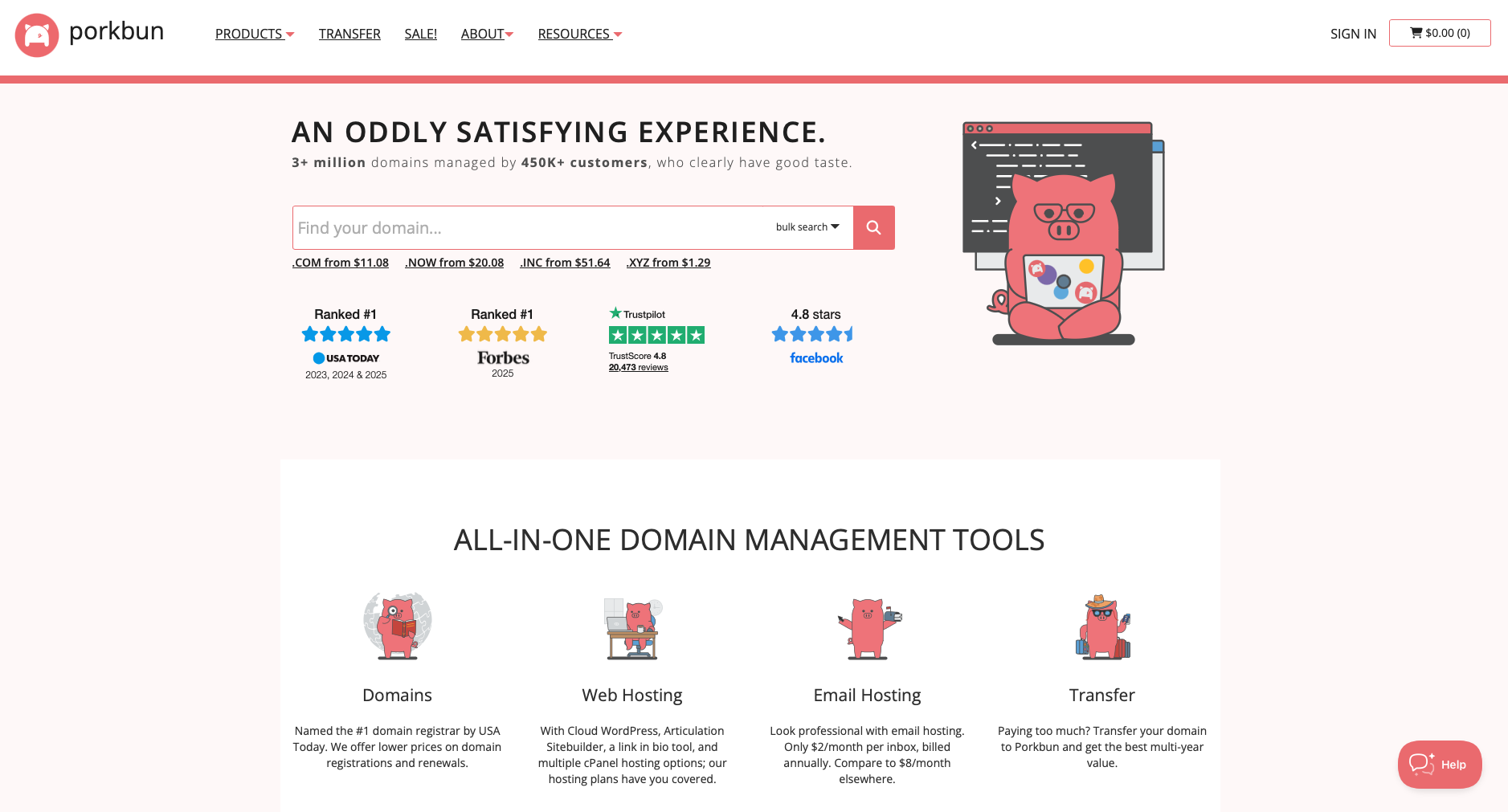
Porkbun is one of the best domain registrars to shop for unique domain name extensions. Choose from over 550 TLDs with ease using bulk and AI search. Users looking for more options can browse the marketplace and auctions by third-party sellers.
Domain name registrations come with free domain privacy, SSL certificates, and trials for web hosting, website builder, and email hosting.
Porkbun also offers web hosting (shared cPanel, Easy WordPress, link‑in‑bio tools) that can be bundled with your domain. While the pricing remains competitive for entry use, some specs (like storage and scalability) suggest these plans are more budget‑oriented rather than enterprise‑grade.
Domain transfers cost the same as registration for many TLDs — for instance, some .com transfers list around $10.37 and include the standard renewal rate for that extension. However, Porkbun doesn’t provide refunds for both domain registrations and renewals.
Free domain forwarding is available for users who host their websites on another platform. It supports 301 Moved Permanently, 302 Found, and 307 Temporary redirects, minimizing the impact on your site’s search engine optimization (SEO) performance.
Porkbun’s key features:
- ICANN accreditation – Porkbun is a fully accredited registrar offering secure and compliant domain services globally.
- Free WHOIS privacy – Automatically included with eligible domain registrations to protect your personal information.
- Free SSL certificate – Basic SSL included with domains to support secure HTTPS setup.
- Built-in email & URL forwarding – Redirect domains and create forwarding emails at no extra cost.
- DNS management tools – Easy-to-use dashboard to manage DNS records like A, MX, CNAME, and TXT.
- Hosting and web services available – Shared hosting, WordPress hosting, and site builders can be bundled with domain purchases.
4. GoDaddy
- Best for: marketplace access, domain auctions, brand familiarity, and promotional first-year pricing
- First-year .com price: $11.99, with promos from $0.01, checked before publishing
- Renewal .com price: $21.99/year, checked before publishing
- Free WHOIS privacy: Yes
- TLD count: 500+ TLDs supported
- ICANN accredited: Yes
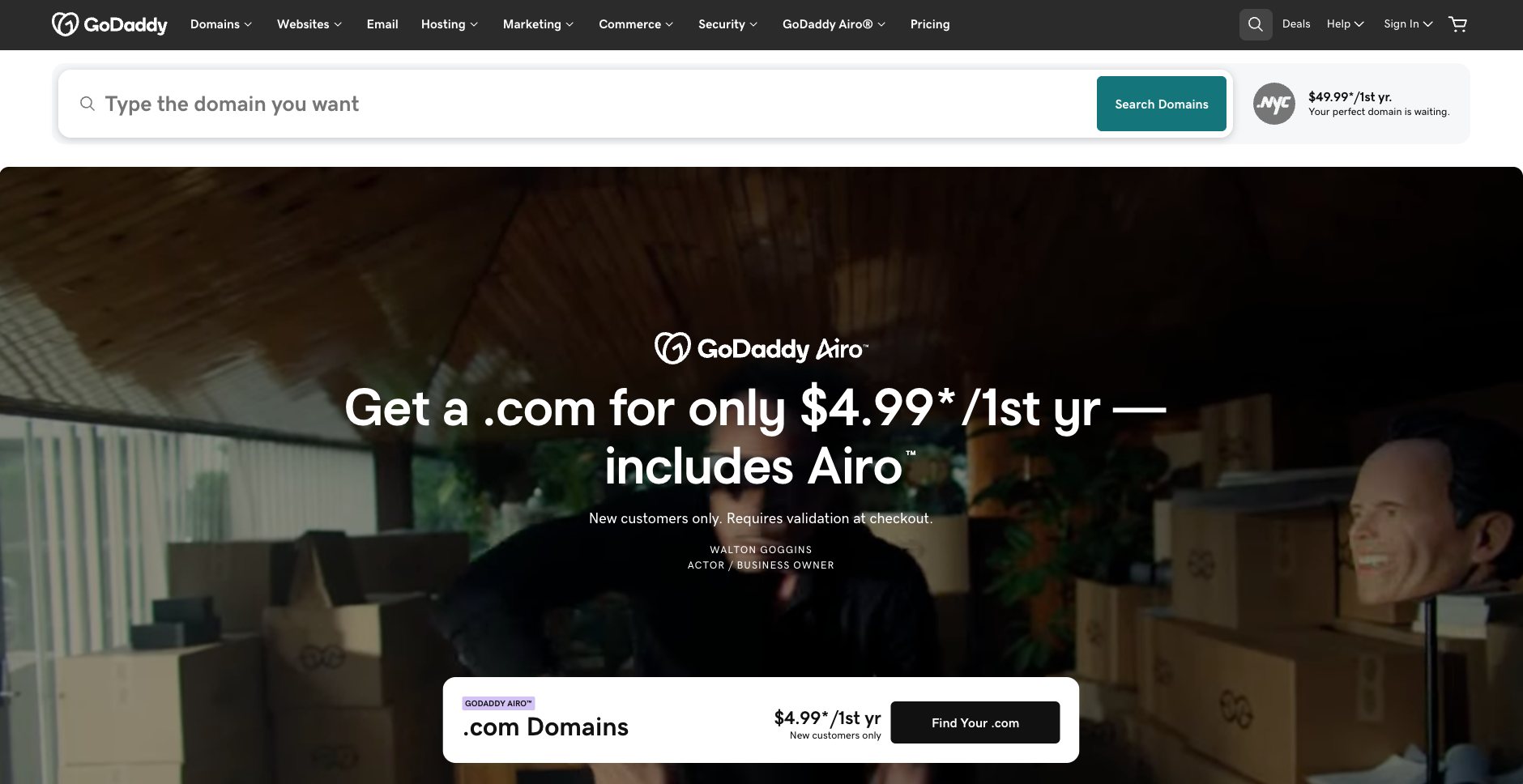
GoDaddy is the cheapest domain registrar on this list, offering .com domains for as low as $0.01 in the first year for a three-year registration. Moreover, domain bundles for up to four extensions can get you discounted first-year prices. Renewal prices are available on GoDaddy’s pricing page, though they are higher than first-year rates.
GoDaddy equips its domain name checker with features like filters, favorites, and history, allowing users to save and revisit domain listings they’re interested in.
Like many hosting providers, GoDaddy bundles its web hosting plans with free domain registration. Starting at $6.99/month, select plans also include one year of SSL certificates, Microsoft 365 mailboxes, DDoS protection, and daily backups.
GoDaddy simplifies domain actions and parking for users seeking profitable side hustles. Use the domain appraisal tool to gauge your domains’ current values.
Users with a large portfolio of domain names can join the Discount Domain Club for deals on registrations, renewals, and transfers. They also get access to better prices when using other domain-related features like CashParking and Auctions.
GoDaddy’s key features:
- ICANN accreditation – Officially recognized registrar managing tens of millions of domains globally.
- Over 500 domain extensions – Wide selection of TLDs, including standard, geo, and industry-specific options.
- AI-powered domain search – Suggests available domain names based on keywords and user preferences.
- Free WHOIS privacy – Included with eligible domain extensions to protect your contact information.
- Domain investment tools ‒ GoDaddy offers broker services, a domain appraisal tool, and the Discount Domain Club membership to help you build your portfolio and make money with domains.
- CashParking program – Monetize unused domains through ad-generated revenue.
- Domain auctions ‒ buy or sell domain names for your online business needs or hustles.
5. Cloudflare
- Best for: at-cost pricing, DNS security, and predictable long-term renewals
- First-year .com price: $10.44, checked before publishing
- Renewal .com price: $10.44/year, checked before publishing
- Free WHOIS privacy: Yes
- TLD count: 390+ TLDs supported
- ICANN accredited: Yes6.99/year
- Free WHOIS Privacy: Yes
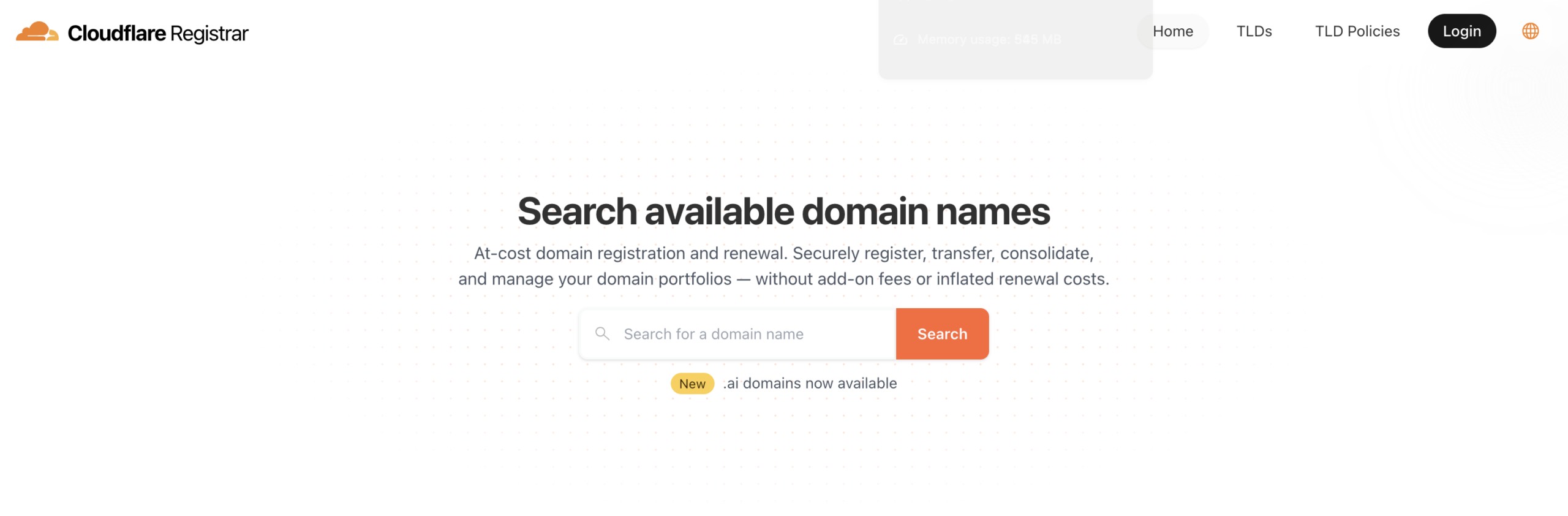
Cloudflare is the best domain registrar for users who want transparent, at-cost pricing with no renewal markup. Unlike registrars that offer low promotional prices in the first year and increase the cost at renewal, Cloudflare charges the same registry-based price for domain registration and renewal. This makes it a strong choice for long-term domain ownership, especially if you manage multiple domains or want to avoid renewal-price surprises.
Cloudflare also stands out for domain security. Its registrar service integrates with Cloudflare DNS, DNSSEC, CDN, SSL, and other security tools, helping users manage domain performance and protection from a single platform. Cloudflare also provides free WHOIS redaction to protect personal contact details from public WHOIS databases.
The main limitation is that Cloudflare is less beginner-focused than registrars like Porkbun or Namecheap. It is best suited for users who already understand DNS settings or want to manage domains inside the Cloudflare ecosystem. If you want a simple domain-only dashboard with fewer technical settings, Porkbun or Namecheap may feel easier to use. If you want domain registration bundled with hosting and website tools, Hostinger is a better fit.
Cloudflare’s key features
- At-cost domain pricing – Cloudflare charges registry and ICANN fees without adding a registrar markup, which keeps renewal pricing predictable.
- Flat .com renewal pricing – The
.comfirst-year and renewal prices are the same, making Cloudflare one of the strongest options for long-term domain ownership. - Free WHOIS redaction – Cloudflare includes WHOIS privacy protection to help protect personal contact details from spam and public exposure.
- 390+ supported TLDs – Cloudflare supports more than 390 top-level domains, including common extensions like
.com,.net, and.org. - Built-in DNS security – Cloudflare includes DNS management, free DNSSEC, SSL, and CDN features for stronger domain and website protection.
- Domain transfer support – Users can transfer existing domains to Cloudflare and manage renewals from the Cloudflare dashboard.
- Best for technical users – Cloudflare works especially well for developers, security-focused users, and domain owners who already use Cloudflare DNS or CDN.
6. IONOS
- Best for: promotional first-year pricing, simple domain registration, and hosting bundles
- First-year .com price: $1.00 promo / $10.00 regular, checked before publishing
- Renewal .com price: $20.00/year, checked before publishing
- Free WHOIS privacy: Free for individuals; paid for businesses
- TLD count: 700+ TLDs supported
- ICANN accredited: Yes
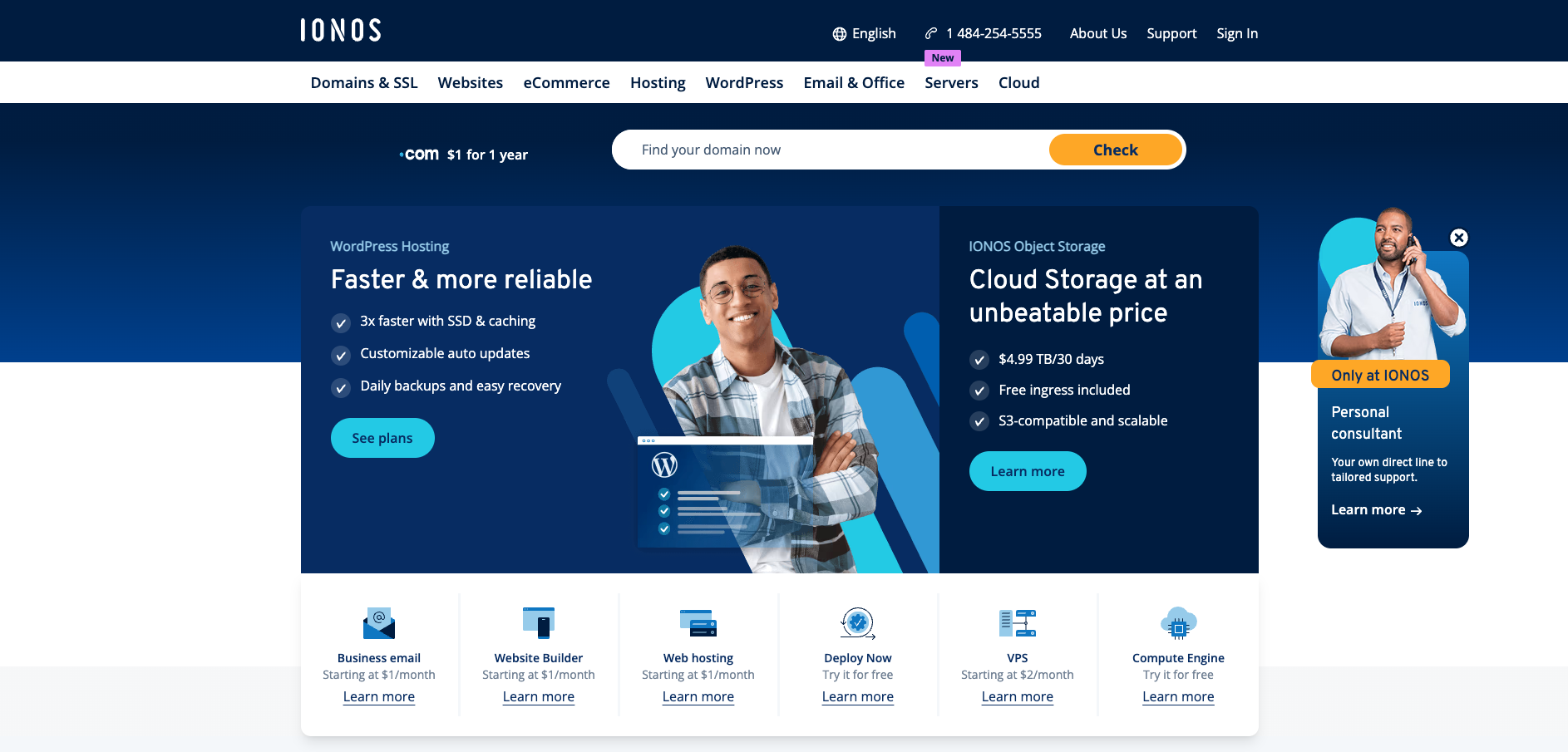
IONOS is a web hosting provider that also offers domain registration services. Many of its hosting plans include a free domain for the first year, a Wildcard SSL certificate, and other essential tools at a low introductory price. While pricing starts around $1/month for some hosting tiers, features like automated backups or email hosting may be offered as paid add-ons depending on the plan.
During checkout, you’ll select your domain and may encounter upsells for additional services. It’s a good idea to check domain availability in advance using IONOS’s domain checker, which also provides AI-generated suggestions to help with name selection.
Promotional pricing for .com domains often starts at around $1 for the first year, but renewals typically rise to $20 or more annually. Some domain packages may include added features like SSL or domain privacy, but email hosting and other services are generally billed separately.
Domain transfers to IONOS are free of charge, though you’ll need to pay for one additional year of registration, which is then added to your existing term.
IONOS’ key features:
- ICANN accreditation – IONOS is a recognized domain registrar under the guidelines of global domain authorities.
- Bundled hosting + domain plans – Many hosting packages include a free domain for the first year and a Wildcard SSL certificate.
- Free domain transfer – Migrate your domain to IONOS without paying a transfer fee; a 1-year renewal is required.
- Custom email hosting – Add email plans starting at 2 GB storage with built-in spam and virus protection.
- DNS management tools – Update A, MX, TXT, and CNAME records via a user dashboard.
- Basic privacy protection – WHOIS masking included with many eligible domains.
- Bulk domain search ‒ check up to 100 domains simultaneously.
7. NameSilo
- Best for: bulk domain buyers, portfolio management, straightforward pricing, and low-upsell domain registration
- First-year .com price: $17.29, checked before publishing
- Renewal .com price: $17.29/year, checked before publishing
- Free WHOIS privacy: Yes
- TLD count: 400+ TLDs supported
- ICANN accredited: Yes
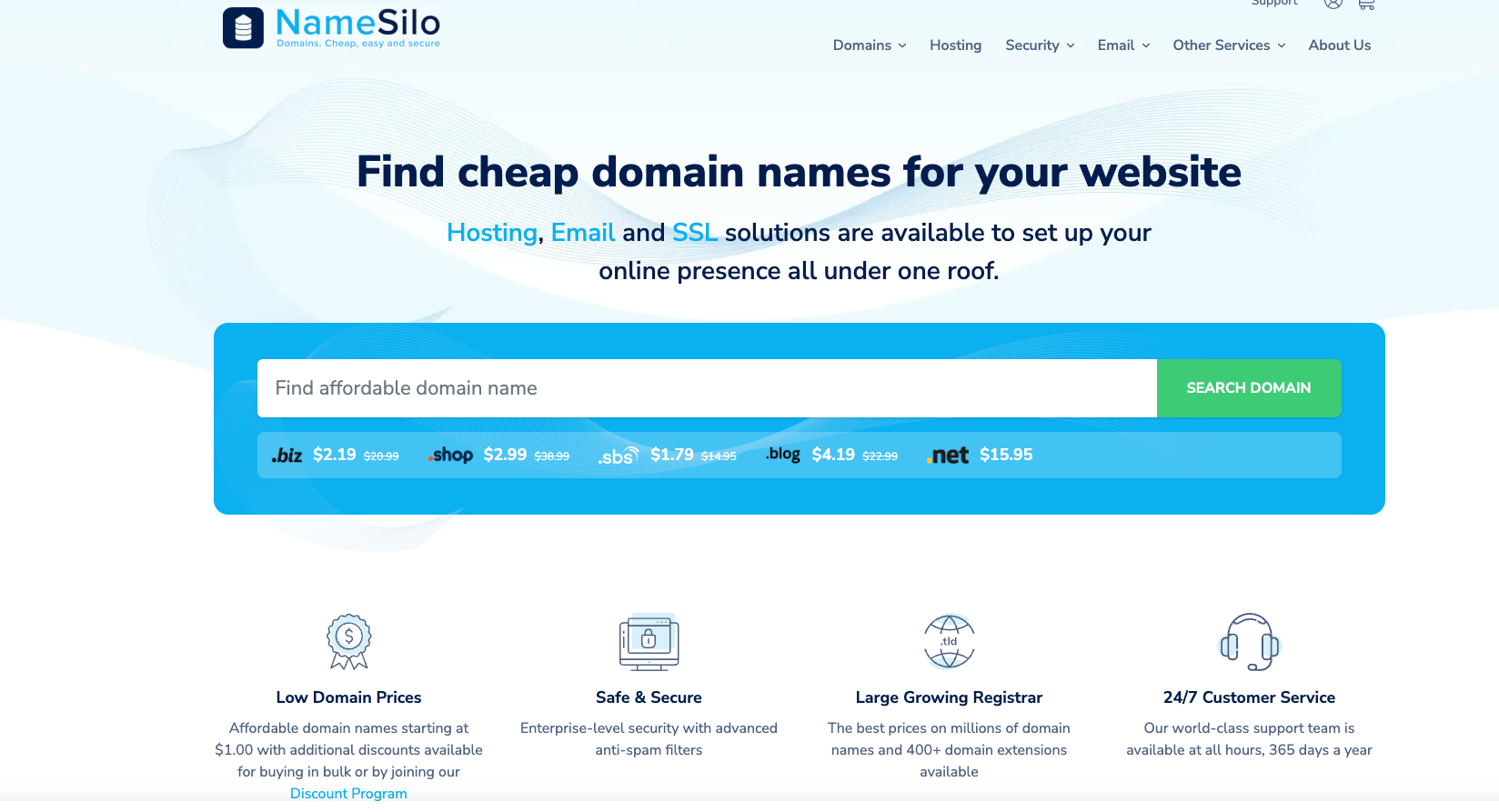
NameSilo is one of the top domain registrars for bulk domain shopping. Large registration orders and Discount Program participants can get discounts on renewal. The bulk configuration mode simplifies domain purchases, allowing users to set the term duration and activate auto-renewal during checkout.
The marketplace manager lets you buy and sell premium and expired domains with a 7.5% commission fee with no minimums and listing fees. It also provides statistics, free parking, and landing solutions to maintain multiple domains. You can backorder expiring domains via NameSilo’s back‑order service.
Register new .com domains at around $17/year. Domain registration includes free domain protection and email forwarding.
Users must create an account to check out, but this also allows them to link their domain to a third-party service and change domain nameservers to save time.
Domain transfers for .com extensions cost $10.95, which includes a one-year extension of the expiry date. NameSilo also allows bulk domain transfers for up to 500 domains via TXT or CSV file importing.
NameSilo’s web hosting options come with a free website builder, emails, and SSL certificates at $2.99/month. However, they don’t include free domain registrations.
NameSilo’s key features:
- ICANN accreditation – Fully accredited domain registrar known for competitive pricing and investor-friendly features.
- Bulk domain management – Register, renew, and configure up to 500 domains at once using TXT or CSV imports.
- Domain marketplace access – List and sell domains with zero listing fees and a flat 7.5% commission.
- Backorder support – Use NameSilo’s internal system or Catch.club to place backorders on expiring domains.
- Free email forwarding – Route emails to another address without setting up a full mailbox.
- DNS management tools – Modify records easily using an intuitive dashboard.
Best GoDaddy alternatives for lower renewal fees
The best GoDaddy alternatives for lower renewal fees are Cloudflare, Porkbun, Namecheap, and NameSilo. These registrars either keep .com renewal prices flat or include WHOIS privacy for free, which helps reduce the long-term cost of owning a domain.
| GoDaddy alternative | Why it’s cheaper long-term | Best for |
|---|---|---|
| Cloudflare | At-cost .com pricing with the same first-year and renewal price | Users who want the lowest long-term renewal markup |
| Porkbun | Flat .com pricing and free WHOIS privacy | Users who want simple pricing with no renewal surprises |
| Namecheap | Lower renewal cost than GoDaddy and free WHOIS privacy | Beginners who want affordable domain management |
| NameSilo | Straightforward pricing and fewer upsells | Bulk domain buyers and portfolio owners |
| Hostinger | Useful when the domain is bundled with hosting, email, and website tools | Users building a full website from one platform |
GoDaddy is useful for users who want a large domain marketplace, auctions, and a familiar registrar brand. However, its renewal pricing is higher than several alternatives, especially for users who manage multiple domains or want free WHOIS privacy included by default.
Choose Cloudflare or Porkbun if renewal cost is your main priority. Choose Namecheap if you want a beginner-friendly dashboard with broad TLD support. Choose NameSilo if you manage domains in bulk. Choose Hostinger if you want to register a domain as part of a hosting or website-building package.
How to choose the best domain registrar?
With so many options available, choosing the right domain registrar can be challenging. Consider the following factors to narrow them down.
Registration period
The registration period is the period during which you can own your domain name before it must be renewed. Most domain registrars offer options ranging from one to ten years.
A longer registration period is beneficial for those with a clear long-term plan for their website. It provides security and reduces the need for frequent renewals. On the other hand, a shorter period is more suitable for experimental projects due to its flexibility and lower upfront costs.
Always check whether the registrar offers discounts for longer registration periods and if there are any restrictions on your chosen domain extension. The ideal domain registrar should align with your website’s goals and budget.
Domain transfers
Pick a domain registrar with flexible transfer policies to maintain control over your domain. For instance, check whether your registrar enforces lock-in periods that restrict domain transfers too soon after registration or renewal.
The transfer process itself should be easy, with a straightforward user interface and accessible customer support. If you plan to register multiple domains, opt for a registrar that allows bulk transfers. Consider the transfer duration as well, as it varies between registrars.
Value for money
It can be tempting to go with the cheapest domain registrar. However, getting the necessary features and support can actually save you money and time in the long run.
For example, many domain registrars have low introductory rates for the first year but higher renewal fees. The lack of transparency for paid add-on services – such as WHOIS protection and domain forwarding – is also common, even among top domain registrars.
Besides the cost, evaluate the range of services offered. A reputable domain registrar may charge more for excellent customer support, robust security options, easy-to-use management tools, and extra services like web hosting and a website builder.
Extensions
A domain registrar offering multiple extensions can give you more alternative domains when popular ones like .com and .net are unavailable.
It’s also an opportunity to get creative with your domain name. Consider unique domain extensions to make your site stand out among competitors.
Additionally, having a broad selection lets you compare and choose an extension that fits your budget and brand identity. Note that different extensions have varying prices and renewal fees.
Ease of use
An easy-to-use domain registrar can save you time and effort. Look for a registrar with a clean layout, user-friendly search tools for finding domain names, and a hassle-free registration process.
The domain management should also be simple. The ideal domain registrar should make updating DNS records, configuring email addresses, renewing the domain, and setting up privacy features easy.
Customer support
Having access to knowledgeable and responsive customer support from your domain registrar can help quickly resolve domain-related issues. It’s especially important if you’re not confident in your troubleshooting skills or are new to domain management and website building.
Effective customer support can guide you through configuring DNS settings, updating records, and minimizing troubleshooting connectivity problems. All these tasks can help minimize your website’s downtime.
Check out our tutorial to learn more about monitoring website uptime and downtime and the role DNS plays in it.
Renewal process
A good registrar will send out reminders to prevent your domain from expiring. Enable the auto-renewal option and keep your payment information up-to-date to avoid ownership lapses.
Additionally, check the registrar’s policies for expired domains, including grace periods and redemption fees. Ensure your chosen platform offers flexibility and protection for your domain in the long term.
Next steps: Registering your domain with confidence
Choosing a domain registrar isn’t just about getting a good price — it’s about securing the foundation of your online identity. Once you’ve compared features like pricing, renewals, extensions, and ease of management, the next step is to register your domain and start building your online presence.
Make sure you finalize your domain name, check availability across relevant extensions, and decide whether you’ll bundle it with web hosting or manage it separately. Enable privacy protection if offered, and set up auto-renew to avoid losing ownership.
If this is your first domain, spend a few minutes getting familiar with your registrar’s dashboard. Learn where to manage DNS, email forwarding, and other essentials. A clean setup early on can save you hours down the road.
To ensure your site launches without issues, follow a structured pre-launch workflow. Our website launch checklist covers every key step — from verifying your domain and configuring DNS settings to securing your site and optimizing performance.

As Hostinger's Head of Domains, Klaudijus Januitis is a product leader but also a customer advocate ensuring the product meets user needs. He works closely with engineering, design, and marketing teams to develop and adapt the product and ensure alignment between product strategy and company goals. Klaudijus is also skilled in building relationships with registries and resellers to support joint marketing efforts and ensure successful partnerships. Follow him on LinkedIn.