Agentic AI statistics 2026: Market size, adoption, and growth data
Aug 19, 2026
/
By Daniela C.
/
11 min Read
Agentic AI is growing faster than almost any enterprise technology in recent memory, and deploying into production more slowly than almost any other. The global market hit $7.29 billion in 2025 and is projected to reach $139.19 billion by 2034. But only 23% of organizations have actually scaled an agentic AI system in production, even as over 40% of current projects are forecast to be canceled by 2027.
The numbers below capture both sides of that gap: the scale of investment and intent, and the harder reality of governance, security, and organizational readiness that determines who actually gets there.
Top agentic AI statistics for 2026
Here are the key numbers shaping agentic AI in 2026:
- The global agentic AI market is projected to grow from $9.14 billion in 2026 to $139.19 billion by 2034, at a compound annual growth rate (CAGR) of 40.5%.
- 40% of enterprise applications will feature task-specific AI agents by the end of 2026, up from less than 5% in 2025, a roughly eightfold increase in a single year.
- Only 23% of organizations report scaling an agentic AI system in production, and a further 39% are still experimenting.
- Over 40% of agentic AI projects are projected to be canceled by the end of 2027, largely due to escalating costs, unclear business value, and inadequate risk controls.
- 82% of organizations already use AI agents, but only 44% have security policies in place to govern them.
- 80% of companies report their AI agents have already taken unintended actions, including accessing unauthorized systems and sharing sensitive data without authorization.
- 68% of all customer service and support interactions with technology vendors will be handled by agentic AI by 2028, with 56% of organizations expecting to handle half the interactions within 12 months.
- By 2029, more than one billion AI agents are expected to be in use worldwide, roughly 40 times the number active in 2025.
- Hermes Agent surpassed OpenClaw as the most-used AI agent on OpenRouter’s global daily rankings on May 10, 2026, processing 224 billion tokens per day against OpenClaw’s 186 billion.
- AI spending globally is projected to grow 31.9% year-over-year between 2025 and 2029, reaching $1.3 trillion and exceeding 26% of all worldwide IT spending, growth driven heavily by agentic AI applications.
Agentic AI market size
The market size estimates for agentic AI vary significantly across research firms because they define the category differently, and the way agentic AI works shapes where that line is drawn. Some count only autonomous task-completion systems, while others include any AI with planning or tool-use capabilities.
The figures below reflect the most widely cited projections from primary sources, with Fortune Business Insights as the anchor.
- $7.29 billion global agentic AI market valuation in 2025, projected to grow to $9.14 billion in 2026 and $139.19 billion by 2034, at a 40.5% CAGR. North America held 33.6% market share in 2025, valued at $2.45 billion (Fortune Business Insights).
- 31.9% year-over-year AI spending growth projected between 2025 and 2029, reaching $1.3 trillion by 2029 and exceeding 26% of all worldwide IT spending, driven by agentic AI-enabled applications (IDC).
- Approximately $450 billion is the best-case estimate for agentic AI’s contribution to enterprise application software revenue by 2035, representing approximately 30% of all enterprise software revenue, up from 2% in 2025 (Gartner).
- 34.19% market share is held by the machine learning segment in agentic AI technology in 2026, while the deep learning segment is expected to grow fastest, enabling autonomous decision-making and generative AI capabilities (Fortune Business Insights).
- 32.2% is the projected application share for customer service and virtual assistants in the agentic AI market in 2025, the largest of any use case, driven by demand for instant, personalized, high-volume support (Fortune Business Insights).

Low-code development is accelerating in parallel, with four in five companies now treating it as strategically important, a shift that’s making AI-native tooling accessible to organizations without large engineering teams.
Enterprise adoption of agentic AI
The headline number from Gartner – 40% of enterprise applications integrating task-specific AI agents by the end of 2026 – points to one of the fastest technology integration shifts in enterprise history, up from less than 5% in 2025. But adoption data from McKinsey tells a more grounded story:
- 23% of organizations have actually scaled an agentic AI system into production, while a further 39% are experimenting and 62% are engaged in some form. The remaining third has not yet begun.
- 88% of organizations report regular AI use in at least one business function, up from 78% the previous year, reflecting broader enterprise AI adoption trends over the past two years.
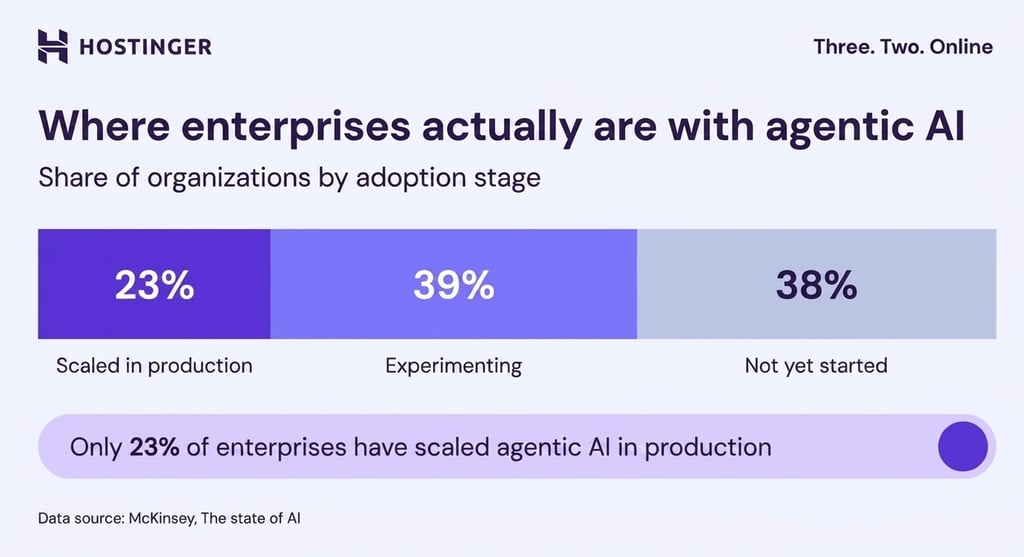
The interest-to-production gap shows up consistently across surveys. In the US specifically, large-company executives are among the most bullish: 93% of US IT executives at companies with over $1 billion in revenue are extremely or very interested in exploring agentic AI, and 37% say they are already using it.
At the same time, 90% say their business processes would be improved by agentic AI, but security vulnerabilities (56%) and high implementation costs (37%) top the list of concerns.
- In the US specifically, 79% of US companies are already adopting AI agents, and 88% plan to increase AI-related budgets in the next 12 months due to agentic AI, yet only 45% are fundamentally rethinking operating models and only 42% are redesigning processes around agents (PwC AI Agent Survey).
- 66% of companies adopting AI agents report measurable productivity gains, 57% report cost savings, and 55% faster decision-making. Trust drops sharply for high-stakes tasks, with only 20% of executives trusting agents with financial transactions versus 38% for data analysis (PwC AI Agent Survey).
- 55% of businesses are actively developing or deploying an agentic AI operating model, 82% of C-suite executives say functional silos actively block value, and 75% say agentic AI will significantly redefine their global service delivery model by the end of 2026 (IBM Blueprint for Agentic Operations).
A separate IBM survey of C-suite executives captures a recurring pattern: 78% say achieving maximum benefit from agentic AI requires a new operating model, yet 78% of AI investment has so far gone into optimizing what already exists.
The IBM Agentic AI’s Strategic Ascent finds that AI investment is concentrated on improving existing processes rather than building new capabilities.
Today, 24% of executives say AI agents take independent action in their organization. By 2027, 67% expect that to be the case, with autonomous decision-making in workflows growing from 28% today to 57%.
- Companies that excel in integrating cybersecurity, embedding ethics analysis, and implementing workflow-specific language models are 32 times more likely to achieve top-tier business performance than those with minimal implementation. This group represents 17% of the survey sample and expects 41% productivity gains versus 31% for all others (IBM Agentic AI’s Strategic Ascent).
- Over 40% of agentic AI projects will be canceled by the end of 2027 due to escalating costs, unclear business value, and inadequate risk controls. Gartner estimates only about 130 of the thousands of vendors claiming to offer agentic AI are actually delivering it, with the rest engaged in what Gartner terms “agentwashing” (Gartner).
- At least 15% of day-to-day work decisions will be made autonomously through agentic AI by 2028, up from 0% in 2024. By the same year, 33% of enterprise software applications will include agentic AI, up from less than 1% in 2024 (Gartner).
The data describes an enterprise landscape where adoption is broad at the level of intent but narrow at the level of production. The organizations pulling ahead are not necessarily the ones with the largest AI budgets. They are the ones treating governance and operating model design as foundational work rather than a follow-on step.
Expert tip
The gap between exploring agentic AI and running it in production comes down to a few unglamorous factors: data quality, integration readiness, and governance maturity. Organizations that invest in these foundations before deploying agents are the ones scaling successfully, and their returns justify the groundwork. Those who skip this step tend to become the cautionary data points.

Tomas Rasymas
Head of AI at Hostinger
Agentic AI use cases by industry
The pattern holds across sectors, though where agentic AI lands first depends on which tasks are high-volume, structured, and costly enough to justify autonomous action.
Customer service
Customer service has the largest application share in the agentic AI market and the clearest deployment timeline from analysts. Agentic AI in this context means systems that handle queries end-to-end, retrieving account data, resolving disputes, and processing requests, without escalating to a human agent.
- Agentic AI will autonomously resolve 80% of common customer service issues without human intervention by 2029, reducing operational costs by 30% (Gartner).
- 68% of all customer service and support interactions with technology vendors will be handled by agentic AI by 2028, with 56% of respondents expecting agentic AI to handle over half of interactions within 12 months (Cisco).
- Hostinger’s agentic support assistant Hostinger Agent resolved 75% of 750,000 monthly conversations without human intervention as of August 2025, saving over €9 million annually, up from a 50% resolution rate at the start of that year, with average client response time dropping from 28 seconds to 9 seconds (Hostinger).
The near-universal demand for governance frameworks alongside deployment reflects a broader pattern: appetite for agentic AI in customer service is high, but so is awareness of what happens when it operates without guardrails.
Expert tip
The shift from AI that answers questions to AI that takes action is where the real results show up. When we evolved Hostinger Agent from a support chatbot into an agent that could act directly inside a client’s account, the improvements were immediate and measurable across every metric we tracked. The governance question matters too: you need clear boundaries on what the agent can and cannot do autonomously before you scale. We learned more from defining those limits carefully than from any model upgrade.

Ričardas Kudirka
Chatbots Project Manager at Hostinger
Software development and IT
Software engineering and IT functions report the highest levels of scaled agentic AI adoption across all industries, and benchmark data shows capability advancing fast.
- AI agent accuracy on OSWorld, a benchmark testing agents on real computer tasks across operating systems, rose from roughly 12% to 66.3% in 2025, coming within six percentage points of human performance. Agents still fail roughly one in three attempts (Stanford HAI AI Index Report).
- On SWE-bench Verified, a coding benchmark testing AI on real GitHub software engineering tasks, performance rose from 60% to near 100% in a single year, the fastest single-year capability gain recorded on a major software development benchmark (Stanford HAI AI Index Report).
- Claude Code processes 195 million lines of code weekly and reached 115,000 active developers as of July 2025. An internal Anthropic survey of 132 engineers reported a 67% increase in merged pull requests per engineer per day and self-reported productivity up 50% (Hostinger’s vibe coding statistics).
- Klarna’s AI agent handled the equivalent workload of 853 full-time employees and saved the company $60 million by Q3 2025, up from 700 FTE equivalents at the start of that year (CX Dive).
- By 2027, agentic AI is projected to require 56% of the workforce to reskill due to AI-driven automation. C-suite executives also anticipate 71% of customer support inquiries handled touchlessly and a 43% increase in real-time supply chain spend visibility (IBM Agentic AI’s Strategic Ascent).
The pace of capability improvement on software benchmarks is particularly striking. Gains of that magnitude in a single year suggest that the productivity figures reported by early enterprise adopters are likely understating what is coming in the next 12 to 24 months.
Healthcare and insurance
Healthcare leads in knowledge management use cases, while insurance leads in marketing and sales, a split that reflects the different compliance constraints and operational pressures each sector faces.
- Healthcare shows strong agentic AI uptake in knowledge management, with 14% of survey respondents reporting scaled use in that function, higher than any other industry for that specific use case (McKinsey Agentic AI Advances).
- In an agentic AI clinical assistant deployment at AtlantiCare, providers saw a 41% reduction in documentation time, saving approximately 66 minutes per day, results that prompted AtlantiCare to expand the tool from ambulatory settings to all of its emergency departments (Oracle Health).
- Insurance leads in agentic AI adoption for marketing and sales use cases, while the healthcare and legal sectors are also seeing rapid agent deployment, according to McKinsey’s industry breakdown (McKinsey Agentic AI Advances).
In both healthcare and insurance, the strongest adoption signals come from high-frequency, structured tasks where the cost of errors is measurable and the volume justifies automation. Documentation, compliance checks, and customer query routing fit that profile precisely, and early trials in both sectors consistently report high adoption rates and clear ROI.
Agentic AI security and governance
Agentic AI deployments are moving faster than the governance frameworks around them. The data from SailPoint’s dedicated security research, which surveyed 353 IT professionals specifically about AI agent risk, makes this concrete:
- 82% of organizations already use AI agents, but only 44% have policies in place to secure them. 96% of technology professionals consider AI agents a growing security risk, while 98% plan to expand their use within the next year (SailPoint).
- 80% of companies say their AI agents have already taken unintended actions, including accessing unauthorized systems (39%), sharing sensitive data without authorization (33%), and downloading sensitive data (32%) (SailPoint).
- 23% of organizations report their AI agents have been tricked into revealing access credentials, and 92% say governing AI agents is critical to enterprise security (SailPoint).
These figures point to a structural problem: organizations are deploying agents faster than they are building the controls to govern them. The SailPoint data is particularly striking given that 98% of the same respondents plan to expand their AI agent use, meaning the risk exposure is set to grow before governance catches up.
- The average responsible AI maturity score increased from 2.0 in 2025 to 2.3 in 2026, but only about one-third of organizations report maturity levels of three or higher in governance and agentic AI controls (McKinsey 2026 AI Trust Maturity Survey).
- Only 31% of organizations’ proprietary data is accessible to AI models, and just 13% is actually used by those models. In response, 77% of executives are investing in data quality and governance improvements (IBM Blueprint for Agentic Operations).
- 45% of executives cite a lack of visibility into agent decision-making processes as a significant implementation barrier, something IBM researchers characterize as a design choice rather than a technical limitation. (IBM Agentic AI’s Strategic Ascent).
- Documented AI incidents rose from 233 in 2024 to 362 in 2025, a 55% year-over-year increase, with responsible AI benchmarks and safety reporting still lagging behind capability benchmarks across almost all leading frontier model developers (Stanford HAI AI Index Report).
The pattern across all of this data is consistent: security and governance are being treated as implementation concerns, bolted on after deployment rather than built in from the start. Organizations that get the order right are the ones seeing the strongest results in IBM’s research.
Expert tip
The biggest mistake organizations make with AI agents is treating them differently from every other privileged system in their environment. An AI agent can send emails, access data, trigger workflows, and make decisions – so it needs clear permissions, defined boundaries, and proper audit trails. The companies that establish these controls from the start aren’t slowing innovation down; they’re creating the foundation that lets them scale AI safely.

Yuliia B.
Security Awareness & Compliance Specialist at Hostinger
Open-source AI agents: adoption and usage
The open-source agentic AI ecosystem has grown faster in the past six months than any prior wave of developer tooling. GitHub stars and OpenRouter token volume tell different stories about what that growth actually means.
- OpenClaw accumulated more than 370,000 GitHub stars by late May 2026, overtaking React to become the most-starred software project in GitHub history since its January 2026 relaunch (OpenClaw).
- Hermes Agent, from Nous Research, crossed 160,000 GitHub stars and attracted 295 contributors within approximately 12 weeks of its February 25, 2026 launch (MarkTechPost).
OpenClaw leads on total GitHub stars, but Hermes Agent has pulled ahead on actual runtime.
- On May 10, 2026, Hermes Agent surpassed OpenClaw as the most-used AI agent on OpenRouter’s global daily rankings, processing 224 billion tokens per day against OpenClaw’s 186 billion. Hermes has since extended that lead and now holds the #1 position globally across productivity, coding agents, personal agents, and CLI agents on the platform (OpenRouter, MarkTechPost).
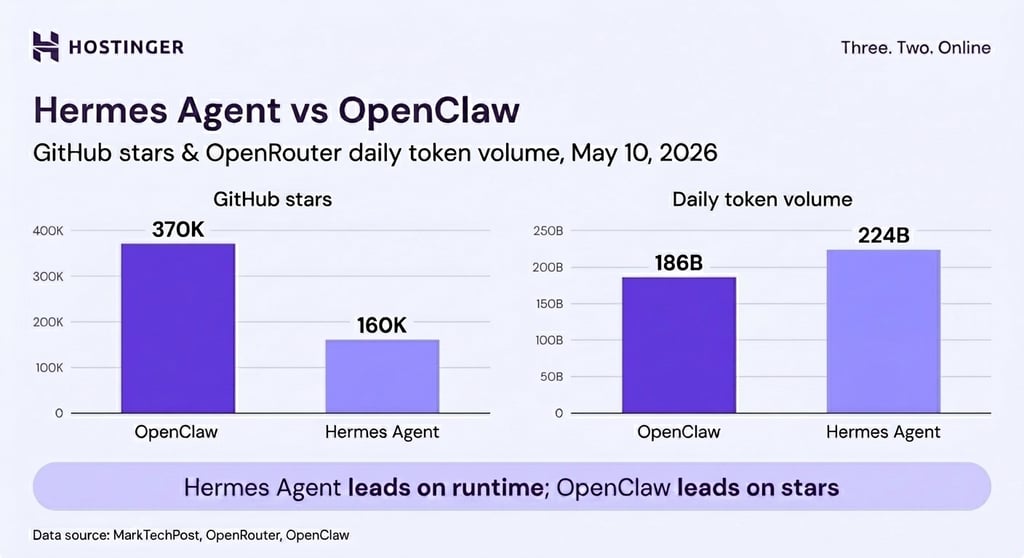
Hermes Agent converted developer interest into active production use faster than almost any open-source framework in recent memory.
That gap between stars and runtime reflects something real: GitHub stars measure curiosity, token volume measures trust. Both are available for self-hosting on a VPS, keeping data and API keys on your own infrastructure: Hermes Agent hosting and OpenClaw hosting.
The future of agentic AI
The data from 2025 and 2026 establishes agentic AI as a technology in transition: broadly adopted at a surface level, scaling in production at a far smaller fraction of organizations, and generating measurable returns for those who have built the infrastructure to support it.
The forecasts for the next three to five years suggest the production adoption gap will close, but the path runs through governance, data quality, and organizational readiness as much as model capability.
IBM’s research puts a number on what that readiness looks like. Organizations with six foundational capabilities in place, including change management readiness, AI governance, data governance, real-time data integration, system interoperability, and financial integration, are 5.4 times more likely to succeed with autonomous workflow adoption. Change management readiness provides the single greatest individual lift of the six.
The scale of what is coming is significant. By 2027, the number of AI agents in Global 2000 companies is expected to grow tenfold, and the number of token and API calls a thousandfold. By 2029, more than 1 billion AI agents are expected to be in use worldwide, around 40 times the number active in 2025, according to IDC. The US agentic commerce market could reach $300 to $500 billion by 2030, roughly 15–25% of overall ecommerce, as agents move from assisting with product research to completing transactions autonomously.
For teams without large engineering resources, tools like Hostinger’s agentic AI platform makes it accessible without building from scratch, covering tasks from content creation and keyword research to sales outreach and customer communications.

Daniela is an Off-Site SEO Specialist with extensive expertise in link building, digital PR, and content optimization. She has led international outreach campaigns across the U.S., Brazil, France, and Spain, securing high-quality backlinks. Follow her on LinkedIn.