How to start a candle business in 8 steps
Oct 06, 2026
/
By Bruno S. & Miglė C.
/
12 min Read
To start a candle business, work through steps from niche selection and product development to channel selection and marketing.
- Pick a niche. It sets your materials, price point, and target audience.
- Formulate your products. Choose the wax, wick, fragrance load, container, and candle size.
- Run burn tests. Every combination needs a full burn cycle before it’s safe to sell.
- Work out your cost per candle. Split startup expenses from ongoing production costs.
- Develop your brand identity. Name, logo, labels, and packaging should reflect your positioning.
- Handle the legal setup. Registration, permits, taxes, and liability insurance.
- Pick your sales channel. Weigh your own store against marketplaces, fairs, retailers, and wholesale.
- Bring in buyers. Visual content timed to gifting seasons is what moves candles.
The order matters: your niche determines your materials, those materials require specific testing, and your test results determine which products are safe to sell.
1. Choose your candle niche
Choose your candle niche by identifying a specific customer type, what they want from a candle, and whether you can offer something competitive at a profitable price.
Your niche affects the materials you use, how much each candle costs to make, what customers are willing to pay, how you brand the product, and where you can realistically sell it.
- Luxury candles often use heavier glass or ceramic vessels, more elaborate packaging, and premium fragrance blends. If a candle costs around $10-12 to make, you may need to sell it for $30-40 or more to leave room for overhead, marketing, and profit.
- Soy or beeswax candles can cost more to produce than basic paraffin candles, which usually pushes them toward a mid-range or premium price point.
- Aromatherapy candles may use essential oils or specialized fragrance blends, increasing ingredient costs and influencing how you position the product.
- Personalized candles can command higher prices because customers are paying for customization, but they take more time to produce and are harder to scale.
- Wedding and event candles are usually sold in larger quantities, so the profit per candle can be lower as long as the overall order remains worthwhile.
- Seasonal candles can be cheaper and simpler to produce, but you may need to make more stock upfront because most sales happen within a short period.
Before committing to a niche, look at comparable products on Etsy, independent candle stores, and retailer websites. Compare their prices, materials, packaging, sizes, and customer reviews. Reviews can show you what buyers value and where existing products fall short.
Then check whether there is enough demand. Use marketplace searches, Google Trends, social platforms, and keyword research to see how often people are looking for that type of candle and whether demand is steady or concentrated around certain seasons.
Finally, run some basic numbers. If a candle costs $8 to produce and you expect to sell it for $20, that $12 difference still has to cover payment fees, marketplace fees, packaging, shipping materials, advertising, and other business costs. A niche can look popular but still be a bad business choice if the margin is too thin.
This kind of validation is a core part of starting a small business: understand the customer, check demand, assess the competition, and make sure the numbers work before you invest heavily in stock.
2. Develop your candle products
To develop your candle products, choose the five core variables that determine how each candle performs: container, wax type, wick, fragrance, and candle size. The wrong combination causes tunneling, soot, or poor scent throw.
Container choice sets the starting point for every other decision. The vessel diameter drives wick selection, the material affects heat distribution, and the shape determines how difficult it is to achieve a full melt pool.
- Glass retains heat more than tin, suits premium positioning, and shows the wax clearly, but costs more and adds weight for shipping.
- Tin is lighter, cheaper, and more portable, making it a practical choice for affordable or seasonal lines.
- Wide, shallow vessels are easier to achieve a full melt pool in, but burn faster.
- Tall, narrow vessels extend burn time but require more careful wick selection to avoid tunneling.
Choose your container before selecting a wick: the vessel diameter is the primary input for wick sizing guides.
Wax type determines the overall character of the burn: how the candle releases fragrance, how it looks in the vessel, and which buyers it attracts.
- Soy wax burns cooler and slower than paraffin and appeals to eco-conscious buyers. It can develop a mottled, uneven surface if the pour temperature isn’t controlled. Choose it for mid-range or natural-ingredient lines.
- Paraffin offers the strongest cold and hot throw at the lowest cost per unit. It’s the most widely used commercial option, but it puts off buyers shopping for natural ingredients.
- Coconut wax blends offer excellent hot throw and a smooth finish, making them well-suited to premium lines – at the highest cost per unit.
- Beeswax burns cleanly with a natural honey scent, which limits how much added fragrance you can use. Choose it when the natural scent is part of the product story.
Wick size is the variable you adjust most often to get the burn right. Wax type sets the character of the burn; wick size controls it. An undersized wick causes tunneling – the candle burns down the center while leaving wax on the sides.
An oversized wick produces a flame that runs too hot, generates soot, and shortens burn time. Use the wick manufacturer’s sizing guide for your container diameter as a starting point, then confirm the choice through testing.
Fragrance oils must be formulated specifically for candles: cosmetic or diffuser oils behave differently in wax and can affect burn performance. Fragrance load is calculated as a percentage of wax weight.
Most waxes have a maximum fragrance load, typically between 6% and 12%; exceeding this limit causes fragrance to pool on the surface rather than bind to the wax.
Candle size follows from your container and wax choices. Larger vessels require more wax and a longer wick, which raises the cost per candle. Smaller candles cost less to produce but need a price that still covers the fixed costs of labeling and packaging.
Start with a focused range rather than a full catalog. Three to five well-tested formulas are far more scalable than 20 untested ones.
3. Test your candles
Test every candle formula by running a full burn cycle before selling a single unit.
Selling untested candles puts you at risk if something goes wrong in a customer’s home. It also catches fixable problems like tunneling, wick drowning, excessive soot, and poor scent throw before you make a larger batch.
For each new formula, run a full burn test cycle:
- Trim the wick to 6mm (0.25 inches) before each burn.
- Light the candle and allow the melt pool to reach the edges of the container on the first burn. This sets the wax memory and prevents tunneling in later burns.
- Burn in sessions of up to four hours, letting the candle cool fully between sessions.
- Record flame height, wick position, melt pool depth, container temperature, soot output, and scent throw (both when lit and unlit) after each session.
- Continue through the full burn life of the candle.
Seven indicators determine whether a candle passes testing:
Indicator | Pass | Fail |
Wick performance | Stays upright and centered throughout the burn | Mushrooms, curls, or drowns in the melt pool |
Flame height | Consistent flame between 2.5 cm and 5 cm (1–2 inches) | Consistently above or below that range |
Tunneling | Melt pool reaches the container edges within the first two or three burns | Wax melts down the center, leaving a ring of unmelted wax on the sides |
Soot | No black deposits on the vessel or visible soot in the flame | Black residue on the glass or a flickering, sooty flame – wick is too large or fragrance load is too high |
Container temperature | Outer surface stays cool enough to touch safely throughout the burn | Vessel becomes too hot to handle – burn and cracking risk |
Burn time | Total burn life matches the expected hours for that candle size | Burns significantly faster or slower than expected |
Scent throw | Noticeable fragrance in a closed room when lit (hot throw) and detectable when unlit (cold throw) | No scent when lit, or fragrance only detectable within a few centimeters of the wick |
Any change to wick size, fragrance percentage, pour temperature, or vessel requires a new test run. For example, results from a 300g soy candle in a glass jar do not transfer to the same scent in a tin.
Keep a burn test log with the date, candle ID, wick code, batch number, and notes from each session. If a candle passes, the log is added to your production record. If it fails, you’ll know exactly which variable to change before retesting.
Testing also informs your warning label: the container temperature data and burn behavior you record during testing are the evidence behind the safety statements your candles are required to carry. Candle safety labeling requirements vary by country, so check the standards that apply in your market before selling.
Every candle sold needs the standard safety statements – burn within sight, keep away from things that catch fire, keep away from children and pets – and your container temperature data supports those warnings if a claim ever arises.
Pro tip
The 84 Candle Rule, a popular community guideline rather than an official requirement, suggests making and giving away roughly 84 candles before selling. The number isn't fixed, but the principle holds: systematic testing takes far more batches than most first-time makers expect.
4. Calculate your candle business costs
To calculate your candle business costs, separate one-time startup expenses from the recurring cost of producing each candle; the second number is the minimum you need to charge per candle to avoid losing money.
Startup costs typically include:
- Candle-making equipment, such as melting pitcher or double boiler, digital scale, thermometer, and pouring equipment.
- Safety gear for working with hot wax.
- Business registration fees and licenses.
- Product liability insurance.
- Testing materials, including sample wicks, wax, fragrance oils, and test vessels.
- Website or marketplace setup fees.
- Label design and initial packaging.
Per-candle production costs include everything that goes into one finished unit:
- Wax.
- Fragrance oil.
- Wick.
- Vessel (jar, tin, or other container).
- Label and packaging materials.
- A share of your time.
To calculate the full cost per candle, add the materials and packaging used for one candle, your labor cost, a share of your overhead, and any selling fees.
For example, if materials and packaging cost $6, labor costs $6.67, overhead adds $1, and selling fees add $2, the full cost of selling that candle is $15.67.
You can then use that figure to price your product at a level that covers your costs and leaves room for profit. If you sell through different channels, calculate the price separately for each one — marketplace fees, payment processing, and wholesale margins can change how much you earn per candle.
Pro tip
Track the time it takes to complete a full production batch, not just a single candle. Setup, cleanup, labeling, and packaging are all part of the cost. Many new candle makers undercount labor and end up pricing below their actual cost per unit.
5. Build your candle brand
Build your candle brand by choosing a name, logo, packaging, and label that match your niche and price positioning.
For example, an affordable seasonal candle might use simple packaging and playful branding, while a luxury candle can support a higher price with premium vessels, more refined packaging, and a polished visual identity.
Start by defining what you want your brand to represent: premium, affordable, artisan, wellness-focused, gift-oriented, seasonal.
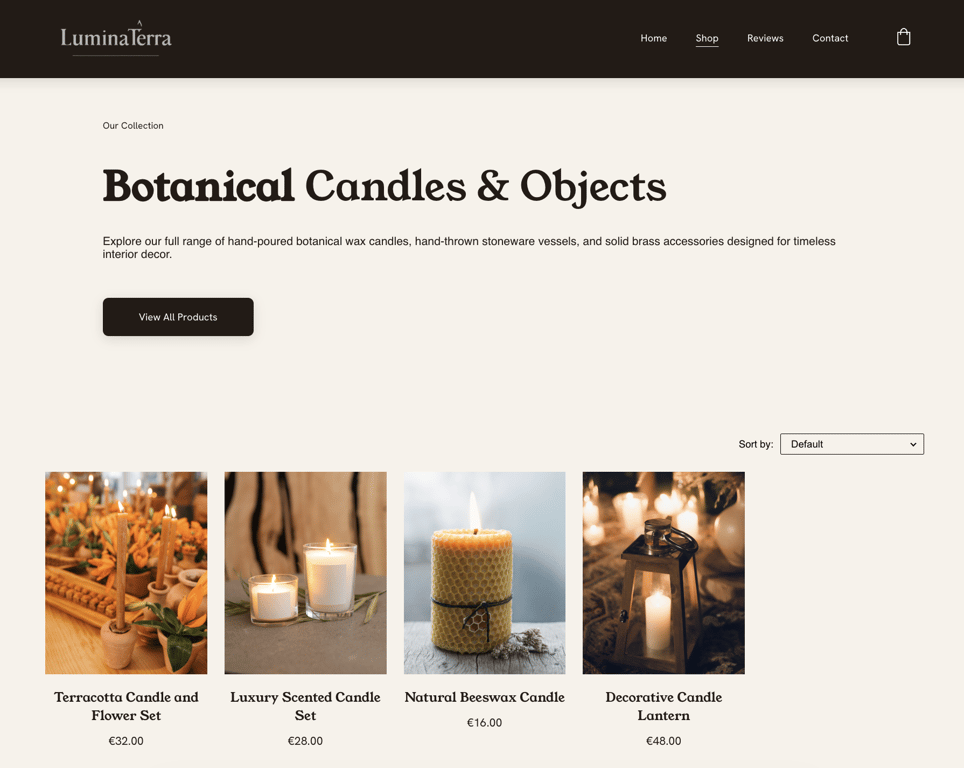
That position determines your color palette, typography, label materials, and the language you use in product descriptions.
- Business name. Choose a name that is easy to pronounce, spell, and search online; check domain availability before committing, and browse candle business name ideas for inspiration.
- Logo and visual identity. Create a consistent look that carries across labels, packaging, social media, and website. Colors, fonts, imagery, and overall design should feel recognizable wherever customers encounter your brand.
- Product labels. Include essential information such as product name, net weight, ingredients, fragrance notes, and required safety warnings. Keep the design clear, readable, and consistent with your overall brand identity.
- Packaging. Use packaging that reflects your price positioning. Thoughtful, gift-ready packaging can increase perceived value, create a stronger customer experience, and support premium pricing.
- Brand tone. A luxury candle brand might sound polished and minimal, while a playful seasonal brand can be warmer and more casual. Define a few traits for how the brand should sound, then apply them consistently across product descriptions, social posts, emails, packaging copy, and customer support.
Your product label carries both brand and compliance information. Design it to handle both without looking cluttered; a label trying to do too much usually fails at both.
6. Register your candle business
Register your candle business by choosing a business structure and completing the legal and financial setup required in your location.
Most first-time candle makers start as sole proprietors, which has minimal registration requirements. Forming an LLC (Limited Liability Company) separates your personal assets from business liabilities, which matters when you’re selling a product that involves open flames and hot surfaces.
The right structure depends on your country and your risk tolerance. Across most markets, the core requirements include:
- Business registration. Registering your business name with the relevant local, state, or national authority.
- Business license or operating permit. Many jurisdictions require a general business license to sell goods.
- Home occupation permit. If you’re manufacturing candles at home, some municipalities require a separate permit.
- Sales tax or VAT registration. Varies by location and annual revenue threshold.
- Business bank account. Keeps personal and business finances separate; most LLCs are legally required to maintain separate accounts.
- Product liability insurance. Covers claims if a candle causes property damage or injury in a customer’s home.
7. Choose where to sell candles
Choose where to sell candles by comparing how much reach, control, margin, and day-to-day effort each sales channel gives you. The best option depends on your candle’s price point, brand positioning, and how much marketing you can handle yourself.
Premium candles with heavy glass vessels and high fragrance loads may struggle on platforms with high per-sale fees. Affordable seasonal candles designed for higher sales volume can perform better on high-traffic marketplaces.
Your own online store gives you the best margin and full control, but requires you to build your own audience.
Channel | Reach | Channel costs | Your control | Setup effort |
Own online store | You build your own audience | Hosting + marketing costs; no transaction fees | Full | Medium |
Etsy | Built-in audience | 6.5% + $0.20 listing + processing fees | Low | Low |
Craft fairs and local markets | Local foot traffic | Booth rental per event | Full | High per event |
Local retailers | Existing store customers | ~50% wholesale margin | Low | Medium |
Wholesale | Bulk buyers | 40–60% discount off retail | None | High upfront |
Compare online selling platforms before choosing where to start. Etsy and craft fairs are common first choices for testing demand before building a standalone store – there’s no required order, but fees compound quickly, so factor them into your per-sale cost calculation before committing.
For sellers who want to manage products, inventory, orders, and payments in one place, Hostinger Ecommerce lets you set up your business operations first and then choose where to sell: your own website, a shareable product link, or additional channels as you grow.
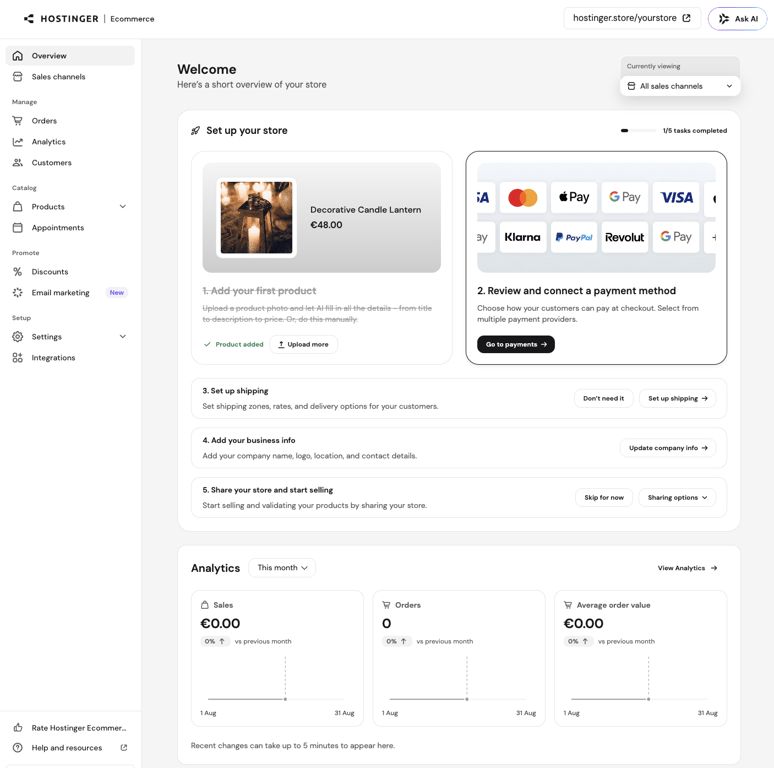
You don’t need a website to start: a quick product link works immediately for sales through Instagram, WhatsApp, or any channel you already use, and Hostinger Ecommerce charges 0% transaction fees, with 100+ accepted payment methods.

8. Market your candle business
Market your candle business by promoting it through social media, Pinterest, email, local events, and seasonal campaigns, using content that shows how your candles look, are made, and fit different moods, occasions, and gifting needs.
Candles photograph and film well, making them a natural fit for the social tactics that most reliably increase online sales.
Burn footage, fragrance descriptions that create a mental image, and behind-the-scenes content showing the maker and process give buyers what a static product shot can’t: a sense of how the candle smells, feels, and performs. Gifting ideas, lifestyle photography, and product launch countdowns round out a content mix that stays fresh across seasons.
Each platform or approach works differently for candle content.
- Pinterest. Candle content has a long shelf life on Pinterest. well-optimized product pins drive traffic for months. Selling on Pinterest works best when product pins link directly to your store.
- Instagram. Lifestyle photography, aesthetic flat lays, and short-form video all perform well – consistency matters more than volume.
- TikTok. Short-form video showing burns, pours, and order packing tends to do well, and behind-the-scenes content and process videos can reach new audiences quickly.`
- Email marketing. Buyers who’ve already purchased are the easiest people to resell to. A simple email list typically outperforms paid social at low budgets.
- Local markets and craft fairs. Scent sells candles better than any photograph. In-person events convert browsers into repeat buyers by allowing customers to experience the product firsthand.
- Customer reviews. Social proof has a strong impact on candle sales because online buyers can’t smell the product before purchasing. Ask customers for a review shortly after their order is delivered.
- Seasonal campaigns. Q4 is the highest-volume period for candle sales. Plan content, inventory, and promotions months in advance.
Email sequences, abandoned cart recovery, and bundle pricing also have a measurable impact at low volume.
Is a candle business profitable?
Yes, a candle business is profitable when the selling price covers production costs, channel fees, and labor, leaving a margin. Four factors decide it: production costs, selling price, sales volume, and the fees your chosen sales channel charges.
Raw material costs for a single candle range from roughly $1 to $2 for a simple tin to $15 or more for a premium vessel with complex fragrance blends. Retail prices typically run from around $10 for simple tins to $60 or more at the premium end.
That gap looks like a strong margin until you add labor, packaging, marketplace fees, and shipping. At that point, a $15 candle can produce $3 in profit after all costs are accounted for.
The models that produce sustainable margins are usually:
- Premium candles sold through your own store or directly, where you capture the full retail price without marketplace fees.
- Gift sets and bundles, which raise average order value without proportionally increasing per-unit production cost.
- Seasonal wholesale to retailers or gift shops, where volume compensates for the lower per-unit margin.
Candle sales are highly seasonal: Q4 accounts for around 35% of annual candle sales, according to the National Candle Association, which means planning inventory, cash flow, and marketing around that cycle is one of the most practical decisions you make in your first year.
Calculating your actual profit per candle is more useful than relying on broad industry margin estimates. Margins vary too much across niches, channels, and production volumes to generalize meaningfully.
Can you legally sell homemade candles?
Yes – selling homemade candles is legal in most countries, provided your business meets the applicable registration, safety, labeling, tax, and insurance requirements.
The label “homemade” has no legal standing. What matters is whether your business is registered and whether your candles carry the right safety warnings.
In the US, fire-safety labeling is covered by ASTM F2058, and the three statements the National Candle Association recommends are the wording most makers use. They’re voluntary but near-universal across the industry:
- Burn within sight.
- Keep away from things that catch fire.
- Keep away from children and pets.
In the EU, EN 15494 makes equivalent labeling mandatory rather than optional, alongside general product safety obligations.
Requirements vary significantly by country, state, and city. Check with your local business bureau before selling, rather than relying on a general guide.
Grow your candle business
Grow your candle business strategically by adding channels and improving production efficiency. Scaling your ecommerce business does not simply mean adding more products.
The candle businesses that scale well usually follow a clear sequence: stabilize one sales channel, refine the product range based on what actually sells, and then add a second channel without disrupting production. Adding channels before the core business is stable multiplies the workload without multiplying revenue.
Inventory management, supplier relationships, fulfillment, and production capacity are the practical constraints that slow most small candle businesses down as volume increases.
This article is a localized version of How to start a candle business in 8 steps, originally published in English.

Bruno is a Content Writer at Hostinger, focused on creating and optimizing helpful, engaging articles about web development and marketing. With a background in journalism, he combines storytelling with practical insights to make complex topics easier to understand. He has also contributed to publications like MacMagazine and Jornal A Tarde. Outside of work, Bruno enjoys exploring art, cooking, and technology.

Miglė Cicėnaitė-Jocė is a Product Manager for Hostinger's Website Builder. She is on a mission to redefine website creation, focusing on the AI flow and its features, and is always eager for product feedback and market insights to improve the user experience. Follow her on LinkedIn.