What is ecommerce inventory management?
Mar 10, 2026
/
By Simon L.
/
8 min Read

Ecommerce inventory management is the system and processes you use to track, control, and optimize your stock levels across your entire online business.
It’s how you know what you have, where it is, when to order more, and how to get products into customers’ hands efficiently.
It encompasses real-time stock tracking, seamless order fulfillment, accurate demand forecasting, and tight supplier coordination to keep everything flowing smoothly.
Here’s the challenge for online retailers: you’re juggling inventory across multiple warehouses, managing returns and new orders simultaneously, and predicting demand without foot traffic patterns.
The sweet spot is having just enough inventory to meet customer demand without tying up too much capital in stock.
Too little means lost sales and disappointed customers. Too much means cash sitting idle, mounting storage fees, and potential markdowns. Master this balance, and you’re set up for sustainable, profitable growth.
Why is ecommerce inventory management important?
Ecommerce inventory management is important because it directly impacts your bottom line, shapes your customer experience, and determines whether you’re running a profitable business or just spinning your wheels.
It protects your profits
Good inventory control is like having a financial superpower. When you keep popular items in stock, you capture every sale opportunity.
On the flip side, smart inventory management means you’re not tying up your capital in products that sit gathering dust or paying unnecessary storage fees.
Finding the balance between too little and too much is where the magic happens. With the right systems in place, it’s totally achievable.
For example, if you sell candles and your bestselling scent typically moves 200 units during the holidays, stocking only 150 means missing 50 sales. Ordering 400 means capital sitting in your warehouse until next December.
It improves ecommerce customer service
Customers want their order to be accurate, complete, and delivered quickly, and when you nail your inventory management, you can absolutely deliver on those expectations.
With solid inventory control, you can:
- Confidently promise and deliver on quick shipping times.
- Keep stock levels accurate so every “buy now” button delivers on its promise.
- Build the kind of trust that turns one-time buyers into loyal fans who recommend you to friends.
It lets you scale
Look at how successful ecommerce businesses operate. Whether it’s a small boutique tracking 100 SKUs or a larger retailer managing thousands, sophisticated inventory systems help them predict demand accurately and deliver products quickly.
The good news? These tools are more accessible and affordable than ever.
When you’re starting an ecommerce business, getting your inventory management right from day one sets you up for sustainable growth instead of constant crisis management.

What is the inventory management workflow?
Inventory management is a continuous cycle that helps you keep just the right amount of stock on hand to avoid both shortages and excess.
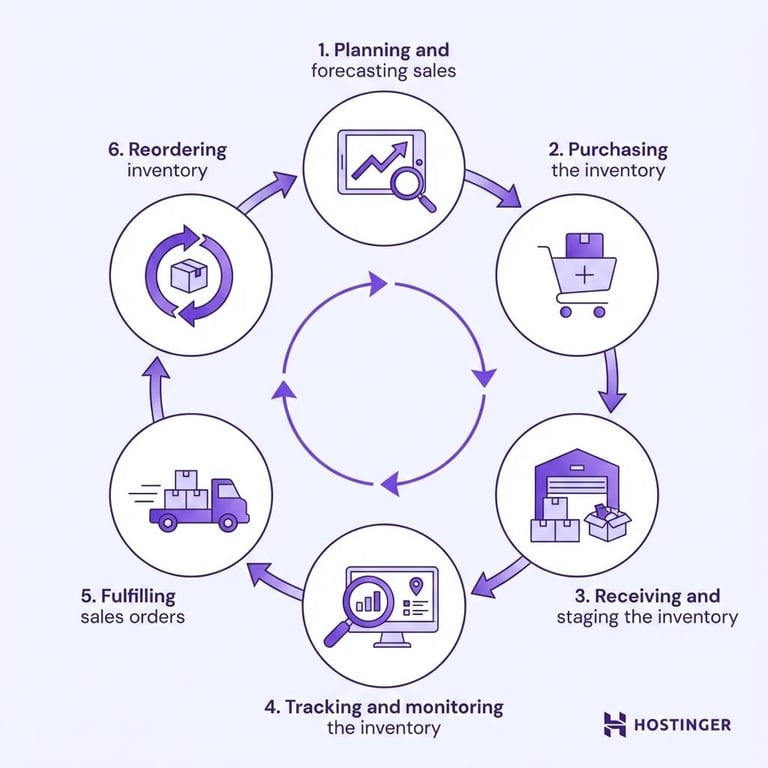
1. Planning and forecasting sales
This is where you put on your fortune-teller hat, except instead of a crystal ball, you’re using data.
Planning and forecasting involve analyzing your historical sales patterns, seasonal trends, market conditions, and upcoming promotions to predict what you’ll need and when.
What the work involves:
- Reviewing past sales data and identifying patterns.
- Accounting for seasonal fluctuations and market trends.
- Aligning with marketing and sales teams on upcoming campaigns.
- Considering external factors like economic conditions.
This results in a solid demand forecast that tells you how much of each product you’ll need, helping you avoid running out of best-sellers during peak season or over-ordering products that don’t sell.
2. Purchasing the inventory
Armed with your forecast, it’s time to actually buy the stuff you’re going to sell.
This stage involves working with suppliers to place orders, negotiating terms and pricing, coordinating delivery schedules, and managing your budget to balance inventory investment with cash flow.
What the work involves:
- Creating and submitting purchase orders.
- Negotiating with vendors about quantities, pricing, and timing.
- Tracking order confirmations and delivery schedules.
- Managing payment terms to maintain a healthy cash flow.
You get the right quantity of products ordered at the right price, with delivery timed to meet your anticipated demand. This means no overflowing your warehouse space or draining your bank account before sales come in.
3. Receiving and staging the inventory
Your products have arrived, but you’re not done yet. This stage requires attention to detail as you physically process everything coming through your doors.
What the work involves:
- Inspecting shipments for accuracy and damage.
- Counting and verifying quantities against purchase orders.
- Checking quality to ensure products meet your standards.
- Entering items into your inventory management system.
- Properly labeling and organizing products in your warehouse.
You’ll have accurate records showing exactly what you have on hand, with products properly stored and ready for fulfillment.
4. Tracking and monitoring the inventory
Now that your inventory is in storage, you need to monitor it actively. This lets you see exactly what you have, where it is, and when it’s time to reorder.
What the work involves:
- Maintaining real-time visibility of stock levels.
- Tracking inventory across multiple locations, if applicable.
- Monitoring stock movement and turnover rates.
- Identifying slow-moving or dead stock.
- Setting up alerts for reorder points.
- Regularly conducting cycle counts to verify accuracy.
This lets you see everything in your inventory at all times, along with actionable insights into which products are performing well and which aren’t pulling their weight.
5. Fulfilling sales orders
Now you’re getting products to customers. Every sale triggers a chain of activities that needs to happen quickly and accurately.
What the work involves:
- Receiving and processing customer orders.
- Picking the correct items from inventory.
- Packing orders securely and efficiently.
- Generating shipping labels and documentation.
- Updating inventory levels immediately when orders are placed.
- Tracking shipments through delivery.
You’ll have orders fulfilled accurately and quickly, inventory counts automatically updated to reflect what’s been sold, and happy customers receiving exactly what they ordered.
6. Reordering inventory
And we’re back to the beginning, almost. As inventory sells down, you need to replenish it before you hit zero. This stage closes the loop and keeps the cycle running smoothly.
What the work involves:
- Monitoring stock levels against your reorder points.
- Analyzing current demand trends to adjust quantities.
- Creating new purchase orders with suppliers.
- Timing orders to arrive before you run out.
- Coordinating with suppliers about delivery timelines.
You’ll replenish stock smoothly to keep shelves stocked without over-ordering, balancing enough inventory to meet demand without tying up excess capital.
What are the ecommerce inventory management methods?
Ecommerce inventory management methods involve different strategic approaches for controlling stock levels, optimizing ordering, and maximizing efficiency.
Think of these as your toolkit. You’ll probably use several of them together, depending on your business needs.
Demand forecasting
Demand forecasting uses your sales history, market trends, and statistical models to predict what customers will want next. You’re essentially looking at patterns from the past to anticipate the future.
If your data shows beach towels spike 250% every June, you’ll order ahead instead of scrambling mid-season.
Best for: Any business with enough sales history. This is your foundation. Pair it with pretty much everything else to make smarter decisions across the board.
Just-in-Time (JIT)
Just-In-Time means you receive products only when you need them for immediate sale, keeping almost nothing in storage by coordinating closely with suppliers.
Best for: Businesses with reliable suppliers and steady demand. Works great with demand forecasting, but it’s the opposite of safety stock (which is all about keeping extra inventory). If your demand is unpredictable or suppliers are unreliable, skip this one.
FIFO vs LIFO
FIFO (First-In-First-Out) means selling your oldest inventory first. LIFO (Last-In-First-Out) means selling your newest inventory first.
Best for: Go with FIFO for ecommerce, especially if you sell anything with expiration dates, seasonal products, or items that can go out of style. LIFO might save on taxes when costs are rising, but it leaves old stock gathering dust and isn’t even allowed under international accounting standards (though it’s still permitted under US GAAP). Pick one and stick with it.
ABC Analysis
In ABC analysis, you sort inventory into three tiers. A items are your revenue champions (usually 20% of products driving 80% of revenue), B items are your steady performers, and C items are your lower-value products.
For example, if you sell skincare products, your vitamin C serum might be an A item generating 40% of revenue, while sheet masks are C items bringing in just 2%.
Best for: Anyone selling more than a handful of products. This is your decision-making framework. Use it to figure out where to apply other methods. Maybe use safety stock for A items, JIT for C items, and EOQ for B items.
Safety stock
Safety stock is the extra inventory you keep as a buffer against surprises like demand spikes, supplier delays, or forecasting hiccups. You calculate how much based on how variable your lead times and demand are.
Best for: Your high-demand items and situations where suppliers aren’t 100% reliable. Pairs beautifully with demand forecasting and ABC analysis (perfect for those A items). Keep in mind that JIT and safety stock work against each other since one minimizes inventory while the other adds buffer stock.
Economic Order Quantity (EOQ)
EOQ is a formula that determines the ideal order quantity by balancing ordering costs against storage costs.
Best for: Products with predictable demand and stable costs. Works great alongside demand forecasting and ABC analysis. Skip it if bulk discounts make ordering larger quantities way cheaper than the formula suggests.
Inventory kitting
You pre-bundle individual items into ready-to-ship packages before orders come in, so instead of picking three separate items, you grab one pre-made kit.
Best for: Products that regularly sell together. Think gift sets, morning routines, or subscription boxes. This fits nicely with other methodologies. You can use demand forecasting to figure out which kits to create and EOQ to decide how many.
Dropshipping
With dropshipping, you don’t hold any inventory. When someone orders, you buy it from a supplier who ships directly to your customer. You’re the connector, not the warehouse.
Best for: Testing new products or starting out without much capital. Since you don’t control inventory, you can’t really use most other methods here. That said, lots of businesses do a hybrid. Dropship the slow movers while keeping your best sellers in stock.
Differences between ecommerce inventory management and traditional inventory management
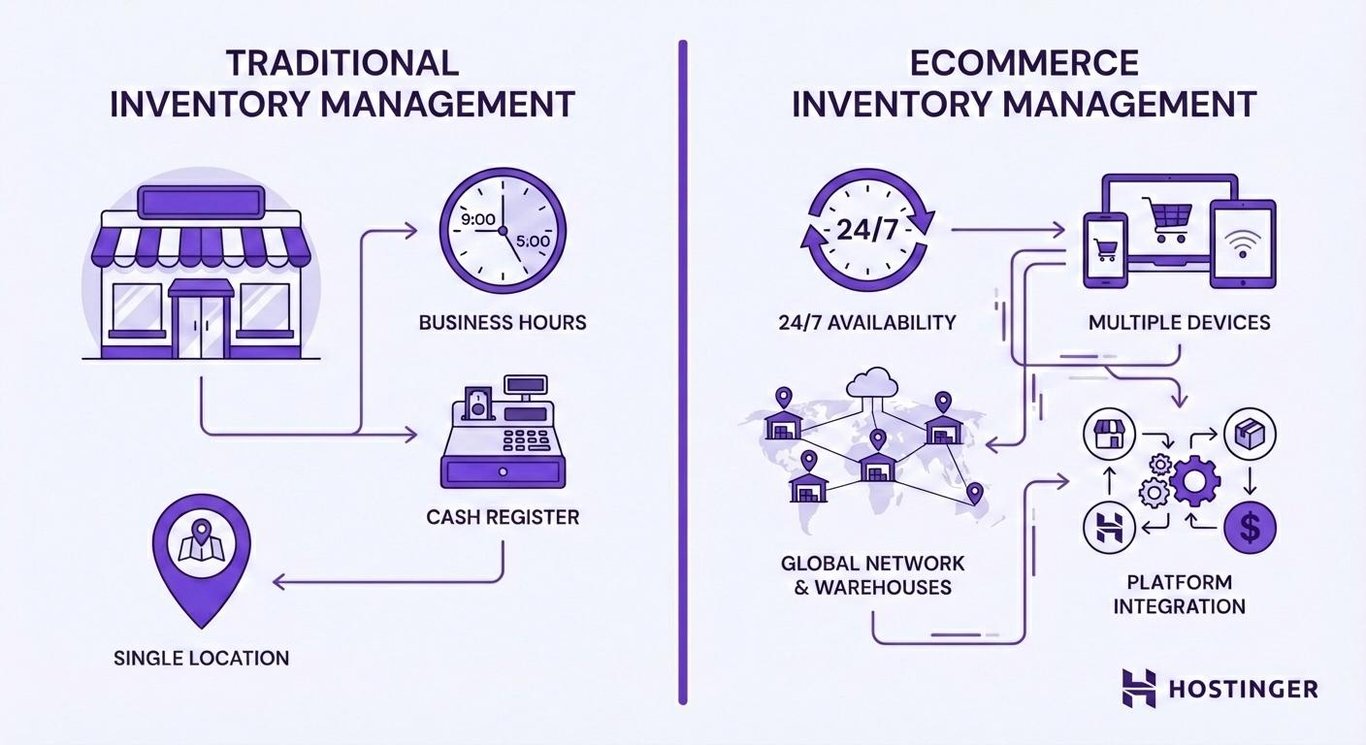
While both ecommerce and brick-and-mortar inventory management share the same goal of having the right products at the right time, the execution looks quite different in practice.
Speed and timing
Traditional retail operates on a relatively predictable rhythm with business hours and scheduled shipments.
Ecommerce never sleeps. Orders come in 24/7, and customers expect rapid fulfillment. Your inventory system needs to be updated in real-time across all sales channels, not just at closing time.
Accuracy requirements
In a physical store, customers see what’s available on the shelf.
Online, you have the advantage of automation, but you need to sync your inventory with your ecommerce platform so product pages update instantly to show out-of-stock items. Customers can still view products, add them to wishlists, and sign up for restock alerts.
SKU management
Traditional stores are limited by physical shelf space, maybe carrying hundreds or a few thousand products.
Ecommerce stores often manage tens of thousands of SKUs, each with variations in size, color, and style that require separate tracking.
Returns management
Physical stores might handle returns at the register, but ecommerce returns are a whole different beast.
Products ship back to you, need inspection and processing, must be returned to available inventory (if they’re still sellable), and tracked through the entire reverse logistics journey.
Integration demands
Traditional inventory management might integrate with your point-of-sale system and accounting software.
Ecommerce inventory management needs to sync with your website, marketplace listings (such as Amazon, eBay, or Etsy), shipping carriers, warehouse management systems, accounting software, CRM platforms, and more.
Geographic complexity
A traditional store has one location (or maybe a few). Ecommerce businesses often distribute inventory across multiple warehouses, use third-party ecommerce fulfillment services, employ dropshipping for some products, and need to track everything in real-time across all these locations.
You’re managing a complex network, not just one stockroom.
Future trends in ecommerce inventory management
The future of inventory management is already here, and it’s pretty exciting.
AI and machine learning
We’re seeing how AI in ecommerce is transforming demand forecasting from educated guessing into predictive science.
AI systems analyze your sales history, weather patterns, social media trends, and more to predict demand with impressive accuracy.
These systems learn over time, anticipating things like umbrella sales before the rain starts or beachwear spikes weeks before seasonal patterns suggest.
IoT inventory tracking
This is the use of connected devices, so your warehouse can essentially manage itself and provide instant alerts about inventory movements or opportunities.
Think smart shelves that detect low stock, RFID tags that track items without manual scanning, or sensors that monitor storage conditions.
Physical automation
Automation is becoming a reality with robots picking and packing orders, automated vehicles moving inventory within warehouses, drones conducting inventory counts, and machine learning optimizing warehouse layouts.
The result? Faster, more accurate fulfillment operations.
Omnichannel fulfillment
Advanced fulfillment systems that treat all inventory as one unified pool rather than separate stock for your website, physical stores, and marketplaces.
This enables exciting capabilities like:
- Buy online, pick up in store for customer convenience.
- Ship-from-store flexibility when distribution centers are out of stock.
- Real-time inventory visibility across all channels.
- Better inventory utilization since any item can fulfill any order from anywhere.
Sustainable inventory practices
Consumers increasingly care about environmental impact, and effective inventory management can help you meet those expectations.
Better forecasting means less waste, smarter packaging uses fewer materials, choosing eco-friendly suppliers makes a real difference, and thoughtful shipping decisions are better for the planet.
Plus, they often save you money through improved efficiency.
Your next steps
Managing ecommerce inventory might never be simple, but with the right systems and strategies, it’s absolutely manageable.
Just starting out? Set up basic inventory tracking with your ecommerce platform, use FIFO for stock rotation, and start collecting sales data.
Already selling? Review the last three months of sales, identify your A/B/C items, and set reorder points for your top 20% of products.
Ready to scale? Invest in inventory management software like Cin7 or Katana that syncs with your sales channels and implements demand forecasting.
The businesses thriving today are the ones that improve one step at a time. Pick one thing and implement it this week. Progress beats perfection.
All of the tutorial content on this website is subject to Hostinger's rigorous editorial standards and values.

Simon is a dynamic Content Writer who loves helping people transform their creative ideas into thriving businesses. With extensive marketing experience, he constantly strives to connect the right message with the right audience. In his spare time, Simon enjoys long runs, nurturing his chilli plants, and hiking through forests. Follow him on LinkedIn.

Comments
0 responses