Domain flipping: What it is and how to get started
Sep 23, 2026
/
By Alma
/
9 min Read
Domain flipping is the practice of buying or registering domain names with the intention of reselling them to buyers at a higher price. A domain flipper looks for names a business or person will want later, holds them, and sells when the right buyer turns up.
It draws people in because the barrier is low: you can register a name for a few dollars and list it the same day.
The hard part isn’t buying; it’s picking names that anyone will pay for and pricing them so a sale actually yields a profit after renewals and fees.
When done well, flipping can pay off, but it’s closer to patient investing than to quick money. What you make depends on buyer demand, what you spend to acquire and hold a name, how closely your price matches what buyers will actually pay, and how long you can wait, since some domains sell in weeks while others sit for years.
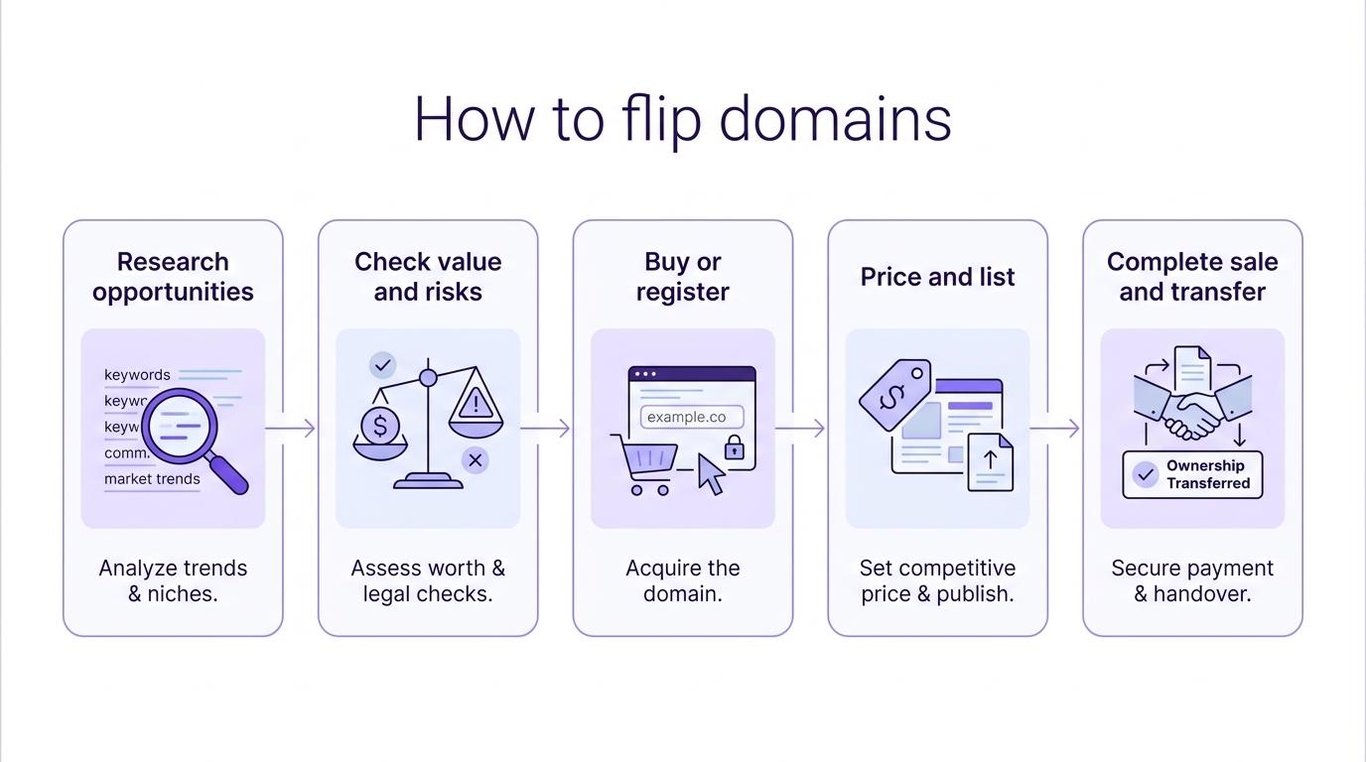
Flipping a domain comes down to five steps:
- Find promising names other people are likely to want.
- Weigh a name’s value against its risks before spending money.
- Acquire the domain once it clears your checks.
- Decide on an asking price and where to list it.
- Close the deal and hand over ownership.
Download website launch checklist
What is domain flipping?
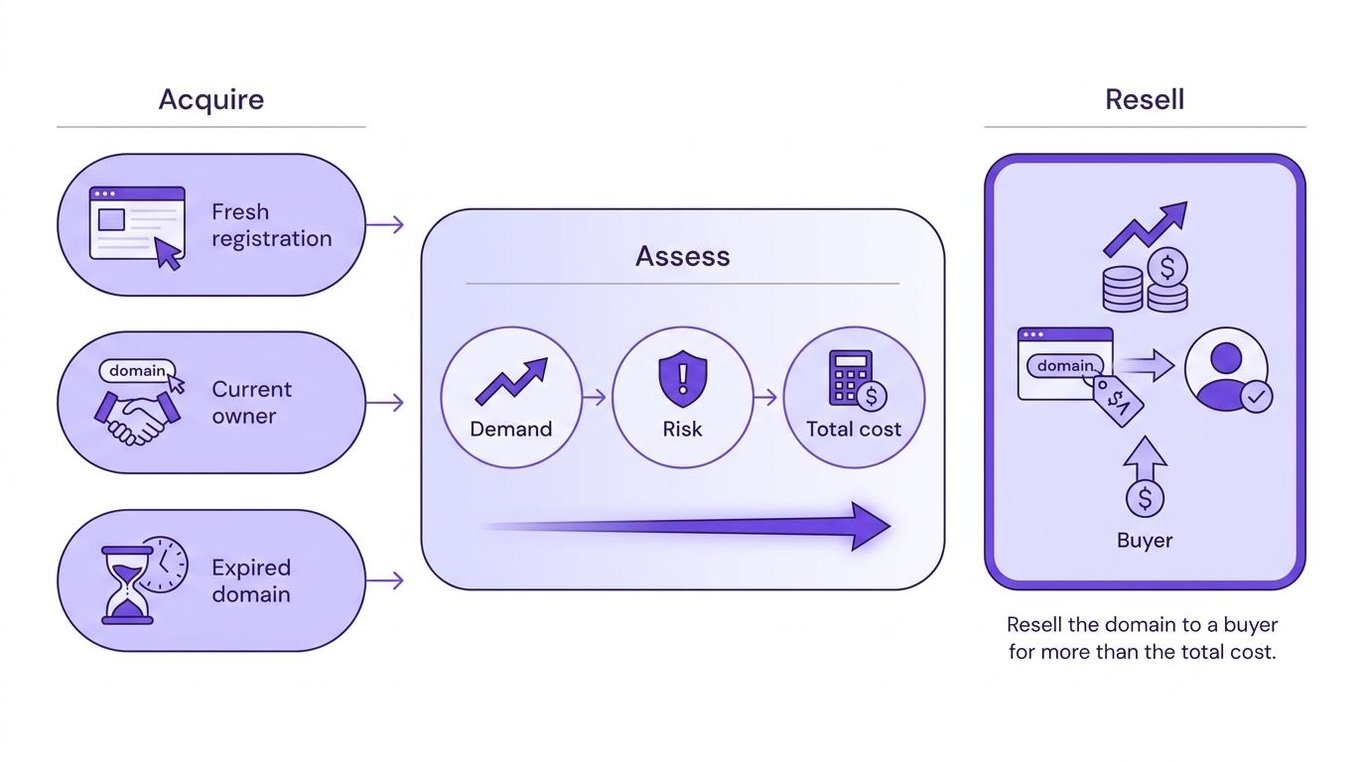
Domain flipping is the practice of buying a domain name at one price and reselling it at a higher one. The flipper acquires a name, then finds a buyer willing to pay more than it cost to get and hold.
The names you flip come from three places: ones you register fresh, ones you buy from a current owner, and expired names that dropped back onto the market when someone didn’t renew.
Owning a good name doesn’t guarantee a buyer or a profit. A domain sells only when someone actually wants it, so your odds depend heavily on the research and valuation you do before buying.
Is domain flipping profitable?
Domain flipping can be profitable, but the profit isn’t guaranteed and rarely comes fast.
Whether a domain flip makes a profit depends on five things:
- Acquisition price. What you paid to register or buy the name.
- Renewal costs. What you pay every year to keep a name while it stays unsold.
- Buyer demand. Whether real businesses or people want this exact name.
- Domain quality, pricing, and fees. How good the name is, whether your price matches the market, and the commission a platform or broker takes when it sells.
- Time to sell. How long your money sits tied up before a buyer appears.
Domains are a relatively illiquid asset – some sell within weeks, but many sit unsold for months or years, and a few never sell at all. While you wait, you still have to pay the renewal fee every year.
For example, if you register 10 domains at $15 each and keep them for three years, each one costs you renewal fees for as long as you hold it, regardless of whether it sells.
Even if only two domains eventually sell, the other eight still cost you three years of renewal fees without generating any revenue. Those ongoing costs reduce the profit from the domains that do sell.
That is why a low purchase price doesn’t automatically make domain flipping cheap. The longer you hold unsold domains, the more they cost you.
You don’t need formal qualifications to flip domains, but your results depend on how well you research demand, value names, set prices, and negotiate with buyers. These skills help you avoid buying domains that are unlikely to sell.
How much does domain flipping cost?
Flipping even one domain typically costs $10–22 a year to register and renew, plus marketplace or broker fees if it sells. Domain flipping costs more than a single registration fee because several charges add to the purchase price, and some recur every year.
The costs break down like this:
- Domain purchase or registration. Often $10–20 a year for a standard name, with the exact price depending on the registrar, though premium names cost far more.
- Annual renewal. Charged every year you hold the name, usually higher than a first-year promo price.
- Marketplace, auction, and sales fees. Listing or setup fees, plus a commission on sale.
- Optional extras. Broker commissions on high-value names, appraisal tools that estimate a domain’s value, or research tools.
Renewal costs increase as your portfolio grows. That’s why it makes sense to start with a small number of domains. You can learn how to research, price, and sell them without incurring high annual renewal costs.
How much can you make from domain flipping?
What you make from domain flipping varies widely because it’s the gap between what you paid and what you sell for, minus everything you spent holding the name.
Your actual profit on any sale is:
Sale price − acquisition − renewals − marketplace or broker fees − transaction costs
So, a name you bought for $15, renewed twice at $18, and sold on a marketplace for $500 that takes 15% commission, doesn’t net $485. After the $15 purchase, $36 in renewals, and $75 marketplace commission, your profit is $374 before tax. Across a portfolio, how many names actually sell matters as much as the sale price.
Occasional headline sales – premium names selling for six or seven figures – are rare outliers, not what a typical flip returns.
How to flip domains
You flip a domain in five steps: research names with demand, value and vet one, buy or register it, price and list it, then close the sale and transfer it.
1. Research domain opportunities
Start by hunting for names buyers are likely to want, before you spend any money. A domain is worth pursuing only if you can picture a real business or person paying to own it.
These traits tend to make a name attractive to buyers:
- Length. Short names are easier to remember and type.
- Easy to say and spell. If people have to guess the spelling, the name loses value.
- Brandability. Names that sound like a brand beat one stuffed with keywords.
- Relevant extension. A .com has the broadest resale market; a city or niche TLD like .nyc can suit a local business.
- Commercial relevance. Names tied to a clear industry, product, or place have an obvious buyer.
Keywords alone don’t equal value, and this is where beginners overpay. Take two names, buycheapinsurancenow.com and Zynto.com. The first is stuffed with search terms and still looks like spam to a buyer; the second is shorter and easier to brand.
The criteria for a strong domain come down to whether someone wants it, not the words inside it, and keyword-heavy names no longer carry the ranking edge they once did.
You can research both fresh and expired names. An expired domain is one that a previous owner didn’t renew, so it returns to the market. Some flippers chase these through drop catching. Expired names are released on a set schedule, and drop-catching services race to grab a good one the instant it drops, so a genuinely good one rarely lands for the base registration price.
Expired names require extra caution, since a history of spam or pages with barely any real content can follow the domain.
You have two routes here. Registering a fresh, brandable domain can give you a name with no previous brand history, while acquiring an existing premium .com gets you a short, memorable name that tends to attract more buyers. AI name generators help you brainstorm, but their output still needs market and legal checks before you buy.
2. Check the domain’s value and risks
Evaluate a domain by comparing it to recent sales and screening it for red flags before you buy, because this is what determines whether the rest is worth doing.
Work through it in order, and if a name fails one check, drop it and move on:
- Look up comparable sales. Search the name and similar ones on a sales database like NameBio to see what names of that type actually sold for. This is your strongest pricing reference, though your exact name will have its own quirks.
- Check who would buy it. Name the specific businesses or people who’d want it. If you can’t name a plausible buyer, the name’s other strengths don’t matter.
- Investigate an expired name’s past. Enter the domain in digital archive sites like Wayback Machine to see what it hosted previously, and search the name for any prior business use. Spam, adult content, or a dead brand are all reasons to walk away.
- Run a trademark check. Search the USPTO trademark database and look for existing business names, so you don’t buy something you could be forced to hand over later.
Lead with real sales, not appraisal scores. An automated tool might value a name at $2,000 off its length and keywords, but if comparable names sold for $200, the tool is describing a market that doesn’t exist. A name is worth what a buyer will pay, so what a domain is really worth comes down to recorded sales, not any estimate.
The trademark check matters just as much, because a cybersquatting conflict is far cheaper to catch now than after you’ve paid for the name.
3. Buy or register the domain
To buy or register the domain, go through a registrar, negotiate with the owner if it is already registered, or use a marketplace or drop-catching service for an existing or expired domain.
When you compare domain registrars, focus on the costs and rules that affect you while you hold and eventually sell the domain:
- Registration and renewal price. Check both the initial price and what you will pay each year until the domain sells.
- Transfer terms. Look for transfer locks, approval steps, and processing times that could delay the transfer of the domain to a buyer.
- Automatic renewal. Turn it on for domains you want to keep so they do not expire by mistake.
- Domain privacy. Check whether privacy protection is included if you want to keep your contact details out of public registration records.
- Expiration policy. Check the grace and redemption periods for a missed renewal – they affect how much control you keep over a domain you’re holding to sell.
- Registrar reputation. Pick a registrar with a reliable track record for support and smooth transfers.
Pay particular attention to renewal pricing. A low first-year price can become expensive if you hold the domain for several years.
If you plan to buy several domains, calculate the registration and renewal costs before expanding your portfolio. This tells you how much you will need to spend each year while you wait for buyers.
4. Set a price and list the domain for sale
Set your asking price using the comparable sales you found earlier, then choose where to sell the domain.
Use a fixed price when similar domains have sold within a clear range, and you already have a target price in mind. Accept offers when the domain is harder to compare, or you want room to negotiate. In either case, make sure the price covers what you paid, renewal costs, and selling fees.
For a first sale, the simplest option is usually to list the domain for sale on a marketplace such as Sedo, Afternic, or Flippa. These platforms already have buyers, but they take a commission from the sale.
Here’s how the main selling methods compare:
Method | Best for | Fees | Seller effort | Pricing |
Domain marketplace | Wide exposure and a large buyer base | Commission on sale | Low | Usually fixed, sometimes offers |
Domain auction | Names with competing interest | Commission, plus a possible setup fee | Low to medium | Bidding, with optional reserve |
Broker | High-value premium names | Commission, set by the broker | Low | Negotiated |
Direct sale | When you already know the likely buyer | No commission, but escrow costs apply | High | Negotiated |
Use an auction when you expect several buyers to compete for the name. A broker is better suited to a high-value domain where the potential sale price can justify the commission.
For a direct sale, contact businesses with a clear reason to want the domain. A company already using the .net version of your .com, for example, is a stronger prospect than a random business in the same industry.
While you wait for a buyer, point the domain to a for-sale page. If it already receives traffic, you can also park the domain to display ads and earn some revenue from those visits.
5. Complete the sale and transfer the domain
Complete the sale in this order: confirm the price and terms, secure the buyer’s payment, transfer the domain, then confirm that the buyer has received it.
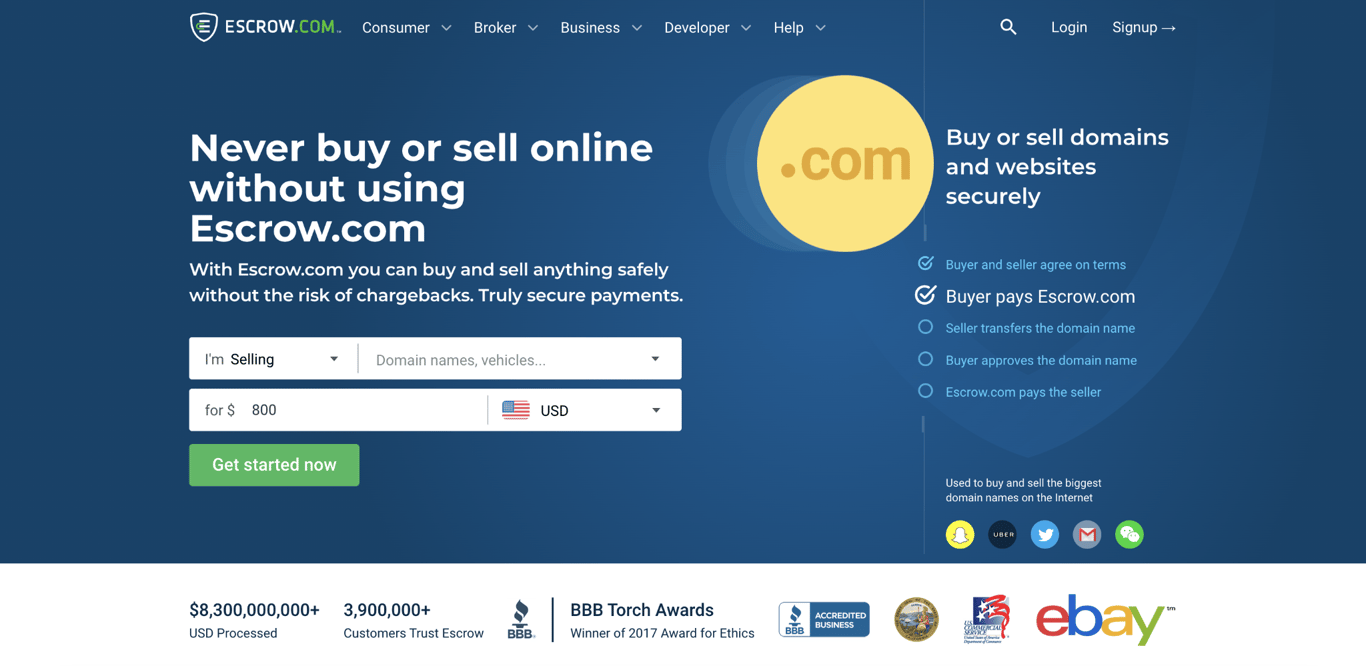
Use an escrow service to protect the payment. Escrow holds the buyer’s money until the domain has been transferred, then releases it to you. Marketplaces such as Sedo and Afternic include this in the sale process. For a direct sale, you can use a licensed service such as Escrow.com.
How you transfer the domain depends on where the buyer wants to keep it. If they use the same registrar, you can often move the domain directly into their account. If they use another registrar, unlock the domain and provide the authorization code, also called an EPP or auth code, so they can start the domain transfer.
Before starting the transfer, check that the domain is eligible to move. A pending or redemption status can block it, and ICANN transfer rules can restrict transfers after a recent registration, transfer, or change to the registrant’s details. Check your registrar’s requirements before changing account or contact information.
Closing one sale well is only half the picture – the domains that don’t sell or that have hidden problems are where domain flipping actually loses money.
What are the risks of domain flipping?
The main risks of domain flipping are buying domains that never sell, incurring ongoing costs while you wait, and facing legal or reputational problems with the names you acquire.
- Overpaying for a low-demand domain. If buyers are not interested in the name, you may never recover what you paid for it. Check comparable sales and identify likely buyers before you purchase.
- Trademark and cybersquatting claims. Registering a domain that uses another company’s trademark can lead to a legal dispute under the Anticybersquatting Consumer Protection Act. Search for existing trademarks and business names before buying. Once you own the domain, use registrar security controls to prevent domain hijacking.
- Problematic history on expired domains. An expired domain may have previously hosted spam, scams, or low-quality content. That history can make the name less useful to a buyer, and using an expired domain mainly to manipulate search rankings through old backlinks can violate search engine spam policies. Check its previous content before you buy.
- Selling fees reduce your profit. Marketplace commissions, listing fees, broker fees, and escrow costs all come out of the sale price. Include them when setting your asking price so you know what you will actually keep.
- Tax obligations. Profit from selling domains may be taxable depending on where you live and how you operate. Keep records of purchase prices, renewal costs, fees, and sales, then check the tax rules that apply to you.
Is domain flipping worth it?
Domain flipping can be worth trying if you can afford to hold domains for a long time, research each purchase carefully, and accept that some names may never sell.
Ask yourself three questions before you start:
- Can you leave money tied up? You will pay to register and renew domains that may take months or years to sell. Do not use money you may need for other expenses.
- Will you research every purchase? Check comparable sales, buyer demand, domain history, and trademark risks before you buy. Skipping these checks increases the chance of paying for a domain nobody wants.
- Can you accept that some domains will not sell? Even a well-researched domain doesn’t have a guaranteed buyer, so you need to be prepared to hold onto names that never sell.
If all three answers are yes, start with a small number of domains rather than building a large portfolio immediately. This keeps your renewal costs manageable while you learn which names attract buyers.
Domain flipping is also one of several ways to make money online, so compare it with options that provide faster or more predictable returns before deciding where to spend your time and money.
For your first domain, use the checks from step two before paying: review comparable sales, identify plausible buyers, check its history if it has one, and search for trademark conflicts. That gives you a stronger basis for deciding whether the domain is worth buying.
Domain Name Checker
Instantly check domain name availability.
This article is a localized version of Domain flipping: What it is and how to get started, originally published in English.

Alma is an AI Content Editor with 9+ years of experience helping ideas take shape across SEO, marketing, and content. She loves working with words, structure, and strategy to make content both useful and enjoyable to read. Off the clock, she can be found gaming, drawing, or diving into her latest D&D adventure.