How to respond to customer reviews
Sep 02, 2026
/
By Ksenija
/
10 min Read

Respond to every customer review with a personalized, professional reply that acknowledges the customer’s feedback and addresses any questions or concerns.
Every response reaches two audiences: the customer who left the review and the people reading it before deciding whether to buy from you.
Taking the time to write a clear, respectful reply can improve the customer’s experience while giving future buyers more confidence in your business.
Following a simple response framework makes replying easier, while tailoring each message to the customer’s specific feedback keeps every response genuine.
AI can also speed up the drafting process, provided every reply is reviewed, fact-checked, and personalized before it’s published.
Why responding to customer reviews matters
Customer reviews shouldn’t end when someone clicks “Post.” Following up with a response keeps the conversation going, giving your business a chance to answer questions, resolve concerns, and leave a positive impression on anyone who reads the exchange later.
Responding consistently to customers:
- Builds trust. A thoughtful response shows that your business listens to customers and values their experiences, whether they’re sharing praise or raising concerns.
- Shows responsiveness. Replying promptly demonstrates that you’re actively engaged and willing to answer questions, address issues, or provide additional support.
- Encourages repeat business. Thanking satisfied customers and following up on concerns helps maintain positive relationships and gives customers another reason to choose your business again.
- Demonstrates accountability. Acknowledging mistakes, explaining improvements, or outlining the next steps shows that your business takes customer feedback seriously.
- Creates opportunities to resolve issues. Responding to a negative review can turn an unhappy customer into a satisfied one by continuing the conversation and working toward a solution.
- Strengthens your reputation. Potential customers often read review responses before making a decision. Professional, respectful replies show how your business treats customers, even when problems arise.
Simply put, businesses that actively respond to reviews can use customer feedback to strengthen buyer trust, improve products, and identify recurring customer concerns.
How to respond to any customer review
Following the same basic response structure helps you stay consistent while leaving plenty of room to personalize every reply.
Step 1: Thank the customer
Start by thanking the customer for taking the time to leave a review, regardless of whether it’s positive, neutral, or negative.
A simple acknowledgment shows that you value feedback and are willing to engage with it.
Keep the opening genuine and appropriate for the situation. A customer who shares a great experience deserves enthusiastic appreciation, while someone who had a poor experience should receive a more measured, empathetic thank-you for bringing the issue to your attention.
For example:
- Positive review: “Thanks so much for your wonderful review! We’re thrilled to hear you enjoyed your experience, and we appreciate you taking the time to share it.”
- Negative review: “Thank you for letting us know about your experience. We appreciate you bringing this to our attention.”
Step 2: Address their specific feedback
After thanking the customer, respond to what they actually wrote. Mention a product, service, team member, feature, or issue they included in their review.
Generic responses like “We appreciate your feedback” or “Thank you for your review” don’t tell the customer, or anyone else reading the review, that you’ve understood their experience.
Even a brief reference shows that you’ve read their feedback carefully and aren’t sending the same response to everyone.
If a customer writes, “The same-day delivery was much faster than I expected,” don’t reply with, “Thanks for your feedback.” Say something like, “We’re delighted our same-day delivery helped you get your order when you needed it.”
A review that says, “I waited 30 minutes for support and couldn’t resolve my issue,” deserves a reply such as: “We’re sorry you had to wait so long to reach our support team. We understand how frustrating that must have been, and we’d like to help resolve the issue as quickly as possible.”
Step 3: Offer a next step
A response should move the conversation forward whenever the customer asks a question, reports a problem, or shares feedback that needs follow-up.
Explain what will happen next so the customer knows what to expect.
If a customer asks whether a product will be back in stock, reply with something like: “The item is expected to be available again next week. If you’d like, we can let you know as soon as it’s back in stock.”
A review that mentions a faulty product should trigger a response such as: “We’re sorry the product arrived damaged. Please contact our support team with your order number so we can arrange a replacement or refund.”
When a customer points out a recurring issue you’ve already addressed, explain what changed. For example: “Thank you for bringing this to our attention. We’ve updated our checkout process to prevent this issue from happening again.”
Give customers a direct way to continue the conversation when appropriate. If you need account details, order information, or other personal information to investigate the issue, invite the customer to contact you through email, phone, or a support ticket rather than discussing those details in a public review.
Step 4: End professionally
A professional closing leaves the customer with a positive final impression and signals that the conversation has reached a thoughtful conclusion.
After addressing the customer’s feedback and outlining any next steps, finish with a warm closing that matches the tone of the review.
A positive review might end with: “Thanks again for your kind words. We look forward to welcoming you back soon!”
A response to a negative review could close with: “We hope to have the opportunity to provide you with a better experience in the future.”
Complete the response with a professional sign-off, such as “Best regards,” “The [Business name] team,” or “Customer Support at [Business name].”
Using the same sign-off across all responses helps create a consistent brand voice while still allowing each reply to feel personal.
How to respond to positive reviews
A response to a positive review reinforces the customer’s decision to choose your business and encourages them to return or recommend you to others.
Keep these best practices in mind when responding to positive reviews:
- Match the customer’s enthusiasm. A glowing five-star review deserves a warmer response than a simple “Good service.” Let your tone reflect the customer’s excitement without sounding exaggerated.
- Expand on the positive experience. Mention the benefit the customer highlighted and explain that you’re pleased it met their expectations. This reinforces the experience for both the reviewer and future customers.
- Strengthen the relationship. Let the customer know you value their support and appreciate them taking the time to leave a review.
- Invite them back. End with a warm message that encourages the customer to visit again or try another product or service.
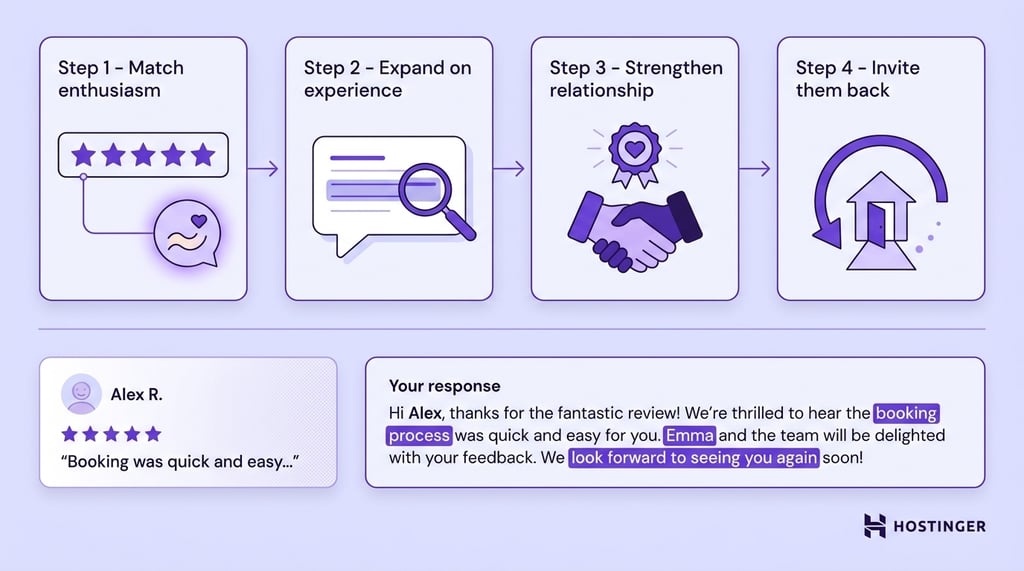
Response example:
Customer review: "Booking an appointment was quick and easy, and Emma made me feel welcome from the moment I arrived. I'll definitely be back!"

Response: “Thank you so much for your wonderful review!

We're delighted to hear the booking process was smooth and that Emma helped make your visit such a positive experience.

We'll be sure to share your kind words with her. We truly appreciate your support and look forward to seeing you again soon!”
Mentioning the booking process and recognizing Emma by name shows that the business paid attention to the review, while sharing the compliment with the team acknowledges good service.
The closing reinforces the relationship by expressing appreciation and welcoming the customer back.
How to respond to neutral reviews
Neutral reviews often come from customers whose expectations were only partly met. They usually mention something they liked alongside something that could have been better.
A thoughtful response can answer questions, clear up misunderstandings, and encourage the customer to give your business another chance.
When responding to a neutral review, focus on these best practices:
- Acknowledge both the positive and the negative. Recognize what the customer enjoyed before addressing the part of the experience that fell short. Responding to only one side of the review can make your reply feel incomplete.
- Answer any concerns or questions. If the customer mentions unclear pricing, confusing instructions, or limited product options, provide the information they were missing or explain how they can get additional help.
- Clarify misunderstandings respectfully. If the review contains incorrect information, explain the situation politely and stick to the facts. Avoid arguing or suggesting the customer is wrong.
- Invite the customer to give you another chance. A friendly invitation to return shows that you value their feedback and are committed to providing a better experience next time.
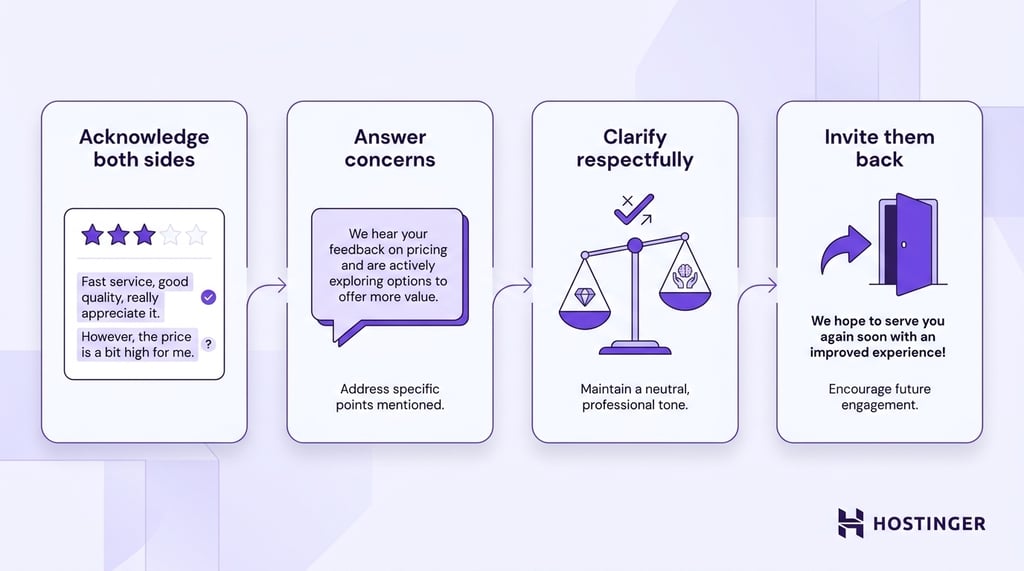
Response example:
Customer review: "The food was good, but the menu didn't clearly show which dishes were vegetarian, so ordering took longer than expected."

Response: “Thank you for sharing your feedback.

We're glad you enjoyed the food, and we're sorry the menu made choosing a meal more difficult.

We've shared your comments with our team as we continue improving the menu, and our staff is always happy to recommend vegetarian options if you visit again. We hope to welcome you back soon.”
The response works because it addresses every part of the review. It acknowledges the positive experience, responds directly to the customer’s concern, explains how the feedback will be used, and ends with a friendly invitation to return.
How to respond to negative reviews
A negative review should be met with a calm, professional response, even when the criticism is unfair.
Your reply shows both the reviewer and future customers how your business responds when something goes wrong.
When responding to negative reviews, try to:
- Acknowledge the customer’s experience. Even if you disagree with some details, recognize that the customer had a disappointing experience. Feeling heard is often the first step toward resolving a complaint.
- Apologize when appropriate. A sincere apology can acknowledge the customer’s frustration without admitting fault. For example, “We’re sorry your visit didn’t meet your expectations” shows empathy while leaving room to investigate what happened.
- Avoid becoming defensive. Public arguments rarely change the customer’s mind and can discourage potential customers who read the exchange later. Keep your response calm, respectful, and focused on finding a solution.
- Explain what happens next. Tell the customer how you’ll investigate the issue, who will follow up, or what steps they can take to resolve the problem.
- Move detailed discussions offline. If you need order details, account information, or other personal information, ask the customer to continue the conversation through a private channel. For example, give customers a direct way to continue the conversation by sharing a dedicated support email address or business phone number.
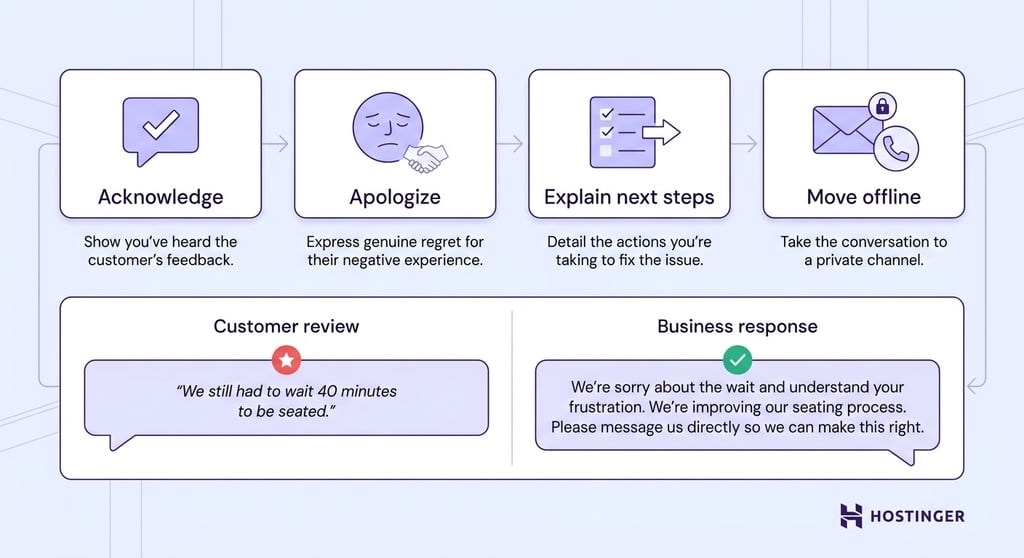
Response example:
Customer review: "I booked a table for my anniversary, but we still had to wait 40 minutes to be seated. By the time we ordered, the evening felt rushed and disappointing."

Response: “Thank you for sharing your feedback.

We're sorry your anniversary celebration didn't go as planned, especially after making a reservation. We'd like to understand what caused the delay and see how we can make this right.

Please contact us at support@example.com or call (555) 123-4567 so we can look into your reservation and discuss a suitable resolution.”
The response begins by acknowledging the customer’s disappointment and offering a sincere apology. It then explains how the business plans to investigate the issue, giving the customer a clear idea of what will happen next.
Ending with a private contact method keeps personal information out of the public review while making it easier to discuss the issue in more detail.
How to respond to inaccurate reviews
People can misunderstand a policy, confuse your business with another one, or remember an experience differently.
Correct factual errors politely and focus on helping the customer understand what happened.
When responding to an inaccurate review, do the following:
- State the correct information clearly. Explain the facts without overwhelming the customer with unnecessary details. If relevant, refer to your business policy, booking records, or other information that helps clarify the situation.
- Remain respectful. Assume the misunderstanding was unintentional and keep your tone professional throughout the response.
- Invite the customer to continue the conversation privately. If you need to review an order, reservation, or account, ask the customer to contact you directly so you can investigate further.
- Avoid public arguments. Repeating the same points or challenging the customer’s version of events rarely changes the outcome and can discourage potential customers from reading the exchange.
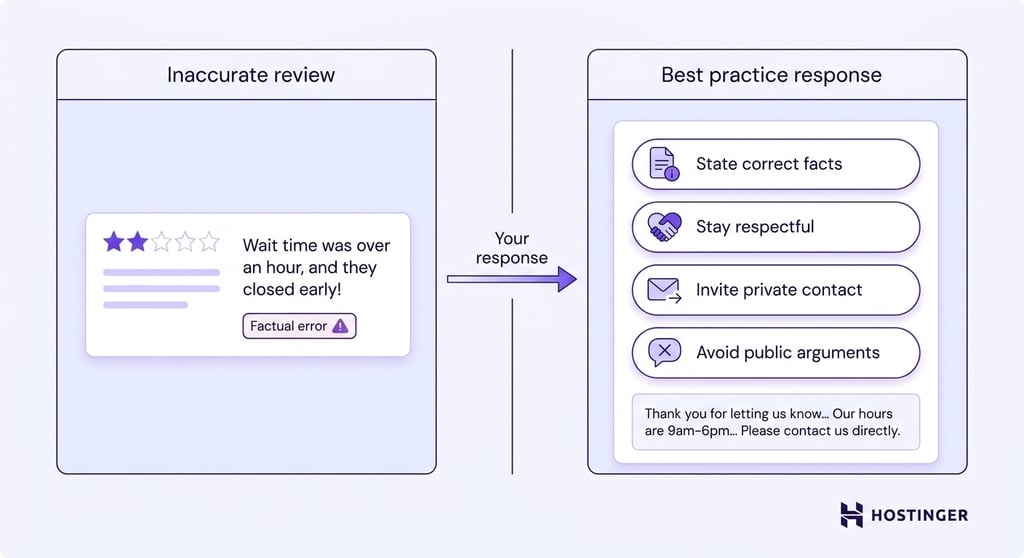
Response example:
Customer review: "Your website said you were open until 8 p.m., but the store was already closed when I arrived at 7 p.m."

Response: “Thank you for letting us know about your experience.

We're sorry you arrived expecting us to be open. Our weekday opening hours are 9 a.m. to 6 p.m., and our website currently reflects those hours.

We'd like to understand where you saw the incorrect information, so please contact us at support@example.com or call (555) 123-4567. We'll be happy to look into it with you.”
The response corrects the factual error without questioning the customer’s honesty.
It explains the business’s opening hours, acknowledges the customer’s frustration, and invites further discussion through a private channel in case the incorrect information appeared somewhere else.
How to respond to fake reviews
Fake reviews require a different approach because the goal is to protect your business’s credibility while following the review platform’s policies.
Before responding, make sure the review is genuinely fake. Not every suspicious review is fraudulent, so review your records carefully before reporting or responding.
Focus on the following principles:
- Stay professional. A calm, respectful response reassures potential customers that your business handles difficult situations professionally.
- Avoid emotional responses. Don’t accuse the reviewer of lying or engage in a public argument, even if you’re confident the review is fake.
- Report the review using the platform’s procedures. Most review platforms let businesses report reviews that violate their policies. Submit any supporting evidence requested and allow the platform to investigate.
- Provide factual clarification. Briefly explain why the review doesn’t match your records or customer interactions without turning your response into a lengthy rebuttal.
- Avoid sharing private customer information. Never publish order details, payment records, account information, or other personal data to prove that a review is fake.
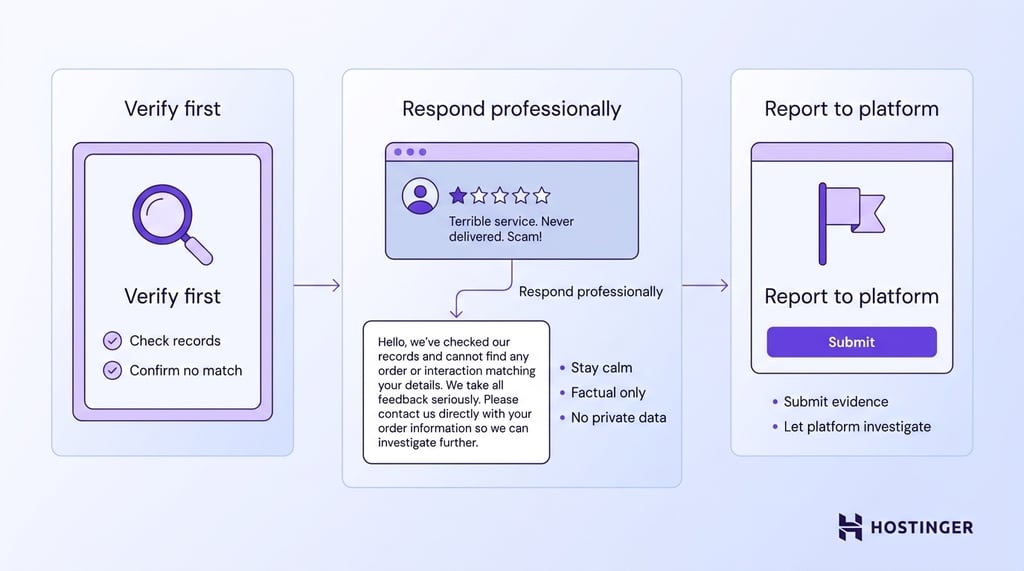
Response example:
Review: "This company charged my credit card twice and ignored every email I sent."

Response: “We're sorry to hear about your concerns.

We've carefully reviewed our records but haven't been able to find any order or customer interaction matching the details in your review.

We've reported this review to the platform for investigation because we believe it doesn't reflect a genuine customer experience.

If you believe there's been a mistake, please contact us at support@example.com so we can investigate further.”
The response stays calm and factual throughout. It explains why the business believes the review is fake, avoids sharing private information, and follows the platform’s reporting process.
Common mistakes when responding to reviews
Even a well-intentioned response can damage customer trust if it appears unprofessional, dismissive, or unrealistic.
The following mistakes are among the most common and can reduce the effectiveness of your response:
- Responding emotionally. A defensive or angry reply can escalate the situation and leave potential customers with a worse impression than the original review.
- Using generic templates. Responses that sound copied and pasted make customers feel that their feedback wasn’t read or valued.
- Ignoring reviews. Failing to respond suggests that customer feedback isn’t a priority, especially when questions or complaints remain unanswered.
- Arguing publicly. Lengthy back-and-forth discussions rarely resolve disagreements and can shift attention away from your business toward the conflict itself.
- Revealing customer information. Sharing order details, account information, or other personal data in a public review can violate customer privacy and damage trust.
- Promising something you cannot deliver. Offering refunds, discounts, or solutions that never happen creates additional disappointment and can lead to even more negative feedback.
Can AI help respond to customer reviews?
Businesses that receive a high volume of reviews can use AI to draft faster, more consistent review responses and create reusable templates for common situations.
AI can also adjust the tone to suit different situations, such as thanking satisfied customers or responding professionally to complaints.
Hostinger’s AI customer service agent helps businesses manage customer communication more efficiently.
The agent can:
- Draft responses to customer reviews.
- Generate reusable templates for common review scenarios.
- Rewrite or refine responses before publishing.
- Produce consistent first drafts when responding to large numbers of reviews.
You can use AI to improve customer communication, but every AI-generated response should still be reviewed before it’s published.
Personalize the draft with details from the customer’s review, verify that all information is accurate, and adjust the wording where necessary.
See how customer communication agents work to understand where you can fit them in your workflow.
Turn customer reviews into business improvements
The insights customers share can help you identify recurring issues, improve your products or services, and make better business decisions.
Set aside time to review new feedback regularly and group similar comments together.
Recurring complaints about delivery times, product quality, customer support, or unclear instructions often point to problems that affect more than one customer.
Positive reviews can reveal the products, services, or experiences that customers value most, helping you understand what to maintain and promote.
Once you’ve identified a recurring trend, share it with the team responsible for addressing it.
Support teams can improve help documentation, product teams can prioritize fixes or new features, and operations teams can investigate issues affecting fulfillment or service quality.
Tracking whether the same feedback appears less frequently over time helps you measure the impact of those improvements.

Ksenija is a digital marketing enthusiast with extensive expertise in content creation and website optimization. Specializing in WordPress, she enjoys writing about the platform’s nuances, from design to functionality, and sharing her insights with others. When she’s not perfecting her trade, you’ll find her on the local basketball court or at home enjoying a crime story. Follow her on LinkedIn.