How to start an online thrift store in 12 steps
Oct 13, 2026
/
By Alma & Simon L.
/
11 min Read
To start an online thrift store, pick a product category you can reliably source, choose where to sell (a marketplace, your own ecommerce site, or both), and build listings detailed enough that buyers feel confident purchasing without seeing the item in person.
An online thrift store is one of the lower-cost ways to start an online business. You’re buying inventory for a few dollars and reselling it at a markup, with no manufacturing or wholesale minimums.
But it works differently from a typical ecommerce store. Every item is one-of-a-kind, so you can’t restock a bestseller. Sourcing takes ongoing effort, product condition varies, and your photos and descriptions have to replace the hands-on inspection buyers would get in a physical store.
The first few steps on how to start an online thrift store are about validating whether the business can work before you invest heavily. Once you know you can source products and sell them at a profit, the remaining steps cover your storefront, shipping, marketing, and how to grow based on what’s actually selling.
Download website launch checklist
1. Find your niche
Pick a product category you know well enough to spot value, then confirm there are buyers actively looking for it. Vintage band tees, mid-century furniture, retro gaming consoles, and secondhand designer bags are all niches with active buyers and a steady supply.
These three questions can help you narrow your choices:
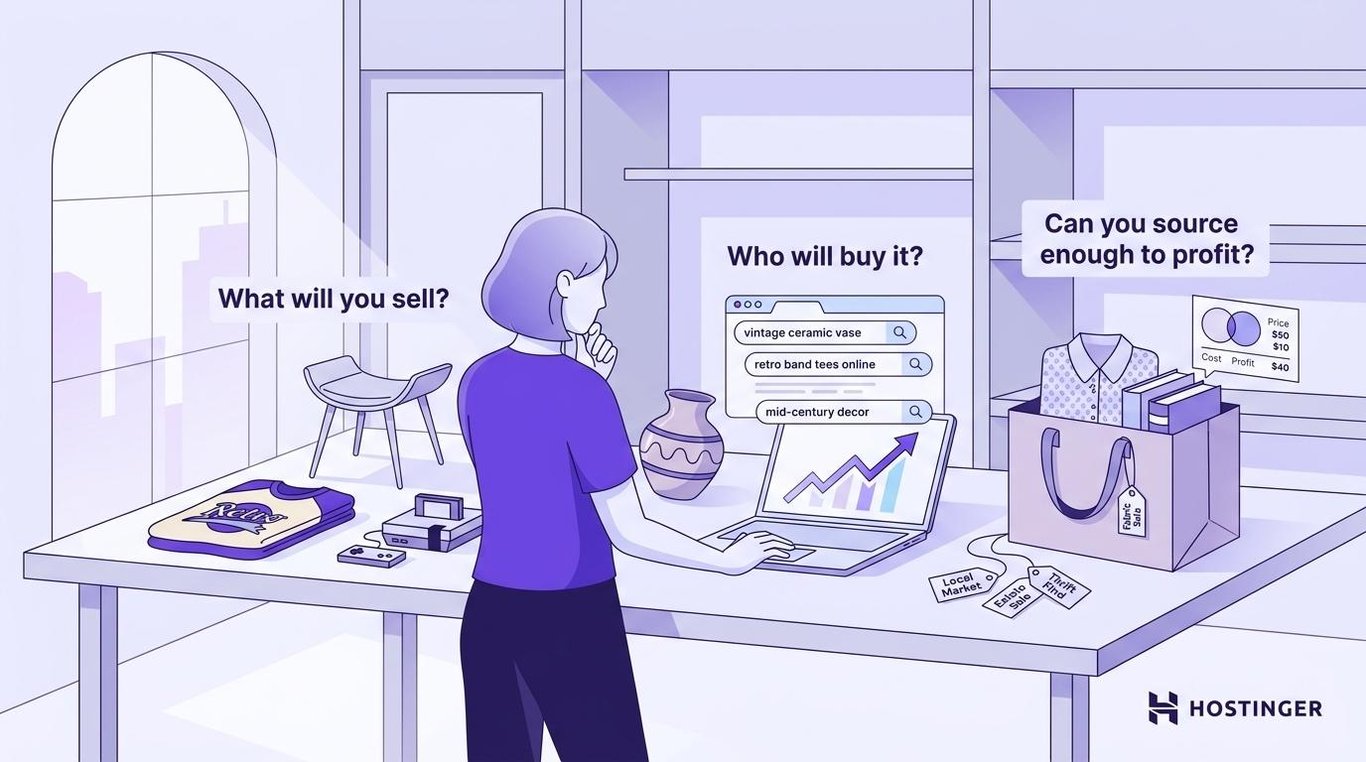
What type of secondhand product will you sell?
Think about categories you know well enough to spot value. Knowing how to tell a mid-century credenza from a mass-produced reproduction, or a genuine band tee from a reprint, for example, gives you an edge in sourcing and pricing.
Who is most likely to buy it?
Look at who’s already buying similar items. Check the profiles of active buyers and sellers on eBay, Poshmark, and Etsy in your category. Are they collectors? Parents looking for deals? Fashion resellers? Vintage enthusiasts?
Knowing this helps you choose the right platform, write descriptions that speak to them, and price appropriately.
Is there enough demand and supply to sustain the store?
Check whether people are actively searching for and buying the items you want to sell. Browse completed listings on eBay and Poshmark to see what actually sells (not just what’s listed). Search Google Trends for your category.
Then check supply: can you find enough of these products locally or online at a price that leaves room for profit? The business model has a problem when every sourcing trip means a three-hour drive.
2. Source your first products
Source your first products from garage sales, estate sales, flea markets, other thrift stores, or wholesalers. Before investing time in building a full store, confirm that you can actually get inventory at a price that leaves enough room for profit.
- Garage sales. Often full of underpriced items, especially in affluent neighborhoods. Arrive early for the best selection.
- Estate sales. These tend to yield higher-quality and vintage items. Check sites like EstateSales.org for upcoming sales in your area. Many are auction-based, so set a price limit before you start bidding.
- Other thrift stores. Visit local stores regularly and build relationships with owners who can let you know when relevant inventory comes in. Stores that are closing or relocating sometimes offer bulk discounts.
- Flea markets. Good for finding undervalued items you can resell at a higher price online. Bring cash to make bargaining easier, and get to know regular vendors who can give you first pick of new stock.
- Wholesalers and liquidation. Companies that sell overstock, closeout, or returned merchandise in bulk. The per-item cost is lower, but you may get a mix of conditions and brands.
Start small. Buy a limited first batch, list it, and see what sells before investing more. This teaches you what your audience actually wants without tying up money in unsold products.
3. Create your brand
To create your brand, pick a store name, a consistent look, and a one-line description that tells buyers what you sell. Thrift buyers can find similar items from thousands of resellers, so your brand is what makes them remember your store and come back.
Choose a name that hints at what you sell and is easy to remember, like Twice Read Books for secondhand books or Analog Again for retro electronics. Before you commit, check that the name is available as a domain name for your ecommerce store and as a username on the social platforms you plan to use. Using the same name everywhere tells buyers your website and social accounts belong to the same store.
Next, keep your look consistent. Use the same photo style for every listing, and match your packaging to your website. A consistent look shows buyers you picked and checked each item, and it does more for a thrift store than an expensive logo.
Finally, write one line that sums up your store, like “Rare vinyl and vintage audio gear.” Use it in your website header, social media bios, and packaging.
4. Handle business and legal requirements
Check what business registration, tax collection, permits, and selling rules apply where you operate. The goal isn’t to become a legal expert. It’s to avoid surprises that could cost you later.
These are the main areas to look into:
- Business structure. Decide whether you’ll operate as a sole proprietor, LLC, or another structure. Some regions require formal registration even for small online businesses.
- Tax obligations. Check whether you need to collect sales tax or VAT on your sales, and understand how to report income from your thrift store.
- Resale permits and licenses. Some locations require a resale certificate, secondhand-dealer license, or similar permit to sell used goods. This is especially common for electronics, jewelry, and branded clothing.
- Restricted items. Certain secondhand products (car seats, cribs, recalled electronics, some cosmetics) may be regulated or prohibited from resale. Check before listing.
- Counterfeit goods. Verify authenticity before listing branded or high-value items. Selling counterfeit products carries legal risk and damages your reputation.
- Marketplace rules. Each platform (eBay, Poshmark, Etsy, your own website) has its own rules about what you can sell and how listings should be formatted. Review these before listing.
- Store policies. Prepare basic privacy and return policies for your store. Buyers expect to see these, and many platforms require them.
Requirements vary, so if you’re unsure whether you need a business license to sell online, check before you start listing.
5. Set up your online thrift store
Set up your online thrift store on a marketplace, your own ecommerce site, or both. Marketplaces are the fastest way to start, while your own store gives you more control and no per-sale marketplace fees.
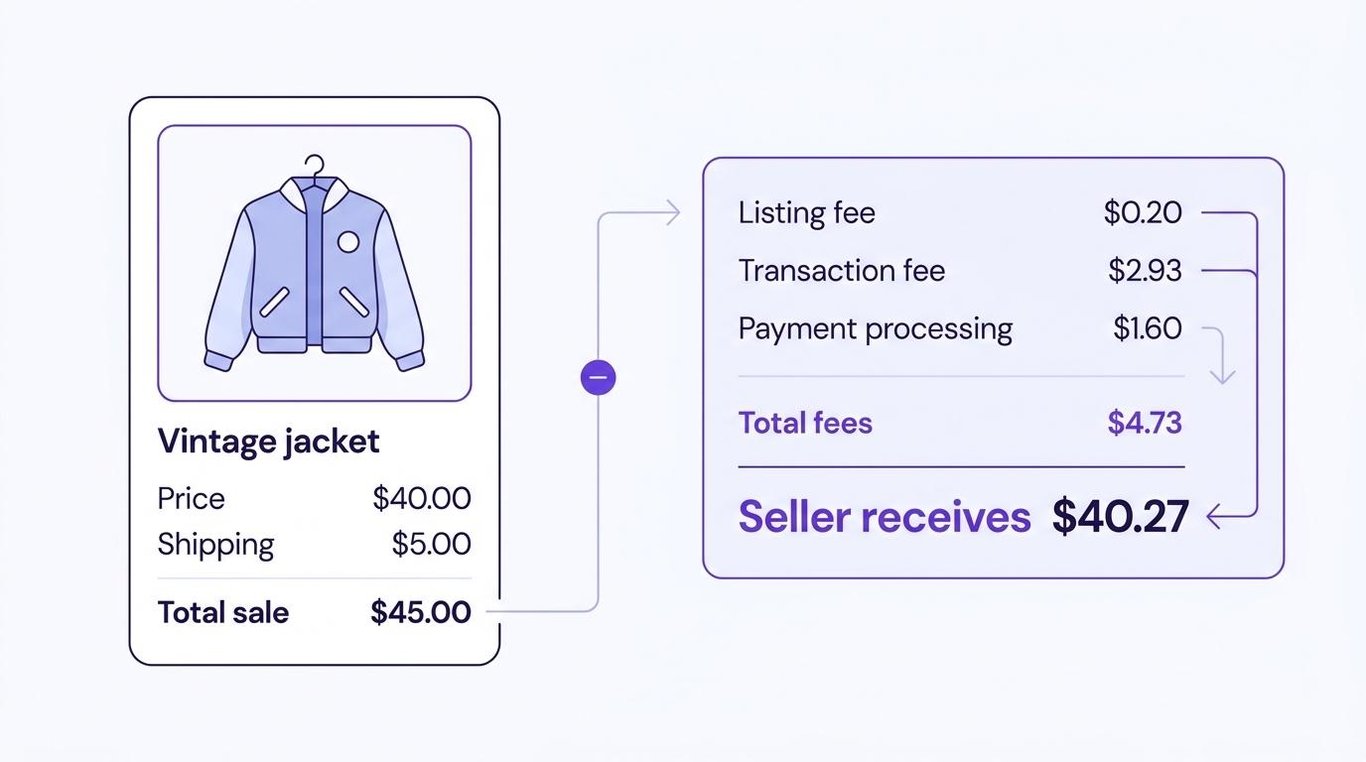
Online marketplaces like eBay, Poshmark, Etsy, and Mercari let you list items without building a website, and they already have buyers searching for secondhand goods. The tradeoff is fees on every sale. On Etsy, a vintage jacket that sells for $40 plus $5 shipping costs about $4.73 in fees ($0.20 listing fee, 6.5% transaction fee, and 3% + $0.25 payment processing). On low-priced thrift items, that takes a noticeable share of your profit.
Your own ecommerce store lets you control your branding, prices, and product pages without paying marketplace transaction fees. But it doesn’t come with buyers, so you’ll need to bring in visitors through search, social media, or other marketing.
Many thrift sellers start on a marketplace to learn what sells, then add their own store later. Others run both at once.
To build your own online store without coding, you can use Hostinger AI Builder. Describe your thrift business, and it creates a storefront you can edit with a drag-and-drop editor. Hostinger Ecommerce keeps your products, inventory, orders, and payments in one dashboard, which helps when every item is one-of-a-kind and sells out after a single order.

6. Store and manage your inventory
Store your inventory in an organized system that makes it easy to find, track, and ship each item. Match your physical storage to your online categories so you can quickly locate products when orders come in.
Secondhand items are harder to replace than new stock, so proper storage also protects your inventory from damage that could make it unsellable.
When you’re starting out, home storage is usually the most practical option. Use a spare room, garage, shelves, or labeled bins to keep products organized.
Here are three more practical tips for managing your inventory:
- Track what you have. Start with a simple spreadsheet listing each product, its category, date acquired, cost, and storage location. This prevents overselling and helps you spot items that have been sitting too long.
- Photograph items before storing them. Take your listing photos as soon as you get the item, while you’re handling it and can inspect it closely. Once it goes into a bin, you’re less likely to pull it back out for a reshoot.
- Check your inventory regularly. Compare your physical stock with your listings at least monthly to catch discrepancies before a buyer orders something you can’t find.
Pro Tip
As your inventory grows, consider moving to a climate-controlled storage unit. This protects items from humidity and temperature changes, which can cause mold on vintage clothing, corrosion on electronics, and warping on wooden furniture.
7. Set up shipping
To set up shipping for your online thrift store, choose a carrier, decide how you’ll charge for shipping, and set clear delivery timelines. Thrift items vary widely in size and weight (a pair of earrings vs. a vintage lamp), so you’ll likely need more than one shipping option.
- Compare carriers. Check rates from USPS, UPS, FedEx, and regional carriers for the sizes and weights you’ll ship most. Many offer discounted rates for small businesses or high volume. USPS flat-rate boxes work well for clothing and small items; oversized or heavy pieces may need freight or local pickup.
- Set your shipping pricing. Decide whether to charge exact shipping, flat-rate shipping, or build shipping into your product prices. A free-shipping threshold (like “free shipping over $50”) can also encourage buyers to add another item.
- Package for secondhand items. Vintage and fragile items need extra protection. Use bubble wrap, tissue paper, and sturdy boxes. Eco-friendly packaging appeals to sustainability-conscious buyers, which overlaps heavily with the thrift audience. The right ecommerce packaging also reinforces your brand when the buyer opens the box.
- Set delivery expectations. Be upfront about how long shipping takes, including your handling time (the gap between receiving an order and actually shipping it). Thrift sellers often need extra handling time to clean, photograph, or re-inspect an item before shipping. Buyers tolerate this when you communicate clearly.
8. Price your products
Price each item by adding up your costs, checking what similar items actually sold for, and setting your price within that range. Sold prices matter more than asking prices, since what sellers ask and what buyers pay are often very different.
Here’s how to price your products:
- Add up your costs. Include what you paid, cleaning or repairs, packaging, shipping (when you cover it), and platform fees. Your price needs to be higher than this total.
- Check sold listings. On eBay, turn on the Sold items filter to see real sale prices. Poshmark shows sold items too.
- Adjust for your item. Compare with current listings, then price up or down for condition, brand, rare details, and season, like winter coats in fall.
- Mark down slow sellers. Lower the price or retake the photos when an item hasn’t sold in 30 days. Unsold items tie up money you could spend on new stock.
9. Create accurate product listings
Create accurate thrift listings by using clear photos, detailed descriptions, and honest condition notes that help buyers understand exactly what they are purchasing. Because shoppers can’t touch, try on, or inspect secondhand items in person, your listing needs to recreate as much of that experience as possible.
Would you buy a $40 jacket online if the listing had one blurry photo, no measurements, and the condition described only as “good”? Most buyers wouldn’t either.
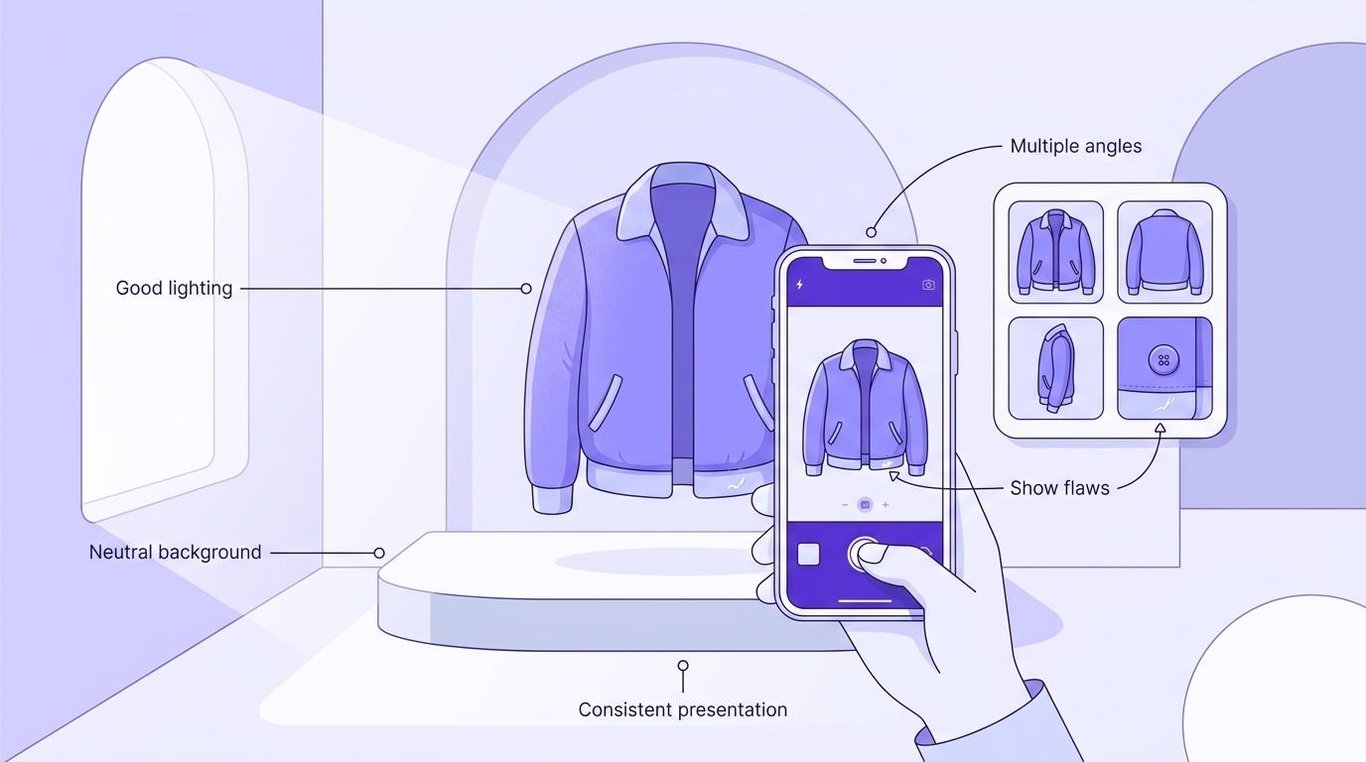
Start with your photos. Show the item clearly enough that buyers can judge its appearance and condition before they buy.
- Use good lighting. Shoot during daylight or use a simple lightbox. Avoid harsh shadows that hide important details.
- Use a neutral background. A plain white, gray, or light background keeps attention on the product.
- Show multiple angles. Include the front, back, sides, and close-ups of details like labels, stitching, hardware, or patterns.
- Photograph flaws. Show stains, scratches, missing buttons, fading, and other signs of wear. Honest photos build trust and reduce returns.
- Keep your presentation consistent. Using the same background, lighting, and photo style across listings makes your store look more professional.
Then, write a description that provides details that photos can’t. Include the item’s type, brand (if relevant), materials, measurements, color, size, and condition.
Be specific about the item’s condition instead of using vague labels. “Good condition” means different things to different buyers. A description like “light pilling on the cuffs, no stains, and all buttons intact” gives shoppers a much clearer idea of what to expect.
Also mention any repairs, alterations, or modifications. Being upfront about changes prevents surprises and helps buyers feel confident when purchasing.
Pro Tip
Use your first batch of listings to learn what information buyers need. Pay attention to the questions they ask, then add those details upfront in future listings.
10. Market your online thrift store
Market your online thrift store on one or two channels where your buyers already spend time, then add more once you know what brings in sales. Every thrift item is one-of-a-kind, so each new find gives you something fresh to post.
These four channels work well for thrift sellers:
- Search engine optimization (SEO). SEO means using the words buyers search for in your product titles, descriptions, and pages so search engines show your store. Specific phrases like “vintage 1970s denim jacket” bring in more ready-to-buy shoppers than broad terms like “jacket.”
- Social media. Instagram, TikTok, and Facebook suit thrift stores because the products are visual. Post new arrivals and sourcing trips to give followers a reason to check back.
- Paid ads. Test Google Ads or social media ads with a small budget, and spend more only on the ads that lead to sales.
- Influencer and affiliate partnerships. Pay creators in the thrift, vintage, or sustainable fashion space a commission for each sale they send you.
11. Provide good customer service
Provide good customer service by answering buyer questions quickly, offering easy ways to reach you, and making your return policy clear. Secondhand buyers ask more questions than buyers of new products, like exact measurements or whether a scratch shows, and your answers often decide whether they buy.
- Respond within 24 hours. Interested buyers are often comparing similar items from other sellers, so a slow reply can lose the sale.
- Offer more than one way to contact you. Email, a contact form, and live chat through WhatsApp or Facebook Messenger cover most buyers’ preferences.
- Publish a clear return policy. State your return window, who pays return shipping, and how refunds work. Secondhand items are more likely to differ from what a buyer pictured, so a fair policy lowers the risk they feel when ordering.
- Answer common questions on your site. An FAQ page covering shipping times, sizing, and how you describe condition saves you from repeating the same answers.
12. Monitor and improve your performance
Monitor your thrift store’s performance by tracking what sells, how fast it sells, and how much profit each item brings in. Once you have enough listings and sales to see patterns, focus on these key metrics:
- Sell-through rate. The percentage of listed items that actually sell. A low rate can mean you’re sourcing the wrong products, pricing too high, or your listings need improvement.
- Days to sell. How long items sit before selling. This shows which products move quickly and which ones tie up your money. Use this information to guide future sourcing and decide when slow movers need better photos, a lower price, or a different approach.
- Margin per item. Your revenue minus all costs (what you paid, fees, shipping, and packaging). Tracking this helps you see which categories and sourcing methods are actually profitable.
- Website traffic and sources. Where your visitors come from (search, social media, direct visits) shows which promotion methods are bringing people to your store.
- Conversion rate. The percentage of visitors who buy something. Your product pages, pricing, or checkout process may need attention when traffic is high but sales are low. Understanding your ecommerce conversion rate can help identify where buyers drop off.
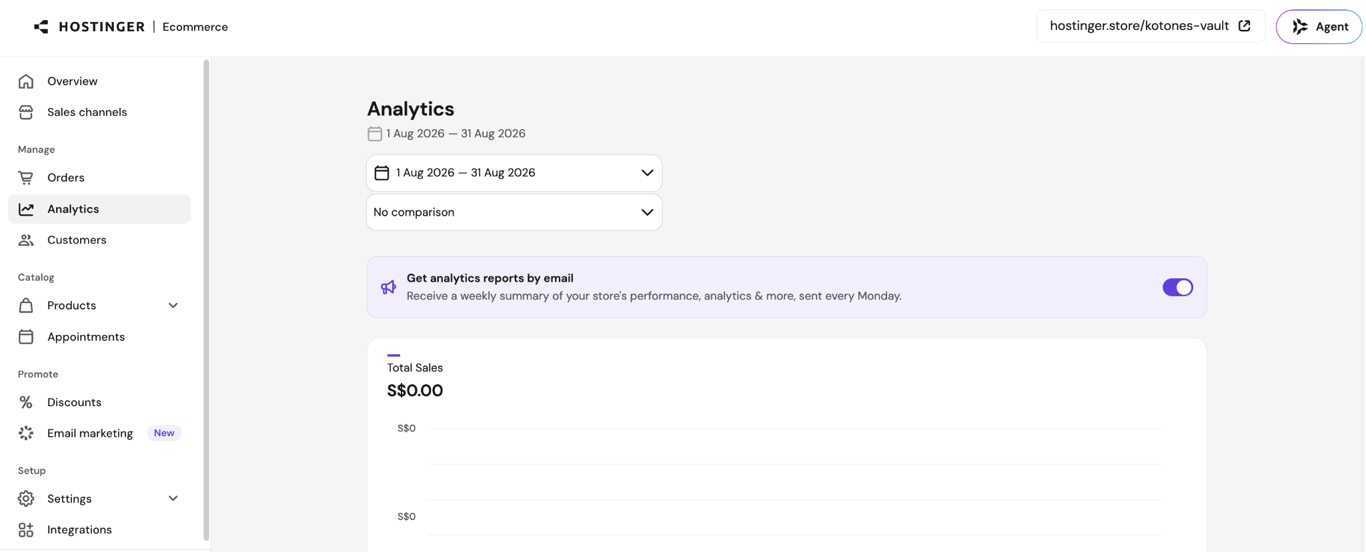
Tools like Google Analytics track visitor behavior for free. On Hostinger, the Ecommerce Store Manager shows daily sales, order history, and performance comparisons in one dashboard.
As your store grows, website optimization and website performance improvements can help pages load faster and keep shoppers from leaving before checkout.
How much does it cost to start an online thrift store?
Starting an online thrift store costs less than most ecommerce businesses. Your product costs are low (secondhand items bought for a few dollars), and you don’t need to manufacture anything.
These are the main startup costs:
- Ecommerce platform or marketplace fees. If you build your own store, Hostinger’s Unlimited plan starts at $3.99/month (48-month term) with no transaction fees. If you sell on marketplaces, expect per-listing and per-sale fees instead.
- Initial inventory. This is the highest controllable cost. A focused first batch of 20 to 50 items from garage sales or thrift stores can cost anywhere from $50 to $500, depending on the category.
- Domain name. A domain typically costs $10 to $15/year. Hostinger plans include one free for the first year.
- Packaging and shipping supplies. Boxes, bubble wrap, tape, and labels typically cost $50 to $100 to stock up on initially.
- Business registration and permits (optional). Costs vary by location, from free to a few hundred dollars.
All in, you can launch a small online thrift store for under $300 if you start with a modest inventory and use a platform that bundles hosting, domain, and ecommerce tools together. Since the initial inventory size is the biggest variable, start small and reinvest profits as you learn what sells.
Is an online thrift store profitable?
An online thrift store can be profitable. Whether yours is depends on one formula: Profit per item = selling price − what you paid − fees − shipping and packaging − overhead
Here’s what that looks like in practice. You buy a vintage jacket for $5 at a garage sale, spend $3 on packaging and shipping, and sell it on your own site for $35. After the fee your payment provider charges (typically around 3%), your profit on that item is roughly $26.
What determines your margin most is how cheaply you can source relative to what the market will pay. Items you find for $1 to $5 and sell for $20 to $50 create healthy margins. Items you overpay for at $15 to $20 and struggle to sell for more than $25 don’t.
What should I focus on once my thrift store is up and running?
Once your store is live, your main focus should shift from adding more inventory to learning what actually works. Use your sales data to decide what to source, what to improve, and where to spend your time. Sell-through rate, days to sell, and margin per item show which products are worth buying again and which ones tie up your money.
Use those insights to guide your next sourcing trips. Prioritize categories or brands that consistently sell quickly with healthy margins. Stop buying products that sit for weeks, and clear out existing stock with better photos, lower prices, or markdowns.
Once you know what sells, focus on bringing buyers back. Follow up after purchases, ask for reviews, and stay active on the channels that already bring you customers. Repeat buyers are often easier to reach than new shoppers, and they become a reliable source of future sales as you find more ways to increase sales online.

This article is a localized version of How to start an online thrift store in 12 steps, originally published in English.

Alma is an AI Content Editor with 9+ years of experience helping ideas take shape across SEO, marketing, and content. She loves working with words, structure, and strategy to make content both useful and enjoyable to read. Off the clock, she can be found gaming, drawing, or diving into her latest D&D adventure.

Simon is a dynamic Content Writer who loves helping people transform their creative ideas into thriving businesses. With extensive marketing experience, he constantly strives to connect the right message with the right audience. In his spare time, Simon enjoys long runs, nurturing his chilli plants, and hiking through forests. Follow him on LinkedIn.