How to become a web developer from scratch
Mar 10, 2026
/
Hasna A.
/
11 min Read
Web development is a popular career choice that’s continuously in high demand. This is because web development professionals create websites and applications – a regular staple of everyday modern life.
According to the US Bureau of Labor Statistics, employment of web developers is projected to grow by 13% from 2020 to 2030 – significantly faster than the average of all occupations.
This article is an in-depth guide for anyone interested in a dynamic and lucrative career in web development. We’ll explain each step toward becoming a web developer and the benefits of becoming one. We’ll also answer some frequently asked questions about web development.
Learn How to Become a Web Developer with Hostinger Academy
Learn how to become a web developer by following these simple steps!

Let’s go over each step in more detail.
How to Become a Web Developer
How to Become a Web Developer
1. Research a Career in Web Development
2. Choose a Web Development Specialization
3. Learn Programming Languages
4. Attend Web Development Courses and Boot Camps
5. Gain Experience to Build an Online Portfolio
6. Apply for Web Developer Jobs
Before getting into web development as a career, it’s important to know what it takes to become one and how to get there. Here’s how to become a web developer in six steps:
1. Research a Career in Web Development
Before cementing your career path in web development, make sure that making websites for a living is what you truly want to do.
Like any other career option, doing something you’re passionate about will improve your chances of success and work quality. Web developers build websites by writing code, so a passion for computer science and programming languages will help.
Here are several tips to help you decide whether a career in web development is right for you:
- Consider your skills. Learning web development requires patience, resourcefulness, adaptability, logical thinking, and creativity. If you possess these characteristics, web development may be right for you.
- Talk to a career counselor. Consulting a professional can help you organize a career plan and identify what it will take to accomplish your goals. They can also help you discover alternatives better suited to your abilities.
- Have a chat with industry professionals. Senior web developers are the best people who can answer your questions about choosing this career path. They can tell you how to avoid common mistakes most web developers make when they start out.
- Research its cons. Despite a flexible work environment, a web developer tends to experience frequent eye strain and back pain due to sitting for long periods. If a sedentary lifestyle doesn’t sound appealing, this career path may not be for you.
- Know the required tools. Be ready to learn the necessary tools such as Sublime Text, version control software like Git and GitHub, Chrome Developer Tools, and jQuery.
2. Choose a Web Development Specialization
In general, there are three different areas within web development to specialize in.
A front-end web developer role focuses on the website’s visual elements that users directly interact with. They make sure that each visual element is functional, user-friendly, and aesthetically pleasing.
The visual elements front-end web developers create include buttons, layouts, navigation, and animation. Usually, a front-end web developer will receive web design made by the web or UX/UI designer and make it a reality.
Front-end developers are expected to know their way around HTML, CSS, and JavaScript. They should also know frameworks and libraries like React.js and jQuery.
A back-end web developer focuses on the part of the website that isn’t seen by the user but is essential to the website’s functionality and performance.
Back-end developers focus on the website’s server-side. Their job includes database management, writing code, and utilizing frameworks. They work alongside front-end developers to make sure that the website’s visual elements function correctly and efficiently.
Back-end developers use server-side coding languages like PHP, C++, Java, Ruby, Python, and Node.js. They are also expected to know back-end frameworks such as Express, Laravel, and Spring.
Finally, a full-stack developer is a web developer that’s well-versed in both the front-end and back-end of a website or web application. Full-stack development experts are a great asset because they can build a website on their own and fix issues of any part of the website.
Many full-stack developers specialize in either the front-end or back-end of web development first. In time, you can learn the other necessary skills to master both the front-end and back-end of web development.
Becoming a front-end web developer requires graphic design knowledge and a deep understanding of user behavior. In comparison, a successful back-end developer possesses logic and critical thinking skills. Make sure that the specialization you choose fits your passion and abilities.
3. Learn Programming Languages
Each website or web application is built using various software applications and computer programming languages. For an aspiring web developer, learning the essential programming tools is a must.
Here are some of the most popular programming languages you can learn that employers will expect a web developer to know:
- HTML. Short for HyperText Markup Language, HTML is the backbone of web development as it defines the structure of a webpage’s content. For example, HTML determines which sections of a page are the title, headings, and body text.
- CSS. Cascading Style Sheets goes hand-in-hand with HTML as it is used to describe how the HTML document will be presented to the end-user. With CSS, you can alter a web page’s font, color, background, and other visual elements.
- JavaScript. It is a coding language that allows interaction between a website and its users. For instance, developers can use JavaScript to create interactive images and carousels.
- PHP. It’s a server-side programming language used to develop dynamic and interactive websites and applications. For example, PHP lets you send and receive cookies to personalize web content and collect form data.
- Java. Java is a server-side programming language often used for website and mobile app development. It is also popular for creating applets or small applications that run as part of web pages.
- Python. Python is a programming language designed for many tasks, including website and application development. In web development, it is used to build server-side web applications. It is considered one of the most accessible programming languages.
4. Attend Web Development Courses and Boot Camps
After familiarizing yourself with the chosen web development specialization, the next step is to dive deeper into it. Get started by taking online courses and attending coding boot camps to develop your web developer certification.
We recommend starting with free classes to make your web developer career journey less financially demanding should you change your mind later. Here are some of our most recommended free web development courses:
- Web Development Full Course – 10 Hours | Learn Web Development from Scratch by Edureka
- Web Design for Everybody: Basics of Web Development & Coding Specialization by the University of Michigan
- JavaScript Programming – Full Course by Free Code Camp
- PHP For Absolute Beginners | 6.5 Hour Course by Traversy Media
- Python Tutorial – Python for Beginners [Full Course] by Programming with Mosh
Additionally, programmer forums like Stack Overflow are also an excellent free resource.
For aspiring web developers who want to go even further, consider purchasing paid courses and attending coding boot camps. Coding boot camps are generally intensive training programs that prioritize practical skills and guarantee job placements.
We recommend the following paid web development boot camps and courses:
- The Web Developer Bootcamp 2022 by Colt Steele
- The Complete Web Developer Course 2.0 by Rob Percival
- Full-Stack Track by iO Academy
- Software Development Training Program by Alchemy Code Lab
- Full-Stack Web Development Program by Career Foundry
- Software Engineering Bootcamp by Thinkful
- HTML, CSS, and JavaScript for Web Developers by John Hopkins University
- 2022 Complete Python Bootcamp From Zero to Hero in Python by Jose Portilla
For aspiring web developers who have the budget and time, obtaining a bachelor’s degree in computer science is another option. Although having a bachelor’s degree isn’t necessary, it can add credibility to your resume.
Another option is to attend short computer science courses and obtain web development certifications. For example, many web developers take the Microsoft Certified Solutions Developer (MCSD) exam annually. This increases the chances of finding a job.
To choose the best web development boot camp, course, or training program for you, consider these criteria:
- Intensity level. Part-time programs last longer than full-time courses because they’re held on nights and weekends. This allows people with other commitments to participate at a slower pace.
- Accessibility. An in-person program provides hands-on learning, while an online program offers more options regardless of your location. Meanwhile, a self-paced program is best for beginners with a specific learning style that requires flexibility.
- Experience. Make sure to check the course or boot camp’s level requirement to ease your learning process. Start with beginner-level programs until you master the basics, then proceed to the next level to deepen your skills gradually.
- Tuition. Many web developer programs, especially boot camps, offer Income Share Agreements (ISA), in which the program fees will depend on the person’s salary after completing the course. However, many boot camps provide their services for a one-time payment.
- Course type. Make sure to review the program’s learning materials before joining it. Some only focus on a specific topic rather than web development as a whole.
- Tutor. Since courses and boot camps don’t have fixed curriculums like traditional schools, there’s little control over their tutors’ certification requirements. Contact the program’s organizer to cross-check their mentorship abilities.
Keep in mind that while gaining knowledge through courses and boot camps is essential, practicing web development is how you’ll refine your skills.
Try to create your own project while you’re learning so that you’ll know for sure that you’ve absorbed the material. By practicing, you’ll also discover which specialization you prefer and which areas you need to improve at.
5. Gain Experience to Build an Online Portfolio
After learning and practicing web development skills, it’s time to gain some real-life work experience. This will familiarize you with the industry, further enhance your computer programming skills, and increase employability.
The easiest way to start is to take volunteer jobs. For example, you can create a simple business website for a local store or build a site to promote local events.
You may work for free, but your experience will be a valuable asset in your job search. Plus, you’ll get to contribute to your community.
Additionally, you can try building new projects using low-cost hosting solutions to gain more experience. Then, once you’re more comfortable, you can consider choosing web hosting for freelancers to scale your projects.
Another way to gain experience is to do freelance web development work. Promote your services on freelance marketplaces like Fiverr and PeoplePerHour, and apply for small web development projects.
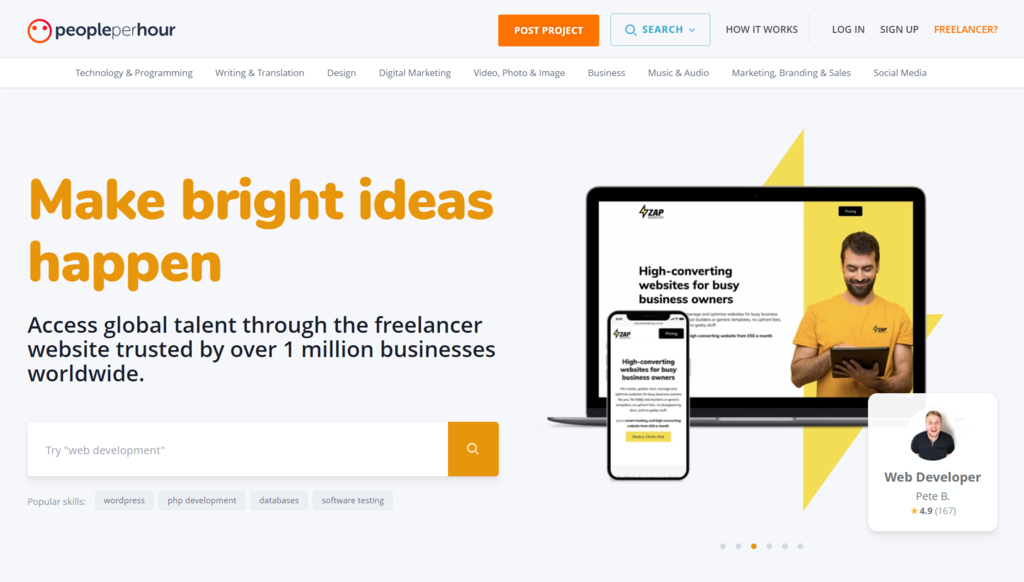
It may take some time to gain customers initially, but this will improve with time and experience.
Alternatively, participate in open-source projects and collaborate with other web developers. This is ideal for honing your coding skills and networking with fellow professionals. GitHub is an excellent platform for open-source projects.
While absorbing as much experience as possible, don’t forget to document it in an online coding portfolio.
An online portfolio is a digital representation of your competencies, experience, and achievements. Having one will help track your career progress and showcase your credibility as a professional web developer during job interviews.
The best way to show this information is to create a website from scratch. Aside from your portfolio’s content, the website itself will be an opportunity to impress prospective clients with your web development skills.
You will need a hosting plan and a domain name to get your website online. Hostinger offers a wide variety of hosting options starting from CA$ 4.19/month. All of our hosting plans have a 99.9% service uptime guarantee, ensuring your online portfolio stays online all the time.
When building your web developer portfolio, consider the following tips:
- Use a clean, responsive design. A well-designed website is accessible on all screen sizes, improving user experience and search engine ranking performance. When in doubt, keep the web design simple and highlight the content.
- Get the right domain name. If possible, use your name in the domain name. Otherwise, secure a unique domain that still reflects you as a professional. Consider pairing it with a .dev domain extension.
- Link to your projects. Instead of just describing your work, provide a table of contents with access to each project via GitHub or BitBucket. Make sure to provide context by explaining what you did and who you worked with.
- Only display the best projects. Allowing potential clients and employers to see your work without spending too much time browsing through many web pages will increase your chances of being hired.
- List specialized skills. Since your goal is to stand out from the competition, displaying the programming languages and web development skills you’ve mastered will add clarity and boost your credibility. Don’t forget to include any relevant certifications you have earned.
- Add personality. To make a lasting impression on potential clients and employers, take advantage of the About page to share your passions, biography, and a professional photo.
6. Apply for Web Developer Jobs
Now that you have what it takes to become a web developer, it’s time to apply for job postings in the web development field.
You can find them on various job portals like Glassdoor and Indeed or companies’ official websites. Alternatively, offer your web development services on freelance websites or work in a WordPress development agency.
Joining web development communities will expose you to more job opportunities and help you network with fellow professionals. Some of the most popular forums for web designers and developers are Designer Hangout, Digital Point, WebDeveloper.com, and CoffeeCup.
Whichever job-seeking method you choose, here are some factors to consider when looking for a job:
- Career advancement opportunities. It’s best to seek job opportunities to build your web developer resume towards higher career levels.
- Salary. Research the average web developer salary rate for the exact position you’re applying for. Then, check whether the company offers any benefits, such as health care, bonuses, and insurance.
- Company culture. Look for company reviews to see whether the organization has a favorable environment that aligns with your values and expectations. There’s nothing more discouraging than working in a toxic environment.
- Working hours. A lot of web developers work overtime, so make sure the company is willing to compensate for your efforts adequately.
- Company stability. Working with a stable company will help maintain your stress levels and ensure steady pay and benefits.
Keep in mind that employment scams are still common on job portals. Here are some warning signs a job offer could be a scam:
- Requires no web developer skills or experience.
- Offers an unreasonably high salary.
- Unprofessional web design and bad spelling.
- Requests advance payment for training.
- Submitted using a free, personal email instead of a business email.
Be sure to cross-check any job vacancy you want to apply for with the development company that supposedly published it.
Benefits of Being a Web Developer in 2024
Like any other occupation, being a web developer has its perks. If you’re still unsure whether becoming a web developer is the right choice, have a look at these benefits:
- Great salary. The average web developer salary in the US is $74,742 per year, with an hourly rate of $36. The more skills and experience web developers have, the higher the salary.
- Plenty of job opportunities. With the rising need for digitized information, people consider a website necessary, particularly for a business. This leads to a high demand for qualified web developers.
- Flexible work environment. As more and more companies transition to working from home, this career gives you a chance to work remotely and decide your working hours. All you need is a laptop and a good Internet connection.
- Continuous self-improvement. Working in one of the fastest-growing industries will let you continuously learn new information, be more creative, and improve your problem-solving skills. This work ethic will benefit both your career and everyday life.
- Lots of opportunities for side web development jobs. Like Upwork and Freelancer, many job marketplaces offer freelance web developer jobs. Besides making extra money, being a freelance web developer will let you gain work experience much faster.
Conclusion
A career in web development continues to be popular, lucrative, and future-proof, with websites and web applications being a part of everyday life.
In this in-depth guide, we have explored the six steps to become a web developer:
- Research a career in web development. Find out what it takes to become a web developer and ask yourself whether it’s a career path that fits you.
- Choose a web development specialization. Before you choose to specialize in back-end or front-end development, make sure that you know what each specialization entails and whether it fits your strengths and interests.
- Learn programming languages. Web developers specialize in creating websites using programming or coding languages. Some of the most popular web development languages are HTML, CSS, JavaScript, and Python.
- Attend web development courses and boot camps. There are many free and paid courses and boot camps that aspiring web developers can attend to learn to be a web developer.
- Gain experience to build an online portfolio. Gain real-world web development work experience by volunteering and applying for freelance gigs. Compile your best work in an online portfolio that will impress prospective employers and clients.
- Apply for web developer jobs. Armed with your web development skills and an impressive portfolio, begin applying for jobs on job portals, freelance networks, or by networking with other professionals.
We hope that this guide has helped you decide if web development is the right career path for you and learn what it takes to be one. Good luck.
Suggested Reading
HTML Cheat Sheet (New HTML5 Tags Included)
CSS Cheat Sheet – The Complete PDF for Beginners and Professionals
60 Linux Basic Commands Every User Should Know
Web Developer FAQ
We hope you better understand how to become a web developer and what it takes to be one. If not, the following section can answer any of your remaining questions.
How Long Does It Take to Become a Web Developer?
Learning web development from scratch may take around 5-6 months for aspiring web developers who can dedicate a few hours every day. However, each person’s accurate learning duration will vary depending on the method and intensity.
Do You Need to Code to Be a Web Developer?
Prospective web developers who discover that coding isn’t for them may consider becoming web designers instead. They design web pages and focus on the visuals and user experience rather than the technical aspects.
Is It Difficult to Become a Web Developer?
Like any other career path, becoming a web developer has its challenges. The tech industry keeps evolving, making web development a life-long learning process.
What Degree Do You Need to Become a Web Developer?
Having a bachelor’s degree in computer science or programming can give you an advantage when seeking employment as a web developer. However, it is not essential.
How to Become a Web Developer Without a Degree?
Many people without a college degree can get jobs as web developers. The best way to become a web developer without a degree is by attending boot camps, courses, certification programs, and building a portfolio of projects and experiences.

Hasna is passionate about tech, culture, and the written word. She hopes to create content that helps people succeed on the web. When not writing, rearranging, or polishing sentences, she enjoys live music and overanalyzing movies.
Comments
February 11 2022
Hi bro, Seriously This post was damn awesome, One thing that strikes me the most is your style of writing. Whoa, you explain stuff so elegantly could understand the concept behind this very well just by reading it once, Very well written Also I came to know much about Web developer tips from this article. Thanks for sharing this wonderful article Looking forward to more from you.
February 14 2022
Thank you for the kind words, we'll continue working on more educational content!
March 14 2024
Quite an interesting article it is, I would say career in PHP development is rewarding.