6 best European VPS hosting providers: Key features and pricing
Jun 09, 2026
/
Ksenija
/
13 min Read
The best European VPS hosting providers offer isolated server resources in EU data centers, with more control and scalability than shared hosting and lower costs than dedicated servers.
A VPS, or virtual private server, uses virtualization technology such as KVM to divide a physical server into isolated environments. Each VPS has its own allocated CPU, RAM, and storage.
Unlike shared hosting, where resources are pooled, and performance can fluctuate, a VPS provides defined resource limits and stronger isolation. With a dedicated server, you rent the entire machine — a VPS skips that overhead while still giving you root access and configuration freedom.
For growing businesses, this balance matters. You gain predictable performance, the ability to scale resources, and control over the operating system without committing to full dedicated infrastructure.
Europe-based VPS providers add another layer of value. Hosting in EU or EEA data centers supports GDPR-aligned data processing and clearer data residency. It also reduces latency for European audiences and gives businesses greater control over regional infrastructure.
If your users are in Germany, France, or the Nordics, hosting locally can reduce response times and improve reliability.
Choosing the right provider is not always straightforward. Common challenges include:
- Deciding between managed and unmanaged VPS plans
- Understanding the difference between shared vCPU and dedicated cores
- Evaluating NVMe versus standard SSD storage
- Comparing fixed monthly pricing with usage-based billing
- Balancing cost against performance and compliance needs
Infrastructure quality, compliance posture, and scalability model should drive the decision. Price alone rarely tells the full story.
Here are the top picks based on value, performance, protection, flexibility, and compliance:
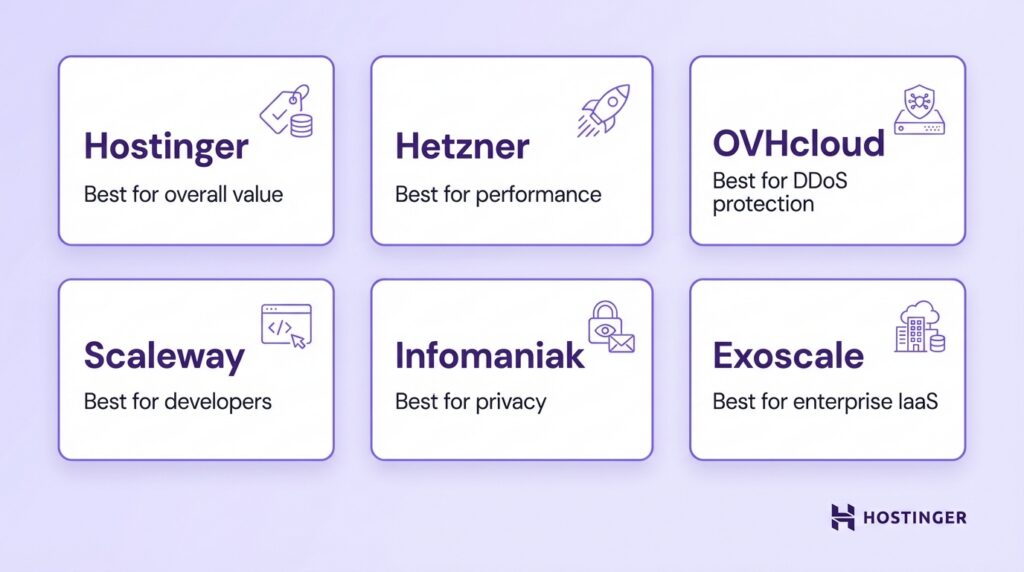
- Best overall value: Hostinger, affordable KVM VPS with NVMe storage and EU data centers.
- Best for high-performance infrastructure: Hetzner, powerful German-engineered cloud servers.
- Best for enterprise-grade protection: OVHcloud, scalable VPS with built-in DDoS mitigation.
- Best for developers: Scaleway, flexible cloud instances with API control.
- Best for privacy-focused hosting: Infomaniak, a Swiss-based VPS with strong data protection standards.
- Best for enterprise IaaS flexibility: Exoscale, high-availability European cloud infrastructure.
1. Hostinger
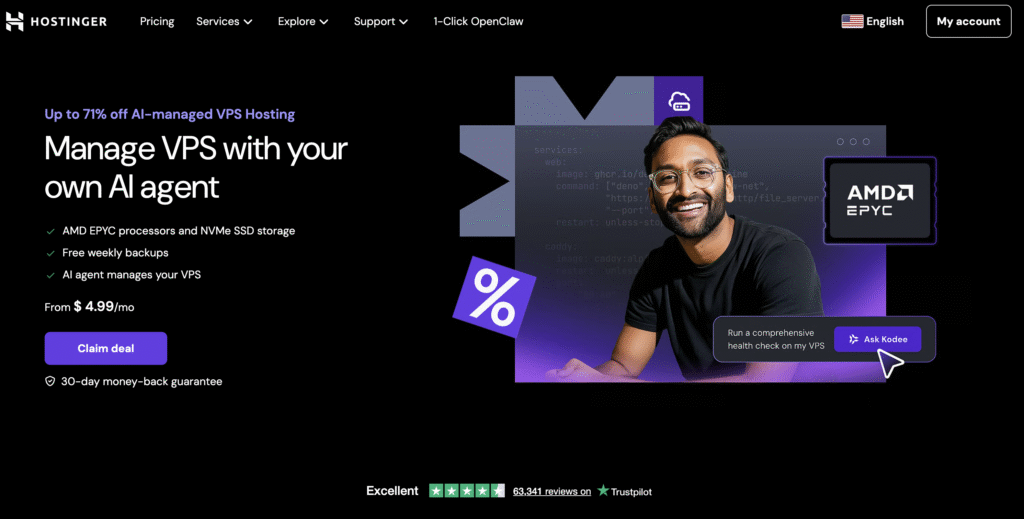
Hostinger is a Lithuania-founded hosting provider that offers KVM-based virtual private server hosting with multiple European data center locations.
It is a cost-efficient unmanaged VPS provider for developers, small to medium businesses (SMBs), ecommerce stores, SaaS startups, and high-traffic content sites that have outgrown shared hosting.
Hostinger’s VPS hosting infrastructure runs on KVM virtualization. In simple terms, this means your VPS gets its own guaranteed slice of Central Processing Unit (CPU) and RAM.
Other users on the same physical server cannot take those resources away from you. As a result, your performance stays stable even if another customer’s traffic spikes.
Hostinger’s VPS plans include:
- Full root access for complete server control
- Dedicated CPU allocations, not just shared vCPU slices
- NVMe SSD storage for high read and write speeds
- IPv4 and IPv6 support for accessibility across both legacy and modern networks
- A custom VPS management panel
- Built-in DDoS protection
Hostinger also adds two features that differentiate its VPS environment from many similarly priced providers. Kodee, an integrated AI assistant, helps users navigate VPS settings, interpret system logs, troubleshoot issues, and generate commands for common tasks such as installing software stacks.
This lowers the barrier for SMB teams and less experienced administrators managing an otherwise unmanaged server.
For developers, Hostinger provides a public API that enables programmatic interaction with VPS instances. This allows infrastructure tasks such as provisioning, configuration changes, and server management to be integrated into deployment pipelines or automation scripts.
Hostinger’s predictable monthly pricing model is one of its strongest advantages. Each plan clearly defines CPU cores, RAM, storage, and bandwidth. There is no complex usage-based billing for standard VPS tiers.
For cost-conscious businesses, this reduces budgeting risk and makes scaling straightforward. If you need more power, you simply upgrade to the next defined tier.
Compared to other European best VPS hosting providers in this list, Hostinger stands out for performance per euro. It offers dedicated CPU cores and NVMe storage at a lower entry price than most cloud-focused competitors.
Hostinger pros:
The main appeal of Hostinger lies in affordable dedicated infrastructure, as well as:
- Fast NVMe storage included across plans
- Quick server deployment with an intuitive custom VPS panel
- Built-in tools such as snapshots, automated backups, and firewall configuration
- Multiple European server locations for regional latency optimization
Hostinger cons:
While powerful for technical users, the unmanaged VPS model also involves:
- The need for technical knowledge to handle server configuration, updates, and security
- The absence of full-service managed support on standard VPS plans
- Limited advanced enterprise networking features compared to large-scale cloud providers
Hostinger pricing:
Hostinger structures its VPS plans into clear KVM tiers based on vCPU cores, RAM, NVMe storage, and bandwidth. Each plan has fixed resource allocations, which makes costs predictable and easy to compare.
Hostinger’s KVM tiers are priced in the following way:
- KVM 1 – ₱679.00
- KVM 2 – ₱889.00
- KVM 4 – ₱1699.00
- KVM 8 – ₱3389.00
Scaling works in fixed steps. If you outgrow your current allocation, you upgrade to the next tier with more CPU cores, RAM, storage, and bandwidth.
Plans are paid upfront, and the monthly rate reflects the total contract cost divided by the plan term. Renewal pricing is stated in advance, which reduces billing surprises compared to usage-based cloud platforms.

2. Hetzner
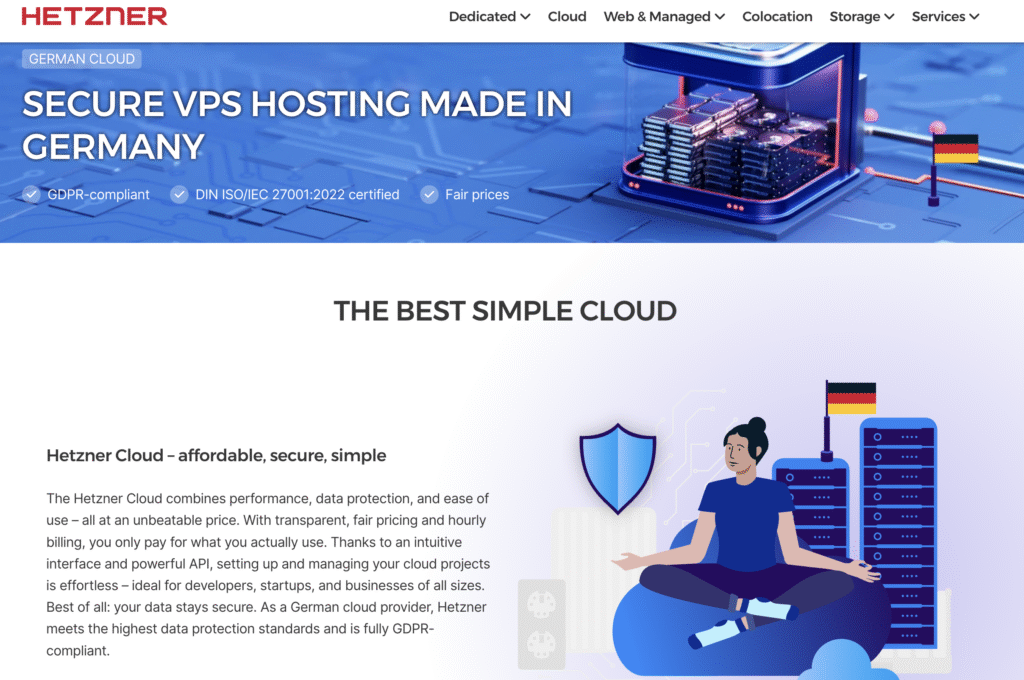
Hetzner is a German hosting provider offering cloud VPS and dedicated servers. It runs its own data centers in Germany and Finland and focuses on modern CPUs, fast SSD storage, and plans that include more RAM than many similarly priced competitors.
Its cloud VPS infrastructure runs on KVM virtualization. This gives each instance isolated resources and predictable performance, similar to other KVM-based providers in this list.
Unlike traditional entry-level VPS hosts, Hetzner focuses on infrastructure performance rather than beginner-friendly hosting. You get powerful compute instances, but you are responsible for server setup, configuration, and maintenance.
Hetzner is best suited for:
- Developers who need direct server control
- SaaS startups running production applications
- Technically experienced teams comfortable with Linux administration
Hetzner equips its data centers with recent-generation CPUs and fast SSD storage. The result is strong compute performance at a lower cost per CPU core and RAM allocation than many competitors.
It matches OVHcloud in infrastructure scale while maintaining a leaner price structure. It provides more hardware-focused flexibility than Hostinger, though with fewer beginner-friendly tools.
Hetzner pros:
Besides high compute performance at a low cost per CPU core and per GB of RAM, Hetzner also offers:
- Choice between shared vCPU and dedicated vCPU plans
- API access for automation and infrastructure management
- Strong compatibility with DevOps workflows and infrastructure-as-code setups
Hetzner cons:
Hetzner prioritizes infrastructure performance over guided hosting support, and this results in:
- Server setup and ongoing maintenance that require technical expertise
- Limited beginner-friendly support and onboarding compared to mainstream hosting providers
Hetzner Pricing:
Hetzner uses a flexible billing model that combines hourly pricing with a defined monthly cap. This means you can deploy instances for short-term testing and pay only for the time used, while long-running production servers will not exceed a predictable monthly maximum.
Entry-level cloud instances start at €3.49 per month (≈ $4.05), while larger configurations can reach roughly €24.49 per month (≈ $28.41).
Pricing scales with the number of vCPU cores, RAM allocation, and SSD storage size. Hetzner also offers both traditional x86-based instances and ARM-based alternatives, which can affect cost efficiency depending on workload.
3. OVHcloud
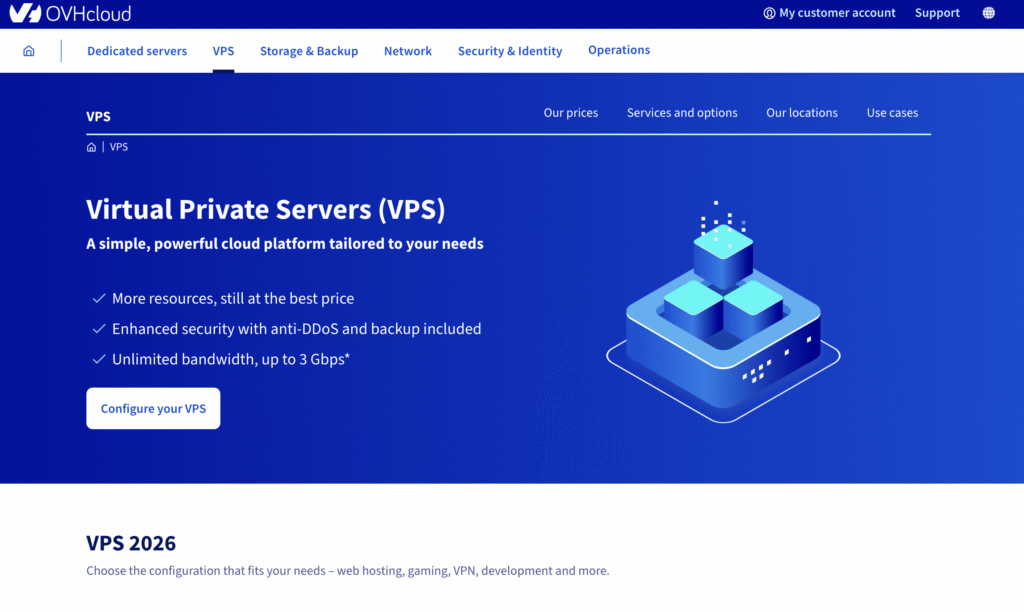
OVHcloud is a France-based cloud provider that delivers VPS and public cloud infrastructure through a large network of European data centers, with major facilities in France, Germany, Poland, and the UK.
OVHcloud operates at a different scale than most traditional VPS hosts. It combines standard VPS plans with broader public cloud infrastructure, making it suitable for businesses that expect growth or require advanced networking options.
It suits ecommerce brands with high traffic, SaaS platforms running production workloads, and enterprises that need scalable infrastructure within the EU.
OVHcloud operates its own global backbone network rather than relying entirely on third-party transit providers. This means traffic between its data centers and major internet exchange points stays on OVHcloud’s infrastructure for longer, reducing dependency on external networks.
As a result, it has more control over routing, capacity planning, and traffic filtering, which improves stability during high traffic loads or network attacks.
OVHcloud delivers deeper network capacity than Hostinger and includes DDoS protection by default, unlike Hetzner’s compute-first model. It runs a broader public cloud platform than Exoscale, but with less emphasis on multi-zone high-availability design.
OVHcloud pros:
Other than built-in network protection and large-scale infrastructure, OVHcloud also offers:
- Integrated DDoS mitigation across VPS plans
- Wide availability of EU data centers
- Customizable VPS configurations with room to scale
- Access to broader public cloud services within the same ecosystem
OVHcloud cons:
OVHcloud prioritizes infrastructure depth over simplicity, which leads to:
- A dashboard and ecosystem that can feel complex for beginners
- Limited managed support on lower-tier VPS plans
OVHcloud pricing:
OVHcloud structures its VPS plans as fixed monthly tiers, which makes budgeting straightforward. Plans begin at $6.46 per month and scale to $73.10 per month in higher tiers.
The price increases with allocated vCores, RAM, and SSD or NVMe storage. Public bandwidth also scales with plan level, which is relevant for high-traffic ecommerce or SaaS workloads.
While core VPS resources are bundled into clear tiers, optional add-ons such as additional IP addresses or extended backup options can increase the final monthly cost.
4. Scaleway
Based in France, Scaleway delivers cloud compute instances through a broader Infrastructure-as-a-Service (IaaS) environment rather than traditional fixed-tier VPS plans.
You deploy instances with defined CPU, RAM, and storage allocations, and gain access to an extended ecosystem that includes managed Kubernetes, object storage, and full API-driven infrastructure management.
Scaleway works particularly well for cloud-native startups, DevOps-driven teams, and container-based projects. It appeals to developers who manage infrastructure through APIs rather than manual configuration.
It offers both standard x86 servers and ARM-based instances built on Ampere CPUs. ARM instances cost less per core and work well for containerized apps and microservices that do not require x86 compatibility. This lets teams lower compute costs without sacrificing required performance.
Scaleway provides stronger native support for containers and orchestration tools, making it more aligned with cloud-native development. At the same time, it is less beginner-focused than Hostinger and less centered on raw hardware performance than Hetzner.
Scaleway pros:
While Scaleway’s main advantage is its cloud-native flexibility and processor choice, it also offers:
- ARM-based instance options alongside standard x86 servers
- Native container ecosystem and Kubernetes integration
- Full API access for infrastructure automation
Scaleway cons:
Scaleway prioritizes developer control over simplicity, resulting in:
- A need for advanced technical knowledge to configure and manage infrastructure
- Less beginner-oriented documentation and onboarding than mainstream hosting providers
Scaleway pricing:
Scaleway organizes its VPS-style instances into workload-based families rather than a single linear plan ladder. Pricing begins at €4.99 per month (≈ $5.79) for smaller START instances and can exceed €500 per month (≈ $580) for high-capacity STORE configurations.
Costs depend on the selected instance family and the amount of vCPU, RAM, NVMe storage, and bandwidth required.
START plans target lightweight development and smaller production workloads. PRO plans increase CPU density and memory capacity for growing applications, while STORE plans significantly expand storage and network throughput for data-heavy use cases.
Scaleway does not require long-term contracts, which allows teams to scale infrastructure up or down as requirements change.
5. Infomaniak
Infomaniak runs renewable energy–powered data centers in Switzerland and offers cloud VPS solutions built around privacy and sustainability.
Its infrastructure is located in European data centers, enabling businesses to keep their workloads within European jurisdictions. Infomaniak operates under European data protection laws such as GDPR, while its Swiss locations follow Switzerland’s separate privacy framework.
This European hosting provider works well for small and medium-sized businesses operating in Europe, agencies managing client projects with strict data protection requirements, and organizations that prioritize privacy.
Infomaniak places a stronger emphasis on privacy and data sovereignty than providers such as Hetzner. It also has a clearer sustainability focus than OVHcloud or Scaleway.
At the same time, it is less focused on enterprise-scale infrastructure than Exoscale and does not compete on the price-to-performance positioning seen from providers such as Hostinger, instead positioning itself as a privacy-driven alternative in the European VPS market.
Infomaniak pros:
Infomaniak offers several advantages for organizations that prioritize regulatory alignment and operational transparency, including:
- Strong data sovereignty aligned with European and Swiss regulations
- Transparent resource allocation across VPS plans
- Clear positioning around compliance and environmental responsibility
Infomaniak cons:
Infomaniak prioritizes privacy and sustainability over scale, which results in:
- Limited geographic expansion outside central Europe
- Slightly higher entry pricing compared to budget-focused VPS providers
Infomaniak pricing:
Infomaniak uses a configuration-based pricing model instead of fixed VPS tiers. You select CPU cores, RAM, SSD storage, and snapshot capacity, and the monthly price adjusts accordingly.
Pricing starts at €24.92 per month (≈ $28.91) for moderate configurations and increases proportionally as resources scale. Billing is available monthly, quarterly, or annually, with discounts applied to longer commitments.
This structure provides clear cost visibility because the displayed price directly reflects the resources allocated, without traffic-based multipliers or hourly compute fluctuations.
6. Exoscale
Operating from Switzerland, Exoscale provides cloud compute instances across multiple European availability zones. It runs as an enterprise-focused cloud infrastructure platform rather than a traditional fixed-tier VPS host.
A defining characteristic is its multi-zone architecture. Workloads can be deployed across separate European data center zones, reducing the risk of downtime if a single location fails.
Exoscale fits SaaS companies running live applications, enterprises with strict uptime requirements, and teams that manage infrastructure programmatically. Its structure assumes technical expertise and long-term infrastructure planning rather than entry-level hosting.
Exoscale emphasizes redundancy and compliance more strongly than Hostinger or Infomaniak. It is more enterprise-oriented than Hetzner’s performance-driven model and places greater focus on cross-zone resilience than OVHcloud’s standard VPS tiers.
At the same time, it is less beginner-focused than Hostinger or Scaleway and does not target small projects looking for simplified hosting.
Exoscale pros:
Exoscale’s main strength is its cross-zone resilience and enterprise infrastructure model, and it also offers:
- Multi-zone deployment across European data centers
- Integrated object storage and advanced networking options
- Strong compliance and data sovereignty positioning
- Full API-driven infrastructure management
Exoscale cons:
Exoscale prioritizes architectural control over simplicity, which means:
- It’s designed primarily for technical and enterprise users
- There is no beginner-oriented hosting interface or guided onboarding
Exoscale pricing:
Exoscale operates on a fully pay-as-you-go model with billing calculated by the second. Compute instances are priced as hourly rates, starting at €0.00729 per hour (≈ $0.0085) for small instances and increasing above €2.00 per hour (≈ $2.32) for significantly larger configurations.
The total monthly cost depends on the selected instance family, the number of CPU cores, RAM allocation, and how long the instance runs.
Local SSD storage is billed separately per GiB-hour, and outbound traffic beyond the included free tier is charged per GiB. Optional services such as Elastic IPs or load balancers are also billed independently.
This model offers granular control and high scalability, but requires closer monitoring to estimate monthly spend compared to fixed-tier VPS plans.
How to choose the right European VPS hosting provider
Choose a European VPS provider based on resource isolation, scalability, and compliance fit.
Start with virtualization.
Hostinger, Hetzner, and OVHcloud use KVM-based virtualization, which provides clearly defined CPU and RAM allocations with strong isolation. If you want predictable performance and fixed monthly resources, KVM-based VPS plans are a reliable baseline.
Cloud platforms such as Exoscale or Scaleway use broader IaaS architectures. These allow more granular scaling and automation but often rely on usage-based billing. If you expect rapid growth or need infrastructure-as-code workflows, cloud-based environments offer more flexibility.
Next, evaluate core resources. Compare CPU allocation models, RAM limits, storage type, and bandwidth policies before looking at secondary features.
Focus on:
- CPU model and allocation type, shared vCPU versus dedicated cores
- Total RAM and upgrade path
- NVMe versus standard SSD storage
- Bandwidth caps or throughput limits
If your project is ecommerce or SaaS, prioritize dedicated CPU and NVMe storage. If it is a staging or development environment, shared vCPU plans may be sufficient.
Then assess network protection and contractual guarantees.
Check:
- Whether DDoS mitigation is included or sold separately
- SLA uptime guarantees
- Number and location of EU data centers
- Whether infrastructure is confined to the EU or extends globally
Confirm where data is processed and stored to ensure GDPR compliance and proper data residency within the required jurisdiction.
Finally, match each provider’s strengths to your project type.
Fixed-tier KVM providers such as Hostinger work well for cost-efficient scaling and SMB websites.
Hetzner delivers strong raw performance per euro. OVHcloud stands out when network resilience and built-in DDoS protection are priorities.
Scaleway fits automation-heavy development environments that rely on API control and container workflows.
Infomaniak appeals to organizations that prioritize privacy and data sovereignty. Exoscale is built for high-availability SaaS platforms and enterprise workloads that require multi-zone redundancy.
If you define your workload first and then map it to infrastructure characteristics, the choice becomes straightforward. Start with your traffic profile, compliance needs, and scaling expectations, then select the provider whose model aligns with them.
Managed vs unmanaged VPS in Europe
The difference between managed and unmanaged VPS hosting comes down to who is responsible for the server. With an unmanaged VPS, you manage everything yourself. With managed VPS, the provider handles technical maintenance.
Here is a side-by-side comparison of managed and unmanaged VPS responsibilities:
Area | Unmanaged VPS | Managed VPS |
OS installation & updates | You handle | Provider handles |
Security patches | You handle | Provider handles |
Firewall configuration | You configure | Provider configures or assists |
Web server & database setup | You install and manage | Provider assists or pre-configures |
Monitoring | Optional, self-configured | Included |
Backups | Optional or manual | Managed backups included |
Root access | Full control | Usually included |
You should also consider pricing.
Unmanaged VPS plans are significantly cheaper because you are not paying for ongoing system administration. Providers like Hostinger and Hetzner focus primarily on unmanaged infrastructure, which keeps monthly costs low.
Managed VPS hosting plans cost more because they bundle operational support. The price difference reflects labor, monitoring tools, and support availability. In some cases, managed plans can cost 30 to 100 percent more than equivalent unmanaged tiers.
Now, determine what you actually need.
Choose an unmanaged VPS if you:
- Are comfortable managing Linux servers
- Use automation tools such as Ansible or Terraform
- Want maximum control at the lowest cost
- Have in-house technical expertise
Choose managed VPS if you:
- Do not have a system administrator
- Want proactive monitoring and patch management
- Prefer a control panel and guided support
If you are unsure, ask a simple question: Who will fix the server at 2 a.m. if something breaks?
If the answer is you, unmanaged may be fine. If the answer is unclear, a managed VPS is the safer choice.
Key compliance and data residency considerations
If you handle personal data from EU users, treat compliance as a provider selection filter, not a nice-to-have. The provider’s data center location, contract terms, and security controls determine whether you can meet GDPR requirements without workarounds.
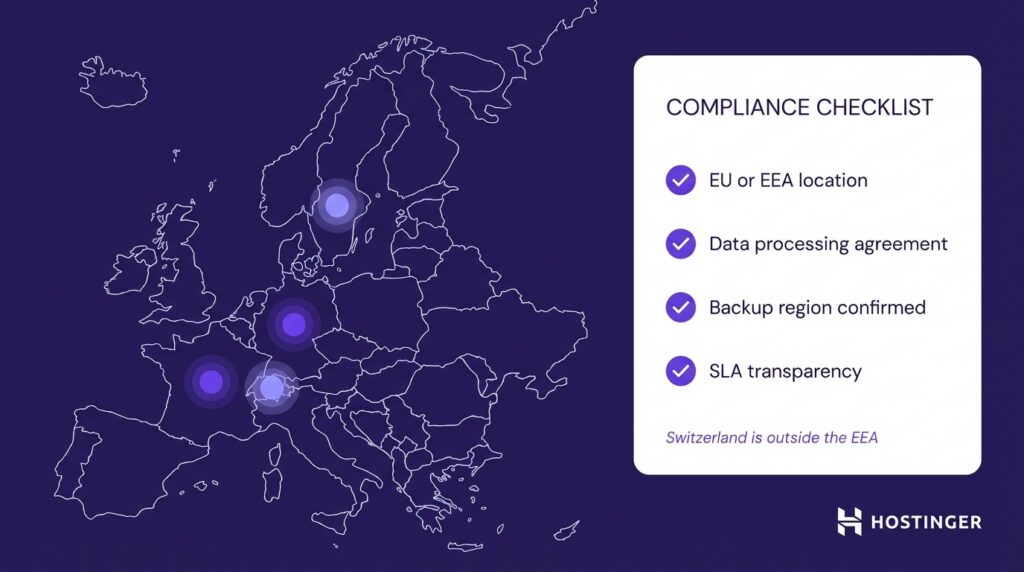
GDPR usually requires a clear controller-processor relationship with a written data processing agreement. Under GDPR Article 28, processing by a provider on your behalf must be governed by a contract that defines responsibilities, security obligations, and how sub-processors are handled.
In practice, that means you should verify three things before you buy:
- The provider offers a Data Processing Agreement (DPA) you can sign, not just generic marketing claims.
- The provider discloses sub-processors and transfer rules, especially if anything leaves the EU or European Economic Area (EEA).
- The contract includes audit rights or equivalent transparency, plus clear incident and breach notification terms.
Next, confirm where your data actually lives.
“Europe-based” can mean different things. For GDPR, the key boundary is typically the EU or the broader European Economic Area. The EEA includes the EU plus Iceland, Liechtenstein, and Norway. Switzerland is not in the EEA, even though it is in Europe and has its own strong data protection laws.
Before choosing a provider, check:
- The exact country where your VPS runs
- Where backups and snapshots are stored
- Whether any data is transferred outside the EU or EEA
Then evaluate proof of security and reliability, not just feature lists.
Look for:
- Recognized security certifications such as ISO/IEC 27001, which is a widely used standard for running an information security management system.
- Clear uptime Service Level Agreement (SLA) and what happens if they miss it. Many providers publish separate SLA documents per product line, so confirm the SLA for the specific VPS or cloud service you are buying.
- Contractual transparency on add-ons that affect risk and cost, such as backup terms, IP address policies, and traffic billing.
Finally, align compliance needs with the provider’s operating model.
Fixed-tier VPS providers are usually easier to budget and document, but you must confirm where all related services live. Cloud IaaS platforms give more control and multi-zone options, but you may need more internal governance because you can spread services across regions quickly.
Your next step is to specify your required data residency (EU only, EEA, or a specific country), then choose only providers that can contractually commit to it via a DPA and provide clear service-specific SLAs.
How do I migrate from shared to VPS hosting?
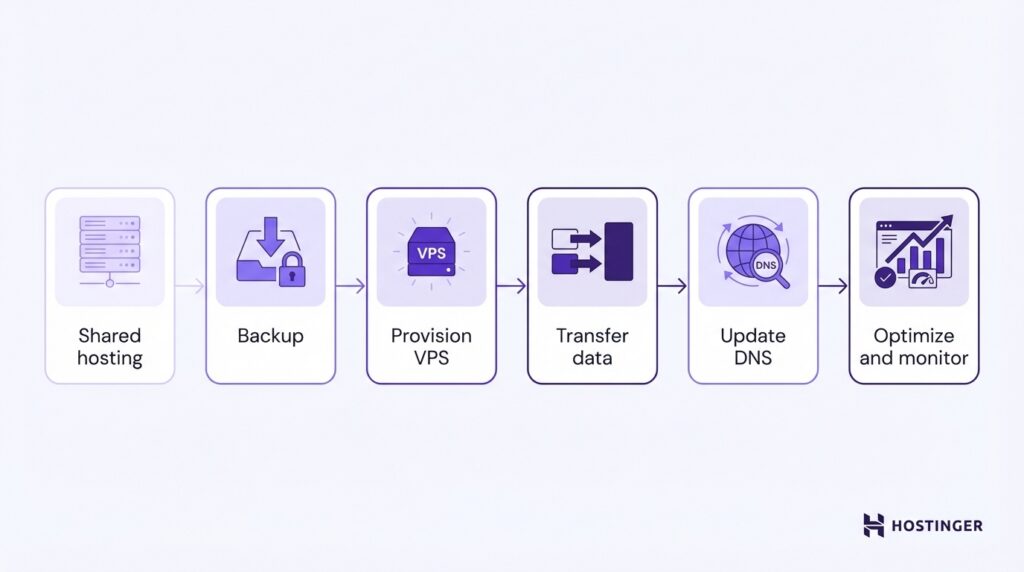
To migrate from shared hosting to VPS, you provision a VPS, set up the server environment, transfer your files and databases, test the site, and then update your DNS to point to the new server.
The key difference between shared and VPS hosting explains why moving is often necessary. With shared hosting, multiple websites use the same server resources, which means CPU and RAM are pooled, and performance can fluctuate.
With VPS hosting, your resources are isolated and allocated specifically to you, giving you predictable performance, root access, and greater control over configuration.
You should consider this move when traffic grows, performance becomes inconsistent, or you need server-level control. If your site slows down during peak hours, hits resource limits, or requires custom server configurations, shared hosting is no longer sufficient.
The migration itself follows a straightforward sequence: create a full website backup, complete with configuration data. Get a VPS plan and configure it, then transfer your files and databases to the new VPS account.
Once moved, test the site on the new server to verify database connections, forms, email sending, and application functionality. Finally, don’t forget to update your DNS records to point your domain to the new VPS.
For a step-by-step walkthrough with command examples and screenshots, explore our detailed guide on how to migrate a website from shared hosting to VPS.
All of the tutorial content on this website is subject to Hostinger's rigorous editorial standards and values.

Ksenija is a digital marketing enthusiast with extensive expertise in content creation and website optimization. Specializing in WordPress, she enjoys writing about the platform’s nuances, from design to functionality, and sharing her insights with others. When she’s not perfecting her trade, you’ll find her on the local basketball court or at home enjoying a crime story. Follow her on LinkedIn.