How much my domain is worth: Complete valuation guide 2026
Dec 01, 2025
/
By Simon L.
/
8 min Read
Your domain name is worth anything from $0.99 to several thousand dollars, depending on various factors that determine its market value.
These key factors include:
- Extension: Popular ones like .com cost more, while alternatives like .net or .info can cost less.
- Demand: High-interest niches, trending topics, or valuable keywords raise the price.
- Memorability and keywords: Short, brandable names with relevant keywords hold higher value.
- Age and traffic: Established domains with existing traffic command premium prices.
- Backlinks: Strong link profiles increase search engine value and resale potential.
- Market timing: Industry trends and buyer intent affect current market value.
To get an idea of your domain name’s value, you can use online appraisal tools like Estibot, HumbleWorth, or NameBio.
You can also manually evaluate your domain’s worth by looking at what similar domains have sold for and checking current market interest.
What determines a domain’s worth?
A domain’s worth is determined by factors such as industry trends, what buyers are looking for, and the competition for certain types of names.
But, unlike a website, a domain’s value comes from its characteristics rather than performance.
A complete website gets valued on its content, how much traffic it gets, and how much money it makes.
The worth of a domain name depends on a mix of measurable data, like search volume and backlinks, and intangibles that are harder to pin down, like whether it sounds professional or memorable.
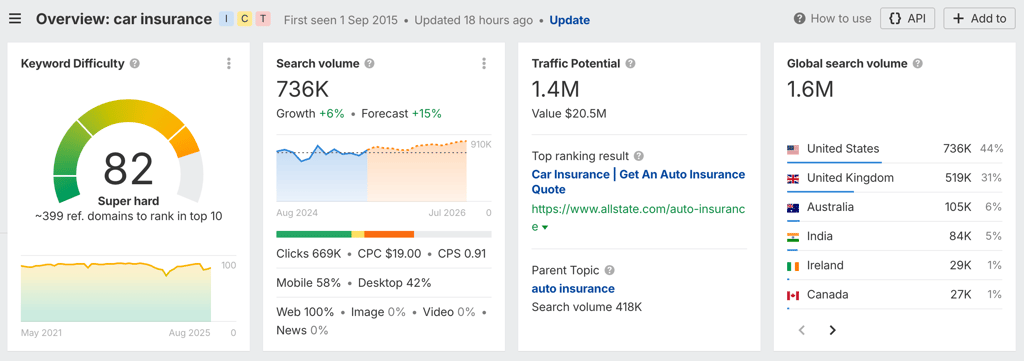
Take a domain like CarInsurance.com, which sold for $49.7 million in 2010. The buyer saw that exact keyword match as the perfect digital real estate because it’s instantly recognizable and memorable to anyone looking for auto insurance coverage.
Plus, the keyword “car insurance” receives over 736,000 monthly searches in the US and has high commercial value.
So what exactly makes one domain worth $10 and another worth millions? Let’s break down the main factors that move the needle on domain value.
Domain length and memorability
Shorter domain names are generally more expensive and valuable because they’re rare, memorable, easy to use, and perfect for branding.
One-word domains like Apple.com or Notion.com are often the most valuable. They’re short, simple, and hard to mess up.
Compare that to something like BestOnlineMarketingServicesForSmallBusiness.com and you can see why shorter wins.
Two-word combinations can work too, but once you hit three or more words, the value typically drops as people start making typos or just can’t remember it.
Memorability matters a lot. A domain needs to roll off the tongue when you say it out loud, and if you can spell it without thinking twice, you’re on the right track.
The key is finding the right balance between being short enough to remember and clear enough for people to understand what you do.
When you’re figuring out how to choose a domain name, sometimes a slightly longer name that’s crystal clear beats a short one that leaves people confused.
Keyword relevance and search volume
Domains with strong keywords are worth more because they are exact matches for what people actually search for.
According to Backlinko’s study of 4 million Google searches, URLs with words matching the search query get clicked 45% more often than URLs without keyword matches.
That’s why domains like Hotels.com or Loans.com can sell for higher amounts, as those keywords have massive search demand.
But it’s not just about raw search numbers. You want keywords with commercial intent, meaning people are ready to buy something, not just browse.
A domain like BuyCarsOnline.com targets people who are ready to purchase, while CarHistory.com might get traffic from people just researching cars, rather than looking to buy.
Industry-specific keywords can be goldmines too. A domain like CloudSecurity.com might not have the search volume of Insurance.com, but in the tech world, it’s highly valuable because companies invest heavily in cloud security solutions.
The key is understanding what your target market actually types into search engines. Generic terms add less value than specific product or service keywords that show a clear intent to purchase or engage.
Top-level domain (TLD)
The extension at the end of your domain name is your TLD, and it plays a big role in determining its worth.
Most people still think .com when they think of domains, which is why they almost always command the highest prices.
But when you understand what a TLD is, you can see how they can add value to your domain.
A short, memorable domain with a .net or .co extension can still be valuable, especially if the .com version is already taken or priced out of reach.
Newer TLDs like .io and .ai have carved out valuable niches. A domain like Tech.io or Data.ai can be worth serious money because it is easily brandable and memorable.
Country-code TLDs like .co.uk or .de have their own value too. If you’re targeting customers in the UK, a .co.uk domain can actually be more valuable than a .com because it shows you’re local. German businesses often prefer .de domains for the same reason.
The key is understanding your market. A .org might be perfect for a nonprofit, while .shop works great for ecommerce stores.
Keep in mind that a memorable domain name with a less common extension might be more valuable than a mediocre name with .com.
Domain Name Checker
Instantly check domain name availability.
Backlinks and domain authority
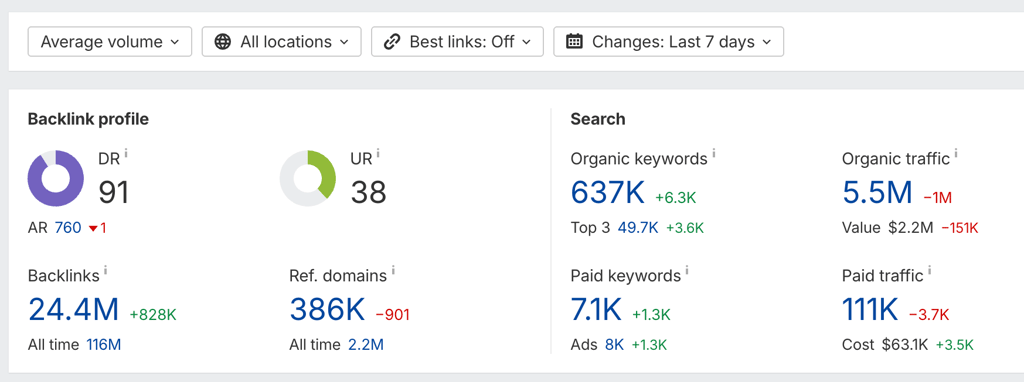
Backlinks are when other websites link to your domain. They are like endorsements that signal to search engines and potential buyers that your site has authority and trust.
A domain with hundreds of quality backlinks from reputable sites is worth more than one with zero backlinks. That’s because the domain has built up SEO authority without having to earn those links from scratch, which can take years and cost thousands of dollars.
But here’s the catch: you need to watch out for domains with toxic backlink histories. If a domain was used for spam or has a negative reputation in search results, receiving links from it might actually hurt your SEO efforts, making the domain less valuable.
Domain authority, which is a measure of how much search engines trust your domain, follows the same pattern. A domain with high authority can rank faster for new content, making it more valuable to anyone looking to build a business around it.
When evaluating a domain’s worth, check tools like Ahrefs or SEMrush to see its backlink profile.
Traffic and age
Older domains with steady traffic often become more valuable over time as search engines trust them more.
They’ve had time to build authority, establish patterns, and prove they’re not just spam sites that’ll disappear next month. This trust translates into better ranking potential.
But age isn’t everything. Traffic history is just as important. A 5-year-old domain that gets 50,000 visitors per month is worth way more than a 15-year-old domain that gets 50 visitors per month. Consistent traffic shows there’s real demand and interest around that domain name.
What matters most is the combination of time, trust signals from search engines, and actual user activity.
When evaluating domains, look at both the registration date and the traffic patterns over the last few years.
What tools can be used to estimate domain value?
Here are the top options to estimate domain value:
| Tool | Pros | Cons |
| HumbleWorth | – Integrates multiple data sources – Detailed valuation breakdown – Shows comparable sales | – Can be overly optimistic – Algorithmic, not market value |
| Estibot | – Detailed breakdowns of value calculations – Shows search volume, commercial value, and similar sales – Free basic and paid detailed options | – Can be overly optimistic – Algorithm-based rather than real sales data |
| NameBio | – Based on actual sales data – Shows what similar domains really sold for – More accurate market-based pricing | – Limited to domains that have actually sold – May not cover newer trends |
| Flippa | – Marketplace with active listings and completed sales – Shows actual market demand and pricing | – Need to search through listings manually – Mix of domain sales and full websites |
| Domain Index | – Quick automated valuations – Considers multiple factors like traffic and backlinks – Free basic service | – Often unreliable estimates – Limited transparency on calculation methods |
These tools will often give varying results for the same domain because each platform uses different algorithms and weighs factors in unique ways.
One tool might prioritize keyword search volume, while another focuses more on comparable sales or domain length.
The key is to use multiple tools as starting points before conducting your own research into comparable sales and market demand.
How to manually evaluate a domain’s worth
To manually evaluate a domain’s worth, you need to analyze its fundamental characteristics, research market data, and compare it to similar sales.
Here’s a step-by-step approach that gives you more accurate results than automated tools.
- Start with the basics: Check the domain length, memorability, and keyword strength. Is it short and brandable? Does it contain valuable keywords that people actually search for?
- Research comparable sales: Look for domains that sold in the past with similar characteristics. NameBio and DNJournal are goldmines for this kind of data. For example, if three-word .com domains in the fitness niche sold for $2,000-$5,000, that gives you a baseline range to start from.
- Check the backlink profile: Use tools like Ahrefs or SEMrush to see what kind of links the domain has. A domain with 50 high-quality backlinks from reputable sites is worth significantly more than one with zero backlinks or spammy links.
- Analyze traffic history: Use tools like SimilarWeb or Google Analytics to see monthly visitor numbers, traffic sources, and user engagement patterns. Look for consistent growth over time rather than sporadic spikes.
- Study marketplaces: Browse active listings on Flippa, Sedo, or other domain marketplaces to see what similar domains are asking for. Remember that asking prices aren’t sale prices, but they give you a sense of market expectations.
The goal is to build a complete picture before putting a price tag on your domain. Manual evaluation takes more time, but it’s often more accurate than trusting a single automated estimate.
Expert tip
For more details on this process, explore our guide on how to check if a business name is taken and domain name cost to understand the broader naming and pricing landscape.
How to increase the value of your domain name
To increase the value of your domain name, focus on building traffic, authority, and revenue streams that demonstrate its potential to buyers.
Here’s how:
- Connect your domain to your brand: Build consistent branding, visuals, and messaging around your domain. Even basic branding elements like a logo and professional website design can increase perceived value.
- Build backlinks: To earn natural backlinks, create high-quality content, guest post on popular blogs, and form partnerships with other website owners. Focus on getting links from reputable sources in your industry rather than buying cheap, spammy links.
- Improve on-page SEO: Optimize meta tags, headings, and keyword usage to increase search visibility. A domain that already ranks well for valuable keywords is much more attractive to buyers than one with no search presence.
- Monetize your domain: Include relevant ads, use affiliate links, or sell products to demonstrate revenue potential. Even modest monthly earnings can significantly increase a domain’s value.
- Create valuable content: Regularly publish helpful, industry-relevant content that attracts visitors and builds authority. Start with a blog, resource guides, or industry news that your target audience actually wants to read.
- Build an email list: If your domain offers content or services, you can build an email subscriber list by offering valuable lead magnets like free guides, templates, or exclusive content.
Expert tip
Learn more about ICU domains for more ideas on building a personal brand around your domain.
Myths and realities of domain sales
Let’s clear up some common misconceptions about domain sales so you can set realistic expectations for that domain sitting in your portfolio.
Myth: All short domains are worth millions.
Reality: Length alone doesn’t guarantee value. A two-letter like QX.com isn’t automatically worth more than a longer, brandable domain like TechStartups.com. What matters is memorability, brandability, and market demand for that specific short domain.
Myth: Any domain with keywords will sell for big money.
Reality: Just because your domain contains popular keywords doesn’t mean buyers are lining up. A domain like BlueCars.com might contain popular keywords, but domains need to make sense together and feel like real brand names someone would build a business around.
Myth: Domain age automatically equals value.
Reality: A 15-year-old domain isn’t valuable just because it’s old. If it had no content, traffic, or backlinks for years, age becomes irrelevant. What buyers want is domains with a history that includes actual use, traffic, and authority.
Expert tip
Read our guide about how domain parking can help monetize unused domains while you decide on their future.
What actually drives domain value
Domain value depends heavily on buyer demand and market timing. If a trend emerges, a domain worth $500 today might be worth $5,000 next year, or it might drop to $50 if interest fades.
The biggest reality to face is that most domains sell for modest amounts. Those million-dollar sales you hear about are rare exceptions, not the norm.
The good news? You can actively work to increase your domain’s value by building content, earning backlinks, and creating traffic.
Just don’t overestimate your domain’s value without solid data from comparable sales and current market demand.
For more insights, check out our guide on how to sell a domain name to explore your options.
This article is a localized version of How much my domain is worth: Complete valuation guide 2026, originally published in English.
All of the tutorial content on this website is subject to Hostinger's rigorous editorial standards and values.

Simon is a dynamic Content Writer who loves helping people transform their creative ideas into thriving businesses. With extensive marketing experience, he constantly strives to connect the right message with the right audience. In his spare time, Simon enjoys long runs, nurturing his chilli plants, and hiking through forests. Follow him on LinkedIn.

Comments
0 responses