What is decentralized social media?
Mar 10, 2026
/
Valentinas C.
/
6 min Read
Decentralized social media platforms run on independent servers worldwide instead of being controlled by a single company or government. As alternatives to traditional social media networks like Facebook and X, these platforms offer more user control, privacy, and freedom of expression.
However, keep in mind that while decentralized social media have benefits, there are also drawbacks.
In this tutorial, we’ll use popular decentralized social media platforms like Mastodon, Steemit and diaspora* to demonstrate the basic differences between them and traditional social networks.
How decentralized social media work
Decentralized social networking is based on blockchain technology, which ensures secure and traceable data interactions. Once data is added to the chain, it can’t be changed, making it tamper-resistant.
They also allow social media users to interact across different services. Think of them as a federation of platforms known as the fediverse.
Important! The fediverse is a collection of decentralized protocols, apps, and instances that allow independently hosted networks to interact with each other.
Decentralized networks operate on peer-to-peer (P2P) technology instead of the centralized databases that traditional social networks use. This extensive network of nodes, operating independently worldwide, ensures uninterrupted service. No central authority also means that users cannot be arbitrarily banned or restricted, fostering a censorship-resistant environment.
Pros and cons of using decentralized social media
The benefits of decentralized social networks may seem enticing at first, but there are certain challenges to be aware of. Here’s everything you need to know about before you decide to use a platform like that.
Advantages of decentralized networks
- User control: decentralized social networks operate on independent servers, rather than centralized servers owned by businesses. Users have more control and autonomy to set up their own social network and determine its rules, including what content and behavior are acceptable.
You can use VPS hosting to set up and manage your own server to host content in a decentralized manner. We help simplify managing protocols like InterPlanetary File System (IPFS) that enable content distribution. With VPS hosting, you ensure the safety of your platforms with built-in firewalls, SSH access, and other security measures.
- Privacy and security: decentralized social media networks operate on distributed networks, often spread across many different geographical locations. This system of interconnected servers ensures that the network remains robust and reliable. Their cryptographic solutions also address concerns about data integrity or selling user data.
- No censorship: decentralized social media resist censorship because no single entity controls them. Individual network administrators moderate content, promoting free speech and avoiding authoritative control.
- Chance to earn money: decentralized social media offer monetization opportunities for their users, not just for the platform holders as is the case with centralized social media companies. Users can earn cryptocurrency through creating content, curating existing posts, or engaging with their community. They can explore innovative ways to profit from their social network without the need for sponsorship or running ads.
Disadvantages of decentralized networks
- Learning curve: decentralized social networks can be more complex for users who are used to traditional platforms. Setting up and managing decentralized networks usually requires some technical knowledge and users need to understand concepts like blockchain, nodes, and server administration before participating.
- Struggle with growth: decentralized networks struggle with scalability. When more people join, maintaining server performance rests on individuals managing the network. Decision-making among a growing number of users also becomes time-consuming and distributing data across too many servers can also lead to latency and synchronization challenges.
- Inconsistent user experience: decentralized social media platforms each have their own rules, features, and interfaces. This lack of consistency can discourage new users. Unlike centralized networks with popular designs, decentralized platforms often have unfamiliar user interfaces and can even overwhelm users with too many advanced customization options.
- User interest. Many users either have limited knowledge of decentralized social media or are completely unaware of their existence. Consequently, the number of users is relatively small compared to giants like Facebook and X. The benefits that decentralized social networks offer can also be difficult to understand and lack the convenient simplicity of traditional centralized social networks.
Comparing centralized and decentralized social media
Let’s compare centralized and decentralized social networks to better visualize the key differences between them.
| Centralized networks | Decentralized networks |
| Data ownership and control | |
| A central authority, like the platform owner or company, controls user data. Users have limited ownership and control over their personal information. | Data control is spread among users. Each participant has more control over their data, which is stored on their devices or the network itself. |
| Content moderation | |
| The platform owner or a company-managed team handles content moderation. Decisions about what content is allowed or removed are made centrally. | Communities moderate themselves, decision-making is democratic, and content guidelines are normally set by consensus. This can lead to more diverse perspectives, but may also result in biased standards. |
| Revenue models | |
| Centralized platforms rely on advertising, data monetization, and premium features. Users don’t usually benefit from the platform’s profits. | Some decentralized social media networks use cryptocurrency, or similar mechanisms, to reward users for their contributions. Monetization is usually more transparent, and users can benefit from their engagement. |
| User experience | |
| Traditional social media platforms offer a more polished and user-friendly experience. They prioritize ease of use, consistent design, and familiar features between different platforms. | User experience is not consistent. Some decentralized platforms prioritize privacy and autonomy over intuitive UI. Instead, most platforms focus on building communities and granting control to individuals. |
All in all, centralized networks prioritize pre-selected content, stability, and convenience, while decentralized networks deliver user freedom, privacy, and communities managing themselves. Each approach has its trade-offs, so it’s up to your preferences or priorities.
Examples of decentralized social media platforms
We selected a few popular examples of decentralized social networks that offer alternatives to centralized platforms like YouTube, Reddit, X, Facebook, Medium, or Substack.
Mastodon
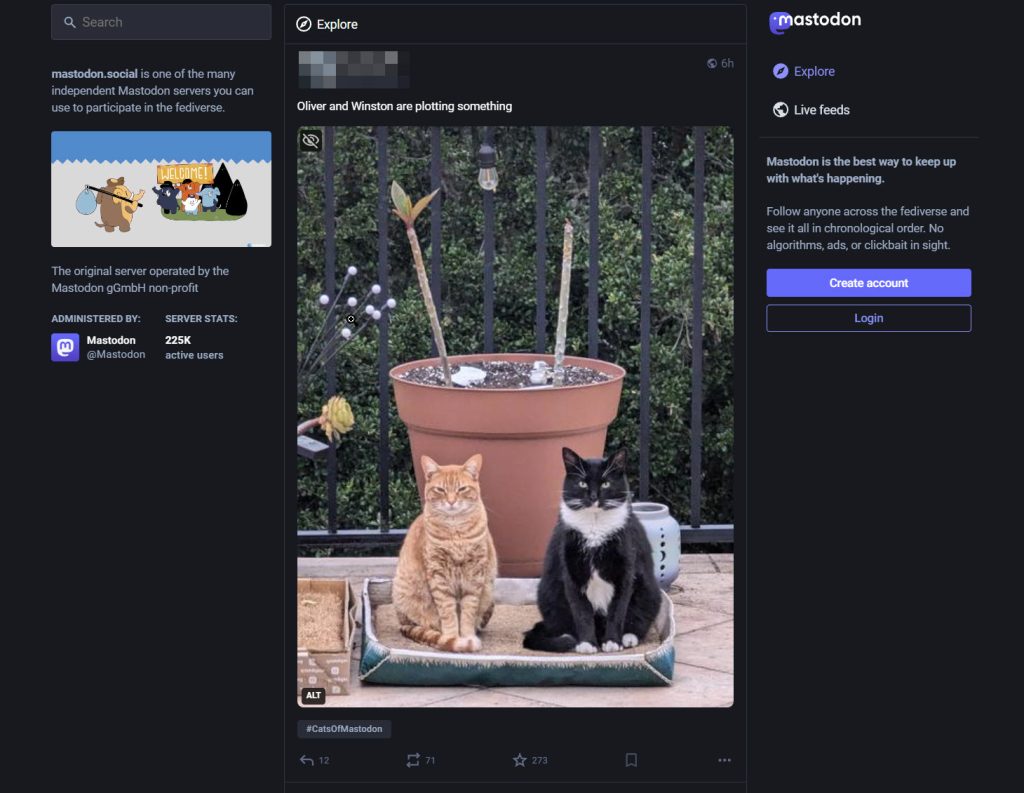
Mastodon is an open-source microblogging platform that is dubbed an alternative to X. Unlike X’s centralized model, Mastodon consists of independent servers managed by its users.
Users are grouped on one server but can freely interact with others across the network. They can toot, instead of post, with up to 500 characters. Mastodon offers tagging users, sharing media, and following accounts. Boosting is like reposting, which allows users to share content across the network.
Mastodon is part of the fediverse, where users post, reblog, and engage with others across different social networking services.
If you want to host your own server, check out our guide on creating your own Mastodon server.
diaspora*
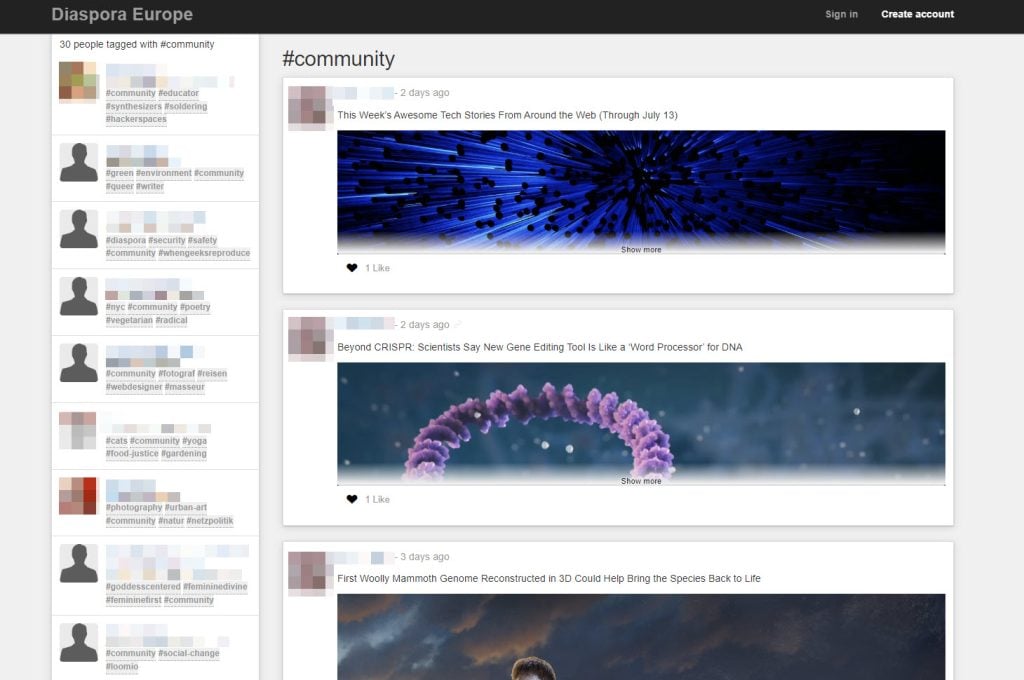
diaspora* is a non-profit and decentralized network of independently-owned servers, called pods, which form the social media platform. Instead of relying on large central servers owned by a single organization, diaspora* operates on smaller pods spread worldwide.
diaspora* is free to use and gives users control over how to interact with it. Users choose a pod to register with and then connect with the global diaspora* community. Unlike some networks, users don’t have to use their real identity.
diaspora* lets users own their data. They choose who sees their shared content while keeping their friends, activity, and other posts private.
Steemit
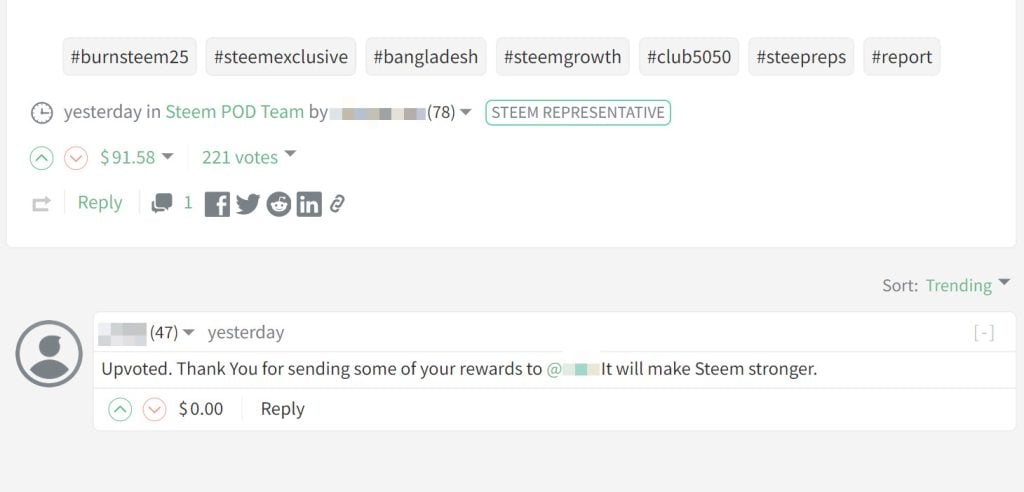
Steemit is a blockchain-based social media platform that rewards users with cryptocurrency for creating and curating content. Launched in 2016, Steemit utilizes the Steem blockchain to provide a decentralized platform where users can earn tokens called STEEM, Steem Dollars (SBD), and Steem Power (SP) through their interactions on the site.
Steemit is the flagship app on the Steem platform, but users can access other apps. Apart from social media, free cryptocurrency transfers and the high throughput of Steem attract developers of decentralized exchange platforms (DEX), decentralized applications (dApps) for gambling, blockchain-based games, decentralized crowdfunding, and more.
Others
There are plenty of other popular decentralized social media platforms.
- Bluesky is an open-source decentralized social media platform created by Jack Dorsey, the original founder of X. Its user interface is similar to X’s, but users also get an algorithmic choice, federated design, and community-specific moderation.
- Odysee is a blockchain-based video-streaming platform that emphasizes ownership for creators and offers cryptocurrency rewards for their contributions.
- Minds is an open-source and decentralized social network where users can also earn cryptocurrency for their activity. They can use tokens to boost posts or crowdfund other users. Minds’ goal is to avoid selling data for marketing and advertising purposes.
- Gab is an X-style social media platform that considers itself a free-speech social network.
- DTube is a decentralized alternative to YouTube, where content creators retain ownership and control.
Conclusion
Privacy and control over personal information are becoming increasingly more difficult to achieve.
Decentralized social media promises to help users maintain their online habits while remaining safer. These platforms operate on independently run servers, giving users more control over their data and content. They also use blockchain technology to enhance privacy and security, reducing the risk of data breaches.
However, decentralized social networks also face some challenges. To set up their own instances of decentralized apps, users need some technical skills. What’s more, decentralized social media promote and use cryptocurrency, which can be problematic for a layperson. Inconsistent and unpolished designs also make these platforms unfriendly to new users.
If you have any more questions, have a look at the FAQ section or leave a comment below.
What is decentralized social media FAQ
In this section, we’ll cover the most frequently asked questions about decentralized social media platforms.
Are there any popular decentralized social media platforms?
By providing alternatives to centralized social media, platforms like Odysee, with over 5 million monthly unique visitors, grow in popularity. Steemit, a content-sharing forum, hosts over 3 million visitors. Gab is known for its freedom of expression, and Mastodon allows users to create diverse content on their own, decentralized instances.
How does decentralized social media protect user privacy?
Decentralized social media use cryptography to enhance security and privacy. By distributing user data across a network of decentralized servers, these platforms reduce the risk of data breaches and unauthorized access. Users stay in control of their personal information, with no surveillance and tracking for targeted ads.
Can anyone create or contribute to decentralized social media platforms?
Decentralized social networks involve users in various ways. Anyone can join, create content, and engage with others. Those with coding skills can improve existing platforms or create new ones. Operators manage servers, ensuring network maintenance. Community leaders spread awareness about decentralized platforms, contributing to their success.
Does decentralized social media have the same features as traditional social media?
Decentralized social media platforms share features with traditional platforms, including profiles, content sharing, and interactions. However, decentralized social media networks prioritize privacy, user control, and censorship resistance. Monetization often involves cryptocurrency rewards.

Valentinas Čirba, Hostinger's Head of VPS, is a seasoned product leader specializing in VPS products with over ten years of experience. He's an expert at setting product strategy, leading cross-functional teams, and making smart decisions to deliver innovative solutions. Valentinas is committed to creating products that not only meet business objectives but also truly serve the customer. Follow him on LinkedIn.