How to start an online fitness business: A comprehensive guide
Mar 10, 2026
/
Matleena S. & Miglė C.
/
10 min Read
Starting an online fitness business can be a rewarding venture for fitness professionals looking to reach a wider audience and build their brand online. With the increasing demand for virtual fitness solutions, now is the perfect time to tap into this growing market.
In this comprehensive guide, we will walk you through the steps to launch and grow your online fitness business. Our aim is to help you focus on delivering top-notch fitness services while making money online.
We will share top tips on how to do market research, define your niche and services, and create a professional website for your business.
Build your fitness business in 6 steps
The following steps guide you through the essential aspects of starting and maintaining a thriving online business.
1. Understand the market
The foundation of any successful business is a thorough understanding of the market it operates in. By knowing market trends and understanding your target audience, you can strategically position your online fitness business for success.
Understand market trends and opportunities
The global online fitness market is expected to reach $59.23 billion by 2027, growing at a compound annual growth rate (CAGR) of 33.1% from 2020.
This remarkable growth is driven by several factors, including more widespread internet access, rising health consciousness, and the convenience of online fitness programs.
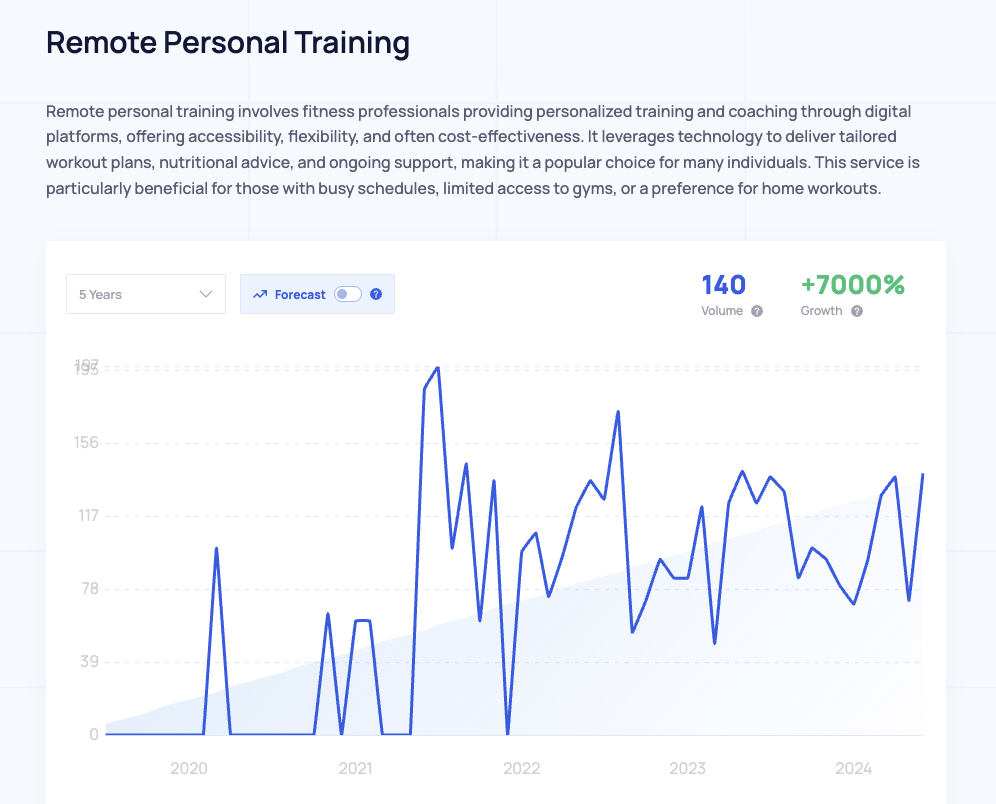
Current emerging trends in the fitness industry include:
- Remote personal training. The demand for real-time, interactive workout sessions has grown substantially since 2020. You could offer virtual training sessions using platforms like Zoom or Skype, and promote your business on social media and your website.
- Streetlifting. A blend of street workout and weightlifting, streetlifting is gaining popularity, especially among younger fitness enthusiasts who seek outdoor and community-based fitness activities. To tap into this trend, consider organizing local streetlifting events and create content around these activities for your website and social media.
- Niche products like creatine gummies. The supplement market is also evolving, with niche products such as creatine gummies becoming more popular. To support remote personal training programs, you could sell niche supplements through an integrated online store on your website and use your platform to educate clients on their benefits.
Utilizing platforms like Google Trends and Exploding Topics helps you identify these growing trends and tailor your online business idea accordingly. For instance, use these tools to track keyword popularity and emerging topics, ensuring your content, services, and products remain relevant and appealing.
Identify target audience and niche
After understanding market trends and opportunities, the next step is to identify your target audience and carve out a niche that aligns with your expertise and passions.
Choosing a niche is crucial for standing out in the crowded online fitness market. Your niche will guide your branding, marketing, and service development, so selecting one that resonates with your target audience is essential. To identify your target audience, consider the interests, demographics, and fitness goals of your ideal customers. Then, conduct thorough market research to understand their needs and preferences.
For example, you could focus on prenatal fitness, senior fitness, or high-intensity interval training (HIIT) for busy professionals. By narrowing down your focus, you can position yourself as an expert in that area, making attracting and retaining clients easier.
2. Develop your business plan
After figuring out the market and defining your niche, it’s time to develop a comprehensive business plan. This plan will serve as a roadmap for your online fitness business, outlining your business model, goals, and strategies.
Identify your business model
Decide on a business model that aligns with your goals and target audience. Common models in the online fitness industry include subscription-based access to workout videos, one-on-one virtual coaching, and selling workout plans or fitness programs. Each model has its advantages and can be tailored to fit your business vision.
For instance, a subscription-based model offers a steady stream of recurring revenue and can include access to a library of workout videos, live classes, and community forums.

On the other hand, one-on-one coaching provides personalized attention and can be sold at higher prices. For example, Advantage Fitness Training offers various types of individualized coaching services for their clients both in person and online.
Similarly, selling workout plans or fitness programs as downloadable content can help you reach a broader audience and is easy to manage through your own fitness website.
Ideally, you want to diversify your revenue streams to ensure business growth and stability. Offering a combination of subscription plans, individual coaching sessions, and downloadable workout plans can maximize your income potential and cater to different client needs.
Set clear goals and objectives
With a business model in place, it’s essential to set clear and measurable goals to track your progress and stay motivated.
Set measurable goals and objectives to track your progress. Examples include acquiring a certain number of clients, achieving specific subscription numbers, or maintaining a high client retention rate. Clearly defined goals will help you stay focused and motivated.
For example, you might set a goal to gain 100 new subscribers in the first three months or to achieve a 90% client retention rate within the first year. Break down these goals into actionable steps and regularly review your progress to stay on track.
3. Build your fitness website
With your business plan set, it’s time to start establishing a strong online presence. This will help you attract and retain clients, making it easier for them to access your services when browsing the web.
Your website is the cornerstone of your online fitness business. It should be professional, user-friendly, and visually appealing.
We recommend opting for the Business plan of Hostinger’s fitness website builder – its beginner-friendly interface, AI tools, and easy-to-use ecommerce features will help get your fitness website up and running without any technical knowledge.
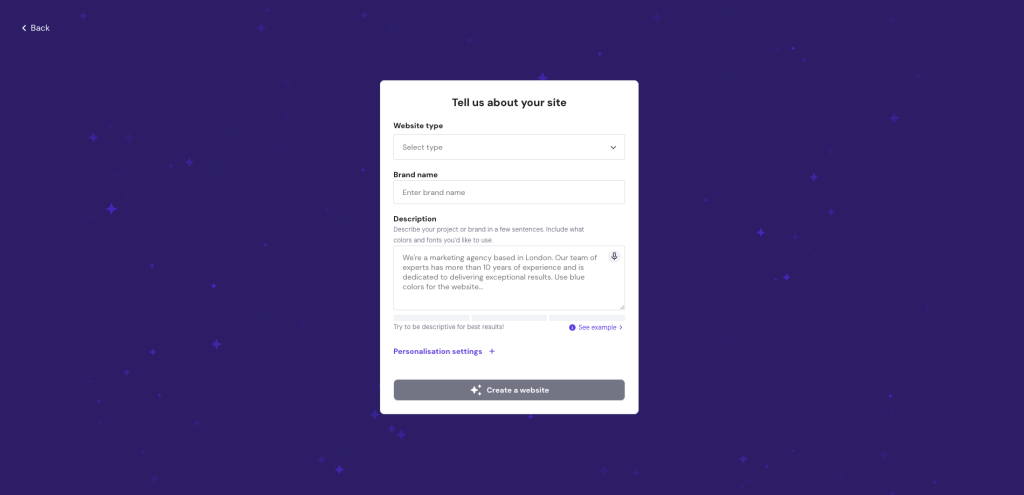
There are two ways you can build your fitness website with Hostinger Website Builder:
- Using the AI Website Builder. Simply describe your fitness business in the prompt box, and let the AI instantly craft the site for you, complete with a unique layout, written content, and images.
- Using pre-made templates. Choose from 150 responsive, designer-made templates, narrow your search to the Health and Beauty category, or start from scratch with a blank template.
In this article, we will cover how to build a website using the AI Website Builder.
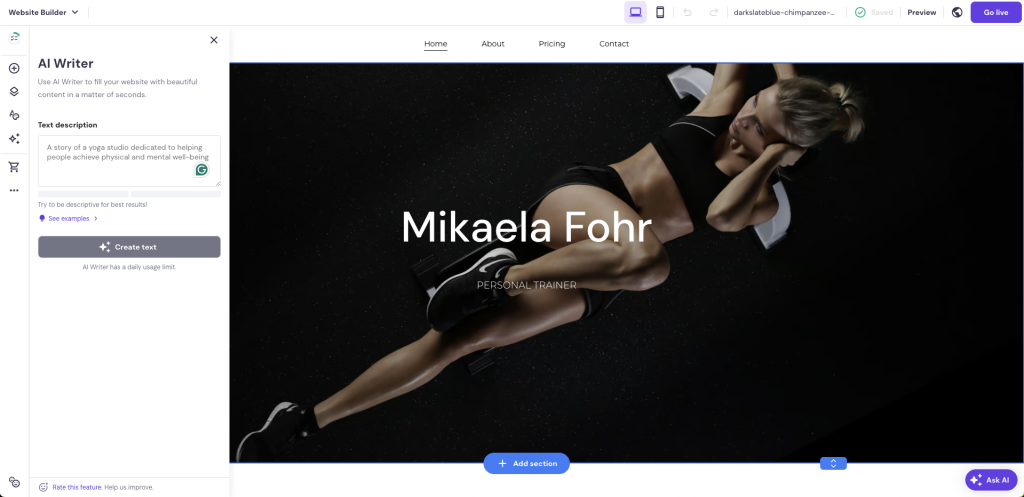
The builder’s AI tools help you customize your website quickly. The AI Writer assists in creating engaging content for your site. Explain the type of content you need, and the tool will write relevant and SEO-friendly text tailored to your specific fitness niche.
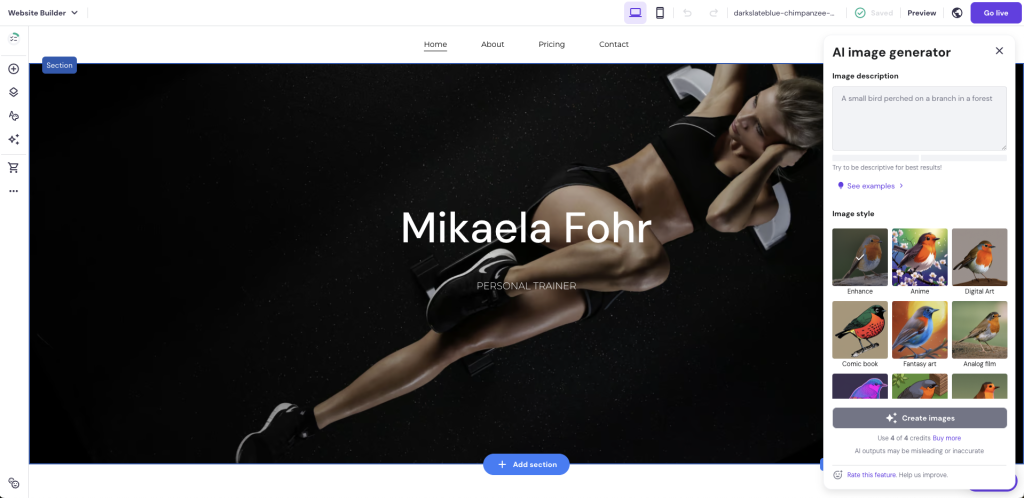
The AI Image Generator, on the other hand, creates high-quality visuals based on a text description. Whether you need images for blog posts, product pages, or promotional materials, this tool ensures that your visuals are unique and aligned with your vision.

You can also use AI to create product descriptions for your online store. Upload a product image and let the AI write up the description, saving you time and effort.
Being a drag-and-drop website builder, Hostinger Fitness Website Builder makes modifying your website fast and easy. Add, remove, and rearrange elements like text, images, and buttons with just a few clicks. Use the mobile editor to double-check everything looks good on smaller screens, too.
When designing your fitness website, focus on including essential features such as:
- Ecommerce features. Set up an online store to sell workout plans and merchandise. With Hostinger Website Builder, you can easily manage your online store using the website editor.
- Appointment booking functionality. Let clients book workout sessions with you easily. You can also offer free appointments for potential clients to try out training with you. Appointments are managed effortlessly through the Store manager.
- SEO tools. Improve your website’s visibility in search results. Use Hostinger’s built-in AI SEO tools to generate relevant keywords, meta titles, and meta descriptions, ensuring your site is found on search engines.
Make sure to highlight your services, share client testimonials, and ensure easy navigation to improve user experience. A well-designed fitness website will establish your credibility and encourage potential clients to reach out.
4. Develop your fitness programs and services
With your online presence established, it’s time to focus on defining and developing the services you offer. This includes your fitness programs and other services that can cater to your target audience and enhance your business.
Decide on your core services
To begin, identify the core services that are the mainstay of your business.
Start with the fitness programs you offer. These should be structured and tailored to different fitness levels, such as beginner, intermediate, and advanced. They need to be comprehensive, incorporating warm-ups, main exercises, and cool-downs to ensure a balanced workout for your clients.
Consider developing specialized programs that target specific groups, such as prenatal fitness, senior fitness, or youth training. These specialized services can help you reach niche markets and stand out in a crowded industry. Event-based programs, like marathon training, wedding fitness plans, or summer body workouts, can also attract clients with specific goals and timelines.
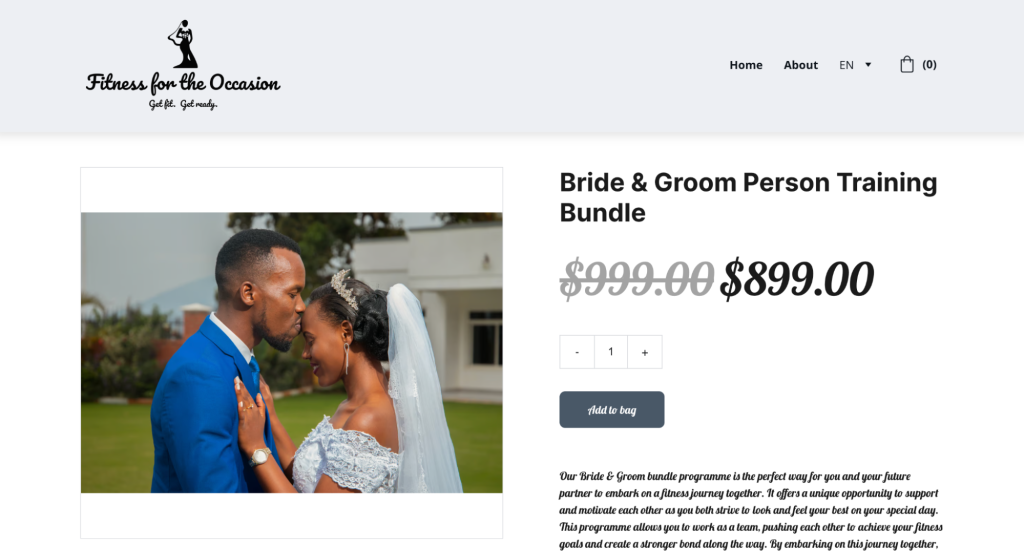
For instance, Fitness for the Occasion specializes in wedding-themed fitness programs for brides and grooms.
Offering personal training sessions, whether one-on-one or in small groups, can provide a higher level of personalized support and command premium pricing. These sessions can be conducted virtually or in person, depending on your business model and client preferences.
Utilize apps for fitness coaches
Fitness apps make it easy to share workout programs and keep in touch with multiple clients, while maintaining a professional appearance.
Consider developing your own custom application. With AI-powered tools like Horizons AI Web App Generator, you can easily build an app that creates workout plans or analyzes photos to track calories and nutrients – no coding required. Or, leverage existing platforms to enhance your services and manage clients more efficiently. Here are a few recommended apps for fitness coaches:
- Trainerize. A comprehensive platform for managing clients, creating workout plans, and tracking progress.
- MyPTHub. An all-in-one software for personal trainers and fitness professionals to manage their clients by creating personalized training and nutrition programs.
- TrueCoach. An app that helps fitness professionals deliver individual training programs, track client progress, and provide real-time feedback.
These tools help streamline and scale your operations, improve client satisfaction, and allow you to focus more on delivering high-quality fitness services.
Offer supplementary services

Beyond the training, consider the types of supplementary services that can add value to your clients. For example, Fitnesstown Store does this by selling various supplements in its online store.
You could:
- Collaborate with nutritionists. Provide comprehensive diet plans that complement your fitness programs. This collaboration can enhance your clients’ overall results and satisfaction.
- Offer wellness coaching services. Include mental wellness coaching, meditation sessions, or stress management workshops. By addressing overall well-being, not just physical fitness, you can differentiate your services and provide a holistic approach to health.
- Create online courses and workshops. Develop educational content on fitness theory, workout techniques, and healthy lifestyle tips. These can be delivered through webinars, video series, or ebooks.
- Sell fitness products. Create an online store to sell fitness-related products such as supplements, equipment, and branded merchandise. This additional revenue stream can enhance your business and provide clients with convenient access to the products they need.
5. Market your online fitness business
With your fitness programs in place, it’s essential to market your online fitness business effectively to attract and retain clients.
A well-defined marketing strategy is essential for business growth. If it’s your first time developing a marketing strategy, use our marketing plan template to get a head start:

Focus on popular channels like social media, email marketing, and content marketing. Ensure consistent messaging across all platforms in order to build a strong brand identity.
When crafting a marketing strategy for an online personal trainer business, consider the following tips:
Social media marketing
Utilize platforms like YouTube, Instagram, TikTok, and Facebook to share valuable content and connect with potential clients. Here are some tips for leveraging each platform effectively:
- YouTube. Post workout videos, fitness tips, and client testimonials to showcase your expertise.
- Instagram/TikTok. Share short workout clips, fitness challenges, and behind-the-scenes content to engage your audience.
- Facebook. Create a business page to post updates, organize events, and interact with your community.
- Google Ads. The Google Ads App is built into Hostinger Website Builder. You can reach potential customers with ads on YouTube as well as Search and Gmail.
Post content that’s valuable for your audience regularly to attract and retain followers. Engaging with your audience through live sessions and Q&A helps build a loyal community and strengthens your brand presence.
Email marketing
Building an email list helps to get new clients and keep current ones engaged. Begin your email marketing activities by doing the following:
- Build an email list. Offer freebies, such as a workout plan or nutrition guide, on your website to encourage visitors to sign up for your newsletter. This provides value to potential clients and gets them interested.
- Send regular newsletters. Provide updates, promotions, and valuable content such as fitness tips, success stories, and upcoming events. Aim for consistency, whether it’s weekly or bi-weekly, to keep your audience engaged and informed.
- Personalize your emails. To increase engagement, use the recipient’s name and tailor the content to their interests and fitness goals. Personalization can significantly boost open and click-through rates.
Content marketing
Creating and sharing valuable information is a great way to attract and keep clients. Get started with content marketing by doing this:
- Start a fitness blog. Create content that addresses your audience’s needs and interests. Wellness blog post ideas can include workout routines, nutrition advice, fitness trends, and client success stories. Regularly updating your blog with fresh content helps establish you as an authority in the fitness industry.
- Optimize your content for search engines. Find out what words people use to search for topics related to your website. Use those words in your website content so that people can find you more easily when they search online. Search engine optimization ensures your content reaches a broader audience.
- Repurpose content. Use your blog posts to create social media updates, infographics, and email content to maximize your reach and impact. Repurposing content allows you to get more mileage out of each piece of content you create, ensuring consistent messaging across all platforms.
Build a community
In addition to a strong marketing strategy, building a community around your fitness business can lead to long-term success.
A community fosters client loyalty and encourages referrals. It also reduces client churn and enhances your business’s reputation. Here are some strategies to build and nurture a community:
- Create accountability groups. Organize groups where members can support each other and stay motivated.
- Organize fitness camps and events. Host events that bring your clients together, fostering a sense of belonging.
- Offer freebies and incentives. To encourage participation and engagement, provide complementary meal plans, workout guides, or other freebies.
By building a community, you create a supportive environment that encourages client commitment and regular participation, leading to a more successful and sustainable business.
6. Grow and scale your business
Once your business is established and running smoothly, focus on growth and scaling to expand your reach and increase revenue.
Expand your service and product line
Explore new revenue streams to grow your business. As mentioned before, one option is to launch an online store to sell sports equipment, apparel, or nutritional supplements. This not only increases your revenue but also provides added value to your clients.
For example, use Hostinger Website Builder to easily add an online store on your website, allowing clients to purchase products directly from you. Offering a variety of fitness-related products can enhance your clients’ experience and boost your income.
Leverage partnerships and collaborations
Collaborating with other professionals and businesses can also play a significant role in scaling your business.
Form partnerships to expand your reach and provide more comprehensive services. Here are some examples of potential collaborations:
- Fitness retreats. Collaborate with other fitness professionals to organize fitness retreats, offering a unique experience for your clients.
- Massage therapist partnerships. Partner with massage therapists to offer complete wellness packages, referring clients to each other for complementary services.
- Affiliate programs. You can work as an affiliate with sports apparel companies and earn commissions for selling their products on your website.
Leveraging these partnerships helps you tap into new markets, enhance your service offerings, and grow your client base more effectively.
Conclusion
Starting an online fitness business requires a blend of fitness expertise and business knowledge.
You can achieve success in the digital fitness space by:
- Understanding the market
- Developing a solid business plan
- Building an online presence with a website
- Creating engaging fitness programs
- Marketing your brand effectively
To grow your business, consistently introduce new products or services. As your brand gains momentum, expand your products and services to reach a wider audience and increase revenue.
Stay focused and motivated, and continually adapt to industry trends to ensure long-term growth.
How to start an online fitness business FAQ
Are there any certifications or qualifications required to start an online fitness business?
While certifications are not mandatory, they add credibility and trust. Consider obtaining certifications from recognized organizations like ACE, NASM, or ISSA.
How do you price services for an online fitness business?
Research competitors and consider your target audience’s budget. Offer various pricing tiers for different services, such as single sessions, monthly subscriptions, and premium packages.
How to create engaging content for my online fitness business?
Focus on creating diverse content that caters to your audience’s needs. Provide value through videos, blog posts, and social media updates. Communicate with your audience regularly to build a loyal community.
What are the best ways to attract and retain clients for an online fitness business?
Offer free trials, provide exceptional service, and build a strong online presence. Stay in touch with your clients through personalized communication and regularly update your services to keep them interested.

Matleena is a seasoned Content Writer with 5 years of content marketing experience. She has a particular interest in emerging digital marketing trends, website building, and AI. In her free time, Matleena enjoys cups of good coffee, tends to her balcony garden, and studies Japanese. Follow her on LinkedIn

Miglė Cicėnaitė-Jocė is a Product Manager for Hostinger's Website Builder. She is on a mission to redefine website creation, focusing on the AI flow and its features, and is always eager for product feedback and market insights to improve the user experience. Follow her on LinkedIn.