Top Base44 alternatives: Best tools compared and pricing
May 18, 2026
/
Simon L.
/
17 min Read

Base44 is an AI-powered no-code app builder that turns plain-English descriptions into working web apps, complete with databases, authentication, hosting, and analytics.
Since Wix acquired it in mid-2025, the platform has attracted a loyal following among founders, solo makers, and small businesses who want to ship fast without writing code. You describe your idea, Base44 builds it, and you can be live within minutes.
But Base44 isn’t perfect for everyone. The credit-based pricing system uses two separate credit types (message credits for building, integration credits for user actions), and once you hit your monthly limit, everything stops until the next billing cycle.
Code export only covers the frontend; your backend always stays on Base44’s infrastructure, which creates real vendor lock-in if you ever want to migrate. Custom domains require the $40/month Builder plan (or $50/month if billed monthly).
And while the AI handles standard app patterns well, highly custom logic or complex workflows can push you toward workarounds that eat through credits fast.
Here are 7 top alternatives to Base44 that cover different needs, budgets, and skill levels.
- Best all-in-one AI builder: Hostinger Horizons – combines AI app creation with hosting, domains, and security starting at budget-friendly plans. No infrastructure juggling.
- Best for complex production apps: Bubble – the most mature no-code platform for building scalable SaaS, marketplaces, and customer management tools. Steeper learning curve, but unmatched depth.
- Best for internal tools: Retool – connects directly to your databases and existing services. If you’re building admin panels and dashboards for your team, this is the tool.
- Best for data-driven portals: Softr – turns your existing Airtable or Google Sheets into a polished client portal or directory in hours.
- Best for developers who want code ownership: Vercel v0 – generates clean React components from prompts that you fully own and deploy anywhere.
- Best for design-first websites: Webflow – pixel-level design control with powerful content management. Not an app builder, but unbeatable for content-driven sites.
- Best for rapid prototyping with clean code: Lovable – AI-generated full-stack apps with exportable, developer-friendly code. Great for early-stage products, though credits add up.
If you’re short on time: Hostinger Horizons gives you the most complete package for the best value price. Bubble is the right move if you need serious depth and don’t mind investing time to learn it.
Everything else on this list fills a more specific niche.
1. Hostinger Horizons
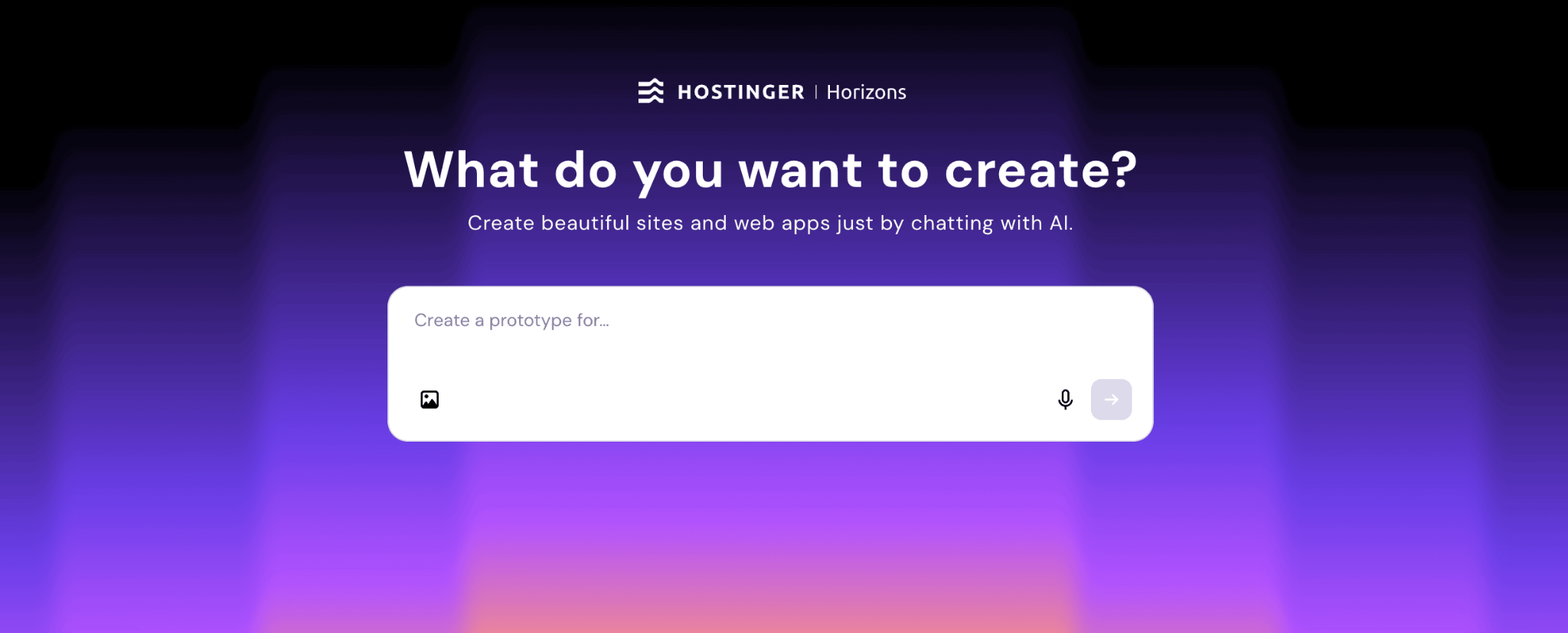
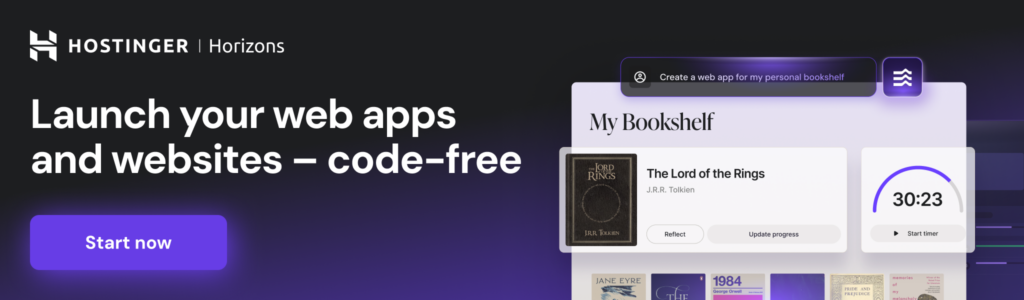
If you want a vibe coding tool that takes you from idea to live app without stitching together separate services, Hostinger Horizons is the most complete option available right now.
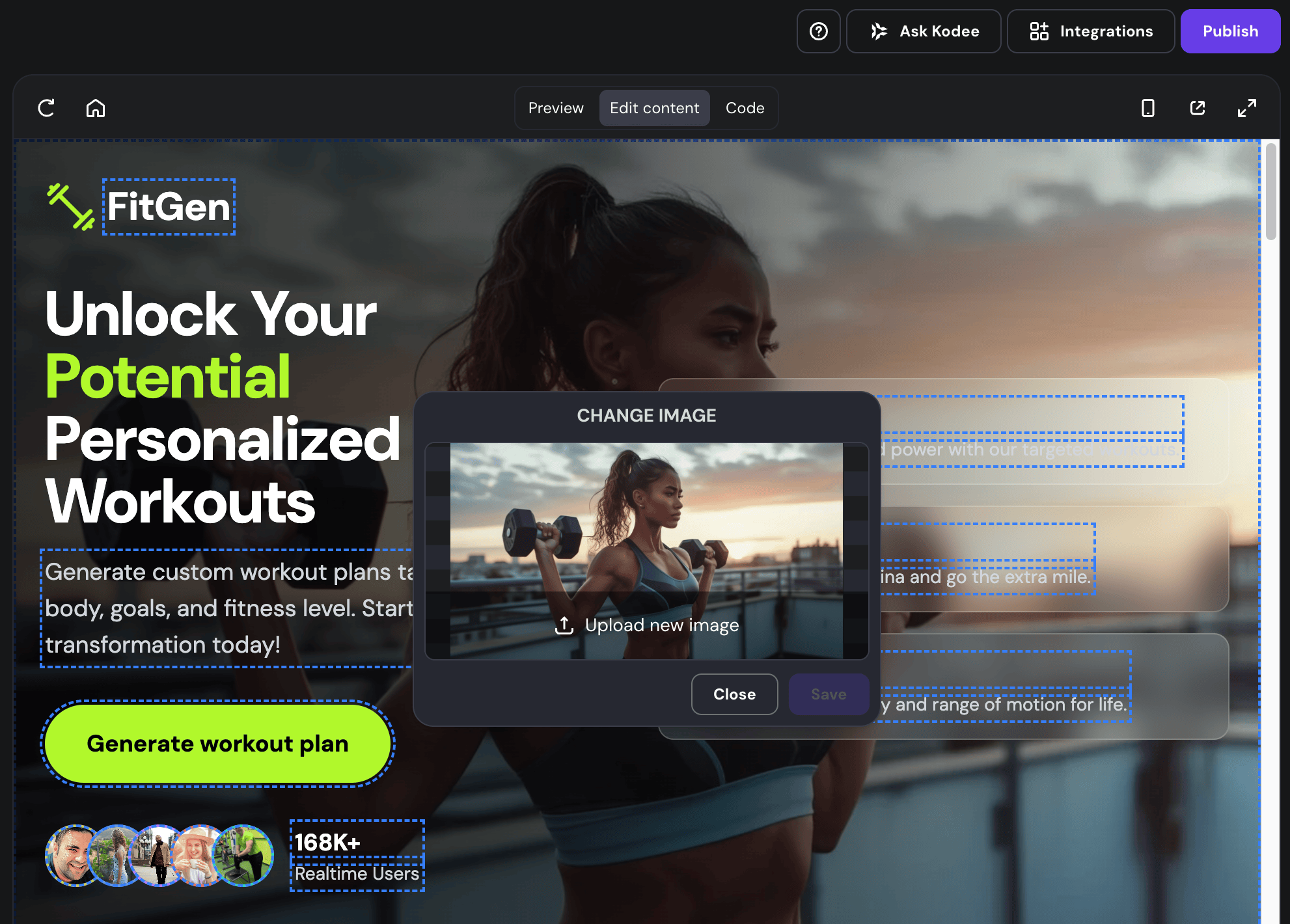
You describe what you want in a chat interface (text, voice, or even by uploading a screenshot), and the AI generates a working web app with frontend, backend, and deployment handled automatically.
Under the hood, it uses a mix of leading AI models that are automatically selected based on the task, so you get high-quality output without needing to understand the technical details.
What makes it the standout Base44 alternative is everything that’s included. Every Hostinger Horizons plan bundles hosting, a free custom domain (Starter and above), an SSL certificate (which secures your site’s connection), Cloudflare CDN (a content delivery network that speeds up load times worldwide), and professional email.
With Base44, you need the $40/month Builder plan just to connect a custom domain, and hosting is managed separately on Base44’s proprietary infrastructure. Hostinger Horizons eliminates that friction entirely.
The pricing is also significantly more approachable, starting at CA$ 13.99/month, and every plan includes the same core features. The only difference between tiers is how many AI credits you get, and you can buy additional credits without upgrading.
The platform supports prompts in 25+ languages, 150+ templates as starting points, and handles everything from portfolio sites to booking systems and SaaS products.
It’s not built for deeply complex enterprise apps that need custom backend programming, but for the vast majority of founders and small businesses, it covers more ground than Base44 at a lower cost.
Hostinger Horizons pros:
- You can buy additional AI credits without upgrading plans. Once you hit your limit, you’re not stuck waiting for the next billing cycle or forced into a higher tier.
- 150+ templates give you a head start, so you’re not describing every detail from scratch.
- Supports voice prompts, image uploads (screenshots, wireframes), and 25+ languages for a genuinely global experience.
Hostinger Horizons cons:
- Complex apps that need custom backend programming will eventually hit limits, similar to Base44 but without the option to write server-side logic (which Base44 unlocks on its Pro plan).
- Web apps and responsive sites only. Like Base44, there’s no path to native iOS or Android apps.
Hostinger Horizons pricing:
Subscription-based plans from CA$ 13.99 to CA$ 139.49/month (billed annually), with all core features included on every tier. Compared to Base44’s $16–$160/month range with its dual credit system, Horizons offers a lower entry point, more included value (hosting, domain, email), and simpler budgeting.
2. Bubble
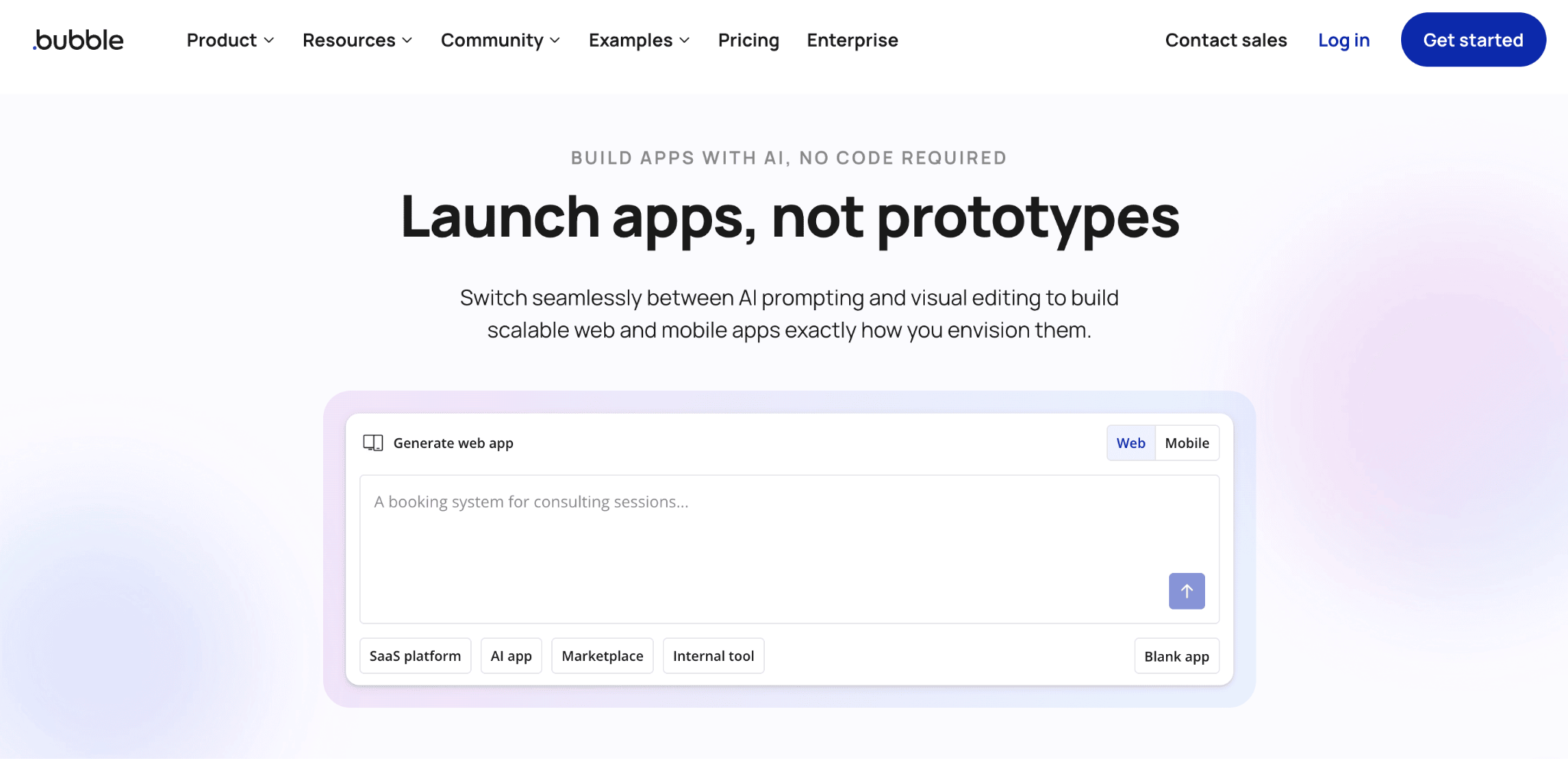
Bubble offers a pixel-perfect visual editor, a built-in relational database, a powerful workflow system, and a marketplace with hundreds of plugins.
If Base44 is the quick sketch, Bubble is the full architectural blueprint.
The trade-off is the learning curve. Most users report needing 2–4 weeks of daily practice to build confidently, compared to Base44’s near-instant onboarding. And Bubble’s pricing is based on workload units (WUs), which measure server processing.
Your costs scale with traffic and workflow complexity, which can lead to surprises. A poorly optimized app can burn through WUs twice as fast as a well-structured one.
That said, if you’re building something complex (a multi-sided marketplace, a SaaS product with custom billing logic, an app with sophisticated user permissions), Bubble can handle it where Base44 would hit its limits.
The ecosystem depth is genuinely unmatched in no-code, which is why it consistently comes up when people compare tools like Bubble for serious production work.
Bubble pros:
- You can build genuinely complex business logic (conditional workflows, role-based permissions, multi-step processes) that would require workarounds on Base44.
- Massive plugin marketplace lets you add Stripe payments, SendGrid emails, or Google Maps without custom code.
- Version control and multi-editor support on higher plans, so teams can collaborate without stepping on each other’s work.
Bubble cons:
- Expect 2–4 weeks of learning before you’re productive. Base44 gets you building in minutes, which is a real advantage if speed matters more than depth.
- No code export at all. Base44 at least lets you export frontend code. With Bubble, migrating away means rebuilding from scratch.
- Workload unit overages cost more than upgrading to the next tier, so a traffic spike can hit your wallet unexpectedly.
Bubble pricing:
Tiered plans starting around $29–$32/month, with costs scaling based on workload unit consumption. It can end up costing more than Base44 at scale, but the depth of what you can build justifies it for complex, long-term products.
3. Retool
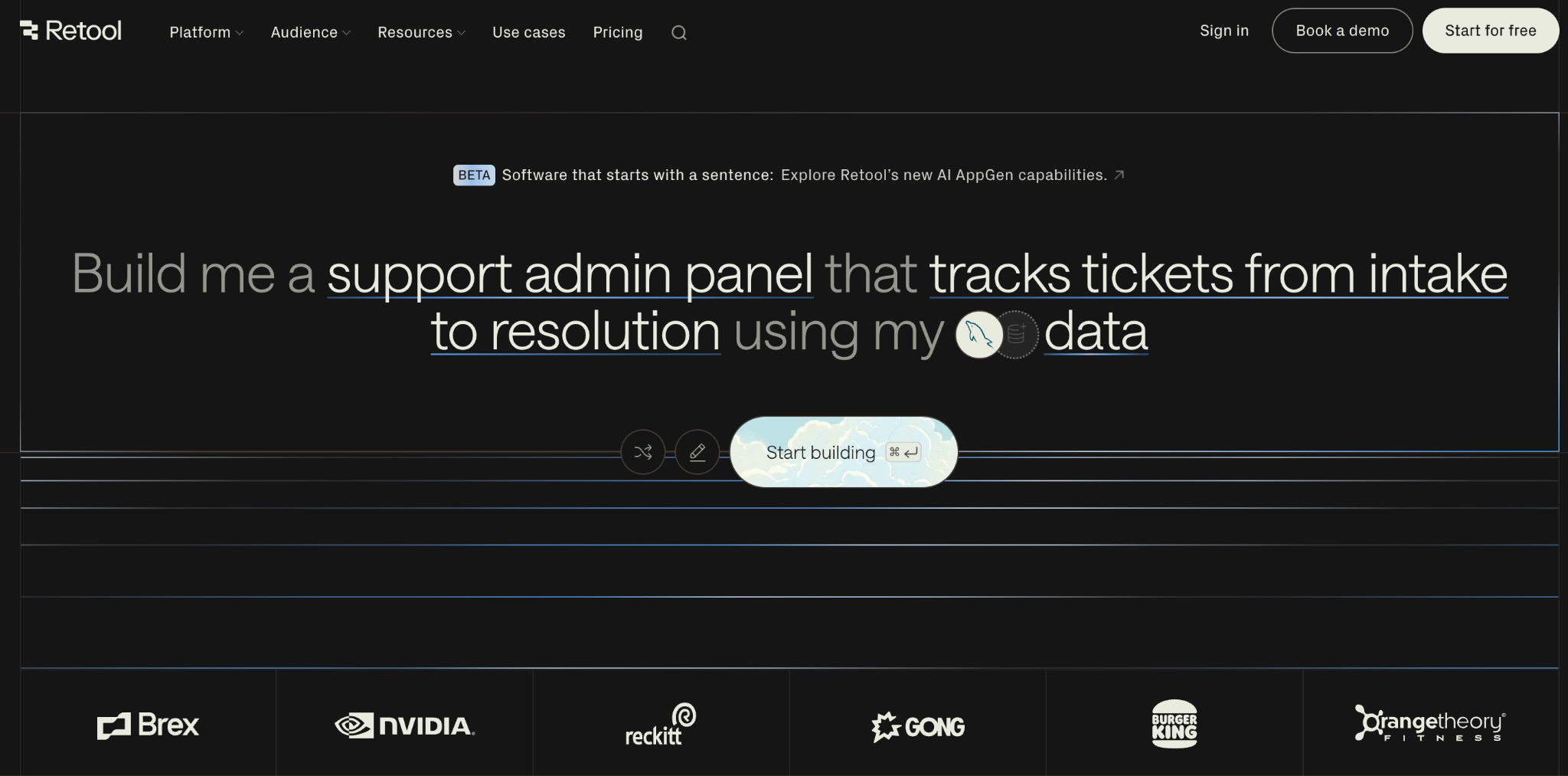
Retool isn’t competing with Base44 for the same audience, and that’s exactly why it might be what you need.
While Base44 targets founders building customer-facing MVPs, Retool is purpose-built for internal tools: admin panels, dashboards, data management interfaces, and operational workflows.
Companies like Amazon, DoorDash, and OpenAI use it for mission-critical internal apps.
The platform connects directly to most popular databases, REST APIs (application programming interfaces, which let different software talk to each other), and dozens of other data sources.
You drag and drop UI components (tables, forms, charts) and wire them up to your data. It’s incredibly fast for the right use case, but it does assume you’re comfortable working with databases and writing basic queries.
Retool pros:
- Connects to virtually any data source out of the box, including SQL databases, NoSQL, and REST endpoints.
- Self-hosting option means your data never leaves your infrastructure, which matters for compliance-sensitive teams.
- Built-in role-based permissions let you control exactly who can view, edit, or admin each app.
Retool cons:
- Not designed for customer-facing apps. If you need something your end users will interact with directly, most other tools on this list are a better fit.
- SSO (single sign-on) and audit logging are locked behind the Business and Enterprise tiers, which pushes costs up quickly.
- Per-seat pricing scales linearly. A 10-person team on the Business plan runs $500/month before you’ve built anything.
Retool pricing:
Free for up to 5 users, starting around $10/month per user on Team. Cheaper than Base44 for small teams, but costs grow linearly with headcount and can outpace Base44’s flat plans quickly.
4. Softr
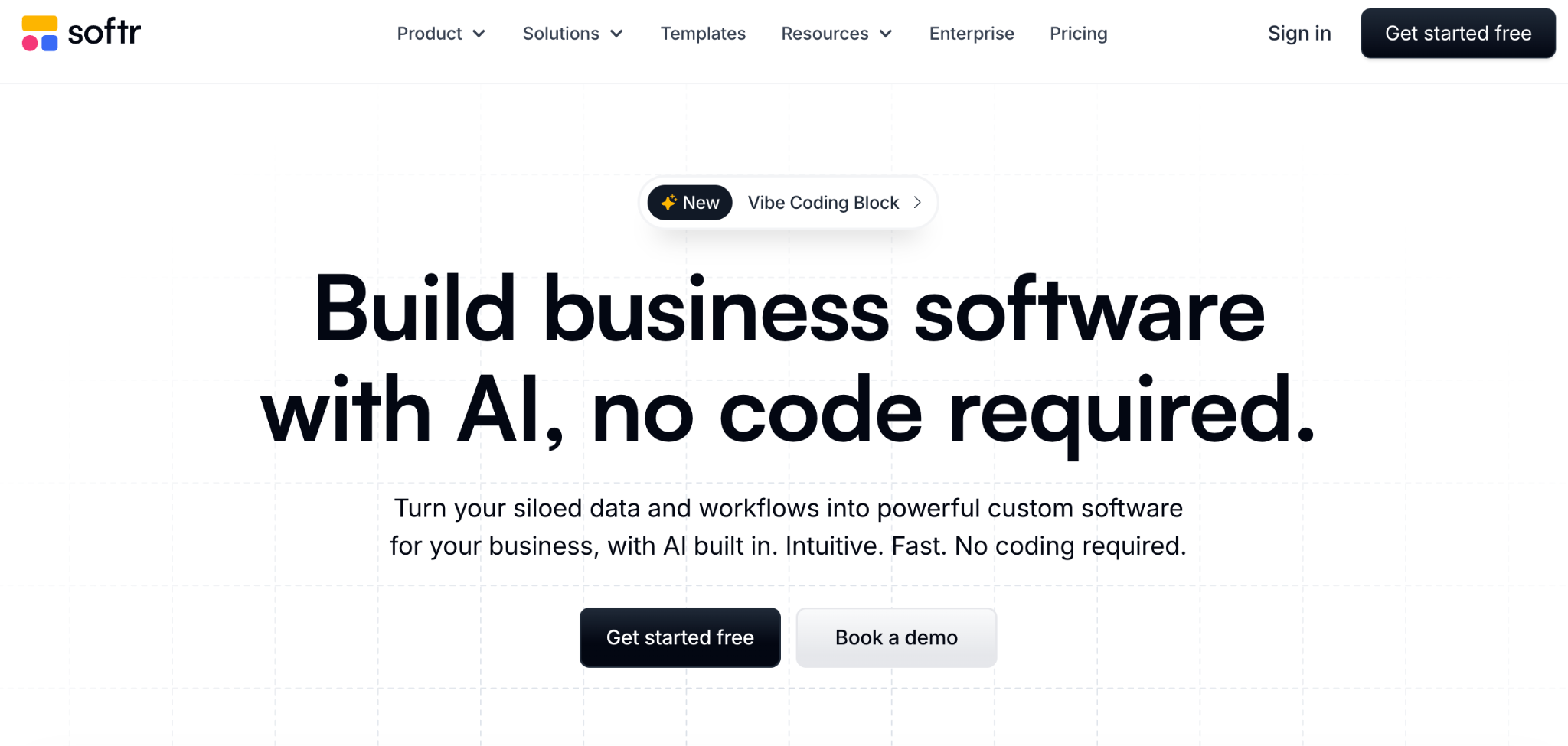
Softr is what happens when someone decides that the fastest path from data to app should go through the spreadsheet you already have.
It sits on top of Airtable and Google Sheets, turning your existing data into client portals, membership sites, directories, and internal dashboards with login systems and user permissions.
Compared to Base44, Softr is more opinionated about what it’s good at. You won’t build a complex SaaS product on it. But for portal-style apps where the data structure is already defined, the setup is remarkably fast, and the results look polished.
Softr pros:
- If your data already lives in Airtable or Google Sheets, you skip the database setup entirely. Base44 builds a database from prompts, but Softr connects to one you’ve already structured.
- Membership and login features are built in, so client portals with gated content are quick to set up.
- Pre-built templates for directories, marketplaces, and internal dashboards get you to a polished result fast.
Softr cons:
- You’re building around your spreadsheet’s structure, which limits how creative you can get with your app’s architecture.
- No AI-driven app generation. You’re assembling from components rather than prompting.
- Scaling beyond a few hundred users or adding complex multi-step logic will push you toward Softr’s limits sooner than Base44.
Softr pricing:
Freemium with tiered paid plans based on features and team size. Affordable entry-level pricing, and unlike Base44’s credit system, costs are based on what you build rather than how many prompts it takes. Worth evaluating alongside other custom AI builders like Softr if your project fits the portal pattern.
5. Vercel v0
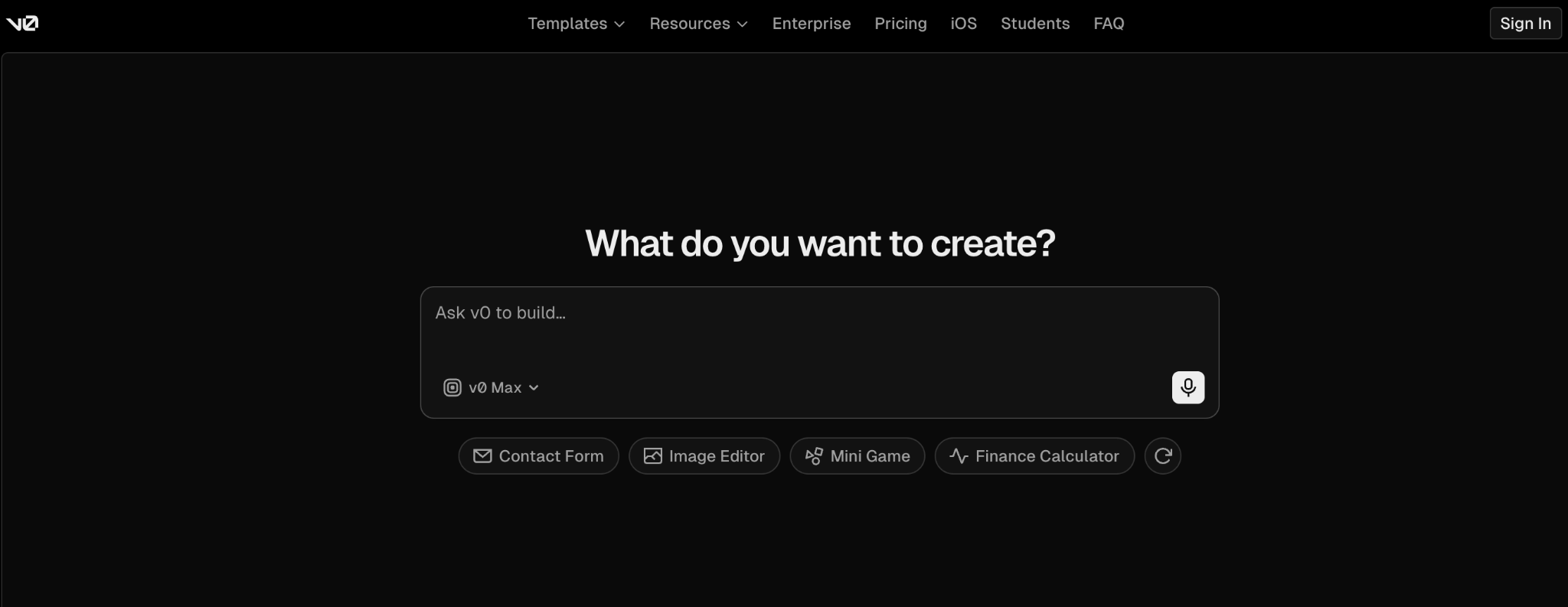
Vercel v0 is for developers, period. Built by the team behind Next.js, it generates production-quality React components from text prompts. You describe a UI, v0 builds it, and you get clean code that you own entirely and can deploy anywhere.
This is the opposite end of the spectrum from Base44. There’s no managed backend, no built-in database, no one-click deployment of a full app.
What you get is a tool that accelerates the part of development most developers find tedious (building UI components) while letting you handle architecture decisions yourself.
If you already have a tech stack and just want AI to speed up frontend work, v0 is excellent. If you want an all-in-one builder, look elsewhere.
Vercel v0 pros:
- You own every line of code. Base44’s export is frontend-only with a locked backend. v0 gives you production-ready components with zero strings attached.
- Free tier includes 200 credits/month, which is generous for component generation.
- Fits into existing development workflows. If your team already uses Next.js or Vercel, v0 slots right in.
Vercel v0 cons:
- Not a no-code tool. Base44 lets a non-technical founder build a complete app. v0 expects you to know what to do with React components once they’re generated.
- Generates UI components, not full applications. You still need to build your own backend, database, and authentication, all of which Base44 handles automatically.
Vercel v0 pricing:
Free tier with 200 credits/month, paid plans for heavier usage. More generous free tier than Base44’s, but you’ll need separate services for hosting and backend. If you’re comparing similar AI code generation tools like Vercel v0, factor in those additional costs.
6. Webflow
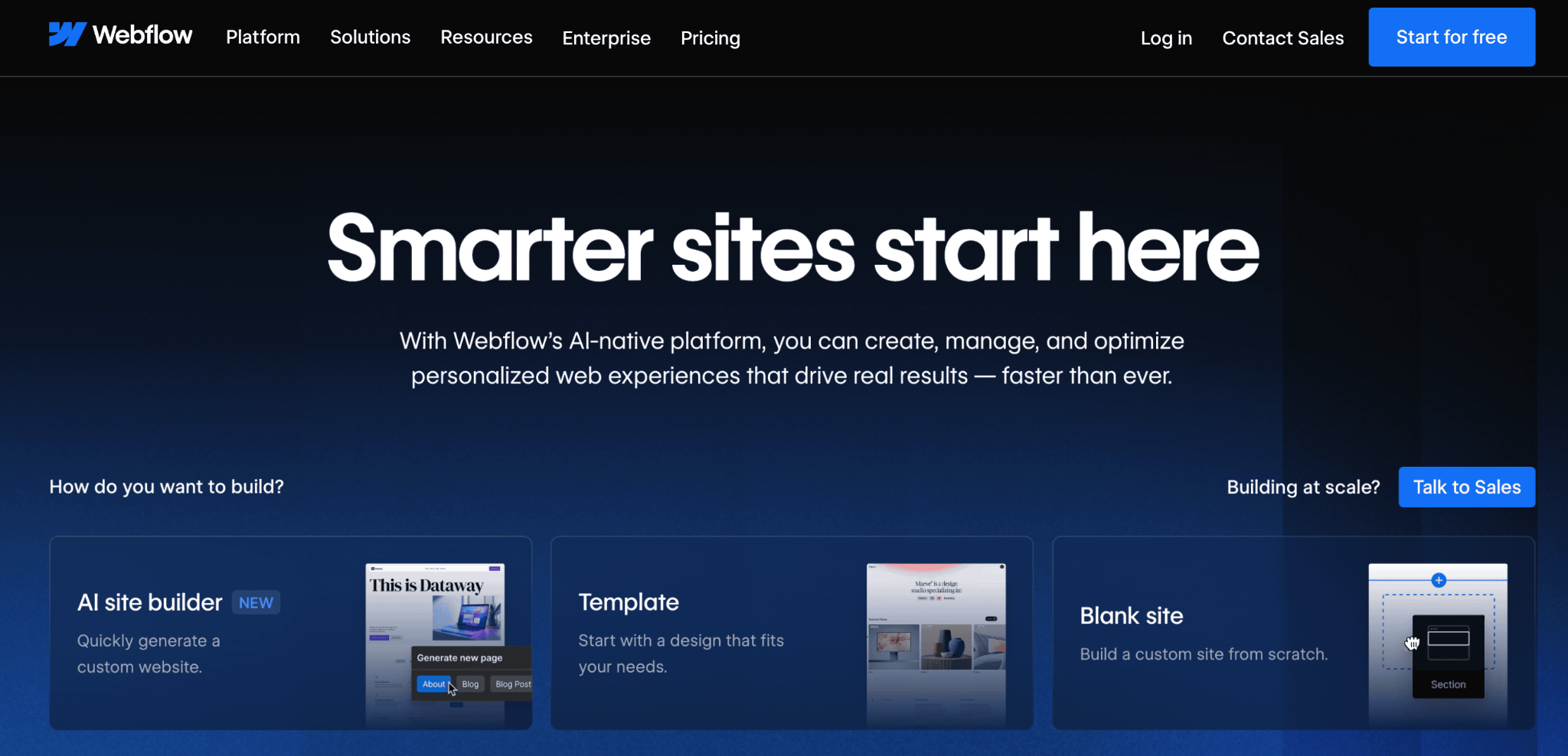
Webflow is a visual web development and CMS (content management system) platform that gives designers the kind of control you’d normally need HTML and CSS for, without writing either.
It’s the industry standard for marketing sites, content-driven websites, and landing pages where design quality is the priority.
It’s not really competing with Base44 in the app-building space. Webflow doesn’t generate databases, handle user authentication, or build application logic.
What it does is let you create stunning, responsive websites with a built-in CMS, global CDN hosting, and the ability to add ecommerce features. If your project is more “website” than “web app,” Webflow is probably the better tool.
Webflow pros:
- Design control that Base44 simply can’t match. If your project is visual-first (a portfolio, agency site, or product marketing page), Webflow gives you pixel-level precision that AI generation doesn’t offer.
- Built-in CMS with structured content collections, dynamic pages, and filtering. Base44 can build content-driven apps, but managing ongoing content is clunkier.
- Site-based pricing is predictable. You pay per site, not per credit or per action, so there are no surprise costs as your traffic grows.
Webflow cons:
- No application logic, databases, or user authentication without third-party tools. Base44 generates all of this from a single prompt.
- The interactions and animations system has a real learning curve. Getting complex scroll effects or multi-step animations right takes practice.
Webflow pricing:
Site-based pricing from around $14/month. More predictable than Base44’s credit model since you pay per site with no surprise costs as traffic grows. See how alternatives to Webflow stack up for more context.
7. Glide
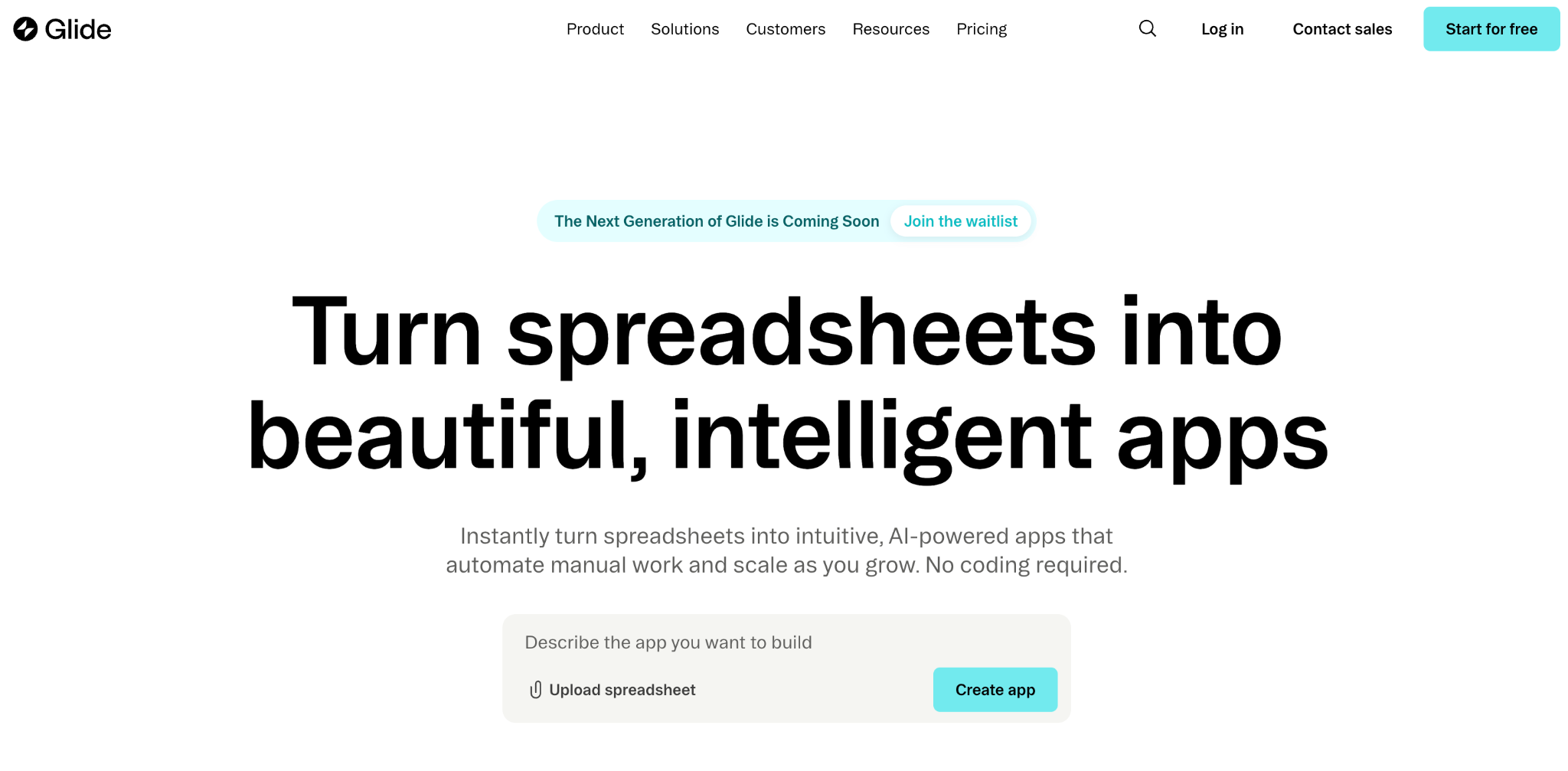
If you have data in Google Sheets, Excel, or Airtable, Glide can turn it into a polished, mobile-first app faster than almost anything else on this list. Inventory trackers, team directories, field service tools, simple CRMs: these are 20-minute projects on Glide.
The catch is that Glide’s simplicity is also its ceiling. Base44 lets you describe complex app behavior, and the AI figures out the architecture.
Glide is more constrained; you’re building around your spreadsheet’s structure, and once you need custom logic or unconventional layouts, you’ll feel the limits. It’s the best tool for a specific kind of problem, but not a general-purpose app builder.
Glide pros:
- Setup speed is unmatched. A working app from an existing spreadsheet takes minutes.
- Mobile-first design means your app looks good on phones and tablets without extra work.
- Non-technical teams can manage and update data directly in the spreadsheet without touching the app builder at all.
Glide cons:
- Per-app pricing at around $60/month adds up fast if you need multiple apps. Base44 allows unlimited app creation on all paid plans.
- Much less customization than Base44. You’re working within Glide’s component library, not describing exactly what you want and having AI build it.
Glide pricing:
Per-app pricing with a free tier and business plans starting around $60/month per app. Simple to understand, but gets expensive with multiple apps. Base44’s paid plans allow unlimited app creation, which is better value if you’re building more than one tool.
8. Adalo
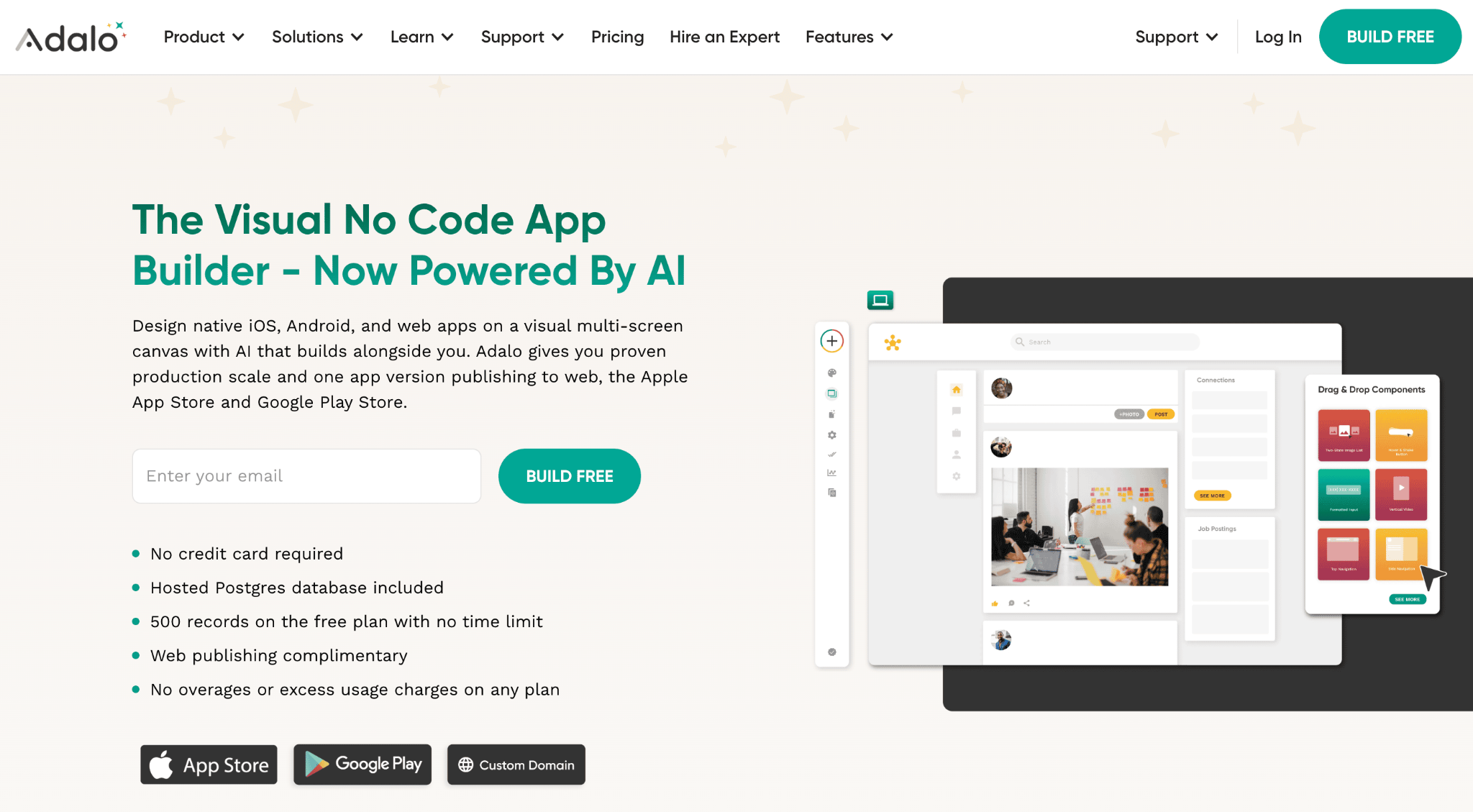
Here’s the thing most AI app builders don’t tell you: they only make web apps. If you need something in the App Store or Google Play, that rules out Base44, Lovable, and most of this list.
Adalo is one of the few no-code platforms that compiles to native code and publishes directly to both stores from a single codebase.
The visual builder handles common mobile patterns well: tab navigation, lists, forms, and push notifications.
Adalo isn’t as fast or polished as Base44 for web projects, and the ecosystem is smaller. But if mobile is your requirement, not a nice-to-have, Adalo solves a problem the others can’t.
Adalo pros:
- Native mobile publishing to both app stores from a single codebase. This is a capability Base44 doesn’t have.
- No usage-based billing surprises. Paid plans include unlimited database records with straightforward pricing.
- Built-in components for common mobile patterns like tab navigation, lists, forms, and push notifications get you to a functional app quickly.
Adalo cons:
- Web apps are a secondary experience. If you need both web and mobile, you’ll get better web results elsewhere.
- Smaller plugin and template ecosystem than more established platforms like Bubble.
- Performance can lag with complex data operations, especially on lower-tier plans.
Adalo pricing:
Tiered plans from around $36/month with unlimited database records included. Easier to budget than Base44’s dual credit system, where every user action consumes integration credits on top of your building credits.
9. Draftbit
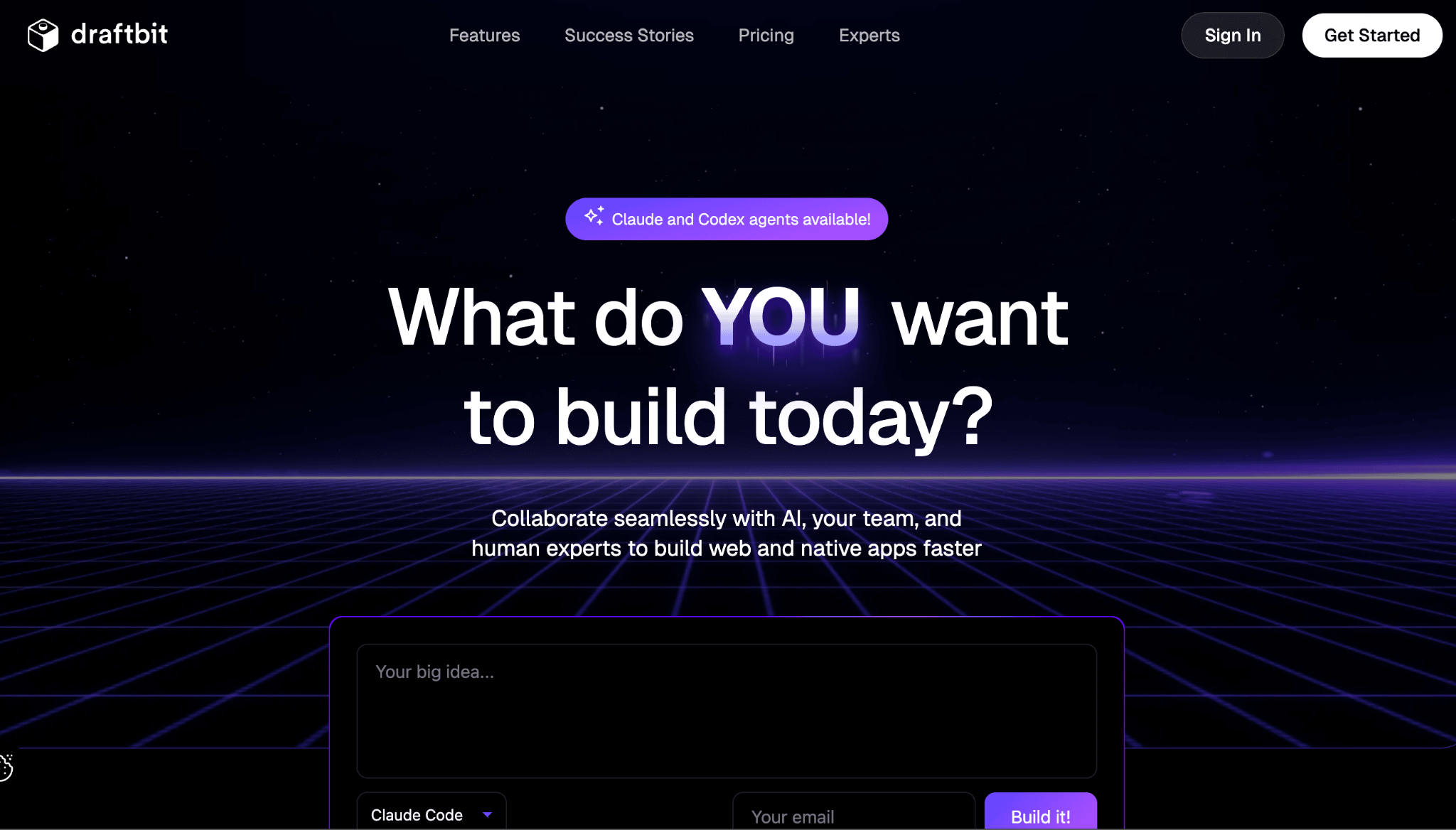
Draftbit occupies a niche that’s easy to overlook but genuinely useful: it’s a visual builder that outputs real React Native code you can export and own completely.
Think of it as having a designer and a junior developer scaffold your mobile app, then handing you the keys to finish and deploy it however you want.
This matters if your long-term plan includes self-hosting, custom backend work, or eventually handing the project to a development team.
Base44’s code export is frontend-only with a locked backend. Draftbit gives you the whole thing. The trade-off is that you need to know what to do with React Native code once you have it.
Draftbit pros:
- Full React Native code export with no strings attached. Base44 only exports frontend code and keeps your backend locked.
- Visual builder speeds up the repetitive parts of mobile development, then gets out of the way so you can customize.
- No vendor lock-in. You can leave at any time and your app keeps working.
Draftbit cons:
- You need real development skills to make the most of it. This is not a no-code tool in practice.
- Smaller template and component library than Adalo or Bubble, so you’re building more from scratch.
Draftbit pricing:
Subscription-based pricing. Strong long-term value compared to Base44 since you’re paying for code you keep forever, rather than ongoing access to a platform that hosts your backend.
10. OutSystems
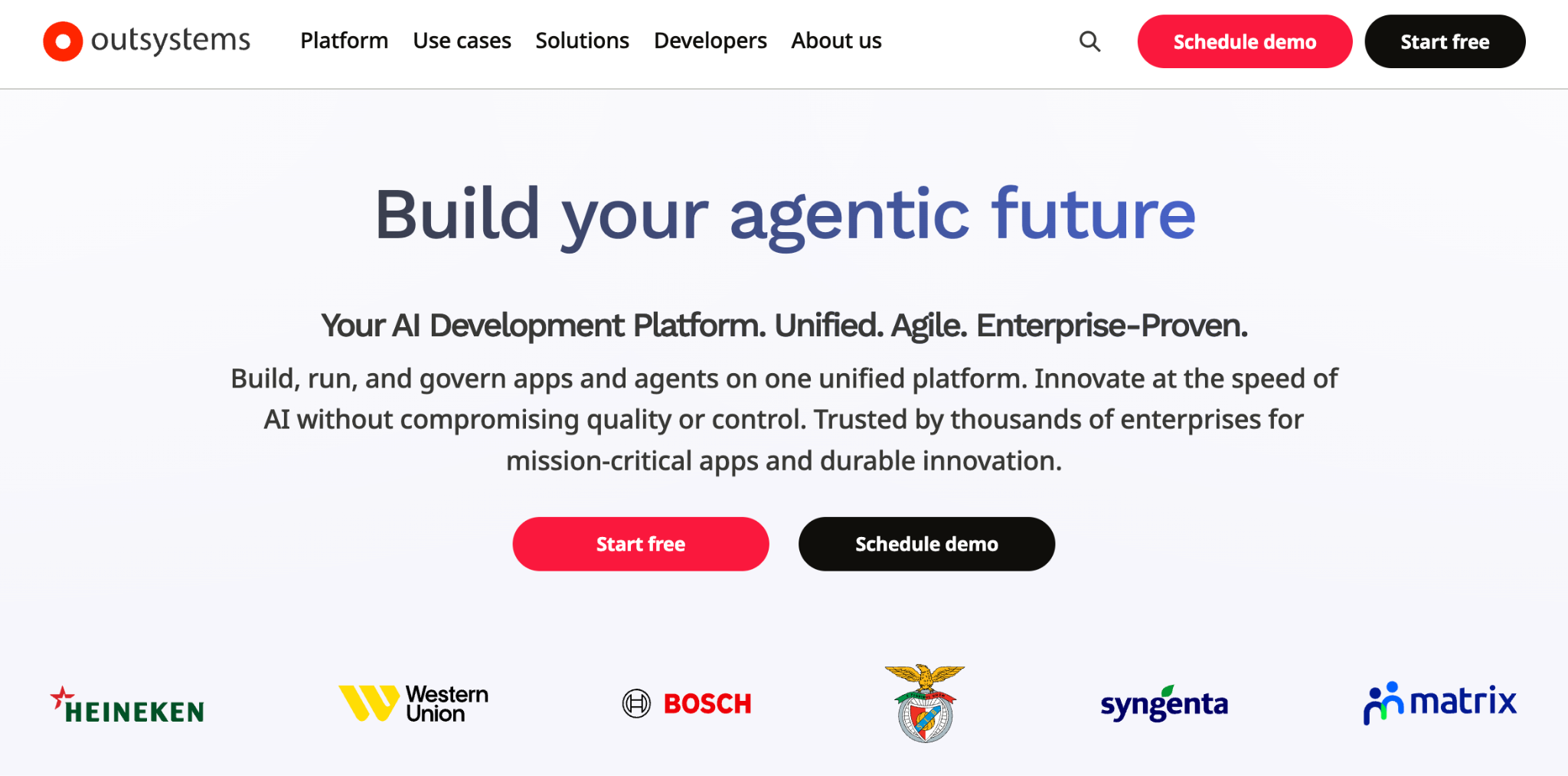
OutSystems is enterprise low-code for organizations that measure their app portfolios in the hundreds and their compliance requirements in pages.
It handles security, governance, lifecycle management, and deployment across cloud and on-premises environments. Fortune 500 companies use it to build and maintain mission-critical internal software.
If you’re reading an article about Base44 alternatives, there’s a good chance OutSystems is more platform than you need.
It’s on this list because it technically occupies the same “build apps without traditional coding” space, but the overlap with Base44’s audience is slim. The pricing alone (enterprise contracts, typically requiring a sales call) puts it in a different category.
OutSystems pros:
- Enterprise-grade security, compliance controls, and lifecycle management built into the platform from the ground up.
- Supports deployment across cloud, hybrid, and on-premises environments, giving IT teams full control over where apps run.
- Scales to handle hundreds of internal apps under centralized governance.
OutSystems cons:
- Expensive. Pricing requires a sales conversation and enterprise contract, which puts it out of reach for small teams.
- Complex setup and onboarding. This isn’t a tool you’ll be productive with in an afternoon.
- Overkill for simple apps, prototypes, or anything a solo founder would build.
OutSystems pricing:
Custom enterprise pricing requires a sales process. Not comparable to Base44’s self-serve model in cost or accessibility.
11. Mendix
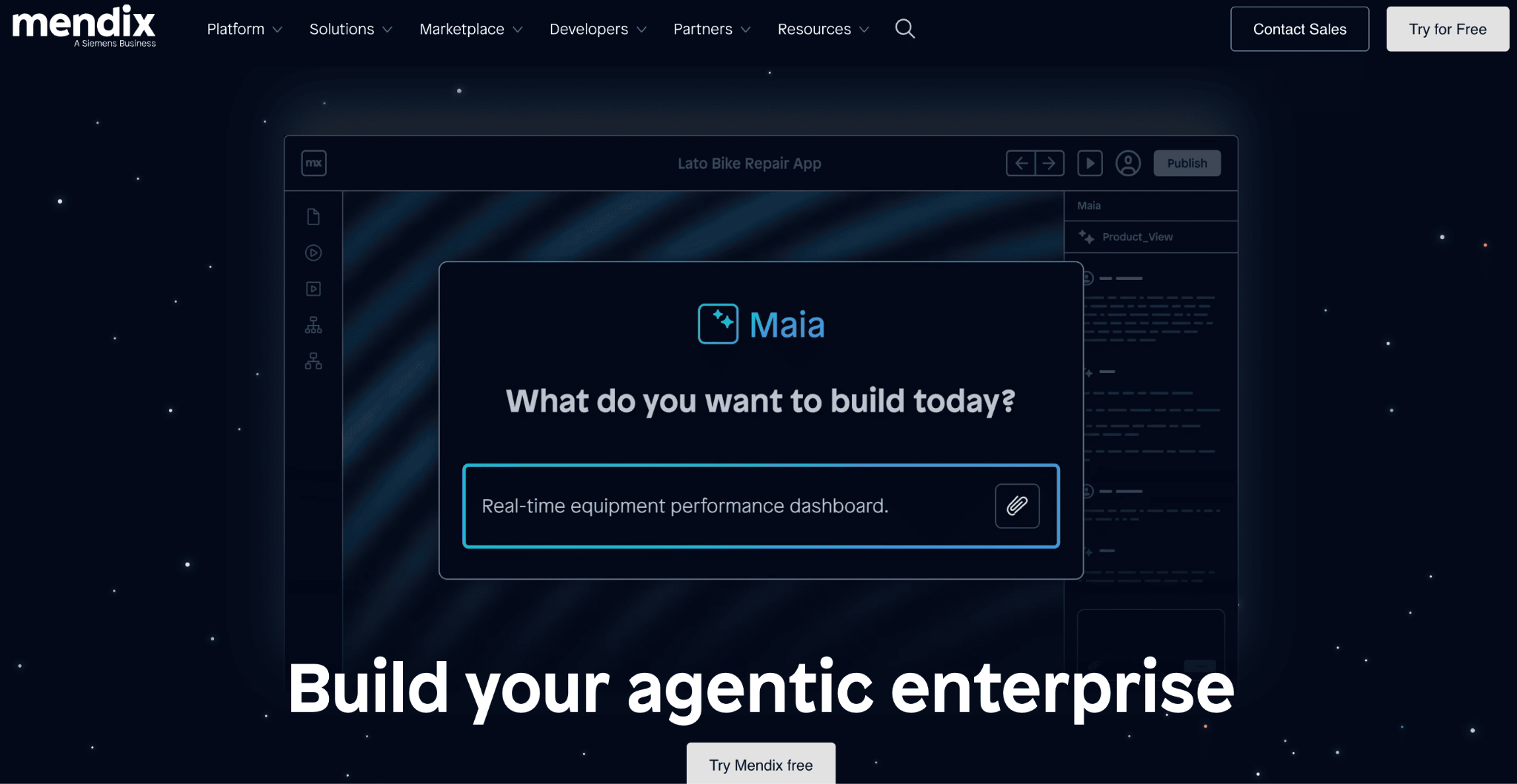
Mendix is OutSystems’ closest peer: another enterprise low-code platform built for large organizations that need multi-experience development across web, mobile, and IoT (internet of things) devices.
Regulated industries like finance and healthcare gravitate toward it for the governance, version control, and audit capabilities.
If you’re a solo founder or small team comparing Mendix to Base44, you’re comparing a commercial truck to a scooter. Both have wheels, but they solve completely different problems.
Mendix pros:
- Strong governance, version control, and audit capabilities that satisfy regulatory requirements in finance, healthcare, and government.
- Multi-experience development across web, mobile, and connected devices from a single platform.
- Collaborative development environment designed for large teams with different skill levels working on the same project.
Mendix cons:
- Steep learning curve. The platform is powerful but takes significant time to master.
- Enterprise-focused pricing that’s out of reach for individuals and small teams.
- Far more complex than needed for simple apps or prototypes.
Mendix pricing:
Free tier for learning, but production plans are enterprise-priced. Where Base44 starts at $16/month for anyone, Mendix’s production plans assume an organizational budget.
12. SAP Build Apps (formerly AppGyver)
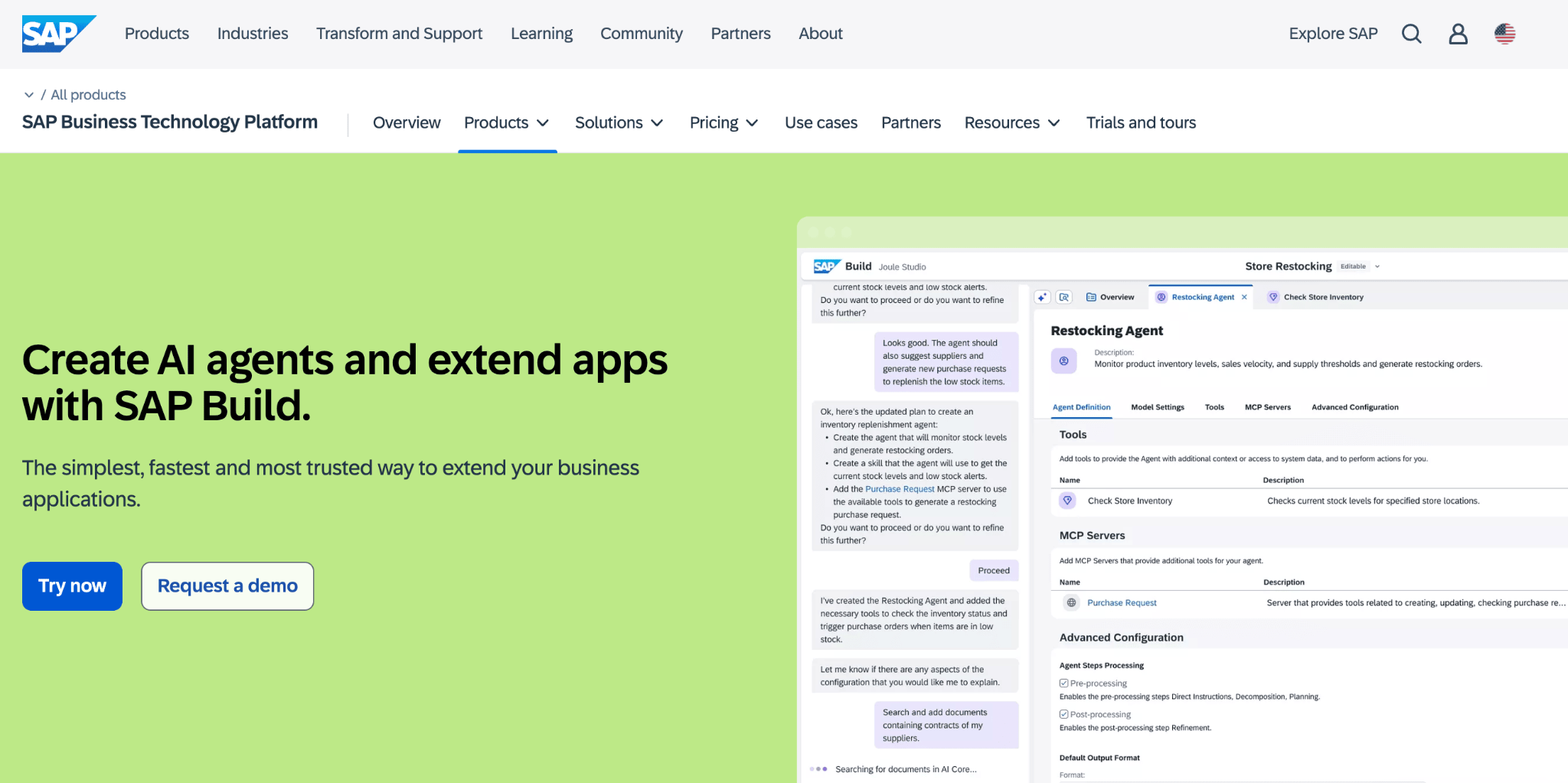
SAP Build Apps is a no-code app builder within SAP’s broader Build platform, designed for creating enterprise applications using a drag-and-drop visual editor and flowchart-style logic.
If your organization already runs on SAP systems, Build Apps lets you create custom tools that connect seamlessly with your existing SAP infrastructure.
For most people exploring Base44 alternatives, SAP Build Apps is a niche pick. It’s enterprise-focused, the pricing is complex, and the community is smaller than what you’ll find around Bubble or Base44.
But if you’re inside the SAP ecosystem and need custom apps that integrate with your business data, it’s purpose-built for that job in a way that general-purpose builders aren’t.
SAP Build Apps pros:
- Deep integration with SAP systems and the SAP Business Technology Platform, which matters if your organization already runs on SAP.
- The visual logic editor handles complex conditional workflows and data transformations without writing code.
- Enterprise-grade security and compliance features are built in, not bolted on.
SAP Build Apps cons:
- Smaller community means fewer tutorials and slower help when you get stuck.
- UI design tools feel a generation behind what AI-first builders produce. The output is functional but not visually polished.
- Pricing is confusing and enterprise-oriented, with multiple license types that can be hard to navigate.
SAP Build Apps pricing:
SAP Build Apps uses a capacity-based enterprise licensing model with multiple license tiers. Pricing requires configuration based on your usage and is aimed at organizations already invested in SAP. A very different model from Base44’s simple self-serve plans.
13. Thunkable
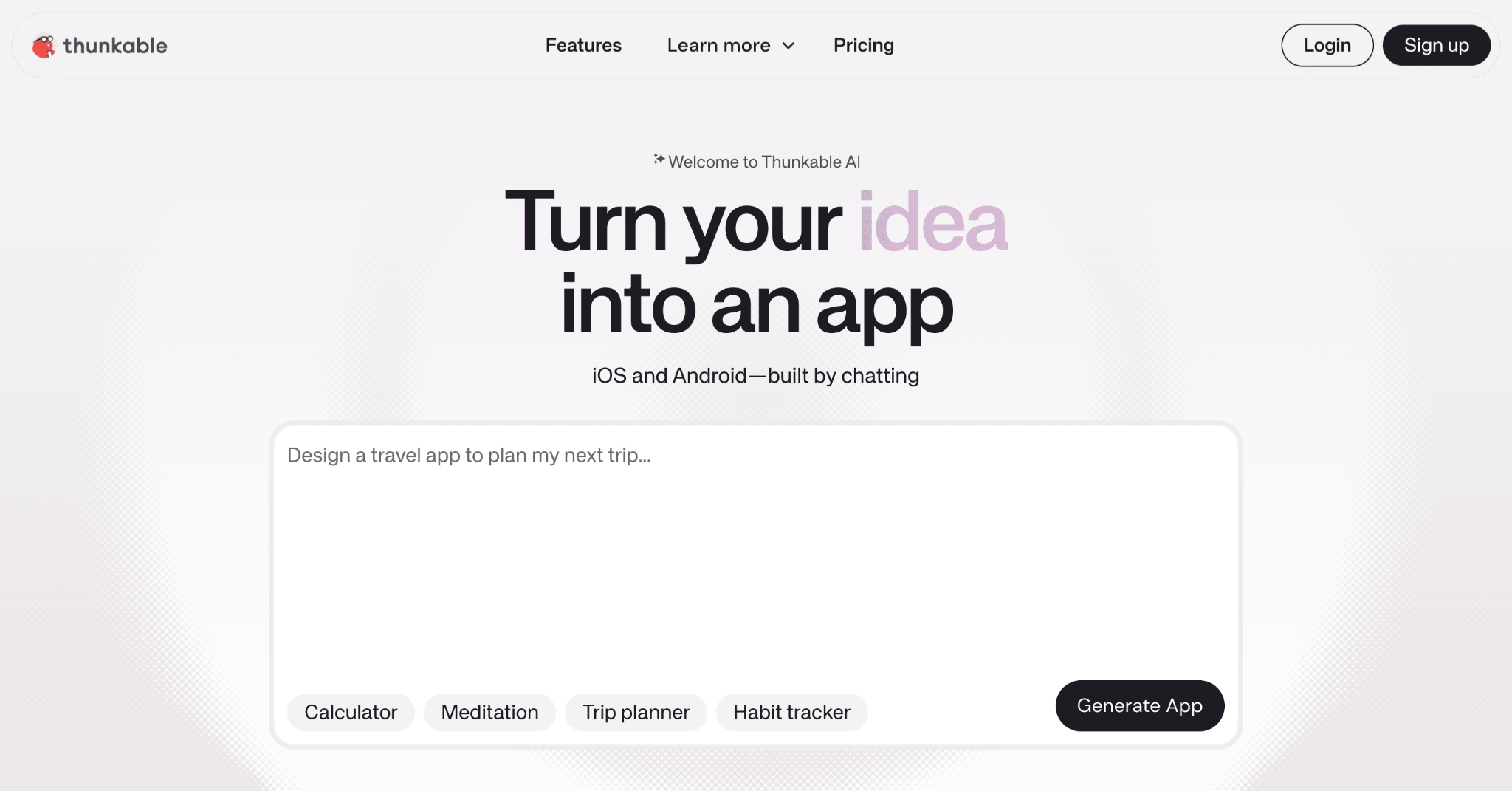
Thunkable uses a block-based logic system that makes it the most approachable platform on this list for absolute beginners. It’s popular in classrooms and coding bootcamps, and you can publish cross-platform mobile apps from a single project.
The limitation is that Thunkable’s simplicity caps out early. Once you need anything beyond basic data entry, display, and simple logic, you’ll outgrow it.
For learning how apps work or prototyping a concept to show to others, it’s great. For building something you’d charge money for, look elsewhere.
Thunkable pros:
- The lowest barrier to entry on this list. Block-based logic (similar to Scratch) is approachable for people with zero technical background.
- Cross-platform mobile publishing from a single project, which most AI builders on this list can’t do.
- The free plan is functional enough for learning and simple prototypes without restrictive daily caps.
Thunkable cons:
- You’ll outgrow it fast. Apps with more than basic logic or data handling will push past what Thunkable can do.
- UI components look basic. If polish matters to your users, the output will feel dated.
Thunkable pricing:
Tiered pricing with a free plan and paid plans for publishing. Lower entry cost and a less restrictive free tier than Base44, but aimed at learners and educators rather than production apps.
14. Lovable
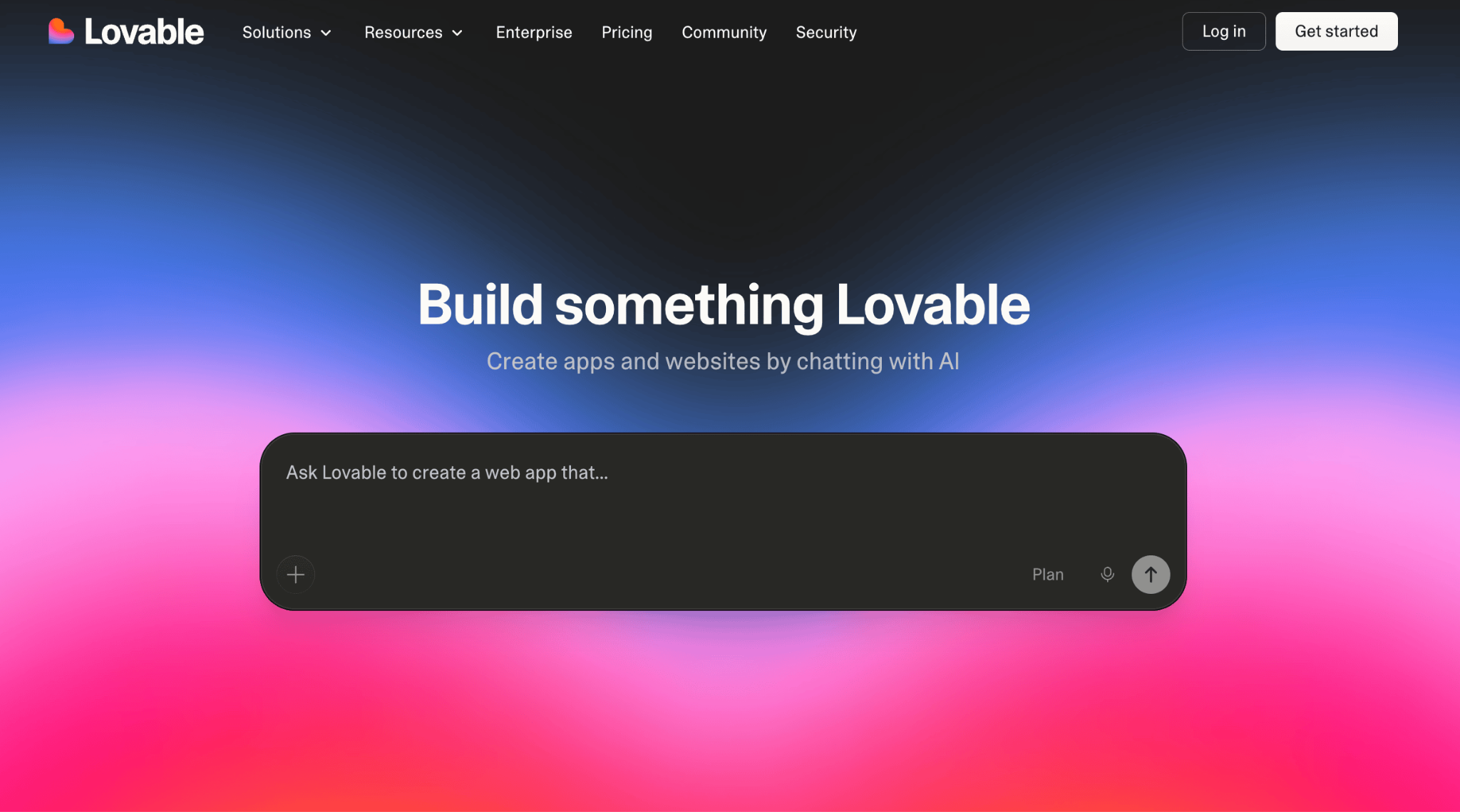
Lovable is a close direct competitor to Base44 in the vibe coding space. You describe your app in natural language, and Lovable generates a full-stack web application with a modern tech stack.
The output is clean, exportable code that you can sync to GitHub and deploy with one click.
Here’s where Lovable clearly beats Base44: you’re a technical founder who wants to prototype fast but eventually plans to hand the codebase to a development team or self-host.
Lovable’s React/TypeScript output is genuinely maintainable, and since it syncs to GitHub, your code lives somewhere you control. Base44’s code export only covers the frontend while your backend stays locked to their infrastructure.
That’s a meaningful difference if portability matters to you.
When comparing Base44 vs Lovable, here’s where Base44 wins: you never want to think about infrastructure. Base44’s managed environment handles hosting, domains, and deployment as one package.
Lovable assumes you’re comfortable setting up a separate database and managing deployments. It simplifies the process, but it’s not invisible the way Base44 makes it.
Lovable pros:
- Code syncs to GitHub automatically, so your project lives somewhere you control from day one. Base44’s GitHub integration is limited to the Builder plan and only covers frontend code.
- Supabase integration gives you a real, queryable database with row-level security that you can access outside the platform.
- Each AI interaction costs one credit regardless of complexity, making per-session costs easier to predict.
Lovable cons:
- Multi-step logic and complex conditional workflows can confuse the AI, requiring manual troubleshooting.
- Credits burn fast during active iteration. If you send 20 prompts refining a single feature, the $25/month Pro plan won’t last the month.
- Web apps only, no native mobile.
Lovable pricing:
Freemium with Pro at $25/month for 100 credits and Business at $50/month. Headline price looks similar to Base44’s Starter ($20/month), but credits burn faster during active iteration, with serious builders reporting real-world costs of $200–$500/month. Compare carefully with tools like Lovable to see which model fits your pace.
15. Zoho Creator
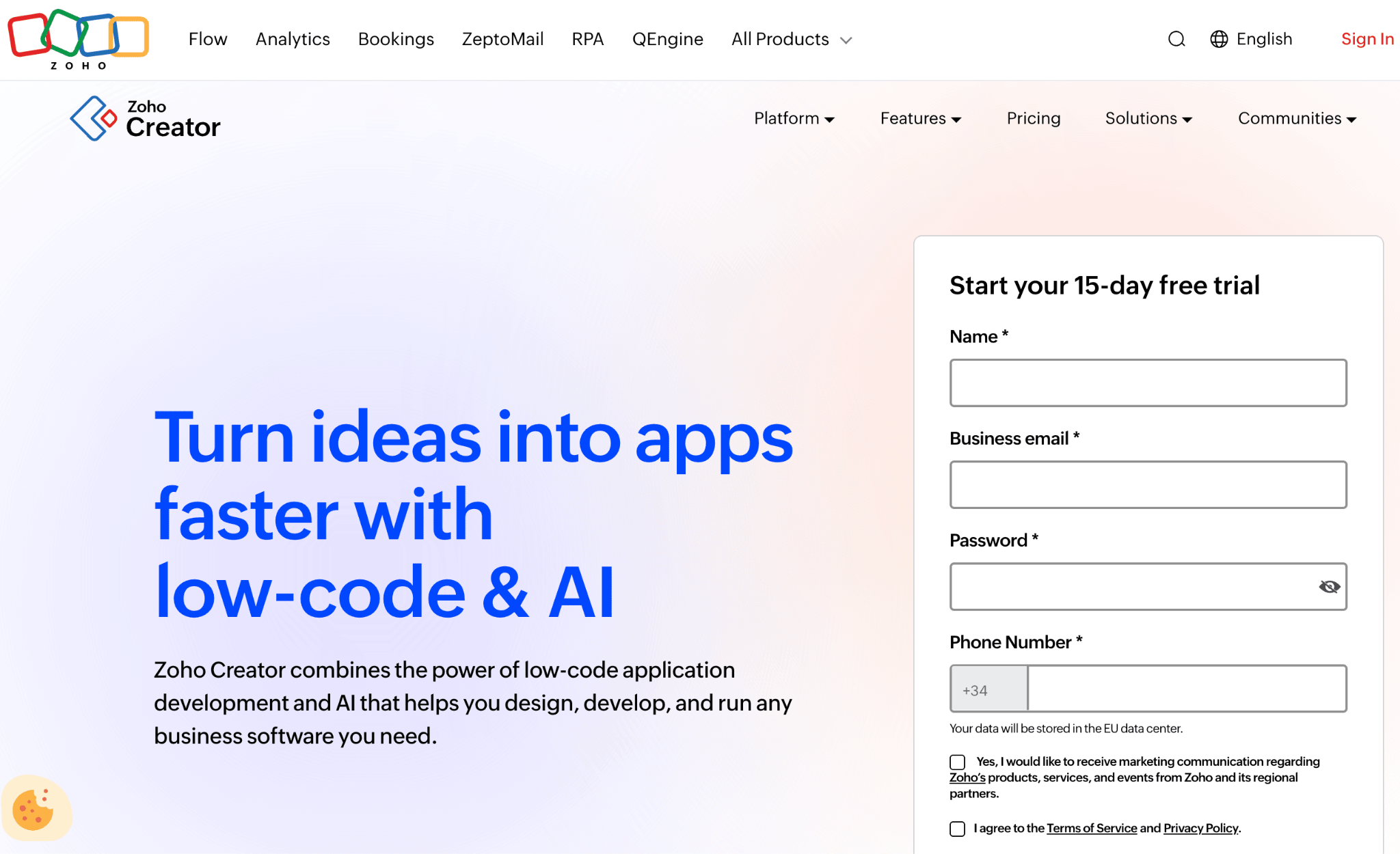
Zoho Creator makes the most sense if you’re already using Zoho products. It integrates natively with Zoho CRM, Zoho Books, Zoho Desk, and 50+ other Zoho apps, which makes building custom business process apps straightforward.
Outside the Zoho ecosystem, the value proposition weakens. The UI feels dated compared to AI-first builders, and you’re taking on vendor lock-in to a specific product suite.
But if Zoho is already your business backbone, Creator is a natural extension.
Zoho Creator pros:
- Native integration with 50+ Zoho products means your app can pull data from Zoho CRM, trigger actions in Zoho Desk, or sync with Zoho Books without third-party connectors.
- Workflow automation is built in. You can set up multi-step processes without writing prompts or burning credits.
- Per-user pricing starts low, making it affordable for teams where multiple people need to build or manage apps.
Zoho Creator cons:
- The UI and design output feel dated compared to modern AI-first builders.
- Heavy vendor lock-in. Your apps, automations, and data all live inside the Zoho ecosystem, making migration difficult.
- No AI-driven app generation. You’re configuring forms, views, and workflows manually.
Zoho Creator pricing:
Per-user pricing at competitive rates, with integrations included rather than costing credits. Scales better than Base44 for teams, but offers less value for solo builders. If you’re evaluating tools like Zoho, the deciding factor is how invested you are in their ecosystem.
Factors to consider when choosing a Base44 alternative
Picking the right tool comes down to three honest questions:
What are you actually building? An MVP to test a startup idea needs speed and low cost (Hostinger Horizons, Lovable).
An internal dashboard for your team needs data connectivity (Retool). A marketing site needs design control (Webflow). A native mobile app needs native mobile support (Adalo, Draftbit). Match the tool to the job, not the feature list.
How much do you want to own? If you want to deploy your app anywhere and never worry about a platform shutting down or changing pricing, choose something with full code export (Lovable, Vercel v0, Draftbit).
If you’d rather never think about servers, domain settings, or security certificates, pick an all-in-one platform (Hostinger Horizons) that handles infrastructure for you.
What will this cost in six months, not just today? Credit-based pricing looks cheap at the starting tier but can scale unpredictably. Per-seat models get expensive with large teams.
Flat plans with included hosting (Hostinger Horizons) are the easiest to budget for. Run the numbers based on your actual expected usage, not the best-case scenario on the pricing page.
How to choose the right no-code AI app builder for your needs
To choose the right no-code AI app builder for your needs, start with your use case, not the tool’s feature list. Here’s a quick decision framework:
Building an MVP or testing a startup idea? Go with Hostinger Horizons for the most complete, affordable package.
Building internal tools for your team? Retool is purpose-built for this.
Building a content-driven website or marketing site? Webflow is the answer.
Balance speed of development with future flexibility. AI-first tools let you ship incredibly fast, but some lock you into their infrastructure. If you think you’ll eventually want to move your app to your own setup, choose a platform with genuine code export.
And don’t skip the integration check. If your app needs to connect to a specific payment gateway, CRM, database, or messaging tool, verify that connection works before committing. A platform that’s perfect in every other way is useless if it can’t talk to your data.
Common mistakes when switching from Base44
Once you’ve picked a Base44 alternative, the transition itself can trip you up if you’re not prepared. Here are the most common mistakes:
- Underestimating the learning curve. Just because another tool is also “no-code” doesn’t mean it works the same way. For instance, Bubble’s visual workflow system operates completely differently from Base44’s prompt-based AI. Budget real time for onboarding, especially if you’re switching to a more complex platform.
- Forgetting about data migration. Base44’s backend is proprietary, which means your database doesn’t export cleanly. Plan for rebuilding your data structure on the new platform, and test with realistic data before switching over any live users.
- Skipping performance testing. Build a small version of your app on the new platform and stress-test it before going all in. Discovering performance bottlenecks after you’ve fully migrated is expensive and demoralizing. Test early, and test with real data volumes.
How vibe coding tools change the way apps are built
Early vibe coding tools could put together a basic app with a form and a database, but struggled with anything more nuanced.
The current generation (Hostinger Horizons, Lovable, Base44 itself) handles user logins, connected databases, third-party integrations, and deployment workflows from prompts alone.
The gap between “AI-generated prototype” and “production-ready app” is shrinking with every model update.
This matters for choosing a Base44 alternative because the tools are converging on similar capabilities but diverging on what happens after the AI finishes building.
Some platforms keep you in a managed environment where everything runs on their infrastructure. Others hand you exportable code and let you deploy wherever you want.
For non-technical builders who want the simplest path from idea to live app, Hostinger Horizons currently offers the most complete vibe coding package: AI generation, hosting, domains, and deployment in one plan.
For technical founders who want to own and extend their code, Lovable and Vercel v0 give you that control. And for teams that need depth beyond what any AI can currently generate from prompts, Bubble and Retool remain the most capable platforms in their respective categories.
The bottom line is that the right tool depends on your project today and your plans for it tomorrow. Pick the one that matches both.

Simon is a dynamic Content Writer who loves helping people transform their creative ideas into thriving businesses. With extensive marketing experience, he constantly strives to connect the right message with the right audience. In his spare time, Simon enjoys long runs, nurturing his chilli plants, and hiking through forests. Follow him on LinkedIn.