How to upload your website (in 6 easy steps)
May 07, 2026
/
Domantas G. & Saulius L.
/
6 min Read
Creating your own website will help boost your online presence, expand your customer base, and increase your conversion rate. However, it’ll be nearly impossible to reach these goals if you haven’t uploaded your website in the first place.
Best of all, you don’t need coding experience to launch your site on the web server. A lot of hosting services and FTP programs provide convenient tools for uploading a website within clicks.
For more information, read our article and find out the full instructions on how to get your website live on the internet within 6 quick, simple steps.

TL;DR
- To upload your website, choose a reliable hosting provider, pick an upload method, and transfer your website files to the server.
- You can upload files using Hostinger’s File Manager, an FTP client like FileZilla, an automatic website importer, or a WordPress migration plugin.
- After uploading, move files to
public_html, import your database if needed, and check your domain after DNS propagation.
1. Pick a Reliable Web Hosting Company
Creating and maintaining a website is not something that you should take lightly. It’s crucial to pick a top-notch web host that has all the key features to kickstart your project.
Here are several factors that you should consider when choosing a hosting provider:
- Live support. A good hosting service should have a team of experts who can help you at any time. There’s no worse feeling than running into some issues and having to wait for days to get a response.
- Control over your web hosting space. The less control you have over your hosting account, the more likely you are to run into trouble when your site grows.
- Room for growth. Before you choose web host, make sure it offers scalable solutions that can provide more power (such as virtual private servers or cloud website hosting).
- Money-back guarantee. Nobody likes a bad investment, so make sure to check for a refund policy. Hostinger, for example, offers a 30-day money-back guarantee for all its hosting plans, giving you peace of mind during the trial period.
Expert Tip
Your choice of web host will directly affect your website, its performance, and your business.
Choosing a reliable hosting provider like Hostinger will give your website enhanced security, a good server response time, automated features to streamline site maintenance, and 24/7 support that is always ready to assist you.
We’re always looking to improve our services’ quality and proactively scan websites for any security threats.

If you are tired of switching between the tabs trying to compare the features that different web hosts offer, we have something more convenient for you.
Feel free to check our comparison pages to learn why Hostinger is the best alternative to Bluehost, GoDaddy, and other popular hosting providers:
- Hostinger vs Hostgator
- Hostinger vs GoDaddy
- Hostinger vs SiteGround
- Hostinger vs Namecheap
- Hostinger vs Bluehost
Hopefully, they will ease your search! But if you already have a website, you can always use Hostinger’s website migration services.

2. Choose Your Website Upload Method
The next challenge is picking the right tool for uploading your website to the internet. Here are four of the most popular tools to upload a website:
File Manager
A file manager is a browser-based tool with all the key features to take care of your website files and directories. If you have a Hostinger account, log into the hPanel and find File Manager under the Files section.
However, the File Manager has an upload limit. If your website files are larger than 100GB, you should opt for the next tool instead.
File Transfer Protocol (FTP)
Most web hosting providers support FTP or file transfer protocol, which you can use to connect to an FTP client. If you don’t have an FTP client, make sure to install one on your PC.
For Hostinger users, all the required credentials for accessing your FTP client are located in FTP Accounts under the Files section.
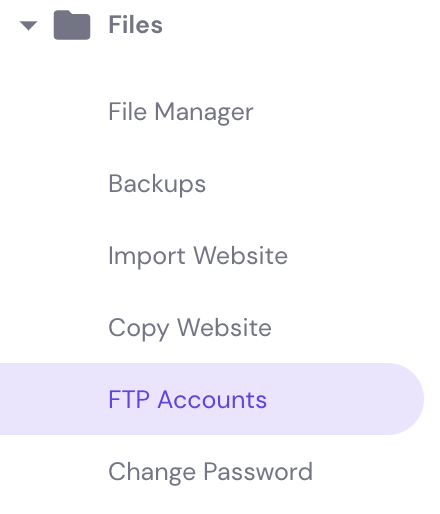
There, you can find all the important information regarding your FTP account, such as your FTP username, hostname, and password.
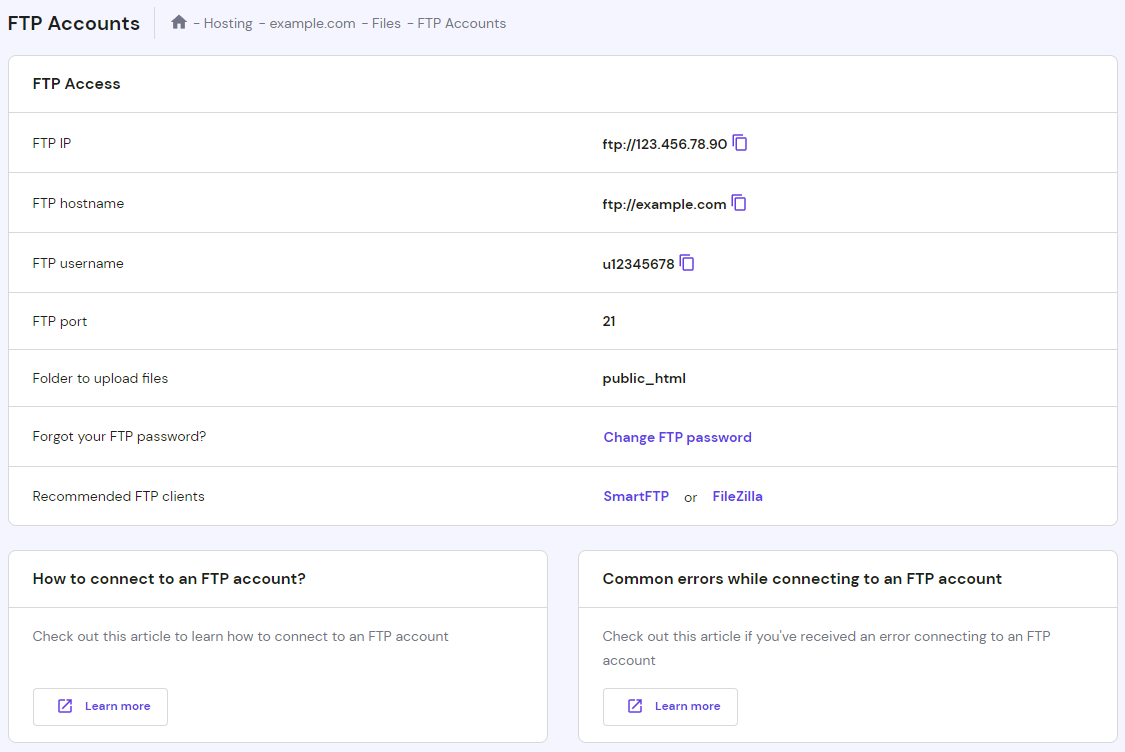
There’s no size limit when it comes to uploading files with an FTP program. However, it does take a bit of technical knowledge that you can learn from this article on how to configure FileZilla and any other FTP clients.
Automatic Website Importer
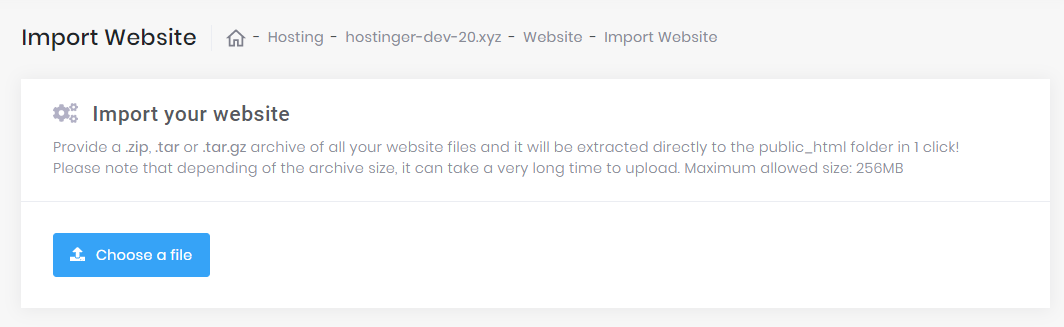
For Hostinger users, you can find an Import Website feature in hPanel. You can use this feature to extract a website archive to the public_html directory. The tool supports .zip, .tar and .tar.gz formats, and the upload limit is 256MB.
WordPress Migration Plugins
If you plan to use WordPress, there are several ways to upload your website to the CMS. One of the easiest methods is using a WordPress migration plugin like All in One WP Migration. After installing and activating the plugin, the rest of the steps are self-explanatory.
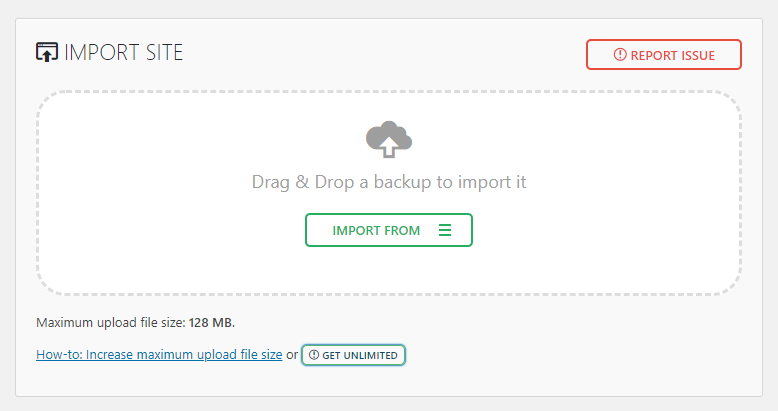
The upload size limit will depend on your hosting provider. Check out how to increase file upload size.
Expert Tip
If you have an existing website on another web host, you can always use Hostinger’s free website migration service. It is the fastest and safest way to migrate unlimited sites, as our dedicated Migration team will handle the process.

3. Upload Files to Your Website
Now that you know the best tools to upload a website, it’s time to get your website live!
In this part of the tutorial, we’ll show you how to upload files to a website using Hostinger’s File Manager and a well-known FTP client, FileZilla.
Using File Manager
- Login to Hostinger’s hPanel and navigate to File Manager.
- Once you’re in the public_html directory, select the Upload Files icon from the upper-right menu.
- Select the website archive file on your computer and Upload it to our server.
- Right-click on the uploaded file and Extract the archived files to the public_html folder.
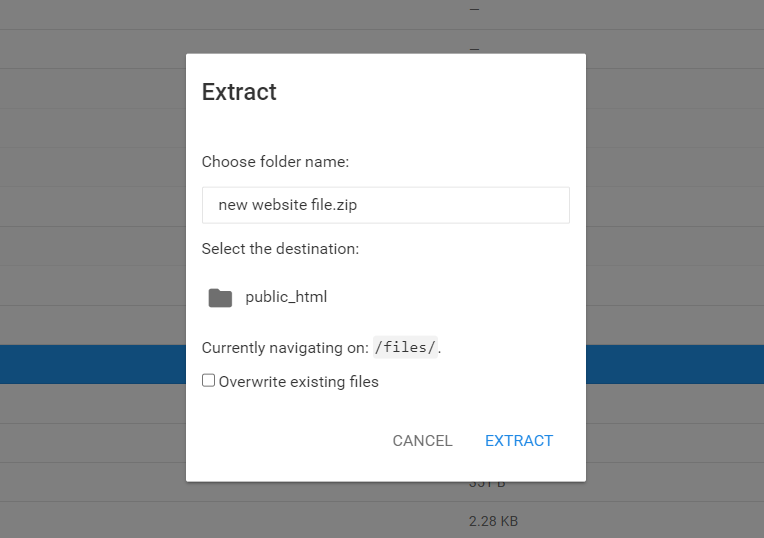
Using FileZilla
Before we begin, make sure to extract the archive to your local computer as FileZilla doesn’t have an Extract feature.
- Connect your account to FileZilla. Use port 22, or connect to SFTP, for a secure connection.
- Navigate to Remote Site panel and click on the public_html folder.
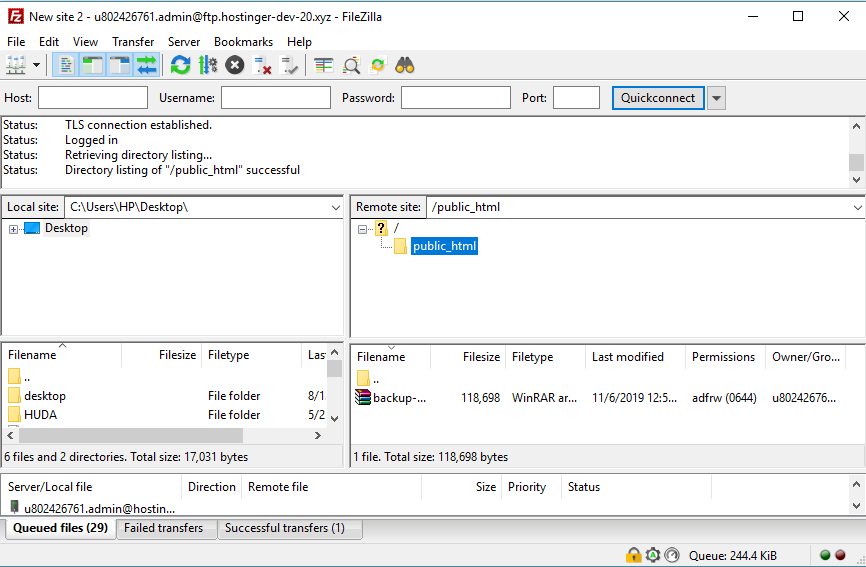
- Head to the Local Site panel and locate the extracted files.
- Select the files, right-click to upload them to the public_html directory.
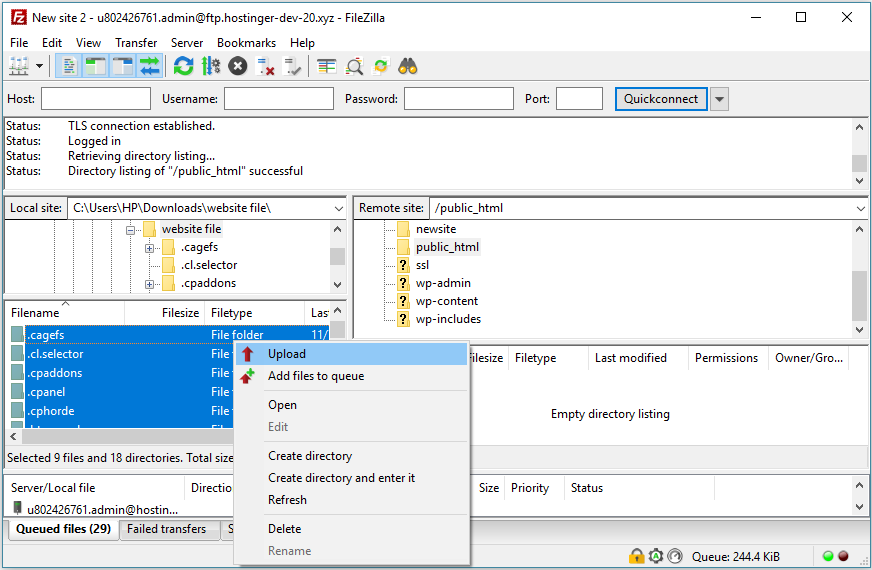
That’s it! By following the above steps, you can transfer all files to public_html without doing any extra work. Otherwise, you’ll need to connect via SSH and extract the archive manually.
4. Move the Website Files to the Main Root Directory
In some cases, an additional directory will be created when you upload website files. As a result, visitors will be directed to yourdomain.com/subfolder instead of the default yourdomain.com.
To prevent that from happening, you need to make sure all the files are located in the root directory of your domain, which is public_html.
You can use the File Manager to move your website files. All you need to do is right-click on the subfolder, select the Move option, and set public_html as the destination.
5. Import Your Database
If your website uses a database, you’ll also need to import it along with your website files:
- Create a new MySQL database and user.
- Access your newly created database via phpMyAdmin.
- Use the Import section to upload the backup file of your database.
- Update the MySQL database connection details (database name, host, user, password) in its configuration files.
Skip this part if you don’t use any database.
6. Check If the Website Works
Once you complete your upload, it’s time for a final check!
If your domain name is registered and already pointed to your web host, enter the domain name into your browser and see if it directs you to your website.
Keep in mind that DNS changes can take up to 48 hours to fully propagate worldwide. As such, if you just pointed your domain to the web host’s name servers, you might need to wait for a while.
For domains using Hostinger nameservers, you can easily check the domain propagation status in your hPanel.
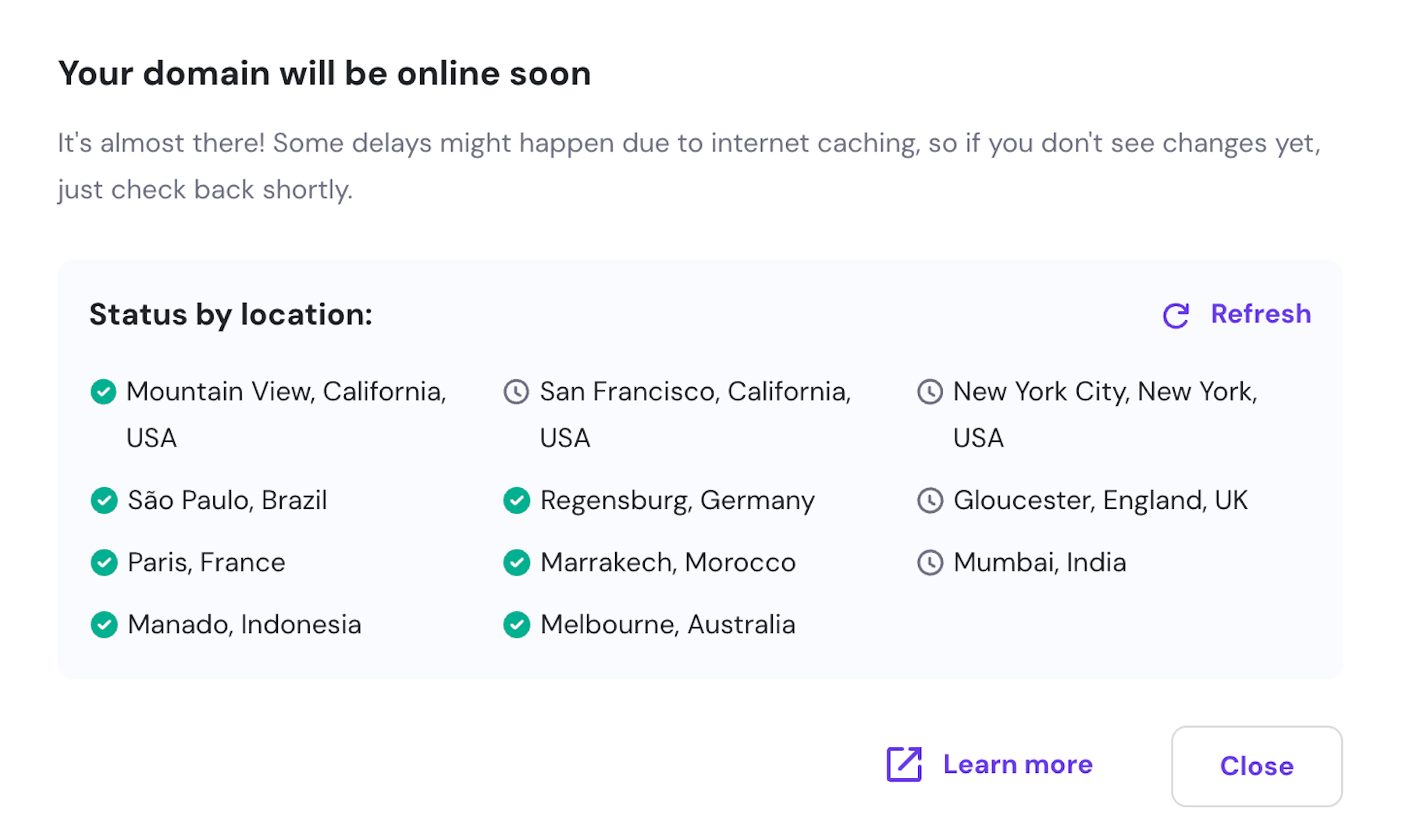
Alternatively, use an online tool like whatsmydns.net to check the state of your DNS propagation. Just enter your domain name and the tool will check the DNS records against multiple name servers.
Should you follow all the instructions correctly, your website will appear just fine. However, if you run into an issue, ask your hosting provider for assistance.
And if you’re a Hostinger client, contact us via the live chat and one of our customer success agents will be ready to help you!
Conclusion
Congratulations, now your website is live on the internet!
To recap, here are the steps to upload your website to the web server:
- Pick the right hosting provider.
- Choose the tool and method to upload your website.
- Upload files to your website.
- Move the website files to the main root folder.
- Import your database.
- Check if your website works worldwide.
That’s it! It may sound a bit complicated at first, but if you follow all the steps carefully, you’ll get your website online in no time. We hope this article will help you out and good luck!
Learn More About Website Creation
15 Best CMS Platforms to Start a Website
Do I Need a Website for My Small Business?
How Much Does It Cost to Build a Website?
How to Build a Website With ChatGPT
All of the tutorial content on this website is subject to Hostinger's rigorous editorial standards and values.

Domantas leads the content and SEO teams forward with fresh ideas and out of the box approaches. Armed with extensive SEO and marketing knowledge, he aims to spread the word of Hostinger to every corner of the world. During his free time, Domantas likes to hone his web development skills and travel to exotic places.

As VP of Product at Hostinger, Saulius oversees Web Hosting Platform & Tools, Managed WordPress, and WebPro Experience. Saulius enjoys observing users through their daily life activities, looking for problems to solve, and building products that make users more efficient online, help them spend more time on the things they love, and leave all the rest for technology to solve. Follow him on LinkedIn.