Top 8 Flask alternatives: Key features and pricing
Jun 12, 2026
/
Ksenija
/
12 min Read
Flask is a lightweight Python web framework used for APIs, prototypes, small web applications, and projects where developers want full control over routing, databases, authentication, and other components.
Flask alternatives are worth considering when projects benefit from built-in async capabilities, API documentation, and framework features that reduce setup and maintenance work.
The Flask alternatives choice comes down to project goals:
- Best for high-performance APIs – FastAPI, a modern Python framework with async support, type hints, and automatic API documentation.
- Best for full-stack applications – Django, a batteries-included Python framework with built-in ORM, authentication, and admin tools.
- Best for Python-only full-stack apps – Reflex, a framework for building interactive frontend and backend apps in Python.
- Best for Flask-like async development – Quart, an asyncio framework that closely follows Flask’s API.
- Best for minimal web services – Bottle, a single-file Python microframework with no external dependencies.
- Best for flexible growth – Pyramid, a Python framework that can start small and scale into larger applications.
- Best for lean REST APIs – Falcon, a minimalist ASGI and WSGI framework for performance-focused APIs and microservices.
- Best for object-oriented Python apps – CherryPy, a minimalist framework for building server-side apps with object-oriented patterns.
1. FastAPI
FastAPI is a modern Python web framework built for APIs. Developers use it to build REST APIs, microservices, machine learning services, and other backend applications that handle many requests efficiently.
FastAPI focuses on API development from the start, which makes it a popular choice for teams building data-driven applications and service-based architectures.
Compared with Flask, FastAPI includes more API-focused functionality out of the box. It provides automatic API documentation, request validation, and editor-friendly type hints without relying on third-party extensions.
FastAPI pros
- Built-in async support makes FastAPI a stronger choice than Flask for high-concurrency APIs, microservices, machine learning APIs, and services that wait on databases or third-party APIs.
- Automatic OpenAPI documentation gives FastAPI interactive Swagger UI and ReDoc pages without extra setup, while Flask usually needs extensions for similar documentation.
- Type-hint-based validation with Pydantic reduces manual request parsing and validation code that Flask projects often handle through separate libraries.
FastAPI cons
- FastAPI is more opinionated than Flask around type hints, validation models, and API-first project structure.
- Flask feels simpler for small server-rendered apps, quick prototypes, and beginner projects where automatic API tooling adds unnecessary structure.
- Flask has a longer ecosystem history, with broad extension coverage for databases, authentication, forms, admin tools, and API documentation.
- Flask gives developers more control over which components they add, while FastAPI makes more decisions upfront for API development.
FastAPI pricing
FastAPI is a free and open-source framework released under the MIT License.
Real-world costs come from infrastructure and operations rather than the framework itself.
Expenses usually include hosting, databases, monitoring tools, logging services, backups, maintenance, and developer time.
Teams deploying FastAPI applications on a VPS can use Hostinger’s AI-managed VPS plans, which include AMD EPYC processors, NVMe SSD storage, free weekly backups, built-in firewall management, full root access, a browser-based web terminal, and Docker deployment options.
Hostinger also provides a public API and AI-assisted server management tools for monitoring, troubleshooting, and infrastructure administration.
Larger production environments may still add managed databases, centralized logging, application monitoring, and container orchestration platforms as infrastructure requirements grow.
2. Django
Django is a full-stack Python web framework designed for building complete web applications with as little setup as possible.
SaaS companies, ecommerce businesses, publishers, startups, and enterprise teams use Django when they need a framework that includes database management, user authentication, administration tools, and application structure from day one.
Compared with Flask, Django includes far more functionality in the core framework. It ships with an ORM, a migration system, an authentication framework, an admin panel, forms, and security features that Flask developers add via extensions.
The trade-off is a larger framework, more conventions, and a steeper learning curve.
Django pros
- Django includes a built-in ORM and migration system, while Flask requires additional libraries to handle database models and schema changes.
- Django’s admin panel can generate a production-ready content management interface from your models, saving significant development time compared to building similar tooling in Flask.
- Authentication, forms, middleware, and security protections are included by default, making Django a strong choice for SaaS platforms, ecommerce stores, internal business tools, and content-heavy websites.
- Django provides a consistent project structure and integrated tooling, reducing the number of framework decisions teams need to make compared with Flask.
Django cons
- Django can feel heavy for small APIs, simple websites, and quick prototypes where Flask’s lightweight approach gets projects running faster.
- Django’s conventions, project structure, and built-in components create a steeper learning curve than Flask, especially for developers who prefer minimal frameworks.
- Django makes more architectural decisions upfront, while Flask gives developers more freedom to choose libraries, folder structures, and application patterns.
- Django projects include functionality that some applications never need, which can add complexity compared with Flask’s smaller core.
Django pricing
Django is free and open source, so there are no licensing costs for the framework.
The main expenses come from running and maintaining the application, including Django VPS hosting, databases, file storage, monitoring tools, email delivery services, CI/CD pipelines, backups, and developer time spent on updates, security, and ongoing maintenance.

3. Reflex
Reflex is a Python framework for building both the frontend and the backend of a web application.
Developers use it for dashboards, internal tools, admin panels, machine learning interfaces, and SaaS products that stay within the Python ecosystem.
Reflex provides UI components, application state management, and frontend interactivity without requiring developers to write React or JavaScript directly.
Compared with Flask, Reflex takes a full-stack approach. Flask handles backend logic and server-side rendering, but developers usually pair it with JavaScript frameworks such as React when building highly interactive interfaces.
Reflex combines frontend and backend development into a single Python workflow. If you want to build both the user interface and application logic entirely in Python, Reflex offers a more integrated experience than Flask.
Reflex pros
- Reflex allows developers to build frontend and backend functionality in Python, while Flask projects frequently require a separate JavaScript framework for interactive user interfaces.
- Built-in state management simplifies the process of creating dynamic dashboards, admin panels, and data-driven applications compared with assembling multiple frontend tools around Flask.
- Reusable UI components help teams develop internal tools, machine learning interfaces, and prototypes without maintaining a separate React codebase.
- Reflex reduces context switching between frontend and backend development, which can accelerate development for Python-focused teams.
Reflex cons
- Reflex has a newer ecosystem than Flask, Django, and FastAPI, which means fewer tutorials, community resources, third-party integrations, and experienced developers.
- Flask gives developers more control over backend architecture, routing patterns, and framework integrations, while Reflex follows a more opinionated full-stack workflow.
- Teams with existing React expertise may find less value in Reflex’s Python-only approach because Flask integrates well with modern JavaScript frameworks.
- Large organizations may encounter fewer deployment examples, community-tested patterns, and ecosystem tools compared with Flask’s more established ecosystem.
Reflex pricing
Reflex Framework is free and open source under the Apache 2.0 license. The free tier includes the open-source framework, 150 AI Builder credits per month, AI-assisted testing, local agent tools, unlimited collaborators, community support, and one hosted application.
Organizations that need dedicated infrastructure, enterprise security controls, governance features, and hands-on support can upgrade to Reflex Enterprise at a custom price.
Enterprise plans include dedicated compute, unlimited applications, private projects, SSO/SAML, RBAC, audit logs, one-click deployment to platforms such as AWS, GCP, Azure, and Databricks, and dedicated onboarding and support.
4. Quart
Quart is an asyncio-based Python web framework that reimplements Flask’s API for asynchronous applications.
The framework lets developers build APIs, web applications, WebSocket services, and streaming applications using patterns that feel very familiar to Flask users.
If you already know Flask, the transition to Quart is straightforward because the routing, request handling, templates, and overall development experience are intentionally similar.
Compared with Flask, Quart’s biggest advantage is built-in support for asynchronous workloads. It supports WebSockets, streaming responses, and async request handling as core features, making it a better fit for real-time applications and services that handle many concurrent connections.
Flask has added async capabilities over time, but async development is central to Quart’s design.
For developers who like Flask’s API but need stronger async support, Quart is the closest Flask alternative available.
Quart pros
- Quart closely follows Flask’s API, making migration easier than switching to a framework with different patterns and conventions.
- Built-in asyncio support makes Quart a stronger choice than Flask for async APIs, streaming services, and applications that handle many concurrent connections.
- Quart includes native WebSocket support, allowing developers to handle persistent client connections using the framework’s built-in APIs. Flask applications that need chat features, live updates, or other real-time functionality usually require additional libraries or services.
Quart cons
- Quart has a smaller ecosystem and lower adoption than Flask, Django, and FastAPI, which means fewer tutorials, extensions, and community resources.
- Some Flask extensions work with Quart, but compatibility is not universal, so teams may need to evaluate existing dependencies before migrating.
- Async programming introduces additional complexity around application design, debugging, and dependency selection compared with traditional Flask applications.
- Flask remains simpler for synchronous web applications and server-rendered websites because its request-response model matches those projects directly. Quart is a better fit when the application needs WebSockets, streaming, or async request handling as core requirements.
Quart pricing
Quart is free and open source under the MIT License. Project costs come from hosting, databases, monitoring, storage, CI/CD pipelines, and developer maintenance rather than framework licensing.
Applications can be deployed on VPS platforms, cloud infrastructure, containers, or managed hosting services, depending on performance and operational requirements.
5. Bottle
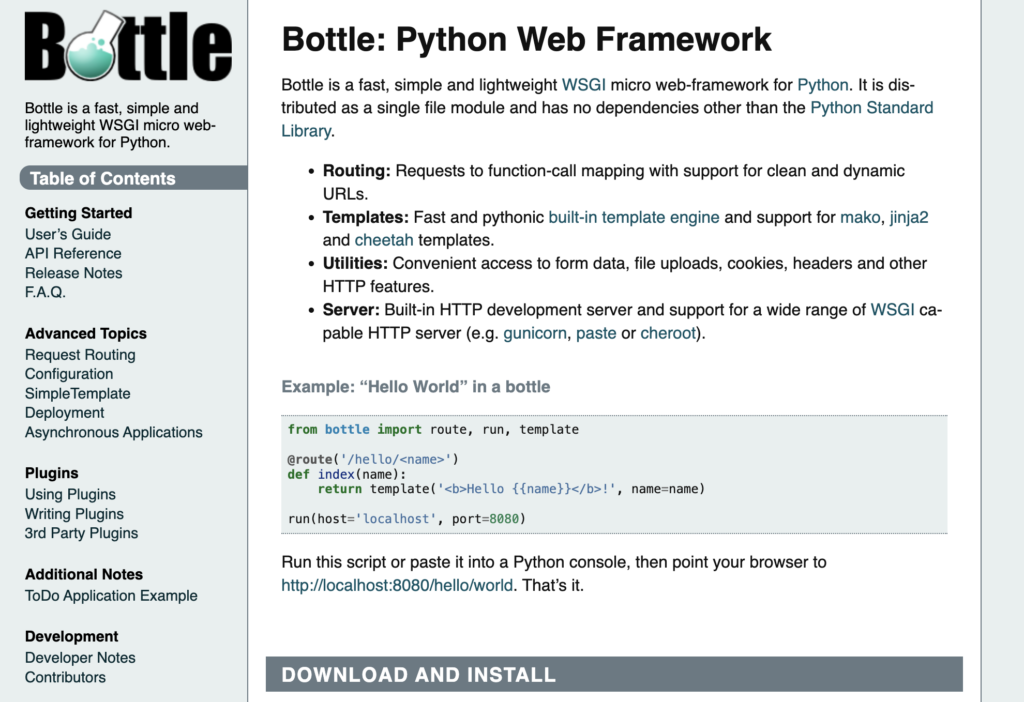
Bottle is a lightweight Python microframework that fits into a single file and has no external dependencies beyond the Python standard library.
It is commonly used for building small web applications, APIs, prototypes, and educational projects.
The framework includes routing, request handling, templates, and a built-in development server without requiring additional packages.
Compared with Flask, Bottle takes minimalism even further. Flask keeps a small core but relies heavily on extensions as applications grow, while Bottle focuses on staying compact and self-contained.
Routing and deployment are straightforward, but Bottle offers fewer expansion paths for larger projects.
Bottle pros
- Bottle has no external dependencies, making deployment simpler than Flask in environments where minimizing packages and installation requirements is important.
- Bottle is distributed as a single file with no external dependencies, while Flask depends on Werkzeug, Jinja2, Click, and other core packages. Bottle is lighter for demos, educational projects, embedded systems, and small utilities where a minimal install matters more than Flask’s larger ecosystem.
- Bottle provides straightforward routing and request handling without the broader extension ecosystem and configuration decisions that often come with Flask projects.
Bottle cons
- Bottle offers fewer built-in capabilities and far fewer extensions than Flask, limiting options as application requirements grow.
- Flask has a larger community, more tutorials, and more established production patterns, making it easier to find guidance and third-party integrations.
- Larger teams may outgrow Bottle faster because the framework provides less structure and fewer ecosystem tools than Flask.
- Flask offers more flexibility for adding authentication, database integrations, API tooling, and other common application features through its mature extension ecosystem.
Bottle pricing
Bottle is free and open source, so there are no framework licensing costs. Project expenses come from hosting, deployment infrastructure, databases, monitoring, security tooling, maintenance, and developer time required to build and operate the application.
6. Pyramid
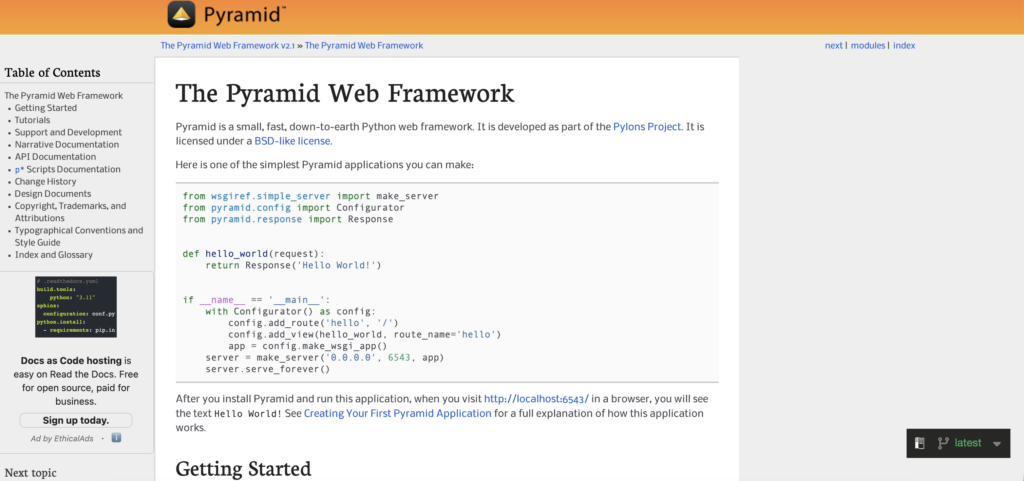
Pyramid is a Python web framework designed to support both small applications and large, complex systems.
Developers can start with a simple project and gradually add authentication, authorization, APIs, content management features, and other components as requirements grow.
Pyramid appeals to teams that want flexibility without committing to either a minimal microframework or a heavily opinionated full-stack framework.
Compared with Flask, Pyramid provides more built-in structure and configuration options for larger applications.
Flask is easier to learn and quicker to start with, while Pyramid gives developers more tools for organizing long-term projects.
Pyramid pros
- Pyramid provides more built-in support for organizing large applications than Flask, making it a strong choice for web portals, enterprise systems, and long-term projects with multiple development teams.
- Explicit configuration gives teams more control over application architecture than many full-stack frameworks while providing more structure than Flask’s minimal core.
- Pyramid offers a practical middle ground for projects that need more organization than Flask but do not require Django’s full collection of built-in components.
Pyramid cons
- Pyramid has a smaller community and lower mainstream visibility than Flask, Django, and FastAPI, which means fewer tutorials, integrations, and learning resources.
- Pyramid’s flexibility comes with additional configuration decisions, making the framework more complex for beginners than Flask.
- Flask is easier to start with for small applications because Pyramid expects developers to think more deliberately about project structure and configuration.
- Flask is easier to start with for simple APIs, prototypes, and lightweight web applications because its minimal design requires fewer architectural decisions and less framework-specific configuration.
Pyramid pricing
Pyramid is free and open source, so there are no framework licensing costs. Project expenses come from hosting, databases, authentication services, add-ons, monitoring tools, developer expertise, and the ongoing maintenance required to support applications as they grow.
7. Falcon
Falcon is a minimalist Python framework designed for REST APIs and microservices. The framework supports both WSGI and ASGI deployments and focuses on handling HTTP requests with minimal overhead.
Falcon is aimed at developers building API backends, high-throughput services, IoT platforms, and other applications where performance and efficiency are primary concerns.
Flask supports APIs, server-rendered pages, templates, and a broad range of web application patterns, while Falcon concentrates on HTTP services and REST-style APIs.
Falcon also takes a more explicit approach to routing and request handling. If FastAPI adds developer productivity features such as automatic documentation and request validation, Falcon takes the opposite approach by staying lean and exposing lower-level control over API behavior.
Falcon pros
- Falcon keeps framework overhead lower than Flask by focusing primarily on HTTP services and APIs, making it a strong choice for performance-focused microservices and backend systems.
- Both frameworks support WSGI deployments, but Falcon also provides first-class ASGI support for teams building asynchronous services.
- Flask supports APIs, templates, and user-facing web applications, while Falcon concentrates on REST APIs and HTTP services.
Falcon cons
- Falcon provides fewer built-in conveniences than Flask, which can increase development effort for applications that need authentication, templating, forms, or broader web application functionality.
- Falcon has a smaller ecosystem, fewer tutorials, and less community visibility than Flask, Django, and FastAPI.
- Developers new to API design may find Flask easier to approach because Falcon exposes more HTTP concepts directly and provides less framework guidance.
Falcon pricing
Falcon is free and open source under the Apache 2.0 License.
Project costs come from infrastructure and operations rather than the framework itself, including VPS hosting, ASGI or WSGI server setup, databases, monitoring tools, API gateways, security controls, maintenance, and developer time.
8. CherryPy
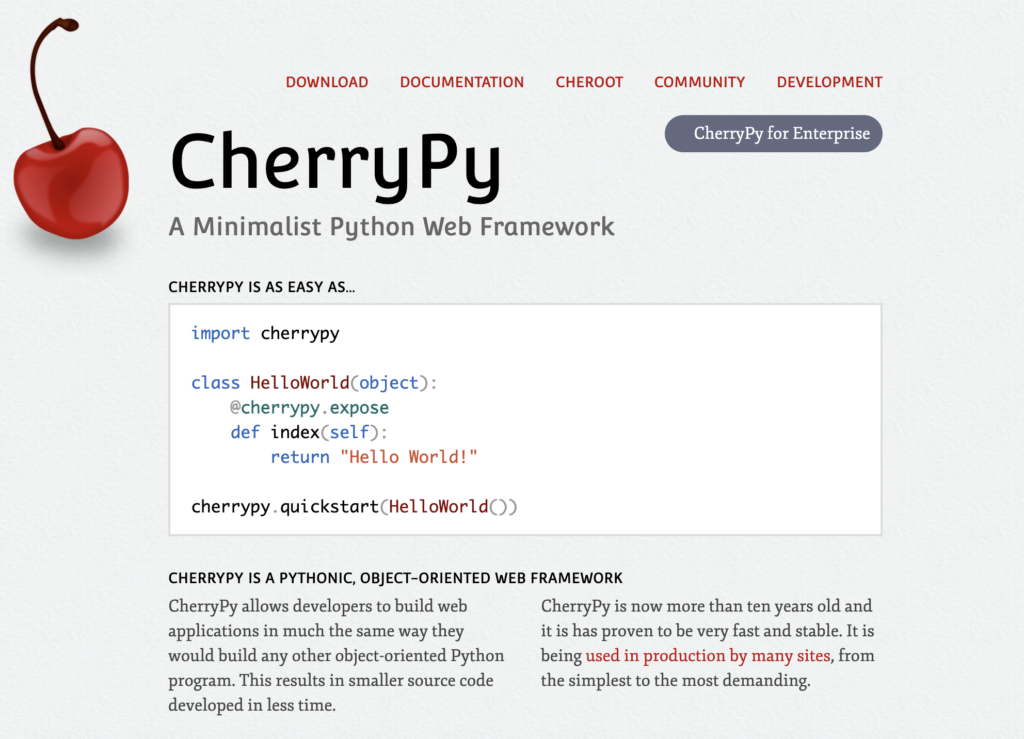
CherryPy is a Python web framework that follows a strongly object-oriented approach to application development. Developers build applications by exposing class methods as web endpoints, which makes CherryPy feel similar to writing standard Python programs.
The framework works well for simple web services, internal tools, educational projects, and lightweight server-side applications.
Flask has a larger ecosystem, broader community adoption, and more third-party extensions for modern web development.
CherryPy is a useful Flask alternative for developers who prefer organizing application logic around classes and methods instead of Flask’s route-centric approach.
CherryPy pros
- CherryPy’s object-oriented design maps web endpoints directly to class methods, which may feel more natural than Flask’s route-based approach for developers who prefer class-driven application structures.
- An integrated HTTP server simplifies development and deployment compared with Flask, which is commonly paired with additional production server components.
- CherryPy maps web behavior to classes and methods more directly than Flask, which may suit educational projects, internal tools, and small web services.
- Flask offers more routing patterns and ecosystem support, while CherryPy can feel simpler for developers who want a class-based structure.
CherryPy cons
- CherryPy has a much smaller ecosystem than Flask, with fewer extensions, tutorials, community resources, and third-party integrations.
- CherryPy is less suited to modern API-heavy, asynchronous, or full-stack application development than frameworks such as Flask, FastAPI, or Django.
- Teams that need specialized authentication, API tooling, database integrations, or modern deployment patterns will find more options in Flask’s ecosystem.
CherryPy pricing
CherryPy is free and open source, so there are no framework licensing costs. Project expenses come from hosting, database integrations, monitoring tools, security requirements, maintenance, and the developer time required to build, deploy, and support the application over the long term.
How to choose the best Flask alternative
Choose a framework based on the type of application you’re building. Start by identifying whether your project needs full-stack web application features, API-focused tooling, async support, or the flexibility to assemble components yourself:
- Choose Django if you need a full-stack framework with a built-in ORM, authentication system, admin panel, forms, and security features. Django is a strong fit for SaaS platforms, ecommerce applications, content-driven websites, and other database-heavy projects.
- Choose FastAPI if you’re building APIs first. FastAPI includes automatic API documentation, request validation, and async support, making it a strong choice for microservices, machine learning APIs, and high-performance backend services.
- Choose Bottle if minimal dependencies and simple deployment matter more than extensibility. Bottle is a good fit for small APIs, demos, educational projects, and lightweight utilities.
- Choose Quart if you like Flask’s development style but need built-in support for WebSockets, streaming responses, or asynchronous workloads.
- Choose Pyramid if you want more structure than Flask without committing to a full-stack framework like Django. Pyramid suits long-term projects that may grow in complexity over time.
- Choose Falcon if API performance and low framework overhead are higher priorities than built-in web application features.
- Choose Reflex if you want to build both the frontend and backend in Python without maintaining a separate JavaScript framework.
- Choose CherryPy if you prefer an object-oriented approach that maps web functionality directly to classes and methods.
Before making a final decision, compare the factors that affect day-to-day development. Check whether you need a built-in ORM, authentication, admin tools, automatic API documentation, async support, strong type-hint integration, or a large extension ecosystem.
Community size, learning curve, hosting requirements, and long-term maintenance needs are just as important as framework features when choosing a platform for production applications.
When is Flask still the right choice?
Small web applications, lightweight APIs, internal tools, prototypes, and educational projects still fit well with Flask.
It also remains a strong option for teams that prefer choosing their own libraries and application structure instead of working within a more opinionated framework.
Before replacing Flask, identify whether the limitation comes from the framework or from the application itself.
Slow database queries, unclear architecture, weak test coverage, missing caching, dependency bloat, and limited monitoring can affect any framework.
Moving to Django, FastAPI, or another alternative will not automatically fix those issues.
In many cases, targeted improvements carry less risk than a full migration. Start by improving application structure, database performance, caching, and deployment workflows.
Flask extensions, blueprints, app factory patterns, and selective async support can solve many problems without rewriting the application.
A migration becomes easier to justify when the project consistently needs capabilities that another framework provides as part of its core design.
How to migrate from Flask to another framework
A phased migration is safer than a full rewrite because the team can replace one part of the application at a time, test behavior against the existing Flask app, and reduce the risk of breaking production features.
A full rewrite creates more uncertainty because routing, authentication, data access, templates, tests, and deployment behavior all change at once.
Migration requirements vary by framework. Moving from Flask to Quart is the least disruptive because Quart closely follows Flask’s API.
Migrating to FastAPI involves adopting request validation models and type-hint-driven development.
Django migrations require adapting to Django’s project structure, ORM, authentication system, and application conventions.
Moving to Reflex may require a larger architectural shift because frontend and backend responsibilities are handled differently than in a traditional Flask application.
Before starting the migration, create an inventory of the application’s dependencies and architecture.
The following steps help reduce risk and make the transition easier to validate and roll back if problems appear.
- Audit routes, blueprints, templates, extensions, authentication, database models, APIs, tests, and deployment workflows.
- Map Flask features to equivalents in the target framework before writing replacement code.
- Separate frontend and backend concerns through APIs where the current architecture allows it.
- Migrate data with backups, schema mapping, validation checks, and rollback plans.
- Rebuild high-risk features first in a controlled environment.
- Monitor performance, errors, API behavior, and user-facing issues after launch.
Deployment is also a good opportunity to simplify infrastructure management. Managed application hosting platforms can reduce operational overhead during a migration by handling deployments, SSL certificates, backups, security updates, and monitoring.
For example, Hostinger’s managed web app hosting supports automated deployments from GitHub, IDE-based deployments, a built-in CDN, WAF protection, managed SSL certificates, and AI-assisted troubleshooting, helping teams focus on application changes rather than server administration.

All of the tutorial content on this website is subject to Hostinger's rigorous editorial standards and values.

Ksenija is a digital marketing enthusiast with extensive expertise in content creation and website optimization. Specializing in WordPress, she enjoys writing about the platform’s nuances, from design to functionality, and sharing her insights with others. When she’s not perfecting her trade, you’ll find her on the local basketball court or at home enjoying a crime story. Follow her on LinkedIn.