Top 8 best European website builders: Key features and pricing
Sep 17, 2026
/
By Ksenija
/
13 min Read

A website builder lets you create a professional site without writing code – drag-and-drop editor, templates, and hosting included. For European users, the choice of platform carries extra weight: EU data residency, GDPR compliance by design, and local-language support matter in ways they don’t with US-based alternatives.
The right builder depends on what you’re launching. A freelancer building a portfolio has different priorities than a retailer setting up a multilingual ecommerce store. The platforms below were evaluated on ease of use, template flexibility, ecommerce depth, GDPR compliance, and pricing transparency.
- Best overall value – Hostinger AI Builder, an affordable smart builder with EU infrastructure.
- Best for multilingual sites – Webnode, an intuitive editor with strong language support.
- Best for privacy-focused users – Infomaniak Site Creator, Swiss-based and GDPR-aligned.
- Best for small businesses – IONOS Website Builder, business-focused tools with EU hosting.
- Best for creatives – Jimdo, a simple portfolio and personal brand builder.
- Best for simple websites – Mozello, a lightweight builder with affordable ecommerce features.
- Best for bundled hosting and builder – One.com Website Builder, simple site creation with integrated hosting.
- Best for business integration – Odoo Website Builder, website creation connected to CRM, ecommerce, and operations.
1. Hostinger AI Builder
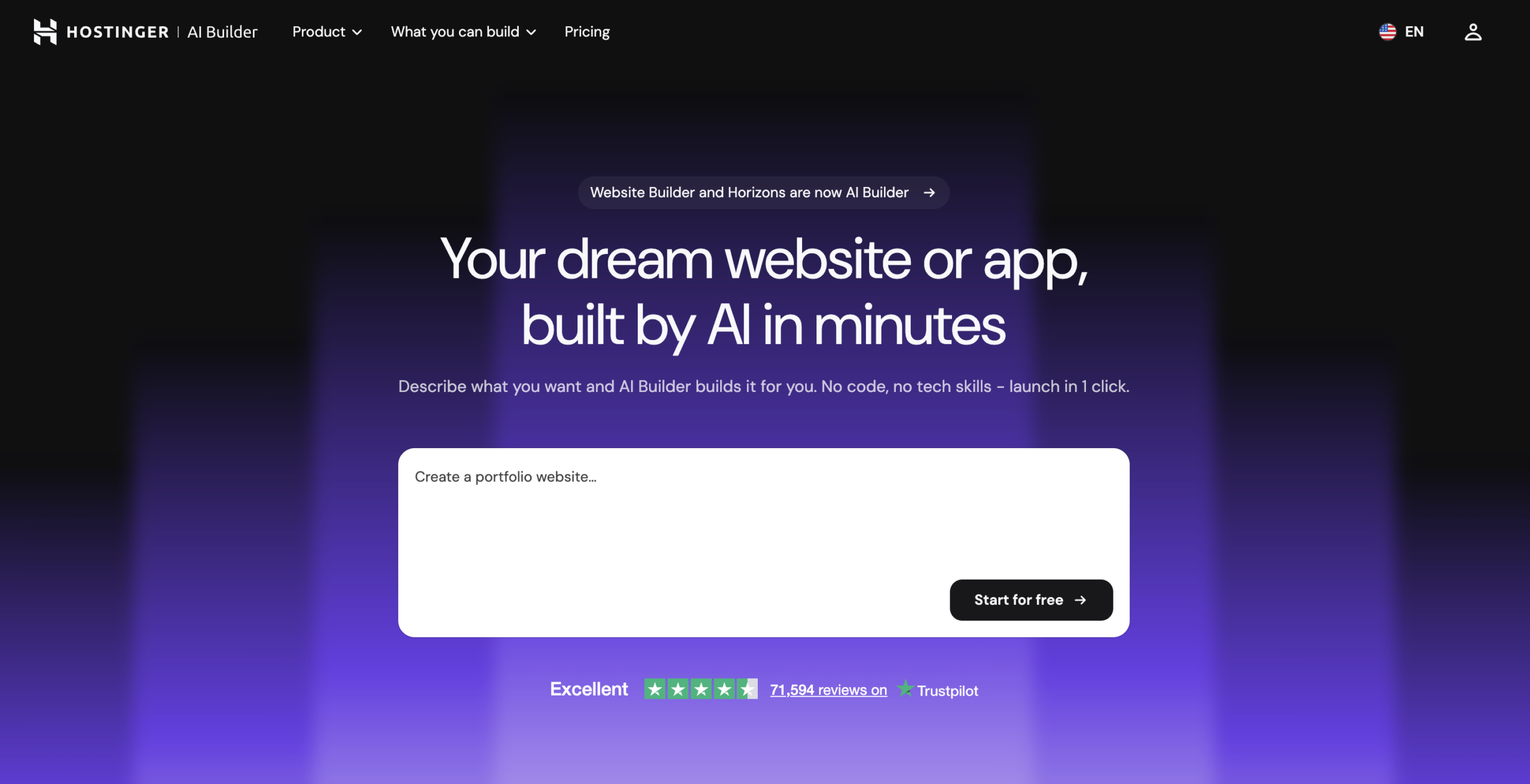
Founded in Lithuania, Hostinger AI Builder is a platform for creating professional websites without coding.
With over 5 million customers worldwide and a portfolio that includes web hosting, VPS, domains, and cloud services, Hostinger is one of the most established European digital providers.
The core advantage is the AI website generator. Instead of starting with a blank template, you answer a few questions about your business, and the platform creates a ready-to-edit site with structure, layout, and initial content already in place. This removes the slowest part of website creation — deciding how everything should be organized.
Hostinger AI Builder offers two modes. Manual mode is a drag-and-drop editor where you refine the AI-generated layout visually, without touching code. Agentic mode goes further – describe your project in a prompt, and AI builds a more complete site or web app, including backend logic, in minutes. You can start in manual mode and switch to agentic later, but not the other way around.
All templates are responsive by default, so the site works across mobile and desktop without extra work. There is no need to configure hosting, connect tools, or install plugins before publishing. The setup is already complete.
Hostinger AI Builder works with Hostinger Ecommerce for selling online. You can manage products, accept payments, track orders, and handle inventory without switching platforms or upgrading into a separate ecosystem. This makes it easier to move from a basic site to an online store without having to rebuild later.
The builder functions as an all-in-one platform, combining hosting, SSL, domain connection, and ecommerce tools in a single system. Hostinger AI Builder is built for small businesses, freelancers, creators, service providers, and ecommerce startups that want a professional online presence without technical complexity.
The platform includes SEO settings, blogging tools, and ecommerce features such as product management, payment gateway integration, order tracking, and inventory control. EU-specific payment options in manual mode include Stripe (with Klarna, iDEAL, and Giropay), kevin. for EU/EEA internet banking, and Paysera for Baltic merchants.
While builders like Odoo emphasize operational integration and platforms like Webnode focus on multilingual publishing, Hostinger AI Builder concentrates on quick AI-assisted setup and robust ecommerce capabilities at a lower entry cost.
Hostinger AI Builder pros:
Its strongest advantage is how quickly beginners can launch a functional website using AI-assisted tools, while also offering:
- An intuitive drag-and-drop editor with a minimal learning curve
- Integrated ecommerce tools with product management and payment gateways
- Built-in SEO settings and automatic mobile responsiveness
- EU-friendly payment options including Klarna, iDEAL, Giropay, kevin., and Paysera
- Competitive pricing compared to many European website builders
Hostinger AI Builder cons:
While accessible and streamlined, the platform prioritizes simplicity over deep customization, which means:
- Limited advanced developer-level customization compared to open-source platforms
- Fewer third-party app marketplace integrations than larger global ecosystems
- Manual mode’s online store is single-language only – a limitation for European sellers targeting multiple language markets
Hostinger AI Builder pricing:
Hostinger AI Builder uses tiered pricing based on features and scale.
The Premium plan starts at RM9.99/month (48-month term) and suits simple informational websites. It includes a free domain for the first year, AI website generation, 300 responsive templates in Manual mode, basic SEO and marketing tools, and 5 AI credits for Agentic mode.
The Unlimited plan starts at RM16.99/month (48-month term) and expands storage, increases AI credits to 15, and unlocks additional tools for generating content, product descriptions, images, and SEO elements. For EU/EEA customers, it also supports region-specific payment options including Stripe (with Klarna, iDEAL, and Giropay), kevin. for EU/EEA internet banking, and Paysera for Baltic merchants.
The Cloud Startup plan starts at RM49.00/month (48-month term) and is built for businesses that need maximum performance and scalability, with 1,000 credits for AI agents on top of all Unlimited features.
To sell online, Hostinger Ecommerce is available as a separate plan starting at $5.99/month (annual billing). It includes unlimited products, unlimited sales channels, 0% transaction fees, and 100+ payment methods including Apple Pay, Google Pay, Stripe, and PayPal. It renews at $8.99/month after the first term.
2. Webnode
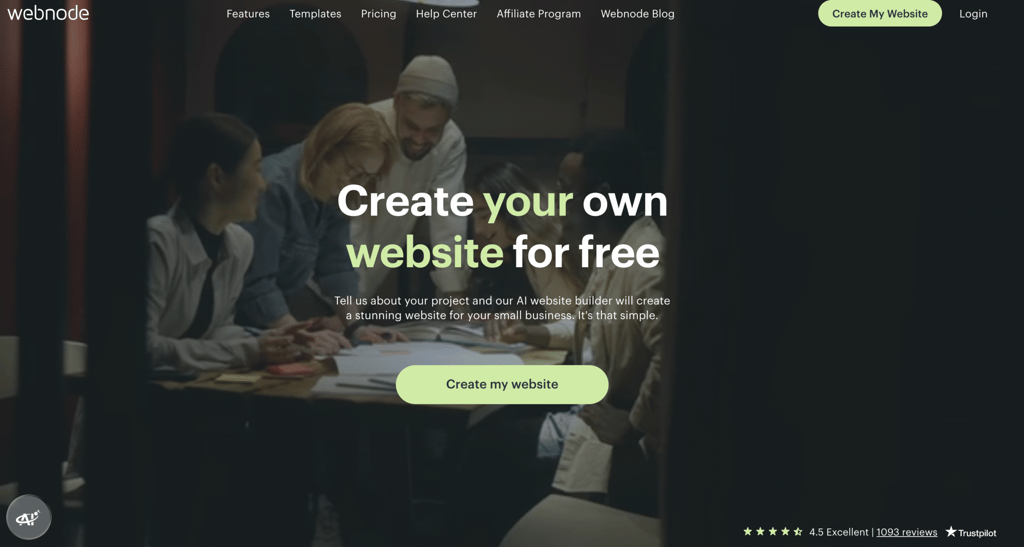
Founded in the Czech Republic, Webnode is a website builder that focuses on simplicity and multilingual publishing.
It uses a visual drag-and-drop editor with built-in language management, which gives it an advantage when creating websites for audiences in multiple countries.
This makes it particularly practical for small businesses expanding into neighboring markets, bloggers publishing in multiple languages, or projects targeting international visitors.
The editor is straightforward and designed for ease of use. You select a template, customize content visually, and publish without dealing with code or external hosting setup.
Templates are responsive by default, and the builder includes standard features such as blogging tools and basic ecommerce functionality.
Unlike Hostinger or IONOS, which prioritize business tooling and ecommerce growth, Webnode’s core strength lies in managing multiple language versions in a single, streamlined dashboard.
Webnode pros:
While its main strength lies in managing multiple language versions within one dashboard, it also comes with:
- A beginner-friendly visual editor
- Quick setup with minimal configuration
- Affordable entry-level plans for small projects
Webnode cons:
Webnode favors simplicity over advanced control, which results in:
- Limited design flexibility compared to more customizable builders
- Ecommerce features that work for small stores but lack advanced tools for larger operations
Webnode pricing:
Webnode offers four primary paid tiers, alongside a limited free plan. Paid plans range from $4.50 per month to $22.90 per month, depending on the selected tier and subscription term.
The Limited and Mini plans are structured for small informational websites with modest storage and bandwidth allowances.
The Standard plan expands storage, supports multiple languages, and introduces ecommerce functionality suited for smaller online stores.
The Profi plan removes branding limitations, increases storage, allows unlimited language versions and memberships, and includes full ecommerce capability with broader marketing integrations.
Discounted pricing typically applies to annual commitments, while month-to-month rates are higher.
3. Infomaniak Site Creator
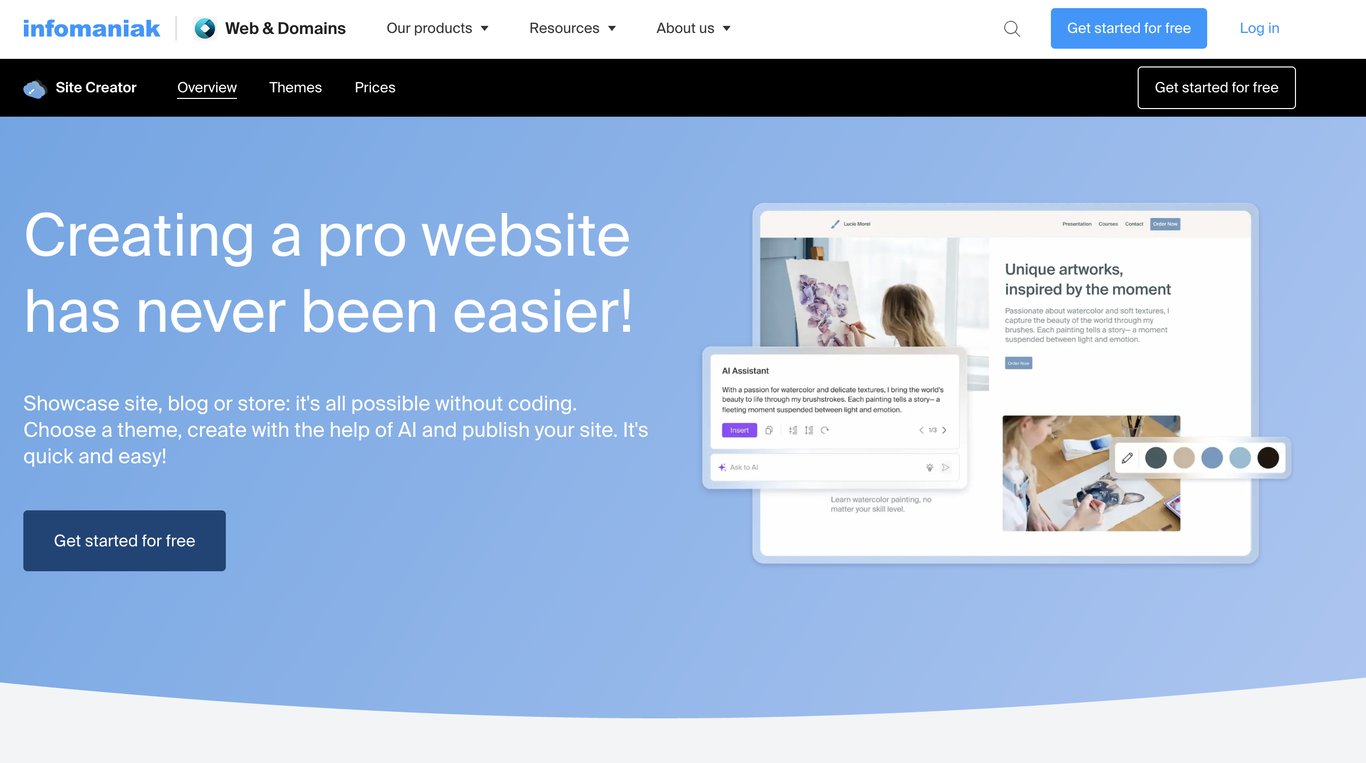
Operating from Switzerland, Infomaniak Site Creator is a website builder built around privacy, sustainability, and local data control.
The company runs its own renewable energy–powered data centers and positions its services around European and Swiss data protection standards.
The builder runs as a fully integrated platform with hosting included, so you do not need to configure external infrastructure. Site creation, hosting, SSL, and support are managed within the same ecosystem, which simplifies oversight and accountability.
Swiss jurisdiction, combined with General Data Protection Regulation (GDPR) processing standards, adds an additional layer of reassurance for organizations handling personal data.
This structure makes Infomaniak Site Creator particularly suitable for privacy-conscious businesses, nonprofits, associations, and public-interest projects that want straightforward site management with stronger data sovereignty safeguards.
The editor is visual and straightforward to use. You start with a template, adjust content using a block-based layout, and publish without touching server settings.
The feature set is practical rather than expansive, but it covers what most informational sites and small business projects actually need.
Infomaniak differentiates itself from platforms like Hostinger and IONOS by prioritizing Swiss data jurisdiction and renewable-energy infrastructure over aggressive pricing tiers or feature expansion.
Infomaniak Site Creator pros:
Its main strength lies in its clear privacy positioning. Beyond that, it provides:
- Infrastructure powered by renewable energy
- Hosting and support bundled into one platform
- Data processing aligned with European and Swiss regulations
Infomaniak Site Creator cons:
Infomaniak prioritizes data sovereignty over design breadth, which comes with the following trade-offs:
- A smaller template selection compared to larger global builders
- Slightly higher pricing than budget-focused competitors
Infomaniak Site Creator pricing:
Infomaniak Site Creator offers a free plan and two primary paid tiers, with pricing starting at €1.95 per month (≈ $2.26) and scaling to around €5.75 per month (≈ $6.67), depending on the selected plan and subscription length.
The Free plan allows a single page with limited storage and a temporary domain, making it suitable for testing the platform.
The Lite plan expands storage and page limits while maintaining core builder functionality, including blog and ecommerce modules. It suits small informational websites.
The Pro plan removes page limits, increases storage, and unlocks full ecommerce capability for online stores and brand development.
Infomaniak also offers broader web hosting bundles that include Site Creator Pro, along with expanded storage and CMS support, which increase monthly costs.
Discounted pricing typically applies to long-term commitments such as 48-month contracts. Renewal rates are higher than promotional pricing.
4. IONOS Website Builder
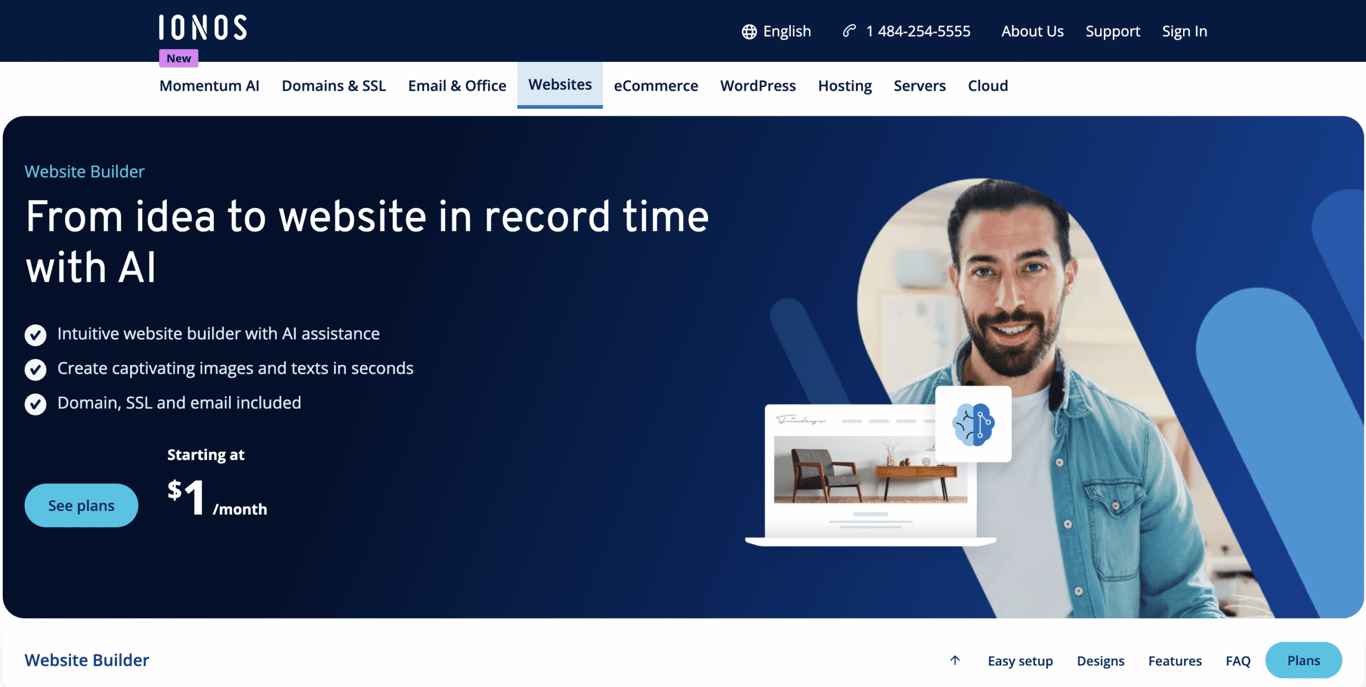
IONOS is a long-established German provider offering a website builder built specifically for small and medium-sized businesses.
The platform combines website creation, hosting, domains, SSL certificates, and business email in a single account. You do not need to coordinate multiple providers or configure external services. Everything is managed in one ecosystem.
Setup is guided, and layouts are pre-structured by industry. Restaurants, law firms, fitness studios, and real estate agencies can start from industry-specific templates designed around real business use cases rather than blank-canvas design.
Built-in tools include appointment booking, contact forms, and entry-level ecommerce features. SEO guidance is integrated directly into the editor, helping you configure page titles and descriptions without installing add-ons.
Domain registration and professional email are tightly integrated, simplifying communication and brand consistency.
IONOS runs on European infrastructure and is part of a broader ecosystem that includes hosting and cloud services.
In contrast to design-led platforms like Jimdo or Mozello, IONOS builds around structured business templates, booking tools, and bundled communication services.
IONOS Website Builder pros:
This builder’s strongest advantage is its business-first structure, supported by:
- Industry-specific templates designed for real-world business categories
- Built-in booking tools and guided SEO setup
- Integrated domain registration and professional email services
- Localized European customer support
IONOS Website Builder cons:
The weaknesses are primarily related to pricing:
- Frequent upsells are required for additional marketing or optimization features
- Introductory pricing increases noticeably at renewal
IONOS Website Builder pricing:
IONOS Website Builder uses fixed monthly tiers with promotional introductory pricing for the first term. Regular renewal pricing is significantly higher, so the total long-term cost depends on contract length.
Paid plans range from $1 per month to $17 per month during the first year, with renewal rates increasing to $14-$20+ per month, depending on the selected tier.
The Starter plan includes 10 pages and 10 GB of storage, making it suitable for small business websites with basic needs.
The Plus plan expands storage and page limits significantly and adds more advanced AI design, analytics, and booking tools.
The Pro plan removes page and storage limits and includes enhanced SEO tools and higher-capacity email services.
5. Jimdo
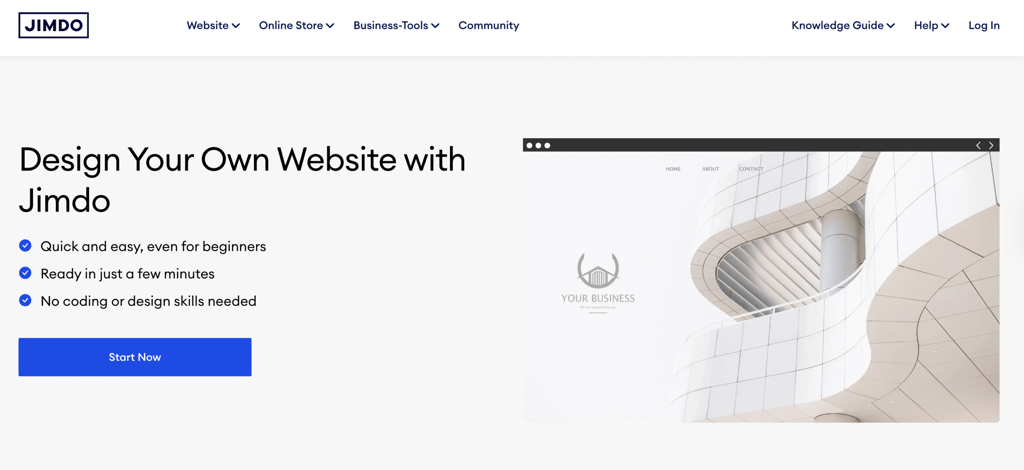
Jimdo is a Germany-based website builder built around speed and simplicity. It targets users who want to get online quickly without navigating complex design systems or advanced configuration settings.
Positioned as an AI-assisted website builder, Jimdo guides you through a short setup process and generates a ready-made site structure based on your answers.
Instead of starting from a blank template, you begin with a layout tailored to your project type, then adjust content through a streamlined editor.
The platform works well for freelancers, solopreneurs, creatives, and small personal brands that need a clean online presence without having to navigate complex settings or advanced configuration. Portfolio sites, small service websites, and compact online shops are its natural fit.
Templates are responsive by default, and the editing interface prioritizes clarity over deep customization. Ecommerce functionality is available for small product catalogs, covering essential tools such as product listings, basic payment processing, and order management.
Where platforms such as Odoo and IONOS expand into business systems and operational tooling, Jimdo intentionally narrows its scope to deliver faster setup and fewer configuration decisions.
Jimdo pros:
Its main advantage is how quickly you can launch a site, as well as:
- AI-assisted setup that generates a ready-to-edit website
- Beginner-friendly onboarding with guided configuration
- Simple ecommerce tools suitable for small catalogs
Jimdo cons:
Jimdo’s simplicity causes:
- Limited customization depth compared to more advanced builders
- Fewer advanced SEO controls and technical optimization options
Jimdo pricing:
Jimdo offers separate plans for standard websites and online stores. Paid plans range from $11 per month to $28 per month, depending on whether you choose a website or ecommerce tier. A limited free plan is also available.
For standard websites, the Start plan includes a custom domain and removes platform branding, making it suitable for personal sites and small professional pages.
The Grow plan adds search engine optimization tools, visitor statistics, and faster support response times, making it more appropriate for business websites.
For ecommerce projects, the Business plan introduces product management features and social selling tools.
The VIP plan expands storage capacity and includes additional design and support services for more demanding projects.
6. Mozello
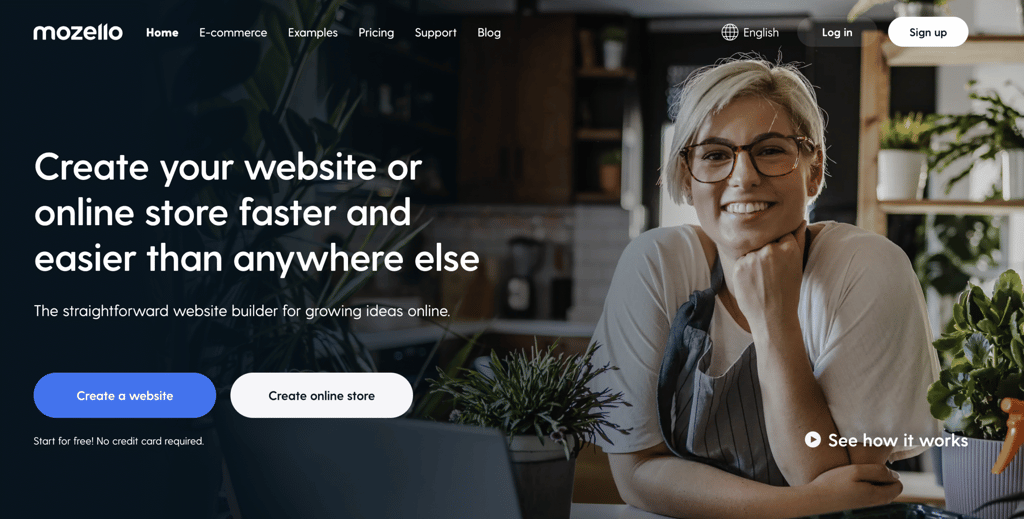
Mozello is a Latvia-based website builder that focuses on simplicity and multilingual website creation.
The builder is designed for small businesses, local service providers, and personal projects that do not require advanced customization. It works well for informational websites, small company pages, and compact online stores.
One of Mozello’s defining characteristics is its built-in multilingual functionality. You can create and manage multiple language versions of a site without relying on external plugins or separate subdomains.
This makes it practical for businesses targeting audiences in different countries while keeping site management centralized.
The editing interface is minimal and easy to navigate. Templates are responsive, and ecommerce functionality is included even in lower-tier paid plans. Product management, payment processing, and basic order handling are available without requiring complex configuration.
Unlike ecosystem-driven builders like Odoo or marketing-focused platforms like IONOS, Mozello keeps its feature set focused on essentials, with multilingual capability built directly into a simplified editor.
Mozello pros:
Besides built-in multilingual website management, Mozello also comes with the following advantages:
- Affordable ecommerce features included in paid plans
- A clean, straightforward editing interface
Mozello cons:
The main limitation is its restricted design flexibility, along with:
- Fewer advanced customization options compared to larger builders
- A smaller ecosystem with limited third-party integrations
Mozello pricing:
Mozello offers a free plan and two paid tiers. Paid plans range from $9 per month to $19 per month, depending on the selected tier and billing cycle.
The Free plan includes 0.5 GB of storage, a Mozello-branded subdomain, and limited ecommerce functionality (up to 5 products). It is suitable for testing or very small personal sites.
The Premium plan increases storage to 50 GB, allows a custom domain, removes branding, and expands ecommerce limits to 15 products with zero transaction fees.
The Premium Plus plan removes storage limits, supports unlimited products, expands product variants, and enables more flexible online payment options.
7. One.com Website Builder
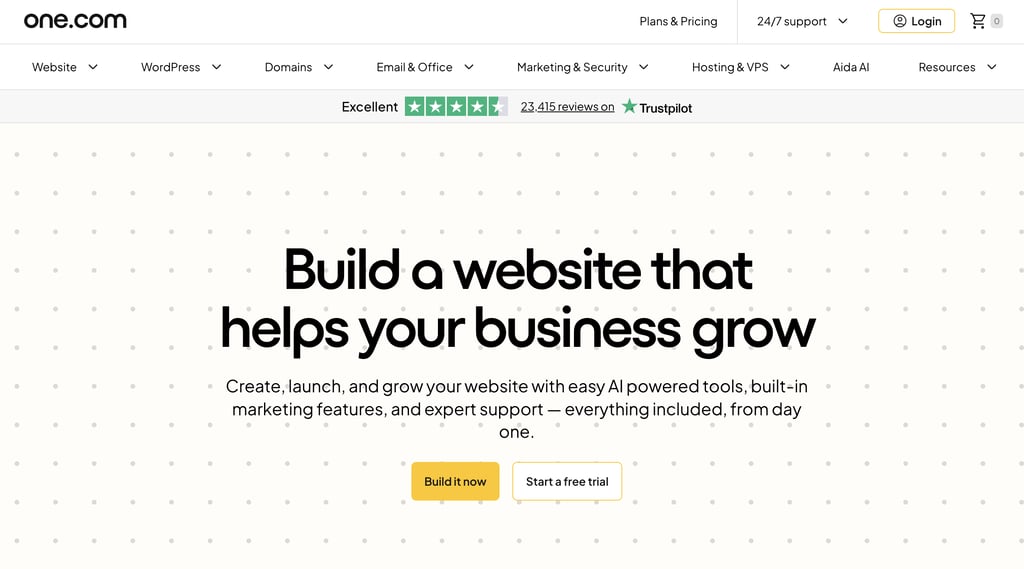
Located in Denmark, One.com is a hosting company that includes a website builder as part of its broader hosting services.
The builder is included with One.com’s hosting plans, which means your website, domain, and related services are managed in a single account. There is no need to connect to third-party hosting or configure technical settings before publishing.
The drag-and-drop editor keeps layout adjustments simple, and templates provide structured starting points for business pages, portfolios, and small online shops.
These features make One.com best suited for small businesses, first-time site owners, and individuals who want a straightforward online presence.
Ecommerce functionality is available as an add-on, allowing users to sell products without switching platforms.
It is designed to reduce setup friction rather than offer extensive design experimentation or advanced marketing automation.
While Jimdo emphasizes AI-assisted speed and minimal configuration, One.com centers more on bundled hosting convenience and low entry pricing.
One.com Website Builder pros:
Its strongest advantage is affordable entry pricing, as well as:
- A beginner-friendly drag-and-drop editor
- Integrated hosting and domain management
- Basic ecommerce functionality available as an add-on
One.com Website Builder cons:
The trade-off for simplicity is reduced flexibility, which can be seen in:
- Limited advanced design customization
- Fewer built-in marketing automation and growth tools
One.com pricing:
One.com offers tiered website builder plans bundled with hosting. Paid plans range from $1.99 per month to $22.99 per month, depending on the selected tier and subscription term, with higher renewal pricing after the introductory period.
The entry-level plan includes access to the drag-and-drop builder, hosting, a free domain for the first term, and limited published pages. It is structured for small personal sites and simple business pages.
The mid-tier plan expands flexibility with backup and restore functionality, additional customization options such as code embedding, and stronger business tools. It fits small businesses that need more control without full ecommerce features.
The ecommerce-enabled plan adds online store functionality, including product management, payment processing, analytics integration, and SEO tools. It is designed for small to mid-sized online stores.
8. Odoo Website Builder
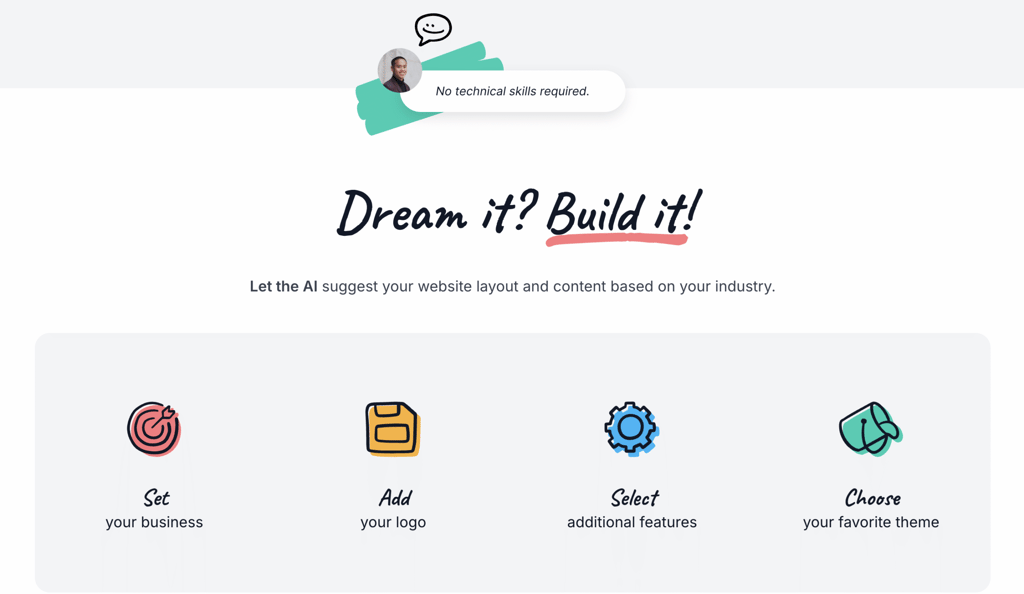
Odoo is a Belgian business software company that includes a website builder within its broader Enterprise Resource Planning (ERP) platform.
The website builder is part of a modular ecosystem. You start with drag-and-drop editing to create pages, publish blog content, and configure an online store.
From there, you can connect the site to invoicing systems, customer databases, email campaigns, and sales pipelines without switching platforms.
Odoo suits small and medium-sized businesses, ecommerce brands, and companies that want their website tightly connected to daily operations. Instead of managing separate tools for customer management, stock control, and billing, everything runs within the same system.
Compared to simpler builders in this list, Odoo offers significantly deeper business integration. The trade-off is complexity. Where platforms like Jimdo or Mozello prioritize quick setup, Odoo prioritizes operational alignment and scalability.
Odoo Website Builder pros:
Its biggest strength is full integration with business operations, reinforced by:
- Direct connection to CRM, inventory, accounting, and ecommerce modules
- Scalable architecture within a unified business ecosystem
- Modular, open-source framework that allows structural flexibility
Odoo Website Builder cons:
That level of integration increases complexity, including:
- A steeper learning curve than simple drag-and-drop website builders
- Additional cost and configuration complexity when activating multiple paid modules
Odoo pricing:
Odoo uses a modular pricing structure with a free single-app option and paid per-user subscriptions. Paid plans range from €11.90 per user per month (≈ $13.80) to €17.90 per user per month (≈ $20.76), depending on the selected plan and deployment model.
The One App Free plan includes one application with unlimited users. It allows businesses to run a single module, such as a Website or Ecommerce, without subscription fees.
The Standard plan includes access to all Odoo apps under Odoo Online hosting.
The Custom plan supports Odoo Online, Odoo.sh, and on-premise deployment, while unlocking advanced features such as Odoo Studio, multi-company management, and external API access.
Odoo follows a per-user subscription model rather than fixed site tiers. Costs scale as additional users require backend access and as businesses expand into more operational modules.
How to choose the right European website builder
Before you choose the right website builder for your project, define what your site needs to achieve over the next few years, not just at launch. Some builders prioritize simplicity and fast setup, while others offer deeper customization and business integrations.
If you want to publish quickly with minimal configuration, choose a platform with a clear drag-and-drop editor and structured templates.
If you expect to customize layouts, expand functionality, or connect the site to internal systems later, look for builders that allow deeper structural editing or custom code blocks.
Ecommerce requirements should also influence your choice early. Small stores can operate with basic product listings and payment gateways, but growing businesses need stronger infrastructure.
Check whether the builder supports product variants, inventory management, shipping configuration, and tax handling for cross-border EU sales.
Platforms that manage Value Added Tax rules applied within the European Union (EU VAT) settings and order workflows reduce operational friction as your store expands.
Data protection and infrastructure location are equally important when choosing a European provider. Confirm that the builder operates EU-based data centers and offers a formal Data Processing Agreement under General Data Protection Regulation (GDPR) rules.
The hosting jurisdiction determines how customer data is stored and processed, which directly affects compliance obligations for European businesses.
Key features to prioritize in an EU-based builder
Search visibility comes first. A builder should let you edit page titles, descriptions, URLs, and image alt text without digging through complicated settings.
If you plan to publish articles or guides, you’ll need one of the website builders optimized for SEO, with blogging systems that support categories, tags, and clean page structures so content stays organized as it grows.
Mobile responsiveness is just as important. Search engines index mobile versions of websites first, so your builder should handle responsive layouts automatically instead of relying on manual adjustments.
Data protection and hosting location also matter. Choose a builder that relies on a European hosting provider with EU-based data centers and a clear GDPR-compliant data processing setup. This affects how customer data is stored, handled, and protected, especially if your site collects forms, runs accounts, or processes payments.
Once visibility and compliance are covered, consider how the site handles multiple languages. If your business serves customers in several countries, choose a builder with built-in multilingual tools so you can manage translations from one place and keep content consistent across regions.
The final piece is integration. Check how the builder connects with other tools before committing. Look for support for payment gateways, email marketing platforms, CRM systems, and analytics tools your business may rely on.
If your website supports sales or customer workflows, choose a builder that connects easily with those systems instead of one that limits you to a closed setup.
When to choose a website builder vs. CMS
Start with how much control you actually need over your website. If your priority is getting online quickly and managing everything from one place, a website builder is the better choice.
If you want deeper customization and are comfortable handling technical setup, a Content Management System (CMS) such as WordPress gives you more flexibility.
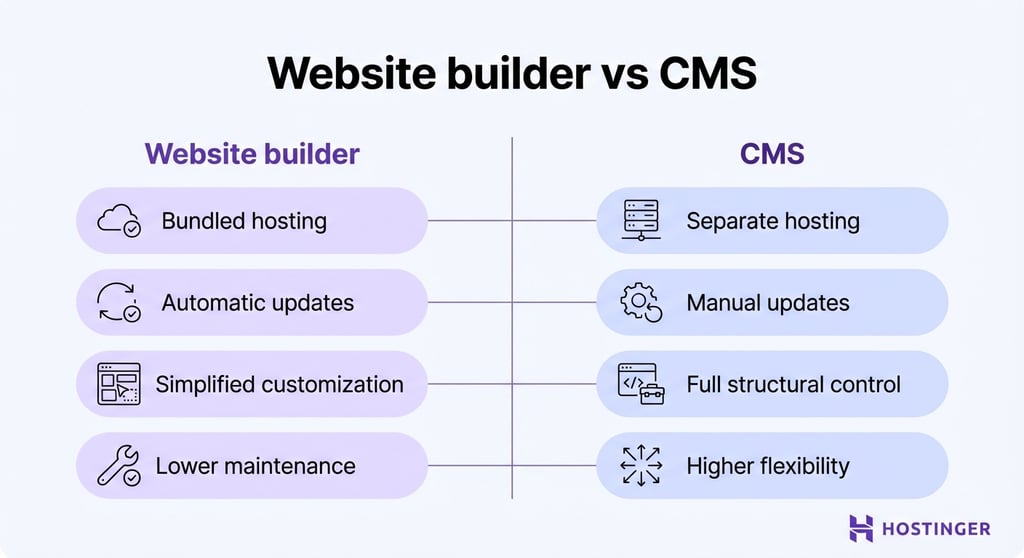
Choose a website builder when you want the technical side handled for you. Hosting, security updates, and website performance optimization are included in the platform, so you can focus on designing pages and publishing content instead of managing infrastructure.
This approach works well for small business websites, portfolios, freelance services, and straightforward ecommerce stores.
Consider a CMS when your project requires more control over how the site is built and maintained. A CMS separates the website software from the hosting environment, which means you manage themes, plugins, server configuration, and updates yourself.
That extra responsibility brings greater customization and scalability, but it also requires more time and technical oversight.
For a deeper comparison before deciding, explore the key differences between website builders and CMS platforms in detail.
Artikel ini merupakan versi setempat bagi Top 8 best European website builders: Key features and pricing, asalnya diterbitkan dalam bahasa Inggeris.
All of the tutorial content on this website is subject to Hostinger's rigorous editorial standards and values.

Ksenija is a digital marketing enthusiast with extensive expertise in content creation and website optimization. Specializing in WordPress, she enjoys writing about the platform’s nuances, from design to functionality, and sharing her insights with others. When she’s not perfecting her trade, you’ll find her on the local basketball court or at home enjoying a crime story. Follow her on LinkedIn.