How to make money copywriting in 8 steps
Sep 02, 2026
/
By Ksenija
/
14 min Read

To make money copywriting, you need to write persuasive marketing content that encourages people to take action.
Businesses rely on copywriters to create assets such as sales pages, ads, email campaigns, landing pages, and website copy that turn readers into paying customers.
When stronger messaging improves conversion rates, the business earns more from the same traffic. That direct impact on revenue is why copywriting is widely considered a high-income skill.
Many beginners, freelance writers, side hustlers, and aspiring digital marketers enter freelance copywriting because the skill can be learned online and applied across many industries.
Early projects often start small, but consistent client work and specialization can turn copywriting into a long-term career or scalable online business.
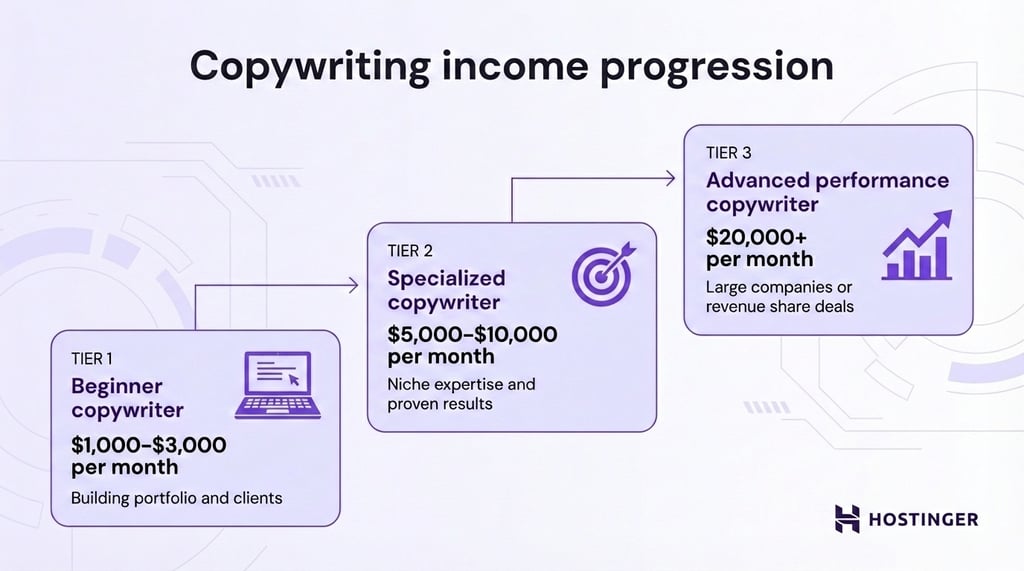
Income grows as your skills and client relationships develop. Beginners commonly earn $1,000–$3,000 per month while building a portfolio and learning how to find clients.
Copywriters who specialize in a niche and deliver consistent results often reach $5,000–$10,000 per month. Experienced professionals working with larger companies or performance-based agreements can earn $20,000 per month or more.
The following eight steps show how to turn persuasive writing skills into consistent copywriting income and a scalable freelance business:
- Master the fundamentals of persuasive writing
- Focus on a niche with strong marketing budgets
- Create a portfolio that showcases conversion-focused work
- Price your copywriting services strategically
- Develop reliable ways to attract clients
- Write copy that improves marketing results
- Secure recurring income through retainers or performance deals
- Grow your freelance work into a scalable business
1. Learn the fundamentals of copywriting
Copywriting is revenue-focused, persuasive writing that encourages a reader to take action, such as buying a product, signing up for a service, or clicking a link. Unlike blog posts or educational articles, the main purpose of sales copy is to generate measurable business results.
Content writing informs or educates readers, while copywriting persuades them to take action. The difference becomes clearer when you see how they compare their goals and formats side by side:
Content writing | Copywriting |
Educates or informs readers | Persuades readers to take action |
Blog posts, guides, tutorials | Ads, landing pages, email campaigns |
Focuses on traffic and engagement | Focuses on conversions and sales |
Supports long-term brand awareness | Drives immediate business results |
Strong copywriting basics start with understanding how people make buying decisions. Once you understand that process, persuasive writing becomes much simpler: connect the product to a clear problem, address objections, and present a believable outcome.
Once you know how buyers think, structured frameworks help translate that insight into effective sales copy. These frameworks guide the reader through a natural decision process rather than presenting random information.
One of the most widely used persuasive techniques for making money online with copywriting is the AIDA formula, which organizes messaging around four stages of persuasion:
- Attention – grab interest with a strong headline or hook
- Interest – highlight the reader’s problem or desire
- Desire – show how the product solves the problem
- Action – tell the reader exactly what to do next
Say you are selling a productivity app; this would be your AIDA approach:
- Attention – “Still finishing work at 9 PM every night?”
- Interest – “Most professionals lose hours every day switching between tasks and tools.”
- Desire – “[product name] organizes your work into one simple dashboard so you can finish faster.”
- Action – “Start your free trial and reclaim your evenings.”
Another widely used structure is the Problem–Agitate–Solution (PAS) model. This framework starts by identifying the reader’s problem, intensifying the pain or frustration it causes, and then presents the product as the solution.
For example:
- Problem – “Your inbox fills up faster than you can answer it.”
- Agitate – “Important messages get buried, deadlines slip, and you spend half your day sorting email.”
- Solution – “[product name] automatically arranges conversations so you can focus on the messages that matter.”
Frameworks help, but persuasion comes from understanding buyer psychology. People buy based on emotion first and justify the decision logically afterward.
Effective copy highlights outcomes customers care about, such as saving time, increasing revenue, reducing risk, or achieving a desired status.
How you present those outcomes depends on the reader’s level of awareness. Buyers move through four stages before making a purchase:
- Problem-aware – they know the issue but not the solution
- Solution-aware – they know solutions exist, but not your product
- Product-aware – they are evaluating specific options
- Most aware – they already trust the brand and need a final push
The same product can be presented very differently depending on the reader’s awareness.
Imagine promoting an ergonomic office chair:
- Problem-aware – “Why does your back hurt every morning after working at your desk?”
- Solution-aware – “An ergonomic chair could eliminate the back pain caused by long desk hours.”
- Product-aware – “The [product name] supports your spine with adjustable lumbar support and posture alignment.”
- Most aware – “Join 40,000 professionals who upgraded to the [product name] this year.”
Copy that matches the reader’s awareness stage converts more effectively because it answers the questions they already have at that moment in the decision process.
To write messaging that matches those questions, copywriters rely heavily on customer research.
They study product reviews, competitor ads, support tickets, and community discussions. These sources reveal the exact language customers use to describe problems, benefits, and objections.
When your copy mirrors that language, the message feels familiar and credible.
Research also exposes the objections that stop people from buying. Buyers hesitate because of price, trust, timing, or uncertainty about results. Strong copy addresses those concerns directly with proof, guarantees, testimonials, or clear explanations.
When you combine buyer psychology, structured frameworks, customer research, and objection handling, persuasive writing becomes a system you can apply to any product or service.
2. Choose a profitable copywriting niche
Choosing a copywriting niche means focusing on a specific industry, audience, or type of marketing asset instead of offering general writing services.
Businesses prefer hiring copywriters who already understand their market. A writer who focuses on SaaS products, for example, knows how software buyers evaluate tools, compare features, and justify purchases to a team.
That familiarity reduces onboarding time and improves results, which makes clients more willing to pay higher rates.
Industries that consistently appear among the highest-paying niches for freelance copywriters include:
- SaaS copywriting – landing pages, onboarding emails, product launches
- Email marketing copy – sales sequences, newsletters, and automated funnels
- Health and wellness – supplements, coaching programs, and digital health services
- Finance – investment platforms, fintech tools, and financial education products
These niches tend to invest heavily in marketing because acquiring customers directly affects revenue.
When evaluating a niche, look at three practical indicators of profitability. First, examine ad spend. Companies that run large advertising campaigns constantly need landing pages, email sequences, and ads.
Second, consider recurring revenue models such as subscriptions or SaaS platforms, which allow businesses to invest more in customer acquisition.
Third, evaluate customer lifetime value (LTV) (the total revenue a business expects from one customer over time). Higher LTV usually supports higher copywriting budgets.
A simple way to choose your niche is to evaluate three factors together:
- Interest – topics you enjoy researching and writing about
- Market demand – industries actively investing in marketing and growth
- Budget size – businesses with strong revenue models and customer value
The best niche sits where these three factors overlap. When you focus on a market with clear demand and strong budgets, your positioning becomes stronger, and attracting higher-paying clients becomes much easier.
3. Build a copywriting portfolio
Creating an online portfolio for your copywriting work helps you prove that you can write persuasive sales copy that drives action. Clients rarely hire writers based on claims alone. They want to see how you structure headlines, present benefits, and guide readers toward a clear call to action (CTA).
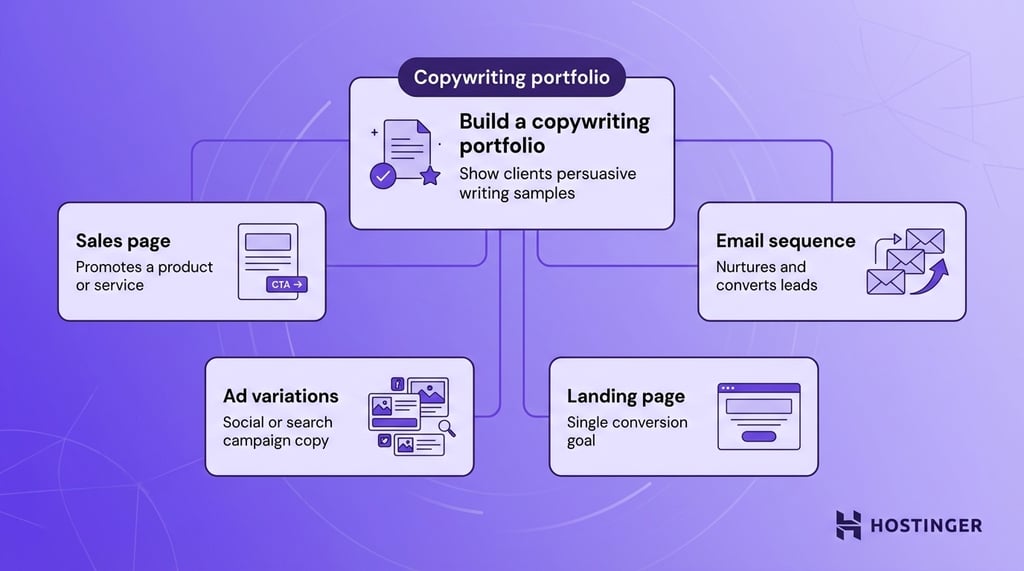
When starting out, focus on creating three to five strong writing samples instead of dozens of scattered pieces. Each sample should demonstrate a different type of marketing asset businesses regularly need, such as:
- A sales page promoting a product or service
- An email sequence designed to nurture or convert leads
- A set of ad variations for social media or search campaigns
- A landing page focused on a single conversion goal
These examples show clients that you understand how different formats influence the buying process.
If you do not have client projects yet, create spec work. Spec projects are sample pieces written for a real or hypothetical company to demonstrate your skills. Choose a business in your niche, study its product and audience, and write a landing page, ad campaign, or email funnel as if you were hired for the project.
Structure each portfolio sample the same way professional sales pages are written. Start with a strong headline that highlights the main benefit, follow with clear subheadings that guide the reader through the offer, and end with a clear CTA.
This format shows clients that you understand how persuasive messaging flows from attention to decision.
You can also include short annotations explaining your strategic choices. For example, briefly describe why a headline emphasizes a specific pain point or why a section focuses on objection handling. These notes demonstrate your thinking process and show that your writing decisions are intentional.
Pro Tip Name your samples after the result they aim for, not the format. Example: “Increase SaaS free-trial signups” instead of “Landing page sample.”
Present your work on a simple portfolio website where potential clients can quickly browse your samples and understand the results you aim to achieve. A clean layout, clear project descriptions, and focused writing samples help build trust and make your expertise easier to evaluate.
4. Set your copywriting rates
Setting your copywriting rates determines how quickly you turn your skills into sustainable income.
Freelance copywriters commonly use several pricing models, depending on the project type and client relationship:
- Per word – common for blog-style content or short marketing assets
- Hourly rate – used for consulting, editing, or ongoing revisions
- Project pricing – a fixed fee for a specific deliverable, such as a landing page
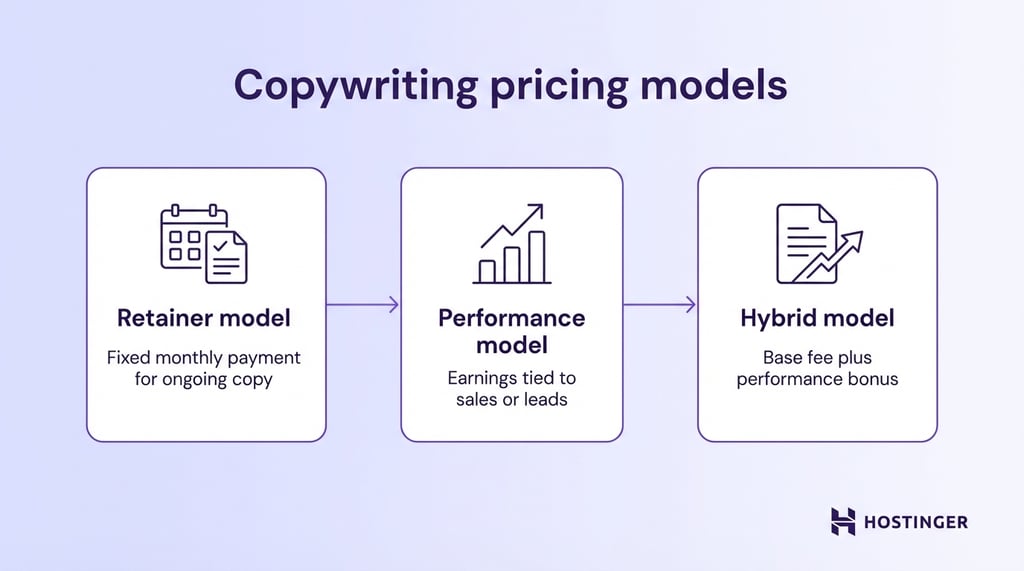
- Retainer agreements – a monthly fee for ongoing copywriting work
- Performance-based pricing – payment tied to results, such as sales or leads generated
Among these options, project pricing is the most common approach for sales copy because it focuses on outcomes rather than writing time.
When starting out, rates are usually lower while you build experience and client results. Typical beginner benchmarks look like this:
Pricing model | Beginner benchmark |
Per word | $0.05–$0.20 |
Project pricing | $300–$1,000 per project |
At these rates, beginner copywriters earn around $1,000–$3,000 per month, depending on workload and the number of active clients.
As your portfolio grows and you specialize in a niche, pricing increases significantly. Intermediate copywriters often charge:
Pricing model | Intermediate benchmark |
Per word | $0.30+ |
Project pricing | $1,500–$5,000 per project |
At this stage, freelancers generate $5,000–$10,000 per month once they maintain a steady client pipeline.
As your experience grows, you can move from one-off projects to retainer agreements or performance-based deals, which allow your income to scale with the results you help clients achieve.
A retainer means a client pays you a fixed monthly fee for ongoing work, such as email marketing, funnel optimization, or campaign launches.
For example, managing a company’s email campaigns might bring you in $2,000–$5,000 per month from a single client.
When you manage several retainers or negotiate performance bonuses tied to revenue, your monthly income can grow far beyond individual project fees.
The key shift happens when you move from time-based pricing to value-based pricing. Businesses do not pay for the number of hours you spend writing. They pay for the revenue impact your messaging creates.
For example, a landing page that increases conversions by even a few percentage points can generate thousands of dollars in additional sales. When your work influences results at that level, value-based pricing becomes the most logical way to structure your fees.
As your experience grows and your copy delivers measurable outcomes, your pricing naturally aligns with the value you deliver.
5. Find copywriting clients
Freelance copywriters rely on two main strategies for finding clients: outbound outreach, where you actively contact potential clients, and inbound acquisition, where clients discover your work and contact you.
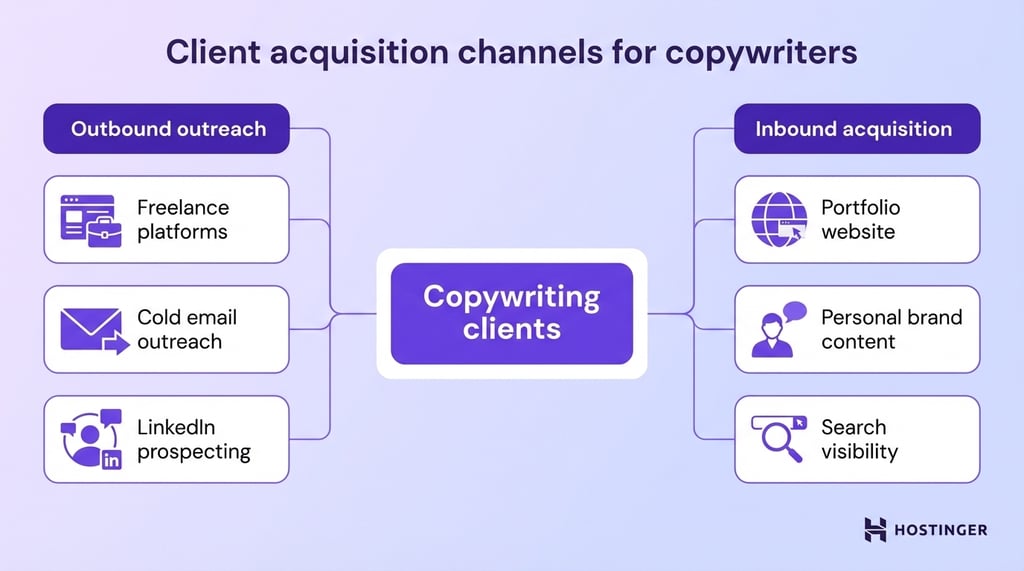
Outbound outreach works well when you are starting because it gives you direct control over how many opportunities you create. Inbound strategies usually develop later as your portfolio, reputation, and online presence grow.
One of the fastest ways to start is to take on copywriting jobs on freelancing websites like Upwork or Fiverr.
These marketplaces connect businesses with freelancers who offer specific services, including landing page writing, email campaigns, and product descriptions.
Another effective channel is LinkedIn prospecting. Many companies actively search for writers and marketers on LinkedIn, which makes it a strong platform for positioning yourself as a niche expert.
Start by optimizing your profile to clearly state the services you offer and the industries you focus on. Sharing insights into your niche, marketing strategies, or copywriting examples also helps demonstrate expertise and attract potential clients’ attention.
Direct outreach through cold email remains one of the most reliable ways to get copywriting clients.
Create a strong cold email that focuses on three elements:
- Problem – identify a clear issue in the company’s marketing or messaging
- Opportunity – explain how improving the copy could increase results
- Solution – offer a quick suggestion or propose a conversation
For example, you might notice that a company’s landing page lacks clear benefits or strong calls to action. A short message highlighting the issue and suggesting an improvement often starts productive conversations.
A simple cold email opening might look like this:
Hi Sarah,
I was looking at the pricing page for Acme Analytics and noticed the headline focuses mostly on features. Highlighting the main outcomes customers care about, such as faster reporting or easier data visualization, could improve conversions. I’d be happy to share a quick idea if you’re interested.
As you begin reaching out to companies, track simple outreach metrics to understand what works. Monitor your response rate, the number of conversations booked, and the number of calls that turn into projects.
These numbers help you refine your messaging and focus on the strategies that generate the best results.
Inbound client acquisition works differently. Instead of pitching companies directly, you create content and visibility that attracts clients who are already looking for copywriting help.
You can build inbound demand by:
- Publishing copywriting breakdowns or marketing insights on LinkedIn.
- Sharing before-and-after examples of landing pages or email campaigns.
- Writing case studies that show how your copy improved conversions.
- Creating a portfolio site optimized for search queries like “SaaS copywriter” or “email marketing copywriter”.
Over time, these assets help position you as a specialist. Instead of constantly searching for clients, potential buyers discover your work, review your portfolio, and contact you when they need help.
6. Deliver results-driven copy
Delivering results-driven copy means writing sales messages that produce measurable outcomes, such as more clicks, leads, or purchases.
Strong results influence not only one project but also your future opportunities and income. When your copy increases sales or leads, clients are more likely to extend contracts, offer retainers, and refer you to other businesses.
To measure performance, marketers rely on several conversion metrics:
- Click-through rate (CTR) – the percentage of people who click a link after seeing an ad or email. This metric shows how effectively your headline, subject line, and call to action capture attention. If CTR is low, test stronger headlines, clearer benefits, or more prominent CTAs.
- Conversion rate – the percentage of visitors who complete the desired action, such as purchasing or signing up. Strong conversion rates indicate that the messaging, value proposition, and page structure effectively guide readers toward a decision. If conversions remain low, the offer, benefits, or objection handling needs refinement.
- Cost per acquisition (CPA) – the average cost required to acquire a new customer. When copy improves conversion rates, businesses can acquire customers at a lower cost because the same marketing budget produces more signups or purchases.
- Revenue per visitor – the average revenue generated from each website visitor. This number reflects how effectively the page turns traffic into revenue. Clearer offers, stronger benefits, and well-placed upsells increase revenue per visitor even when traffic stays the same.
These metrics show how effectively your copy moves readers from attention to action.
Strong performance begins with understanding consumer psychology and buyer awareness. A message written for someone who just discovered a problem will look very different from a copy aimed at a reader already comparing products.
For example, problem-aware audiences need education about the issue they face, while product-aware audiences need proof, differentiation, and reassurance before making a purchase decision.
Aligning your message with the reader’s awareness stage increases clarity and improves conversion rates.
Results-driven copy also improves through data and testing. Instead of relying on assumptions, marketers run split testing (also called A/B testing) to compare different versions of headlines, calls to action, or page structures.
For example, testing two headlines on a landing page might reveal that one version increases conversions by several percentage points. Over thousands of visitors, that difference can translate into substantial additional revenue.
Grammar and style still matter, but persuasion and psychology have a greater impact on results. Readers rarely convert because a sentence is perfectly written. They convert because the message addresses their problem, builds trust, and clearly explains the solution’s value.
As you gain experience analyzing results and refining your messaging, your sales copywriting becomes more predictable and effective.
7. Build recurring and performance-based income
Building recurring revenue stabilizes your income and reduces the pressure of constantly finding new projects.
One common model is a copywriting retainer. In a retainer agreement, a client pays a fixed monthly fee for ongoing work, such as managing email marketing campaigns, writing sales funnels, or producing landing pages for new promotions.
For example, an ecommerce company might hire you to write weekly promotional emails, while a SaaS company may need ongoing onboarding sequences and product launch campaigns.
Another approach is performance-based copywriting, where part of your compensation depends on the results your copy generates. In this model, you might earn a commission or revenue share tied to the sales or leads produced by a campaign.
Let’s say your client is launching a new digital product. They might offer a base payment for writing the sales page plus a percentage of every sale generated through that page. If the campaign performs well, your earnings increase alongside the client’s revenue.
Many copywriters combine these approaches using hybrid pricing models. This structure includes a base project fee and a performance bonus tied to measurable outcomes, such as conversions or total revenue.
Performance agreements involve higher risk, so evaluate the business carefully before accepting commission-based work. In these arrangements, your income depends on factors outside your control, such as traffic quality, product demand, and the client’s sales process.
Watch for warning signs before agreeing to performance-based compensation:
- Low or unproven traffic – If the business receives little traffic, even strong copy will not generate meaningful sales.
- Unvalidated products or offers – Avoid performance deals for products that have never been tested or sold before.
- Weak conversion infrastructure – Poor checkout flows, broken analytics, or slow websites can reduce results regardless of copy quality.
- Clients avoiding upfront payment – Some businesses propose commission-only deals to avoid paying for work rather than sharing real upside.
Retainers, on the other hand, provide stability. Ongoing agreements reduce the need for constant outreach and allow you to focus on improving campaigns for the same clients over time.
By combining retainers, performance bonuses, and project work, you can build a copywriting business that generates both reliable income and opportunities for higher earnings as client campaigns grow.
8. Scale your copywriting business
To scale your copywriting business, you need to increase your income without relying only on one-off projects. At this stage, you stop thinking like a freelancer who sells writing and start operating like a premium service provider who sells outcomes.
One way to scale is to move beyond writing individual pages and start helping clients improve their entire marketing funnel.
Instead of only delivering a landing page or email, you analyze how the messaging works across ads, pages, and email sequences, then recommend improvements that increase conversions.
When you own the strategy, premium pricing becomes easier to justify because you tie it to performance rather than word count.
Another scaling lever is building a personal brand that brings clients to you. For instance, you can share short breakdowns of landing pages, ads, or email campaigns on LinkedIn or X (Twitter), explaining why the copy works and how it could improve.
Posting these analyses shows how you think about messaging and attracts companies that need similar help. Over time, this visibility can bring client inquiries without relying entirely on cold outreach.
As demand for your work grows, the next challenge becomes handling more projects without burning out.
You can hire help for research, competitive analysis, draft formatting, or content updates. You can also bring in junior writers to handle supporting assets while you focus on the high-value work like positioning, messaging, and conversion strategy.
Beyond hiring, Hostinger’s content marketing agent writes blog posts, landing pages, and product copy in your voice, so you can scale your output without starting every piece from scratch.
As your systems improve, you can expand your services beyond writing and offer additional support for your clients’ marketing campaigns.
Common add-ons include:
- Campaign planning – Helping clients plan the messaging, structure, and timeline for a marketing campaign before writing any copy.
- Funnel audits – Reviewing an entire marketing funnel (ads, landing pages, emails) to identify weak messaging and opportunities to improve conversions.
- Offer positioning – Refining how a product or service is presented to make its value and benefits clearer to the target audience.
- Collaboration with designers or media buyers – Working with designers who build the landing pages and media buyers who manage advertising campaigns to ensure the message stays consistent across the campaign.
If you enjoy managing people and processes, you can grow into a copywriting agency. An agency model lets you serve multiple clients at once by standardizing your workflow and delegating execution.
Your role shifts to client strategy, quality control, and business development while your team handles production.
The core idea stays the same: scale what already works. When you focus on a niche, document your process, and build a visible brand, you can scale a freelance business into a predictable, higher-income operation.
Common mistakes when trying to make money copywriting
Some of the most common beginner copywriting mistakes include:
- Underpricing services – Charging extremely low rates may bring quick projects, but it often attracts clients with limited budgets and high demands. You end up completing more work for less income, which slows skill development and limits your earning potential.
- Staying a generalist for too long – Writing for every industry slows skill development because each project requires new research and messaging. Specializing in a niche helps you build expertise and charge higher rates.
- Overrelying on AI tools – AI can help generate drafts or ideas, but it cannot replace the strategic thinking required for a strong copywriting strategy. Effective sales copy still depends on understanding customer motivations, objections, and decision triggers.
- Inconsistent client outreach – Sending a few messages and stopping after limited responses prevents momentum. Consistent outreach, portfolio improvements, and skill development produce better results over time.
- Ignoring the business side of freelancing – Writing skills alone do not guarantee success. Positioning your services, communicating value, and managing client relationships are essential parts of building a sustainable freelance business.
How to turn copywriting into a profitable online business
Starting an online business as a copywriter begins with building a professional online presence that lets potential clients quickly understand your services and contact you.
A dedicated copywriting website acts as your central platform for showcasing your expertise, portfolio, and service offerings.
You can create your site using a tool like Hostinger Website Builder, which lets you quickly publish pages for your services, portfolio, and contact information without writing code.
The platform includes ready-made templates, drag-and-drop editing, and built-in hosting, so you can launch a professional copywriting website and update it easily as your portfolio and services grow.
At a minimum, your personal brand website should include the following pages:
- Services page – Clearly explain the types of copywriting you offer, including landing pages, email sequences, and ad copy.
- Portfolio page – Showcase your best writing samples and highlight the goals or results behind each project.
- Testimonials section – Display feedback from clients to build credibility and trust.
- Contact form – Give potential clients a simple way to reach out about new projects.
As your business grows, you can also create niche-specific landing pages that target the services you specialize in.
For example, a page dedicated to SaaS email copywriting or ecommerce product page optimization helps attract businesses searching for those exact services.
Owning your own website also improves long-term visibility. When your pages are optimized for search engines, potential clients can discover your services through organic search rather than through freelance platforms or outreach.
Over time, your website can evolve into a complete online business platform. In addition to client work, many copywriters expand into consulting, training, or selling digital resources such as copywriting templates and marketing guides.
If you want to grow your freelance work into a scalable business, building a professional website is one of the most effective ways to strengthen your credibility, attract inbound leads, and position your copywriting services for long-term growth.
All of the tutorial content on this website is subject to Hostinger's rigorous editorial standards and values.

Ksenija is a digital marketing enthusiast with extensive expertise in content creation and website optimization. Specializing in WordPress, she enjoys writing about the platform’s nuances, from design to functionality, and sharing her insights with others. When she’s not perfecting her trade, you’ll find her on the local basketball court or at home enjoying a crime story. Follow her on LinkedIn.