33 entrepreneurship statistics in 2026: Global trends, challenges & insights
Jun 18, 2026
/
By Ricardo
/
9 min Read

Entrepreneurship drives economies all over the world. Over the last four years, nearly every major economy has seen a steady rise in new entrepreneurs, with the global average annual startup growth rate reaching 21% by 2025.
Although entrepreneurs drive economic growth, studies show that most new businesses operate with limited resources and inadequate infrastructure. Exploring key statistics will help us understand how startup businesses solve these challenges and nurture skills to capture opportunities.
Let’s deepen our knowledge with data and statistics around trends, obstacles, and expectations surrounding business creation.
Top entrepreneurship statistics for 2026
- There are approximately 665 million entrepreneurs worldwide.
- Overall, 62% of entrepreneurs hold a bachelor’s degree.
- Over 30% of entrepreneurs hold a job in the retail, manufacturing, and professional industries.
- The global GDP could grow 20% by closing the gender gap in entrepreneurship.
- Small businesses that invest in marketing double their chances of survival.
- Up to 80% of entrepreneurs believe in digital tools to boost customer engagement and sales.
- Fear of failure stops 40% of potential entrepreneurs from pursuing business ideas.
- More than 50% of entrepreneurs focus on sustainability over profit, and women lead this change.
- Over two-thirds of new startups fail within 10 years.
- Service-based businesses are twice as likely to survive as product-based ones.
General facts about entrepreneurship
New businesses are transforming and powering economies globally. Entrepreneurs contribute to growing employment, investment, and industry rates.
1. There are approximately 665 million entrepreneurs worldwide
One in eight working-age people is engaged in an entrepreneurial activity, according to the Global Entrepreneurship Monitor (GEM) 2024/2025 Global Report. This means there were nearly 665 million entrepreneurs around the world by the end of 2024.
2. Entrepreneurship services market to reach $5.1 billion by 2033
Entrepreneurs and startups require tailored services. Mentorship programs, funding solutions, incubators, accelerators, and educational businesses expect to grow at a CAGR of 8.8% from 2026 to 2033.
3. Small businesses employ nearly half of US private workforce, with 61.7 million jobs
According to small business statistics, 41% of the private workforce in the United States works for small businesses – those with fewer than 500 employees. The US economy relies on over 34 million existing small businesses for job creation and economic growth.
4. Ecuador leads globally with 33% involved in early-stage entrepreneurial activity
In a global-scale comparison, Ecuador boasts the highest percentage of adults starting or running a business (33%), the GEM report states. At the same time, Ecuador’s annual Gross Domestic Product (GDP) per capita of below $20,000 is one of the lowest in the world. On the opposite end of the scale, early-stage entrepreneurship is limited to less than 5% of the populations of Poland, Romania, and Costa Rica, but these countries’ GDP per capita exceeds $25,000.
5. Global startup ecosystem growth reaches 21% in 2025, fueling entrepreneurship worldwide
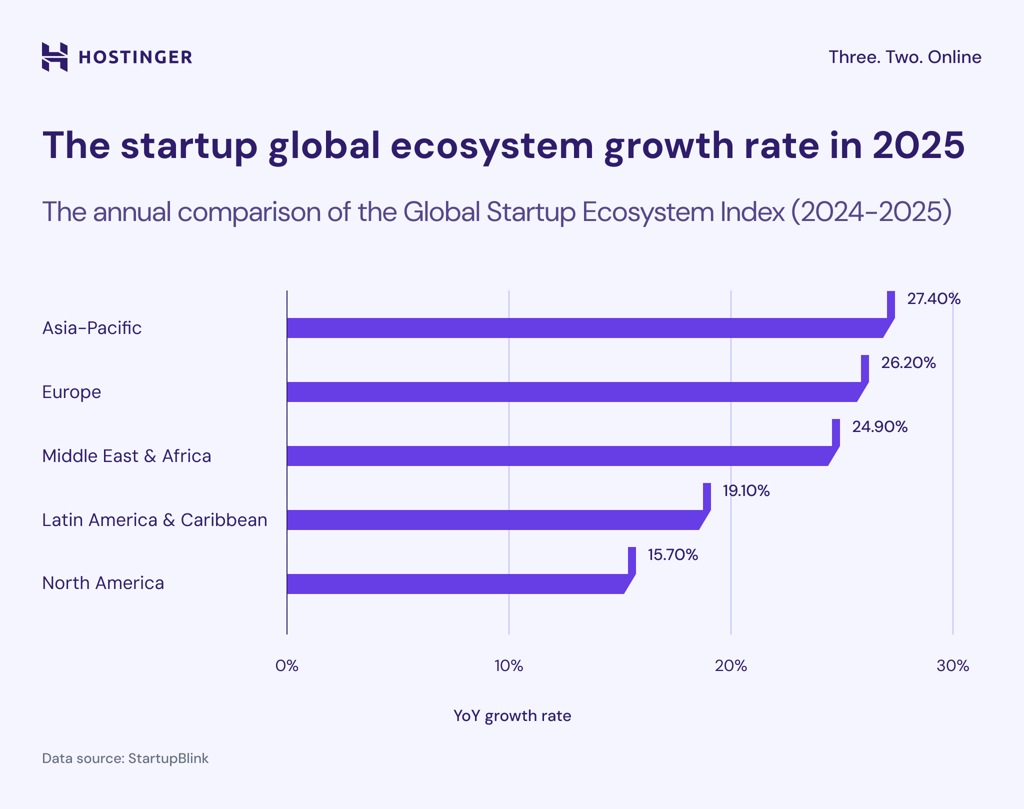
The Asia-Pacific region is the fastest-growing startup ecosystem in the world with a rate of 27.4% year over year, according to a StartupBlink report. North America had the lowest growth rate in this regard among all regions at 15.7%.
Entrepreneur demographics breakdown
Most new companies are created by women and young people. Although the majority of entrepreneurs have higher education degrees, some groups face social and structural barriers.
6. Gender gap in entrepreneurship increases in high-income countries
In most countries, the rate of men starting businesses is higher than that of women. Of the 51 economies analyzed, in 14 of them (27%) males outnumber females in early-stage entrepreneurship by 5% or more. Nine of these 14 countries enjoy high levels of income.
7. Nearly half of economies lack adequate support for women entrepreneurs
In 49% of countries, women lack the basic resources to start a business. According to the GEM report, in 25 out of the 51 economies analyzed, women’s relative access to resources is acknowledged as less than sufficient. This metric highlights the systemic barriers that persist despite global progress in gender equality.
8. Younger adults are leading new business creation across 80% of economies
Young entrepreneurs lead the rate of business creation in 42 out of 51 economies (80% of the countries studied). The most significant rate difference between younger and older adults engaged in the early stages of new business creation is in Canada (36% versus 20%).
9. About 62% of entrepreneurs hold a bachelor’s degree
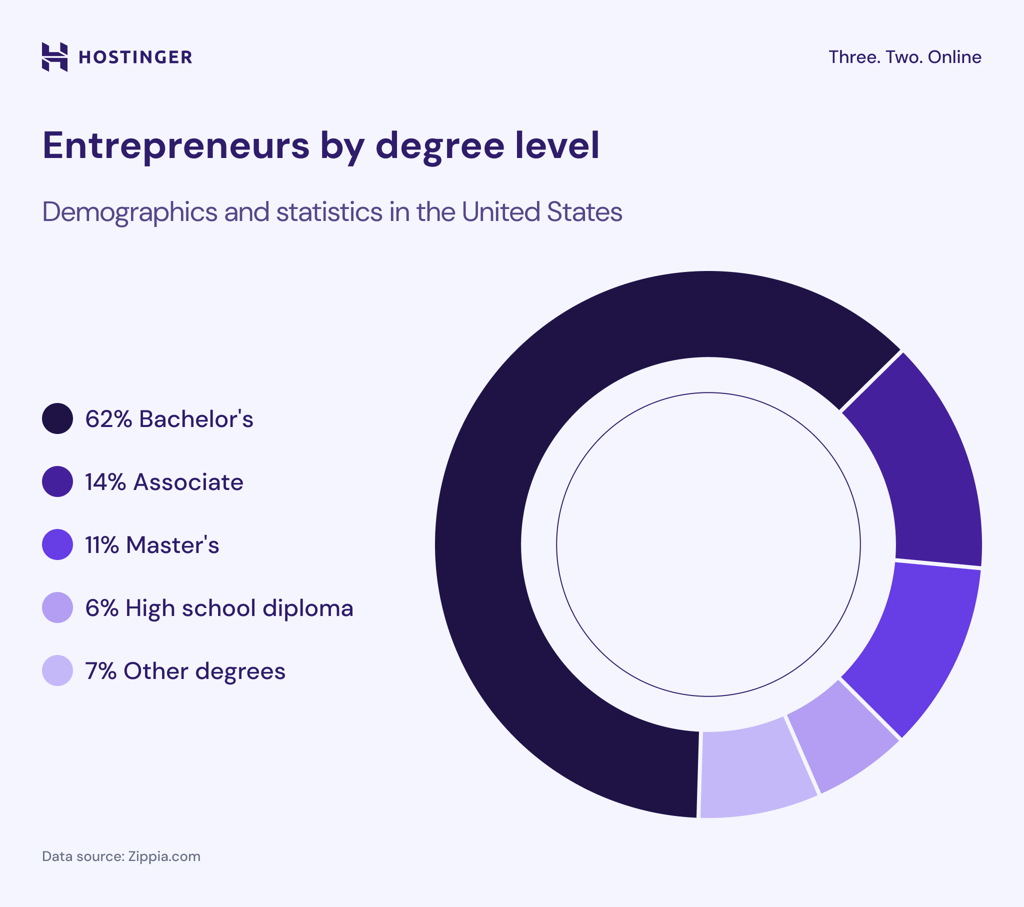
Six out of every ten entrepreneurs have undergraduate degrees, highlighting the role of higher education in fostering creativity and innovation.
10. Entrepreneurs who prioritize personal time are more likely to succeed
More than half of 2,000 small business owners say that spending evenings with family and keeping weekends free is essential to their success. However, most find it difficult to disconnect during their time off. Only 28% turn off their phones or laptops after working hours.
Industry-specific entrepreneurship statistics
New businesses don’t always succeed. A company’s chance of surviving one, two, or ten years depends on its managerial skills, type of audience, and product focus, among many other factors.
11. Three out of four new businesses are consumer or business services
Starting a business is never easy, but data shows that consumer and business services account for 75% of new business activity worldwide. In low-income economies, entrepreneurs often launch small consumer-focused businesses, such as hardware stores or hair salons. In high-income countries, small business founders are more likely to pursue opportunities in both consumer and business services, such as accounting or consulting.
12. More than 30% of entrepreneurs hold jobs in the retail, manufacturing, and professional industries
Entrepreneurs often have to work for another company during the startup phase. The most common industries for entrepreneurs holding a job are retail (12%), manufacturing (9%), and professional services (9%).
13. SaaS continues to dominate startup models across tech industries
Software as a service (SaaS) business is thriving thanks to new AI-powered application development tools. US-based SaaS companies are serving more than 14 billion users (almost double the world’s population). The global SaaS market is forecast to reach $1.25 trillion by 2034.
14. Service-based businesses are more likely to survive than product-based ones
New companies that focus on services rather than just a product are more than twice as likely to survive: 41% of new service-based businesses remained afloat against 19% of product-based ones. There is a better chance of keeping a small business running by offering unique services with a clear niche audience than fighting for a spot in a crowded market with a broader audience.
Entrepreneurship funding and financial insights
‘Funding a new business can involve several economic and social challenges. Entrepreneurs must include clear strategies to get through the initial growth period as well as to take care of both expected and unexpected financial obstacles.
15. In the US, the average small business loan amount is $437K
The Small Business Administration’s latest stats (2024) indicate that the average loan is nearly half a million dollars ($437K). Banks and other approved financial institutions fully approved 39% of business loans and partially approved another 30%.
16. Almost 80% of US solopreneurs use personal funds in response to financial challenges
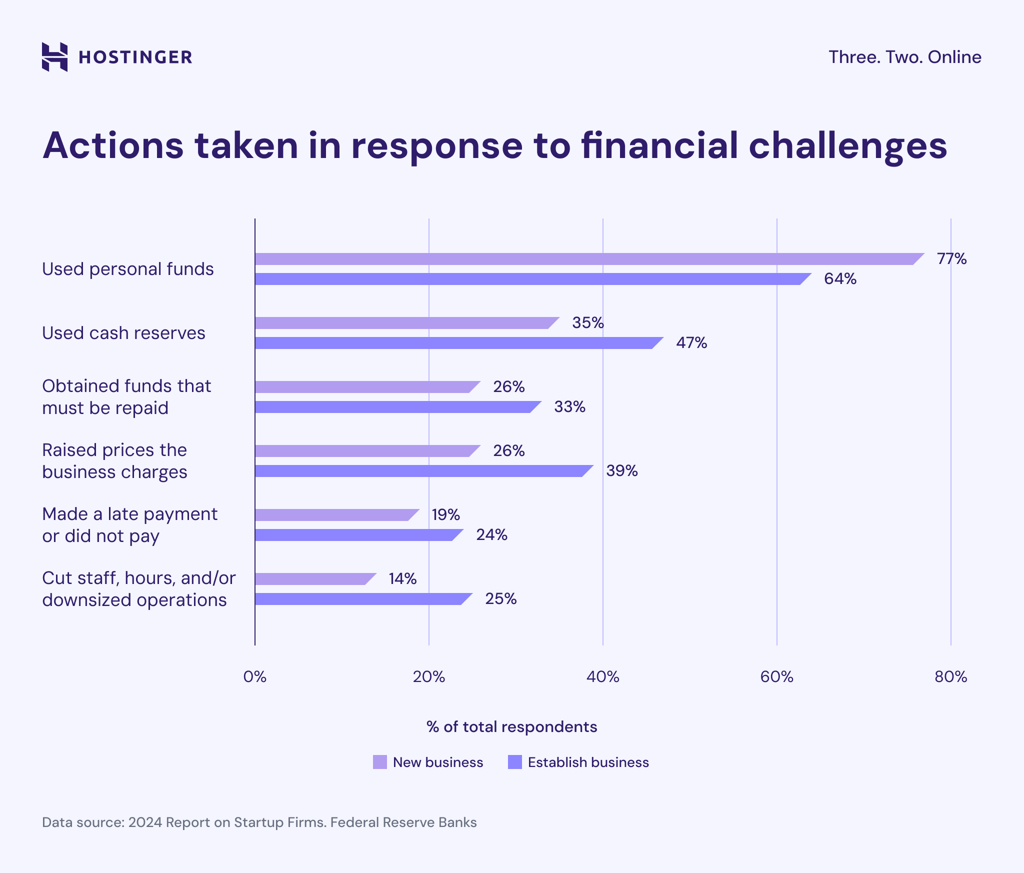
Besides considering loans for funding, 77% of US startups without employees rely on personal funds to finance their businesses in response to financial challenges. Among firms that applied to banks for financing, startup employers were less likely than more established employers to be fully approved.
17. Closing the entrepreneurship gender gap could fuel 20% global GDP growth
McKinsey, a global consulting firm, estimates that closing the gender gap could add $12 trillion to the global gross domestic product (GDP). According to the World Bank, this would represent a 20% increase. Achieving this growth would require sustained and coordinated efforts to give women better access to jobs and entrepreneurship opportunities.
18. Most economies report household income declines amid global uncertainty
The global economy suffered a period of recession after the COVID-19 pandemic, and in 2025, most countries are still recovering. According to the GEM report, 33 out of 51 economies have more people reporting a decrease in household income than an increase, which signals continued economic challenges for new business globally.
19. Investing in marketing doubles survival odds for small businesses
In hindsight, founders who had to close their businesses regret not investing enough in marketing and customer service. Forty-nine percent of surveyed business owners found success by spending on marketing campaigns (social media, advertising, PR) compared to the 20% whose businesses failed.
Technological impact on entrepreneurship
While founders and small business owners often use digital tools, they need to adopt newer technologies like artificial intelligence on a large and faster scale.
20. AI awareness remains low among entrepreneurs
Less than 30% of entrepreneurs in 73% of countries believe AI will be a vital business asset over the following three years. Entrepreneurs in the US, the UK, Canada, India, and Egypt tend to be more aware of AI than those in other countries.
Expert tip
AI is advancing faster than any other technological breakthrough. At Hostinger, we believe AI allows everyone to put ideas into motion while democratizing access to digital resources and entrepreneurial opportunities. We are already seeing new business owners who get AI involved in their small organizations, reaching unseen potential on product testing, productivity automation, or website development with our AI-powered tools.

Mantas Lukauskas
AI Tech Lead at Hostinger
21. Entrepreneurs are turning to digital tools to boost customer engagement and sales
According to the 2024/2025 GEM study, at least 70% of early-stage entrepreneurs in Brazil, Mexico, Guatemala, Qatar, the United Arab Emirates, and Luxembourg expect to boost customer engagement and sales with digital tools. The rest of the countries (45 out of 51) reach a lower rate between 20% and 69%.
22. Ecommerce opens global markets to entrepreneurs, reaching 2.77 billion shoppers by 2025
More opportunities for new businesses to sell products or services online lie ahead. Ecommerce will reach 3.9 billion people in 2029, according to 2025 statistics. That means a 49% exponential growth in shoppers compared to 2025 (2.77 billion).
23. AI levels the playing field for skill development among underserved entrepreneurs
The latest academic research on AI and entrepreneurship identifies five benefits of this new tech:
- AI offers the potential to enhance overall performance in complex work tasks.
- It can help to improve the quality of output among lower performers.
- It can help identify broad market possibilities and capitalize on diverse products and services.
- It can bridge literacy gaps and enhance skills development.
- It can simplify complex tasks.
Entrepreneurship challenges and risks
Building your own business is inherently a risky endeavor, and it is fraught with challenges, particularly in the current global economic climate. This is often enough to discourage entrepreneurship altogether.
24. Fear of failure stops 40% of potential entrepreneurs from acting on opportunities
For at least 40% of potential new business owners, the fear of failure stops them from becoming one. Entrepreneurs are significantly more likely to have the following traits: willingness to bear risks, openness to experience, belief in their ability to control their future, and extraversion. However, sharing those characteristics doesn’t guarantee success.
25. In most economies, one-third of entrepreneurs plan not to hire for five years
In 72% of countries, at least one out of every three new entrepreneurs plans to employ no new workers in the following five years. To clarify, this means they aim to continue operating as solopreneurs or with the workforce they started with. The highest proportion of new business owners with no expectation to hire – two-thirds – is in Spain, Sweden, Israel, Germany, and Kazakhstan.
26. Entrepreneurial ecosystems rated insufficient by local experts in 70% of economies
According to the GEM study, most economies (70%) do not offer a well-structured ecosystem for small businesses to thrive – experts in these countries argue that conditions are insufficient.
27. Inflation tops list of challenges entrepreneurs face, affecting 22%
Inflation is the biggest challenge for new business owners or founders. Twenty-two percent of entrepreneurs are affected by rising prices.
Entrepreneurship trends
What matters to entrepreneurs? New and established founders consider social media, social and environmental sustainability, and innovation the main prerequisites for growth.
28. More than half of entrepreneurs prioritize sustainability over profit with women leading the shift
In 78% of economies, a majority of entrepreneurs value social and environmental sustainability over the accumulation of profit. Women in charge of small businesses in high and middle-income countries are leading this trend by driving this shift and by reporting their actions.
29. New business registrations in the US doubled
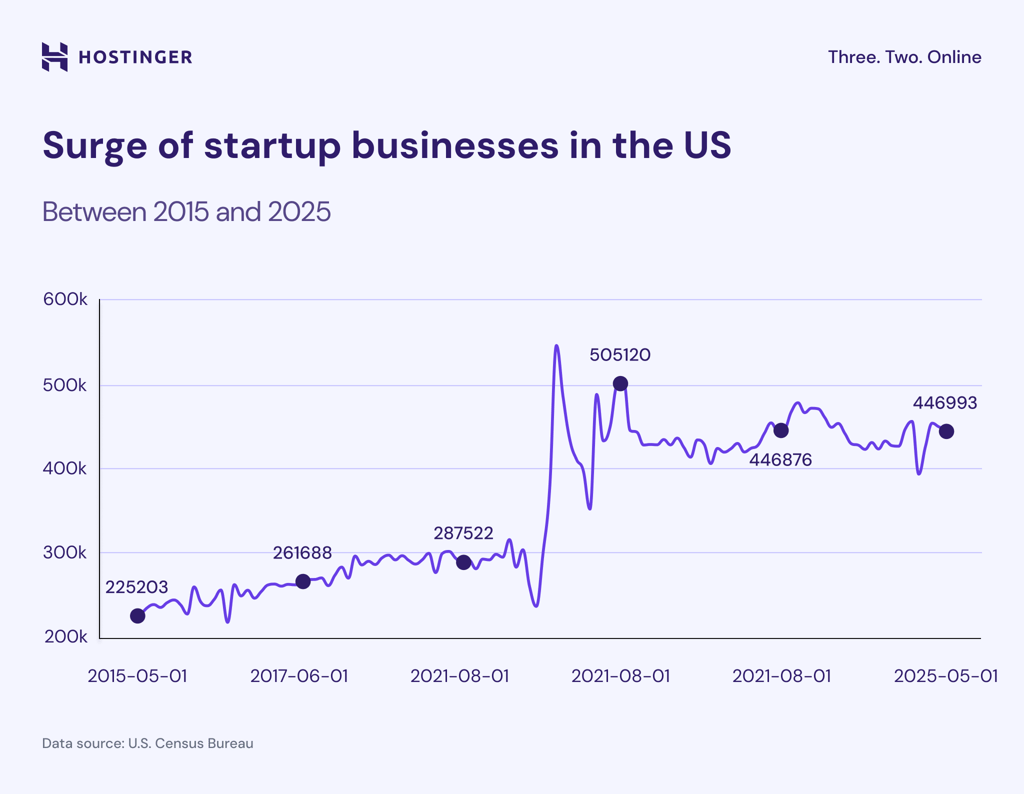
According to the US Census Bureau, the number of new business registrations has surpassed 400,000 per month since late 2020. Before the COVID-19 pandemic, the average number of business registrations barely reached 300,000.
30. Around 65% of new startups fail during the first 10 years
Almost two out of three new businesses will stop operating before the 10-year mark. This rate of failure grows with time. 10% of new startups fail within the first year, and 20% cease operations within two years.
31. Social media dominates digital marketing strategies
Entrepreneurs need to discover ways to reach their target markets in order to survive and prosper. As reported in social commerce statistics, 82% of consumers use social media platforms to discover and research products, making it the most used marketing strategy in 2025.
32. Almost 70% of SaaS companies use AI to enhance customer experience
New and existing SaaS companies are leveraging AI to deliver a better customer experience, with a clear focus on hyper-personalization. This technology is helping to analyze customer behavior and preferences to provide custom recommendations.
33. AI reshapes entrepreneurship by driving automation, innovation, and global growth
AI will contribute over $15.7 trillion to the global economy by the end of 2023. New businesses using AI are increasing by the day: in 2024, there were more than 90,000 companies worldwide that use AI in some way. Along with that trend, new jobs will emerge: AI is expected to create 133 million new vacancies by 2030.
The future of entrepreneurship
People who turn ideas into products or services are the driving force behind most economies. Entrepreneurs play a vital role in both developed and developing countries. They contribute significantly to investment and job creation.
New businesses face diverse challenges: inflation, gender inequality and other social issues, insufficient support, lack of investment, and environmental crises.
The adoption of AI and other digital tools is crucial for entrepreneurs to keep up in competitive markets. Not all business owners are aware of how to use new technologies, but most intend to adapt.
Sources
- PennState Social Science Research Institute
- Gitnux
- Entrepenerd
- Zippia
- Global Entrepreneurship Monitor
- Xero
- World Economic Forum
- IZA World of Labor
- Entrepreneur
- Verified Market Reports
- Global Startup Ecosystem Index 2025
- Small Business Administration
- Fed Small Business
Statistics FAQ
How many entrepreneurs are there in the US?
There are 34 million entrepreneurs in the US by 2025, according to the latest report from the Small Business Administration. At a national level, the number of new business registrations surpasses 400,000 per month, a rate that has doubled since the pandemic. Companies with less than 500 employees provide jobs for around 41% of US private-sector workers.
What percentage of new businesses survive longer than 10 years?
Thirty-five percent of businesses manage to continue operating after 10 years. The hard truth is that almost two out of three businesses fail within 10 years. Ten percent of new startups fail within the first year.
What percentage of entrepreneurs are successful?
Overall, 10% to 20% of new businesses reach some measure of success – some define success by maintaining operations over a period of time, others by revenue targets. Depending on the type of business, founders might face multiple stages of funding or scaling up that can also define success.
This article is a localized version of 33 entrepreneurship statistics in 2026: Global trends, challenges & insights, originally published in English.

Ricardo is a data journalist and visualization expert with over seven years of experience uncovering insights through data storytelling. His work focuses on data exploration, geospatial analysis, and interactive visualizations, helping audiences understand complex information through compelling narratives. His projects have been featured in Statista, Forbes, La Nación, among others. When he’s not analyzing datasets, Ricardo enjoys brewing specialty coffee, watching sports, and reading fiction. Follow him on LinkedIn or check his Portfolio to see his latest work.