How much do affiliate marketers make?
Apr 27, 2026
/
By Jordana A.
/
7 min Read

The affiliate marketing industry shows no signs of slowing anytime soon. With a 10% yearly growth, we’ll likely see a growth of up to $27.78 billion by 2027.
When done right, it’s possible to earn around $8,000/month. This figure can grow as you gain more experience and build your audience.
Curious about how profitable affiliate marketing is? Keep reading as we uncover everything you need to know about affiliate marketing revenue ‒ from average earnings to maximizing your revenue.
How do affiliate marketers make money?
Affiliate marketing is a performance-based business model where individuals, known as affiliates, earn commissions by promoting products or services from companies.
After joining an affiliate program, affiliates receive a unique link to track their referrals. They then promote products or services using their chosen platform ‒ blogs, social media, YouTube, or email newsletters.
When someone clicks the affiliate link and completes a purchase, the affiliate earns a commission, usually a percentage of the sale or a fixed amount per transaction (PPS). Some companies also pay for clicks (PPC) or leads (PPL), even if no purchase is made.
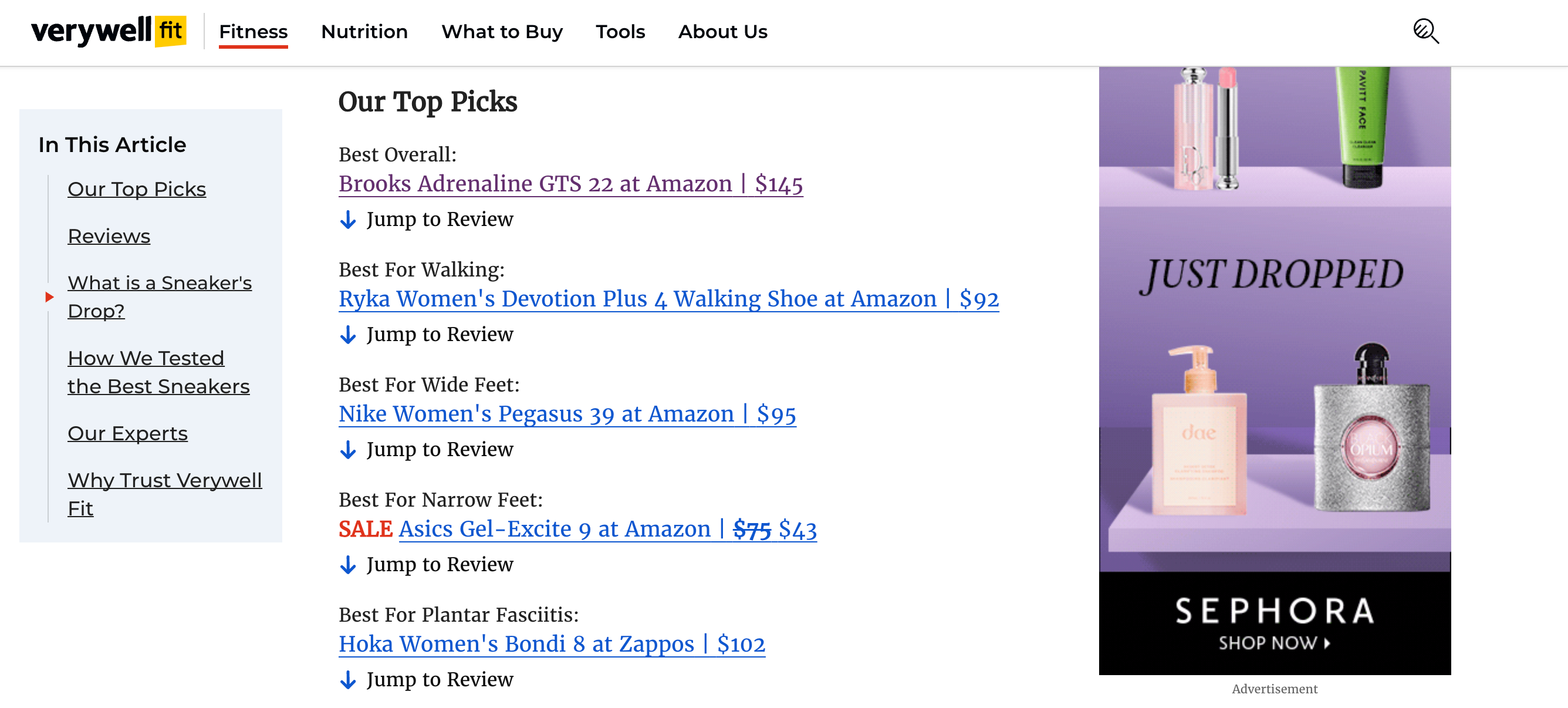
For example, Verywell Fit features several affiliate links to Amazon products in a blog post about the best sneakers. If a reader buys a pair of $145 running shoes through their link, and the affiliate marketing program offers a 4% commission for that product type, the affiliate earns $5.8.
Affiliate platforms use tracking cookies to make sure affiliates get credit for purchases made within a set period (for example, 30 days). Once you reach the minimum payout amount, you can request your earnings based on the platform’s payout schedule.
Read our article on affiliate marketing to learn how it works, its commission structures, and how to succeed as an affiliate marketer.
How much do affiliate marketers make?
The short answer: it varies.
According to the data of a popular affiliate tracking platform, FirstPromoter, when done right, affiliate marketers earn up to $8,000/month. On the other hand, Influencer Marketing Hub reports their respondents make a monthly average of $2,501.
The big difference comes down to who was surveyed in the affiliate marketing statistics. So, instead of just focusing on the averages, we dig deeper into how earnings vary across three categories ‒ experience, niche, and platform.
Affiliate marketer’s earnings based on experience
Niall Roche from AuthorityHacker breaks down affiliate marketing earnings by experience level:
- Beginner – $0 to $1,000 per month.
- Intermediate ‒ $1,000 to $10,000 per month.
- Advanced – 10,000 to $100,000 per month.
- Super affiliate – $100,000+ per month.
Beginners are usually in their first year of affiliate marketing, spending time learning the basics and building their platforms. Most reach the intermediate level within one to three years as they develop solid strategies to grow their audience. Reaching advanced-level income usually takes three to five years, while hitting the super affiliate level requires even more time and work.
Many success stories from various affiliate marketing websites support this. NerdWallet made $161.9 million in 2024 ‒ 15 years after its launch. Pat Flynn from Smart Passive Income earned over $224,000 in 2016 by promoting his book’s affiliate link after eight years of building his brand.
Of course, experience alone doesn’t guarantee higher earnings, which brings us to the next category.
Affiliate marketer’s earnings based on niche
Some affiliate marketing niches are considered profitable if they meet at least one of these criteria: high commission rates, a large customer base, or low competition.
Retail products, for example, might be low-value, but the high demand allows affiliates to make frequent sales. On the other hand, travel offers higher commission rates because the products are more expensive, even if sales occur less often.
Meanwhile, unique and luxury niches stand out because there’s less competition. This helps attract loyal customers while earning more from fewer sales.
We’ve written a separate article about the best affiliate marketing niches based on these parameters. Here’s a table of average commission rates from popular affiliate programs in each niche, along with average monthly revenues from AuthorityHacker’s stats.
| Niche | Average commission rates | Average monthly revenue |
| Software | 10-70% | $5,967 |
| Personal finance and investment | 20-40% | $9,296 |
| Health and wellness | 10-50% | $7,194 |
| eLearning | 15-30% | $15,551 |
| Travel | 10-15% | $13,847 |
| Beauty | 10-30% | $12,475 |
| Gadgets and electronics | 5-20% | $7,418 |
| Home improvement | 2-10% | $5,095 |
| Pet care | 2-20% | $920 |
| Sustainable products | 2-10% | $555 |
When estimating potential revenue, consider the niche’s product price range and whether companies offer subscription-based pricing or charge a one-time payment. Keep in mind that some companies pay commissions on subscription sales only for the first purchase instead of monthly.
Affiliate marketer’s earnings based on platform
A platform here means the channel you use to promote affiliate products or services and earn revenue. You can either join an affiliate network (a platform that manages multiple programs) or sign up for an affiliate program directly with a specific company.
Each affiliate program has its own commission structure, so the amount you make can vary even within the same niche.
Here are some of the best affiliate marketing programs in different niches:
- Amazon Associates. Despite its low commission rates (1-20% per sale), its strong brand authority helps drive sales across various price ranges.
- Fiverr Affiliates. Those with strong networking skills can make 25-70% on first orders and 10% on future ones.
- Hostinger Affiliate Program. We offer a 40% commission rate on web hosting sales without a sign-up fee.
- GetResponse Affiliate Program. It has two commission models ‒ a recurring model with up to 50% monthly commissions and a bounty model paying $100-150 per sale.
- Teachable Affiliate Partner Program. This eLearning affiliate program offers 30% recurring commissions for a year, averaging $450/month.
Factors that affect affiliate’s earnings
it’s worth highlighting that affiliate marketing income usually depends on a combination of these key factors:
- Program commission rate. Higher commissions mean more money per sale. Recurring commissions (like subscriptions) can offer more long-term income over one-time payouts.
- Niche selection. Profitable niches with high demand, high-priced products, or low competition create better opportunities to drive sales.
- Affiliate channel. The platform you use affects how effectively you reach and engage your audience.
- Traffic quality and volume. The more people see your affiliate content, the more potential sales you can make. Quality traffic (visitors who are likely to convert) is also important for driving even more sales.
- Conversion rates. Affiliate marketers who can effectively turn leads into buyers through persuasive content and strong calls to action tend to succeed.
- Experience and expertise. Knowledge of marketing strategies, search engine optimization (SEO), and audience engagement is key for creating multiple income streams and maximizing your affiliate marketing efforts.
- Trends. Sales often spike or dip depending on seasonal demand, trending products, or big events like Black Friday or the holiday season. Knowing the right timing for your affiliate marketing campaigns can make a big difference in your revenue.
How to maximize your affiliate earnings
By now, you know the earning potential of affiliate marketing. Here’s what you can do to become a successful affiliate marketer and boost your average earnings.
1. Choose the right affiliate programs
One of the most common mistakes many affiliate marketers make when looking for a program to join is focusing only on its commission. While looking for competitive rates is important, there are other factors that you should pay attention to, such as:
- Minimum payout threshold. Many affiliate programs require you to earn before you can request a payout. A lower threshold can help you access your revenue sooner.
- Payout schedule and methods. Check how often payouts occur and whether the program supports your preferred method of payment (PayPal, bank transfer, or others).
- Cookie duration. Affiliate programs use cookies to track users’ activity and determine whether their action (usually purchasing or signing up for a newsletter) is credited to you. A longer cookie duration means you have a higher chance of earning a commission.
- Program policies. Check the rules on payment terms, promotional methods, and what’s not allowed to avoid any issues that can jeopardize your account.
- Support and resources. Affiliate programs that provide up-to-date marketing materials and easy access to support want you to succeed, too.
- Company reputation. Choosing a program that aligns with your values will make your marketing efforts more genuine and easier to execute.
2. Create high-quality content for your selected niche
Content is key to communicating your product or service, building trust, and influencing buying decisions. When paired with the best SEO practices, it helps your brand climb the search engine results pages, driving more traffic to your chosen platform.
Speaking of platforms, you have many options to choose from ‒ blogs, YouTube, and social media, to name a few. Social media is great for getting started easily, while YouTube is better for video-focused content marketing.
For better audience reach, consider creating your own website. Don’t worry ‒ Hostinger’s Managed WordPress hosting plans (Business and Cloud) come with AI Website Builder for WordPress, making the setup process super easy even for beginners.
And if you decide to join Amazon Associates, our Amazon Affiliate Connector WordPress plugin can help you easily display affiliate links in various formats.

Check out our tutorial on writing SEO-friendly content to shape your content strategy. We also compiled the best affiliate marketing websites for inspiration.
3. Improve your conversion rates
One way to check the effectiveness of your affiliate marketing campaigns is with earnings per click (EPC). This metric measures how much you earn each time someone clicks on your affiliate link.
We covered EPC and ways to improve it in detail in a separate tutorial. To summarize, here are some ways to improve your website for higher conversion rates:
- Place your affiliate link strategically and avoid overwhelming visitors with too many of them.
- Use elements like floating bars, countdown timers, and color psychology to attract attention and create a sense of urgency to take action.
- Set up exit intent pop-ups to recapture visitors’ attention and turn them into sales.
- Use affiliate marketing tools to track campaign performance and identify issues or opportunities.
If you want to see these strategies applied end-to-end — from creating affiliate links to actually getting them clicked, this short walkthrough covers the full process:


4. Build a relationship with your audience
At the end of the day, it’s your audience who will make or break your affiliate career. Building a strong relationship with your audience helps you earn their trust and loyalty, increasing the chances they’ll click your links and make purchases.
With content marketing, it’s crucial to write with your target audience in mind. This means not overstuffing your content with affiliate links and calls to action. Instead, focus on offering real value through your content and the affiliate products or services you promote.
You can also encourage visitors to keep returning to your content by offering coupons and sneak peeks of upcoming affiliate product launches. Many affiliate marketers adopt this strategy with email newsletters and social media posts ‒ learn how to create your own email newsletter from our tutorial.
Last but not least, maintain communication with your audience. Engaging with them via social media and taking their feedback seriously will show that you have their best interest in mind.
Conclusion
The affiliate marketing industry today is bigger than ever. If you’re thinking about starting an affiliate business, now is the time to do it. With the right strategies and tactics, anyone has a shot at becoming the next successful affiliate marketer.
Ready to get started? We hope all the tips we included in this tutorial can help you get off on the right foot. Feel free to leave a comment if you have any questions. Good luck!
How much do affiliate marketers make FAQ
Can I make a living off affiliate marketing?
Absolutely! It will take some time to fine-tune your marketing campaign and grow your audience base. However, with experience and new connections, you could earn around $8,000 per month like many other affiliate marketers and make it your primary source of income.
Can a beginner make money from affiliate marketing?
Of course! Beginners with under three years of experience can make up to $1,000 per month. That said, your affiliate revenue will ultimately depend on various factors, such as niches, trends, and programs.
How quickly can I start earning in affiliate marketing?
Many affiliate marketers say it takes 6-12 months to start earning and turn their side gig into an active income stream. This business model significantly relies on having a strong audience base, so if you already have that, you can achieve financial success sooner.
This article is a localized version of How much do affiliate marketers make?, originally published in English.

Jordana is a Senior Content Writer with a background in Information Systems. She has over five years of experience in WordPress and is casually dabbling with PHP and MySQL. Her passion for writing and technology drives her to create tutorials for anyone wanting to build their online presence. Follow her on LinkedIn.