What is a freelancer? How a freelancer works
Mar 27, 2026
/
Ksenija
/
14 min Read

A freelancer is a self-employed professional who provides services to clients on a project or contract basis instead of working as a regular employee for one company.
Freelancers usually work with multiple clients, set their own rates, and control when and where they work.
This work model is common across industries like writing, design, development, marketing, and consulting.
A freelance writer might create blog posts for several brands, a developer might build websites for small businesses, and a designer might handle logos or product visuals for online stores.
In each case, the freelancer is hired to deliver a specific result, manage the client relationship, and get paid based on an agreed pricing model, such as hourly, per project, or on retainer.
Freelancing works through a simple cycle: offer a service, find clients, agree on the work, deliver it, and get paid. From there, the key differences come down to how freelancers operate day to day, what kinds of jobs they do, and how this independent work model compares with traditional employment.
Freelancer meaning and key characteristics
A freelancer is a self-employed professional who works with clients instead of being employed by one company.
You may also see freelancers referred to as independent contractors or self-employed professionals. These terms all describe the same basic setup: working independently and getting paid by clients for specific services or projects.
What makes a freelancer different is the way their work is structured.
Independence and work structure
Freelancers work independently from employers, which means they are not hired as part of a company’s regular staff.
In a traditional job, an employer controls the role. The company sets your schedule, assigns your tasks, defines your responsibilities, and pays you a fixed salary or wage. In freelancing, that structure is different. You are hired to complete specific work, but you decide how to do it.
This is the core of freelance independence. The client pays for a result, not for full control over your working day.
Flexibility in schedule and location
Freelancers control their working hours and location, so they can decide when and where they work.
In a regular role, the company usually sets the schedule and expects you to work from a specific place.
In freelancing, the focus is on the result. If you deliver the work on time and meet the agreed standard, you have more freedom to organize your day as you see fit.
That freedom applies to both schedule and location.
Schedule flexibility means you can decide when to work. You might work in the morning, late at night, or split your day into smaller blocks.
For instance, a freelance designer might spend the morning on client work, take a long break in the afternoon, and finish revisions in the evening. The client cares about the deadline and the quality of the work, not whether the work happened from 9 to 5.
Location flexibility means you are not tied to one office. Freelancers work from home, coworking spaces, cafes, or while traveling. As long as you have the tools you need and a stable internet connection, you can work from almost anywhere.
This flexibility is possible because most freelance work happens in digital work environments. Communication, collaboration, and delivery are handled online through tools such as:
- Video calls
- Chat apps
- Project management tools
- Cloud storage platforms
A writer can draft content in Google Docs, send it by email, and discuss feedback on a video call. A developer can build a website locally, push changes online, and update the client through a project board. A marketer can run campaigns, review analytics, and report results without ever being in the same room as the client.
That is why remote freelance work is so common. The internet gives freelancers access to clients far beyond their local area. You are not limited to companies in your city. You can work with people in other regions or countries if the work can be done digitally.
This flexibility is a real advantage, but it also requires discipline. When no one sets your hours for you, you need to manage your own time, stay organized, and make sure deadlines are still met.
Income structure and payment types
Freelancers earn money through paid work, but the way they get paid can vary from project to project.
Unlike a regular job, there is no fixed monthly salary. Income depends on the type of service, the pricing model, and the volume of work.
The three most common payment types are project-based, hourly, and retainers.
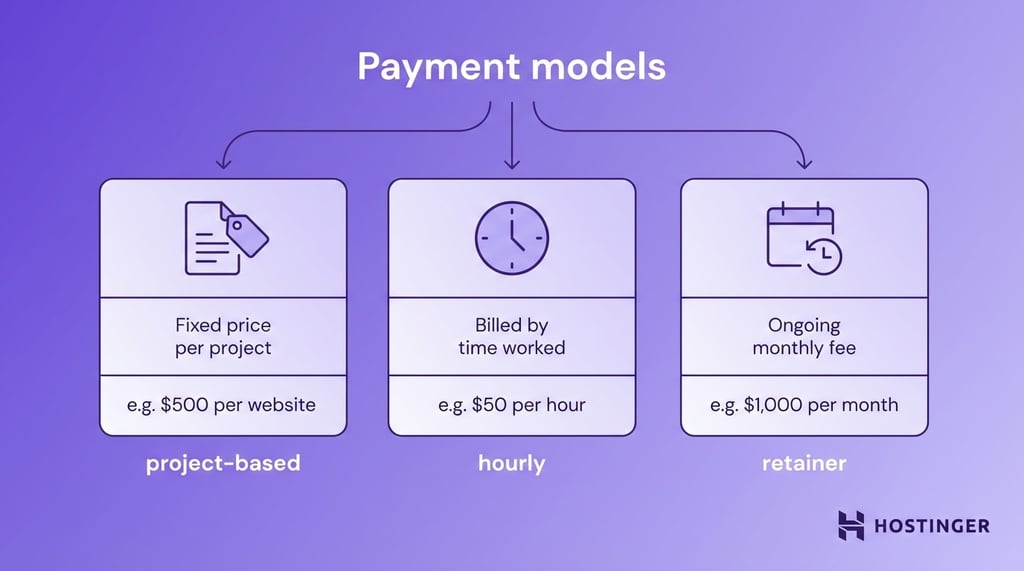
Project-based payment means you charge one fixed price for a defined piece of work.
For example, a designer might charge a fixed fee for a logo, or a writer might charge a set price for a blog article.
This model works well when:
- The deliverables are clear
- The timeline is defined
- The work is unlikely to change much
Hourly rates mean you charge for the time you spend working.
For example, a developer fixing technical issues may charge by the hour because the exact number of fixes is not known in advance. A consultant may also use hourly billing for calls, audits, or strategy sessions.
This model works well when:
- The scope is unclear
- The client needs ongoing adjustments
- The work depends on troubleshooting or support
Retainers mean a client pays you a regular amount, usually monthly, for ongoing work or ongoing access to your services.
For instance, a marketer may manage campaigns every month for the same client, or a copywriter may deliver a set number of articles each month under one agreement.
This model works well when:
- The client has recurring needs
- The relationship is long-term
- Both sides want more predictability
Freelance income is variable, which means it can go up or down from one month to the next. One month may include several well-paid projects. Another may be slower because a client paused work, a project ended, or no new jobs have come in yet.
Tax responsibilities and legal status
Freelancers are legally classified as self-employed, which means they are responsible for handling their own taxes and financial reporting.
In a traditional job, the employer calculates and deducts taxes from your salary before you receive it. In freelancing, that responsibility shifts to you. You receive the full payment from clients, and you must set aside part of it and pay taxes yourself.
This is called the self-employment tax, which includes income tax and, depending on the country, social contributions such as health insurance or pension payments.
In practical terms, this means you need to:
- Track all income from clients
- Keep records of business expenses
- Report earnings to your local tax authority
- Pay taxes on time
Your legal status as a freelancer also means you are operating as a business, even if you are working alone. Depending on your country, this may require registering as a sole trader, self-employed individual, or similar legal structure.
You may also need to:
- Issue invoices for your work
- Follow local business regulations
- Keep documentation for audits or reporting
In the United States, freelancers often receive a 1099 form, which reports how much a client has paid them during the year. This helps both the freelancer and the tax authority track income.
Outside the US, the exact form and process may differ, but the concept is the same. Clients report payments, and freelancers are responsible for declaring that income and paying the correct taxes.
This is why many freelancers use accounting tools or hire an accountant once their income grows.
Freelancer vs employee vs contractor
A freelancer, employee, and contractor differ in three main ways: the work relationship, who handles taxes, and how much control you have over the work.
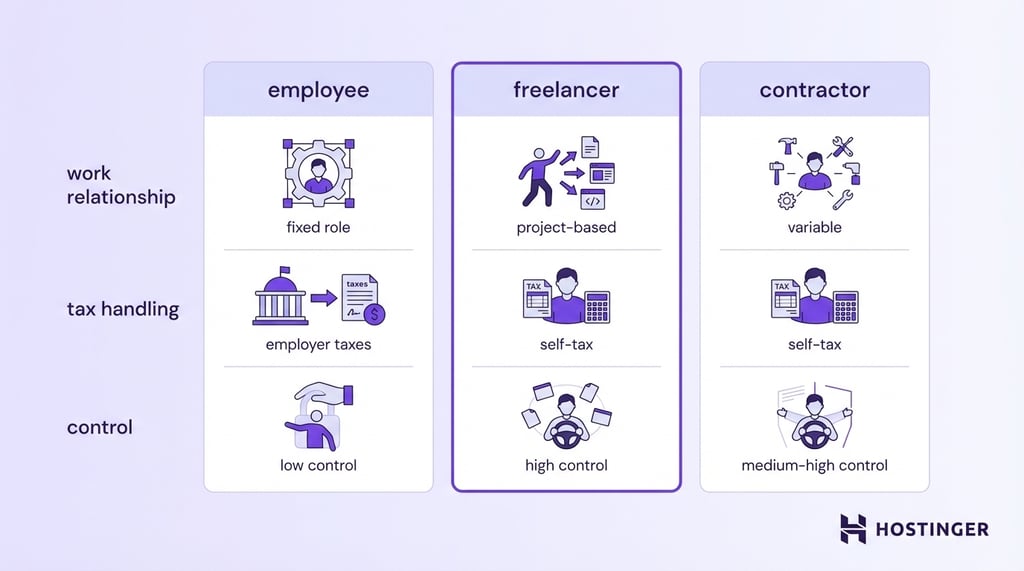
The easiest way to understand this is to look at how each setup actually works in practice.
First, the work relationship is different.
An employee works for one company under a long-term agreement. The company defines the role, assigns tasks, sets the schedule, and manages how the work is done. Even if the tasks change, the relationship stays in place.
A freelancer works with clients instead of being part of one company. You are hired for a specific service or project. Once the work is done, the relationship can end or continue based on a new agreement. You are not part of the client’s internal structure.
A contractor also works outside a standard employment setup, but the term is broader. Some contractors work with one company for a longer period, sometimes full-time hours, without becoming employees. Freelancers, in contrast, usually work with multiple clients at the same time.
Next, tax responsibility is handled differently.
As an employee, taxes are usually deducted automatically from your salary. The employer handles reporting and often contributes to social benefits depending on local laws.
As a freelancer, you receive the full payment from clients and handle taxes yourself. That means tracking income, keeping records, and paying taxes based on your local regulations.
Contractors usually follow the same model as freelancers. Since they are not employees, they are responsible for managing their own taxes, either as self-employed individuals or through a business structure.
Finally, control and autonomy set these roles apart.
A freelancer has full control over how the work is done. You choose your schedule, tools, and workflow. The client cares about the outcome, not your internal process.
An employee works within a company system. The employer sets working hours, tools, processes, and priorities. Even flexible roles still operate within company rules.
A contractor also has a high level of control, but it depends on the agreement. Some contractors work very independently, while others follow stricter guidelines if they are closely integrated with one company.
Freelance work model explained
Freelancing works as a service-based business model where a freelancer sells their skills directly to clients.
The key idea is simple. You are paid for solving a problem, completing a project, or providing ongoing support. This makes freelancing closer to running a small service business than having a traditional job.
In a regular job, the company brings in work, assigns tasks, and pays you through payroll. In freelancing, you handle all of that yourself. You need to find clients, agree on the work, deliver it, and make sure you get paid.
That means every freelance project follows the same basic cycle.
- First, you find a client who needs what you offer. This can happen through platforms, referrals, social media, or direct outreach.
- Next, you deliver the service. This is the work you were hired to do, based on what you agreed in advance. It could be a one-time task or ongoing support.
- Finally, you get paid. This part depends on how you structured the project. You might send an invoice, get paid through a platform, or use a payment tool.
Freelance platforms and marketplaces
Freelance platforms and marketplaces are websites that connect freelancers with clients who need services.
Their main role is client acquisition. Instead of finding work entirely on your own, you use these platforms to access clients who are already looking to hire.
Different platforms work in different ways, and that changes how you find clients.
Upwork is built around job listings. Clients post projects, describe what they need, and freelancers apply. You compete by sending proposals that explain your experience, approach, and price.
This gives you direct access to active demand, but it also means you are competing with many other freelancers for the same job.
Fiverr takes a different approach. Instead of applying to jobs, you create a service listing that explains what you offer.
Clients browse these listings and choose who to hire. In this case, your job is to present your service clearly so it is easy to understand and attractive to buyers.
Toptal works as a curated network rather than an open marketplace. Freelancers go through a screening process before joining, and clients are matched with pre-approved professionals.

This reduces competition but raises the entry barrier. It is usually more suitable for experienced freelancers with a strong track record.
If you are just starting, platforms can help you get your first projects, build a portfolio, and learn how clients think. They also handle parts of the process, such as contracts and payments, which makes things easier early on.
At the same time, they come with trade-offs. Competition is high, fees apply, and pricing is often lower at the beginning.
Freelance contracts and agreements
A freelance contract is a written agreement that defines the work to be done, when it must be delivered, and how payment will be made.
The most important part of a freelance contract is the scope of work. This explains exactly what you are being hired to do.
If the scope is clear, both sides know what is included and what is not.
For example, if you are hired to design a five-page website, the contract should say that clearly. Otherwise, a client may assume that extra pages, extra revisions, or extra features are included when they are not.
The next key part is the deadline. A contract specifies when the work is due and, if needed, when feedback or revisions should be submitted.
Then there are the payment terms. This part explains how much you will be paid, when payment is due, and how it will be made.
A freelance contract also serves as proof of what both parties agreed to. If a dispute happens, it gives you something concrete to point to.
It helps protect you if:
- A client asks for more work than agreed
- Payment is delayed or refused
- Deadlines are disputed
- The final deliverable is questioned
How freelancing works
Freelancing works through a repeatable workflow where you find a client, agree on the work, complete it, and get paid.
First, you choose a service to offer. You define what you actually sell in clear terms, such as blog writing, logo design, or website development.
Next, you create proof of your work. This can be a small portfolio, a few sample projects, or real examples if you already have experience. The goal is to show what you can do, not just describe it.
Then, you start finding clients. You apply to jobs, reach out to businesses, or use freelance platforms. At this stage, the focus is on starting conversations and getting your first opportunities.
After that, you pitch your service. You explain how you can help solve the client’s problem, focusing on the result you can provide.
Once the client is interested, you agree on the details. You define the scope, price, timeline, and expectations.
Then you do the work. You complete the task based on what was agreed, while communicating with the client and meeting deadlines.
After delivering the work, you handle feedback and revisions. The client may ask for small changes, which you complete based on the agreed terms. This is a normal part of the process.
Once the work is approved, you get paid. Payment may come through an invoice, a platform, or a recurring agreement. This step should already be defined before the work starts.
Finally, you maintain the relationship. If the client is satisfied, they may come back with more work. Over time, repeat clients reduce the need to constantly search for new projects.
That full cycle repeats again and again. At the beginning, it may feel slow and uncertain. With experience, it becomes a system you can improve, making it easier to find better clients, charge higher rates, and build more stable income.
Types of freelance jobs
Freelance jobs can be grouped by industry based on the type of service you offer, which makes it easier to understand where your skills fit.
Writing and content creation
This category focuses on creating and improving written content for businesses.
You work with words, but the goal is always practical: inform, persuade, or explain something clearly. Most clients need content for websites, blogs, or marketing.
Examples:
- A content writer who produces blog articles to drive traffic
- A copywriter who writes landing pages or email campaigns that help sell a product
Design and creative services
This category covers visual work that shapes how a brand looks and feels.
You help businesses present ideas visually, whether that is through branding, marketing materials, or digital interfaces.
Examples:
- A graphic designer who creates logos, ads, or social media visuals
- A UI designer who designs how a website or app looks and feels
Web development and IT
This category focuses on building, maintaining, and improving digital products. You work on the technical side of websites, applications, and systems.
Examples:
- A front-end developer who builds the visible part of a website
- A WordPress developer who creates or customizes websites for clients
Marketing and SEO
This category focuses on helping businesses get traffic, leads, and customers.
You do not just create content or assets. You focus on results like visibility, clicks, and conversions.
Examples:
- An SEO specialist who improves a website’s ranking in search engines
- A social media manager who plans posts and manages audience engagement
Finance and consulting
This category includes services based on expertise, analysis, and decision-making.
You help businesses manage money, plan strategy, or solve specific problems that require experience.
Examples:
- An accountant who manages financial records and reporting
- A business consultant who advises on growth, operations, or strategy
Benefits of freelancing
The main benefits of freelancing are flexibility, income potential, variety, independence, and long-term growth.
More control over your schedule
Freelancing gives you more control over when you work. You are not locked into one company’s fixed hours, so you can structure your day around your workload, energy, or other responsibilities.
For instance, if you work best early in the morning, you can finish your most important tasks before noon. If you need time during the day for family, study, or another job, you can plan your work around that.
More control over where you work
Freelancing often makes location more flexible because much of the work is done online. You can work from home, a coworking space, or anywhere with a reliable internet connection.
More income potential
Freelancing gives you more direct control over what you earn. In a regular job, pay usually changes slowly. In freelancing, you can increase income by raising your rates, improving your skills, specializing, or working with better clients.
More variety in the work
Freelancing exposes you to different clients, industries, and types of projects. That keeps the work from feeling too repetitive and helps you build experience faster.
In one month, you might write product pages for an online store, edit articles for a software company, and create email copy for a consultant. That kind of variety helps you learn what type of work you enjoy most.
More independence in decision-making
Freelancing gives you more say in the kind of work you take, the clients you accept, and the way you run your day. You are not waiting for a manager to assign every task or approve every step.
More room to grow over time
Freelancing can start as solo work, but it does not have to stay that way. Over time, you can turn it into a more stable business by building repeat clients, creating service packages, raising prices, or even hiring other people.
The biggest strength of freelancing is the ability to shape your work around the kind of life and career you want.
Challenges of freelancing
The biggest challenges of freelancing are inconsistent income, finding clients, working alone, and handling the legal and business side yourself.
Inconsistent income
Freelance work is not guaranteed every month. Projects end, clients pause work, and new jobs do not always appear right away.
The impact is financial uncertainty. One month may feel strong, and the next may feel slow even if your skills have not changed. That makes budgeting harder than it is in a regular job.
Client acquisition
Freelancers need to keep finding people who are willing to hire them. Work does not arrive automatically the way it does in a regular job.
A lot of time goes into pitching, networking, following up, and applying for work, especially at the beginning. That time is necessary, but it is unpaid.
Isolation
Freelancers often work alone and do not have the built-in social structure of an office or team.
Work can feel lonely, especially if you are used to daily conversations, feedback, and collaboration. It can also make motivation harder to maintain during quiet periods.
Legal and financial complexity
Freelancers are responsible for contracts, invoices, taxes, and recordkeeping. There is no employer or HR team handling those tasks for you.
Extra admin work is required and there is a higher risk of mistakes if you ignore the business side. Even simple projects can become stressful if the scope is unclear or payment terms are not documented.
Time management pressure
Freelancers must balance client work with everything else that keeps the business running.
Your day can become fragmented. You are not only doing the work. You are also answering emails, sending invoices, finding leads, and planning your schedule.
Freelancing best practices
The most important freelancing best practices are building a portfolio, choosing a clear niche, maintaining client relationships, and managing your finances properly.
One of the most useful things you can do is build a portfolio.
Your portfolio is proof of what you can do. Clients usually trust examples more than claims. Saying you are a good writer or designer is not enough on its own. Showing real work makes the decision easier for them.
If you are just starting, your portfolio does not need to be huge. A few strong samples are enough.
A writer can create two or three sample articles. A designer can show logo concepts or mock brand work. A developer can build a demo website. The goal is to make your skills visible.
Another strong practice is to specialize in a niche.
When you try to do everything for everyone, it becomes harder for clients to understand why they should hire you. Specializing makes your offer clearer and often makes your rates stronger.
For example, “freelance writer” is broad. “Freelance writer for SaaS companies” is much clearer. “Designer” is broad. “Designer for eCommerce brands” tells the client more right away.
You also need to maintain client relationships, not just finish projects.
A lot of freelance growth comes from repeat work, referrals, and long-term trust. That only happens when you stay professional after the first project. Reply on time, meet deadlines, communicate clearly, and make the process easy for the client.
Even small actions help here. You can follow up after a project ends, ask whether the client needs more help, or simply leave the experience on a positive note.
It is also important to manage your finances from the beginning.
Freelancing can feel flexible, but the money side needs structure. Track what you earn, record your expenses, send clear invoices, and keep track of which payments you are still waiting to receive. If you ignore this part, even good client work can turn into stress later.
A simple habit helps a lot: record every payment as soon as it comes in. That gives you a clear view of your income and makes taxes easier to handle later.
Freelancing works better when you treat it like a business, rather than a series of tasks.
Where can you find freelance jobs?
Freelancers usually find work through online platforms that connect them with clients who already need a service.
This is often the easiest place to start because the demand is already there. Instead of finding every client on your own, you use a platform where businesses post jobs or search for freelancers directly.
Three of the most popular freelancing websites are Upwork, Fiverr, and Toptal.
Freelancers also find clients outside of platforms by reaching out directly and building their own presence.
One common approach is direct outreach. This means contacting businesses that already need your service.
For example, if you see a company with a weak website, you can offer web design help. If a blog has poor content, you can offer writing services. You are not waiting for a job post. You are creating the opportunity.
Another approach is using LinkedIn and social media.
You can share your work, talk about your process, and connect with potential clients. Over time, this builds visibility. A client may discover your work through a post and reach out without you applying anywhere.
You can also create a simple personal website or portfolio.
This gives you a place to show your work, explain your services, and make it easy for clients to contact you. Instead of sending scattered links, you send one clear page that builds trust.
Tools like Hostinger Horizons make this easier. You can describe what you want to build, generate it without coding, and publish it in one place.
All of the tutorial content on this website is subject to Hostinger's rigorous editorial standards and values.

Ksenija is a digital marketing enthusiast with extensive expertise in content creation and website optimization. Specializing in WordPress, she enjoys writing about the platform’s nuances, from design to functionality, and sharing her insights with others. When she’s not perfecting her trade, you’ll find her on the local basketball court or at home enjoying a crime story. Follow her on LinkedIn.