14 tips to write SEO-friendly content
Mar 20, 2026
/
Ksenija
/
14 min Read

To write SEO-friendly content that drives organic traffic, you need to choose the right keywords, structure your content clearly, satisfy search intent immediately, and maintain technical and content quality over time. When these elements work together, your pages rank consistently and attract qualified visitors without paid promotion.
SEO-friendly content aligns two things from the start:
- What users are actually searching for
- How search engines evaluate relevance and quality
Keyword research determines what you target. Headings and structure signal relevance. Content depth and clarity determine whether readers stay. Technical optimization supports discoverability and performance. Getting these elements to work together is what separates content that ranks from content that resonates.
1. Research relevant keywords
Keyword research is one of the foundational practices of SEO. Keyword research starts with search intent. Before choosing a keyword, ask: What does the user want to achieve? Are they looking for a definition, a tutorial, a comparison, or a product recommendation?
For example, someone searching “what is intermittent fasting” wants a clear explanation. Someone searching for “best intermittent fasting schedule for beginners” expects a practical comparison with guidance on how to start. Your content must precisely match that expectation.
Next, evaluate competition. High-volume keywords usually attract intense competition. If tens of thousands of people search for “intermittent fasting” each month, established health websites, medical publishers, and fitness brands are likely competing for that term. That makes it harder for newer or smaller sites to appear on the first page.
Instead of targeting broad terms like “intermittent fasting,” narrow your focus. Look for more specific variations such as:
- “intermittent fasting schedule for women over 40”
- “16:8 intermittent fasting meal plan for beginners”
- “intermittent fasting results after 30 days”
These long-tail keywords attract more qualified traffic because they address specific concerns or situations.
Before committing to a keyword, analyze the first page of results:
- Are the top results dominated by large medical or fitness publications?
- Is the content highly detailed and difficult to outperform?
- Are there outdated articles, weak explanations, or missing examples you could improve upon?
If you identify gaps, such as unclear step-by-step guidance or generic advice without practical detail, that is your opportunity. If the results are consistently strong and comprehensive, refine your keyword further to narrow the angle.
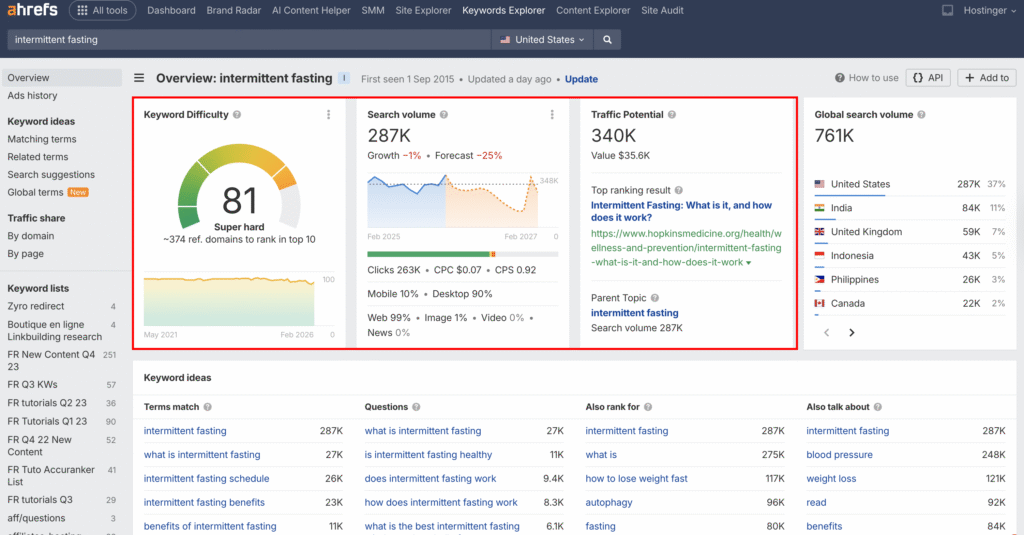
Finally, validate your decision with keyword research tools. Platforms such as Google Keyword Planner, Ahrefs, or Semrush help you assess:
- Search volume – The estimated number of times users search for a keyword each month. This shows whether there is enough demand to justify creating content around it.
- Keyword difficulty – An estimate of how hard it will be to rank on the first page. A higher score usually means stronger competitors and more authority required.
- Traffic potential – The estimated total traffic the top-ranking page receives from related keywords. This helps you understand whether the topic can rank for a broader cluster, not just one phrase.
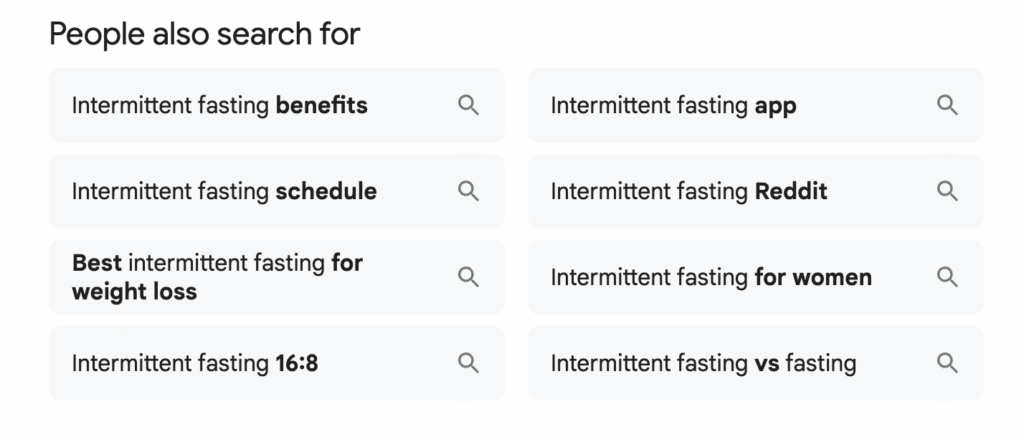
Google itself is also an SEO research tool. Review autocomplete suggestions, “People also search for” questions, and related searches at the bottom of the results page. These reveal how users naturally phrase their questions and what follow-up topics they expect you to cover.
The right keyword matches search intent, has realistic competition, and allows you to create content that is genuinely more useful than what already ranks. If you cannot clearly explain how your article will improve upon the top results, refine the keyword before you start writing.
2. Optimize titles and headings
Titles and headings tell both search engines and readers what your content is about. If they are unclear, overly generic, or poorly structured, your article becomes harder to understand and rank.
Start with your primary keyword. Include it naturally in the page title and at least one main heading.
For example, if your target keyword is “intermittent fasting schedule for beginners,” your title could be:
- “Intermittent fasting schedule for beginners: a simple step-by-step plan”
- “Best intermittent fasting schedule for beginners in 2026”
Avoid forcing the keyword into awkward phrasing. If the title sounds unnatural, rewrite it. Search engines evaluate context, not just exact matches.
Make your titles specific and intent-driven. Instead of vague headings like “Fasting basics,” use headings that reflect real search queries, such as:
- “What is the best intermittent fasting schedule for beginners?”
- “How to start intermittent fasting safely”
- “Common mistakes beginners make with intermittent fasting”
Headings that match real questions improve clarity and increase your chances of appearing in featured snippets or AI-generated summaries.
Use a logical heading hierarchy. Your H1 should define the main topic. H2s should break the article into core sections. Subsections should expand on those ideas in a structured way. Do not skip levels or use headings purely for visual styling.
Here is how that structure would look in practice:
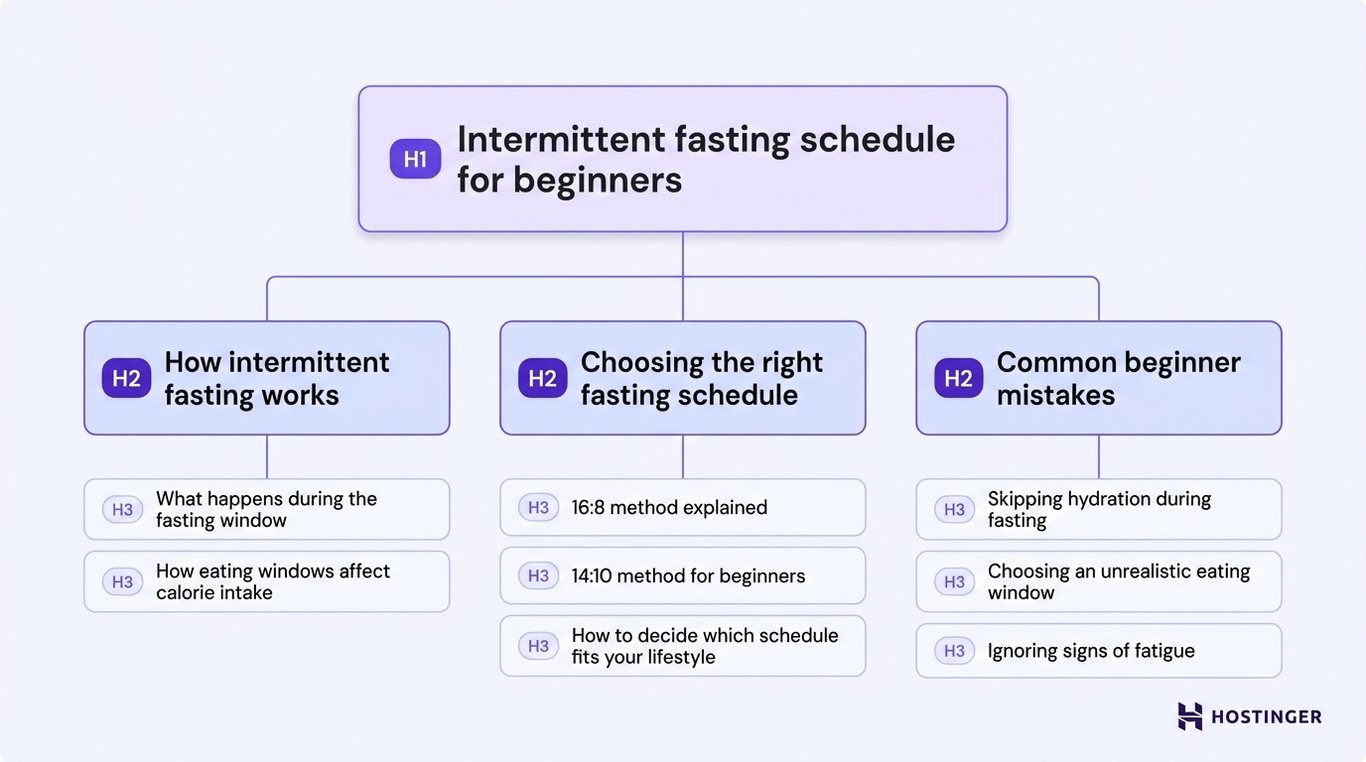
This structure shows clear progression. The H1 defines the topic. The H2 sections divide it into core themes. The H3s answer focused sub-questions within each theme.
Before publishing, scan only your headings. If they read like a logical outline of the full article, your hierarchy works. If they feel disorganized or repetitive, restructure them before editing the body text.
3. Write compelling meta descriptions
A meta description appears below your title in search results. Its purpose is to summarize the page clearly and persuade users that your content answers their query better than other results.
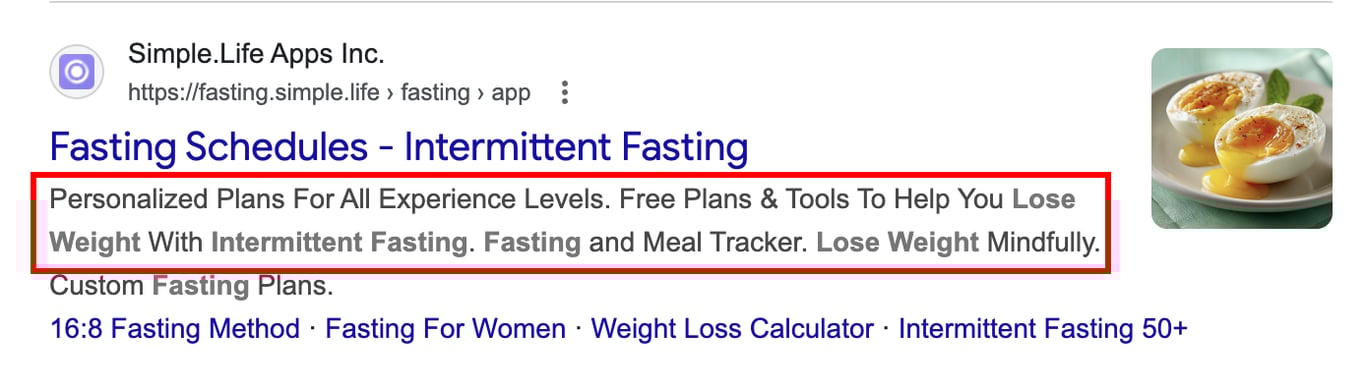
Start by including your primary keyword naturally. If someone searches for “intermittent fasting schedule for beginners,” your description should reflect that phrase or a close variation.
Keep it concise and informative. Aim for around 150–160 characters so the full description displays in most search results. Focus on what the page covers, who it is for, and how it benefits the reader.
Write in clear, direct language. Avoid vague promises like “transform your body fast.” Instead, highlight a specific outcome, such as helping beginners choose the right fasting window or avoid common errors.
Weak meta description: “Intermittent fasting schedule for beginners with fasting tips and beginner fasting advice.”
Strong meta description: “Discover a simple intermittent fasting schedule for beginners, including meal timing, common mistakes, and practical tips to start safely.”
4. Create high-quality, original content
High-quality content solves the searcher’s problem better than the pages already ranking. If your article does not add clarity, depth, or practical guidance, it will not outperform competitors.
In practice, that means:
- Explaining concepts more clearly than competing pages
- Updating outdated advice or examples
- Adding step-by-step guidance instead of general tips
- Addressing common beginner mistakes directly
If the top results are vague, be specific. If they are long but unfocused, be structured. Your goal is not to say something new. It is to say it better.
Relevance is non-negotiable. If someone searches for “intermittent fasting schedule for beginners,” they want a practical plan. They do not want a history lesson. Remove anything that does not help them start safely and confidently.
Next, structure your content so both readers and search engines can easily interpret it. Modern search engines evaluate how clearly concepts are defined and connected.
Follow these rules:
- Define terms immediately. If you mention “16:8 fasting,” explain it in one sentence: “The 16:8 method means fasting for 16 hours and eating within an 8-hour window each day.”
- Explain cause and effect. Do not write, “Intermittent fasting helps with weight management.” Write, “Limiting your eating window can reduce total calorie intake, which supports gradual weight loss.”
- Answer follow-up questions before readers leave. If you mention fasting windows, clarify what is allowed: “During fasting hours, you can drink water, black coffee, or unsweetened tea because they contain little to no calories.”
Every paragraph should do one job: define, explain, demonstrate, or guide. Delete filler sentences that do none of these.
Before publishing, run this quality check:
- Does this fully answer the search query?
- Is every key term clearly defined?
- Have I improved on what already ranks?
- Would a beginner understand this without searching again?
5. Answer the intent early
If you delay the main answer, you lose the reader. Search engines also deprioritize pages that do not quickly satisfy intent.
State the core answer immediately under each heading. Do not warm up with background or general context. If the heading is a question, answer it in the first one to three sentences.
For example, if your heading is:
“What is the best intermittent fasting schedule for beginners?”
Start with the conclusion:
“The 16:8 schedule is the best intermittent fasting schedule for most beginners because it is simple to follow and does not require skipping a full day of meals.”
Then expand. Explain how the 16:8 method works. Clarify who it suits. Mention realistic alternatives. Support the answer after you state it.
This structure does two things:
- Confirms relevance immediately
- Makes your content easier to extract for featured snippets and AI summaries
Avoid openings like:
- “There are many approaches to consider.”
- “Intermittent fasting has become popular in recent years.”
- “Before choosing a schedule, it is important to understand the basics.”
These delay the answer and weaken clarity. Use this rule instead: Answer first. Explain second. Expand third.
Before publishing, scan every H2 and H3. Read only the first paragraph under each. If it does not directly satisfy the heading, rewrite it.
6. Write for readability and engagement
Poor readability increases bounce rates and reduces time on page, which weakens search performance.
To prevent that, start with paragraph length. Keep paragraphs short, ideally two to four sentences. Large blocks of text discourage reading, especially on mobile. Short paragraphs create visual space and improve flow.
Next, structure information for scanning by:
- Breaking complex ideas into bullet points
- Using numbered lists for steps or processes
- Adding descriptive subheadings that guide progression
- Including visuals to clarify a concept
Language matters just as much as layout. Use simple, direct phrasing. Replace abstract language with concrete instruction.
Instead of: “Optimize your nutritional timing strategy for metabolic efficiency.” Write:
“Choose an eating window that fits your daily routine so you can follow it consistently.”
Tone also affects engagement. Write in a professional but direct voice. Address the reader when it improves clarity. Give specific actions they can take, not general advice.
End sections with direction. Tell the reader what to check, revise, or improve.
Before publishing, test your article on a smartphone. Scroll through it quickly. If it feels dense or difficult to skim, simplify it.
Pro Tip
Use readability checking tools like Hemingway Editor to identify long sentences and complex phrasing. If large sections are highlighted or the grade level is too high for your audience, shorten sentences and simplify your wording.
7. Use keyword variations
If your article keeps repeating “intermittent fasting schedule for beginners” without adding new information, it signals low-quality optimization and can quickly turn into keyword stuffing.
Keyword stuffing is the practice of repeating the same keyword unnaturally in an attempt to manipulate rankings. It reduces readability, weakens trust, and can trigger Google’s spam detection systems.
Instead, use natural variations of your primary keyword. If your target phrase is “intermittent fasting schedule for beginners,” you can include:
- Beginner intermittent fasting plan
- 16:8 fasting schedule
- Simple fasting routine for beginners
- How to start intermittent fasting safely
Move beyond just phrasing and focus on topical depth by explaining the real decisions behind the keyword.
Answer the practical questions a beginner must resolve before starting, such as:
- What is the fasting window, and how long should it be?
- What is the eating window, and when should it start?
- How does meal timing affect total calorie intake?
- What can someone drink during fasting hours?
- What mistakes cause beginners to quit?
- Who should avoid or modify this schedule for safety?
Pro Tip
Use a free keyword density tool, such as SE Ranking’s Keyword Density Checker, to scan your draft for keyword stuffing.
8. Cover the main entities
An entity is a clearly defined concept, method, system, or term related to your subject. In an article about an intermittent fasting schedule for beginners, key entities might include fasting windows, eating windows, calorie intake, hydration, 16:8 method, OMAD, insulin levels, and metabolic adaptation.
If you mention these terms without explaining them, your content remains shallow. To build topical depth, you must clearly define the main entities and show how they connect.
For example, instead of simply listing “16:8 fasting” as an option, explain what it means and why beginners often choose it. Clarify that it involves fasting for 16 hours and eating within an 8-hour window, and explain how that structure can make calorie control easier.
Covering entities means doing three things:
- Defining important concepts clearly.
- Explaining how they relate to the main topic.
- Showing how they influence each other.
For instance, your chosen fasting window affects meal timing. Meal timing influences calorie intake. Calorie intake affects weight management outcomes. When you explain these relationships, your article becomes more coherent and useful.
This improves more than “semantic relevance.” It increases ranking potential because search systems evaluate topical completeness. Pages that clearly define entities and connect them logically are easier to classify, compare, and rank.
9. Build authoritative signals
Authority signals help search engines and AI systems evaluate whether your content is trustworthy. Even if your article is well-written, it will struggle to perform if it lacks credibility indicators.
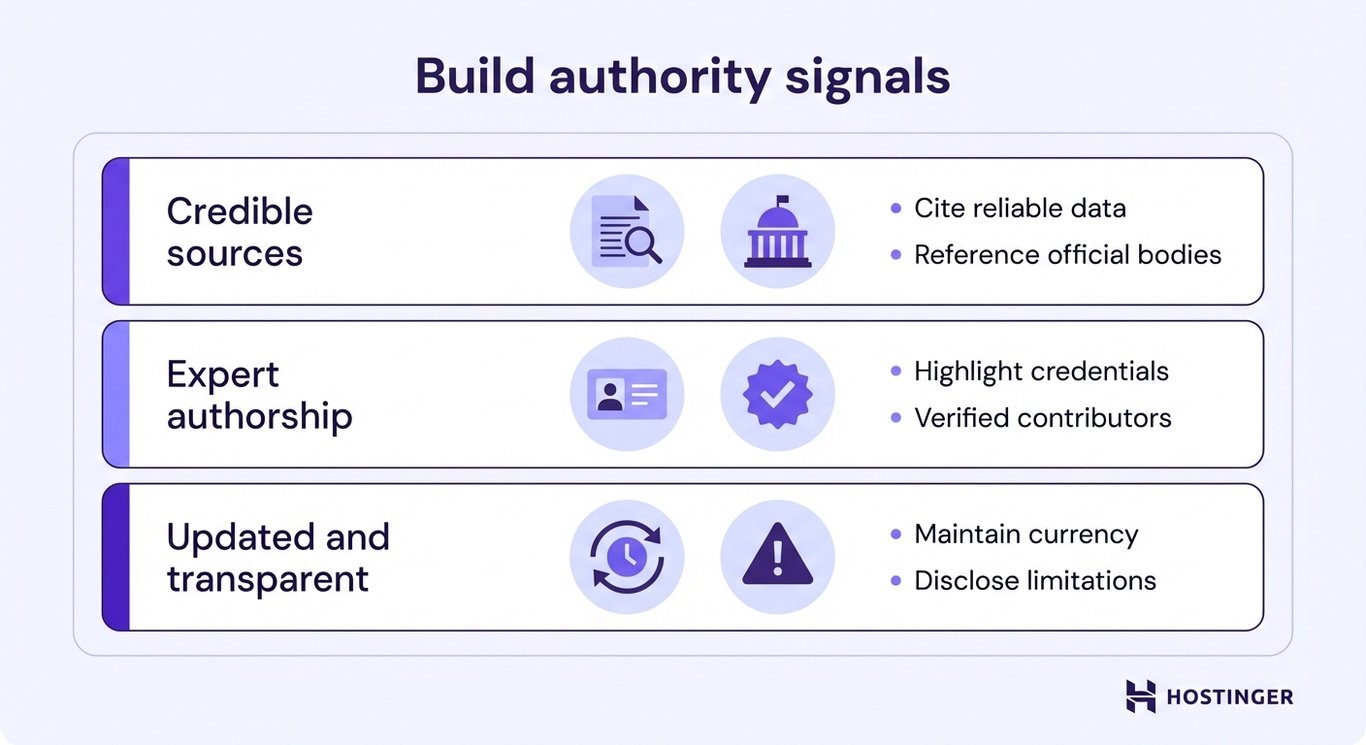
Start by citing credible sources where appropriate. If you reference health benefits, safety considerations, or physiological effects, support those claims with reliable medical or scientific organizations. Avoid vague phrases like “studies show” without identifying the source.
Use an authoritative author profile. If the article includes health advice, the author bio should reflect relevant expertise, qualifications, or documented experience. This signals accountability and transparency, which are important for AI-driven evaluation systems.
Add first-hand insights where possible. For example, instead of saying “Many beginners struggle with hunger,” clarify what commonly happens during the first week and how people typically adapt.
You can also strengthen authority by:
- Including updated information rather than outdated claims.
- Avoiding exaggerated promises or unsupported health benefits.
- Acknowledging limitations or risks where relevant.
10. Use internal and external links wisely
Links strengthen context and credibility when they are relevant and intentional. Used correctly, they help search engines understand your content and help readers explore topics in depth.
Start with external links. For example, if you reference research, statistics, or official definitions, link to the original study, government website, or established publication to show that your claims are verifiable.
Prioritize credible, verifiable sources such as:
- Government or educational websites for official data
- Recognized industry publications for trends or research
- Authoritative blogs with proven expertise
Avoid linking to low-quality or unrelated websites. If a link does not directly support a claim or improve understanding, remove it.
Next, use internal links to connect related pages on your website. Internal linking improves navigation and distributes authority across your site.
For example, if your article mentions fasting basics, link to a related guide such as:
- A detailed explanation of how intermittent fasting works
- A breakdown of the 16:8 method
- A guide on common intermittent fasting mistakes
Use descriptive anchor text. Instead of writing “click here,” write “16:8 intermittent fasting guide” or “how intermittent fasting works.” Clear anchor text tells users and search systems exactly what they will find on the linked page.
Internal links also help search engines map your content structure. When multiple articles link to a core guide, that page gains stronger topical relevance.
11. Optimize images with alt text
Alt text helps search engines understand your images and makes your content accessible to users who rely on screen readers. If your images are not described clearly, you lose search visibility and exclude part of your audience.
Follow these rules when optimizing images for alt text:
- Describe the image clearly and specifically
- Include the primary keyword only if it fits naturally
- Keep it concise, usually under 125 characters
- Skip decorative images or use empty alt text for purely visual elements
Alt text should explain what the image shows in plain language. Avoid vague descriptions like “fasting.” Instead, describe exactly what the image shows, such as “16:8 intermittent fasting schedule chart showing eating and fasting windows.”
12. Optimize content for mobile devices
Google evaluates the mobile version of your site first. If your content is hard to read or slow to load on a smartphone, your rankings will drop.
Start with formatting by following these rules:
- Keep paragraphs to two or three sentences
- Use clear subheadings to guide scanning
- Break steps and comparisons into bullet lists
- Avoid large text blocks that require excessive scrolling
Next, ensure your site uses a responsive design. Responsive design means your layout adapts automatically to different screen sizes. Text resizes, images scale correctly, and navigation works for touch interaction.
Test the mobile experience directly and confirm the following:
- The text is readable without zooming
- The buttons are large enough to tap comfortably
- The menu opens and closes smoothly
- Images fit the screen without breaking the layout
Complex menus, intrusive pop-ups, and tightly packed links create friction. Navigation should be simple. Make primary actions obvious and easy to access.
Speed matters even more on mobile because many users rely on slower connections. When pages load slowly, abandonment increases, and rankings decline.
Common mobile performance issues include:
- Large, uncompressed images
- Excessive JavaScript
- Too many third-party scripts
- Unoptimized fonts or heavy animations
If your desktop version performs well but your mobile version is slow or cluttered, Google will rank you based on the weaker experience.
➡️For a deeper breakdown with practical steps, read our complete tutorial on how to make your website mobile-friendly.
13. Create evergreen content
Evergreen content targets topics that remain relevant over time and continue attracting traffic long after publication. It answers recurring questions, not temporary trends.
Strong evergreen formats include:
- Definitions and beginner guides
- Step-by-step schedules
- Best practices and safety tips
- Common mistakes and solutions
For example, “What is the 16:8 intermittent fasting method?” can attract traffic for years. In contrast, “Intermittent fasting trends this month” loses relevance quickly.
Evergreen content also strengthens topical authority. When you build comprehensive resources around core subjects, you create structured coverage instead of isolated posts.
Before publishing a new article, apply this filter:
- Will this topic remain relevant in two years?
- Does it answer a recurring informational question?
- Can it serve as a core resource within your niche?
14. Review and update your content regularly
Search engines favor pages that remain accurate, complete, and aligned with current intent. Over time, statistics change, competitors improve, and search results evolve. A page that ranked well last year can lose visibility if it no longer meets expectations.
Start with content and SEO audit, and identify pages that:
- Lost rankings or organic traffic
- Contain outdated statistics or examples
- Target keywords with declining impressions
- Compete with newer, stronger results
Use tools such as Google Search Console or analytics platforms to detect performance drops. Focus first on pages that already have authority. Updating an existing ranking page is often faster than building a new one from scratch.
Next, review the content itself to check for:
- Broken internal and external links
- Outdated data, screenshots, or references
- Thin sections that lack depth
- Keyword opportunities you did not originally target
Replace or remove broken links immediately. Update statistics with current sources. Expand sections that feel incomplete. If new related keywords appear in Search Console queries, integrate them naturally into headings or supporting paragraphs.
Re-evaluate search intent as well. Open the current top results and compare formats. If most ranking pages now include step-by-step instructions and your article is mostly theoretical, restructure it. Match the format that users clearly prefer.
Create a simple review schedule:
- High-traffic pages: every 3 to 6 months
- Core evergreen guides: at least once per year
Treat every important article as a living asset that requires regular maintenance to protect and grow organic traffic.
How to measure the success of SEO-friendly content
To measure the success of your SEO-friendly content, focus on three areas: traffic, rankings, and engagement.
Start with organic traffic by tracking:
- Total organic sessions – The total number of visits your website receives from unpaid search engine results.
- Traffic growth over time – The increase or decrease in organic visits over weeks or months.
- Traffic to individual pages – The number of organic visits each specific page receives.
- New versus returning users – The comparison between first-time visitors and repeat visitors.
Next, monitor keyword rankings by focusing on:
- Primary keyword position – The current ranking of your main target keyword in search engine results.
- Secondary keyword positions – The rankings of related keywords that support your main topic.
- Featured snippet visibility – Whether your page appears in the highlighted answer box at the top of search results.
- Ranking trends over time – How your keyword positions improve, decline, or stay stable across weeks or months.
Review the following engagement metrics to assess content quality:
- Bounce rate – The percentage of visitors who leave your site after viewing only one page.
- Average time on page – The average amount of time users spend reading a specific page before leaving or navigating elsewhere.
- Scroll depth – How far users scroll down a page, showing whether they engage with the full content.
- Pages per session – The average number of pages a visitor views during a single visit to your site.
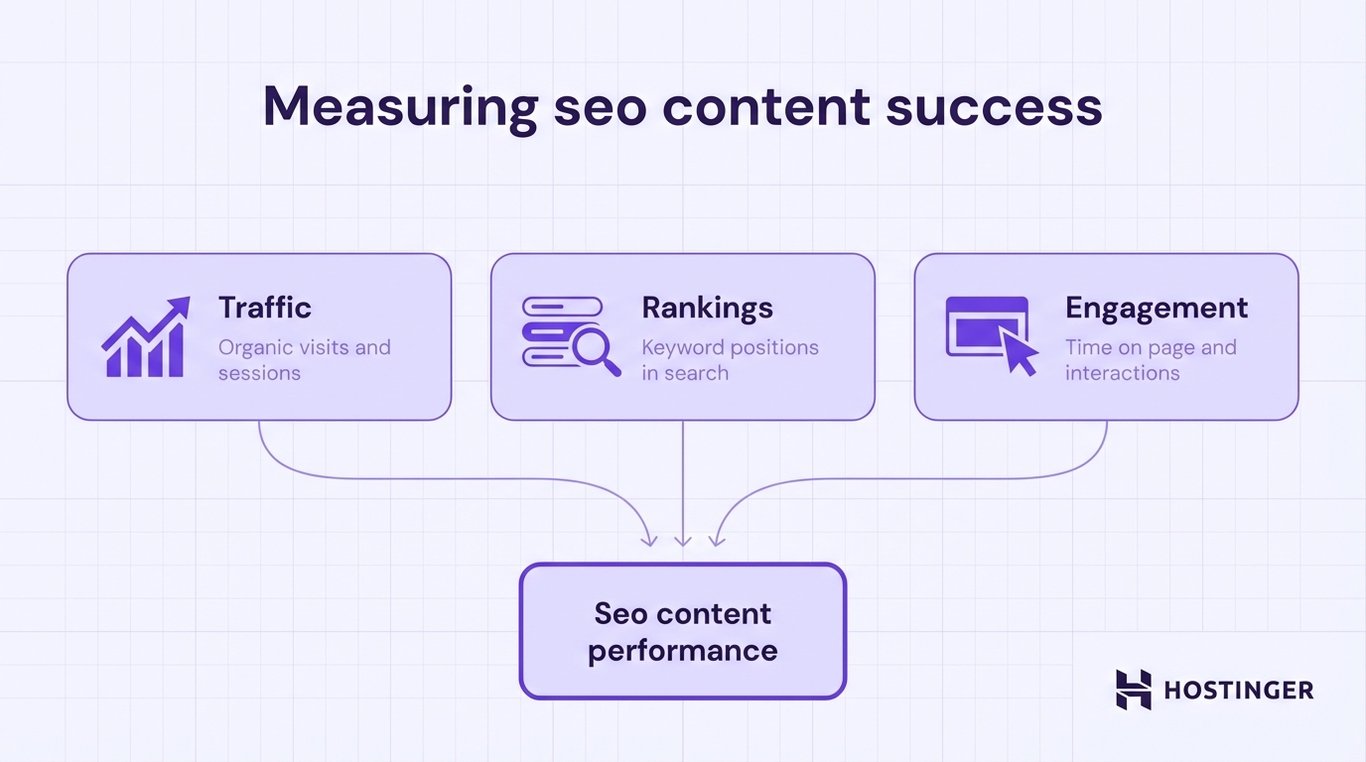
Use Google Analytics for traffic and engagement metrics, Google Search Console for keyword impressions, clicks, and query data, and SEO tools such as Ahrefs or Semrush for ranking and competitor tracking.
Search Console is especially useful for identifying new keyword opportunities. Review the “Queries” report to see which terms generate impressions but few clicks.
What’s more, Search Console doesn’t just show performance. It shows where improvement is possible. Look for patterns in your data and connect them to specific actions.
For example:
- If impressions are high but clicks are low, your page is visible but not compelling. Improve the title and meta description to better match search intent.
- If a keyword ranks on page two, your content is relevant but not strong enough yet. Expand the section that targets that keyword, clarify the answer earlier, and strengthen internal links.
- If rankings improve but engagement drops, users may not find the content clear or useful. Simplify structure, tighten explanations, and remove filler.
- If engagement is strong but traffic remains low, the topic may be too narrow or poorly targeted. Revisit your keyword strategy and consider expanding related subtopics.
Next step: Optimize your website with technical and off-site SEO
Optimizing your website for better SEO means improving its technical performance, structure, and authority so your content can rank consistently.
Start with technical performance. Search engines evaluate how efficiently your website loads, renders, and allows pages to be crawled and indexed. If your site is slow, unstable, or difficult to navigate, strong content alone will not compensate.
Focus on the fundamentals that directly influence crawlability and user experience:
- Website speed and Core Web Vitals – Ensure pages load quickly and remain visually stable while rendering.
- Mobile responsiveness – Confirm that layouts adapt properly to smartphones and tablets.
- Secure HTTPS connection – Protect user data and meet basic security expectations.
- Clean URL structure – Use clear, descriptive URLs that reflect page hierarchy.
- Proper indexing and crawlability – Make sure important pages are accessible to search engines and not blocked by technical errors.
If your pages load slowly, contain crawl errors, or are difficult to navigate, even well-written content will struggle to rank. Technical issues reduce user satisfaction and limit how search engines access your pages.
Next, strengthen the internal structure. Clear navigation, logical categories, and strategic internal linking help search engines understand how your content connects. A well-organized site distributes authority across important pages and improves topical relevance.
Off-site SEO also matters. Backlinks remain a strong ranking factor because they signal trust and authority.
Quality matters more than quantity. A few links from relevant, authoritative websites carry more weight than dozens from low-quality directories.
Build backlinks by:
- Publishing in-depth, original resources
- Creating data-driven or research-based content
- Writing guest posts on reputable industry sites
- Earning mentions through partnerships or collaborations
Avoid manipulative link schemes. Search engines detect unnatural patterns, and penalties can erase progress quickly.
Finally, align content with strategy. Each article should support a larger topical focus. Random content creates scattered signals. Focused content clusters build authority.

All of the tutorial content on this website is subject to Hostinger's rigorous editorial standards and values.

Ksenija is a digital marketing enthusiast with extensive expertise in content creation and website optimization. Specializing in WordPress, she enjoys writing about the platform’s nuances, from design to functionality, and sharing her insights with others. When she’s not perfecting her trade, you’ll find her on the local basketball court or at home enjoying a crime story. Follow her on LinkedIn.