Node.js vs. Python: Key differences between Node.js and Python
May 14, 2026
/
By Alma
/
10 min Read
The main differences between Node.js and Python come down to performance, concurrency, ecosystem, and the types of projects they’re best suited for.
Node.js is a JavaScript runtime that lets developers run JavaScript on the server. It uses an event-driven, non-blocking model, so it can handle many I/O tasks at the same time without waiting for each one to finish before starting the next.
This makes Node.js a strong choice for:
- REST APIs
- real-time apps, such as chat apps or live dashboards
- microservices
- full-stack JavaScript projects where the frontend and backend use the same language
Python, on the other hand, is a general-purpose programming language known for its clean syntax and readability. It’s used across many areas, including backend development, automation, AI, machine learning, data science, and scientific computing.
Python is often the better choice for data-heavy and CPU-intensive work when it uses optimized libraries such as NumPy, TensorFlow, and PyTorch. These libraries are mature, widely used, and better suited to model training, data processing, and scientific workloads than most JavaScript alternatives.
Python is also easier to learn and usually offers a simpler day-to-day developer experience. Node.js, however, is often a better fit for I/O-heavy apps, real-time features, distributed services, and teams that want to use JavaScript across the stack.
So, the Node.js vs. Python decision depends on the workload and the team:
- Choose Node.js when you need fast I/O, real-time features, or a unified JavaScript stack.
- Choose Python when you need AI/ML tools, data processing, automation, or a structured backend framework like Django.
Here’s how they compare at a glance:
Feature | Node.js | Python |
Type | JavaScript runtime environment | General-purpose programming language |
Performance | Strong for I/O-bound tasks | Strong for CPU-bound and data-heavy tasks when using optimized libraries |
Concurrency | Non-blocking event loop | Threads, asyncio, multiprocessing; GIL affects CPU-bound threading in standard CPython |
Scalability | Strong fit for real-time and distributed systems | Strong fit for structured backend systems and data-heavy workloads |
Learning curve | Moderate; requires JavaScript and async patterns | Easier; clean, readable syntax |
Ecosystem | npm, with 2+ million packages | PyPI, with 800,000+ projects |
Best for | Real-time apps, APIs, microservices, full-stack JavaScript | AI/ML, data science, automation, backend development |
Full-stack potential | Strong if the frontend also uses JavaScript or TypeScript | Usually requires JavaScript or TypeScript for the frontend |
What are the advantages of Node.js over Python?
The main Node.js advantages over Python appear in I/O-heavy web applications, real-time features, and full-stack JavaScript projects.
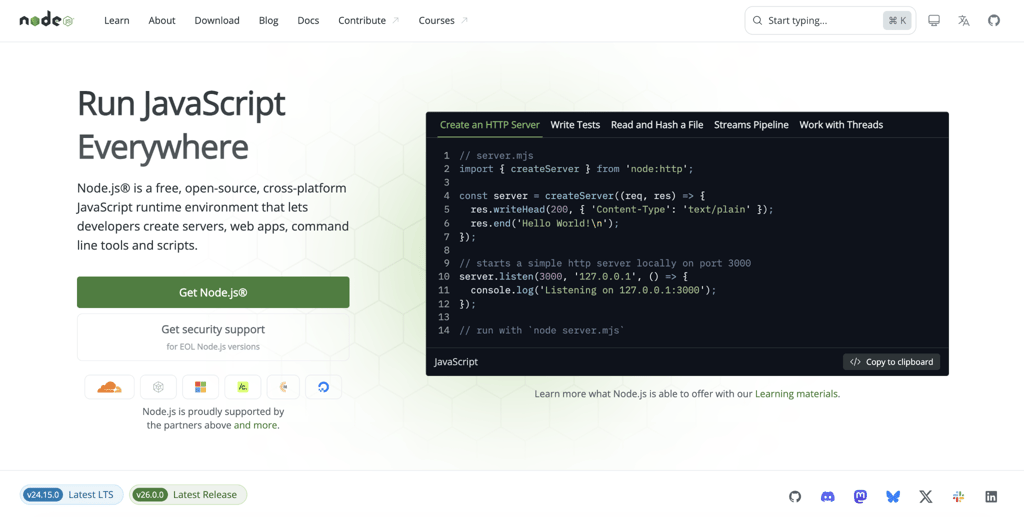
- Non-blocking I/O model. Node.js processes I/O tasks without waiting for each one to finish before starting the next. Its event loop helps it handle many simultaneous connections efficiently, which makes it a strong fit for high-traffic APIs and backend services.
- Strong fit for real-time apps. Chat platforms, live dashboards, multiplayer games, and streaming services need fast two-way communication between the client and server. Node.js’s event-driven model works well with WebSocket libraries like
wsand Socket.IO, making real-time features easier to build. - Full-stack JavaScript. Node.js lets you use JavaScript on both the frontend and backend. Your team can share one language, one package ecosystem, and some reusable logic across the stack, which reduces context-switching.
- Large npm ecosystem. The npm registry includes over two million packages, with ready-made tools for authentication, database connections, payment processing, logging, testing, and many other web development needs.
- Well-suited for microservices. Node.js works well for small, independent services that handle specific tasks. Its lightweight runtime and strong I/O performance make it useful for distributed systems where services need to start quickly, communicate often, and scale separately.
What are the disadvantages of Node.js compared to Python?
The main disadvantages of Node.js are its limits with CPU-heavy work, async complexity, smaller AI/ML ecosystem, and lack of built-in project structure.
- Less suitable for CPU-heavy work. Node.js runs JavaScript on a single main thread by default, so heavy computation can block the event loop and slow down other requests. Worker threads and separate services can help, but they add complexity. Python is often a better fit for data-heavy workloads because libraries like NumPy, TensorFlow, and PyTorch run performance-critical tasks in optimized native code.
- Async complexity. Node.js relies heavily on callbacks, promises, and
async/awaitfor tasks like database queries and API calls. These patterns are powerful, but they can become harder to trace and debug in larger applications. - Smaller AI and machine learning ecosystem. Python has a much stronger ecosystem for AI, data analysis, model training, and scientific computing. Node.js has useful tools for calling AI APIs and running some JavaScript-based ML workloads, but it does not match Python’s library depth for training, preprocessing, and research workflows.
- Less built-in structure. Node.js does not enforce a project layout or application architecture. That flexibility is useful, but larger teams need their own conventions to avoid inconsistent codebases. Python frameworks like Django provide more structure out of the box for routing, database models, authentication, and admin features.
What are the advantages of Python over Node.js?
Python is the stronger choice when you need readable syntax, mature data tools, AI/ML libraries, and structured backend frameworks.
- Simple, readable syntax. Python uses clean, consistent syntax with less boilerplate than JavaScript. This makes code easier to write, review, and return to later, especially for teams that value readability.
- Strong AI and machine learning ecosystem. Python has the more mature ecosystem for AI, machine learning, data analysis, and scientific computing. Libraries like pandas, NumPy, scikit-learn, TensorFlow, and PyTorch are widely used for data processing, model training, and research workflows.
- More versatile across domains. Python works well for web development, automation, scripting, data science, scientific computing, and internal tools. A team that knows Python can apply it across many types of projects, not just web applications.
- Better for data-heavy and CPU-bound tasks with the right libraries. Pure Python is not especially fast for raw computation, but libraries like NumPy and SciPy run performance-critical work in optimized native code. This makes Python a strong choice for numerical analysis, image classification, statistical modeling, and machine learning workflows.
- Structured backend frameworks. Django gives you a full backend framework with routing, an ORM, authentication, an admin panel, and project conventions included. Flask is more minimal, but still gives teams a simple foundation for building Python web services. To compare Flask with a JavaScript runtime in more detail, read our guide on the differences between Node.js and Flask.
What are the disadvantages of Python compared to Node.js?
The main disadvantages of Python are slower performance for some web workloads, more complexity around parallel CPU-bound work, a less natural fit for real-time apps, and no shared frontend-backend language.
- Slower for some web workloads. Python’s default implementation, CPython, can add more overhead than Node.js’s V8 engine in some API and web server workloads. The actual difference depends on the framework, server setup, database, and application code.
- GIL limitations in standard CPython. In the traditional CPython build, the Global Interpreter Lock limits how multiple threads execute Python code at the same time. This can affect CPU-bound workloads that try to use multiple cores through threads. Free-threaded Python builds are now available, but many production applications still depend on the standard GIL-based runtime and library ecosystem.
- Less natural for real-time apps. Python can support WebSockets and async workloads through tools like FastAPI, asyncio, aiohttp, and Django Channels. However, Node.js usually offers a more natural ecosystem for persistent, two-way communication features like chat, live notifications, and collaborative editing.
- Concurrency depends more on setup. Python can scale well, but concurrency often depends on the framework, server, worker model, and async setup. Node.js’s event-driven model is usually simpler to apply for large numbers of I/O-heavy connections.
- No full-stack language uniformity. Python works well on the backend, but browser frontends still require JavaScript or TypeScript. This means teams usually work across two languages instead of sharing one language across the full stack.
Which is better for performance: Node.js or Python?
Node.js is usually faster for I/O-bound workloads, such as API calls, database queries, and network requests. Python is stronger for data-heavy and CPU-intensive work when paired with optimized libraries like NumPy, TensorFlow, or PyTorch.
Node.js runs on Google’s V8 engine, which compiles JavaScript to machine code. Its event-driven, non-blocking model lets it process many I/O operations on a single main thread without waiting for each request to finish before starting the next one.
For I/O-heavy REST APIs and real-time services, Node.js often delivers higher throughput than Python, though the exact difference depends on the framework, database, server setup, and application code.
Python adds more interpreter overhead for general web tasks, but that matters less in scientific computing and machine learning workflows. Libraries like NumPy, TensorFlow, and PyTorch run performance-critical operations in optimized native code, so Python mainly coordinates the workflow.
For model training, data pipelines, numerical analysis, and scientific computing, Python’s ecosystem is usually faster to build with and more mature than JavaScript alternatives.
Which is better for scalability: Node.js or Python?
Node.js is often easier to scale for real-time and I/O-heavy systems. Python scales well too, especially when used with structured frameworks and the right infrastructure.
Node.js works well in horizontally scaled systems, where you run multiple instances behind a load balancer. Its event-driven, non-blocking model makes it efficient for handling many I/O-heavy connections, which is useful for APIs, microservices, live dashboards, and real-time applications.
Python can also scale across multiple servers using load balancers, containers, and orchestration tools like Kubernetes. Frameworks like Django give teams a structured way to build larger applications, while Flask and FastAPI offer lighter setups where you choose your own caching, task queue, and database strategy.
The main difference is concurrency. Node.js has a simpler default model for handling many simultaneous I/O operations. Python can handle concurrency through threads, multiprocessing, and async frameworks, but the right setup depends more on the framework and workload.
For CPU-heavy scaling, Python often relies on multiprocessing, task queues, or optimized libraries that run native code. For I/O-heavy scaling, Node.js is usually the simpler choice.
Which is better for web development: Node.js or Python?
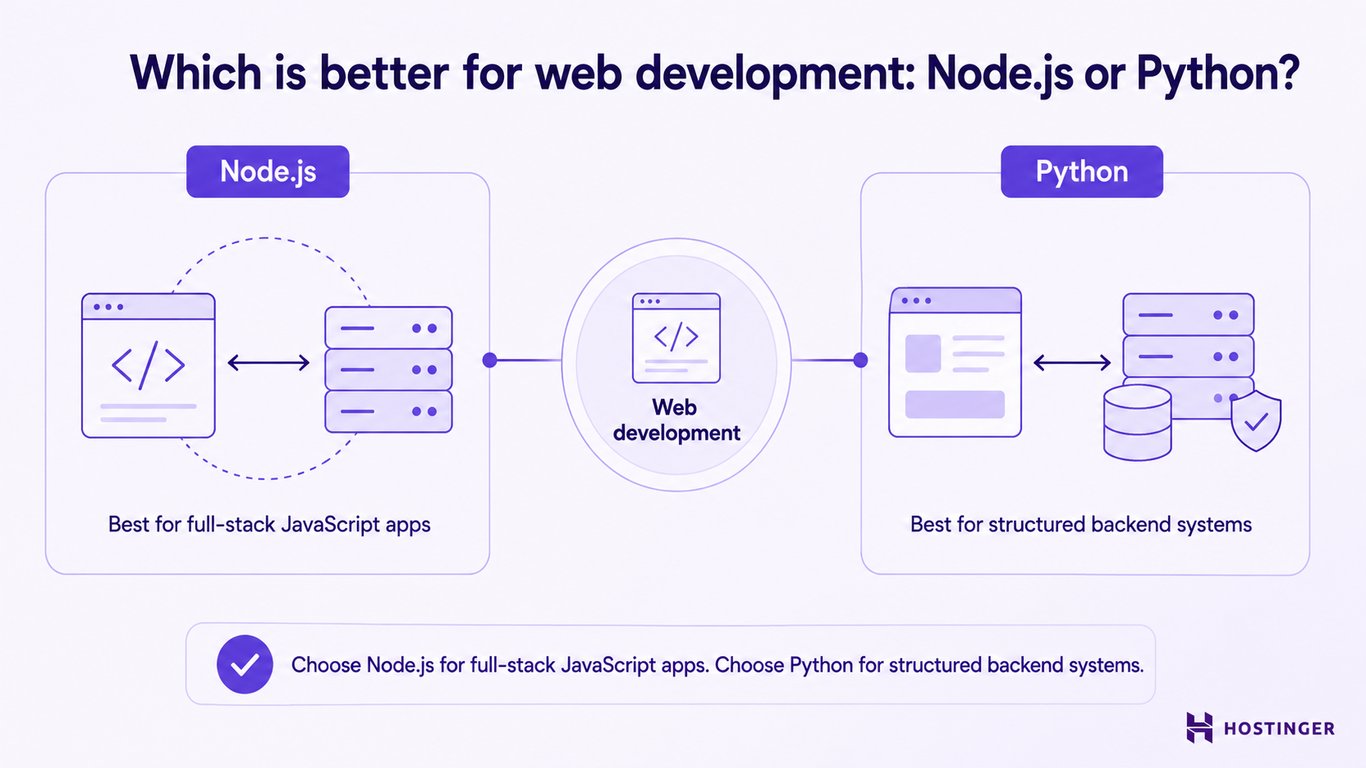
Node.js is the better choice for full-stack JavaScript apps, while Python is better suited to structured backend systems with complex business logic.
With Node.js, your frontend (React, Vue, Angular) and backend (Express, Fastify, Next.js) share JavaScript, so you can reuse validation logic, type definitions, and utility functions across both layers.
Full-stack frameworks like Next.js and Remix let you handle routing, rendering, and API endpoints in a single project.
Node.js uses middleware functions (small pieces of code that run between a request and a response) to handle tasks such as authentication, logging, and error handling. You can chain them together in Express or Fastify, giving you full control over the request pipeline.
Python’s web frameworks take a different approach: The Django framework is a complete toolkit with an admin panel, ORM (a layer that lets you work with databases using Python instead of SQL), authentication, and URL routing built in.
Django also includes its own templating engine for rendering HTML pages, plus a built-in middleware system.
Flask is more minimal and lets you pick your own tools. FastAPI is newer and built around type hints and async support, making it a good option for API-first projects.
Which is better for data science: Node.js or Python?
Python is the clear winner for data science and AI. It has more maintained libraries, more community tutorials, and more pre-trained models available than any other language in this space.
According to the JetBrains Python Developers Survey, over 75% of machine learning practitioners use Python as their primary language. The most widely used libraries are all Python-first: pandas for data manipulation, NumPy for numerical computing, matplotlib for visualization, scikit-learn for classical ML, and PyTorch and TensorFlow for deep learning.
Jupyter Notebooks, the standard tool for data exploration, also run Python natively.
Node.js includes some data tools (such as D3.js for browser charts and TensorFlow.js for running pre-trained models in the browser). But they cover visualization and inference, not the full pipeline of cleaning, analyzing, training, and evaluating data.
You won’t find a JavaScript equivalent to pandas that’s mature enough for production data work.
Many production systems split the work: Node.js serves the API layer while Python runs the model behind it.
Which is easier to learn: Node.js or Python?
Python is easier to learn, especially if you’re new to programming. Its syntax is cleaner, its error messages are more helpful, and you need less setup to get started.
Python uses indentation to define code blocks, which forces a readable structure. There’s usually one obvious way to do something, so you spend less time guessing. You can write a working web scraper or a simple API in a few hours.
Node.js has a steeper learning curve. You need to understand JavaScript first, then learn how the event loop works, how async patterns behave, and how callbacks, promises, and async/await fit together.
Already know JavaScript from frontend development? Node.js is faster to pick up because you’re building on existing skills.
Both have large communities and free learning material. Python has official docs written for beginners, plus thousands of tutorials on YouTube and freeCodeCamp. Node.js benefits from being part of the JavaScript world, where Stack Overflow alone has millions of answered questions.
Which is better for real-time applications: Node.js or Python?
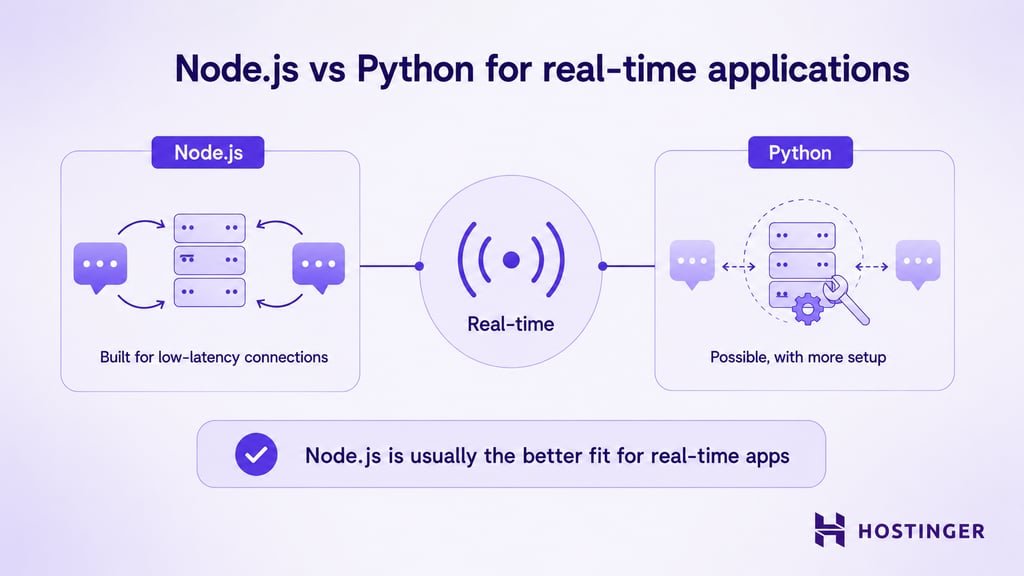
Node.js is the better option for real-time applications because its event-driven architecture is built around the kind of persistent, two-way connections these apps need.
Features like chat, live notifications, collaborative editing, and multiplayer games need a constant open connection between the client and server. Libraries like Socket.IO build on Node.js’s event-driven I/O and handle connection management, reconnection logic, and room-based messaging for you.
Incoming messages get processed immediately without waiting for other operations to finish. That keeps latency low even when many users are connected at once, because the event loop doesn’t block on any single connection.
Python can handle real-time work, but you need more setup. FastAPI, asyncio, and Django Channels all support WebSocket connections, though you’ll find fewer pre-built solutions for reconnection and room management than Node.js has.
Python’s concurrency model also adds additional per-connection overhead, increasing latency as user counts grow. The practical uses of Python lean more toward automation, scripting, and data processing.
Which is better for developer experience: Node.js or Python?
Python offers a simpler day-to-day developer experience, while Node.js gives you more flexibility and control over your setup.
Python’s tooling is straightforward. pip installs packages, virtual environments keep your dependencies isolated, and linters like ruff enforce consistent style.
The language itself has strong formatting conventions (PEP 8), so your team spends less time debating code style. IDEs like PyCharm and VS Code offer auto-completion, inline error detection, and step-through debugging out of the box.
Node.js gives you more choices. The node package manager (npm) is the default, but you can also use yarn or pnpm.
Build tools, linters, and bundlers each come in multiple options. You can assemble a custom toolchain, but it also means more decisions and more onboarding time.
Python’s error messages tend to be clearer and point you to the right line. Node.js errors in async code can be harder to trace.
Both let you prototype quickly, but Python typically needs fewer lines to express the same logic. That means less time writing and reviewing backend code.
Which is better for deployment and hosting: Node.js or Python?
Node.js is easier to deploy for lightweight web apps and APIs. Python needs more environment setup, but it works well in structured hosting environments.
Node.js apps are self-contained. You bundle your code, run npm install, and start the server with one command.
This setup works well with Docker containers, serverless platforms (like AWS Lambda), and managed hosting services. Most cloud providers have Node.js runtimes pre-installed, so you can deploy without configuring the server environment yourself.
Python deployments need more preparation. You manage Python versions, virtual environments, and sometimes system-level dependencies for packages that rely on compiled C code. Frameworks like Django also need database migrations and static file configuration before you go live.
For projects that need more control over the server environment, a VPS gives you full access to install runtimes, configure services, and manage deployments for both Node.js and Python apps.
For Node.js projects, Hostinger web app hosting removes the server management work entirely. You connect your GitHub repository, and the platform handles builds, deployments, SSL, and scaling automatically. Every push triggers a redeployment.
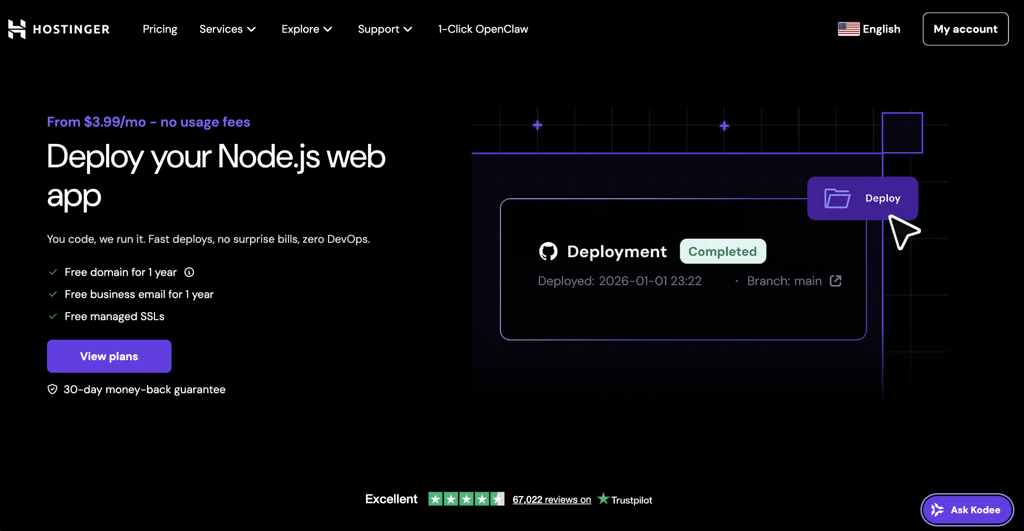
The service includes a CDN, DDoS protection, and a web application firewall, so security is covered without extra setup.
Both languages integrate well with CI/CD pipelines. Node.js tends to be faster to configure because it has fewer environment dependencies. Python pipelines require additional steps to manage virtual environments and system-level packages.
Should you choose Node.js or Python?
Node.js is the better fit for I/O-heavy, real-time workloads. Python is the better fit for data-heavy, computation-heavy projects.
Choose Node.js if you’re building:
- Real-time apps like chat, live dashboards, or collaborative tools
- REST or GraphQL APIs that serve high traffic
- Microservices that need to start fast and scale independently
- Full-stack JavaScript apps with shared code between frontend and backend
Choose Python if you’re building:
- AI or machine learning systems using TensorFlow, PyTorch, or scikit-learn
- Data pipelines, analytics platforms, or scientific computing tools
- Backend systems with complex business logic where Django’s structure helps
- Automation scripts, internal tools, or rapid prototypes
Many teams use both. A common setup runs Node.js for the API layer and real-time features while Python handles data processing, model training, and background jobs. Node.js serves the requests; Python crunches the data.
For a startup’s MVP, Node.js lets a single team get a web product live faster. For enterprise systems that will add analytics or ML features over time, Python reduces the need for retooling later. For an ML research project, Python is the only serious option.
Also, think beyond the first release. JavaScript developers are more common in the job market, which makes hiring for Node.js projects easier in most regions. Python’s developer pool is smaller but growing fast, especially in AI and data roles.
Both languages have active communities and libraries that are regularly maintained, so neither is a risky long-term bet. The deciding factor is usually which one your current team knows well enough to ship, debug, and maintain without slowing down.
All of the tutorial content on this website is subject to Hostinger's rigorous editorial standards and values.

Alma is an AI Content Editor with 9+ years of experience helping ideas take shape across SEO, marketing, and content. She loves working with words, structure, and strategy to make content both useful and enjoyable to read. Off the clock, she can be found gaming, drawing, or diving into her latest D&D adventure.