Lovable vs. Bolt.new: Key differences in features and use cases
Aug 25, 2026
/
By Simon L.
/
11 min Read

Lovable is a guided AI web app builder that prioritizes speed and simplicity, generating structured applications with minimal technical decisions on your end.
Bolt.new is a code-first AI builder powered by StackBlitz that gives you a full development environment right in your browser. The AI writes and runs code alongside you, and you can edit every file directly.
For non-technical users validating an idea, Lovable gets you to a working prototype faster. For developers who want full-stack flexibility, logic control, and the ability to hand-edit every file, Bolt.new gives you more room.
The choice between a no-code vs low-code approach really depends on how much control you need versus how fast you want to move.
There’s also a strong third option worth considering: Hostinger AI Builder. It’s an AI-powered no-code platform that bundles app creation, hosting, domain management, and deployment into a single package.
For users who want the simplicity of a guided AI web app builder and the confidence that their app will be production-ready without juggling external services, Hostinger AI Builder fills a gap that neither Lovable nor Bolt.new fully covers on its own.
Here’s how the three AI development platforms compare on the features that matter most:
Feature | Lovable | Bolt.new | Hostinger AI Builder |
Customization depth | Structured, frontend-focused; Supabase for backend. | Full-code access; custom backends, APIs, and logic. | AI-guided and built-in code editor; code export available. |
Learning curve | Low; guided prompts and visual editing. | Moderate to high; rewards coding experience. | Lowest; conversational AI with prompt optimization. |
Hosting included | Basic on lovable.app; custom domains on Pro. | Via Bolt Cloud; Netlify integration. | Fully included on all plans (SSL, CDN, email, domain). |
Pricing model | Credit-based; Pro from $25/mo (100 credits). | Token-based; Pro from $25/mo (10M tokens). | Bundled plans from $6.99/mo; hosting included. |
Ideal use cases | Fast MVPs, prototypes, frontend-first apps. | Full-stack apps, complex logic, dev workflows. | Websites, web apps, ecommerce, MVPs with one-click deployment. |
What are the advantages of Lovable over Bolt.new?
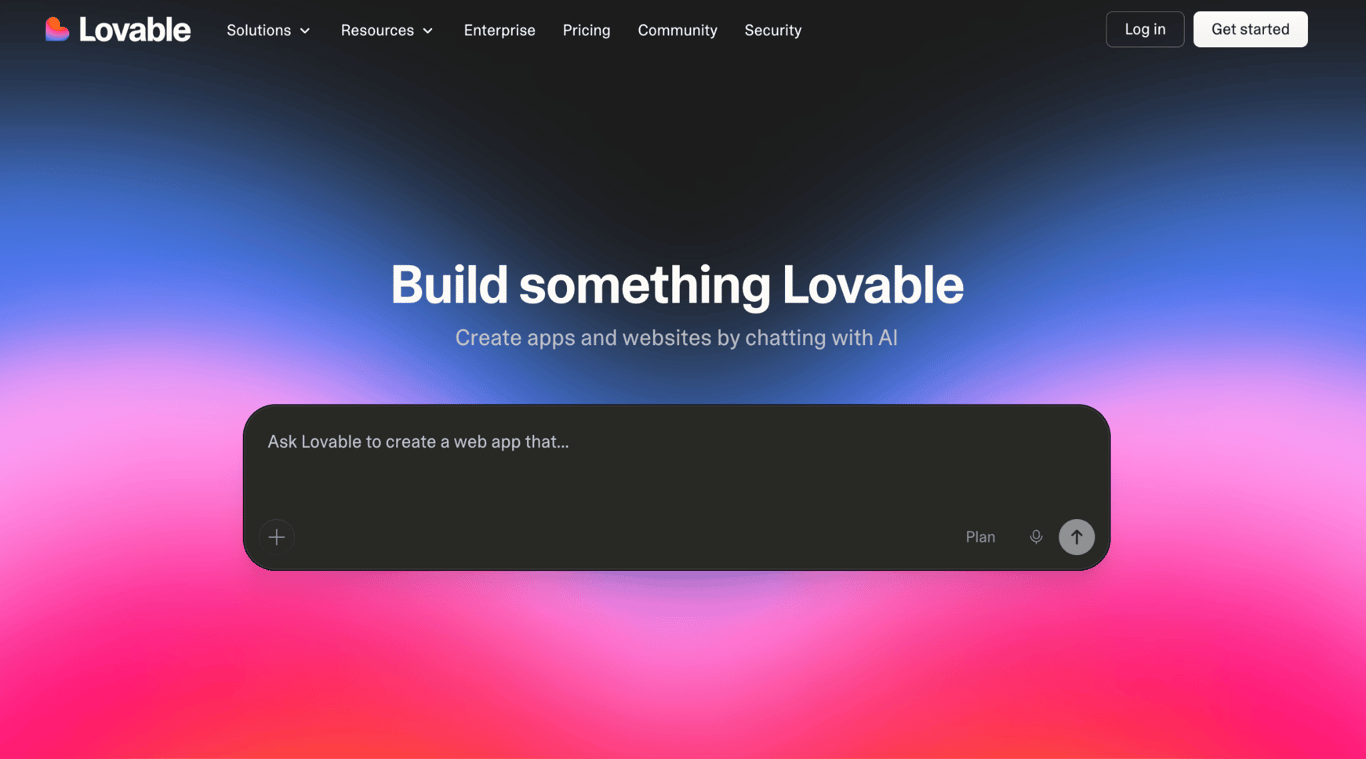
Lovable’s whole pitch is fast app creation with as few technical decisions as possible. And it genuinely delivers on that for the right use case. Lovable’s advantages over Bolt.new include:
- Speed from prompt to prototype. Describe your app, and Lovable generates a structured application with routing, components, and a clean UI. It handles architecture decisions for you, so there’s no fiddling with file structures or package configs. Bolt.new hands those decisions back to you, which costs time if you don’t already have a stack preference.
- Cleaner, more predictable outputs. Since Lovable controls the generation pipeline tightly, the code it produces tends to be more consistent than what you’d get from Bolt.new. You’re less likely to spend time debugging AI-generated logic that went in an unexpected direction.
- Genuinely beginner-friendly AI tools. Non-technical users and designers can use Lovable without touching code. The visual style editor handles CSS changes, Dev Mode gives optional code access for those who want it, and native Supabase (an open-source backend service for databases and authentication) integration means you can add a database without writing backend logic from scratch. Bolt.new assumes you’re comfortable reading and editing code – its interface is a development environment, not a guided builder.
- One-click deployment. Publishing to a lovable.app subdomain is instant. The Pro plan adds custom domains and GitHub sync. Bolt.new requires you to configure deployment through Bolt Cloud or Netlify – more flexible, but more steps between you and a live URL.
- Built for product validation. If you’re testing a concept with real users, Lovable’s speed and simplicity let you iterate quickly without burning time on infrastructure. Bolt.new’s full-stack depth is an asset for complex builds, but it’s overhead you don’t need when the goal is learning whether the idea works at all.
What are the disadvantages of Lovable compared to Bolt.new?
The same simplicity that makes Lovable accessible starts to feel limiting as your project grows.
- Shallow backend support. Lovable leans heavily toward frontend generation. You can wire up Supabase for databases and auth, but building custom server-side logic, complex APIs, or multi-step workflows is significantly harder than it is in Bolt.new’s full-stack environment. These customization limits show up fast once you move past basic database operations like creating, reading, updating, and deleting records.
- Less room for non-standard designs. The guided approach means less room to deviate from what the AI generates. If you need advanced layout control, custom animations, or a design system that doesn’t fit Lovable’s defaults, you’ll feel the limitations quickly.
- Scalability constraints beyond MVP. Teams building production-grade applications with complex state management or heavy API integrations often find they’ve outgrown Lovable. At some point, you’ll likely need to export and move to a traditional advanced app development setup. If that’s a concern, then it’s worth exploring Lovable alternatives.
- Credits burn faster than you’d expect. Every AI interaction costs credits, and complex projects chew through them quickly. Users have reported that the Pro plan’s 100 monthly credits aren’t always enough for serious builds, which can push real costs well above the $25/month sticker price.
What are the advantages of Bolt.new over Lovable?
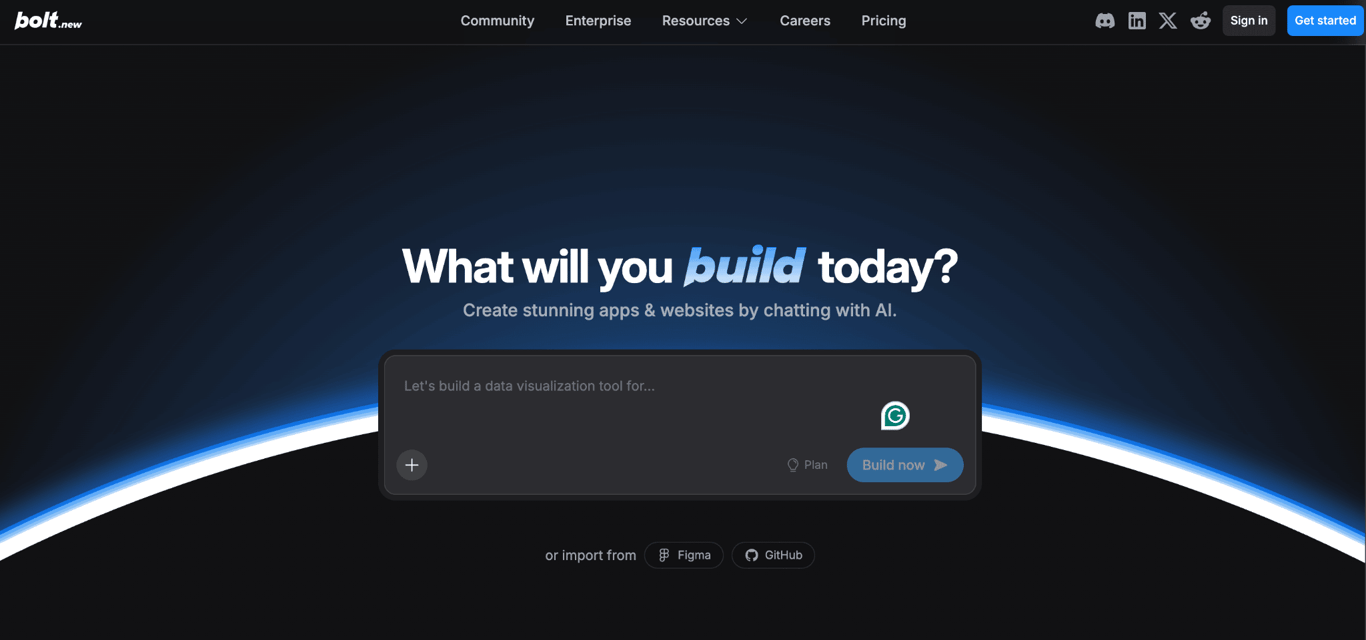
Bolt.new is built for developers who want AI to accelerate their work, not abstract it away. If you’re comfortable reading code and making architectural decisions, here’s where Bolt.new pulls ahead:
- Full-code access. Bolt.new gives you a complete browser-based development environment. You can view, edit, and manage every file in your project directly. Lovable abstracts the codebase away by default – Dev Mode offers a window into it, but you’re not meant to live there the way you would in Bolt.new.
- True full-stack development. Bolt.new generates frontends, backends, API routes (the connections that let your app communicate with databases and external services), and database schemas. Its WebContainers technology runs a full development environment directly in your browser, so you can install packages, start a local server, and test how your app connects to other services without installing anything on your computer.
- Developer flexibility through model choice. You can switch between Claude, GPT-4, and other models depending on the task. The open-source bolt.diy variant goes further, letting you self-host with 19+ LLM providers for full control over your AI coding environment. Lovable uses a fixed generation pipeline – you get consistency, but no ability to choose the model powering your build.
- Natural iterative workflow. Bolt.new supports a generate-edit-test-prompt loop that feels natural for experienced developers. You can hand-edit generated code, run it, see the results, and then ask the AI to keep building. That human-in-the-loop approach preserves code review habits rather than replacing them.
- Deeper ecosystem for complex projects. Bolt.new has the architectural depth to handle projects well beyond landing pages and prototypes. Built-in database management through Bolt Cloud, Supabase integration for advanced backends, Expo support for mobile apps, and serverless functions – backend code that runs on demand without a dedicated server – all come standard.
What are the disadvantages of Bolt.new compared to Lovable?
Bolt.new’s developer-first philosophy has real trade-offs, especially for people who aren’t writing code daily:
- The learning curve is steep. Bolt.new’s interface is a code editor, and it expects you to navigate file structures, package management, and error messages like a developer. If you’re not familiar with React or Node.js, the experience can go from exciting to frustrating fast.
- More setup overhead. Getting a project production-ready on Bolt.new involves configuring deployment through Bolt Cloud or Netlify, handling your own debugging, and managing infrastructure decisions. Lovable abstracts most of that away. The developer complexity is the feature, but it’s also the cost.
- Token consumption can spiral during debugging. This is probably Bolt.new’s most frustrating issue. When the AI gets stuck on a bug, it can burn through tokens in trial-and-error loops without making real progress. Some users have reported spending far more than expected because error-fixing cycles eat tokens rapidly.
- Overkill for simple projects. If you’re building a landing page, a basic tool, or an MVP for investor feedback, Bolt.new’s full-stack capabilities are more than you need. The time spent managing code and infrastructure is time you could spend validating your idea on a simpler platform. If that resonates, there are Bolt.new alternatives worth considering.
What are the advantages of Hostinger AI Builder over Lovable and Bolt.new?
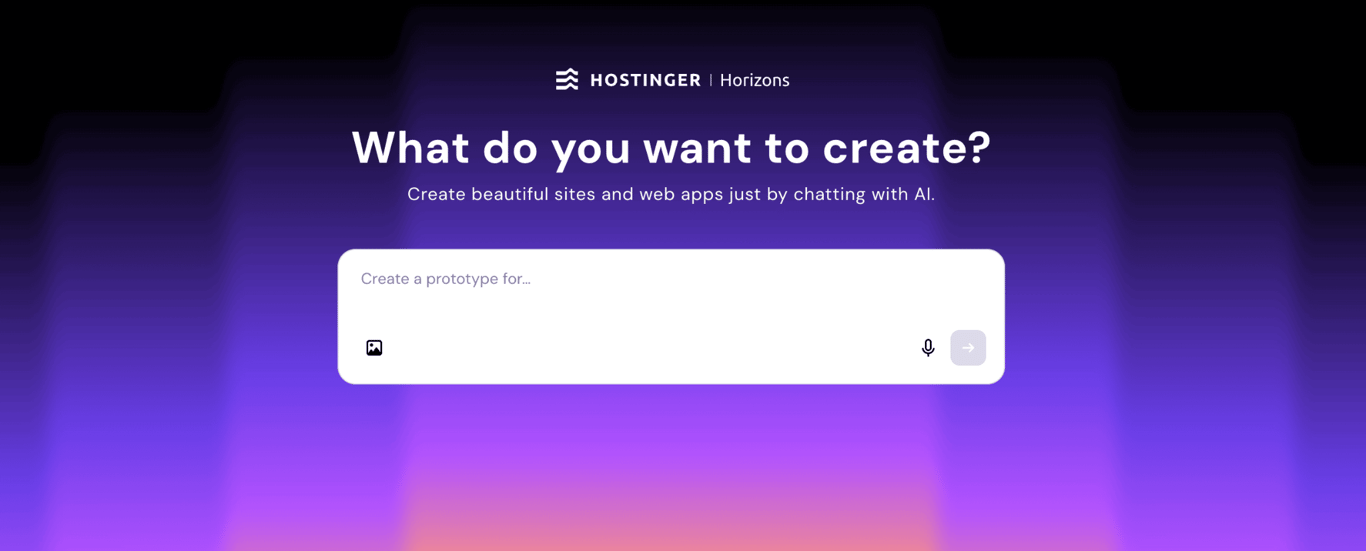
Hostinger AI Builder takes a different approach by combining the AI development experience with everything you need to actually run the app long-term. Here’s where it stands out compared to both platforms:
- Everything is actually bundled. Every Hostinger AI Builder plan includes hosting, SSL, CDN, a professional email address, and domain management. With Lovable and Bolt.new, you’re paying for the builder and hosting, while domains and email are either extra or require external services. With Hostinger AI Builder, that’s one subscription instead of three or four.
- The planning agent saves credits and frustration. Before you spend a credit, the AI asks targeted questions to help you write a better prompt. This is a small feature that makes a big practical difference, especially for beginners who’d otherwise waste credits on vague requests. Manual code edits through the built-in code editor don’t consume credits either, so you can refine your project without worrying about your allowance.
- Simpler transition from prototype to production. Since hosting and deployment are already handled, going live is just a click. There’s no separate deployment step, no Netlify or Vercel configuration, and no need to export code to another platform.
- Lower maintenance over time. Hostinger handles server management, security patches, backups, and performance optimization. Unlike Hostinger AI Builder, Bolt.new puts that on you. Lovable handles it within its ecosystem, but scaling beyond the platform means migrating to something else entirely.
- More accessible entry price. Plans start at ₱619.00/month with hosting included. Compared to $25/month on both Lovable and Bolt.new (without bundled hosting), Hostinger AI Builder offers a significantly lower barrier to entry.
Hostinger AI Builder combines the ease of use you get with Lovable and the long-term infrastructure reliability you’d expect from a company with 20+ years of hosting experience.
That said, it’s not without trade-offs. There’s no two-way GitHub sync, no multiplayer editing, and exported code can’t be re-imported.
The platform is also newer than both competitors, so the feature set is still maturing in some areas.
For solo builders and small businesses, those gaps are usually manageable. For developer teams that rely on version control and real-time collaboration, they’re worth weighing.
Which is more beginner-friendly – Lovable or Bolt.new?
Lovable is the clear winner for ease of use. Its AI onboarding walks you through describing your app, and the AI handles the rest. You get a visual style editor, a clean preview, and the option to access code through Dev Mode only if you want to.
The whole experience is designed so that someone with no coding background can build and deploy a working app. For a beginner AI app builder, Lovable sets a high bar.
Bolt.new rewards prior development experience. The interface looks and feels like a code editor because that’s exactly what it is. You’ll benefit from understanding React, Node.js, and how web applications are structured. Beginners can still use it, but they’ll hit a wall faster when debugging or managing more complex projects.
The learning curve difference is real. Lovable’s approach is hand-holding. Bolt.new’s approach is collaborative, treating you as a developer who happens to have an AI partner.
Is Hostinger AI Builder easier to learn than Lovable and Bolt.new?
Yes, and by a noticeable margin. Hostinger AI Builder has the lowest learning barrier among the three because it was built from the ground up for people who have never built software before.
The AI chat interface is conversational and supports 25+ languages, plus voice prompts and image uploads.
A built-in planning agent helps you shape your prompts before the AI starts generating, so beginners aren’t punished for vague first attempts. And because manual code edits don’t consume credits, you can experiment freely once you’re comfortable looking at the code.
That combination of prompt optimization support, forgiving credit usage, and integrated deployment means you spend less time learning the tool and more time making your web app.
Which is more flexible – Lovable or Bolt.new?
Bolt.new wins on raw development flexibility by a wide margin.
You get full code access, logic control over both frontend and backend, the ability to integrate third-party services, and freedom to structure your project however you want.
For design customization, visual vs code-based editing, and workflow freedom, Bolt.new gives you the most control of any platform in this comparison. The trade-off is that you need the skills to use it.
Lovable is more structured and constrained by design. That’s its strength (faster, more predictable results) and its weakness (less room to deviate).
The visual editor handles common styling changes well, but non-standard UI patterns, custom branding requirements, or complex workflows push up against its guardrails.
The choice depends on what you value more: development flexibility or speed and simplicity. Bolt.new optimizes for the first. Lovable optimizes for the second.
How does Hostinger AI Builder compare with Lovable and Bolt.new in terms of customization?
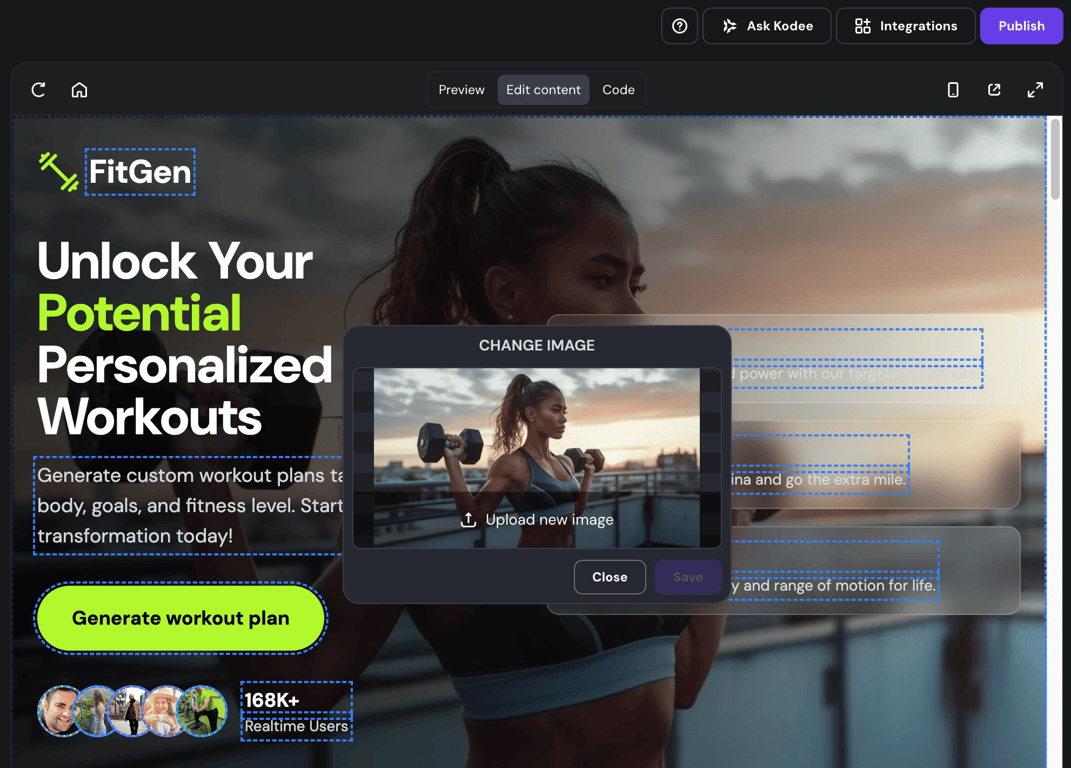
When it comes to customization, Hostinger AI Builder sits in the middle, and that’s intentional. You get a conversational AI interface for building (like Lovable), plus a built-in code editor for directly modifying your project’s source code (closer to Bolt.new).
This makes Hostinger AI Builder practical for real-world business use cases, SaaS tools, and product MVPs where you want AI to do the heavy lifting but still need the option to fine-tune things manually.
You’re not locked into prompt-only editing, but you also don’t need to manage a full development environment.
Which is better for scalability – Lovable or Bolt.new?
Scalability has two sides: how complex your app can get (development scalability) and how well it performs under load (website performance). These platforms handle each differently.
Bolt.new has more development scalability. Full-stack capabilities, custom backends, and integrations with Supabase and Firebase mean you can build applications that grow in complexity without hitting a ceiling.
But you’re responsible for managing deployment infrastructure, site speed optimization, and production stability yourself.
Lovable excels at getting from zero to MVP, but teams building for scale often find they need to export code and move to a traditional development setup. Think of it as a launchpad, not a long-term home for a growing product.
How does Hostinger AI Builder compare with Lovable and Bolt.new in terms of scalability?
Hostinger AI Builder approaches scalability from the infrastructure side. Performance is handled at the infrastructure level. CDN – a global network that speeds up load times for visitors wherever they are – and WebP image optimization are enabled by default on all new projects, with SSL and security built in.
For small to medium projects, you can go from MVP to live product without switching platforms. For more complex applications that need custom server configurations or microservice architectures, you can export the code and deploy to Hostinger’s cloud hosting or VPS hosting.

The development scalability isn’t as deep as Bolt.new’s, but the operational scalability requires far less effort on your end. That trade-off works well for most projects that aren’t building the next enterprise SaaS platform.
Which one is cheaper – Lovable vs Bolt.new?
Both platforms start their paid plans at $25/month, but the pricing models work very differently.
Lovable uses a credit-based system. The Pro plan gives you 100 credits per month, and every AI interaction (generating, editing, debugging) costs one or more credits.
Complex projects burn through credits fast. Users report that serious development work can push costs well beyond the base price, especially when the AI needs multiple passes to get something right.
Bolt.new uses a token-based system. The Pro plan includes 10 million tokens, with consumption varying by prompt complexity and AI model. Tokens roll over for one additional month on paid plans, which helps with variable workloads.
But debugging cycles can eat tokens rapidly, and some users feel the consumption model isn’t always transparent about where tokens actually go.
For simple projects, both platforms are similarly priced. For complex, ongoing development, costs can escalate on both, but Bolt.new’s token rollover gives it a slight edge for users with variable workloads.
How does Hostinger AI Builder compare to Lovable and Bolt.new in terms of pricing?
Hostinger AI Builder is significantly more budget-friendly, especially when you factor in what’s included. Plans start at ₱619.00/month (billed annually), and most plans include hosting, SSL, CDN, and a professional email address.
The Starter plan at ₱1,189.00/month adds 70 credits, up to 25 websites, ecommerce functionality, and a free domain. For roughly half the price of Lovable or Bolt.new’s entry-level paid plans, you get a more complete package.
Credit predictability is another advantage. Each credit equals one prompt, making costs easier to estimate. And since manual code edits are free, you’re only spending credits on AI generation, not on refining details you could fix by hand.
Which platform makes it easier to deploy to production – Lovable or Bolt.new?
Lovable offers a more guided deployment experience. You can publish to a lovable.app subdomain with one click, and the Pro plan supports custom domains and two-way GitHub sync.
For simple projects and MVPs, going live is straightforward.
Bolt.new gives you more deployment flexibility but more responsibility. Bolt Cloud handles hosting for apps built within the platform, and Netlify integration covers external deployments.
Configuring production environments, custom domains, and backend services takes more technical knowledge and hands-on effort.
How does Hostinger AI Builder compare with Lovable and Bolt.new for deployment and production readiness?
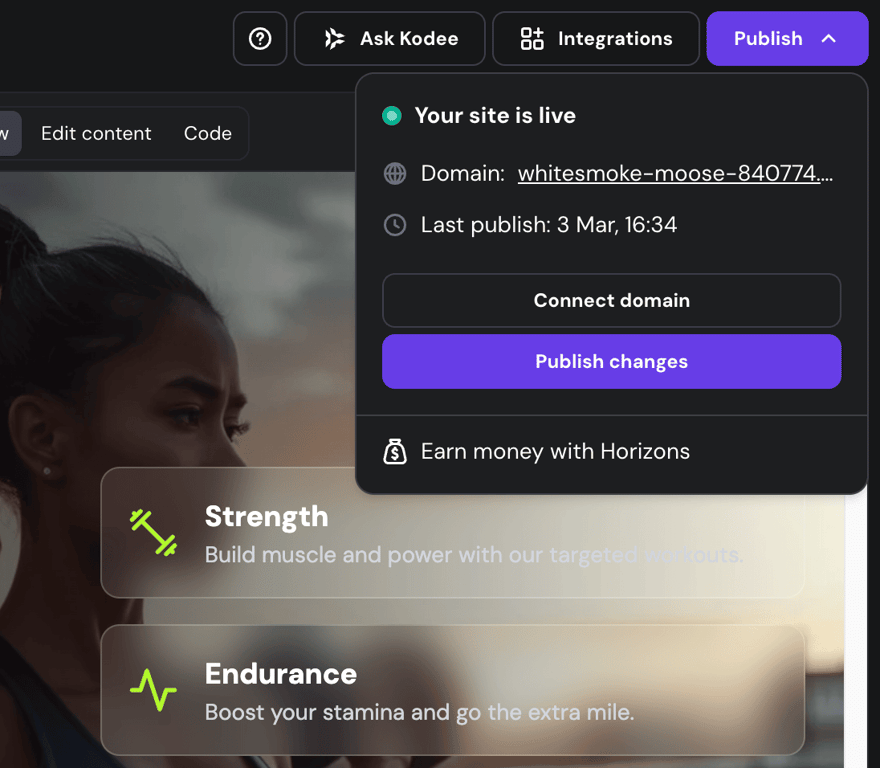
Hostinger AI Builder is the simplest path to production among the three. You build your app, click publish, and it’s live with SSL and CDN already configured. There’s no separate deployment step, no external hosting to manage, and no DevOps knowledge required.
This zero-friction deployment model is especially valuable for non-technical users, small businesses, and entrepreneurs who just want their app online.
Both Lovable and Bolt.new can get you to production too, but they require more steps and, in Bolt.new’s case, more technical understanding of deployment workflows.
Which platform should you choose to build with AI – Lovable, Bolt.new, or Hostinger AI Builder?
There’s no single best AI-powered platform here. The right choice depends on your technical comfort level, what you’re building, and how far you want to scale.
Choose Lovable if you’re a non-technical founder or designer who wants to validate an idea fast. Lovable.dev is excellent for rapid prototyping, frontend-first apps, and situations where getting a working product in front of users matters more than deep customization. It’s at its best during experimentation and early-stage product validation.
Choose Bolt.new if you’re a developer or technical team building something with real architectural complexity. Custom backend logic, multiple API integrations, full code-level control, and a proper development workflow make Bolt.new the right AI development platform for production-grade software. Just be prepared to manage your own infrastructure and budget carefully around token consumption.
Choose Hostinger AI Builder if you want to go from idea to live, hosted app with the least friction. It’s the strongest option for people who don’t want to think about deployment, hosting, or DevOps, and it’s the most budget-friendly entry point of the three. It works for landing pages, ecommerce stores, SaaS MVPs, and business tools. Need inspiration? Check out these web application examples to see what you can build.
Here’s a quick framework for matching your stage to the right tool:
- Experimenting or learning: Hostinger AI Builder (lowest cost, gentlest learning curve) or Lovable (guided, visual, beginner-friendly).
- Building an MVP: Lovable (fastest prototyping) or Hostinger AI Builder (prototype with a built-in path to production).
- Scaling to production: Bolt.new (maximum technical control) or Hostinger AI Builder (managed infrastructure, less operational overhead).
AI app development is moving fast, and all three of these AI-powered platforms are genuinely useful for AI product creation at different stages.
But the biggest risk isn’t picking the wrong platform. It’s spending weeks researching instead of building.
All three have free tiers or trials. Pick the one that fits your current skill level, build something real with it this week, and you’ll learn more in a few hours than any comparison table can teach you.
Ang artikulong ito ay isang lokal na bersyon ng Lovable vs. Bolt.new: Key differences in features and use cases, orihinal na inilathala sa Ingles.
All of the tutorial content on this website is subject to Hostinger's rigorous editorial standards and values.

Simon is a dynamic Content Writer who loves helping people transform their creative ideas into thriving businesses. With extensive marketing experience, he constantly strives to connect the right message with the right audience. In his spare time, Simon enjoys long runs, nurturing his chilli plants, and hiking through forests. Follow him on LinkedIn.